

WHEN Ibrahim Pilasar Mbaya asked to spend the night at a friend’s off-campus apartment in Jos, neither of them imagined that such a simple request would set in motion a chain of events that would end with tragedy and the loss of life.
On July 26, Mbaya, a 25-year-old student of the University of Jos, was accused of stealing his friend’s iPhone 12. Instead of reporting the suspicion to law enforcement agents, the friend, together with a group of young men, tied up Mbaya and assaulted him with wooden planks.
He was later rushed to the Jos University Teaching Hospital, where doctors confirmed him dead on arrival.
Days later, the police confirmed the arrest of four suspects in connection with the torture that led to Mbaya’s death and one of the suspects, Emmanuel Newyear, admitted that he struck the deceased three times with a wooden plank in an attempt to force him to confess to the alleged theft.
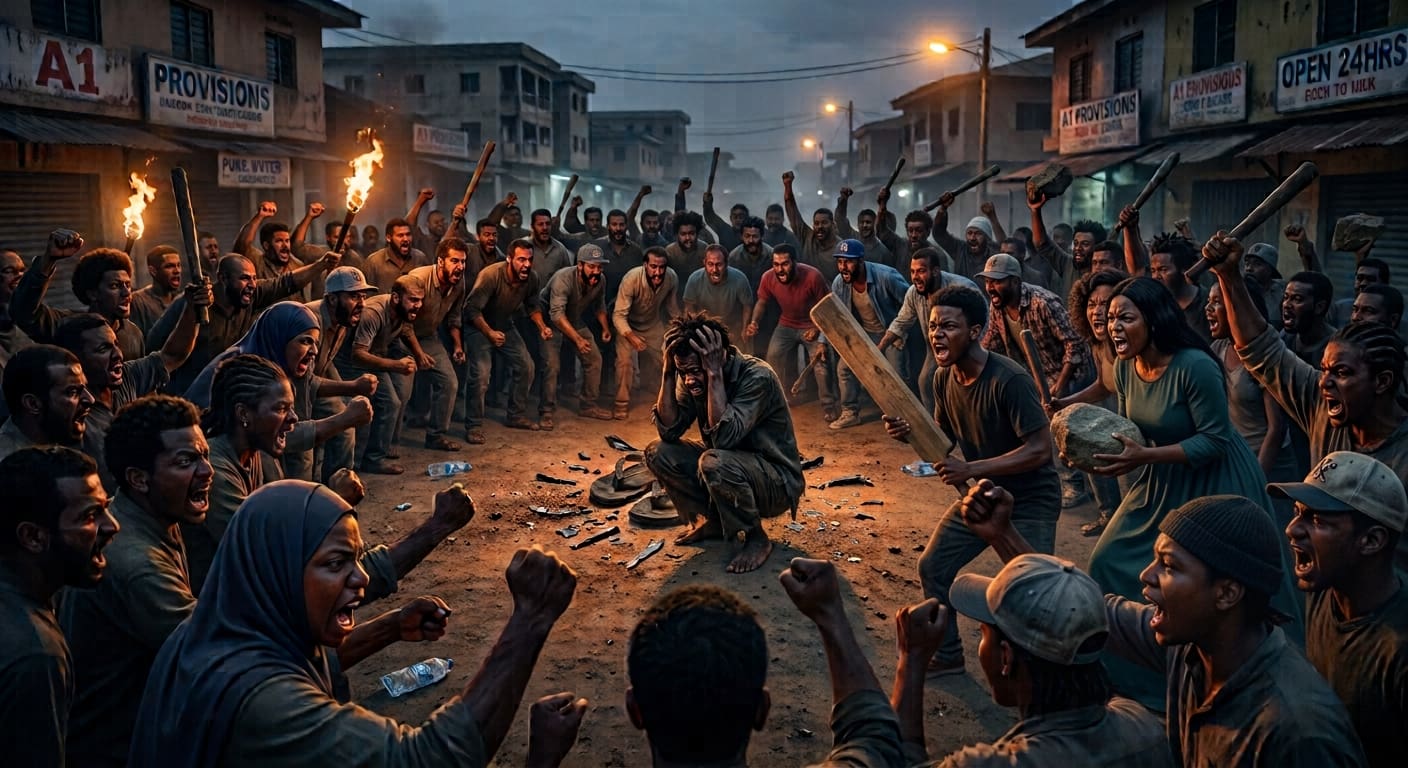
Mbaya’s death is not an isolated incident but highlights Nigeria’s growing resort to jungle justice, a form of collective violence that thrives on public distrust of formal institutions.
Allegations of theft, blasphemy, kidnapping and other offences increasingly trigger instant punishment by crowds rather than due process.
Barely a month earlier, another fatal mob attack had claimed the life of Ummulkhairi Aliyu, an Islamic teacher in Mararaban Jos, a community along the Kaduna-Zaria highway, after being falsely accused of attempting to kidnap children. According to a Humangle report, residents became suspicious because she was unfamiliar in the neighbourhood and wore a face veil.
What happens when people lose faith in the justice system?
Accusation becomes conviction.
A crowd becomes judge.
And sometimes, an innocent person pays with their life.Watch our video on how distrust, impunity and weak institutions are fuelling Nigeria’s dangerous culture of… pic.twitter.com/pdGzcs9uGj
— The ICIR (@TheICIR) August 27, 2026
As the situation deteriorated, she was taken to a nearby police station. Still, even that could not save her, as many eyewitnesses and a petition submitted by human rights activist and lawyer Hamza Dantani alleged that a senior police officer had dragged her out and handed her to the mob, which killed her and set her body ablaze.
Although the Kaduna State Police Command insist an angry mob overwhelmed officers and dragged her out to her death, the Inspector General of Police, Olatunji Disu, has directed the Force Criminal Investigation Department (FCID) to investigate allegations of police complicity.
A pattern of mob violence
The ICIR reports that besides Mbaya’s death in Jos, university students have also been common victims of mob violence. In November 2022, Lukman Malami, a 200-level dental student at the Sultan Abdurrahman College of Health Technology in Sokoto, was allegedly beaten to death by fellow students after they accused him of stealing a mobile phone.
The same year witnessed one of Nigeria’s most widely condemned lynchings when Deborah Samuel, a student of Shehu Shagari College of Education, Sokoto, was stoned and burnt to death by fellow students over allegations of blasphemy.
In a 2024 report titled ‘Instantly killed! How law enforcement failures facilitate mob violence in Nigeria,’ Amnesty International Nigeria documented 363 incidents of mob violence between January 2012 and August 2023, in which at least 555 people were victims of jungle justice across the country.
Since then, mob violence has not slowed down.
For instance, over 20 people have been reported dead in similar circumstances between 2024 and 2026, according to media reports analysed by The ICIR.
On June 19, 2024, Yunusa, a resident of Ningi Local Government Area of Bauchi State, was lynched after he was accused of making blasphemous remarks against Prophet Muhammad (SAW). Reports indicated that police officers were overwhelmed by an angry crowd that beat him to death.
Barely a year later, on March 27, 2025, 16 hunters travelling from Rivers State to Kano for the Eid-el-Fitr celebration were intercepted by local vigilantes and residents in Uromi, Edo State. Falsely labelling them as kidnappers after firearms commonly used for hunting were found in their possession, the mob killed them, with several victims burnt alive before security agencies could intervene.
Less than three months later, on June 20, 2025, another mob attack occurred in Mangu Local Government Area of Plateau State, where a bus conveying 31 travellers from Zaria to Qua’an Pan for a wedding ceremony came under attack.
At least 13 people, including the groom’s father, relatives and friends, were killed, while their bus was set ablaze. Police later arrested 22 suspects in connection with the killings. On July 10, 2025, the Plateau State Police subsequently arraigned the suspects before the state high court
The pattern continued into 2026 with the killing of Mbaya and Ummulkhairi.
Eroding public confidence
To understand the social and psychological forces driving Nigeria’s recurring mob violence, The ICIR spoke with a sociologist and a clinical psychologist. While each approached the issue from a different discipline, they agreed that the persistence of jungle justice reflects deeper failures within Nigerian society rather than isolated acts of individual brutality.
Abubakar Abdulsalami, a lecturer in the Department of Sociology at the University of Ilorin, explained that the growing resort to mob justice mirrors a society steadily losing confidence in its criminal justice institutions.
He said citizens increasingly resort to self-help because they perceive the justice system as unable to protect them or punish offenders effectively.
“When citizens are not satisfied with the judgments being given to those who carried out these actions, that’s why they decide to take justice into their own hands, even though they know it is unconstitutional. They also know it constitutes a crime, but it becomes very hard to identify the perpetrators because they hide in the crowd while carrying out these actions,” he said.
According to him, years of insecurity, particularly the widespread kidnappings that have affected communities across northern Nigeria, have fundamentally reshaped public attitudes toward justice.
Although mob justice remains unconstitutional, Abdulsalami argued that understanding why ordinary citizens participate in it requires looking beyond individual morality to the wider social environment.
Drawing on strain theory, a sociological perspective developed by American sociologist Robert Merton, he explained that people are more likely to adopt unlawful alternatives when legitimate institutions fail to meet societal expectations.
“The theory says that when the legitimate means available in society no longer function properly, people find other ways to survive. Also, in this situation, people are not happy with the way the justice system is handling crime, especially crimes committed by those who displace people from their communities and kill breadwinners,” he told The ICIR.
That frustration, however, is only part of the explanation.
Khayrah Dosunmu-Ogundipe, a clinical psychologist at EmpathySpace Consulting Services, said people also undergo profound psychological changes once they become part of a violent crowd.
According to her, one of the strongest explanations is de-individuation, a psychological process in which people temporarily lose their sense of personal identity and act according to the group’s behaviour and beliefs.
She said personal moral restraint weakens because participants increasingly define themselves by the collective rather than by their own values.
“The first one is de-individuation. It’s when, in a crowd, a person does not see themselves as an individual acting on their own volition. Rather, they see themselves as part of the group.
“So, it means they are part of the group, and their sense of right and wrong becomes weaker. Everything that the group does becomes what their sense of right and wrong feels like. They become less of themselves and more of, “I’m a part of this group. Whatever action this group is trying to complete, I join in that,” she explained.
She also spoke about diffusion of responsibility as one of the underlying factors visible in mob violence.
“Because many people are doing something together, they are completing an action together; each person feels less guilty. They feel like, “Oh, I only did this little action. Other people probably did worse than me,” she said. “So, it makes it easier for them to join in because the guilt and the responsibility are spread among everyone in that group that’s completing the action,” she added.
The clinical psychologist further explained that responsibility becomes psychologically shared across the crowd, making it easier for people to participate because the guilt feels smaller.
The psychologist noted that the shift does not necessarily mean participants permanently lose their values, but they follow whatever the crowd believes is right. “If the crowd believes that a person must be punished, they follow through with that belief. Even people who are gentle or normally law-abiding by themselves can behave differently in that situation,” she said.
“I think another thing to note here is the way emotions spread very fast. Emotions like joy, fear, anger, and excitement are contagious,” she said, adding that participants often convince themselves that the crowd’s actions are justified, particularly when they believe formal justice has failed.
Normalising violence?
Dosunmu-Ogundipe explained that repeated exposure to violent incidents, whether witnessed physically or through social media, reduces people’s emotional reactions over time.
She described the process as habituation, where repeated exposure makes previously disturbing experiences appear increasingly normal.
“For instance, the first time a person sees someone being beaten or killed, of course, the reaction is shock because it’s the first time they are seeing it. But after seeing it many times, whether in person or online, the shock is most likely going to become less,” she said.
She factored social media as another factor increasingly accelerating mob violence, warning that digital platforms allow accusations to spread faster than facts.
“A narrative can already be formed online and then transferred into real life. An audience is formed, and that can even encourage more dramatic and extreme behaviour.” She said online discussions often reinforce existing beliefs and encourage users to endorse increasingly extreme responses.
Meanwhile, Abubakar Abdulsalami shared similar views from the sociological perspective. He cited social disorganisation theory, arguing that weak institutions create conditions that allow crime to flourish and eventually become normalised.
“When the system is weak or broken, it gives room for people to commit crime, and if nothing is done about it, gradually it becomes normalised,” he said.
He pointed to the country’s repeated exposure to kidnappings and violent crimes as evidence that persistent insecurity can desensitise citizens and encourage them to resort to self-help when they lose confidence in state institutions.
A dangerous cycle
Continued reliance on jungle justice will further weaken public confidence in law enforcement while exposing more innocent people to wrongful killings, says Dosunmu-Ogundipe.
“It will start to feel like when an accusation is made or when people feel they want justice, that is the only way justice can be achieved,” she said, adding that unjust killings will continue to be shared online for people to watch them which could lead to lasting psychological effects.
She also warned that children repeatedly exposed to videos and public approval of mob attacks could grow up believing violence is a legitimate response to accusations.
Abdulsalami similarly argued that rebuilding trust in Nigeria’s justice institutions is essential to reversing the trend. He urged citizens to resist taking the law into their own hands and instead report crimes while actively following up on investigations through lawful means.
He also encouraged greater civic participation and public awareness of legal rights to strengthen accountability.
Beyond citizens’ responsibilities, he called on the government to improve accountability and adequately equip security agencies to enable them to respond more effectively to crime.

Mustapha Usman is an investigative journalist with the International Centre for Investigative Reporting. You can easily reach him via: musman@icirnigeria.com. He tweets @UsmanMustapha_M