
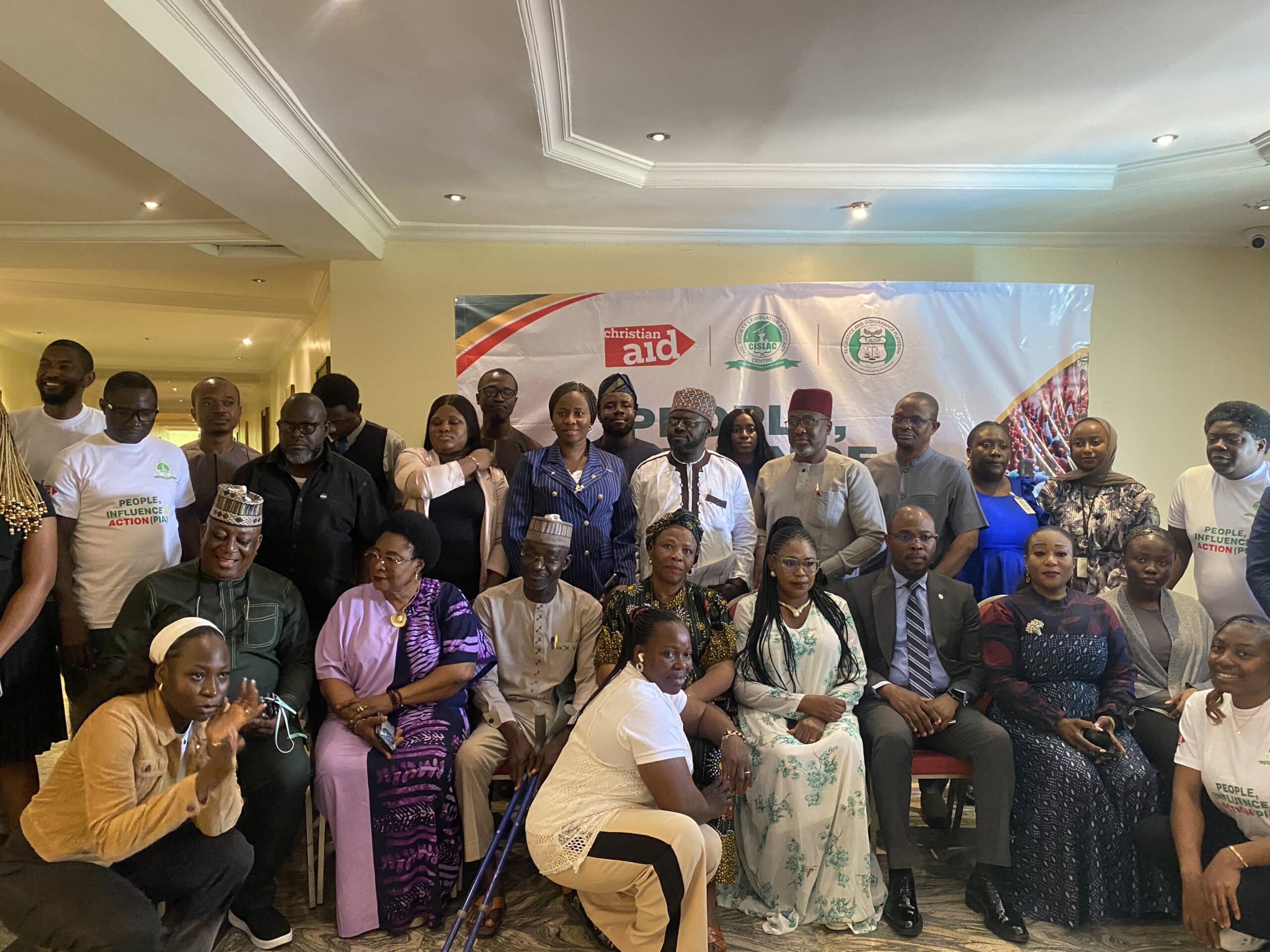

THE Civil Society Legislative Advocacy Centre (CISLAC) has launched a four-year project aimed at strengthening citizens’ ability to participate in governance, influence public decisions and hold institutions accountable.
The People Influence & Action (PIA) Project, implemented with support from Christian Aid under its People in Action Signature Programme, was launched on Tuesday, September 15, in Abuja.
The project, which will run from August 2026 to March 2030, will be implemented at the national level and in Kano, Kaduna and Plateau states.
Speaking about the initiative, the Executive Director of CISLAC, Auwal Musa-Rafsanjani, said the project was designed to strengthen civic agency, collective action and inclusive governance.
He said meaningful change could only occur when citizens were not merely consulted but were able to influence decisions, organise collectively and hold public institutions accountable.
“This is at the heart of the PIA project. The project recognises that civic space, citizen power and inclusive governance are interconnected,” Musa-Rafsanjani said.
He explained that the project would seek to create conditions that would enable people to influence decisions affecting their lives through civic participation, evidence, advocacy and responsive governance systems.
The organisation’s PIA Project Manager and Senior Programme and Gender Officer, Dorcas Asaolu, who introduced the project, themed People Influence and Action, presented the project’s objectives and implementation strategy.
She identified limited citizen participation, poor awareness of public decision-making processes and weak collective organising as some of the barriers to effective civic participation in Nigeria.
Asaolu also identified limited knowledge of state budgets, the effects of inflation, public policies and service delivery as barriers to citizens’ ability to participate meaningfully in governance.
She said another challenge was the inability of civil society organisations and other civic actors to organise collectively, noting that organisations often carried out similar activities separately despite working towards common goals.
“We are saying that is also a barrier,” she said. “You might be doing the same thing I’m doing, but we’re not in the same room.”
She also raised concerns about citizens’ ability to hold public institutions accountable.
According to her, women, young people, persons with disabilities, informal-sector workers and people in underserved communities could face different structural barriers to participating in decision-making.
“We don’t need to be confrontational with the government. Instead, we need to come from a collaborative approach,” she said.
According to her, the project’s broader goal is to enable people experiencing poverty and exclusion to exercise greater political, economic, social and territorial power, while promoting inclusive governance, stronger civic space, access to rights and resources, and greater influence over decision-making.
She stressed that the project would support citizens to monitor budgets and public spending and generate evidence that could be used to advocate for better services.
CISLAC also plans to expand a model previously implemented in Kaduna, Kano and Jigawa states, where citizens engaged local governments on the use of locally generated revenue for community priorities.
Dorcas said the model had enabled communities in some major markets to negotiate with local governments on allocating part of the revenue generated from their communities to priorities such as market security, fencing, access roads and electricity.
According to the organisers, the PIA Project will operate through five major workstreams covering civic space and evidence generation; civic agency, organising and participation; public finance, tax justice and service delivery accountability; citizen-state dialogue and institutional accountability; and civic and media mobilisation.
Under the civic space component, CISLAC said it would conduct participatory assessments of civic space, power relations, gender equality and social inclusion in the target areas.
The organisation will also map relevant actors, gatekeepers and allies while supporting communities to generate evidence on public spending, service delivery, participation and resource governance.
The project will provide civic education, rights awareness, protection awareness and organising support.
CISLAC said the four-year programme would be implemented in phases.
The first year, covering August 2026 to March 2027, will focus on baseline analysis, setting up platforms and strengthening capacity for evidence generation.
The second year will focus on testing accountability tools, including scorecards, civic space monitoring and dialogue platforms, while the third year will deepen institutional engagement, evidence use and cross-state learning.
The final year will focus on documenting outcomes, strengthening sustainability and positioning the model for complementary funding.

Mustapha Usman is an investigative journalist with the International Centre for Investigative Reporting. You can easily reach him via: musman@icirnigeria.com. He tweets @UsmanMustapha_M