

THE South-east region of Nigeria has lost an estimated N17 trillion in almost five years because of the enforcement of sit-at-home orders from non-state actors, comprising mainly the Indigenous People of Biafra (IPOB), according to research data from The ICIR.
The enforcement of the sit-at-home order every Monday was an approach IPOB adopted to protest the federal government’s continued detention of its leader, Nnamdi Kanu.
While reaffirming the colossal loss to the region, the Onitsha Chamber of Commerce, Industry, Mines and Agriculture (ONICCIMA) reported that over N12 trillion was lost in businesses and related investments in the Southeast region due to the enforcement of the sit-at-home directives.
In counting the cost of the enforcement, they said the investment climate in the region was all time low, as some investors severed investment and supply chains
The enforcement of the Monday sit-at-home order lasted for almost 5 years, with its commencement on August 9, 2021. However, there was respite following the intervention of Governor Chukwuma Soludo and other governors in the region, who issued a directive for economic activities to resume on Mondays, with sanctions for violators already being enforced.
Other states, such as Enugu, Ebonyi, Imo, and Abia, have also been assuring businesses and banks of security provisions on Mondays as banks and traders cautiously return to business.
Currently, businesses, banks and schools ‘cautiously’ go about their economic activities on Monday, as most Southeast governors have issued a directive calling for an end to the sit-at-home.
The President of ONICCIMA, Chinedu Nwonu, who recounted the loss to businesses and affirmed the over N12 trillion losses, said many businesses lost supply chains, which affected investors’ confidence.
He recalled that Onitsha, as a trading and business hub with transport, logistics and banking systems interconnected, got weakened because of the directives largely enforced by non-state actors.
“Onitsha has transportation links to every part of Nigeria for business linkups. This is why logistics, banking and textile industries were adversely affected. Investment confidence and supply and logistics chains got broken as a result of the sit-at-home enforcement,” he said.
“In most cases, clients have to incur extra costs by staying in Asaba from the weekend to Monday to meet up with their business partners at the Onitsha main market and other link-up markets, which inflates trading costs,” he added.
While admitting that people still express fears about their activities, he described the days lost to the sit-at-home as a national tragedy.
“It would still take time for most of the businesses to recover and consolidate fully as a result of the sit-at-home. Onitsha is a big West-African market hub and has linkages across the country and beyond. Logistics and business match-making links are broken.
He also noted that industrial and hospitality hubs are gradually finding their feet, adding that banks are some strategic businesses are still opening with caution.
What data says
Notably, The ICIR data highlighted colossal losses from micro, small and medium enterprises agencies.
The data relied on figures from the National Bureau of Statistics (NBS), Nigeria’s data agency, and the Small and Medium Enterprise Development Agency of Nigeria (SMEDAN) 2021 survey reports.
The survey classified Nigerian businesses into four categories: nano, micro, small and medium enterprises.
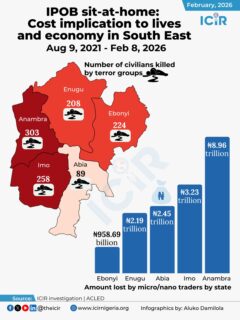
In Anambra, The ICIR data showed micro businesses lost N1.3million on Mondays. It also said individual micro traders lost N29,409 each Monday. The amount lost in the State for every sit-at-home is N38.1 billion. For a period of 235 days, the state lost N8.96 trillion to the sit-at-home.
In Enugu, micro businesses lost N1.1 million on Mondays, while individual traders lost N8,090 on each Monday.
Enugu State lost N9.3 billion every Monday and N2.19 trillion for a period of 235 days that the site at home lasted.
In Imo state, micro businesses lost an average of N1.2 million every Monday, and each trader lost N11,156 on Mondays.
The state lost N13.7 billion every Monday in businesses, while N3.23 trillion was lost cumulatively in the 235 days traders sat at home for five years.
In Abia, another commercial hub, small businesses lost N764,844 on Mondays to sit at home. Individual traders lost N13,613 and N10.4 billion each Monday to sit at home. The state lost N2.4 trillion cumulatively in 235 years that made up the five years.
In Ebonyi state, small businesses lost N561,284 each Monday to sit-at-home. Each trader lost N7,268.18.
The state lost N4.1 billion every Monday to sit at home and N958 billion in 235 days that made up the five years of every Monday lost to sit-at-home.
Meanwhile, an earlier report by the SBM Intelligence titled: ‘Four Years of Disruption’. The report shows how a protest that started to demand freedom for IPOB leader Nnamdi Kanu has become a long-lasting economic and humanitarian crisis. The crisis includes violence, fear, and destroyed jobs.
In most parts of Abia, Enugu, Imo, Ebonyi, and Anambra states (which make up the south-east), SBM said Mondays now have no business activity. Streets stay empty, and businesses remain closed.
People stay home not just because they support the cause, but also because violent groups attack anyone who tries to work on Mondays, the report said.
“The sit-at-home protests, enforced by IPOB since 2021, have transformed from a symbolic act of dissent into a protracted crisis with devastating socioeconomic and security consequences for Southeast Nigeria,” the report reads.
According to the report, the region has suffered staggering losses, including N7.6 trillion in economic damage, 776 fatalities, and systemic disruptions to education, governance, and livelihoods.
“Initially rooted in legitimate grievances over marginalisation and the detention of Nnamdi Kanu, the movement has been hijacked by violence, criminality, and internal fragmentation, eroding public support and deepening instability,” the report stated.
Small businesses lose about N4.6 trillion every year, while transport companies lose between N10 billion and N13 billion every Monday when groups force the shutdown, the SBM report said.
SBM Intelligence said IPOB started the weekly Monday shutdown across the south-east in 2021. At first, people followed it mainly to show support.
“These losses stem from widespread market closures, disrupted supply chains, and the inability of businesses, particularly SMEs, to operate effectively,” the report said.
“Micro-businesses have been particularly hard-hit, with annual losses reported at approximately N4.6 trillion due to the recurring sit-at-home days.
“The impact is evident in both urban and rural areas. Large commercial hubs like Onitsha Main Market, one of Africa’s largest, have been repeatedly forced to close, resulting in missed transactions and financial strain for traders and consumers.”
The report also found that 776 people died and 332 violent attacks happened between 2021 and 2025. Imo and Anambra states had more than half of these deaths.
IPOB’s armed wing — the Eastern Security Network (ESN) — and other criminal gangs force people to follow the sit-at-home order by burning buildings, kidnapping people, and killing targeted victims, according to SBM Intelligence.
SBM said government forces have tried to bring things back to normal in states like Enugu and Ebonyi. Peter Mbah, the governor of Enugu, imposed penalties for compliance with the sit-at-home order, which helped bring some normalcy back to Enugu.

Harrison Edeh is a journalist with the International Centre for Investigative Reporting, always determined to drive advocacy for good governance through holding public officials and businesses accountable.