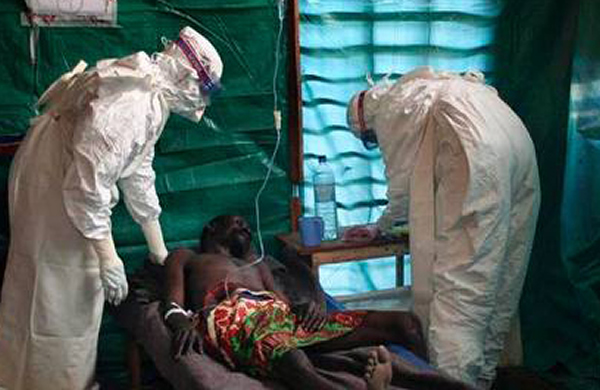
- THE Democratic Republic of the Congo (DRC) has recorded nearly 5,000 deaths from an Ebola outbreak that is generating between 50 and 80 new confirmed cases daily, according to the World Health Organisation (WHO).
The executive director of WHO’s Health Emergencies Programme, Chikwe Ihekweazu, disclosed this during an interview with ARISE NEWS on Wednesday, October 28.
He said the outbreak had reached about 10,000 cases and spread across eight provinces in eastern DRC, describing the situation as dire.
“We’re reporting 50 to 80 new confirmed cases every single day. So, the situation is still very dire. This is a large part of the country, the east of the country.
“Eight provinces are affected, equivalent to eight states in Nigeria. This is over 1,000 square kilometres. So, we’re in the sixth month of this outbreak,” Ihekweazu said.
His disclosure comes as Nigeria continues efforts to contain its first imported case of Ebola disease caused by the Bundibugyo virus, following the confirmation of an infection in a 42-year-old woman who reportedly travelled from Uganda to Abuja.
Nigeria continues Ebola monitoring
On Nigeria’s reported outbreak, Ihekweazu said Nigeria must complete the required monitoring period before it could be declared free of Ebola.
According to him, health authorities must monitor the 53 identified contacts of the confirmed patient for 21 days, followed by another 21-day period, in line with WHO protocols.
“What it means still is that we have about 53 people, contacts, individuals with whom that individual had contact over the days that she was ill. And now, we have to continue to follow each of them for 21 days and then require another 21 days, coming up to 42, in order to declare Nigeria Ebola-free.
“These are the standard protocols as defined by the World Health Organization, where I work, and which we use in every country around the world that has a similar incident,” he said.
The Nigeria Centre for Disease Control and Prevention (NCDC) had earlier stated that the contacts included healthcare workers, domestic staff and the patient’s spouse.
The agency said contact tracing and daily monitoring were ongoing to identify possible further infections and prevent transmission.
The patient was subsequently evacuated to Switzerland on October 26 after her reportedly condition improved.
Ihekweazu, however, clarified that the evacuation was carried out at the request of the patient’s country of origin and did not indicate that Nigeria lacked the capacity to manage the infection.
He also commended Nigeria’s response, citing the speed of laboratory confirmation, genomic sequencing and clinical management.
The WHO official said every confirmed Ebola case required a coordinated outbreak response because the disease belongs to a group of infections known as viral haemorrhagic fevers.
He urged Nigerians to allow health authorities to carry out their work without politicising the response.
DRC outbreak strains health response
Ihekweazu said response efforts in the DRC had expanded to include more than 2,000 treatment beds and over 25 laboratories, alongside intensive engagement with communities in affected areas.
He also noted that the outbreak has raised concerns about vaccine availability because the Bundibugyo virus responsible for the current outbreak is a different strain from the Zaire ebolavirus targeted by the widely used Ervebo vaccine.
Ihekweazu said trials involving three vaccine candidates had begun in the DRC, describing the development as encouraging.
He said the trials were being led by the country’s National Institute of Biomedical Research, with support from international partners.
According to him, successful trials could lead to the rapid development of a vaccine against the strain.
The former Director-General of the Nigeria Centre for Disease Control and Prevention urged African countries to support the DRC rather than blame it for the spread of the disease, noting that infections had also been exported to other countries, including Uganda and Kenya.
He said the affected countries had responded to the imported cases and prevented further outbreaks.
WHO urges investment in preparedness
Ihekweazu said African governments needed to strengthen disease surveillance, public health expertise and emergency response systems to manage future outbreaks.
He noted that although outbreaks could not always be prevented, countries could reduce their impact through early detection, effective monitoring and well-equipped public health agencies.
He also identified opportunities to use artificial intelligence to improve disease surveillance and contact tracing, provided reliable and standardised data were available.
However, he stressed that technology alone would not be sufficient without trained personnel and sustained investment in public health systems.

Mustapha Usman is an investigative journalist with the International Centre for Investigative Reporting. You can easily reach him via: musman@icirnigeria.com. He tweets @UsmanMustapha_M