

By Abubakar SULAIMAN & Idris KAMAL
Talatu Mado, 25, who arrived at the Vesicovaginal Fistula (VVF) ward of Jahun General Hospital, in Jigawa state, was done fighting death after days of obstructed labour, a delayed referral and a surgery that failed and cost her womb.
Talatu was left with a condition that stripped her of sleep, dignity and hope, the constant, uncontrollable leakage of urine, the smell clung to her clothes, her bedding and her sense of self.

“I told them to give me death medicine. I felt my life was already over,” she told The ICIR, quietly. Instead, a nurse looked her in the eye and replied, “Here, we only give medicine for life.”
That moment marked the beginning of Talatu’s slow return, not just to health, but to humanity.

The ICIR reports that across Northern Nigeria, obstetric fistula continues to sentence thousands of women to silent suffering. UNICEF estimates that between 50,000 and 100,000 new cases occur annually in Nigeria alone. For many, fistula brings a double tragedy, the loss of a child, followed by rejection by family, friends and even husbands.
In Jigawa State, however, a comprehensive fistula-treatment programme centred at Jahun General Hospital is quietly rewriting these painful stories, one woman at a time.
Fistula patients who once arrived broken now sit upright, sharing food, stories and hope. Some of the patients return home with sewing machines strapped to the roofs of buses. Others carry new skills, fresh confidence and a renewed sense of belonging.
To Talatu, the woman who once begged for death, life now feels possible again.
“I can sleep. I can walk outside. I can talk to people. I feel human again,” she said.
At Jahun, healing goes beyond surgery. It restores dignity, rebuilds identity and proves that even in the most forgotten corners, compassion can change lives.
Pain meets possibility
The Jahun VVF unit, run through a partnership between the Jigawa State Ministry of Health and Médecins Sans Frontières (MSF), offers free, holistic care to women living with fistula. Over the past six years, the centre has recorded a cumulative continence rate of 76 percent, meaning nearly eight out of every ten women leave the ward dry.

But healing here is not measured only in medical success. Inside the ward, women form a fragile sisterhood, sharing stories, tears, prayers and laughter. They wash clothes together, cook, learn new skills, and, slowly, relearn how to trust themselves and others.
“It is like another society,” said Aisha Muhammad 29, who travelled from Zaria for treatment. “Here, nobody insults you. Nobody laughs at you. You are free.”
For women who have spent years hiding indoors, sleeping apart from their families and avoiding public spaces, that freedom is revolutionary.
For Hadiza Shuaibu, fistula costs her more than her health; it costs her marriage.
After four days of labour, a caesarean section and a failed first surgery, her relationship with her husband collapsed under family pressure.

“My mother-in-law told him that if he did not divorce me, she would curse him,” Hadiza said.
She added, “And he listened.”
Stories like Hadiza’s are painfully common. In communities where a woman’s value is tied to domestic and reproductive roles, fistula becomes a justification for abandonment.
To counter this, Jahun’s fistula treatment treats emotional healing as seriously as physical recovery. Peer-support groups, counselling sessions and daily interactions in the ward help women rediscover confidence.
“They come here broken,” said Gloria Dabit, MSF’s Newborn Unit Supervisor. “They feel isolated, ashamed and worthless. Our job is to help them see that they still matter.”
Returning home, not empty-handed
Yet healing the body and mind is not enough if a woman returns to poverty after a successful fistula treatment. That is why fistula treatment at Jahun integrates vocational training into recovery. Survivors learn trades such as tailoring, soap-making and local food processing. Some leave with basic equipment to start small businesses.
Rahana Muhammad remembers the day she was given a macaroni-making machine, flour and a small start-up capital.
“I felt like I was given my life back,” she said. Today, she earns an income and supports her household. “Now, people respect me again.”

Economic independence often determines whether reintegration succeeds. Women who return home with skills are more likely to regain dignity, rebuild relationships, and avoid the social isolation that once defined their lives.
Still, some say follow-up support has been inconsistent, limiting long-term growth. For many, true reintegration remains fragile, shaped by poverty, stigma and lingering trauma.
Barriers remain
Despite its impact, the Jahun programme faces serious challenges. Transportation costs and distance still delay access, and socio-cultural barriers persist, with fistula often viewed as a “curse.”
Jahun is increasingly overwhelmed. Since 2020, the unit has managed over 6,400 total exits and 2,883 OPD visits. Yet, as demand surges, the surgical team has thinned from three specialists to just two. This has forced theater sessions to drop from bi-weekly to once a month. While 2,928 women have achieved final discharge, hundreds more remain trapped in a “bottleneck of hope,” their recovery delayed by a lack of specialised hands.
“For a woman with a fistula, every extra day is another day of shame,” said Halima Umar, the VVF Unit in-charge.

Socio-cultural barriers also persist. In some communities, fistula is still seen as a curse or divine punishment, discouraging women from seeking care early.
Yet, even this success has its limits. Rahana points out a significant ‘wait’ in the system after her training and equipment were provided five years ago, in 2021. Since then, follow-up capital and advanced training promised to many have been inconsistent and distant.
“If they had continued with the skill training… our lives would have been better than what they are now,” she lamented. It is a subtle but vital critique for policymakers: a one-time donation of a machine is a start, but true reintegration requires a sustained economic ecosystem.
Also, there is the issue of timing. Gloria Dabit, the Supervisor, notes that many women still arrive at Jahun far too late, often after days of obstructed labour at home or in ill-equipped primary health centres (PHCs).
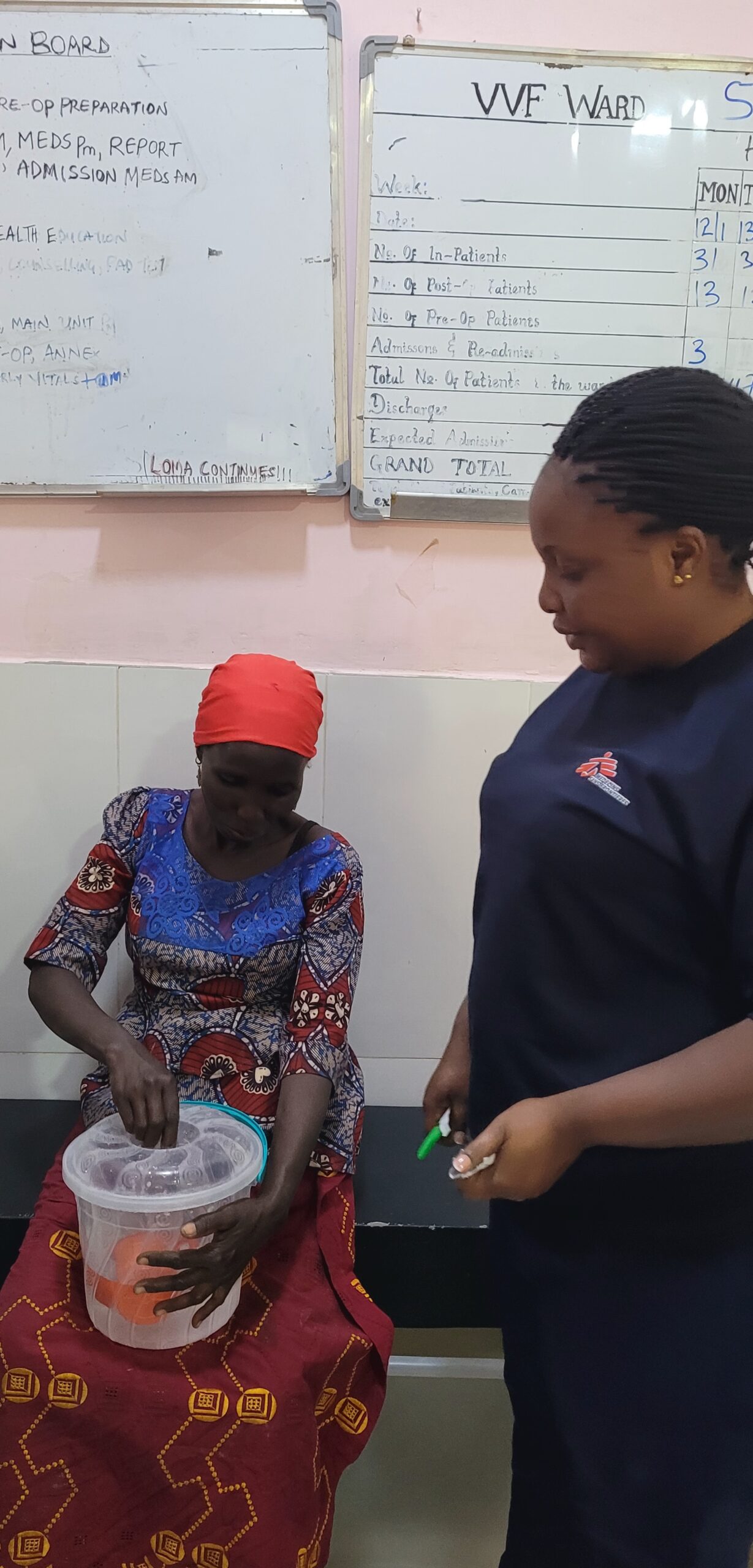
“We only cover about four (catchment areas), Garki, Gwaram, Jahun, and Aujara. But we receive complicated cases from all over,” Dabit told The ICIR.
The solution, according to the experts on the ground, isn’t just more surgeons in Jahun; it’s replicating this model across regions. If the government can equip PHCs to handle emergency obstetric care and make those services truly free, the “menace” of fistula could be stopped at the source before the first drop of urine is ever leaked.
Despite these obstacles, Jahun stands as proof that fistula is not a life sentence.
Its success lies in combining free surgery, emotional support, economic empowerment, and community outreach—an approach that addresses not just the injury, but the woman behind it.
Health experts, Dr. Mustapha Umar, Medical Activity Manager for MSF, say replicating this model across underserved regions could dramatically reduce fistula-related suffering. Strengthening primary healthcare, improving emergency obstetric care, and investing in trained surgeons would shift the focus from treatment to prevention.