
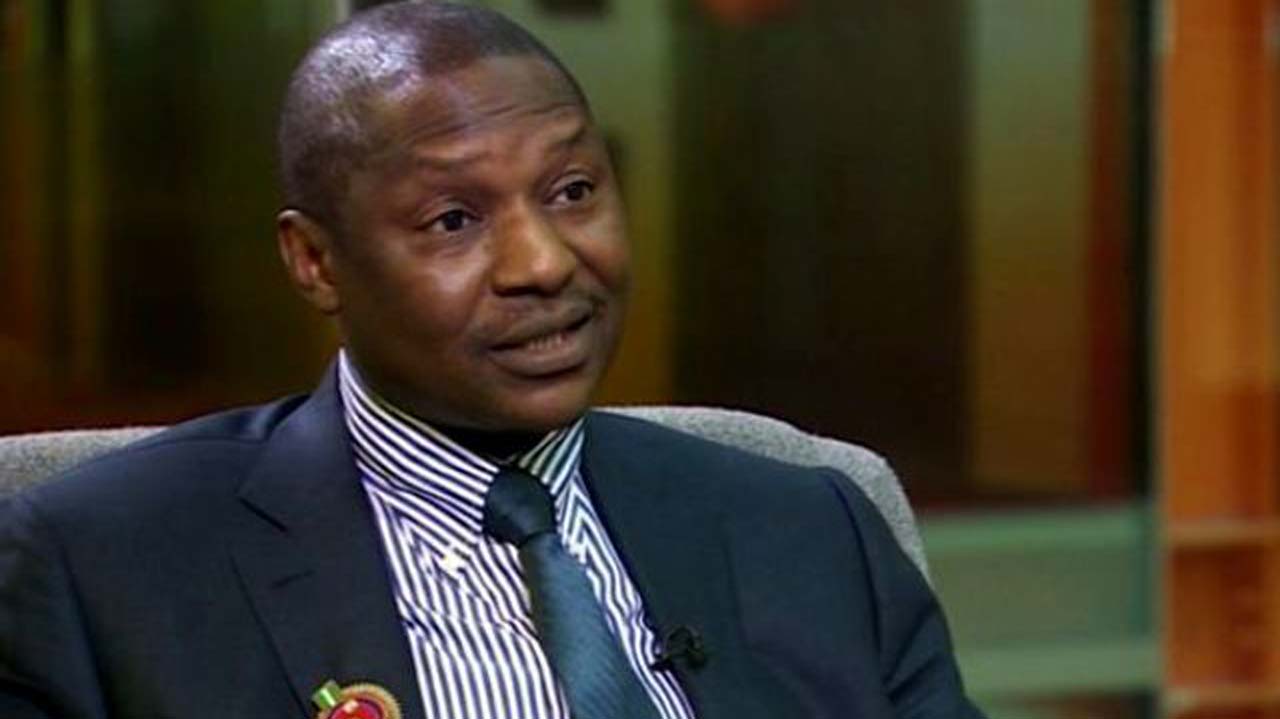
FORMER Attorney-General of the Federation, Abubakar Malami, reversed his position on Sunrise Power and backed a settlement that could have exposed Nigeria to $400 million, despite previously describing the company’s promoter, Leno Adesanya, as a “criminal of the highest order,” an International Chamber of Commerce (ICC) tribunal has revealed.
The tribunal said Malami’s position shifted from opposing Sunrise’s claims over the Mambilla hydropower project to pushing for a settlement that worsened Nigeria’s financial exposure.
The findings are contained in a 616-page final award delivered in Paris on September 16, 2026 and reported by The Cable, following a long-running dispute between Nigeria and Sunrise Power over the Mambilla project in Taraba State.
The tribunal examined Malami’s handling of the dispute and found a significant shift in his position between 2017 and 2020.
The court noted that in January 2018, Malami described Adesanya in an email to former President Muhammadu Buhari’s Chief of Staff as “a criminal of the highest order.” He accused him of conspiring with previous administrations to file frivolous arbitration claims and siphon government funds.
Malami, the African Democratic Congress (ADC) governorship candidate for the 2027 election in Kebbi State, also reportedly called Adesanya the “number one enemy” of the Mambilla project.
The tribunal said Malami had earlier concluded, after reviewing a 2003 Federal Executive Council decision, that Sunrise had no valid basis for claiming it had been awarded the Mambilla build-operate-transfer contract.
In an April 2018 legal opinion, he also supported Nigeria’s decision to defend the arbitration instead of settling the dispute.
But by January 2020, his position had changed, according to the court.
The tribunal found that Malami approved a $200 million offer to Sunrise and subsequently signed a settlement agreement with the then Minister of Power, Saleh Mamman.
The January 21, 2020, agreement required Nigeria to pay Sunrise $200 million in one instalment. If Nigeria defaulted, Sunrise could regain its position as exclusive local content partner for the Mambilla project.
However, a March 25, 2020, addendum changed the terms, splitting the payment into two $100 million installments and introducing a further $200 million default penalty.
It also imposed interest on unpaid sums at 10 per cent per annum, compounded daily.
The tribunal said the revised terms meant Sunrise could receive as much as $400 million, excluding interest.
“The Tribunal is unable to discern any upside for Nigeria in the renegotiated terms and conditions,” it stated.
It concluded that Malami was not negotiating the revised terms for Nigeria but for Sunrise, adding that his conduct was consistent with him being motivated by “other incentive(s).”
Buhari rejected settlement
The tribunal found that Buhari repeatedly refused to approve the settlement after Malami and Mamman had signed it.
According to the award, the officials signed the agreements without first obtaining approval from Buhari or the Federal Executive Council.
When Malami sought Buhari’s approval on April 20, 2020, the late former president declined, saying the government did not have $200 million to pay Sunrise.
On January 11, 2021, Malami again sought approval to continue negotiations, but Buhari declined.
The tribunal said the response “leave[s] no room for interpretation” and ruled that neither Malami nor Mamman had the authority to bind Nigeria to the agreements.
It also found that information Malami supplied to Buhari about the settlement was inaccurate. In an August 2020 brief, he said the deal would cost Nigeria $200 million and save $2.154 billion in potential liability.
The tribunal said this failed to reflect the additional $200 million default penalty and 10 per cent compounded interest contained in the revised terms.
The ICIR reports that the Mambilla project, initially conceived in 1982 as a 3,050MW hydropower plant, became the subject of negotiations with Sunrise and its Chinese partner from 2001.
A technical committee recommended the company for a 3,960MW build-operate-transfer project in March 2003, and former Minister of Power, Olu Agunloye, later issued a letter that Sunrise relied on as the contract award. Former President Olusegun Obasanjo, who led Nigeria at the time, maintained that the Federal Executive Council did not approve the deal.
The dispute later went into international arbitration, while efforts to develop the project continued with a Chinese consortium. The legal dispute with Sunrise also affected the project financing, with China Exim Bank reportedly insisting that the matter be resolved before it could release funds.

Mustapha Usman is an investigative journalist with the International Centre for Investigative Reporting. You can easily reach him via: musman@icirnigeria.com. He tweets @UsmanMustapha_M