THE Nigerian Communications Commission (NCC) has said that citizens of the country will be required to submit International Mobile Equipment Identities (IMEIs) of their phones to the commission from July, 2021.
This was contained in the Revised National Identity Policy report for SIM Card Registration released by the Federal Ministry of Communications and Digital Economy on Friday.
It stated that the implementation of a Centralised Equipment Identity Register (CEIR), otherwise known as Device Management System (DMS), would serve as a repository for keeping records of all registered mobile phones’ IMEIs and owners of such devices in the country.
The report noted that the deployment of DMS would serve as a means of protecting citizens from theft and generate revenue for the government, among other benefits.
“DMS aims to curtail the counterfeit mobile phone market, discourage mobile phone theft, enhance National Security, protect consumer interest, increase revenue generation for the government, reduce rate of kidnapping, mitigate the use of stolen phones for crime, and facilitate blocking or tracing of stolen mobile phones and other smart devices,” the ministry said.
The report said that the NCC would be responsible for the implementation and management of the DMS to achieve the policy objectives.
It also stated that the President Muhammadu Buhari had directed that the DMS should be implemented within three months.
This means any Nigerian who fails to comply will be unable to make calls, send text messages, or use the internet except through WiFi.
“DMS will also provide access to all operators to cross-check the IMEIs and their status before allowing a device to become active on their network. Furthermore, registered mobile phone technicians will also be provided with an interface to check IMEIs and ensure it has not been reported as stolen or illegal before they render their technical services.”
Nigerians react
Meanwhile, Nigerians have taken to the social media to register their displeasure over the new DMS policy.
A twitter user, Ayemojubar, with the username @ayemojubar, tweeted that her IMEI was her private property which should not be invaded.
My phone, my IMEI is my private property. I bought it with my hard-earned, taxed money.
Another Twitter user, Ochiaga, with the username @ronaldnzimora, tweeted that the new IMEI policy with the NIN would give the government the opportunity of tracking down people and probably killing anyone who disagreed with them.
“NIN + IMEI registration is a way for the Govt to track down and kill you when you disagree with them. Stop registering for it. Even if you did NIN, don’t ever do IMEI registration.”
Elder Seun, with the username @iamseunalaofin, on his own part, said with BNN, NIN and now IMEI, it was clear that the government was demanding too much, adding that government could soon start asking Nigerians to start going around with the president’s portrait.
We did NIN, we did BVN now they want us to drop our phone’s IMEI number.
Very soon they would tell us to put Buhari portrait in our homes for one reason we don’t know yet.
At this stage anyone that believes in this government needs Bigi Apple to get their senses back!! pic.twitter.com/98DlShslXe
JUSTICE of the Court of Appeal Kalu Anyah travelled from Arochukwu to Owerri for a book launch and decided to spend the night in a nearby hotel.
Anyah drove into Imo Concorde Hotel, where security men on duty issued him with a plastic disc labelled 102 at the entrance. He then parked his car in a space provided by the hotel.
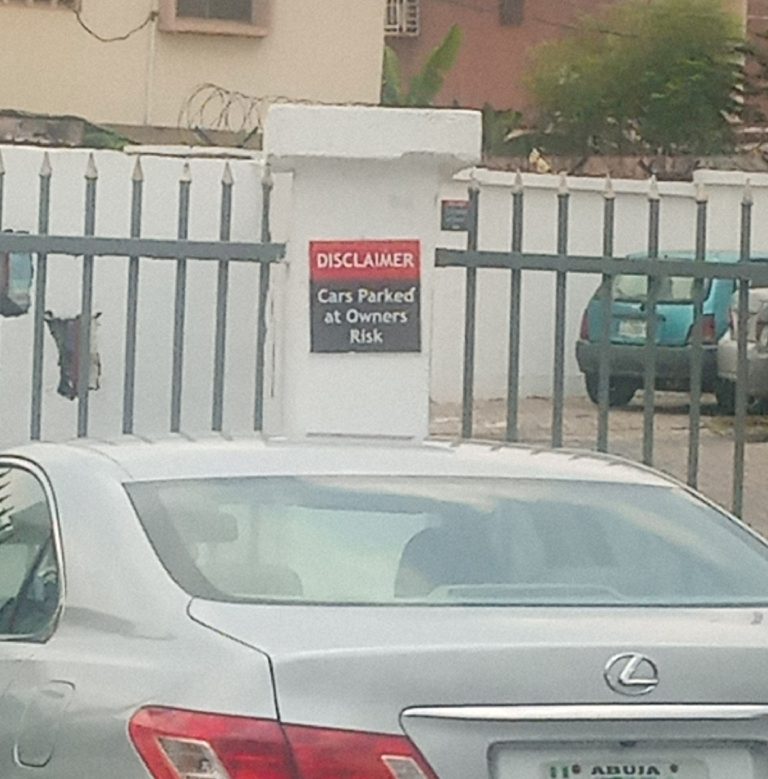
Despite the signpost that read, ‘owners park at their own risk,’ Anyah locked his car and put the keys into his pockets. He then proceeded to retire for the night into the room allocated to him.
The following morning, Anyah checked out of his hotel room at about 7.00 AM, walked down to the parking lot to get his car, but his car was gone.
He reported to the hotel management and an investigation was ordered into the theft, but it yielded no result.
The lawsuit that ensued afterwards would be known across Nigeria as Anyah v. Imo Concorde Hotels Limited & Ors. Anyah filed an action against the hotel, claiming compensation for the value of his stolen car and other expenses he had incurred as a result.
The hotel management, however, argued in court that the parking facility was merely a service rendered to customers and did not imply a guarantee of safety for their cars, especially with the presence of a notice that cars were being parked at owners’ risk.
Anyah’s case is similar to several arguments that have ensued among individuals, hotels and some corporate entities, especially in places like the Federal Capital Territory (FCT) for several years. When cars are parked within the premises of an organisation, are they still at owners’ risk?
A report has estimated that about 2,544 vehicles have been stolen across the country between 2013 and 2015, and the steady rise in vehicle theft in Abuja has resulted in extra measures by car park authorities to exonerate themselves of liability that may arise from vehicle damage or theft within their premises.
One of such measures is the inscription of a notice often displayed at public car parks, that cars are parked at owners’ risk.
Whether or not the caveat absolves an institution of liability arising from cars stolen or damaged within their premises, the issue has remained a topic for debate by car owners, most of whom are unsure of its legality.
As the arguments continue to unfold, The ICIR examines the position of the law on the caveat of cars being parked at owners’ risk.
A legal practitioner Franklin Okeke, in an article, said parties to a contract were free under the law to exclude obligations arising from their transactions through the use of an exclusion or limitation clause.
“Exclusion and limitation clauses are binding on parties as there is a general presumption of intention on contractual terms,” it read.
Thus, the caveat “cars are parked at owners’ risk” is a clause that excludes the obligation that ordinarily should be binding on authorities at public car parks.
In a phone conversation with The ICIR, a Senior Advocate of Nigeria (SAN) Olusina Sofola explained that while the law might generally hold an occupier liable for damage done to a licensee’s property, putting up a notice that could be spotted easily by a reasonable person upon entry might exonerate the occupier from liability.
“If you are there to conduct business or something, it is left for you to decide not to conduct that business again and go somewhere else. They have informed you in advance that they will not cover any loss or damage,” he said.
Another legal practitioner Chukwubuikem Azoro told The ICIR that while the presence of a car park or security men within a premises would not imply a duty of care, it posed a duty on occupiers to make, at least, minimal efforts as could be expected from a reasonable person to ensure the safety of a licensee’s car.
“If after they have done their best, a third party tampers with the car, can one still hold them liable? They are not bailees of the car in the first place. And if, for any reason, they have put up the caveat, ‘cars parked at owners’ risk,’ then it is conclusive of the matter,” he said.
Several car parks demand the payment of a certain sum before entry into the premises can be granted to car owners. Receipts are issued upon payment, and this is the practice across major markets in Abuja.
In Wuse Market, Abuja, car owners are required to pay the sum of N100 in exchange for receipts, but despite this payment, security operatives at the market maintain that they will not be held liable for any vehicle theft, as a caveat boldly inscribed on the receipts reads, ‘vehicles are parked at owners’ risk.’
According to a management staff member at Wuse Market, who identified himself as Attah, security officials were primarily employed to keep the shops safe and not necessarily to assume responsibility for customers’ vehicles.
“They stay all through the night to protect the shops. But they try their best in the sense that if another person comes close to a car, they’ll know that he’s not the owner,” he said.
A security guard at Wuse Market Gideon, who is often stationed at the exit gate, also told The ICIR that liability would not be borne by market authorities in the event of car theft or damage.
He noted that payment for parking space was not for security, but a means of generating revenue as all monies realised from the sales of tickets were remitted to the relevant government agencies.
Speaking on this, Azoro maintained that the conspicuous presence of a caveat on gates, fences or receipts issued at the point of payment absolved a landlord or occupier of liability in the event of car theft or damage, regardless of payment.
The Supreme Court held in Anyah v. Imo Concorde Hotels Ltd that a car owner who parked his car within premises where a caveat was boldly inscribed did so at their own peril. Based on this, “cars are parked at owners’ risk,” the court ruled.
But when is a car owner absolved of liability for the theft of his car?
The ICIR, in a conversation with a lawyer Samuel Oyigbo, gathered that the first step to be taken in transferring liability to car park authorities is to establish a duty of care.
A duty of care can be established where a car owner goes beyond just parking his car within certain premises, to entrusting his car into the care of the authorities upon whose premises he parked, Oyigbo said.
Justice of Supreme Court (JSC) Umaru Atu Kalgo in the case of Anyah v. Imo Concord Hotels Ltd stated that a licensee who drove into a car park, handed his key over to the staff or authorities of the park and drew their attention to where they parked had established a duty of care on the part of the institution to ensure the safety of the car regardless of the presence of a caveat.
Cars, therefore, are not parked at owners’ risk when a duty of care has been established between a car owner and the authorities upon whose premises they parked.
The principle of vicarious liability, which holds an employer liable for the actions of his worker, also exonerates a car owner from liability in the event of theft or damage done to the car by a staff member of the institution on whose premises a car was parked.
Car owners who wish to be absolved of liability arising from car theft, therefore, must endeavour to establish a duty of care that would place the car’s safety on the institution, regardless of the presence of a caveat.
KADUNA State Governor Nasir el-Rufai sees himself as a tough guy who does not concede an inch in a battle. Though petite, his ego is as big as an elephant, which he feeds with the sanctimonious adulations of his lickspittles.
Foul-mouthed, el-Rufai has little or no respect for others. He picks fights to prove his machismo. He loves dominating his environment.
And give it to him, he has won most, if not all, his battles since he emerged on the political stage; first as the Director-General of the Bureau of Public Enterprise (BPE), and later as the Minister of the Federal Capital Territory (FCT), during the administration of President Olusegun Obasanjo.
Even as the governor of Kaduna State since May 29, 2015, el-Rufai has remained pugnacious. If he is not pulling down the houses of his political opponents, he is talking down on Southern Kaduna leaders and insulting religious authorities. He is manipulative and authoritarian and does not take prisoners. Conceited and immodest, he relishes conflicts and abhors harmony.
Why is el-Rufai, a brilliant man by all standards, the way he is? His former boss, Obasanjo, gave an insight in his 2015 memoir My Watch.
“Nasir el-Rufai’s penchant for reputation savaging is almost pathological. Why does he do that? He is brilliant and smart. I grant him that too. Very early in my interaction with him, I appreciated his talent and brilliance. At the same time, I recognised his weakness,” Obasanjo wrote.
“The worst is his inability to be loyal to anybody or any issue consistently for long, but only to Nasir el-Rufai. He barefacedly lied which he did to me severally about his colleagues and so-called friends … My vivid recollection of el-Rufai is his penchant for lying, for unfair embellishment of stories and his inability to sustain loyalty for long.”
Obasanjo insisted that describing el-Rufai as a ‘malicious liar’ will not only be a gross understatement but, in fact, demean fibbers. “He is more than that,” the former president wrote before landing the sucker punch. “He is a pathological purveyor of half-truths with little and no regard for integrity.”
That is a harsh characterisation of any individual no matter how villainous, not to talk of a public officer of el-Rufai’s status.
But he has not done anything to disprove Obasanjo in the two decades he has been in public office. Never mind that they have since made up, with Obasanjo paying el-Rufai a surprise visit in Kaduna on December 11, 2019, where he praised him as one of the best persons to work with and also a near-genius.
Many people will disagree with Obasanjo’s new characterisation of el-Rufai as a delight to work with but only a few will dispute that he is a genius, albeit an evil one – apologies to General Ibrahim Babangida.
Now, el-Rufai is in the news again, and as usual, for a very wrong reason. This time, he is fighting the entire Kaduna State workforce with the purported retrenchment of thousands of workers.
Organised labour kicked against the move particularly at a time like this when poverty walks on all fours. But the Emperor would not listen. The Nigeria Labour Congress (NLC) declared industrial dispute, and on Monday, state workers, with the backing of the central labour union, began a five-day warning strike.
The first day was a runaway success. The state was paralysed as aggrieved civil servants, aviation and rail workers joined the industrial action.
All over the world, warning strike is a euphemism for an appeal by labour unions for dialogue. It is a way of saying, we are here, come, let us talk. But to Emperor el-Rufai, who sees himself as the state writ-large, that is an intolerable affront, a challenge to his assumed sovereign authority.
The enraged Emperor of Kaduna State went berserk, literally. As the workers turned out on Tuesday in their numbers not only to continue with the strike but to march to the Sir Kashim Ibrahim House, the seat of Kaduna State government, on Polytechnic Road, Badiko to peacefully express their grievances, all hell was let loose.
A more diplomatic leader would have personally received the peaceful protesters and explained to them the constraints of the government. Who knows? They might have seen reason with him or even where there are differences, meet him halfway.
But to the el-Rufais of this country, compromise is a sign of weakness and dialogue is seen as an act of betrayal.
So, he did what he knows how to do best – deployed thugs to confront the peaceful protesters. Of course, that sounds familiar. It was the same tactics the government deployed last year in dealing with youths protesting police brutality. Thugs armed to the teeth were deployed by the agents of the deep state to kill and maim peaceful protesters which they in turn used as a pretext to violently crack down on the youths.
But the tactic failed spectacularly in Kaduna on Tuesday as the brave workers led by NLC President Ayuba Wabba outnumbered the thugs and chased them away.
Trying to save the Emperor from his self-inflicted predicament, governors of the All Progressives Congress (APC) advised el-Rufai to tread softly by exploring the option of dialogue in dealing with the striking workers rather than issuing threats.
The Progressive Governors Forum (PGF) urged him to negotiate with the NLC in the interest of the people who would be the most affected by the crippling impact of the strike on the state’s economy.
El-Rufai spurned the advice and bared his fangs. Resorting to his notorious playbook, he declared Wabba wanted for ‘economic sabotage,’ and branded the entire Labour leaders bandits, who are not different from those terrorising Kaduna State.
He fumed that they will be prosecuted on charges of “wanton destruction of public properties and disruption of peace,” and ordered his Ministry of Justice to initiate the prosecution of all nurses involved in the strike and immediate sack of those below Grade Level 14. Lecturers of Kaduna State University (KASU) were not spared. They were also sacked for joining the five-day warning strike.
On Tuesday, el-Rufai tweeted: “Ayuba Wabba & others of @NLCHeadquarters declared wanted for economic sabotage and attacks on public infrastructure under Miscellaneous Offences Act. Anyone that knows where he is hiding should send a message to @MOJKaduna KDSG. There will be a handsome reward!
“They have attacked facilities. They have engaged in economic sabotage. That’s an offence under the miscellaneous act and we want him (NLC President). We will bring him to justice. We are looking for him. He should report to the nearest police station or report to us. He will be prosecuted for economic sabotage.”
Such a childish stunt. He was just making a mockery of himself because at the time he was tweeting, Wabba was at the rally at NEPA roundabout, which the state-sponsored thugs interrupted and el-Rufai knew his whereabouts. He was only dancing naked in the court of public opinion.
Asked if the two parties – labour and government – had found a middle ground in the industrial dispute, el-Rufai said: “There are no grounds for compromise. They have used their last ultimate weapon. It will not change anything. It will not change our position and that’s it.”
But what crime have the workers committed? Peaceful protest is constitutional. It is their human right. It is not a crime. What is illegal is the crackdown. Allowing thugs to disrupt peaceful protest by workers is not only unlawful and unconstitutional, it is repugnant and barbarian.
Declaring NLC leaders ‘wanted’ for peacefully exercising their right runs contrary to the Constitution and is antithetical to all international treaties and obligations that Nigeria freely signed. But this is Nigeria where governors see themselves as bigger than the states they govern and are not accountable to anyone.
Nigerian governors behave like emperors. They are dictatorial, tyrannical, overbearing and arrogant. El-Rufai exemplifies all that is wrong with the Fourth Republic democracy.
And to imagine that el-Rufai – like the other emperor in Kogi State, Yahaya Bello – is eyeing the presidency post-Buhari! Our leadership nightmare is still at the infancy stage.
ISRAEL and Palestine agreed to a ceasefire brokered by Egypt on Thursday, in addition to pressure mounted by the international community, ending 11 days of fighting that has killed 243 Palestinians, including 66 children and 12 people in Israel.
The ceasefire came into effect 2 a.m. on Friday after more than 1,900 people were injured, with 58,000 Palestinians displaced from their homes and at least 18 health facilities, including other critical infrastructure, destroyed.
In the countdown to the 2 a.m. truce, rocket attacks from the Palestinian militant group had continued and Israel had carried out at least one airstrike. However, there has been no report of violations Friday, though each side said it stood ready to retaliate for any attacks by the other.
Earlier today, Israeli Prime Minister Benjamin Netanyahu had said that Israel would respond with “a new level of force against any expression of aggression against communities around Gaza and any other part of Israel.”
On Thursday, a senior member of the Hamas political bureau Ezzat El-Reshiq said: “It is true the battle ends today but Netanyahu and the whole world should know that our hands are on the trigger and we will continue to grow the capabilities of this resistance.”
El-Reshiq also told Reuters in Doha that the movement’s demands included protecting the Al-Aqsa mosque in Jerusalem and ending the eviction of several Palestinians from their homes in East Jerusalem.
Egypt, which also mediated a ceasefire agreement between both countries after four days of violence that left more than 20 Palestinians dead in 2012, said it would send two delegations to monitor the ceasefire.
Meanwhile, German Foreign Minister Heiko Maas, who visited Israel and Ramallah on Thursday, welcomed the truce.
“Good that there is now a cease-fire,” Maas posted on Twitter. “Now we have to deal with the causes, rebuild trust and find a solution to the Middle East conflict,” he said.
In his brief remarks, US President Joe Biden said Thursday that the deal opened an opportunity to seek a broader peace agreement amid the parties.
“I believe the Palestinians and Israelis equally deserve to live safely and securely and to enjoy equal measures of freedom, prosperity and democracy,” he said.
“My administration will continue our quiet, relentless diplomacy toward that end. I believe we have a genuine opportunity to make progress and I’m committed to working for it,” Biden added.
Fighting between both countries began with clashes that first erupted months ago when several Palestinian families living in the east Jerusalem neighborhood of Sheikh Jarrah were threatened with eviction from their homes.
The ceasefire agreement comes after international diplomatic efforts and growing pressure from Israel’s closest ally, the United States, to bring an end to the most intense conflict between Israel and Hamas since the 2014 war in Gaza.
THE Nigeria Governors Forum may have been wrong to have proposed N385 price for the premium motor spirit (PMS) as energy analysts insist that a deregulated market would not allow price-fixing.
They argue that a deregulated market allows the price to be determined by the forces of demand and supply.
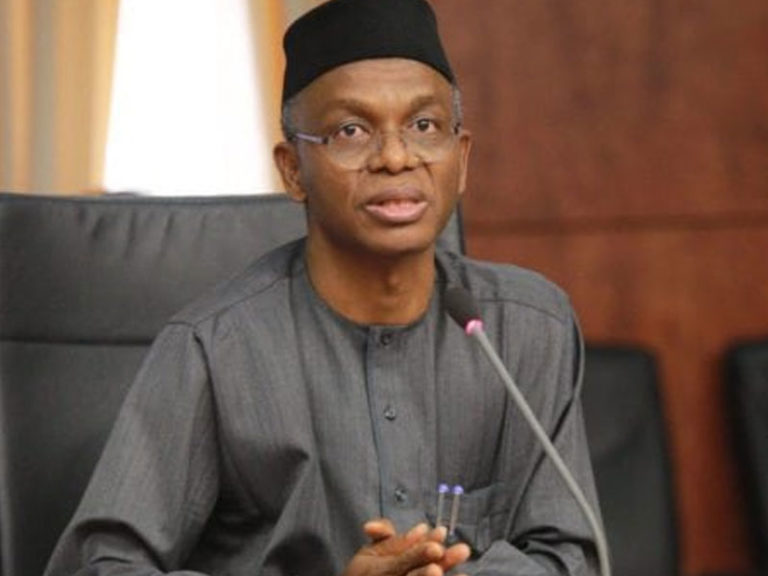
The Nigerian governors had, on Wednesday, at its virtual meeting, considered the report of a committee headed by Kaduna State Governor Nasir el-Rufai and accepted its recommendation backing full deregulation of petrol, with a suggestion that the pump price of the product should hover around N385 per litre.
However, energy analysts argue that many factors come into play in the price determination of PMS product, wondering why the governors are almost fixing the price without considering various market variables.
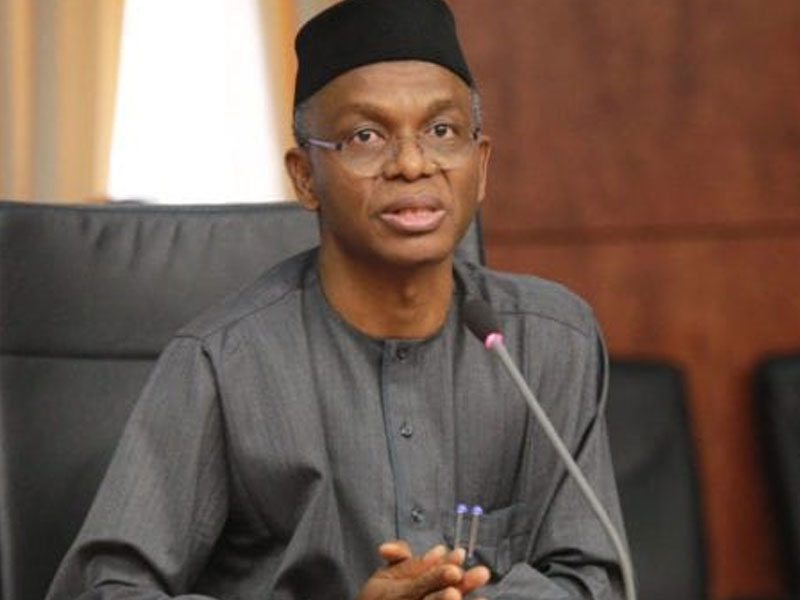
Kaduna State Governor, Nasir El-rufai
“There are several factors that come into play in price determination in a deregulated market. There are still multiple exchange rates that the country is still battling with and the issue of access to foreign exchange. These are some of the concerns alongside the daily price of crude at the international market, the landing costs and other variables that are involved. These are all important before determining the price,” President of the Major Oil Marketers Association of Nigeria Adetunji Oyebanji told The ICIR.
“If we don’t do it, states that depend on the federal allocation for their survival would be dealt a blow, and won’t be able to meet up with their obligations. Workers would be sacked and definitely more hardship would be felt.”
For an efficient market to work, prices should be determined by the market forces. This enables suppliers to allocate products optimally and buyers to obtain products at the required quantity, basic economics says.
“The lead question for the government is, how do you arrive at the price? Did you consult with the PPPRA and the PPMC on the pricing template? The price is still very high. What template did they use in arriving at the price? Even the price they suggest is not market reflective. Ordinarily, if we have the fuel subsidy removal, and considering all the variables, the price band should be between N260-N270 per litre,” Adigun explained.
Speaking on the pros and cons of the PMS subsidy removal, he said:” The cons would be inflation, higher pricing and the pros would be driving efficiency and more revenue for states. The government is still discussing with labour as they are yet to settle with them on why the removal of subsidy should be enforced now, amid concerns of a Covid-19 ravaged economy,” he said.
Professor of Energy Economics at the University of Ibadan Adeola Adenikinju told The ICIR that the National Assembly should hasten up and pass the Petroleum Industry Bill (PIB) to have a defined fiscal template for the oil sector.
“The upstream, midstream and downstream sub-sectors would have a commercially-driven template to drive the sector once the PIB is passed,” he said.
“We have a system that is not enabling us to harvest the benefits in the oil sector. We need to ensure the oil sector works for us effectively. We can’t keep going back and forth on this for a long time like this, for a resource that is at the heart of the economy,” Adenikinju explained.
While presenting the report to his colleagues, el-Rufai reportedly said the increase in the price of petrol to N385 per litre would help stem the increasing smuggling of the product to neighbouring countries.
According to him, if petrol was sold at N385 per litre, FAAC would gain between N1.3 trillion and N2. 2.3 trillion per annum.
The committee also recommended that the Federal Government should sell the three refineries after rehabilitation.
The report revealed that Nigeria lost billions of dollars due to the COVID-19 pandemic, noting that there was already a cash crunch in the states.
NNPC had said that it would remit zero allocation to FAAC in May due to the huge cost of subsidising petrol.
A member of the Presidential Economic Advisory Committee Bismarck Rewane noted that the government’s subsidy removal must be followed by efficient deployment of the resources which would have a direct impact on the lives of the people.
He further warned that the subsidy funds must not be warehoused within the government’s wallet, noting that there could be concerns about accountability if the government warehoused the funds.
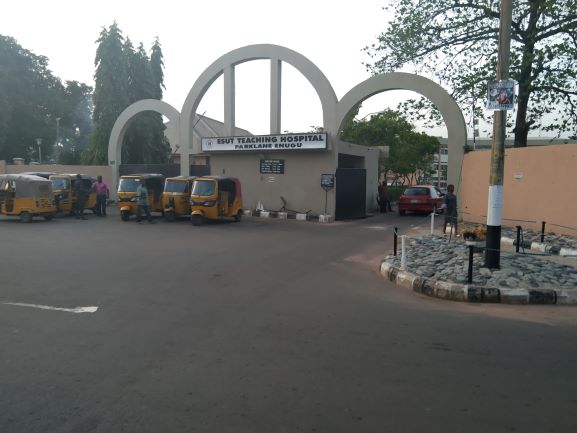
Arinze Chijioke was at the Children’s ward inside the Enugu State University of Science and Technology Teaching Hospital ESUTH, Parklane, to see how the hospital management extorts money from patients by asking them to pay for poorly prepared meals they don’t eat.
THE cries of children in the children’s ward repeatedly rise and fall at the Enugu State University of Science and Technology Teaching Hospital (ESUTH), Parklane, in the capital city of Enugu. Nurses garbed in white dresses walk around the ward, catering to the needs of the children. Some of the mothers in the ward hold conversations in groups of two and three. At one end of the room, housing about 15 beds, 10-month-old Chisom Nnamdi fiddles with a book. He just recovered from malaria, which began in March and wants to go home. But he can’t.
His mother, Joy Nnamdi, sits just beside him. Her face forlorn, her head resting on the bed. The hospital management had served her a bill of N92,000 after a 17-day stay at the ward.
But there was a problem.
Entrance to the children’s ward
Since she and her husband bought the drugs and everything needed to treat their son, Nnamdi thought their bill would be 40,000 to 50,000 naira.
“When they brought it, I was shocked. I thought it was for a different family”. “My husband and I had exhausted all the money we had on drugs, drips and Oxygen, which costs 8,500 each,” she said.
Afterwards, when she found time to look closely at the breakdown of the bill, she was shocked to find that N25,000 was included as money for feeding for the 17 days she and her son spent there. That is 1,500 per day and 500 per meal.
However, throughout their stay in the ward, she and her son didn’t eat any of the meals generally served by the ward orderlies because they were always terribly prepared.
Her husband had only been able to raise funds to clear half of the bill, and Nnamdi said she was prepared to stay at the hospital until her husband pays the remaining part of the bill.
“Eating hospital food should be optional,” she insisted. “You can’t force me to eat what I don’t like.”
Egusi soup and small sized Garri served inside the ward
Egusi soup served inside the ward
Beans served inside the ward
Nnamdi’s experience is common at ESUTH, where patients and their families are forced to pay for meals that lack nutritional value. After admission, they are told to prepare to eat in the hospital as payment is compulsory.
When patients come to the hospital, some expect to learn how to balance their diet, apart from receiving treatment. But the story is different here. The hospital management prepares bad meals and ensures they pay before they leave.
Most families have had to spend more days inside the hospital, even after being discharged, because they cannot afford the exorbitant bills they are given. These families only pray and wait for Individuals and non-governmental organizations that come to the hospital to help clear patient’s bills.
Across different sections and units inside the hospital, the story is the same. But families hardly eat the food. When it is time to serve each meal, the orderlies — a group of women always garbed in brown uniforms, place the cooler on top of the table and ask individuals to “pass their plates to be served”.
Oftentimes, they carry the cooler from one ward to the other-begging people to eat because they are always rejected. The orderlies know the meals are bad. But for fear of losing their jobs, they always carry the meals around.
Usually, in the morning, watery tea and a small bread are served. It is either beans or porridge yam in the afternoon hours, and in the evening hours, it is Garri and soup. The meals are often recycled.
At the Children’s Ward, five sources interviewed said they purged endlessly after eating the meals. What some of them manage to collect is the small bread. They always go outside the hospital to get food or wait for family members to visit them.
The first time pregnant Amaka Nwobodo tasted yam and beans offered by the orderlies, she purged for three days. That was the last time she collected food. She did not want to risk her health.
Nwobodo had come to the hospital on April 9 with her son, Olisa, who had difficulty breathing. She hoped to get the best treatment and care for her son. But her hopes were dashed.
Her experience in those days when she purged was better imagined than felt. “I could not get myself. The toilet facilities were nothing to write home about. I was afraid of contracting the disease” I was afraid of remaining in the hospital after my son was discharged,” she explained.
To avoid all that, she bought everything she needed outside the hospital.
According to a study conducted by the World Health Organization, WHO, Nigeria has one of the most inefficient health systems in the world. This is partly due topoor hygiene conditions, most common in public health services often overcrowded by those who cannot afford the out-of-pocket costs for private health services.
A collaborativeSurvey conducted by WeBelieve Health and NOIPolls Limited revealed that most Nigerians (53%) visited public hospitals, (43%) visited Pharmacies, while only (34%) visited private hospitals.
This is even with a universal health insurance Scheme- a public health system established to provide universal coverage. The ability of the system to provide free and good quality healthcare for the entire population has been limited.
This is making life difficult for theestimated40 per cent of Nigerians living below the poverty line of N137,430 ($381.75) a year.
Pushing for change
Leonard Onuchukwu was determined to change the narrative.
When the native of Amechi Awkunanaw in Enugu South Local government first heard that families of patients were being asked to pay for the food they don’t eat, he thought it was all a joke. He ignored it.
He and his wife, Uchechi, had brought their daughter, 1-year and three months old Daniella, to the hospital on 10 April after she started stooling and vomiting. They had returned from Abuja for the burial of his father-in-law.
Onuchukwu became interested when one of the orderlies serving the meals walked into the children’s ward, begging families to collect food.
“What she was serving was jollof rice she had brought from another ward where it was rejected. But she continued, and when she got to one of the women inside the ward with the food, the woman asked why she (the ward orderly) was forcing people to eat,” he said.
The orderly said the food was meant for some families in another ward who said they were not interested. When she was asked to eat the food, she refused and said it was not good enough.
Onuchukwu was disappointed when he took a closer look and saw what the woman was serving. He said he only saw grains of rice that looked like they were only coloured, without necessary ingredients. “I could not believe my eyes,” he said.
Irked by what he had seen, Leonard told the orderly that he would not pay and that he had been buying meals outside the hospital all this while. But she insisted that he would pay since everybody was paying.
When she left, women inside the ward began to complain about how bad the meals were and how they had a running stomach when they tried to eat.
Onuchukwu quickly picked up his phone and called the hospital’s hotline to complain about what was happening. But he was told by the worker that picked the call that it was an established policy of the hospital.
“She said I was the only one who has complained about the practice and that I was only wasting my time by calling to complain, “he said.
As soon as he said he would not pay for the food and was ready to take up the hospital management on the matter, the worker hung up the call.
“Even if it meant going to the police, I was ready because I can’t pay for service they did not render. It is unheard of. Eating hospital food should be optional,” he said.
Leornard Onuchukwu and his wife entering the police van
Because he was a civil servant and only recently came back from Abuja, Leonard quickly asked his wife to request the transfer of their baby to a hospital in Abuja. Tension was beginning to brew at this point.
“We decided that we would take her to the University of Abuja Teaching Hospital and told one of the doctors, and he prepared a reference letter for us. They prepared the bill,” he continued.
When he received it, the amount was N29,500 for the four days he had spent with his wife and daughter.
Out of that amount, he was charged N6,000 for food. He was also charged 10,000 for utility — electricity and water, which is N2,500 daily. There were 2,000 for children’s consumables, 7,500 for daily stay, 2,000 for out-patient-department cards and 2,000 for admission fees.
Immediately, he went to the Cash Office and questioned why he was being asked to pay for the food he did not eat. He was told by the workers that there was nothing they could do as the management had taken the decision.
He asked to pay other bills. But they refused and insisted he must pay the whole amount. Unwilling to pay the money, he came back to the children’s ward and asked his wife to prepare so they could leave the hospital.
Immediately they got out of the ward; they were stopped by security men who said they would not leave the hospital unless they cleared their bill. Soon, Onuchukwu began an anti-food protest, raising his voice for everyone to hear.
A text message exchanged between the Chief Medical Director of the hospital and Onuchukwu after he had left the hospital
“I could not imagine myself paying for the food. It was a clear case of extortion, “he said.
Other women in the ward soon joined, too. That attracted the attention of visitors at the hospital and patients in other wards who questioned the decision by the management to enforce their food on patients.
Soon, police officers arrived and took Leonard and his wife to the Abakaliki Road police station. The Divisional Police Officer, DPO, asked them to return to the hospital and settle their differences.
The hospital management had invited the police to quell the situation.
Back at the hospital, the chief security officer, CSO Fidelis Onuduagu, met with the Chief Medical Director, CMD Hycienth Onah, who ordered that the bill for daily feeding be waived for Onuchukwu. He finally paid N21,500. He had paid N2,000 earlier.
Onuduagu said it had been a rule in the hospital that whether patients admitted to eating the meals offered to them or not, they must pay.
“The food given to patients is not healthy enough. Many people have been complaining, “But there is nothing we can do. We have to obey the hospital management,” he said.
Part of what families are asked to pay for is the utility bill- light and water. But hanging on top of the wall, inside the ward, is a television set that did not work while this reporter was at the hospital. Sources interviewed also said it had not worked since they were admitted.
Not all families are as bold and fortunate as Leonard. It is a different story for such families who can’t speak up as the hospital management is determined to keep extorting money from patients.
A new twist
Five days after Onuchukwu and his family left, nurses came to the children’s ward to inform parents that the hospital management has asked anyone who is not interested in receiving their meals to fill a form, detailing why they don’t want to eat and wait for an appointment with the chief medical director.
Sources interviewed, however, said they filled the forms, but nothing changed.
“Some of us went, but the Chief Medical Director said our reasons were not genuine enough and that we just have to pay,” Chioma Ozioko, who left the hospital one week after she was discharged, said.
Ozioko had spent 15 days in the hospital with her five-month-old son, Kachisicho Ozioko, who was admitted with Sepsis which caused him to stool and vomit. When her bill came out, it was N83,100, out of which she was billed N22,500 for feeding per day.
She had other bills to clear, such as utility, children’s consumables, daily stay, emergency cases card and admission card. But what was most worrying for her was the bill for food which she said she did not eat all through her stay.
“I am breastfeeding. I could not have eaten that poison and fed my son so he would become sick again. I had spent everything I had on medication. On Oxygen alone, I spent N34,000,” she explained.
Ozioko also spoke of how one of the workers at the hospital, who would not want to be mentioned for fear of victimization, alleged that CMD Onah had a target given to him by the Enugu State government.
“He does not want to stop extorting patients because he is supposed to make returns to the state and also have his share out of it,” Ozioko, who only left the hospital one week after they were discharged, said.
Mba left three weeks after he was discharged.
When Gabriel Mba got a bill of 128,000 from the hospital, he was troubled with the thought of how to clear the money. What was most worrying for him was that he would have to pay N42,000 just for food.
He and his wife, Ijeoma, had spent four weeks at the hospital after their child,Dominion, was admitted with a seizure. Like every other family, Mba did not eat the meals served. He always went outside the hospital to buy everything they needed.
“I came to the hospital with N50,000. But I had already spent everything on food, drugs and oxygen used in treating my son. And now, I have this bill to clear”. I don’t know what to do,” an enraged Mba said.
After they were discharged, Mba said they spent three weeks inside the hospital because he could not afford the bill. “It was one day when we were inside the ward that a certain man came and helped us clear the bill, “he said.
He said he would have remained in the hospital.
Culture of negligence
Apart from the fact that patients are made to pay for the food they don’t eat, there is a deep-seated culture of negligence at the hospital.
Onuchukwu recalled how he and his wife were badly treated when they first got to the hospital at 6:45 pm that Saturday with their daughter.
Staff told the couple that the man assigned to give the hospital card was not around. Leonard and his wife had to move around in search of him. He was eventually found discussing with fellow workers. He had left his duty post.
“He asked us to pay 2,500 for the card. We paid and got the card,” Onuchukwu said.
But when they got to the emergency ward and called the attention of doctors and nurses around, no one responded. They only got attention at 9:30 pm when one of the doctors came and wrote a list of drugs for Onuchukwu to buy. Uchechi became a bit okay after she took some of the drugs that night.
But she started stooling and vomiting the next morning again. This time, her condition had gone worse. Leonard had left the previous night and asked his sister to come and stay with his wife at the hospital.
When he came back the following morning, his wife was crying. His daughter was left unattended.
“She was dying before my eyes. She was losing strength. As my wife cried, I begged the doctors and nurses. But they couldn’t respond till it was 2 pm,” he recalled.
Angered by the negligence, he asked that his daughter be discharged so he could take her elsewhere. “They gathered and started begging me to calm down so they could give me attention. They gave me attention immediately, and my baby began to recover,” he said.
He also spoke of how a certain family rushed to the emergency ward that same day, carrying their baby and shouting that she had bullet wounds. Armed robbers had attacked them.
The parents had wounds too. But that of the baby was more critical and needed urgent attention. When they came in, shouting that they had been attacked, the doctor said there was no space.
“When he said there was no space, I became weak and imagined my child in that condition. It could be anybody’s child. That was when I realized that negligence was a character in that hospital. How can a doctor that swore to save lives tell a baby in an emergency that there was no space”?
Chief Medical Director declines comment
When contacted for his reaction to the allegations, CMD Onah said he doesn’t speak to journalists.
“No comments. I don’t talk to Journalists,” he said.
Nnamdi finally left the hospital two weeks after she was discharged. But that was after some group of individuals helped clear her bills.
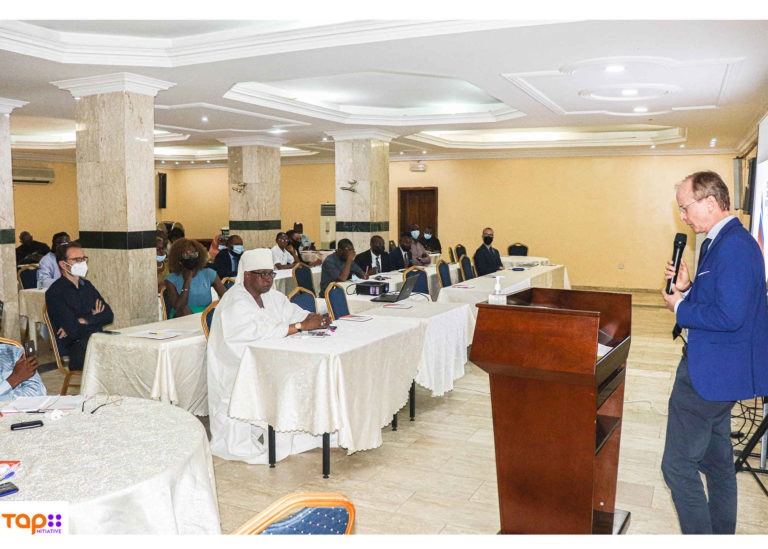
A new group that seeks to promote human rights in Nigeria is set for launch.
The group was midwived by citizens’ advocacy organisation, Tap Initiative For Citizens Development and Heinrich Boll Stiftung, which is devoted to promoting democracy and human rights worldwide.
It brought together civil society actors such as religious and traditional rulers, lawyers, gender and sexual reproductive rights activists, scholars, youth groups, people living with disabilities, media organisations, media practitioners and community-based organisations on Thursday in Abuja to brainstorm on the new association.
They are to form a consortium in response to continuous threats faced by Nigerians in exercising their rights to freedom of expression, assembly, speech and association.
Besides, the consortium will be carrying out advocacy campaigns in underrepresented communities.
Addressing the guests, Team Lead at Tap Initiative for Citizens Development Mbasekei Martin Obono said the group was formed to respond to civic space attack by giving legal representation to human rights advocates and defenders.
“The diversity in the calibre of participants presents an opportunity for both information clearinghouse, advocacy, mediation, support for victims and legal intervention in defence of the civic space,” Obono said.
According to him, the platform would complement the work of other coalitions of civil society actors by providing an avenue for a loose marketplace for conversations, resources and actions.
“The idea behind this consortium is to have a platform that serves as a clearinghouse where everyone involved in civic space defence benefits. The consortium welcomes representatives from existing coalitions to work in exchange of information and ideas,” he said.
Country Director of Heinrich Boll Stiftung Jochen Luckscheiter, who declared the two-day meeting open, reminded the participants of roles which civic actions had played in the country in ensuring the protection of the civic space.
Luckscheiter cited Aba Women’s Riot of 1929 as one of such noble roles, noting that people in the country had been relentless in the protection of the civic space in the face of unfavourable laws being enacted to muzzle human rights in the country.
Similarly, Swedish Ambassador to Nigeria Carl-Michael Grans, who delivered the keynote address at the meeting, decried shrinking democratic space globally.
Grans said the COVID-19 pandemic and its attendant effects in the form of restrictions, curfews and lockdowns had worsened the challenge across continents.
While calling for an immediate halt to shrinking democratic and civic space among nations, he urged all countries to return to the core values of humanism, democracy and inclusion, including to the right of free speech and the right of association.
In her presentation, Country Director of Amnesty International Osai Ojigho said for the civic space to be effective, people across various fields must be engaged as seen with the consortium.
Other speakers at the meeting included: Pastor Abigail Dike of Pentecostal Fellowship of Nigeria; Fuad Adeyemi, Abdul Mahmud, Dayo Olaide and Etim Okon.
Participants at the meeting agreed that similar meetings would be held across the six geopolitical zones in the country in order to build structures that would strengthen civic engagement and participation.
Dignitaries at the meeting included: Chairman of Traditional Rulers Council of Cross River State, Etim Okon; Emir of Dass, Bauchi State, Lawan Baraza; Chairman of Traditional Rulers Council in Ezinihite, Imo State, Eze Ositadinma Nwokocha; Secretary of Traditional Rulers Council, Akwa Ibom State, Michael Akpabio.
Others were: Executive Director of International Centre for Investigative Reporting (ICIR), Dayo Aiyetan; Publisher of Sahara Reporters, Omoyele Sowore; Inibehe Effiong; Omolara Oriye; James Ibor; Okechukwu Nwaguma; Agba Jalingo; Nelson Olanipekun; Abdul Mahmud, among others.
MICRO, small and medium enterprises (MSMEs) in Nigeria are hard hit by the high cost of loans offered by deposit money banks, which range from 16 to 30 per cent per annum.
Chukwubuike Nnoli runs Zubnol Investment Limited, a micro-business that manufactures interior decoration products and supplies them to retail stores, open markets and several outlets. In 2020, he sought a loan in a Tier-1 bank, which agreed to give him N1 million at 16 per cent per annum. He needed the money to expand his business, but he was offered N1 million and was asked to return N1.155 million in 12 months.
Chukwubuike Nnoli
“Apart from the fact that it is just a million, it costs 16 per cent. It was even around 20 to 21 per cent the year before,” he told The ICIR.
Millions of small businesses in Nigeria are foraging for cheap loans in the ugliest of places, including from street money lenders. Africa’s largest economy has 41.5 million MSMEs, according to a report published by the National Bureau of Statistics (NBS) and the Small and Medium Enterprises Development Agency (SMEDAN) in 2019, but many of them are struggling to obtain cheap loans for expansion.
The NBS-SMEDAN report said 85 per cent of small businesses in Nigeria could not have access to external financing between 2013 and 2017.
Only 5.3 per cent of MSMEs had access to bank credit, even with 40 per cent of them having relationships with banks.
Interest rate charged to small-scale manufacturers averaged 20.75 per cent in 2020 as against 21.25 per cent recorded in 2019, according to the Manufacturers Association of Nigeria (MAN).
Founder of a start-up Liverstock247.com Ibrahim Maigari Ahmadu said the interest rate was a major problem for MSMEs in the country.
“Nigerian commercial banks are risk-averse. They put so many bottlenecks on the way when you want to access funds,” he said.
“Interest rate is very high, which is a major inhibiting factor. Collaterisation is structured to knock you out,” he further said.
The Central Bank of Nigeria (CBN) has raised the Loan-to-Deposit (LDR) to 65 per cent to boost lending to businesses and has made several funds available for small businesses. But the problem, according to Chief Executive of Jon Tudy Enterprises Jon Kachikwu, was that many small businesses would not have access to them.
In 2020, PwC Nigeria estimated that the yearly financial gap for Nigerian MSMEs was N617.3 billion.
In the report entitled, ‘PwC’s MSME Report 2020,’ the consulting firm surveyed over 1,600 MSMEs, out of which 22 per cent said that obtaining finance was their biggest challenge.
The PwC noted that SME credit market in Nigeria was notoriously characterised by market failures and imperfections.
“Hence, in emerging markets and developing economies, 55 per cent to 68 per cent of formal SMEs are either un-served or under-served by financial institutions, leading to a total credit gap estimated to be $5.1 trillion.”
Benchmark Interest Rate in Selected Sub-Sahara African countries
Nigeria’s Monetary Policy Rate (MPR), which is the benchmark interest rate in the economy, is 11.5 per cent, according to the CBN. This is higher when compared with SouthAfrica‘s 3.5 per cent; Kenya’s 7.5 per cent; and Zambia’s 8 per cent, according to their central banks. In Ethiopia, another SSA nation, the benchmark interest rate is put at 9 per cent, according to the National Bank of Ethiopia. Botswana’s rate is estimated at 3.75 per cent while Uganda’s is 7 per cent. Similarly, Namibia’s benchmark rate is 7.75 per cent.
In a recent interview, Director-General of the Lagos Chamber of Commerce and Industry (LCCI) Muda Yusuf said access to funding was much more difficult for MSMEs than large enterprises.
Godwin Emefiele, CBN Governor
“For micro and small businesses, because they are perceived as high risk, collaterals are tougher and many of them cannot provide such,” he said.
The CBN has reduced the MPR from 13.5 per cent to 11.5 per cent in the last two years, forcing banks to lend to small businesses. However, financial experts say many MSMEs are not prepared for loans as they lack good credit history, book-keeping skills, structured documentation and technology that could drive their credibility.
“Banks are looking at your cash flow, audited accounts, and they are looking at whether you have the technology to drive your business and if you have a good credit history,” said Managing Director/ CEO of CRC Credit Bureau Tunde Popoola, while offering his advice recently in a Zoom meeting.
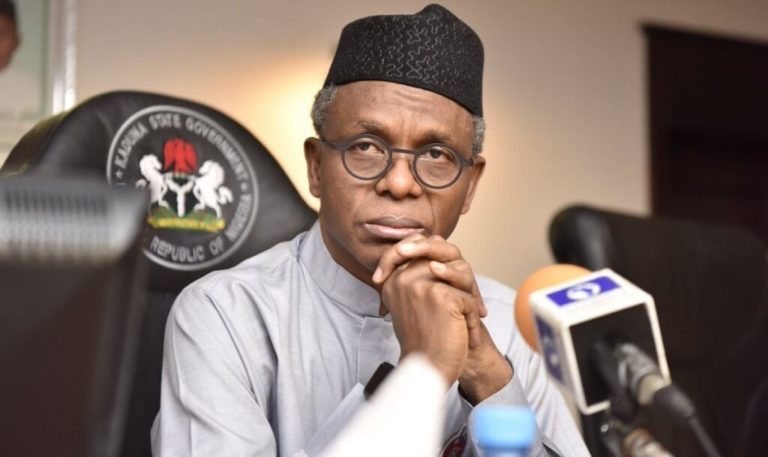
GOVERNOR of Kaduna State Nasir El-Rufai has accused a governor of financially sponsoring the five-day warning strike in the state.
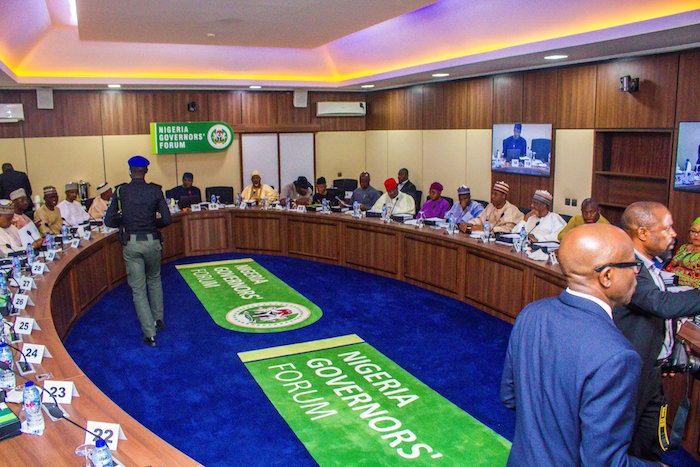
El Rufai said this on Wednesday during the meeting of the Nigerian Governors Forum, noting that his fellow governors refused to offer him support during the strike.
According to El Rufai, a governor, who he did not name, gave money to the Nigeria Labour Congress (NLC) to organise the strike action.
“I would like to inform the forum that one of our colleagues, a state governor, actually gave the NLC money to come to Kaduna to do this because people think everything is politics. This is not politics. This is a monster that will consume all of us. It will not consume Kaduna I’m confident of that,” El Rufai said.
He further lamented that he was used to fighting his battles alone but he had expected an ‘unequivocal and unqualified support’ from the NGF.
When El Rufai was reminded that the NGF released a statement concerning the strike, he said the NGF tried to ‘play both sides.’
The NLC had, on Monday, embarked on five- day warning strike over the sack of thousands of workers and refusal to pay entitlement to retrenched workers in the state.
El Rufai said the sacks were part of the government’s process to ‘rightsize’ the state’s civil service.
He condemned the strike action that lasted for three days before it was called off on Wednesday evening by the NLC chairman Ayuba Wabba. The NLC chairman said the strike was called off to give room for negotiations after the Federal Government waded in.
During the strike, lecturers of the Kaduna State University (KASU) and some nurses who joined the union in the action were also sacked by the governor.
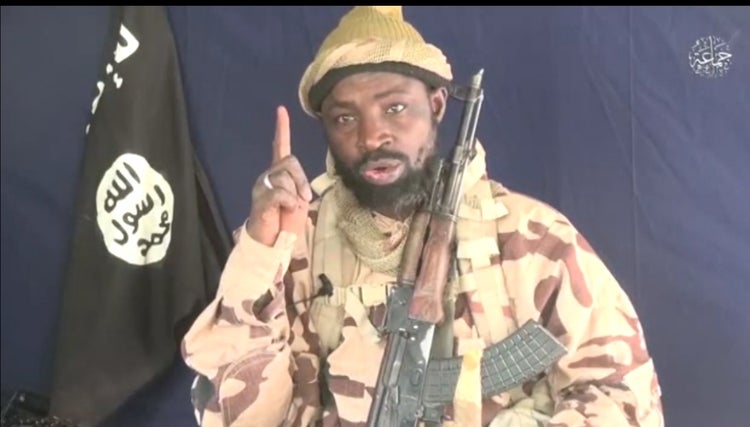
LEADER of Boko Haram terrorist group Abubakar Shekau has reportedly committed suicide after his ‘territory’ was attacked by a faction group, Islamic State West Africa Province (ISWAP).
According to HumAngle, the ISWAP fighters invaded the stronghold of Shekau and subdued his bodyguards in some parts of the Sambisa Forest ‘controlled’ by him.
After he was surrounded, Shekau reportedly blew himself up during a negotiation with some members of ISWAP who demanded that he pledge allegiance to them.
In another report, the AFP reported that although Skekau was surrounded by ISWAP fighter, he did not blow himself up, rather he shot himself in the shoulder to avoid being captured. The report further read that due to the gunshot, Shekau was badly injured.
ISWAP is a faction of Boko Haram that separated from the latter over a disagreement with the methodology. However, The ICIR is yet to confirm his death.
The Boko Haram terrorist group has claimed responsibility for several violent atrocities against Nigerians, including killings and abductions. The terrorist group was responsible for kidnapping 276 schoolgirls in Borno State.
For more than six years, several reports about the death of Shekau have been in circulation across Nigeria and the Lake Chad Basin where the terrorist group is most dominant.
In 2014, the Nigerian Army claimed that it had killed Shekau in Buni Yadi, Borno State, but did not provide evidence to prove that he was killed. However, Shekau resurfaced in a video calling the bluff of the Army’s claim.
Two years later, the military againcame out to say Shekau was fatally wounded during another military operation in Borno State.
The ICIR contacted Army spokesman Mohammed Yerima, but he said he would not talk about the issue. Defence spokesman Clement Nwachukwu did not respond to the reporter’s calls.