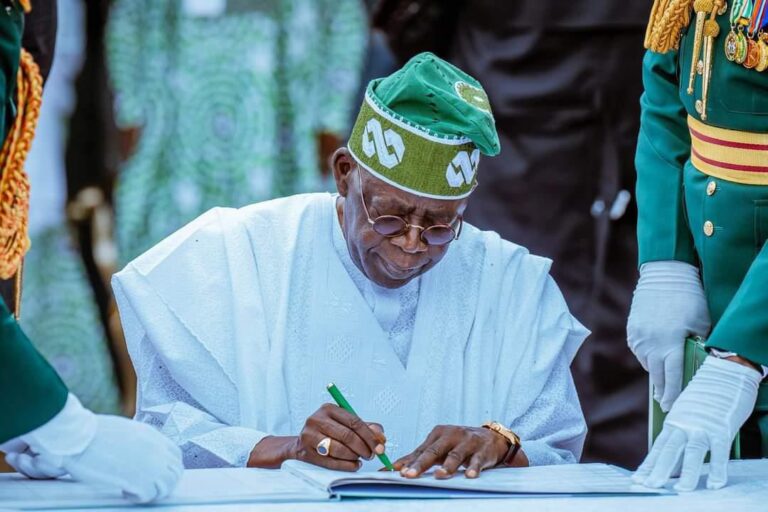
PRESIDENT Bola Tinubu has signed the Nigerian Insurance Industry Reform Act (NIIRA) 2025 into law.
He assented to it on Tuesday, August 5, according to a statement by his special adviser on information and strategy, Bayo Onanuga.
The Act is aimed at strengthening the financial sector as the country pushes toward achieving a $1 trillion economy by 2030.
It repeals and consolidates several outdated insurance laws into a single, modern legal framework, providing for comprehensive regulation and supervision of all insurance and reinsurance businesses operating within Nigeria.
“This development reaffirms the administration’s commitment to financial stability, economic development, and inclusive growth.
“The NIIRA Act 2025 ushers in a new era of transparency, innovation, and global competitiveness for the insurance industry. It aligns with the Federal Government’s vision of achieving a $1 trillion economy,” Onanuga stated.
According to him, the Act is a part of the renewed hope agenda for the insurance sector, noting that it introduces critical measures such as stringent capital requirements to ensure the financial soundness of operators.
Onanuga stressed that the Act would help ensure enforcement of compulsory insurance policies to enhance consumer protection, and the digitisation of the insurance market to improve access and efficiency.
He stated further that the new Act would ensure zero tolerance for delayed claims settlement, creation of dedicated policyholder protection funds in insolvency cases, and expanded participation in regional insurance schemes like the ECOWAS Brown Card System.
“The National Insurance Commission (NAICOM) is mandated to administer and implement the provisions of the NIIRA 2025 in a manner that unlocks the industry’s full potential and significantly improves insurance penetration across the country,” Onanuga said.
He believes that the reform introduced by the new law is expected to catalyse new investments, boost consumer confidence, and position Nigeria as a leading insurance hub in Africa.
The ICIR reports that the Senate had, in December 2024, passed the bill which consolidates various existing laws governing insurance in the country, including the Insurance Act (2003), Marine Insurance Act, Motor Vehicles (Third Party Insurance) Act, National Insurance Corporation of Nigeria Act, and Nigerian Reinsurance Corporation Act.
A notable provision in the bill is the reduction of the minimum capital requirement for reinsurance businesses from N45 billion to N35 billion.
THE victory of 17-year-old Nafisa Aminu at the 2025 TeenEagle Global Finals in London has sparked widespread celebration and renewed national discourse on the value of education in Nigeria.
Nafisa, a student of Nigerian Tulip International College (NTIC), Yobe State, reportedly beat over 20,000 participants from 69 countries, including native English-speaking nations, to emerge the overall best in English Language skills.
The achievement, which many described as historic and inspiring has drawn commendations from across political, educational, and public spheres, with some Nigerians demanding that the Federal Government confer national honours and financial rewards on the teenager, akin to those granted to Nigeria’s sports champions.
A statement on Tuesday, August 5, by Yobe State Governor Mai Buni congratulated Aminu and one other teenager Ruqayya Fema, for emerging overall best in the English Language and debate competition at the 2025 TeenEagle Global Finals in London.
The statement, signed by the governor’s Director-General, Press and Media Affairs, Mamman Mohammed, described the outstanding performance as a great honour to the state and country.
It noted that both Aminu and Fema were beneficiaries of the governor’s scholarship scheme, which also covers tuition for 890 students currently enrolled at NTIC.
“These are great feats that make us proud and justify the government’s investment in the education sector,” he said.
The governor further said he had approved a grand reception to honour the winners at a later date.
Other national leaders react
Former Vice President Atiku Abubakar lauded Aminu’s perfomance at the global stage, describing her success as “a powerful testament to the limitless potential of the Nigerian girl-child when provided with quality education and a supportive environment.
“Investing in the education of our girls is not just a matter of fairness; it is a strategic necessity for national transformation.
“:Let us, as a community, commit to dismantling every barrier that prevents the girl-child from realising her full potential,” Abubakar said in a statement.
Similarly, the former Minister of Communications and Digital Economy, Isa Ali Pantami, said that Nafisa should be honoured with $100,000, a three-bedroom flat, and the national honour of Officer of the Order of the Niger (OON), similar to rewards recently given to members of the Super Falcons and D’Tigress.
“I strongly recommend that Nafisa deserves $100,000, a three-bedroom flat, and a national honour from the Federal Government of Nigeria. In addition, her English teacher deserves a reward similar to the one given to the coaching and technical team of the football and basketball players. We must continue to take education very seriously and reward the efforts of our citizens.
“Interestingly, it is said that education is the passport to future development, for tomorrow belongs to those who prepare for it today through education and skills,” Pantami stated.
On July 28, the Nigerian government gifted each member of the Super Falcons $100,000, a flat, and national honours after their Women’s Africa Cup of Nations triumph in Morocco. A similar gesture was extended to the D’Tigress basketball team for their fifth consecutive AfroBasket title on August 4.
Nigerians laud Aminu’s achievement
A social media user Gideon stated that “The best offer is full scholarship for the entire duration of her studies in any school of choice, an apartment for her family and immediate employment after graduation from school.”
Another user, Jasper, framed the achievement within the broader context of Nigerian youth potential, adding that the Nafisa’s victory “is a powerful reminder that Nigeria’s educational system still has bright sparks…It would be unjust for a student like Nafisa, who received a solid foundation from NTIC, to be limited by outdated systems at the next academic level.”
Also, @Kayode_MK wrote: “She deserves more than applause; she deserves the nation’s honour. We roll out red carpets for athletes. Let’s do the same for intellect. Genius is also a national treasure.”
Many citizens echoed similar sentiments online, celebrating Nafisa as a role model for young girls across Nigeria and urging both state and federal governments to recognise and support more academic achievers.
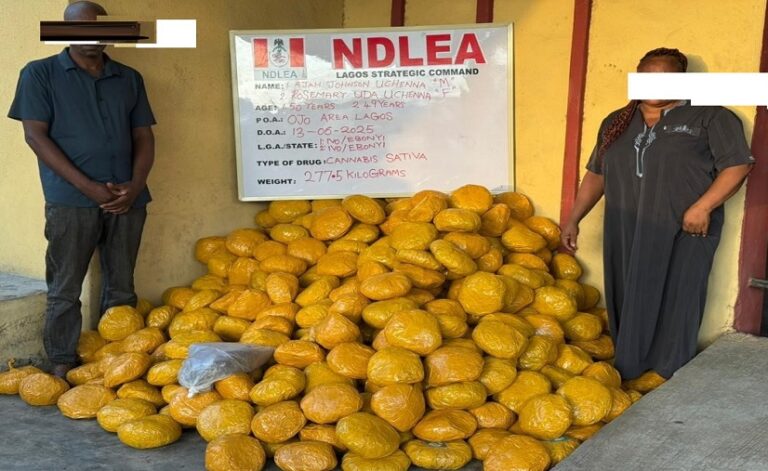
THE Federal High Court 8 in Lagos State sentenced a businessman, Ajah Johnson Uchenn, and his wife, Rosemary Uchenna, to a combined total of 22 years in prison on Monday, August 4, for dealing in illicit drugs.
The National Drug Law Enforcement Agency (NDLEA), in a statement on Tuesday, August 5, signed by its Director of Media and Advocacy, Femi Babafemi, said the couple was caught with 277.5 kilogrammes of skunk, a strain of cannabis.
The NDLEA said that while the couple was still being investigated in custody, credible intelligence revealed that the family’s business was going on in their house.
This led to a raid of the home and a store, where 231 kilogrammes of the same substance were recovered by NDLEA operatives on Tuesday, July 1.
They were subsequently arraigned in charge number FHC/L/632C/2025 at the Federal High Court, Lagos, on a four-count charge bordering on conspiracy, dealing, and storage of 414.2 kilogrammes of cannabis sativa.
In his judgement on the case on Monday, the judge, Deinde Dipeolu, convicted Rosemary on counts 1, 2, and 3 and sentenced her to 17 years in prison without the option of a fine, while her husband, Ajah Uchenna, was convicted and sentenced to five years imprisonment without the option of a fine on count 1 and six months in jail on count 4 with the option of a N1 million fine.
In addition to the jail terms, the trial judge also ordered that the sum of ₦ 3.4 million recovered from the couple as proceeds of crime be forfeited to the Federal Government.
Similarly, a Federal High Court in Kano presided over by Simon Amobeda convicted and sentenced a 42-year-old Indian lady, Neetu Neetu, to five years imprisonment for importing 72 parcels of heroin factory sealed in wafer wraps and packaged as chocolates, weighing 11 kilogrammes, into Nigeria through the Mallam Aminu Kano International Airport (MAKIA), Kano.
The ICIR reported on Sunday, August 3, that the NDLEA arrested an 80-year-old grandmother, Grace Ekpeme, and a Chinese businessman, Liang Tak You, for drug peddling.
In a statement by the NDLEA on Sunday, July 27, the duo were among those caught in a nationwide crackdown that uncovered synthetic cannabis, popularly known as Colorado, hidden in ‘moimoi’ sachets, and Canadian loud concealed in imported canned food items.
According to Babafemi, Liang was apprehended on Friday at the arrival hall of the Murtala Muhammed International Airport in Ikeja, Lagos State, after tracking him from his port of departure, allowing him to pass through Immigration and other airport protocols before arresting him on his way out of the airport.
Small-scale businesses and industries are expressing displeasure about the impact of President Bola Ahmed Tinubu’s economic reforms, which are raising further concerns about the negative effects on their operations.
This is a sharp contrast to the latest comment by Aliko Dangote, Chairman of the Dangote Group, who has praised the reforms of the current administration led by President Bola Ahmed Tinubu.
Dangote has praised the reform efforts of Tinubu’s administration, noting specifically that the ‘Naira-for-Crude initiative and the Nigeria First Policy’ as bold, transformative steps capable of reviving the economy.
Dangote stressed that these reform initiatives brought a measure of stability to the naira-dollar exchange rate.
He further said that the government reforms improved market predictability and have helped investors make sound business decisions, and restored confidence in the investment climate.
“We are also beginning to see some stability in the naira-to-dollar exchange rate, which has a positive impact. There are now fewer fluctuations, and this has brought a degree of predictability to the market.
“For those of us in the business sector, this is a welcome development, as it allows us to plan more effectively. Looking ahead, we can expect to see a more favourable rate,” Dangote said in a statement issued.
Tinubu’s policies and the economic cost to Nigerians
Tinubu made fuel subsidy removal and foreign exchange liberalisation a key focus of his administration, which has had a huge impact on the cost of living and rising inflation. Since the foreign exchange devaluation, many Nigerians have had to battle rising inflation, the cost of food, medical expenses, and other sundry expenses.
Businesses, particularly those in the small-scale category, are currently facing a significant increase in borrowing costs, with commercial bank lending rates approaching 35 per cent.
Affirming the rising cost of borrowing, the latest report by the Central Bank of Nigeria (CBN) has disclosed that Nigerians ranked high interest rates as the most severe constraint affecting their operations in June 2025, overtaking long-standing challenges such as insecurity and poor electricity supply.
The apex bank disclosed this in its June 2025 Business Expectations Survey, which polled 1,900 firms across the agriculture, services, and industrial sectors. According to the report, high interest rates scored 75.6 on the constraint index, followed by insecurity at 75.2 and insufficient power supply at 74.3.
“Respondents identified High interest rate (75.6), Insecurity (75.2), and Insufficient power supply (74.3) as the top three business constraints in June 2025, highlighting concerns around factors that directly impact operational stability and profitability,” the CBN stated in the report.
It’s not just businesses feeling the impact. A survey by The ICIR reveals that medicine prices have surged even more sharply than food prices, driven largely by Nigeria’s currency devaluation. Some medications that sold for less than N10,000 per pack in April 2023 now cost as much as N55,000 per pack.
Further checks by The ICIR showed that a packet of malaria drugs, which cost N500 in April 2023, now costs as much as N6,000, and a box of 100 tablets of Panadol now costs as much as N5,000, from N1,000 in April 2023.
A 20-plastic-bottle pack of Nestlé water, which sold for N800 in April 2023, now sells for N4,000, and a crate of 30 eggs, which sold for N750 in April 2023, now sells for N8,000.
Available data from the domestic commodities price from Finance Derivative Company(FDC) shows 50 kilogramme (kg) of garri currently sells of N46,000, 50 kg of rice long grain sells for N85,000,50 kg of flour sells for N62,000,50 kg of beans currently sells for N150,000,50 kg tomato sells for N60,000, 50 kg of onions sells for N115,000 while plantain bunch sells for N7,000.
Tales of woes for small businesses
From corner shops to innovative startups, and from salons to small factories, many small businesses are struggling to keep their head above water. This is largely due to the high cost of doing business.
For instance, bread is almost going out of the reach of an average Nigerian with the rising cost of production, and rising electricity tariffs impacting production costs.
President of Premium Bread Makers Association of Nigeria (PBAN), Emmanuel Obiorah, who reacted to the economic impact of President Tinubu’s reforms, said the President has offered a moratorium on flour, wheat, and dough import, but the cost of production is eroding it.
He said, “The President offered us a moratorium on the importation of wheat, dough, flour, and some other raw materials. This helped our production. However, the energy cost rise wiped all of them out.
“Energy costs for some of us in band A went up so high, and yet we can’t see the light. We had to resort to using diesel for our baking business. Can you imagine someone’s energy cost rising from N1 million to N15 million in a month because of Band A classification?” he asked.
He stressed that despite the rising electricity costs, the supply had been poor, as most bakers had to rely on diesel to sustain their businesses.
The concerns raised by the premium bread makers are not different from those of a restaurant manager who spoke to The ICIR.
For Oluchi Mgbemena, a restaurant manager in Kubwa, a suburb on in the Federal Capital Territory (FCT), the rising cost of foodstuffs has brought an unexpected sense of predictability to her home-based business.
“The prices of foodstuffs are not stable currently. You buy a kilogram of meat this week, next week, the price changes, same with one mudu of crayfish, Egwusi, and Ogbono, and even beans.
“What we did was to peg our food price at N2,500 per plate. Most of my customers, especially artisans and low-income earners, are complaining about this, but there’s little I can do as a manager. We cannot control rising cost of food prices, they are susceptible to market forces,” she stated.
Nigeria’s food inflation is worsening, and rising food inflation and insecurity in Nigeria’s food-belt have failed to solve the crisis. The cost of food in Nigeria increased 21.97 percent in June of 2025 over the same month in the previous year.
Policy concerns by the Chamber of Commerce
In May 2025, the Lagos Chamber of Commerce and Industry, LCCI, said reforms by the President Tinubu administration, despite being bold, have imposed short-term hardships on businesses and households, particularly Small and Medium-sized Enterprises (SMEs), which remain the backbone of the Nigerian economy.
Chinyere Almona nDG at LCCI.
“These measures have also imposed short-term hardships on businesses and households, particularly SMEs, which remain the backbone of the Nigerian economy,” the Director-General of Lagos Chamber of Commerce and Industry (LCCI), Chinyere Almona, said.
Commenting on the country’s macroeconomic outlook in an event to mark President Tinubu’s second anniversary, she said, inflation remained a critical challenge due to fuel subsidy removal and foreign exchange liberalisation.
She stressed that while the government’s reforms improve the fiscal Outlook, they increased the business operating expenses, particularly logistics, processing, and retail SMEs.
Almona said the current macroeconomic landscape reflected a nation in transition.
“There are also growing concerns about policy coordination. While monetary authorities target inflation, fiscal policy expands through borrowing and recurrent expenditure.
“This divergence has weakened the impact of economic interventions,” she said.
She suggested better policy coordination between monetary and fiscal policy to realise a better business environment.
She notes the need for the Central Bank of Nigeria, the Ministry of Finance, and the development finance to work in tandem to manage inflation without stifling productive investment.
She also advocated improved infrastructure, expanded social safety nets, promotion of local content, and sustained reforms in the foreign exchange market.
THE Federal Capital Territory (FCT) Police Command has arrested four suspects in connection with a staged kidnapping designed to extort ₦5 million from an elderly man, allegedly orchestrated by his two daughters.
The Command spokesperson, Josephine Adeh, in a statement on Tuesday, August 5, said on Wednesday, July 30, at about 11:30 am, one Innocent, a resident of Jikwoyi Phase II, reported to the Jikwoyi Police Division that his 16-year-old daughter, Lead Way Innocent, left home on July 18, to sit for an examination at Government Secondary School, Karu, Abuja, and had not returned.
The police said Innocent subsequently received a phone call from an unknown person demanding a ransom for his daughter’s release.
“Upon receipt of the report, the Divisional Police Officer (DPO) of Jikwoyi Division immediately launched a discreet investigation.
“Through coordinated intelligence gathering and digital tracking, the phone number used to contact the complainant was traced to a residence in Jikwoyi Phase II.
“Operatives proceeded to the location, where they found Miss Lead Way Innocent in the company of one Mrs. Tina Mayowa, the wife of Mr. Mayowa Adedeji. Both individuals were seen eating and conversing freely, indicating no signs of distress,” the command stated.
According to the police, subsequent investigations led to the arrest of Joy Innocent (the elder sister of the alleged victim) and her boyfriend, Mayowa Adedeji.
The command said findings revealed that Joy conspired with her boyfriend, who is legally married to Tina Mayowa, to stage the kidnapping of her younger sister, Lead Way, in a calculated attempt to defraud their father of ₦5 million.
The police said investigations revealed that Lead Way was not only aware of the plan but actively participated in it, willingly staying with the suspects during the alleged abduction period. Meanwhile, Joy stayed home, pretending to be unaware of the scheme, and watched as her parents suffered emotional distress while trying to raise ransom money.
“All four suspects are currently in police custody and have voluntarily confessed to the crime. They will be charged to court upon the conclusion of the investigation,” the police stated.
Meanwhile, the FCT PoliceCommissioner, Ajao Adewale, condemned the act.
He urged parents and guardians to pay close attention to their children’s emotional well-being and behavioural patterns, and to encourage regular, honest communication at home.
Adewale warns that any attempt to exploit familial ties for criminal purposes would not be tolerated and would be met with the full weight of the law.
In another development, the FCT Police Command on Friday arrested a school security guard, David Moses, for masterminding the murder of a 55-year-old caregiver, Chinyere Anaene, and a 14-month-old toddler, Nanenter Asher Yese, at a private school in Dawaki, Abuja.
The victims went missing on July 23, and their families received ransom demands, but investigations showed that Moses and his accomplice, Sunday Irimiya (still at large), had killed the victims and dumped their bodies in a canal.
Moses was arrested after being stabbed by Irimiya over a ransom-sharing dispute. The police also arrested the school’s principal, two other security guards, and the chief security officer of the private security firm.
The police said it had intensified efforts to apprehend Irimiya and called for improved vetting of security personnel in schools.
HUMAN rights lawyer Femi Falana has said President Bola Tinubu’s administration’s reforms have decimated Nigeria’s middle class, further worsening living conditions for millions of citizens.
The senior advocate expressed his concern on Channels Television’s Politics Today programme on Monday, August 4, night.
He described Tinubu’s economic reforms as “harsh neoliberal policies.”
“Most Nigerians cannot afford three square meals a day. The middle class has been wiped out by the neoliberal policies of the government.
“The government must go back to the drawing board and review each of these policies, especially those pushed by the IMF and World Bank, in the interest of Nigerians. It is in the interest of the government to review its policies as soon as possible,” Falana stated.
He recalled hearing the President ask the All Progressive Congress (APC) governors to “wet the ground” more, noting that, as far as the masses are concerned, things are getting tougher by the day because of the harsh economic crisis in the country.
“Because of the religious implementation of neoliberal policies by the government, poverty is on the ascendancy. That will require a review of these policies,” Falana maintained.
According to the senior advocate, the government’s privatisation drive contradicts efforts to tackle income inequality, urging it to reorder its priorities and provide targeted support for vulnerable Nigerians, especially those in rural areas.
“You cannot be addressing income inequality in a country while handing over the nation’s resources to a few people in the name of privatisation,” he said.
Falana had recently raised concern that Tinubu’s reforms are making life better only for the rich and top government officials while worsening the plight of the masses, The ICIRreported.
Tinubu introduced sweeping reforms on assuming office on May 29, 2023, including currency liberalisation and fuel subsidy removal.
The two policies have triggered a high cost-of-living crisis, with energy costs, food prices and other household commodities on the rise, pushing the poverty levels to alarming heights.
At the twilight of the commencement of his administration, the World Bank projected that Nigeria’s poverty level, which was about 89.8 million at the time, could further rise to 100.9 million if the government failed to compensate vulnerable citizens for the fuel subsidy removal.
The removal of fuel subsidies, in particular, caused petrol prices to soar, triggering ripple effects across the economy, from rising transport fares to soaring food prices and general inflation, as the ICIR has reported several times.
Continuing in his thoughts, Falana noted that to eradicate poverty, the government must begin by implementing welfare laws to alleviate widespread suffering.
He pointed to the National Social Investment Programme (NSIP) which was codified under the Social Investment Programme Agency Act in 2023.
The NSIP is a federal initiative designed to reduce poverty through schemes such as N-Power (for youth empowerment), the Government Enterprise and Empowerment Programme (GEEP), a school feeding initiative, and conditional cash transfers to vulnerable households.
“President Tinubu should be able to persuade the governors to codify social investment programmes and enact them into law,” Falana added.
In a related conversation, renowned author Chimamanda Adichie had also expressed deep concern over the rising economic hardship in the country, warning that it has pushed many middle-class citizens into destitution.
Adichie shared her worries in an interview on Channels Television’s Amazing Africans programme on Saturday, August 2.
She stressed that the suffering of ordinary Nigerians remains the most troubling aspect of the current national crisis.
“Life has become so hard in Nigeria, and I can see it. For example, people who were formerly kind of securely middle class, not that life was rosy for them, but they got by—are now people who beg and are in need. That worries me greatly,” she said.
Adichie believes that a government’s performance should be measured by how well it improves the lives of everyday people.
“The level of suffering, how expensive food has become… I think the biggest political judgment one can make is about the lives of ordinary people,” she added.
THE METROPOLITAN Police have arrested and charged two suspects to court in connection with the fatal stabbing of a 26-year-old Nigerian, Ayowale Aladejana, in New Cross, southeast London.
The Metropolitan Police revealed on Monday, August 4, in a report that detectives investigating the stabbing had charged a man and a woman with murder.
A 23-year-old man was arrested on suspicion of murder shortly after the incident, with a 23-year-old woman taken into custody later on Sunday.
“Ben Wazabanga, 23 (24.10.2001) of Fairfax Road, Bedford, was charged with murder and possession of a knife on Monday, 4 August. He was remanded in custody and will appear at Croydon Magistrates’ Court on Monday, 4 August.
“Ronique Belfon, 23 (10.05.2002) of Morinsbury Road, Bedford, was charged with murder on Monday, 4 August. She was remanded to appear at Westminster Magistrates’ Court on Monday, 4 August,” the report read.
Detective Chief Inspector Lucie Card, who is leading the investigation, said, “Our thoughts are with Ayowale’s family and friends at this difficult time.
“I understand this incident will be concerning, and we are carrying out a fast-paced and thorough investigation to establish the circumstances,” Card added.
He explained that the investigation was launched after officers responded to reports of a man with stab wounds at a residential address on Monson Road, New Cross, at 7:26 p.m. on Saturday, August 2.
Officers responded to the scene alongside the London Ambulance Service and medics from London’s Air Ambulance, but despite their efforts, Ayowale was pronounced dead at the scene.
According to Card, a post-mortem examination carried out on Sunday indicated a preliminary cause of death as a stab wound to the chest.
Aladejana joins a number of Nigerians that have been murdered in the diaspora.
The ICIRreported in May that a nurse residing in Leeds, United Kingdom, Nnena Miriam, was found dead in her apartment.
The news was confirmed in a statement released by Fellow Nurses Africa, an organisation committed to promoting the nursing profession in Africa.
It revealed that police discovered Miriam’s body following a missing person report.
A week later, Nigeria recorded another tragic death of one of its citizens abroad, as 23-year-old student nurse, Elizabeth Tamilore Odunsi, was stabbed to death in Texas, United States, just two days before her graduation.
According to the Houston Police, the deceased, a student, was found dead by police at her home in Houston shortly before 4 pm local time on Saturday, April 26.
The ICIR also reported in May that a human rights lawyer, Ifeanyi Ejiofor, called on the Nigerian Government and the Government of Switzerland to launch a thorough investigation into the controversial death of Michael Kenechukwu Ekemezie, a 39-year-old Nigerian man who allegedly died on May 25 following a violent confrontation with Swiss Police in Lausanne.
Ejiofor demanded a full, independent, and transparent investigation into the killing, the public release of the identities and roles of all officers involved, and the immediate suspension and arrest of those officers pending the outcome of the probe.
THE Zambian government and the family of the country’s late former President Edgar Lungu appeared before the Gauteng High Court on Monday, August 4, to resolve the dispute over his final resting place.
The ICIRreported that Lungu passed away on Thursday, June 5, while receiving treatment at a medical centre in South Africa. He was 68.
The news of his death was contained in a statement issued by his daughter, Tasila Lungu, noting that the nation would be informed of other arrangements about his funeral plans.
The family eventually resolved not to fly its patriarch’s body to Zambia for burial but chose to bury him in South Africa – a decision the Zambian government, headed by Hakainde Hichilema, rejected.
Peeved by the family’s decision, the Zambian government filed a suit in South Africa to halt the burial plans just as it was about to start on June 26.
The announcement was made to mourners at a church in South Africa only after the funeral mass had ended. The family had chosen a private ceremony in South Africa instead of a full state funeral in Zambia.
The dispute reportedly traced back to a long-running feud between Lungu and his successor, Hichilema, with Lungu’s family insisting he had made it clear that Hichilema should not be present at his funeral.
The family wanted full control over the funeral arrangements, including the repatriation of his body, but the Zambian authorities moved to take charge instead.
The government and the late leader’s family initially agreed on a state funeral, but tensions resurfaced over the specific arrangements, forcing the family to choose a burial in South Africa instead.
Meanwhile, Hichilema has maintained that, as a former head of state, Lungu “belongs to the nation of Zambia” and should be laid to rest on Zambian soil.
The court gave the Zambian government until July 4 to file its amended notice of motion backing Lungu’s repatriation to Zambia, while the late leader’s family was given until July 11 to submit its opposing arguments.
The counsel for the Lungu family, Casper Welgemoed, argued before the court on Monday, August 4, that there was no evidence to suggest that the late leader wanted to be buried in Zambia.
Welgemoed urged the court to dismiss any argument stating that Lungu wanted to be buried at home.
“There’s no evidence, no evidence showing that he wanted to be buried in Zambia and they cannot make that submission to the court, and this court can never find such a fact exists. Wherefore those parts in our striking application are all hearsay and irrelevant,” the lawyer said.
Meanwhile, Zambian government contended that individual wishes should not take precedence over the broader public interest, pointing to the example of founding President Kenneth Kaunda.
The government argued that in 2021, the country’s first president Kenneth Kaunda was buried at Embassy Memorial Park in Lusaka, despite his family saying he wanted to be laid to rest next to his wife and not at the site designated by the government.
Reports indicate that the current dispute over Lungu’s burial highlights the strained relationship between him and his successor – a crisis rooted in a past incident where Lungu had Hichilema detained for over 100 days on treason charges.
The ICIRreports that Lungu was the sixth leader of the Southern African country. He led Zambia between 2015 and 2021, when he lost an election to long-time opposition leader and incumbent president.
Lungu assumed the presidency in 2015 following the death of then-president Michael Sata. He was subsequently elected in a presidential poll, serving from August 2016 to August 2021.
A trained lawyer, Lungu previously served as Minister of Justice and Minister of Defence.
Following his defeat in the 2021 election, he retired from politics but returned in 2023 and was eventually confirmed as the leader and presidential candidate of the alliance that included the Patriotic Front.
However, in December 2024, Zambia’s Constitutional Court ruled that he was not eligible to contest another term in office.
PRESIDENT Bola Tinubu has awarded national honours on Nigeria’s women’s basketball team, D’Tigress, following the team’s triumph at the 2025 FIBA Women’s AfroBasket tournament.
Each player also received a cash prize of $100,000.
At a reception held on Monday, August 4, at the Presidential Villa in Abuja, Tinubu conferred the national honour of Member of the Order of the Niger (OON) on all 12 players of the victorious squad.
He also announced the allocation of flat to the team.
The coaching crew members will also receive $50,000 each in recognition of their accomplishments.
D’Tigress clinched the AfroBasket championship after defeating Mali 78–64 in the final on Sunday, August 3, at the Palais des Sports Treichville in Abidjan, Côte d’Ivoire.
The victory earned the team its sixth overall title and a record fifth consecutive championship, further cementing Nigeria’s dominance in African women’s basketball.
The victory also secured Nigeria’s automatic qualification for the 2026 FIBA Women’s Basketball World Cup in Berlin.
D’Tigress had a perfect run in the tournament, topping Group D, defeating Cameroon in the quarterfinals, edging Senegal 75–68 in the semis, and sealing the title against Mali.
Amy Okonkwo and Ezinne Kalu were standout performers, with Nigeria also recording the highest offensive average in the tournament.
The reward for D’Tigress came just a week after the Super Falcons won their 10th Women’s Africa Cup of Nations (WAFCON) title in Casablanca.
Following that victory, Tinubu also honoured the football team with national awards, $100,000 each, and the allocation of three-bedroom apartments in the Renewed Hope Housing Scheme.
THE Organisation of the Petroleum Exporting Countries (OPEC) and its allies, known as OPEC+, plan to raise crude oil production by 547,000 barrels per day (bpd) in September could further strain Nigeria’s oil revenue target for the year.
Opec+ members’ decision to increase their crude oil out by the coming month was in response to improved global economic growth and oil market fundamentals.
The decision followed a virtual meeting on Sunday, August 3, where Saudi Arabia, Russia, Iraq, the UAE, Kuwait, Kazakhstan, Algeria, and Oman reaffirmed their commitment to ensuring market stability.
The move marks the fourth monthly increment in a phased rollback of 2.2 million bpd in voluntary production cuts, which were introduced in April and November 2023 to support prices during market uncertainties.
“By the decision agreed upon on 5 December 2024 to start a gradual and flexible return of the 2.2 million barrels per day voluntary adjustments starting from 1 April 2025, the eight participating countries will implement a production adjustment of 547 thousand barrels per day in September 2025 from the August 2025 required production level,” OPEC stated.
However, market watchers are already worried that the decision is going to pressure oil prices, which will negatively impact Nigeria’s oil revenue.
On Monday, crude oil prices fell to their lowest in a week as the OPEC+ agreement set for another large output increase in September.
Brent crude futures fell $1.17 to $68.50 a barrel by 11:27 GMT, while the United States West Texas Intermediate crude declined $1.26 to $66.07.
This raises worries as Nigeria has not been meeting its OPEC crude oil production quota of 1.5 million bpd, and has been far from meeting its budgetary benchmark target of 2.06 million bpd, causing a strain on its crude oil revenue, which makes up a significant portion of the 2025 budget.
Nigeria relies hugely on the proceeds from oil to fund a large chunk of its yearly budget, The ICIR had earlier reported, and a drop below the benchmark rate and output poses an implementation challenge.
In its N54.99 trillion appropriation, the federal government set a crude oil budgetary benchmark price of $75 per barrel and a 2.06 million bpd production target.
It further set a N34.8 trillion revenue target to fund the budget, of which N19.6 trillion will come from oil proceeds and N15.22 trillion from non-oil sources.
Analysts believe that a dropping crude oil price below the $75 per barrel benchmark and an unmet production benchmark target amid the OPEC+ out increase, which will further cause oil prices to steep, however, portends a possible setback for the country while increasing the chances for increasing borrowing by the government.
With a total public debt that has surged to N144.67 trillion as of December 31, 2024, according to the Debt Management Office (DMO), and recent loan approval of $21 billion loans with $347 million hanging in the balance, Nigeria’s debt is expected to widen.
Given its huge implications for the country’s fiscal stability, a former Vice President, Atiku Abubakar, feared that the government could be mortgaging the country’s future with its borrowing spree.
This is even as the Nigerian Economic Summit Group (NESG) has repeatedly expressed that continued underperformance in the oil sector could seriously threaten the federal government’s ability to meet its planned budgetary commitments and sustain key national projects.