TRUCALLER, Stockholm-based caller identity and spam detection tech company on Tuesday ranked Nigeria amongst countries that receive the most spam calls and Short Message Services in the world in 2019.
In a report titled “Truecaller Insights: Top 20 Countries Affected By Spam Calls & Sms In 2019” based on aggregated anonymous incoming calls already marked as spam by user or flagged by the firm from January to October revealed that the level of unwanted calls and SMS rose from a previous 61 per cent to an 85 per cent over the past ten months in Nigeria alone.
“Last year Nigeria fell off from the list, but this year Nigeria has once again emerged as a top spamming country in the world,” said the report.
For spam SMS and calls, the app ranked Nigeria seventh and 18th among the top 20 countries affected in the different categories.
While calls and messages from operators made up 85 per cent, those from telemarketing accounted for three per cent, and twelve per cent were scams.
Brazil topped the list as the most spammed country in the world based in the call category, with Peru coming second and Indonesia at third place with 30.9 and 27.9 spam calls, respectively.
Ethiopia, on the other hand, ranked top on the list of countries most affected spam messages.
While the U.S. continues to be in the top 10 list of the most spammed countries in the world as nearly one in every six American adults falls victim to scam calls.
Other emerging African states on the list include South Africa and Egypt with the later having the least record of spam calls in the region.
According to the researchers, due to the constant revolution in the Information and Communication sector, the phone seen as an extended part the body and required if the information is to be passed across the world at minute seconds, however, with this development comes privacy issues.
“The frightening part is we’re always accessible because of it, and this is something that spammers and scammers take advantage of,” read the report.
The firm said that within the period reviewed, the mobile application helped users identify 116 billion calls and 8.6 billion spam SMS globally.
THE Nigerian government has signed a new agreement with Uralchem, a Russian firm to increase fertiliser production in the country.
On Monday, under the Presidential Fertiliser Initiative, the company signed on to supply Nigeria with potash, a vital ingredient for the production of the product in a ceremony held at the Presidential Villa.
Uche Orji, Managing Director of the Nigerian Sovereign Investment Authority, signed on behalf of the Nigerian government while Dmitry Konyeaev, a representative of Uralchem, signed on behalf of the company.
Abubakar Badaru, Chairman of the PFI and Governor of Jigawa State said the new development was a result of President Muhammadu Buhari’s discussions with Putin Vladimir, Russian President during the Russia- African Summit held in Sochi, October.
He said the agreement between the country and the company was a milestone in the government’s efforts to improve food production by making fertilisers cheaper for the farmers that need them.
“What we have just witnessed will help in stabilising the price of NPK brand of fertiliser that we produce locally. The beauty of this deal is that it is a direct purchase; no commissioned agent and also because of the involvement of the two Presidents, the price is very competitive,” Badaru stated.
In addition, Orji said that since the initiation of the programme, over 19 million bags of fertiliser had been blended since 2017 and two blending plants revived.
“Today, as we approach the programme for 2020, 26 local blending plants, which include some of the old and new ones, have joined the programme.”
The new business deal comes barely a week after the National Assembly called for an investigation into the Nigeria-Russian deal to revive the Ajaokuta Steel Mill.
ON Tuesday, a former councillor in the Ekiti Local Government Area of Kwara State, Samuel Opeyemi Adeojo, was arrested by the Economic and Financial Crimes Commission (EFCC) over allegations of car theft.
According to a statement by the Head, Media and Publicity, Wilson Uwujaren, Adeojo was fingered as the leader of a car theft syndicate notorious for stealing vehicles from car dealers pretending as genuine buyers.
The EFCC said it had been on his trail after series of petitions against his gang’s criminal activities submitted to the Commission’s Ibadan zonal office.
“No fewer than three cases of car theft have been established against the syndicate, with all the vehicles involved recovered and kept in the Commission’s custody in Ibadan,” the statement read.
According to EFCC’s findings, Adeojo often disguised to be a medical doctor, adopting different names and different institutions as his place of work to appear responsible and create a false sense of confidence to penetrate the victims.
The Commission’s Investigations revealed that the gang deploys a similar pattern of tricks to steal vehicles from their victims.
Also discovered was a reported case involving a Toyota Avensis wagon car in which Adeojo claimed to be one Dr Gboyega Omojola of the University College Hospital, Ibadan. The case was, however, reported to the EFCC, Ibadan office on March 23, by an Ibadan-based car dealer, Tunde Adejuwon
“According to the petitioner, ‘Dr. Omojola’ had come in company of one Babatunde Oluwatope Oni, his supposed driver, to his stand to negotiate for the car and later agreed to pay N2,000,000 (Two Million Naira) for it.
“After the agreement, ‘Dr. Omojola’ issued N2m Skye Bank Cheque ostensibly in favour of the dealer and ordered his ‘driver’ to pay it into his Zenith Bank account at Bodija, Ibadan.
“Oni later came with a copy of the Zenith bank deposit teller, depicting ‘payment’ of the agreed sum into the dealer’s account.
“It was, however, later discovered that the payment was not approved as the payer used a cloned cheque for the transaction.
“Unfortunately, the decline did not come until after the gang had eloped with the vehicle,” the EFCC said.
Similarly, one Amos Arole Oloja, also an Ibadan-based car dealer said the duo came to his car stand in a Honda CRV to price a Toyota Sienna car and agreed to pay N2.2 million.
“This time, Adeojo claimed to be Dr Odumodu also of UCH, Ibadan, while Oni, his ‘driver’ gave his name as Kayode.
“‘Dr. Odumodu’ issued a Standard Chartered Bank cheque for the payment of the sum and directed his ‘driver’ to go with the dealer to lodge the cheque into his account domiciled in the First Bank, Iwo Road branch.
“Unfortunately, the cheque could not be confirmed as the account rather carried the name Akinjide Sefiu Odusanya.
“On hearing the news, Adeojo pretended to be surprised. He left with the SUV with the promises to go and bring another cheque to offset the car cost. Oni was left behind.
“Though, he (Oni) had pretended to be sick all the while, he took advantage of the time the dealer went to return a borrowed battery to his colleague to strike. Before the dealer’s return, Oni made away with the negotiated Avensis car,” the Commission said.
The EFCC in the statement noted that the two were also linked with another car theft matter involving a Toyota Matrix car somewhere in Iwo, Osun State.
The anti-graft said Oni is currently in the Agodi Correctional Centre, following a court order.
THE Economic and Financial Crimes Commission, EFCC, Makurdi zonal office, on Tuesday, arraigned Emmanuel Kucha, former Vice-Chancellor of the Federal University of Agriculture, Makurdi, over an alleged N70 million bribe.
Kucha, a professor in mechanical engineering, was arraigned before a Federal High Court sitting in Makurdi, Benue State on a four-count charge of conspiracy, misappropriation of public funds, abuse of office and gratification.
He is alleged to have collected money to the tune of N70 million as a bribe while carrying out his official duties.
The prosecuting counsel for the anti-graft agency, Y. Tarfa told the court that Kucha committed the offences while serving as a public officer at the university between 2012 and 2017.
The presiding judge, Justice A. Olajuwon had the charges read to the ex-vice chancellor for him to understand the seriousness of the alleged offence.
“That you Emmanuel Kucha whilst serving as the Vice-Chancellor of Federal University of Agriculture, between 2012 and 2017 in Makurdi within the jurisdiction of this honourable court did accept the total sum of N70,327,197 (Seventy Million, Three Hundred and Twenty Seven Thousand, One Hundred and Ninety Seven Naira) through several payments into your Guaranty Trust Bank Account No: 0124395144 as a bribe for performing your official act and thereby committed an offence contrary to section 18(c) of the Corrupt Practices and Other Related Offences Act, 2000 and punishable under section 18(d) of the same Act,” the charge sheet reads.
The former vice-chancellor, however, pleaded not guilty to the charges.
Tarfa said the offences contravened Section 18(c) of the Corrupt Practices and Other Related Offenses Act, 2000.
The Defence Counsel, Timothy Dim, urged the court to grant his client bail on liberal terms, and also remand him in EFCC custody, pending the perfection of the bail condition.
Justice Olajuwon granted the defendant bail in the sum of N10 million, with one surety in like sum.
He also ordered that the surety must be a public servant with the federal or Benue State Government on Grade Level 17, stating that the court must confirm the authenticity of the documents of the surety.
The judge also ordered that the former vice-chancellor should be remanded in EFCC’s custody, pending the completion of his bail conditions.
He adjourned hearing till January 5, for the admission of evidence from prosecution before the court.
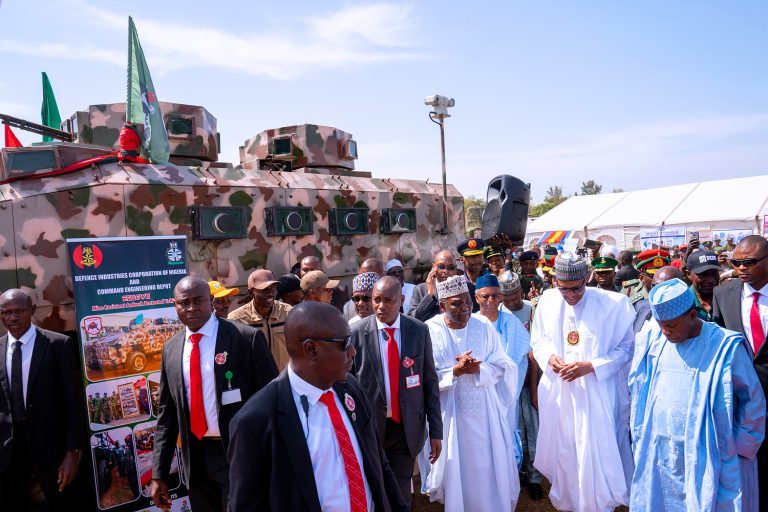
PRESIDENT Muhammadu Buhari has inaugurated a military war vehicle, made in Nigeria and an ultra-modern Army Reference Hospital in Kaduna on Tuesday.
The president commissioned them at the opening of the 2019 Chief of Army Staff Annual Conference.
The made-in-Nigeria war vehicle called, ‘Mine-Resistant Ambush-Protected vehicles’ with the vehicle code-named ‘Ezugwu’, would be used by the Nigerian Army for operations in the North-East.
The vehicle was manufactured by the Defence Industrial Corporation of Nigeria, Kaduna.
Delivering his open speech, the president commended the efforts of the Nigeria Army in tackling insecurity across the country, assuring the soldiers of their welfare and that of their families.
Buhari said his government would resolve to do everything within its constitutional power to ensure the security and safety of law-abiding citizens.
“This is a commitment we have made and will continue to keep”.
He, however, urged the Nigerian soldiers to keep to the rules of engagement and international code of conduct while carrying out their constitutional duties.
“I urge our soldiers to continue to abide by their ethics and ethos and keep to the rules of engagement and code of conduct while ensuring that human rights and international humanitarian laws are promoted and respected in the conduct of military operations,” the President said.
Buhari also commended the Chief of Army Staff, Tukur Buratai, on his thrust in the critical areas such as “the innovative and inventive approach to produce military hardware, infrastructural development, restructuring, and reorganisation, among others, with significant results”.
“This government will continue to support the army to sustain these laudable initiatives aimed at repositioning you to deal with contemporary security challenges and to achieve a modern army of the future,” Buhari said.
“Many personnel have lost their lives, some have sustained injuries and a significant number have been away from their families for a long time.
“I, once again, send my condolences to the families of those who have paid the supreme sacrifice in an effort to safeguard the sovereignty of our great nation. May their souls rest in perfect peace,” Buhari said.
NIGERIA’s Minister of Women Affairs and Social Development, Dame Pauline Tallen, according to a report, said last week that two (2) million Nigerians are raped every year, but there is no reliable public data to support or disprove this claim.
“The Federal Government on Monday launched the Sex Offenders register to tackle issues of rape in Nigeria, saying the over two million Nigerian girls and women being raped annually is unacceptable,” the Daily Trust wrote in twoseparate reports.
“Minister of Women Affairs and Social Development (FMWASD), Dame Pauline Tallen, disclosed this in Abuja while unveiling the register at the 2019 International Day for Elimination of Violence Against Women, saying there cannot be any justification for rape.”
When we asked the Director of Press at the Ministry of Women Affairs, Shehu Maikai, about the report, he said he could neither confirm whether the minister truly made the claim nor that it is true because he does not have “the statistics readily available”. He, however, promised to find out and share his discovery with The ICIR. (We will update this report once that happens.)
As far back as in 2011, Caroline Ajie, a human rights lawyer, made a similar claim by estimating that “at least 2 million Nigerian girls experience sexual abuse annually and that only 28 per cent of rape cases are reported”. It is not clear what the estimate is based on.
What is reported to the police
Latest statistics from the United Nations Office on Drugs and Crimes (UNODC) which captures the number of police-recorded offences of rape and sexual violence in various countries up till 2010 does not include figures on Nigeria. This caused Amnesty International, in its 2006 country report of Nigeria to complain that “the Federal Government does not make public any records it holds of incidents of gender-based violence in general nor of rape in particular”.
Since this period, however, the National Bureau of Statistics (NBS) has twice released a breakdown of crime statistics in the country—in 2016 and 2017.
The 2016 report does not specify how many cases of rape were reported but instead states that there were 45,554 cases of “offences against persons”. These include murder, manslaughter, infanticide, concealment of birth, rape and other physical abuse, and so on.
In 2017, the NBS went a step further by providing statistics for specific crimes. According to the statistical agency, that year, 2,279 cases of “rape and indecent assault” were recorded by police across the country.
Figures from the Nigerian Correctional Service on “prison admission by type of offence” are, however, higher. In 2013, 5,797 Nigerians were admitted for “sex offences”. In 2014, this figure dropped to 4,436. And by the second quarter of 2015, the figure was 1,621.
Records from other countries show that in South Africa, 41,583 cases of rape were recorded in 2018/19 and 52,420 cases of sexual offences generally; and at least 38,947 cases of rape were recorded in India in 2016. Each year in the United States, there are on average 433,648 victims of rape and sexual assault—the world’s highest in absolute terms.
Police reports don’t show the full picture
For various reasons, including the fear of stigmatisation, police extortion, and a lack of trust in the criminal justice system, the vast majority of sexual assault victims do not make formal reports at police stations.
In the US according to the National Crime Victimization Survey conducted by the Justice Department, out of every 1000 cases of sexual assault, only 230 (23 per cent) are reported to the police.
In the United Kingdom, official statistics on sexual violence released by the Ministry of Justice, Office for National Statistics, and Home Office revealed that only about 15 per cent of people who experience sexual assault report to the police.
A public opinion poll conducted by NOIPolls in 2019 shows that underreporting is also a problem in Nigeria. One academic study estimates that only two of 40 cases of rape (five per cent) are reported as a result of “arduous legal requirements needed to prove the cases and the associated stigma”.
Conclusion
There is no evidence supporting the claim attributed to the Women Affairs minister that up to two million Nigerians are raped or sexually assaulted every year.
Most recent statistics from the NBS state that 2,279 cases of rape and indecent assault were reported to the police in 2017. And the Nigerian Correctional Service has said 4,436 people were jailed for sex-related crimes in 2014.
Many studies have, however, established that official records are grossly inadequate in offering insights into the prevalence of sexual violence across the world.
THE Nigeria Extractive Industries Transparency Initiative (NEITI) has launched a mobile application, REMTrack, for tracking transparency and accountability issues in the oil and gas industry.
The Executive Secretary of NEITI, Waziri Adio presented the technology tool developed and deployed by OrderPaper Advocacy Initiative in conjunction with the Civil Society Steering Committee (CSSC) of NEITI in Lagos.
The NEITI boss while delivering a keynote address before the unveiling of the app, noted that the app is a major milestone in attempts to fix remediation, track issues and implement recommendations arising from his agency’s report, a statement on Tuesday disclosed.
He said REMTrack was also a major milestone for the CSSC, NEITI and Nigerians should take credit for its emergence especially those who birthed the process.
Adio said the app is a remediation tracker and is a critical part of NEITI, noting that it focuses on transparent and accountable governance of the nation’s extractive resources.
“We do 3 things; we do reporting, which is publishing the audits, we do dissemination because there is no need just publishing so if we do the audits we have to disseminate it to critical stakeholders and beyond that, we so what is known as remediation,” he said.
Adio urged Nigerians to take advantage of the app, especially as it leverages on technology to solve problems, which nonetheless is the order of the day.
He, however, cautioned against viewing remediation in money terms only and called for a focus on how to fix systematic procedural issues that keep knotty issues from reoccurring.
Kolawole Banwo, Chairman of the CSSC of NEITI, said the RemTrack tool would enhance easy engagement by all and make accurate information readily available for use at any time. He expressed fulfillment over his participation in the success of the app.
Also speaking, the representative of the Revenue Mobilisation, Allocation and Fiscal Commission (RMAFC), Babatunde Odu, expressed delight about the RemTrack app, saying it would aid the commission to effectively carry out its functions.
He said the core mandate of RMAFC is to monitor accruals into the federation account and disbursement from the same account to the three tiers of government, adding that REMTrack will
provide essential information to even ordinary Nigerians on what exactly is being generated.
Although the information would be in the oil and gas and extractive industries, it would go a long way in enhancing the operations in RMFAC, he said.
The executive director of OrderPaper Advocacy, Oke Epia, assured that the app is not designed to humiliate or deride anyone, but solely for the good of the country.
He assured the stakeholders in the oil and gas industry that the integrity and sanctity of data contained in the app have met the highest possible standards of co-creation and authorization.
“We are careful to place in the hands of citizens a verified and validated tool that promises only healthy, factual and evidence-based engagements we all will be happy about at the end of the day”.
He likened the mobile application to ConsTrack, a mobile app for civic engagements in budget and public projects tracking, stating that RemTrack app boasts of the highest standards of content verification and validation which have gone through layers of vetting across value chains.
REMTrack is a technology-for-development intervention built to organize the audit reports into user-friendly data on remediation issues, progress and outcomes of reconciliation, and the covered entities. The app is designed for android and apple devices to be used in mobile phones and other hand-held devices.
PROTECTING the health of human beings from climate change impacts is more urgent than ever, a new World Health Organisation report noted.
The new report that drew data from 101 countries, including Nigeria, and published on Tuesday noted that most countries were not implementing their national plans to help to safeguard citizens health against the effects of climate change.
Titled Health and Climate Change Survey Report, it stated that lack of prioritisation, human resource constraints, poor financing among the countries are barriers to achieve health protection.
Health is among the five sectors most often described as vulnerable to climate change. But this has not resulted in the necessary level of implementation and support, the report noted.
It also stated that nine per cent of the countries channelled resources to implement their action plan completely.
While there are international funds available for countries to fight climate change, the survey found that countries have difficulties in accessing international climate finance to protect the health of their people.
More than 50 per cent of the countries reported lack capacity in preparing proposals, over 75 per cent lack information on opportunities to access climate finance.
And over 60 per cent, a lack of connection of health actors to the climate finance processes stunt care of the health of citizens.
“Mainstreaming health in national and international climate processes could help access the necessary funds,” it noted.
Of the 101 surveyed countries, 37 countries are currently accessing international climate finance.
“It is a moral imperative that countries have the resources they need to act against climate change and safeguard health now and in the future,” said Tedros Adhanom Ghebreyesus, Director-General of the World Health Organization.
He said the price of climate change is momentarily being paid by people’s health.
The climate-sensitive health risks were identified as heat stress and injury or death from extreme weather events. Food, water and vector-borne diseases like cholera, dengue or malaria are also health risks associated with climate change.
The report surveyed 101 countries across the six regions with 13 from Africa, 27 from Americas and eight from South-East Asia Region. 20, 17 and 16 countries were selected from European, Western Pacific and Easter Meditarean Regions respectively.
As reductions in air pollution alone could save about a million lives a year,the report revealed that less than 25 per cent of countries have clear collaborations between health and the key sectors driving climate change and air pollution; transportation, electricity generation and household energy.
“The health gains that would result from cutting carbon emissions are rarely reflected in national climate commitments,” it added.
For the Paris Agreement that countries committed to in 2015 be effective to protect people’s health, Maria Neira, Climate Change and Health expert at WHO, said all levels of government need to prioritise building health system resilience to climate change.
“By systematically including health in Nationally Determined Contributions – as well as National Adaptation Plans, climate finance pledges, and other National Communications to the UNFCCC — the Paris Agreement could become the strongest international health agreement of the century,” she said.
Six-year-old Yusufa Isah shares a makeshift wooden sleeping platform with Tijani Abubakar, 13, on this isolated cattle farm, about 40 minutes’ walk from their family settlement in Osomo Village in Iseyin, Oyo State, southwest Nigeria.
The two underage boys lay on a mat half-covered with a mosquito net. There is no infrastructure or water or sanitation facility here.
“This is where he sleeps with the cows,” says a mature pastoralist who only gave his name as Mohammed. He pointed his hand at Tijani, who looked up at intervals shyly. Yusufa hid in the makeshift home as though frightened at the sight of a stranger. The three individuals share an extended family tie.
Under Nigerian laws, as well as guidelines set under the United Nations’ Sustainable Development Goals and Human Rights Commission’s Guidance Principles for Business and Human Rights, Yusufa and Tijani should be in school. Similar protocols by the International Labour Organisation and the Organisation for Economic Corporation and Development support that position.
But against relevant laws, the boys spend most of their days each week herding and milking cows, generating the key ingredient that goes into the production of dairy products.
At 5 AM each day, they begin the first task of extracting milk from cows. By 11 AM, they herd the animals to graze in the bushes and urban areas, trekking several kilometres in keeping with an outdated animal husbandry method still common in sub-Saharan Africa.
The boys return at dusk. Their ages notwithstanding, they sleep on the isolated farm apparently to ensure the security of the animals in a country where farmers and herders frequently clash over land rights and resources.
Yusufa and Tijani are not the only child workers here. Mohammed Isah, 13, also works on the cattle farm at Osomo and several others also do in other parts of Oyo State, such as Fashola, Maya, Saki, and Alaga, where FrieslandCampina WAMCO, the Nigerian subsidiary of Dutch dairy giant Royal FrieslandCampina and producers of Peak Milk and Three Crown, collects raw milk.
The United Nations Children’s Fund says 10.5 million children are out of school in Nigeria, many of them from pastoral families like those in Oyo State. The ILO deplores child labour as “a violation of fundamental human rights” and says it has been “shown to hinder children’s development.”
Regardless of these concerns, the Nigeria government is not doing nearly enough to enforce its own law on child labour or to respect global conventions that protect the rights of children.
Months-long investigation by PREMIUM TIMES that included visits to over a dozen cattle farms across Oyo State, showed child labour routinely boosts the production and perhaps profits of FrieslandCampina. Our investigation also revealed that the company failed to implement necessary due diligence that would have helped check the rampant incidence of child labour in its supply chain.
“Companies have a responsibility to ensure they are not contributing to abuses in their supply chains,” Juliane Kippenberg, associate director in charge of child’s rights division at Human Rights Watch, told PREMIUM TIMES.
NO DUE DILIGENCE
Through FrieslandCampina’s Dairy Development Programme based in Oyo, the company off-takes raw milk daily from cattle farms across the state, which employ the unpaid labour of children, our investigation revealed.
Though the children are not in direct contract with FrieslandCampina, the results of their labour are clearly linked with the operation and the products of the company.
“This type of ‘linkage’ situation will be the leading source of child labour risks,” according to the ILO and the International Organisation of Employers’ Child Labour Guidance Tool for Business, which is grounded in the United Nations Guiding Principles on Business and Human Rights, 2011.
Solar-powered borehole donated by the company. In places we visited, the facility is at the settlements, not the farms where milking takes place.
In one particularly troubling case, PREMIUM TIMES found two children of school age working as cleaners at the company’s facility at Baale, where the company donated a solar-powered borehole to the community.
The 2011 UN guiding principles on business and human rights recognise that businesses have an obligation to act with due diligence to address adverse human rights issues with which they are involved wherever they operate “regardless of states’ abilities and/or willingness to fulfill their own human rights obligations.”
Similarly, the OECD guidelines for multinational enterprises specifically, ask companies to “Contribute to the effective abolition of child labour and take immediate and effective measures to secure the prohibition and elimination of the worst forms of child labour as a matter of urgency.”
Pic: An out-of-school child labourer near Fashola in Oyo West LGA
The corporate responsibility failure by FrieslandCampina breaches Nigeria’s child rights and basic education laws. It is also potentially a crime in the company’s home country, The Netherlands, where the Child Labour Due Diligence Law obliging companies to check child labour in their supply chain home and abroad was adopted this year (though not immediately enforced).
It also runs contrary to the duties expected of businesses in the Sustainable Development Goals (SDGs).
Pic: Tijani Abubakar milking a cow
“The Netherlands is not the first country to take steps toward tackling child labour… It is encouraging to see that lawmakers in the Netherlands have joined this trend (of countries such as France, United Kingdom and Australia that have introduced legislation for due diligence on human rights and modern slavery in global supply chains),” said Ms Kippenberg of Human Rights Watch in an article, welcoming the anti-child labour law in The Netherlands, which she shared with PREMIUM TIMES. “Companies need to be held accountable for human rights conditions in their supply chain,” she added.
Children’s sweat, FrieslandCampina’s gain
In Nigeria, the Dairy Development Programme promoted as FreislandCampina’s flagship sustainability practice aims at sourcing raw milk from local pastoralists to develop the dairy sector. It is endorsed by Nigeria’s Ministry of Agriculture and Rural Development and the Dutch Foreign Affairs ministry. Starting in 2011 with a collection facility at Baale Village, near Fashola in Oyo West LGA, the company now has more facilities at Saki, Maya and Alaga with a bulking centre in Iseyin.
Pic: One of the child-cleaners seen at FrieslandCampina’s facility at Baale, near Fashola in Oyo.
The company has made a pioneering effort in helping develop the dairy sector in Nigeria, where pastoralism mostly focuses on beef. It says its intervention has resulted in about 3,000 crossbred dairy cows across Oyo State and it is extending its local sourcing facilities to Niger State, central Nigeria.
The supply chain, however, involves the extraction of milk from cows done by children, PREMIUM TIMES can report.
When PREMIUM TIMES met Sanusi at his cattle farm at Igbokeke Village in Oyo West LGA in October, his two children had just finished extracting milk from the cows for the day. One of those boys was Yunusa, 10-year-old boy.
13-year old Mohammed Isah with the milk he’s extracted at Osomo ahead of collection by FrieslandCampina
“If you want to see how milk is extracted, you come very early in the morning,” said Mr Sanus, who migrated from Niger State in central Nigeria. He said Yunusa had to do the work “compulsorily”.
He answered in the negative when asked if the children working with him were receiving an education. He also said their labour was unpaid.
Mr Sanusi and 10-year old Yunusa, with the latter’s hovel, at Igbokeke. Yunusa and another boy on the farm milk and her cows
Between the pastoralists and the company in the supply chain, there are motorcycle riders enlisted to go take the raw milk from farms to the collection facilities. These are adults who are able to scrape together some money.
At 6 AM, the riders have to go to the farms to collect the milk using 10-litre or 20-litre jugs tied to their bikes. At about 8 AM, paths that link villages that surround the milk collection centres are busy with the riders.
A FrieslandCampina’s rider at Olonje Village
They buy a litre of raw milk extracted by children from the pastoralists for N80 ($0.22) or N100 ($0.28) depending on the distance.
“For farms not far from a collection point, we pay N100 for a litre but N80 where the farms are far away,” explained Umar Hammed, a rider, who described how under-15 children extract milk on the farms at Olonje and Alaruba Villages of Oyo West Local Government Area where he sources for FrieslandCampaina.
Each rider is paid N120 ($0.33) per litre of milk by the company. So, the riders are able to keep for themselves N20 ($0.055) or N40 (0.11) on each litre depending on the location of the farms. A rider may be able to collect up to 50 litres from different farms a day but each farm scarcely extracts up to 20 litres a day.
FrieslandCampina realised N123 billion in 2016 from sales of its dairy products in Nigeria, according to the company’s financial report for that year. Part of that revenue may have come off child labour.
A company’s truck
As of April 2019, the company already collected 789.5 thousand litres of raw milk in Oyo State, a presentation the company shared with this newspaper showed. An emailed request for the contribution of the local collection to the country’s overall raw material was not granted.
A secretary of the pastoralists in Iseyin, Husseini Tijani, said Iseyin alone supplies 5,000 litres daily; and in June 2017 during the opening of its Saki collection centre, the company said its daily collection from local dairy farmers through the DDP was already 40,000 litres.
The FrieslandCampina milk bulking centre in Iseyin
The pastoralists and their farms are formally known to FrieslandCampina, which has tried to organise them into cooperatives and for training programmes. But concerns remain about child labour, said Mr Tijani.
Somehow, in the company’s ISO 26000 declaration, it lists education, as well as culture, as a low priority in its corporate social responsibility policy. (ISO 26000 provides guidance on how businesses and organisations can operate in a socially responsible way and it is also grounded in the UNGPs on Business and Human Rights).
“But that should not be seen from face value,” the company’s Corporate Social Responsibility Manager, Ojeawe Ajulo, told PREMIUM TIMES at the company’s Lagos office. He said he company prioritised education although there were other items it considered more important. “Human rights which we state as high priority cover everything.”
In the company’s ISO 26000 self-declaration, it lists suppliers, such as farmers, among its stakeholders. The company now has 7000 farmers – apart from modern “smallholder” farmers, like Moyosore Rafiu of Iseyin-based Genius Farm, supported by the company – its officials said.
The company’s rider, Mr Hammed, said the company did not tell him and his colleagues not to collect milk extracted by children. He, and another rider, Abdullah Agbona, said separately children “up to 15 years” and “up to 12 years” were milking cows at the farms, including Alaruba, Olonje, Latula, Olodo and Galadinma, among others where they source from for FrieslandCampina.
Child labour worst in Africa
Mr Hammed, a company’s rider, said the company did not tell him and his colleagues not to collect milk extracted by children. He, and another rider, Abdullah Agbona, said separately children “up to 15 years” and “up to 12 years” were milking cows at the farms where they source from for FrieslandCampina.
While Nigeria’s child rights law permits children to help parents do light work in agriculture or horticulture, it categorically prohibits any engagement of children for any purpose that deprives them of the opportunity to attend and remain in school.
Similarly, the universal basic education law provides that children of primary and junior secondary school or between the age of six and 16, like Yusufa and Tijani, must access compulsory and free basic education.
Pic: A child working poses before the camera on a cattle farm near Fashola in Oyo West LGA
According to the current Global Estimates on Child Labour published by the ILO under the 8.7 Alliance in 2017, there are 152 million children in child labour globally, accounting for almost one in ten children of 5-17 years worldwide. Target 8.7 of the SDGs specifically calls on the global community to end child labour by 2025 in all its forms.
The report says that child labour is most prevalent in Africa. “Africa ranks highest both in the percentage of children in child labour – one-fifth – and the absolute number of children in child labour – 72 million,” it says.
The report says progress against child labour “appears to have stalled” in Africa, where 85 per cent (61.4 million) of children affected are reported to be in the agriculture sector, including livestock herding of the sort practised in Nigeria’s cattle farm at Osomo Village that supplies FrieslandCampina.
Source: Global Estimates of Child Labour, 2012-2016, ILO.
According to UNICEF, citing ILO, “the number of working children under the age of 14 in Nigeria is estimated at 15 million. The major causes of child labour, according to UNICEF, are widespread poverty, rapid urbanisation, breakdown in extended family affiliations, high school dropout rates, and lack of enforcement of legal instruments meant to protect children.
What the organisation does not list, however, is the failure of downstream businesses that depend on primary producers in agriculture or animal husbandry, to act with due diligence and leverage their position of power in the supply chain to address child labour incidence.
Source: Global Estimates of Child Labour, 2012-2016, ILO
A development expert, Seun Kolade, from De Montfort University’s Leicester Castle Business School in the United Kingdom, told PREMIUM TIMES that such businesses are in a position of power and responsibility to address child labour incidence, “because they play a key role in the value chain.”
Mr. Kolade, who has publications on education, pastoralism and business in Nigeria, added: “The primary sector relies heavily on the downstream businesses for their income, so those downstream businesses cannot abdicate responsibility. Nor should they escape sanction.
“Nevertheless, it is a shared responsibility. The responsibility of the downstream businesses does not substitute for the responsibility of the primary sector to ensure they refrain from child labour.”
Company promises probe
PREMIUM TIMES made its findings known to FrieslandCampina.
“No child labour is going on,” said a company’s PR consultant, Kunle Hamilton. Mr Hamilton insisted this newspaper had no evidence and had not been to the farms.
When provided with more details of our investigation, he said, “Some of the things you have alleged, I don’t see myself but we are doing something that will improve society at large.”
He added that all the training programmes had been for “adults, men, and women.” This is true. Nevertheless, the actual milking of the cows for supply to the company is routinely by children, who do not attend school.
Later in an email response, Mr Hamilton said, “FrieslandCampina WAMCO is a responsible corporate citizen that works as preferred partners of the Federal Ministry of Agriculture and Rural Development in improving Nigeria’s dairy sector and the lives of dairy farmers and their families.
“We are not aware of your allegation. We continue to do everything we can to improve life and living in communities under our Dairy Development Programme.”
In a letter on Saturday, the company’s Executive Director of Corporate Affairs, Ore Famurewa, said the company “is committed to preventing and eliminating child labour in its supply chain and working with stakeholders and working with stakeholders to develop and implement meaningful solutions, in line with the UN Guiding Principles for Business and Human Rights and with the OECD Guidelines for Multinational Enterprises.”
Ms Famurewa continued, “FrieslandCampina WAMCO is glad that this concern has been brought to our attention as this gives us a chance to investigate the situation and, if necessary, to work towards providing remediation for the person(s) affected.”
She said the company “will work with an international NGO to conduct an independent investigation into these incidents and look for a meaningful response.” The findings of the said NGO’s investigation, she said, would be shared “directly with you by the international NGO.” She did not disclose the name of the NGO or when it is to start the investigation.
The Dutch ministry of foreign affairs, which supports the company’s operation in Oyo State, Nigeria, was reached by phone for comment. A respondent said she could not comment and requested an email via the ministry’s contact form on its website, which we did as advised. A reply last Tuesday indicated “no enough information to answer your question” and a further transfer to a more suitable authority to comment.
The Second Secretary at the country’s embassy in Abuja, Chelsey Buurman, told PREMIUM TIMES by phone, last Thursday, that the government was investigating the child labour incidence and would share findings in “two weeks”. “We aim to share a response soonest,” she added in a followup email.
“Our children need education”
Although basic education is officially free and compulsory, 10.5 million children Nigerian children aged 5-14 years are not in school, says UNICEF. Only 61 per cent of 6-11 year-olds regularly attend primary school and only 35.6 per cent of children aged 36-59 months receive early childhood education, it added.
There are no definitive statistics regarding the contribution of the pastoral children to the out-of-school incidence, but some believe that anti-school sentiment is culturally deep among the group.
“It is not easy to change them,” said a senior official of FrieslandCampina who called following our email and requested anonymity because he was not authorised to speak to the press on the matter. “We are just trying to change their culture and settle them and it is not what will happen overnight.”
Mr. Tijani, the secretary for the Osomo-Iseyin pastoralists supplying FrieslandCampina, told PREMIUM TIMES the pastoralists are attitudinally ill-disposed to education.
“They fear their children may be jobless and not return to raise animals,” he said. “So, having their children to raise the cattle is a way of ensuring they have a job.”
However, Mr Tijani said some “pastoralists now don’t want their children to do like they are practising. They know the land available is shrinking because of new houses and animals will not move freely. So, they want a better way of practising (pastoralism).”
He said FrieslandCampina could help incentivise positive attitude towards education among the pastoralists by making no-child labour a condition for collecting milk from farmers.
“Since they (FrieslandCampina) collect milk from the Fulani (pastoralists), they should encourage us so that our children will go to school and become like their officials later,” he said. “If the company says to buy milk from farmers, the farmers should not use children to get milk or that they enrol their children in school, there will be change because the farmers want to continue selling their milk.”
Mr Tijani said the firm does not pay “thorough” attention to the concern about child labour and education raised by some of the pastoralists.
“This issue of education has been raised many times but there is no any change from them (the company),” he said. “They have to take thorough action on it.”
State’s failure
Nigeria’s federal and state governments have shown little capacity to enforce the country’s laws against child labour.
The Section 30 (2)(D) of the country’s Child Rights Act provides that a child shall not be used for “any purpose that deprives the child of the opportunity to attend or remain in school as provided for under the Compulsory, Free Universal Basic Education Act.”
The spokesperson for Oyo State, Wasiu Olatunbosun, did not comment for this report when reached by phone.
A government spokesperson, Ikemefuna Ezeaja, from the ministry of agriculture and rural development, said he could not comment when reached by phone last week. A followup call and a text message were not answered.
Due to the impacts of corruption and weak institutions as well as poor work ethics, the capacity of the state to penetrate the society and implement laws and policies is eroded. Consequently, despite having laws in place that make basic education free and compulsory, prohibit child labour and even specifically provide for nomadic schools for itinerant pastoral families – and funds for these purposes – Nigeria’s incidence of child labour, as well as children out of school, is one of the worst in the world.
For instance, two state-funded schools at Igbokeke and Baale villages, visited on different days during our investigation, had no teacher on duty at about 9-10 AM and on Fridays, the villagers at Igbokeke said, the teachers would not come at all. Supervisory officials at the Local Government education inspectorate are aware of the teachers’ dereliction of duty in the rural communities but are not enforcing duty standards, one official said.
So, in a developing country like Nigeria where state authourities are barely effective in delivering their own responsibilities and holding multinationals to be socially responsible, children are particularly vulnerable to abuses.
However, the UNGPs for Business and Human Rights say that “The responsibility to respect human rights is a global standard of expected conduct for all business enterprises wherever they operate. It exists independently of States’ abilities and/or willingness to fulfil their own human rights obligations and does not diminish those obligations.”
Solution: “Carry out due diligence checks on all suppliers…”
The development expert, Mr Kolade, said progress against child labour can be made if businesses like FrieslandCampina and others that depend on the primary sector are more socially responsible and act with due diligence to check abuses in their supply chain, Mr Kolade suggested.
“Multinational corporations should be made to sign an agreement – preferably legally binding ones – that commits them to carry out due diligence checks on all their suppliers to ensure that their suppliers abide by relevant national legislation and international laws against child labour,” he said.
“The MNCs should be compelled to publish the names of their suppliers, making them publically available. This is the most effective way to facilitate public scrutiny, ensuring that the companies abide by their commitments in tangible and measurable ways.
“There should be a regular audit – may be annual – of companies with regard to their commitment to child labour legislation. This audit should be publicly available on companies’ websites. This ensures that the public is co-opted as monitors of compliance. Good in the context of developing countries where institutions are weak and still evolving and very much vulnerable to elite capture and official corruption,” he said.
In the end, minors like Yusufa, Tijani, Mohammed and Yunusa do not have to work in hazardous conditions if the primary producers are able to hire adults and adopt decent work instead, Mr Kolade added. But apart from insisting on decent labour standards, this may depend on the pricing of milk by the downstream businesses, like FrieslandCampina, and – in the context of Nigeria’s pastoral group that is long educationally-disadvantaged and conservative – the role of government and development partners in the process.
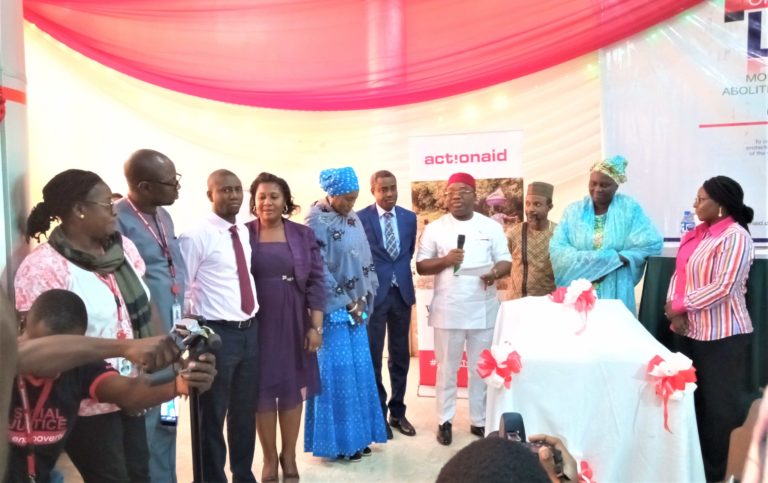
A NON-GOVERNMENTAL organisation that promotes human rights and tackles poverty, ActionAid Nigeria, AAN, has launched a project to bring an end to the killing of newborn babies, especially twins, in the Federal Capital Territory.
Though it was kicked off in January, the project, titled Mobilising Actions Towards the Abolition of Infanticide (MATAI), was formally unveiled at an event that took place in Abuja on Tuesday. It is funded both by the European Union and AAN.
The event also featured the signing of a Memorandum of Understanding between ActionAid and the National Human Rights Commission (NHRC).
Ene Obi, AAN’s country director, said in her welcome remarks that it is sad twins and children who are generally products of multiple births are still being killed in communities all over Nigeria. She explained that the project is a collaboration between AAN, the NHRC, and Vine Heritage Homes, which caters for over 150 children in Abuja who were in danger of being killed due to cultural practices.
“ActionAid does not believe we need to work alone. By working together with many stakeholders, you can achieve more,” she said.
According to her, AAN has been working with the National Human Rights Commission, traditional rulers, area councils, and the communities.
“ActionAid is working in this area, but we are not government. We can only support the work that government is doing. When we find people with this kind of vulnerability, we go there.”
The country director said though the project has a limited lifespan, AAN hopes to continue supporting the activities of VHH beyond that period.
Giving an overview of MATAI, the NGO’s Programme Advisor, Ubong Tommy, said over a period of 36 months, it is intended to cover 57 communities from five area councils in the FCT, including AMAC, Abaji, Gwagwalada, Kuje, and Kwali.
“One of the specific objectives of the project is to ensure the implementation and monitoring of existing legal and policy frameworks that address infanticide practises in the FCT,” he said.
Others are to raise awareness in the FCT on infanticide practices, especially among practising communities and to establish mechanisms to safeguard unborn babies and infants who are vulnerable.
Through the initiatives, AAN will be reaching out to community leaders, birth attendants, caregivers, media organisations, as well as various government establishments such as the National Assembly, FCT Social Development Secretariat, Child Rights Implementation Committees, and National Population Commission.
Already, the organisation said it has trained 75 traditional birth attendants across various communities using the Community Health Influencers, Promoters and Services (CHIPS) manual of the National Primary Health Care Development Agency (NPHCDA).
It has conducted a baseline survey and has also acquired a piece of land for VHH so that it may build a school and dormitory.
While delivering his goodwill message, the Executive Secretary of NHRC, Tony Ojukwu, said the killing of infants is largely due to illiteracy and the lack of formal education.
“For us in human rights, infanticide is a practice against natural justice, equity, and good conscience and hence not one that should be encouraged by any reasonable mind in modern society,” he said.
He added: “It is cruel, inhuman, and degrading treatment against children. It also constitutes violence and harmful practice against children considering the provisions of the Child Rights Act 2003.
“The National Human Rights Commission and Action Aid Nigeria are poised to combat the ugly practices through sensitisation campaigns and a commitment towards eradicating infanticide wherever it is found.”