Home Blog Page 2285

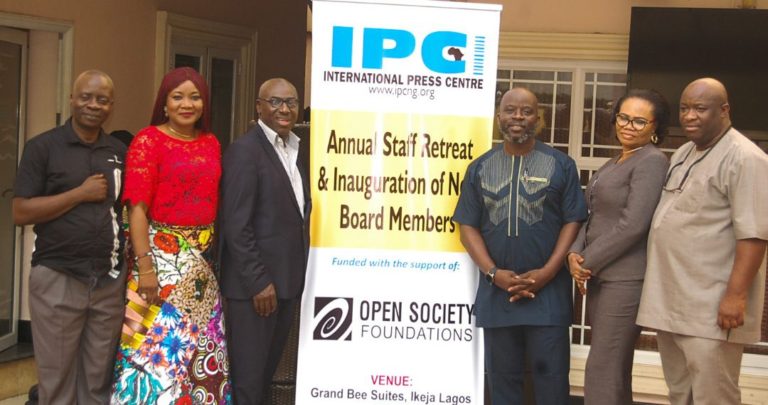
IPC at 20: Ogunleye, Durodola, Ibanga join governing board

0

AS the organisation prepares to mark the 20th anniversary of its establishment in October, 1999, The International Press Centre (IPC), Lagos-Nigeria, has announced the reconstitution of its Governing Board.

The Executive Director and Secretary to the Board, Mr. Lanre Arogundade, disclosed this at the end of the organisation’s board meeting and annual staff/management retreat held  in Lagos on September 20 and 21.

He said the three new members of the Board bring its total number to six.

The three new members are:

Ms. Victoria Ibanga, a seasoned journalist, is a former Visiting Fellow of Freedom House in the United States and Alumna of Women’s Edition, PRB, USA. She is a former General Secretary of the Nigerian Guild of Editors, current National Treasurer of the body and the Managing Director and Editor-in-Chief of Next Edition Online newspaper;

Mrs. Funke-Treasure Durodola, a multiple award-winning international broadcast journalist, is a seasoned news anchor, producer and presenter, media trainer and Fellow of the Thomson Foundation, UK. She is the author of ‘Pronunciation Guide for Second Language Speakers of the English Language’ and until her recent retirement, Assistant Director of Programmes at the Federal Radio Corporation of Nigeria (FRCN), Lagos Operations;

Mr. Gbemiga Ogunleye, a lawyer, seasoned journalist and Editor. He is a former Editor and Deputy Editor-In-Chief of Punch Newspapers and a former Director of News and Current Affairs at Television Continental, TVC. He was the pioneer Head of Corporate Communications of Arik Air and a former Vice President of the Nigerian Guild of Editors. Mr. Ogunleye is the current Provost of the Nigerian Institute of Journalism (NIJ), Nigeria’s leading journalism training institution.

According to him, both Mr. Edetaen Ojo and Mr. Wale Adeoye retain their positions on the Board as Chairman and member respectively, while Senator. Babafemi Ojudu, journalist, human rights activist and one of the founding Editors of The News Magazine and Special Assistant to the President on Political Affairs, voluntarily stepped down as a member on the account of his current political engagements.

Mr. Edetaen Ojo, a journalist and former editor Judiciary Desk at The Guardian newspapers, is a renowned advocate for the right of access to information. He was honoured by the African Platform on Access to Information (APAI) with an award for freedom of information activism in 2011 while in 2017 he got the Lifetime Award for Journalistic Excellence of the Wole Soyinka Centre for Investigative Journalism. He is the Executive Director of Media Rights Agenda and Chair of the Board of the Media Foundation for West Africa of which IPC is national partner in Nigeria.

Mr. Wale Adeoye, an environmental rights activist, is an award-winning journalist who has previously worked with The Punch and The Nation Newspapers. He is a four-time winner of the Nigerian Merit Award (NMMA), first Nigerian to win the Steve Biko Scholarship instituted by Institute for Advanced Journalism (IAJ), South Africa and Alumni of the United Nations Institute for Research and Training, (UNITAR), Cologne Switzerland. A former CNN African Journalist of the year and winner of the Diamond Media Merit Award, he is the Executive Director of Journalists for Democratic Rights.

Mr. Lanre Arogundade, the founding Coordinator of IPC and newly designated Executive Director by the Board, has worked across the print, broadcast (Radio) and Online media including the National Concord, Vanguard newspapers, Panos Radio and Voice of America as a journalist. A media development specialist with passion for media professionalism and independence, he is also a media trainer, researcher, advocate for freedom of the press and author of ‘Media and Elections: The Professional Responsibilities of Journalists’.

“The scholarly, intellectual, professional and gender diversity of the new Board demonstrates the commitment and readiness of IPC to continue to deliver on its mandate as Nigeria’s leading media development and press freedom organisation,” Mr. Arogundade said.

“We are also sure that given their vast experience and commitment to media professionalism, the board members will add value to our work in the areas of capacity building, media monitoring, campaigns, advocacy, networking and partnerships to advance the course of media freedom, media independence, safety of journalists and enhance the role of the media in development and democratic governance”, he added.

According to him, the board members would be publicly presented during the forthcoming public lecture and airing of a documentary as part of a series of activities to commemorate the 20-year anniversary of IPC, the details of which will be announced soon.

Minimum Wage: NLC Dismisses rumoured N30,000 payment implementation

0

THE NIGERIA Labour Congress (NLC) has dismissed rumours that the Federal Government has begun payment of N30, 000 minimum wages.

According to the nation online, the Federal Government has started the payment of N30,000 minimum wage with officers on grade levels 01 to 06 on the federal payroll and they were paid the new minimum wage as their August salary.

Nigeria Labour Congress Head of Information, Benson Upah confirmed to The ICIR that he is unaware of the development.

He said there is no way the Federal Government will pay some tier of workers and not pay others and that he is never aware of the development.

Nigeria Civil Service Union Ag. General Secretary, Yahaya Idris Ndako also told  The ICIR that he knows nothing about the rumoured payment.

There have been unsuccessful meetings between the Federal Government and the Joint National Public Service Negotiating Council because of differences in percentage increase in the salaries of workers which made the Head of the Civil Service of the Federation, Winifred Oyo-Ita describe the NLC’s demand as “unrealistic”.

Joint National Public Service Negotiating Council,  General Secretary, Alade Lawal, told the News Agency of Nigeria (NAN) after meeting on Monday, September 16, that the organised labour would decide on the next line of action towards the issue of the minimum wage, saying in due time, Nigerians would be informed.

He said the meeting ended in a deadlock and that the “Federal Government officials are not serious about it at all”, saying that they suspect a hidden agenda somewhere.

NAN subsequently reported that that the organised labour had on September 12 issued a 14-day ultimatum that would expire on September 25 to the Federal Government for the Tripartite Committee on the National Minimum Wage to reconvene and complete its assignment.

Nigeria closes in on $88 million oil deal with CPDC, to rake in more from royalties and taxes

0

THE Nigerian National Petroleum Corporation (NNPC) sealed an oil deal worth $875.75 million with CMES-OMS Petroleum Development Company (CPDC), to provide alternative funding for its subsidiary firm the Nigerian Petroleum Development Company (NPDC), which operates Oil Mining Lease, OML 65.

This development was announced by NNPC’s spokesperson, Ndu Ughamadu on Sunday when the corporation finalised the contractual arrangements in Dubai, United Arab Emirates, ensuring CMES-OMS Petroleum Development Company would provide funding and technical services to the NPDC.

It is anticipated that the project would generate over $6.35 billion in taxes and royalties to Nigeria.

NNPC’s Chief Financial Officer, Umar Ajiya, also disclosed that the project’s scope cuts across exploration, development, production and provision of facilities with incremental first oil targeted at the fourth quarter of 2020.

Ajiya said the oil target had potential reserves of 800 million barrels of oil equivalent with a recoverable reserve of 244 million barrels of oil equivalent, mmboe, and cumulative production of 44mmboe from the Abura Main and Abura SE fields.

He described the contractor’s financing model as an innovative approach by the NPDC to funding its operations in response to the challenging economic environment to fast track development of the NPDCs underdeveloped assets.

The project is expected to ramp up production at OML 65 from 900 barrels per day to 60,000 barrels per day with average production over a field life at 40,000 barrels per day.

Speaking on the financing strategy, the CFO explained that the package required a comprehensive financing solution that would address the complex issues involved in growing the NPDC’s production.

He maintained that the expectation was that the collaboration between the NPDC and the CPDC would translate in real terms to the efficient execution of the scope of activities for the optimal development of the OML 65 asset within cost and schedule while maximizing value to all the stakeholders.

“The collaboration would enhance operational and financial performance strictly guided by the pre-agreed Key Performance Indicators which was critical for determining incentive payment due to the CPDC,” he said.

Analysis: Despite forex restriction on milk importation, Nigeria’s apex bank still fund dairy imports

0

PUBLIC outcry and criticism greeted the supposed ban of the importation of dairies in Nigeria by the Central Bank of Nigeria in July, and the apex bank speedily debunked the news clarifying it did not stop the importation of milk in the country but only restricted the sale of forex for its importation from the Nigerian foreign exchange market.

The bank claimed that the ban on forex is another strategy towards the actualisation of national food security while ensuring forex savings, job creation and investments in the local production of milk.

Noteworthy, Nigeria relies on imports for most of what its estimated 198 million population consumes.

Currently, data from the Food and Agriculture Organisation revealed that cattle milk production in the country amounts to 585 000 tonnes of milk per year, which covers 40 per cent of the milk population demand while 60 per cent of the milk consumed is imported to satisfy the demand of about 1.3 billion tonnes of milk required annually.

According to the CBN governor, Godwin Emefiele, Nigeria spends up to $1.2 billion to $1.5 billion annually on the importation of milk alone —the amount calculable based on the amount of forex the apex bank offers milk importers.

Although, the CBN has clarified that it has no power to declare an absolute ban on milk imports, the current denial of forex to importers by the apex bank has not only caused the price of this commodity to rise in the market but have also facilitated the continuous importation of milk.

How CBN still sponsors milk Importation

On the directive of the CBN, the Deposit Money Banks running the interface between importers and the Nigeria Stock Exchange do not furnish the dealers with forex required for importation of dairy products. This means that the cost of milk imports would for dealers increase, unlike what is obtainable in the past when they can approach the DMB’s for forex.

Consequently, this service which was initially the sole preserve of the CBN could now be rendered by Bureau d’ Change agencies.

One dollar is traded at the price of N306 by the CBN. While  BDC who is funded by the CBN sells at N360 per dollar– parallel market price.

At this market price, importers hence would have no other option but to consequently hike the price of milk or dairy products in the market to cover their cost.

Therefore, although the CBN set out to ban the forex, it indirectly is still enabling the importation of milk by making forex available to milk importers through BDC at a higher cost.

The only difference is the channel of forex accessibility for milk importers which would lead to obvious increase in the market price of milk.

Whose side is the ban on?

In 2016, the Federal Government of Nigeria approved the Fiscal Policy approved the implementation of the Supplementary Protection Measures and the Economic Commission of West African States (ECOWAS), Common External Tariff.

One major attribute of this move was to initiate a reduction of import duty tariff on milk imports initially at 10 per cent to five per cent.

Although the demand for dairy products is expected to rise considering Nigeria’s population growth, particularly among children and young people according to Euromonitor International, an independent global market research company that provides strategic research services for the consumer markets.

However, Nigeria having a huge human resources of over 190 million persons of which almost half the entire population–46 per cent are currently under the age of 15, overtook India in 2018 to become the poverty capital of the world with 87 million– having over 23 million children–living below the poverty line of $1 and 90 cents per day.

With the low tariff and the restriction of forex on the importation of milk, importers who are able to source forex for their business through the BDC would still be able to import milk at a low tariff rate and sell at a high market price in Nigeria.

This implies that low-income earners or those below the poverty line- over 91 million persons– would be saddled with the burden of paying higher to purchase milk.

Kyari, Daura, others in Buhari’s kitchen cabinet have two things in common: journalism, UK education

0

PROFILES of President Muhammadu Buhari’s kitchen cabinet members show not only that they all graduated from prestigious universities in the United Kingdom but they also have a substantial background in journalism.

This was pointed out on Sunday by Martins Oloja, editorial board member and former editor at the Guardian newspaper, in an opinion article. The institutions attended by the president’s men include the University of Cambridge in England, University of Dublin in Ireland, Manchester University, and University of Sussex.

Oloja had argued in the first part of the article published on September 15 that surrounding himself with an experienced and well-educated “cabal” enabled Buhari to take “control of the three arms of government with his men from his region and religion”.

These kitchen cabinet members include Chief of Staff Abba Kyari, Alhaji Mamman Daura, Alhaji Ismaila Funtua, and Alhaji Babagana Kingibe. According to Oloja, they are “some of the brightest men he [Buhari] can trust from his region” and a wrong understanding of them has also led many into underrating Buhari himself.

“Only some members of the aristocracy of the Nigerian mass media may know that there is sense in which one can claim that the best profession in the world, journalism actually brought together this triumvirate of powerful men behind the president (Daura, Ismaila and Kingibe),” the columnist wrote on Sunday.

“In other words, these are not ordinary men. They are very educated. They are very British (they were all educated in ‘Great Britain’). They all understand the history of their relationship with the very British colonial masters who taught them to understand the peculiarities that define our complex diversity.”

As curated by Oloja, below are their profiles:

Abba Kyari

Abba Kyari, Chief of Staff to President Muhammadu Buhari was appointed to the position on 27 August 2015. He holds a Bachelor of Arts Degree in Sociology from the University of Warwick, England in 1980. He also possesses a Bachelor of Law from the University of Cambridge, England and was called to the Nigerian Bar after attending the Nigerian Law School l in 1983.

In 1984, he returned to the United Kingdom, where he obtained a Master’s degree in Law from the University of Cambridge. He later attended the International Institute for Management Development at Lausanne, Switzerland and participated in the Program for Management Development at the Harvard Business School in 1992 and 1994.

Abba Kyari worked for the law firm Fani-Kayode and Sowemimo for some time after his return to Nigeria. From 1988 to 1990, he was Editor with the New Africa Holdings Limited Kaduna, which published the defunct The Democrat based in Kaduna. In 1990 he served as Commissioner for Forestry and Animal Resources in Borno State. From 1990 to 1995, Kyari was Secretary to the Board of the then African International Bank Limited (Mamman Daura was Chairman). Kyari later rose to be Executive Director, Management Services, United Bank for Africa Plc. (UBA) and was later appointed Managing Director and Chief Executive of the Bank. He was appointed a Director of Unilever Nigeria Plc. in 2002 and is a Director of Exxon Mobil Nigeria. He is a recipient of the Nigerian Honor Award of Officer of the Order of the Niger (O.O.N).

Mamman Daura

Alhaji Duara, always introduced in any document as a Nigerian journalist and businessman who was once Editor of the once-influential New Nigerian (newspaper) as a graduate of an Irish University. Daura finished secondary education at Okene Provincial School in 1956. He worked with the Daura Native Authority for a couple of years before joining the Nigerian Broadcasting Corporation as a Programme Assistant. From 1962 to 1968, he studied Economics and Public administration at Trinity College, Dublin, of the University of Dublin, Ireland.

In 1968, Adamu Ciroma, Editor of the New Nigerian was looking to recruit qualified and educated northern Nigerians for the newspaper. One of those recruits was Daura who had completed his degree in Dublin. Daura was hesitant to take the position when he returned to Nigeria but instead worked in the office of Abba Kyari, the then military governor of North Central State. In April 1969, he finally joined the staff of New Nigerian as the newspaper’s new Editor. The first two years of his stewardship was a focus on coverage of issues affecting Northerners and protection of northern interests. Daura later became the Managing Director of newspaper’s holding company. When General Murtala Mohammed’s military administration opted to take over the ownership of the newspaper, Daura left the company.

He was a board member of BCCI’s Nigerian affiliate, Africa International Bank and founded a furniture factory in Kaduna. He was also a chairman of the now-defunct Nigerian Bank of Commerce and Industry.

Ismaila Isa Funtua 

He trained as an administrative officer at the Institute of Administration, Ahmadu Bello University (ABU) Zaria. The Katsina-born publisher and businessman thereafter proceeded to the Manchester University in the UK. He was the Monitor General of the Course 9 of the prestigious National Institute of Policy and Strategic Studies (NIPS), Kuru. Funtua served the Katsina Native Authority for seven years as Administrative Officer. He later served in various ministries in the defunct Northern Region before secondment by the Northern Region government as the Personnel Manager of the 10,500 strong United Nigerian Textile Company, Kaduna. From there he became a successful entrepreneur.

Funtua is the founder of Bulet International Nigeria Limited (one of the largest wholly-owned indigenous construction companies), which built some of the iconic public buildings in Abuja. He is the founding Managing Director of the New Africa Holdings (publishers of the defunct The Democrat (newspapers) Abba Kyari once edited. Funtua was elected Vice President to the late MKO Abiola as President of the Newspaper Proprietors Association of Nigeria (NPAN). He later became the President of the NPAN. Funtua, the youngest Minister (Water Resources) in the Shagari administration, is a life patron of the NPAN. He is still the Chairman of the Governing Council of the Nigerian Institute of Journalism (NIJ) in Lagos.

Babagana Kingibe 

Kingibe, born in 1945 has held many high-level governmental posts. He hails from Borno State in the northeastern part of Nigeria, and is of Kanuri extraction. In 1960, he travelled to London to complete his O-and A-levels at Bishop Stortford College, on a Borno Native Authority sponsored scholarship scheme. He took up further studies earning a Bachelor of Arts degree in International Relations at the University of Sussex, UK, where he was a mate with Thabo Mbeki. He actually began a doctorate programme in Switzerland but left abruptly, returned to Nigeria and started work as a Research and Planning Officer at Ahmadu Bello University, Zaria. But he soon left A.B.U for a career in journalism and he was the Head of Features and Current Affairs at the Broadcasting Corporation of Northern Nigeria (BCNN).

In 1972, he joined the Nigerian Foreign Service where he started work as a senior counsellor and later became the head of the political desk at the Nigerian High Commission in London. During the Obasanjo administration in the late 1970s, Kingibe worked in the Political Affairs Department as Principal Secretary and was involved in the government’s return to civil rule programme, states creation and boundary adjustment, local government reforms and the constitutional drafting committee. In 1981, at age 36, he was appointed the Nigerian Ambassador to Greece and later the country’s representative in Pakistan. The former Special Services Senior Officer was vice presidential candidate to M.K.O Abiola in the June 12 1993 Presidential Election military president, General Ibrahim Badamasi Babangida annulled.

Elite naivety

The former Guardian newspaper editor concluded that many Nigerians keep saying President Buhari is “clueless and uneducated”, forgetting the rich background and experience of those he surrounds himself with.

He wrote: “We will continue the conversation on the ‘elite naivety’ and lack of understanding of most of our very educated people who continue to underrate the powers behind the throne of Buhari. In the main, I think the First Lady’s consistency in the way she classifies the Cabal is a decoy and a distraction because she knows too well that we are naïve. What journalism has put together in the Big Four, who can put asunder?”

Aisha had in December 2018 alleged that a powerful group of two to three people are dominating affairs of government.

“Our votes were 15.4 million in the last elections and after that only for us to be dominated by two people… this is totally unacceptable,” she said.

“If 15.4 million people can bring in a government and only for the government to be dominated by two people or three people, where are the men of Nigeria? Where are the Nigerian men? What are you doing? Instead of them to come together and fight them, they keep visiting them one after the other licking their shoes (I’m sorry to use those words).”

She made similar statements during an interview with BBC Hausa in October 2016, where she said her husband’s government had been hijacked by a “few people”.

Army arrest 5 key terrorist suppliers, fighters

0

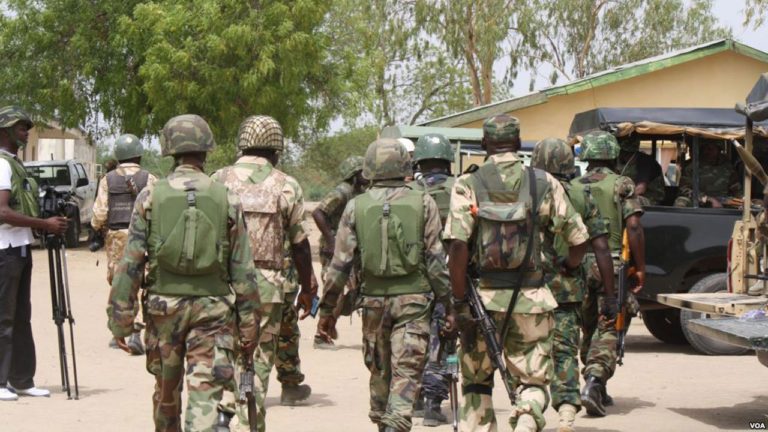
THE NIGERIAN Army Troop of Theatre Command Operation LAFIYA DOLE has apprehended five key terrorist suppliers and fighters on Sunday following the commencement of “Operation Positive Identification” across Northeastern Nigeria.

In a release made available on Monday by the Deputy Director Army Public Relations OPLD, Ami Ida, a Colonel of the Nigerian Army, he stated that the Nigerian Army commenced thorough searching and seizure of all suspected criminal elements across the Northeastern part of the country.

The Chief of Army Staff, Buratai Tukur, on September 16 appointed new commandants to head operations in the Army Theatre Command Operations in Northeast.

He mentioned that the “Operation Positive Identification” is a follow-up of the reports that escaping criminals are hiding in some towns and villages in Northeast particularly Borno and Yobe states.

Over a year ago, the troops of the 159 Battalion arrested 2 Boko Haram suppliers while filling their Jerry cans at a gas station owned by a member of the Yobe State House of Assembly.

Ida in his statement enjoined members of the public passing through Adamawa, Borno and Yobe States to ensure they carry valid means of Identification as troops have been directed to strictly check for legitimate means of Identification such as National Identification Card, Voter’s registration card, Driver’s License and International Passports or other valid official identification before allowing passage to anyone.

The Theatre Command also stated that anyone not positively identified will attract further scrutiny and comprehensive investigation to determine his or her activities with the insurgents.

He advised that while the Operation continues, members of the general public should cooperate with the efforts of the troop to arrest fleeing terrorists by carrying and showing their valid means of identification.

El-Rufai fulfils promise, enrols son in public primary school

0

Following his commitment to improving the education sector in Kaduna State, Governor Nasir El-Rufa’i has enrolled his six-year-old child, Abubakar, in primary one of a public school as an act of fulfilling a promise he made in 2017.

The governor announced this on the Kaduna government’s Twitter handle @GovKaduna on Monday that Abubakar has been enrolled at the Capital School Malali, Kaduna State.

Fulfilling 2017 Promise

It will be recalled that Mr. El-Rufa’i in a state broadcast in December 2017 promised to enrol his child in a public school when he turns six years.

On 28 Dec 2017, Malam Nasir @elrufai stated that “I will by personal example ensure that my son that will be six years of age in 2019 will be enrolled in a public school in Kaduna State, by God’s grace,” the tweet reads.

The move which he said is part of reforms to revamp public schools in the state to make them more competitive.

“We are determined to fix public education and raise their standards so that private education will become only a luxury,” he said.

In one of Tribuneonlineng reports, the governor recalled that he attended Local Education Authority Primary School Kawo, Kaduna, in the 60s along with children of elites.

“So, if children of elites are in public schools, they will be forced to do all that is necessary to improve the schools,’’ he argued.

Photo source: @GovKaduna Twitter handle

Mr. El-Rufai also urged senior officials of the to enrol their children in public schools.

Similarly, this report is coming a few days after Kaduna SUBEB confirmed the commencement of a massive campaign to enrol 145,000 out-of-school children for the 2019/2020 academic year.

According to Premium Times, The board’s Acting Director, Social Mobilisation, Ibrahim Aminu, said the board had earlier mobilised 2,000 education stakeholders as influencers, who would sensitise and mobilise parents to send their children to school.

He added that the campaign, under the World Bank assisted Better Education Service Delivery for All (BESDA), aimed to enrol 727,764 out-of-school children in the state in the next five years.

“We have trained the 2,000 enrollment influencers, and they have begun community-based house-to-house sensitisation campaign on Monday with huge success so far recorded.

“If every school community will enroll at least 35 out-of-school children in the 4,260 primary schools in the state, we will achieve the 145,000 target.

“Already, we are recording more than 100 pupils enrollment in most schools,” Mr. Aminu said.


Fake scholarship scheme pulls down website after TETFund’s disclaimer

0

By DANIEL Whyte


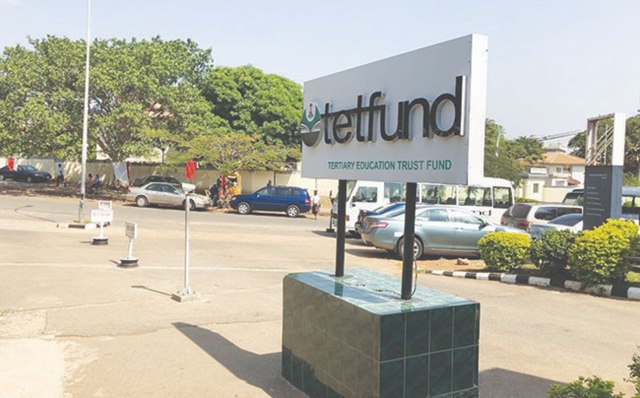
A FAKE scholarship scheme that claimed affiliation with Tertiary Education Trust Fund, TETFund, and described itself as the first online intervention of the government agency has pulled down its website after TETFund released a disclaimer, denouncing it.

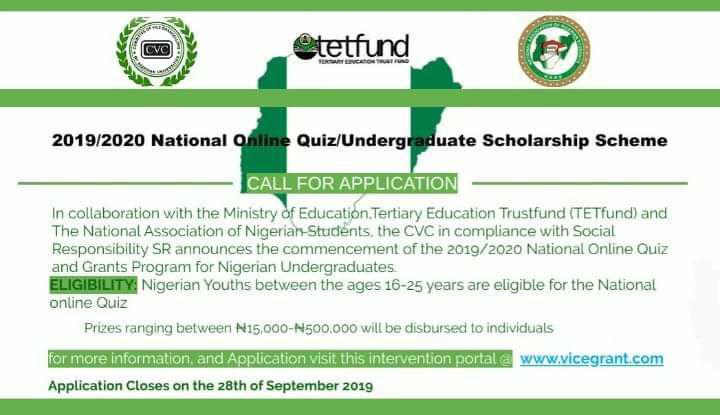
The scheme had earlier advertised the call for application for a supposed “2019/2020 National Online Quiz/Undergraduate Scholarship Scheme”.

According to a copy of the advert received by the the ICIR, it announced that “in collaboration with the Ministry of Education, Tertiary Education Trust Fund (TETfund) and The National Association of Nigerian Students, the CVC in compliance with Social Responsibility, SR, announces the commencement of the 2019/2020 National Online Quiz and Grants Program for Nigerian undergraduates”.

The said National Online Quiz is open to “Nigerian Youths between the ages 16-25 years” while prizes to be won range from “15,000–500,000” Naira.

Applications were also expected to close on September 28, and prospective applicants were urged to visit www.vicegrant.com for more information and application.

In a statement signed by Gbenga Arolasafe, Deputy Director, Public Affairs, and retrieved from the agency’s official website, TETFund, however, denied affiliation with this scheme and consequently warned the general public and most especially undergraduates to be wary of the scam.

The statement reads: “The attention of the Management of Tertiary Education Trust Fund (TETFund) has been drawn to a website (www.vicegrant.com) claiming affiliation with TETFund under a fraudulent Intervention named ViceGrant

“The operators of this illegal website claim that ViceGrant is an intervention established by TETFund under the TETFund Act and involved in accessing, processing and disbursement of the Committee of Vice-Chancellors and tertiary institutions leadership academic grant.”

TETfund described the scheme as an attempt to defraud unsuspecting students of Nigerian universities.

It said, “In their efforts to defraud unsuspecting members of the public, the perpetrators of this scam are currently inviting students to apply for quiz competition, undergraduate grants and post-graduate grants.”

The government agency refuted the alleged affiliation with the supposed intervention and warned the public from falling prey to the fraudsters.

“The general public and students, in particular, are hereby informed that TETFund does not operate any intervention named ViceGrant and has no affiliation whatsoever with the perpetrators of this illegal act,” the disclaimer read.

“They are therefore advised to disregard in their entirety, advertisements being placed by these fraudulent persons either on the website www.vicegrant.com or any other medium concerning ViceGrant as they do not emanate from or have any connection with TETFund.”

It further directed the public to its official website for authentic information about its grants.

Fraudulent advert from Vicegrant

Following the disclaimer, checks made by this reporter revealed that the website of the fake scheme has been pulled down.

The domain has since been placed for sale by GoDaddy, a publicly traded Internet domain registrar and web hosting company.

Checks by The ICIR on Whois, a database for verified website registration information, revealed that the site was registered on July 13 by an organisation referring to itself as the “Scholarship Board of Nigeria”. The domain registrant also gave their location as Kano.

In August, a similar case of scholarship fraud was reported in The Nation newspaper. Not fewer than 140 students of the Federal University Oye-Ekiti were duped of N2000 each to make them eligible for a scholarship opportunity offered by a fraudulent JK Consulting Firm.

FACT CHECK: Is BUK off-grid hybrid solar power plant the largest in Africa?

THE Federal Government on Tuesday, September 3 commissioned what it claimed to be the largest off-grid hybrid solar power plant at the Bayero University, Kano. The plant was commissioned by the Vice President, Yemi Osinbajo.

The claim

“The Federal Government, under the Rural Electricity Agency, will commission the largest off-grid solar hybrid power plant in Africa at Bayero University, Kano (BUK) under the Energizing Education Programme (EEP) today. The project will provide 55,815 students and 3,077 staff with constant electricity supply from the university’s 7.1MW solar hybrid power plant.”

The Managing Director of the Rural Electrification Agency (REA), Damilola Ogunbiyi, stated that “This is the largest off-grid solar hybrid power plant in Africa; We, as Nigerians, should be very proud of, thanks to the commitment of the Federal Government towards sustainable energy and education.

The Minister of Power, Saleh Mamman, in a tweet on Tuesday also shared from his handle that he would accompany the Vice President to commission the largest off-grid solar hybrid power plant. The post has been retweeted about 189 times and liked by 442 people as at the time of filing this report.

The same claim was shared on the official Twitter handle of the Federal Government of Nigeria, @NigeriaGov.

The tweet reads: “The @NigeriaGov (federal government), under the @realREANigeria (REA) will commission the largest off-grid solar hybrid power plant in Africa at Bayero University, Kano (BUK) under the Energizing Education Programme (EEP) today.”

What is a hybrid solar power plant?

A hybrid power plant is one that generates power by using two or more sources of energy. It also refers to a combination of solar and energy storage. The plant combines solar power from a  power system designed to supply usable solar power by means of converting light into electricity.

Verification

To verify this claim, The ICIR did a search of the largest off-grid solar hybrid power plant in Africa on the internet and also visited websites of contractors who have constructed solar hybrid power plants. The findings revealed that the commissioned power plant at the Bayero University, Kano is not the largest on the continent.

The largest hybrid solar power plant is in Burkina Faso. In March 2018, Wartsila, a power engineering firm completed the world’s largest solar hybrid power plant.

The power plant has a capacity of 15MWp (megawatt peak), doubling that of the BUK plant, and was awarded by the global renewable energy independent power producer, Total Eren, and African Energy Management Platform (AEMP).

As part of the verification process for the claim, Etore Thomas, the Deputy Director, Press and Public Relations at the Ministry of Power, could not respond to calls and messages sent when The ICIR contacted her even as she read the message sent to her via WhatsApp.

The ICIR contacted Ayang Ogbe, Director of Promotion (Information and Outreach) at the Rural Electrification Agency ( REA). Ogbe referred The ICIR to the website of the REA where numbers of who to talk to can be gotten. However, calls placed to the numbers could not be reached.

We also contacted Wartsila, the engineering firm responsible for the construction of the largest solar hybrid power plant. Wartsila confirmed that the project in Burkina Faso is currently the largest solar hybrid power plant.

“I confirm that the project delivered by Wärtsilä in Essakane, Burkina Faso is to date the world’s largest solar hybrid project and therefore larger than the one delivered in Nigeria,” wrote Fabien Cadaut, Area Marketing Manager of Wärtsilä’s Africa Energy Business.

Wartsila’s response

Conclusion

It is certain that Nigeria is not home to the largest off-grid solar hybrid power plant in Africa. Rather, Burkina Faso, another country in west Africa is.

The claim that the BUK off-grid solar hybrid power plant is the largest in Africa is, therefore, INCORRECT.

CBCN to Buhari: Do not allow ethnic, religious hegemony in Nigeria

0

THE Catholic Bishops’ Conference of Nigeria (CBCN) has urged government at all levels to shun ethnic or religious hegemony in Nigeria while ensuring religious and tribal equity, with no one religious favoured over another.

The CBCN stated this in a communique issued at the end of its plenary meeting held at the Divine Mercy Pastoral Centre, Agbamaya, Obada-Oko, Abeokuta, Ogun State.

The communiqué captioned, ‘Moving beyond precarious living in Nigeria’ was signed by the President and secretary of the association,  Augustine AKubeze and Camillus Umoh respectively.

“We urge especially the Federal Government, to ensure that it does not allow ethnic or religious hegemony to prevail in our multi-religious and secular state. No one religion should be favoured over another,” the CBCN said.

According to the document, the 10-day conference which held from September 11 to 20, was aimed at reflecting on issues affecting the Church and the Nigerian State.

Speaking on the need for national integration, the Catholic clergymen opined that much effort is required from both government and citizens to be co-opted into having a sense of belonging, irrespective of the nation’s heterogeneity in tribe, religion or political affiliation.

They however expressed displeasure on the state of the nation describing it as divided and in disarray following the outcomes of the 2019 election.

While calling for fairness, justice, and neutrality in relation to all religions and ethnic groups in the country, the CBCN members lamented that the absence of justice, would lead to lack of harmony, hysteria and poor development in the country.

“We, therefore, enjoin all Nigerians to see themselves as one united people and work for justice in order to ensure a peaceful and united nation,” the CBCN said.

In the Communique, the clergymen also expressed worry over the non-effect of religious practices on citizens especially on their moral, socio-economic and political lives.

“While praying for solutions to our problems, we must endeavour to be just in our dealings with others, work hard in fulfilling our duties, and collaborate with others in the social transformation of our country,” the paper said.

Stating its observation on Nigeria’s “derailing democracy”, the union said, “The qualities of accountability, transparency, independence of the judiciary, respect for fundamental rights, observance of the rule of law, and fair and credible electoral process, to mention only these, are still lacking”.

“We, therefore, urge all politicians, businessmen, religious leaders, public servants and indeed all citizens to live out the values of their faith for the common good,” the statement said.

The religious body, bemoaned the xenophobic attacks on Nigerians and other non-nationals in South Africa, leading to the lynching of Nigerians, lost of properties, inciting repatriation to the country.

They condemned “the unfortunate reprisals on perceived South African investments in some part of Nigeria, as two wrongs do not make a right!”.

The CBCN however, commended the South African Catholic Bishops’ Conference (SACBC) for “being prophetic in their condemnation of the attacks and urging the government to take decisive steps to end them”.

“At the same time, we note that South Africa and Nigeria have come a long way in fraternal and diplomatic relations. We advise Nigerians living at home and abroad to be good and law-abiding,” the Catholic Union said.

On the state of insecurity ostensibly ravaging the country, the CBCN stated that there are still “instances of killings as a result of banditry, kidnapping, assassination, armed robbery, reckless use of force by security agencies and lynching” inciting an upsurge in the cases of suicide, even among our youths.

While they noted the efforts adopted by the government to halt insecurity in the country, the religious body underscored the need for more strategic efforts, while praying for the peaceful repose of the victims.

“We urge governments at all levels to provide the enabling environment that would make it possible for both the government and the private sector to create job opportunities for our teeming youth population,” the CBCN said.

They said, “This would certainly minimize the menace of insecurity in our land”.

“We continue to urge the government and security agencies to do all they can to secure the immediate release of Leah Sharibu, the remaining Chibok girls and all the other persons still in captivity,” they said.

The Catholic union stating the roles of the family in the society, said they are the foundation for the integration of virtues and values in their offspring, calling on parents take the lead in upholding the ideals of decency, discipline, honesty, and marital fidelity.

The CBCN further emphasized the need for peace and justice in the country, which would translate to sustainable development.

“We enjoin all Christians and people of goodwill to preach daily this message of justice and peace, and to live it out coherently”, because “Where there is no fair sharing of wealth and opportunities, there is bound to be crisis.”