Ibrahim Magu, Acting Chairman of the Economic and Financial Crime Commission (EFCC), wants the government to build a prison in Sambisa Forest strictly for corrupt public office holders.
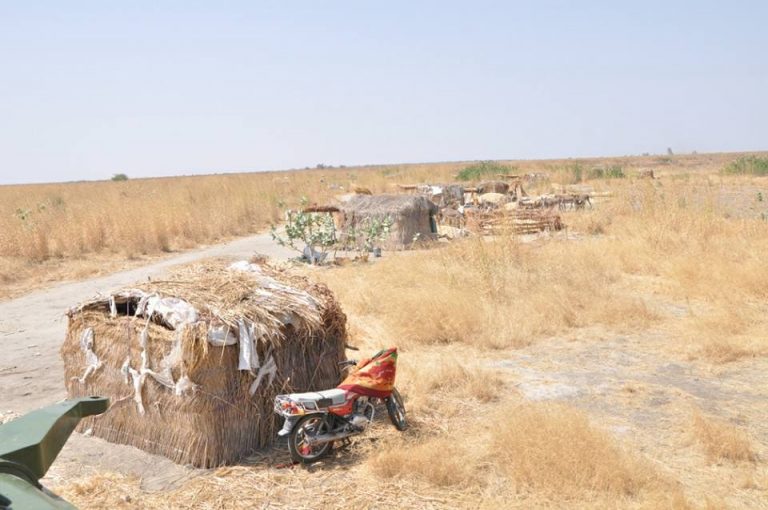
Sambisa, the stronghold of Boko Haram, is about 60 kilometres southeast of Maiduguri, the capital of Borno State, and also occupies parts of Borno, Yobe, Gombe, Bauchi, Jigawa and Kano states.
Speaking in Kaduna on Thursday at the commissioning of EFCC’s zonal office in the state, Magu expressed resolve to “fight back those who do not want the fight against corruption to succeed.
“We want to call for the establishment of a prison in Sambisa forest in order to keep away corrupt people from our midst,” he said.
“In this case, the judiciary has direct influence to help in the fight against corruption. Concerted efforts are being made by some big Nigerians to neutralise the fight against corruption.
“We must change the narrative by fighting back those who do not want the fight to succeed. We must, therefore, join hands together to kill corruption before corruption will kill us.”
Earlier at the occasion, Yemi Osinbajo, Vice President, said through Nasir el-Rufai, Governor of the state, that Magu would remain EFCC Chairman as long as he is Acting President and Muhammadu Buhari is President.
Going by reports in the media, there is no doubt Your Excellency is aware of the painful death in Abuja of Joy Odama, a 200-Level Mass Communication student of Cross River State University, and an indigene of Cross River State which is currently under your leadership.
She had returned home last December after the close of school to celebrate Christmas and New Year with her family. But she ended up celebrating neither. Instead, Joy met gruesome death in the home of one Alhaji Usman Adamu in Karmo, a suburb of Abuja. Surely you are aware of the evil-minded circumstances surrounding this unfortunate incident, and so repeating them here would be needless.
According to reports, not only were you jolted by this death, but also by the very embarrassing manner the police are handling it. To that extent, you had directed the Attorney General of Cross River State to take up the matter while, on its part, the State House of Assembly has also resolved to ensure that justice is done in this case. Thank you for taking this remedial step. Indeed, it is not only indigenes of your State that should be outraged by what befell Joy. All those who place premium on the sanctity of human life, regardless of race or creed, should. Especially in light of the position the police have taken.
From incontrovertible available reports, clearly Usman Adamu is responsible for the poor lady’s death, but the police, in its usual despicable act of ignominy, are doing everything to shield the suspect from punishment. They have lied all through and applied all sorts of measures including open intimidation, harassment and bribing the Odama family just for them to forgo the case.
Recall that Philomena Odama, the deceased’s mother, says they are in possession of N400,000 bribe money offered by Usman Adamu through the police. Also remember that in their determination to get to the root of Joy’s death, the family had sought an autopsy report at the National Hospital to which the police, according to the family lawyer, were not only privy but also endorsed. That autopsy revealed “acute cocaine poisoning” as the possible cause of death. That is the report almost every single Nigerian believes in.
But seeing that the family is unwavering in its demand for justice with the refusal to fall for threats and bribery, the police upped their game. They deceitfully declared the suspect, who before then had been walking free, wanted. And then went on to perfect an orchestrated plot to ensure freedom for the suspect anyhow.
The police went on to schedule a bogus meeting with the family, during which the suspect whom they had declared wanted and whose arrest was never made public, suddenly surfaced. The Odamas were dumfounded seeing him at the meeting. Meanwhile, the police hierarchy had secretly perfected a plot to sell to the public the story that the lady died from generator fumes.
That was why, following the meeting, the police announced that a second autopsy must be conducted. Of course they got the report done, which expectedly identified generator fumes as the cause of death. They then invited the star witness, Victoria Ezekiel, threatened her and forced her to change her original statement most presumably from the fact that the generator was never switched on that night to the police-invented fable that the generator was on and, therefore, the fumes were responsible for Joy’s death.
At this point, Your Excellency, you do not need a Sherlock Holmes to tell you that the police are working hard to pervert justice; that in spite of the overwhelming evidence of Usman Adamu’s culpability, the police are set to free him.
Evidence of this wicked intent of the police can also be gleaned from the apparently hurried, uncoordinated and panicky press conference held in Abuja June 30, 2017, by Moshood Jimoh, Force Public Relations Officer. Although at that conference police announced that they had concluded investigations in the case and were ready to prosecute the suspect, it was obvious they were not sincere as they were working toward a determined answer.
First, by sending the report to the DPP the police are simply trying to fool the public. If as stated in their report that Joy’s death resulted from generator fumes, why was it necessary to send the file to the DPP for advice? It simply means that no offence was committed by Usman Adamu and that there is no need for his prosecution.
Second, the police are being disingenuous for declaring as inconclusive the first autopsy report which it approved.
Third is the fact the police jettisoned the first report because it implicated the suspect and is thus an irrefutable proof of his culpability.
Fourth is that a second autopsy was unnecessary, but the police opted for it as a way of escape for the suspect.
Last, but not the least sir, where was the suspect during the press conference? Why was he not paraded at the event as has been the usual practice?
Is it not a fact that Raph Nkem, Chief Superintendent of Police, Divisional Police Officer in Karmo Police Station where the case was first reported and a known friend of the suspect, no longer deserves a career in the police from the way he handled the case at the initial stage? Nkem is known to most people as the suspect’s friend. But what was his punishment? Redeployment, according to the police.
Even Moshood Jimoh, the conveyor of every police decision, should he want to be honest, knows that nothing the police have done about the Joy Odama case in the last six months would pass the true test of professionalism. Is it not a fact, for instance, that the police image maker has been sending messages of appreciation to some media outfits for their “favourable” reports, and accusing others of thwarting justice while boasting that the police will never give such media houses a chance?”
The purpose of this memo, Your Excellency, is to commend you for wading into this case, and to urge you not to abandon the Odamas in their quest for justice. In fact, given the dysfunctional nature of the Nigerian society, you, as a member of the privileged and influential class by virtue of your position as governor, are suitably placed to challenge the impunity of the police and help the grieving family and our heavily traumatized society to get justice.
Therefore, I am appealing to you to mobilize every arsenal in your government to ensure that this objective is realized. That way you will live forever not just in the minds of the people of Cross River, but also in the hearts of all who cherish the soul of the human person. Thank you.
Godwin Onyeacholem is a journalist. He can be reached on gonyeacholem@gmail.com
How did a nation draped in delirium on October 1, 1960 find itself dripping with blood just under seven years later? Exactly 50 years after the kick-off of the Civil War of 1967, ‘FISAYO SOYOMBO, Editor of the ICIR, recalls the events that led to Nigeria’s lowest moment in history.
But now we have acquired our rightful status, and I feel sure that history will show that the building of our nation proceeded at the wisest pace: it has been thorough, and Nigeria now stands well-built upon firm foundations — Sir Abubakar Tafawa Balewa, Independence Day, 1960
A HAPPY BEGINNING
You could sense the joy of the people. In Lagos, then seat of power where hordes thronged the streets — and in other parts of the country — it was a once-in-a-lifetime moment of animated merrymaking exemplified by widespread wining and dining. Even in the far-flung villages, wine swigging and food gobbling were de rigueur, at least for the day.
Earlier at midnight, the small but rising clique of elites had clutched at their radios as devout Catholics would the Rosary, listening as the sonorous voice of Emmanuel Omatsola — a doyen of broadcast journalism — announced from Race Course: Nigeria is a free, sovereign nation.
Ask the primary school pupils at the time what the occasion was about and they would probably grope clumsily in search of the right words, but they sure had an idea: first, they holidayed away from school, and then returned to be served unusual rounds of sumptuous meals and handed lovingly petite green-white-green flags. As my father described it, at Independence on 1st October 1960, the mood all over the country was that of “naked excitement”.
FORESHADOWED CAPITULATION
Sir Abubakar Tafawa Balewa, the Prime Minister who delivered Nigeria’s maiden Independence Day speech, was one of the most brilliant and learned Nigerians of his time, at a time securing a scholarship to study at the University of London’s Institute of Education. And although he succeeded in earning a reasonable degree of notoriety for championing northern interests — a splotch that nearly all leaders of other ethnic groups equally bore — he cut an influential and likable figure outside the country especially because of his front-line roles in the founding of the Organisation of African Unity (OAU), the negotiations for the resolution of the Congo Crisis of 1960 to 1964, the condemnation of the South African Sharpeville Massacre of 21st March 1960 and quelling the attempted expulsion of South Africa from the Commonwealth in 1961.
Sadly, for all his education and intelligence, the two-time Prime Minister misjudged the country’s foundations at Independence, which were anything but “well-built”. It was a blunder he never recovered from; well, the chance itself never came. Six years after delivering that fervent speech, Balewa paid with his life — alongside those of some others who championed the quest for Independence. With the benefit of hindsight, it was a death that was always coming. It was foreshadowed.
TUSSLE FOR SUPERIORITY
(L-R) Balewa, Bello, Azikiwe
In the early 1950s when Nigeria’s century-long crave for independence began gathering steel, each region — Northern, Eastern, and Western (as the country had been divided by the Richards Constitution of 1946) — championed its own agenda. To every region, there was a political party to advance self-serving needs: the Northern Peoples Congress (NPC) for the northern region, the National Council of Nigeria and the Cameroons (NCNC) for the eastern region, and Action Group for the western region.
It proved a grueling task to write a Constitution that was suitable to various interests. The north, the most populated of the three, considered autonomy from the other regions as well as a large representation in any federal legislature its birthright. In addition, it feared the fading of Islam — the dominant religion in the region — and worried over the economic might of the south. The west itself craved autonomy, dreading the redistribution of its cocoa wealth to other regions. Only the east dithered, not exactly due to nationalist orientations but because of its survival needs, which it felt would best be served by a powerful central government and the redistribution of wealth.
The Lyttleton Constitution of 1954 attempted a compromise, creating a federation out of the three ethnic regions, establishing a Federal House of Representatives and providing for the appointment of a Premier for each region. Yes, it inched Nigeria closer to self-governance. But did it fix the festering regional rather than national drive for self-advancement? Certainly not — and the impending implosion was always a matter of time.
Half-a-decade on, Nigeria was all but an independent nation. In December 1959, ethnicity-coloured federal parliamentary elections starring 10 political parties held — ethnicity-coloured because in addition to the three heavyweight parties (NPC, NCNC and AG), the names of the lightweights themselves easily gave out their ethnocentric orientations: the Northern Elements Progressive Union, which, like the NPC, was formed to advocate northern interests; the Igala Union for Igala people; the Niger Delta Congress; and the ostensibly chauvinistic Igbira Tribal Union.
As it was more of an inter-region contest than an inter-party affair, the most populated region — the north — expectedly stole the show. The NPC won 134 of the available 312 seats in the House, and then formed a coalition with five other parties and two independents to hold a summary 148 seats; at a distant second position with 89 seats was the NCN-led coalition, while the AG-led coalition had 75 seats.
INDEPENDENT BUT BELLIGERENT
Nigeria nicked Independence on October 1, 1960; and one of the defining incidents of the country’s early-independence years was the 1962 split of the Cameroon trust territories into two, the generally Muslim northern Cameroons voting to fuse with Northern Nigeria and the southern Cameroons electing to join the Federal Republic of Cameroons.
From then until the mid-1960s, the country carried on with seething but bottled-up tension. The controversial censuses of 1962 and 1963 spawned fresh north-south acrimony, owing largely to allegations of population falsification. While that of 1962 was cancelled, a second attempt the following year was accepted, notwithstanding its official population figure of 55.6 million, which, compared to the modest effort a decade earlier, implied an improbable annual growth rate of 5.8 per cent. The polity was charged with suspicion, each region thinking the other manipulated the counting for local and regional political gains.
As the rumpus surrounding the census raged on, a separate turmoil was unfolding. In 1962, the Balewa government accused Obafemi Awolowo, idolised leader of the westerners — alongside other prominent leaders such as Olabisi Onabanjo, Anthony Enahoro, Lateef Jakande, Alfred Rewane, Ayo Adebanjo, Michael Omisade, Chike Obi, and Oladipo Maja — of treason. Awolowo’s British lawyer E. F. N. Gratien (QC) was denied entry into the country on the orders of Minister of Internal Affairs in a prelude to his eventual sentencing to 10 years in prison. Although Awolowo was eventually freed after Yakubu Gowon, a general, ascended the country’s reins, his supporters were already harbouring deep-seated animosity against the government.
All these pent-up animosities across the regions considered, Nigeria was teetering on the brink of implosion by the time it became a Republic on October 1, 1963.
PANIC AFTER REPUBLIC
Post-independence, 1965 witnessed the maiden incident of large-scale politically-motivated killings in the country. But the stage had been set since the previous year, in the lead up to the country’s first election after independence. As with the federal parliamentary elections of 1959, the electioneering process was more regional and ethnocentric than political, all political parties at the time congregating into two alliances.
On a side was the Nigerian National Alliance (NNA), comprising the Northern People’s Congress (NPC), Nigerian National Democratic Party (NNDP), Midwest Democratic Front (MDF), Dynamic Party (DP), Niger Delta Congress (NDC), Lagos State United Front (LSUF), and the Republican Party (RP).
On the other was the Unity Progressive Grand Alliance (UPGA), comprising the National Council of Nigeria and the Cameroons (NCNC), Action group (AG), Northern Progressive Front (NPF), Kano People’s Party (KPP), Northern Elements Progressive Union (NEPU), United Middle Belt Congress, (UMBC), and the Zamfara Commoners Party (ZMC). While the NNA was merely an effort of the NPC to help the north to federal might, it nevertheless appealed to voters outside region by presenting the benefits of associating with the party in power. UPGA, meanwhile, was NCNC’s footway to federal power, presenting itself as the alternative to northern dominance over other regions.
The standout feature of the time’s politicking was UPGA’s continued allegation of NNA’s plans to manipulate the election. For weeks, the election was postponed to resolve the shocking mismatch between the population of registered voters and the census figures. When it was finally to hold in December 1964, UPGA ordered a boycott that, in the end, was only partially effective. In regions of effective boycott, elections held in March 1965. The NNA secured 198 of the 312 seats in the House of Representatives (162 of those coming from NPC) while NCNC-dominated UPGA lost out with 108 seats. When Samuel Akintola’s NNDP left NCNC in the dust in the November 1965 legislative elections in the Western Region, violence broke out. Within the next six months, about 2000 people died in violent clashes across the Western region.
THEN A COUP
Nzeogwu
The chaos that followed the election tilted the country towards anarchy. The relationship between Prime Minister Tafawa Balewa and President Nnamdi Azikiwe degenerated to such extent that it was thought that they weren’t on speaking terms. Both refused to meet to form a new government after the election, allowing opportunistic junior soldiers, led by Majors Emmanuel Ifeajuna and Kaduna Nzeogwu, to profit from the uncontrollable killings in the west by engineering a coup d’état in January 1966.
Balewa; Akintola, Premier of Western Region; Ahmadu Bello, Premier of Northern Region; and a number of senior military officers were murdered. The military officers and political leaders spared were mostly easterners, sending the signal that it was an eastern attack on the north. All but one of the arrowheads of the coup were easterners: Major Tim Onwuategwu, Major Don Okafor, Major Chris Anuforo, Major Humphrey Chukwuka, Captain Emmanuel Nwobosi, Captain Ben Gbulie, and a Captain Oji.
While the coup succeeded in the north but failed in the federal capital (Lagos) and in the west, it did not hold at all in the mid-west and the east. In addition, Azikiwe, who embarked on a health trip to the Caribbean in late 1965, had not returned to the country as of the time of the coup, not even after his personal physician, Dr. Humphrey Idemudia abandoned him and returned home, or even at the country’s maiden hosting of the Commonwealth Leaders’ Conference in January 1966. General Officer Commanding (GOC)), Major-General Johnson Aguiyi-Ironsi stepped in, coercing the most senior political leaders alive to cede the country’s reins to him. And thus began what would eventually become decades of military rule.
A COUNTER-COUP
For a region that considered itself the natural heir to the country’s headship, the north was never going to accept the status quo. Aguiyi-Ironsi’s reign surely had to be temporary. The northern feeling of injustice was further aggravated by Aguiyi-Ironsi’s refusal to try plotters of the January putsch in line with military practice, despite acknowledging them as “rebels” at the start of his reign. On July 29, 1966, tragedy struck.
Murtala Mohammed a Lieutenant-Colonel and Inspector of Signals, led Theophilus Danjuma, a Major, and Martin Adamu, a Captain, to stage a reprisal coup, resulting in the murder of Aguiyi-Ironsi; his host in Ibadan, Colonel Adekunle Fajuyi; and hundreds of eastern military officers. Yakubu Gowon, Lieutenant Colonel and Chief of Staff, was installed as Head of State. He was only 31 at the time.
AND THEN THE WAR
The burdens that lay ahead of Gowon were far weightier than his age. The killing of thousands of Igbos in post-coup riots in the north in September spawned an exodus of north-based Igbos to their region of origin. Returning to the east, they no longer felt like Nigerians; they wanted a nation of their own. Gowon neither helped himself nor the country months later, in 1967, when he literally stripped Eastern Region of oil-rich Niger Delta in his new 12-state structure. On May 27, 1967, the region’s Igbo-dominated Assembly authorised Odumegwu Ojukwu, a Lieutenant Colonel and Governor of the region, to declare independence as the Republic of Biafra. It took Ojukwu three days to respond. When he did, it was positive.
On 30th May 1967, he declared: Having mandated me to proclaim on your behalf, and in your name, that Eastern Nigeria be a sovereign independent Republic, now, therefore I, Lieutenant Colonel Chukwuemeka Odumegwu-Ojukwu, Military Governor of Eastern Nigeria, by virtue of the authority, and pursuant to the principles recited above, do hereby solemnly proclaim that the territory and region known as and called Eastern Nigeria together with her continental shelf and territorial waters, shall, henceforth, be an independent sovereign state of the name and title of The Republic of Biafra.
FAILED ACCORDS
A number of failed peace accords, particularly the Aburi Accord reached in Ghana, followed. On July 6, 1967, the Federal Government launched a forceful effort to reclaim the secessionist state. Within months, what began as a “police action” degenerated into full-scale war.
Till date, one of the most prominent talking points of the war is the Nigerian government’s imposition of a blockade around Biafra, totally eliminating the secessionist state from receiving food supplies. The tragedy was captured by heartrending pictures of the ravages of famine on Biafran children. Looking malnourished, forlorn and hopeless, their arms and legs were ungracefully thin and long, their ribs awkwardly protruding, and their bellies and ankles swollen.
THE DEATHS
More than one million people were estimated to have died of hunger alone, during the war, which ended in January 1970 after the capture of the Biafran town of Owerri and Ojukwu’s fleeing to Cote d’Ivoire. The Federal Government claimed the war gulped 2 million lives and $840million. And on April 11, 1970, a report from relief workers stated that an additional 50,000 persons had died since the war ended. It was difficult, almost impossible, to think that Nigerians hurt Nigerians, brothers maimed brothers, families killed families; the country allowed and suffered a needless, avoidable implosion.
Sadly, exactly 50 years on, the ethic divisions that formed the foundations of the war are ever so starkly evident in the country. As Obiageli Ezekwesili, former minister and leader of the #BringBackOurGirls group, admitted earlier in the week, it doesn’t seem likely that Nigerians have learnt any lessons from the war
Yemi Osinbajo, Vice President, says Ibrahim Magu will remain the Chairman of the Economic and Financial Crimes Commission (EFCC) as long as he is Acting President and Muhammadu Buhari is President.
Osinbajo said this through Nasir el-Rufai, Governor of Kaduna State, who represented him on Thursday at the commissioning of the EFCC zonal office in the state.
“Mr Chairman sir, a few weeks ago, I discussed the EFCC and your appointment with President Muhammadu Buhari, and he told me in no uncertain terms that he has every confidence in you, in the commission and the work that you are doing. And as long as he is President, you will remain the Chairman of the EFCC.
“Lat night, I spoke with the Acting President, Yemi Osinbajo, who reconfirmed the position of the President, and told me that as long as he remains the Acting President or Vice President, Ibrahim Magu will be the Chairman of the EFCC.
“That is the only message from the President. So for those thinking that corruption is beginning to win this war, Magu will remain their nightmare for the next two years or six years as the case may be.”
The Senate rejected Magu based on a report by the Department of State Services (DSS) to the effect that he had received favours from some questionable characters.
Although Magu has denied the allegation, the Senate has insisted that he will not be confirmed. During Plenary on Tuesday, the legislators resolved that it will no longer screen any nominee sent to it by the executive until Magu leaves office.
One of them, Sam Anyanwu, of Imo State even threatened that the Senate will move against the executive if Magu does not leave his post after 48 hours.
Dino Melaye, the Chairman of the Senate Committee on the FCT, noted that Magu can serve Nigeria in other capacities because “he is not the only Nigerian Angel; his mates are DPOs and area commanders”.
When the Lagos State Police Command announced that it had arrested over 100 suspected members of the dreaded “badoo” cult in their various hideouts on Saturday, July 1, residents of Ikorodu and its environs received the news with a pinch of salt. It was not their first time hearing such announcement and things did not get any better.
Just two days later, their skepticism was justified.The Badoo cult has continued to terrorise the Ikorodu area of Lagos, and the police and even vigilante groups appear incapable of curtailing the gang. So, who are these killers, what do they want, how do they operate?
Below are 10 things of interest about the group, particularly for the purpose of public security.
BADOO IS LIKE SHEKAU, ‘HE’ IS NOT AN INDIVIDUAL
The criminal whose name was given simply as Badoo
A criminal, described by residents as a “serial rapist and ritual killer”, was apprehended at Ibeshe in Ikorodu on June 12, 2016. His name was given simply as “Badoo”.
According to Ikorodu residents, after every attack, he would write “I am Badoo” and paste on the door of his victims. He continued in a seemingly invincible manner until he was caught after he raped and killed a 27-year-old woman and her nine-month-old child.
A resident told journalists at the time that they had been trying over the months to catch him to no avail. “In order to succeed this time, the community came together, performed sacrifices, made incantations and went out for him. That was why he was caught,” he said.
But it would later become clear that “Badoo” was not a single individual but a group of sick, gruesome murderers. Like Abubakar Shekau, we now know it’s not just one person behind the name.
THEY USE A WEIRD KIND OF WEAPON
The cult group carries no guns or machetes. Their weapon is primarily a stone. In addition, they use clubs, preferably household grinding stones and mortar and pestle.
THEY KILL THEIR VICTIMS BY SMASHING THEM
Their modus operandi is to sneak into targets’ homes in the dead of the night and smash their heads with grinding stones or mortars.
Israel Ajao, a retired Deputy Inspector-General of Police and Chairman of the Lagos State Neighbourhood Corp, said: “It has become a disturbing trend and their modus operandi is worrisome. There is more to it than meet the eyes.
“They come into a house with no weapon except a stone or mortar, which they use to smash their victims’ head. They are not spirits but they come at the dead of the night, 2am, and they use the grinding stone and mortar to smash the heads of an entire family.”
THEY LEAVE WITH THEIR VICTIMS’ BLOOD
“After they are done, they clean the blood with white clothes and they escape,” Ajao added. “This is bizarre and it is fetish and a ritual.”
THEY’RE LOOKING FOR OPEN WINDOWS AND LOOSELY-SHUT DOORS
Most of Badoo’s attacks have taken place in houses where the windows were open or ajar, or where doors could be opened with one kick. Badoos don’t come prepared to break down high-security apartments. If you live in Ikorodu, it’s time you took a second look at your doors and windows. Replace them if you need to.
SURVEILLANCE BEFORE ATTACK IS A RULE FOR BADOO
Badoo doesn’t just attack; it’s surveillance first. Among one of the many residents to have confirmed this is Alade Adesina, who said: “We noticed that before members of the Badoo gang strike any area or building, they would have done a thorough surveillance of the place during the day time.”
Time for everyone in Ikorodu, not just vigilante groups, to watch out for who’s coming in and out, and who is loitering around, both day and night.
THEY KILL MEN, BUT WOMEN ARE THE PRIME TARGETS
“The reason why they kill men is that they can tackle and overpower them; otherwise it is women that they really target,” a vigilante member once said. “We got this fact from some of those we have apprehended and handed over to the police.”
A ‘BLOODY’ HANDKERCHIEF COSTS N500,000
One handkerchief used to clean the blood of a female victim is bought for N500, 000 from the Badoo guys.,” according to another vigilante member.
BADOO MEMBERS CAN’T FACE A COUNTER-ATTACK
If a gang member attacks you, it is advisable that you fight back or a relative does. The accounts of the few surviving victims show that Badoo cannot withstand resistance. For example, Olawale Anthony, a minister with the Mountain of Fire and Miracles Ministry who was attacked by the gang on June 2, said his assailants escaped when his wife called for help.
“I was sleeping that night after a hard day’s job when one of the cult members came into the house around 2:00am through the window and hit my head with a heavy stone,” he said. “I lost consciousness immediately but my wife who managed to escape before the guy could overpower her, rushed out to call for help. The man escaped before people could come around.”
Caroline Orji, another Ikorodu resident, who almost became a victim, said: “We suddenly saw a man naked in our bedroom around 1am with a big stone. As he wanted to smash it on my husband, he shouted Jesus, and the man ran out. He dropped the stone on the premises, scaled the fence and escaped.”
CHURCHES ARE EASY TARGETS AFTER VIGILS
Badoo is on the prowl for churches where vigils have held and some members of the congregation are waiting back for the break of dawn. For example, when it attacked the Cherubim and Seraphim Ccurch on Anibaba Street, Weigh Bridge, Owode Onirin, where it killed three people, including a woman and her nine-month-old baby, the raid happened around 2am, not long after the church rounded off a vigil.
Clearly, churches now know they have to bolster their security, especially for vigils.
Abubakar Malami, Attorney-General of the Federation (AGF), says the federal government will abide by the court ruling that ordered it to publish names of public officers from whom money has been recovered so far.
However, Malami told journalists after the Federal Executive Council (FEC) meeting on Wednesday that the naming would happen “at the appropriate time” and “after some factors have been considered”.
“Let me place it on the record that we have Freedom of Information Act in place. And the government is fully aware of its responsibility,” he said.
“But we have to take into account and consideration the fact that there are some factors that have to be considered as far as making these disclosures are concerned .
“There are matters that are sub judice in court. There are matters of reconciliation, compilations and other associated things.”
Malami also pointed out that it is not true that the anti-corruption campaign has so far been shrouded in ambiguity, saying the Federal Government has been making necessary statements public.
“The disclosure will definitely be made,” he said, “but it is contingent on reconciliation of associated considerations as they relate to sub judice principles, as they relate to concluding, reconciliation and confirmation of figures.
“So that has been done and the government will at the appropriate time make necessary disclosures perhaps intermittently against the background of the prevailing conditions relating to the pendency of certain things.”
Earlier on Wednesday, Justice Hadiza Shagari of the federal high court, Lagos, ordered that government should release information about high-ranking public officials from whom public funds were recovered.
The ruling same after a freedom of information suit filed against the federal government by the Socio-Economic Rights and Accountability Project (SERAP), a civil society organization.
The Federal Executive Council (FEC) says it cannot defend remarks attributed to Acting President Yemi Osinbajo regarding the confirmation of Ibrahim Magu as Chairman of the Economic and Financial Crimes Commission (EFCC) by the Senate.
In April, Osinbajo had agreed with Femi Falana, a senior lawyer, who questioned the propriety of sending Magu’s name to the senate for confirmation in the first place.
“I agree with Mr Falana that there was no need in the first place to have sent Magu’s name to the Senate,” he had said at the time.
But on Tuesday, the Senate expressed misgivings over Osinbajo’s statements and resolved not to consider any other nominee sent in by the executive until Magu, who was twice rejected by the lawmakers, leaves office.
Fielding questions from state house correspondents after Wednesday’s FEC meeting, Abubakar Malami, Attorney-General of the Federation, said the body could not defend the Vice President’s comments because the decision was not taken by the council.
“Although the issue came up for discussion at the cabinet meeting, since the cabinet was not particularly connected or reached a consensus to maintain a particular position, it cannot begin to defend what it did not decide on.
“The fundamental consideration about the alleged statement is the fact that at no point ever did the federal executive council sit down to arrive at the decision in one way or the other as far as the issue of nomination or otherwise is concerned.
“So, I do not think it constitutes an issue for the federal executive council to make any clarification about because it has never been considered by the FEC.”
However, Lai Mohammed, the Minister of Information, said there was no cause for alarm as the situation was under control. “We have mechanisms in place to handle such situations,” he said.
Similarly, Garba Shehu, spokesman to President, assured Nigerians that all is well and there was no face-off between the executive and legislative arms of government.
“From the time the Vice President gave that opinion to now, more than 20 nominations have been forwarded to the Senate and quite a number of them have been screened, sworn in and are now occupying positions. Therefore; this is not a big issue as some people want to make it,” Shehu said.
“The party, government and the National Assembly will sit on a round table and this matter will be discussed and resolved, I assure you.”
The House of Representatives ad-hoc committee investigating the $1.3 billion Malabu oil deal says it invited Goodluck Jonathan, former President, to its probe of the Malabu oil deal in the interest of thoroughness, natural justice and fair play.
Razak Atunwa, Chairman of the committee, told the House plenary on Wednesday that the letter would be dispatched in a few days.
In a document that was mailed to journalists on Wednesday, Atunwa enumerated the reasons why it was important for Jonathan to appear before the panel, as follows:
i) Jonathan was the President at the material time the Ministers brokered the deal that led to the allegation of diversion of $1bn.
iii) A U.K. Court Judgment in relation to an application to return part of the money being restrained, castigated the Jonathan Administration as not having acted in the best interest of Nigeria in relation to the ‘deal’.
iv) The Attorney-General of the Federation at the material time, Mohammed Bello Adoke, has recently instituted proceedings in court wherein he pleads that all his actions were as instructed by former President Goodluck Jonathan.
According to Atunwa, these allegations against ex-President Jonathan were too compelling to be ignored, hence the need for him to attend one of the panel’s sittings to officially state his own side of the story.
The Economic Financial Crimes Commission (EFCC) has obtained an interim court order compelling Abdulaziz Yari, Governor of Zamfara State, to forfeit the sums of N500 million and $500,000 to the federal government.
The commission alleged that the monies were part of the Paris Club funds given by the federal government to state governors to pay off salary and pension arrears in their respective states.
In an affidavit filed by the EFCC before the federal high court, Abuja, to support its ex parte application, Yari was accused of diverting N500 million to offset a personal loan he obtained from the First Generation Mortgage Bank Limited.
Yari, who is also the Chairman of the Nigeria Governors’ Forum, was also accused of transferring $500,000 to Gosh Projects Limited, a property firm, for the purchase of building materials for his 100-room hotel project in Lagos. Part of the looted funds was also used for the purchase of treasury bills and transfers to offshore accounts.
The allegedly looted funds were recovered from the two firms by the EFCC.
Justice Nnamdi Dimgba granted the interim forfeiture order on June 30, but details of the judgement became public notice on Wednesday.
The judge also gave a 14-day ultimatum within which any interested party can show approach the court and provide evidence why monies should not be permanently forfeited to the federal government.
Yari is not the first sitting governor whose assets would be frozen by the EFCC.
In June 2016, the commission froze the personal account of Governor Ayodele Fayose of Ekiti State, alleging that it contained proceeds of crime.
The EFCC said Fayose had benefitted from the $2.1 billion arms deal money which was misappropriated by Sambo Dasuki, former National Security Dasuki, NSA.
However, the freeze order was lifted after Fayose filed a counter application at the Ekiti high court, which held that the EFCC’s action was against laid down procedures as the Governor was never invited nor charged with any crime before his assets were frozen.
“The plaintiff is entitled to be heard before his property or money can be seized, doing otherwise will amount to denying him fair hearing and constitutional rights,” ruled Justice Taiwo Taiwo.
Fayose is the first to speak out in condemnation of the “persecution” of Yari by the EFCC.
He said EFCC’s action is “a direct attack on all the governors of the 36 States of Nigeria”, and called on all the governors to “rise and protect the NGF”.