Home Blog Page 2750

After a series of death threats, ‘assassins open fire’ on EFCC investigator


Austin Okwor, a top investigator with the Economic and Financial Crimes Commission (EFCC), is currently hospitalised in Port-Harcourt, the Rivers State capital, after he escaped from suspected assassins on his way from work.

Wilson Uwajuren, spokesman to the EFCC, made this known in a statement on Wednesday.

Okwor is attached to the Property Fraud Section of the EFCC Zonal office in Port Harcourt and is one of the operatives investigating some sensitive cases including that pertaining to corrupt judicial officials.

He had closed late on Saturday and was on his way home when the assailants opened fire on him.

“Luckily for him, he was able to shake off his assailants but not without sustaining some bullet wounds as they kept firing at him,” uwujaren said.

“He was rushed to a private hospital in Port Harcourt where he is receiving treatment.”

Uwajuren noted that before the attack, Okwor had been receiving threat messages. “One of such messages, which he received sometime in May 2017, was reported to the Police,” he stated.

The assassination attempt has also been reported to the Police in Port Harcourt.

According to Uwajuren, this was not the first time officials of the EFCC were being attacked and unlike Okwor’s, some of the attacks had led to the death of operatives of the commission.

He said: “This incident underlines the hazards which operatives of the Commission are daily exposed to in the discharge of their duties.

“In 2010, precisely September 14, the head of the Commission’s Forensic Unit, Abdullahi Muazu was shot and killed by unknown gunmen in Kaduna.

“Six months earlier a team of prosecutors returning to Enugu after a court appearance in Owerri, Imo state was attacked by gunmen who opened fire on them. Sergeant Eze Edoga the police escort was cut down while a senior counsel with the Commission, Joseph Uzor, was critically wounded but survived.”

How Boko Haram slaughters babies with double-edged knives and collects their blood in buckets


Boko Haram insurgents kill their sons and use blood to wash their hands when they return from fighting, a report funded by the Pulitzer Centre on Crisis Reporting has revealed.

The story, which is on the cover of this week’s New York Times Magazine, is based on the testimony of four boy soldiers of Boko Haram who escaped from the insurgents’ enclave.

Sarah Topol, the journalist who wrote the story, spoke with 25 children in Borno State about their abduction.

“The stories they told me about rituals like infant slaughter and bathing your hands in blood have not been previously reported as part of life under Boko Haram. But their stories were consistent, and rumours of such acts have circulated around northeast Nigeria,” Topol wrote.

One of the boy soldiers, Mustapha (not real name), who rose to become a deputy to an emir in one of the Boko Haram’s units, narrated how infant killing and washing of hands with blood were carried out.

“Whenever a woman at Mustapha’s base delivered a son, he reported the birth to the babban emir. The other emirs did the same,” Sarah wrote.

“One month after the birth, a man from the palace would come to collect the baby, and everyone would know. In the palace courtyard, the baby would be put on a special table with a hole in the middle.

“Anybody could watch as they lay the baby flat, neck over the hole. The emir from the unit would be given a special knife — sharp, double-edged with a black handle. He would use it to slaughter the baby. The blood would drain through the hole and into a bucket. That was how the insurgents slaughtered their sons. Mustapha couldn’t ask questions. He slaughtered four babies this way. It was just something that needed doing.”

Whenever Mustapha and other insurgents returned from fighting, they would go through the ritual of soaking their hands in blood. The blood was collected from the slaughtered infants and adults killed by the insurgents in their base.

Topol wrote in the report that she interviewed the boys over several days in her hotel through an interpreter.

The boys, who are now between 14 to 18 years old, were kidnapped by Boko Haram in Baga.

According to the report,  Boko Haram has kidnapped 10,000 boys over the last decade.

FACT CHECK: Are education parastatals over-populated by Muslims as alleged by CAN President?

Last week, the Christian Association for Nigeria (CAN) alleged that out of all the parastatals in the ministry of education, only four are headed by Christians.

Samson Ayokunle, the CAN President, made the allegation when criticising some of the topics added to the new syllabus of Christian Religious Studies (CRS).

“To say the least, that is a misleading statement from a Minister who is not only trying to Islamise the ministry with all the appointments he has made but denying the reality of discrimination policy under his watch,” Ayokunle had said.

“A situation where 13 of their heads are Muslims while the remaining four are Christians is an ill-wind that would blow no one any good.”

17 PARASTATALS — IS THAT TRUE?

Ayokunle’s statement implied that there are 17 parastatals/agencies in the ministry of education. This isn’t true.

According to the website of the ministry of education (www.education.gov.ng), there are 21 parastatals, but these include the West African Examination Council (WAEC), which is a sub-regional body and is not under the direct control of the ministry. The chairman is  Evelyn S. Kandakai, a Liberian.

So if one excludes WAEC, then there are 20 parastatals on the list.

However, the list of newly appointed heads of education parastatals, released in August 2016, featured the Nomadic Education Commission and the National Institute for Nigerian Languages, both of which were not listed as parastatals on the website of the education ministry. These two take the number of education ministry parastatals to 22.

ANSWER: No, there are at least 22 parastatals in the education ministry.

13 MUSLIMS, 4 CHRISTIANS — IS THIS TRUE?

Interfaith

Here is a table containing the parastatals in the ministry and the religion of their heads

S/N PARASTATAL HEAD RELIGION
1 National University Commission (NUC) Abubakar A Rasheed Muslim
2 Teachers’ Registration Council of Nigeria Josiah Olusegun Ajiboye Christian
3 JAMB Ishaq Oloyede Muslim
4 National Board for Technical Education Masa’udu A. Kazaure Muslim
5 Tertiary Education Trust Fund Abdullahi B. Baffa Muslim
6 National Business and Technical Examination Board Ifeoma Isiugo-Abanihe Christian
7 National Commission for Colleges of Education Bappa Aliyu Muhammadu Muslim
8 National Examination Council Charles Uwakwe Christian
9 National Institute for Education Planning and Administration Lilian Salami – Christian
10 National Library of Nigeria Lanre Aina – Christian
11 National Mathematical Centre Stephen Ejugwu Onah – Christian
12 Universal Basic Education Hameed Bobboye Muslim
13 National Open University Adamu Uba Abdalla Muslim
14 National Teachers’ Institute Garba Dahuwa Azare Muslim
15 National Educational Research and Development Council Ismail Junaidu Muslim
16 Librarian Registration Council of Nigeria Michael Afolabi – Christian
17 Computer Professionals (Registration Council) of Nigeria Vincent Asor  Christian
18 National Commission for Mass Literacy, Adult and Non-Formal Education of Nigeria Abba Aladu Muslim
19 Nigeria Arabic Language Village Muhammad Mu’az – Muslim
20 Nigeria French Language village Rauf Adebisi – Muslim
21 National commission for nomadic education Bashir Usman – Muslim
22 National of institute of Nigerian Languages Chinyere Ohiri-Aniche – Christian


ANSWER
: From the the table, it is clear that the ratio of Muslims to Christians in the leadership of education parastatals is not 13: 4. Instead, it is 13:9. Therefore, CAN President Ayokunle was WRONG when he said “a situation where 13 of their heads are Muslims while the remaining four are Christians is an ill-wind that would blow no one any good”.


READ ALSO:

Six reasons why Adesina won the ‘Nobel Prize for Food and Agriculture’

0

The World Food Prize Foundation has explained why Akinwumi Adesina, Minister for Agriculture in the regime of Goodluck Jonathan, won the $250,000 2017 World Food Prize on Monday.

We list six reasons why Adesina won the award, otherwise known as the ‘Nobel Prize for Food and Agriculture’, as explained by Kenneth Quinn, a former US Foreign Service Officer and President of the Foundation.

CHANGE

Quinn said Adesina won the prize “for driving change in African agriculture for over 25 years and improving food security for millions across the continent”.

BREAKTHROUGH ACHIEVEMENTS AS MINISTER

Adesina, who is also President of the African Development Bank (AfDB), was named winner to reflect “both his breakthrough achievements as Minister of Agriculture of Nigeria”.

“Adesina led a major expansion of commercial bank lending to farmers as Vice President of Alliance for a Green Revolution in Africa (AGRA) and as Minister of Agriculture in Nigeria, introduced the E-Wallet system”.

As Nigeria’s Minister of Agriculture from 2011 to 2015, he “successfully transformed his country’s agriculture sector through bold reforms”. The bold reforms include creating programmes to make Nigeria self-sufficient in rice production, and to make cassava become a major cash crop.

CREDIT INITIATIVE TO FARMERS

He also “introduced initiatives to exponentially increase the availability of credit for smallholder farmers across the African continent and galvanized the political will to transform African agriculture”.

ANTI-POVERTY CAMPAIGN

Adesina “grew up in poverty himself and embarked on a journey to use his academic training to “lift up millions of people out of poverty, especially farmers in rural Africa”.

GREEN REVOLUTION


Quinn said in 2006, as Associate Director for Food Security at the Rockefeller Foundation, Adesina played a critical leadership role in organising the Africa Fertilizer Summit in Abuja.

He said the summit was described as absolutely essential in igniting the campaign to spread a new Green Revolution across Africa, which led to the creation of AGRA.

“Our Laureate next played a leadership role in the development of AGRA, during which he led the effort to exponentially expand commercial credit for the agricultural sector and for farmers across the continent,” he said.

‘BREAKING THE BACK OF CORRUPTION’

“As Minister of Agriculture of his home country Nigeria, our Laureate introduced the E-Wallet system which broke the back of the corrupt elements that had controlled the fertilizer distribution system for 40 years.

“The reforms he implemented increased food production by 21 million metric tonnes and attracted 5.6 billion dollars in private sector investments, thus earning him the reputation as the ‘Farmer’s Minister.’”

Adesina is the first person from agriculture to ever lead a regional development bank. He becomes the 46th person and the sixth African to win the World Food Prize.

He will be presented the prize and Laureate sculpture at a ceremony at the Iowa State Capitol on October 19.


Biafra as focal point for fresh perspectives of Nigeria

0

Omolade Adunbi

In the past few months, there has a resurgence of Biafra in Nigeria by a group known as Indigenous Peoples of Biafra (IPOB), led by Nnamdi Kanu. Interestingly, the new agitation began in the diaspora, in the United Kingdom where Kanu is a citizen, through Radio Biafra. Using easily accessible social media platforms and broadcast technology, IPOB was able to reach thousands of Igbos and non-Igbos across Nigeria and the world. IPOB has been variously described as a breakaway faction of another pro-Igbo group, the Movement for the Actualization of the Sovereign State of Biafra or MASSOB.

Kanu is now in Nigeria, where he was briefly imprisoned by the Nigerian state for a year and a half. The government charged him with treason; in some of his speeches he told supporters, “We need guns and we need bullets.” The trial is ongoing.

Since the truncation of the march to a democratic Nigeria in 1993 by the military junta of General Ibrahim Babangida, there continues to be a resurgence of ethnic agitations for self-determination and in the case of IPOB, secession from Nigeria. The reason for such resurgence is often dominated by cries of marginalization and in some cases domination of power. The aggrieved point to the fact that the presidency of Nigeria has been dominated by the Hausa/Fulanis, an ethnic group mainly in the north. The election in 2015 of Muhammad Buhari, considered a member of the northern elite, further heightened the agitation for self-determination or secession by various groups from the south, IPOB in the southeast and Niger Delta Avengers in the south-south. More importantly, control of Nigeria’s oil resources in the Niger Delta often get inserted into the agitation for self-determination or secession either by groups within the Niger Delta or those outside of the region.

Narratives of belonging most times dominate this form of insertion and who can claim membership in whatever country emerges from the rubbles of Nigeria. For example, in the map circulated on the Internet, the entire Niger Delta region is incorporated into Biafra by IPOB and the response of different groups in the Niger Delta had been to dissociate itself from such a map while also lending support to the IPOB agitation as a legitimate struggle against Nigeria. The insertion of Niger Delta by IPOB in the proposed Biafra Republic is understandable considering the fact that the Niger Delta produces the wealth that Nigeria relies on in running its mono-economy—an economy heavily dependent on oil extraction. The Niger Delta was also central to the prosecution of the civil war, also known as Nigeria-Biafra war, between 1967 and 1970, the period when oil extraction started taking a deep root in the socio-economic and political life of Nigeria.

However, what is missing in the conversation around the resurgence of Biafra currently is how the structure of the economy creates spaces of violence and oppression of the majority of the Nigerian population. It is the structure of the capitalist economy that puts the commonwealth of Nigerians in the hands of a few elite. The elite beneficiaries of the Nigerian commonwealth cut across all ethnic groups because capitalist exploitation defies ethnic colouration. Therefore, the many years of marginalization and disfranchisement of the greater majority of the Nigerian populace from the structure of the economy shapes today’s agitation for self-determination and secession. The elite class have been in power since independence and continue to recycle themselves while sometimes tokenistically co-opting a few into their fold. The dominance of a rampaging neoliberal economic and political practice, and the absence of a coherent and coordinated opposition in Nigeria further compounds the problem for the Nigerian populace. The absence of a sound and strategic opposition to a structurally deficient economic system that could shape the discourse of power and resources further creates a space where those economically and politically disenfranchised look for creative ways of survival. Thus, agitation for secession and self-determination is symptomatic of a system that remains ineffective in addressing the problems of the people of Nigeria.

In the two decades preceding the advent of the current pseudo-democratic system, particularly the 1980s and 1990s, the Nigerian left was the formidable intellectual and political opposition to elite greed and capitalist exploitation. The many organizations formed by the broad Nigerian left were able to generate a particular discourse that put social inequality and elite mismanagement of the nation’s human and material resources at the core of the problems within the Nigerian state. The rise of neoliberal economic and political practices and its resultant effect on left politics has seen the rise of NGOism, which represents a particular space that fails to account for why and how people are socially and politically disenfranchised.

The ascendancy of ethnic agitation cannot be disconnected from how neoliberal economic and political practices of the last three decades have continuously taken away the wealth of the people and concentrated it in the hands of the few. The rich are getting richer in Nigeria while the poor are left to fend for themselves. The irony of it all is that when a few elite lose power at the centre, the poor become the pawns that are used to whip up ethnic and religious sentiment.

Not surprising, then, that Atiku Abubakar, the former vice president, is clamoring for the restructuring of the federation. At the same time, it should worry us that Ohaneze Ndigbo, an elite Igbo organization, whose members have always collaborated with other elites to decimate Nigeria’s commonwealth are today throwing their support behind IPOB. To those who are familiar with the different epochs of struggle in Nigeria, this is no surprise.

In the 1990s, various left organizations converged to form the Campaign for Democracy and the Democratic Alternative as platforms within which power could be wrestled from the elite. The latter responded by forming its own National Democratic Coalition, NADECO, and when democracy was finally won, NADECO members took credit for it and positioned themselves as the leaders of the new republic. The struggle for a truly democratic Nigeria was lost at that point and the outcome is what we are witnessing today.

To be clear, IPOB, NDA and other ethnic organizations have the right to self-determine whether they want to be part of Nigeria or form their own independent republic. However, it is important to ask questions that could help us engage in a healthy conversation as we mark the 50th anniversary of the beginning of the Nigeria-Biafra war.

The death of Joy Odama: Acid test for Ibrahim Idris and the Nigeria Police

0

By Godwin Onyeacholem

There is no question that in Nigeria, the poor, the less privileged and the largely dispossessed majority who find themselves in that demeaning class of human categorization have been condemned to a life of perpetual oppression. Forget what is in the law books. Under this rightly described prevailing order of fascist democracy, it has been the lot of the masses to be tormented, denied, and subjugated, except something revolutionary happens. And indeed as this phenomenon seems to have been ingrained in the system, the only way out, at the risk of being labelled an anarchist, is a revolution.

When you happen to live in this abnormal society and be so cursed as to be in that lower rung of the ladder – social, political or economic – without “connections,” just resign yourself to the reality that in the circumstance, unless in some strange way, you will never get justice if you ever turn up against an affluent and seemingly more powerful compatriot or a foreigner in our courts and/or at the offices of the law enforcement agencies.

No, you will not get justice because your low, inconsequential status does not endorse you as a beneficiary of that globally acknowledged ennobling act of rectitude. And more importantly, because the rich and powerfully “connected” will deploy the wherewithal to effect a miscarriage of the justice that easily ought to have been served you in a fair and an uncorrupted system.

Yet, the real tragedy in Nigeria is the bitter irony embedded in this subject. In most cases, those who have the mandate to facilitate the attainment of justice by ensuring public order and doing their work in accordance with the law regardless of who is involved, are themselves the real perpetrators of crime and abettors of criminals. Here, one has in mind the Nigerian Army, Nigerian Navy Nigerian Air Force, the police, other paramilitary forces and, in short, all the other coercive institutions existing under the Nigerian law.

They are all implicated in the despicable act of committing unforgiveable crimes, working with criminals to achieve selfish ends and, wait for it, openly playing very strategic but shameful roles in impeding justice of which the poor and those who don’t have influential people in the society to “fight’ for them are mostly the victims.

In fact, it can be safely argued that the frequency and intensity of crime in the Nigerian society is proportional to the level of co-operation between law enforcement agents and criminals. Of course crimes will be committed when perpetrators are aware that enforcement agents will co-operate.

On this score, the police are the worst culprits. In a cheeky negation of their own popular catchphrase (The Police is your friend) affirming friendship with the public, the police will rather choose to befriend criminals than be “your friend.” There is a legion of stories over the years to validate this claim, and the one trending now is just as ugly, stomach-churning and damaging to the unflattering image of the police as its antecedents. It’s the alleged murder in Karmo, a surburb of Abuja, just a little over six months ago of Joy Odama, a 200 Level Mass Communication student of Cross River State University.

The suspect, Alhaji Usman Adamu, is without doubt currently enjoying the full protection of the police who seem bent on ensuring that the Odama family, who obviously belong to the aforementioned class of the less privileged, does not get justice no matter how hard they try.

Sadly, in this tragic drama that evokes a mixture of anger and hopelessness, the Inspector General of Police, Ibrahim Idris, who has a golden opportunity to prove for once that the police under his watch will not toe the rotten conspiratorial line of the past, has himself shown, from utterances and actions, to be the chief conductor in the sordid orchestra of injustice.

From the beginning, the role of the police has been geared toward making sure Alhaji Adamu, who obviously counts the top hierarchy of the police as friends, does not answer to his crime. Suspecting foul play on sighting the lady’s corpse when Adamu sought to deposit it in the mortuary at the Federal Medical Centre, Jabi, Abuja, the management had asked for a police report before the corpse could be kept in the mortuary.

Adamu rushed out and returned with Raph Nkem, a Chief Superintendent of Police and Divisional Police Officer of Karmo Police Station who ordered the mortuary staff to embalm the body and admit it. According to one of the witness, the DPO had been a regular visitor to Adamu’s house where he was usually entertained with fried meat and wine.

Nkem it was who dished out a cocktail of lies to the Odama family in defence of his evil-minded friend, Adamu. He it was who started the harassment and intimidation of the family, while declaring to them with shameless bold face that Adamu was not culpable in Joy’s murder. Instead of arresting Adamu and working towards getting him to have his day in court, see how a police officer at that level has put everything on the line to cover up a suspected criminal. Who will now say Adamu and Nkem are not working together?

That circle of despicable characters in the police has since widened to the Force Headquarters in Abuja where top officers have tried without success to force the Odamas to collect money from the suspect and permanently shut up. In response to public outcry over the failure to arrest the suspect, the police declared Adamu wanted. But it turned out the declaration had no sincerity behind it. It was the usual farce and mendacity to which the police are richly accustomed. The police never told the public that the man whom they declared wanted had been arrested at any point.

Meanwhile, the deceased’s family had obtained an autopsy report at the National Hospital Abuja which puts the cause of Joy’s death as “cardiogenic shock secondary to diffuse myocardial infection secondary to possible acute cocaine poisoning.”

At a meeting between the police and the Odamas at the headquarters, Adamu, the suspect, suddenly showed up flanked by officers, pumping hands and back-slapping cheerfully with people who supposedly had declared him wanted as he took his seat in the room. The Odamas were shocked to the bones. Faced with that perplexing spectacle, who will now say the police and Adamu are not working together?

It was at the end of the so-called meeting that the police, realizing that Adamu had been nailed by the autopsy report, delivered yet another shocker to the grieving family and the public: Police boss, Idris, directed that a fresh autopsy be conducted.

Predictably, this is done for no other reason than to, by all means, create a window of escape for the suspect. At the moment, the police are working hard to come up with the claim that the probable cause of Joy’s death was generator fumes. Really?

And rightly so, members of the Odama family and their lawyer have responded point-blank with the charge that the police want to manipulate the result with the claim of generator fumes to contradict the first autopsy report. Thankfully, the Odamas have the lead pathologist at the National Hospital on their side. The pathologist insists he stands by his report that the lady died from a heavy dose of cocaine.

The world is watching how the police are scheming to pervert justice in this case. It is one case that will more than determine the professionalism of the current IGP in the history of policing in Nigeria. If Idris and his men eventually succeed in undercutting the Odamas by freeing the man who allegedly murdered their daughter, he will surely be listed on the negative side of history as far as police work is concerned in Nigeria.

Let it be told in this country and beyond that the Odamas, who are from Cross Rivers State, are crying for justice. To be poor does not make anyone less human. Whoever is responsible for their daughter’s needless death must be punished. It is gratifying that the Cross River State Government under the leadership of Ben Ayade and Senator Rose Oko, also from the State, have both shown more than casual interest in this case. They should keep an eye on it to its logical end. So should all well-meaning Nigerians.

Onyeacholem, a journalist, can be reached on gonyeacholem@gmail.com    

APGA: Nnamdi Kanu lacks ‘proper articulation’ of the Biafra struggle

The All Progressives Grand Alliance (APGA) has warned Nnamdi Kanu, leader of the Indigenous People of Biafra (IPOB), to stop seeing himself as an emperor but rather to humble himself to “the true leadership of Ndigbo for a proper and better articulation of the Biafra struggle”.

The warning was contained in an open letter to Kanu, signed by Ifeatu Obiokoye, APGA’s National Publicity Secretary, and made available to the media in Awka, the Anambra State capital, late on Monday.

In the letter, the party described Kanu’s call for citizens to shun the forthcoming governorship election in the state as callous and irresponsible.

According to APGA, Kanu had no authority to speak for all Igbo of the South-East, even though he is the leader of IPOB.

“Nnamdi Kanu’s call for a boycott of elections in the South-East, beginning with the governorship polls scheduled for November 18, 2017 in Anambra, is irresponsible, irredentist and totally devoid of any focus,” the letter read.

It also pointed out that “the right to vote and be voted for is a universally declared right under the United Nations Charter of People’s and Citizenship Right, and in the 1999 Constitution (as amended).”

The party said the concept of Biafra is a metaphor for the demand for equity and fair play in the Nigerian state and not necessarily a secessionist movement.

It said,“You must appreciate that for different logical reasons and perception, the Biafra concept has attracted favourable comments among our people, ostensibly borne out of the marginalisation of Ndigbo in the Nigerian state.

“While youths of the East are agitating for Biafra, the Arewa youths are equally restive; the same goes for Níger Delta youths and youths from Oduduwa states.

“In this popular agitation for Biafra, Ndigbo have not instituted a separatist movement or a terrorist gang as it were. We are more concerned about the continued existence of Nigeria under the present structural arrangement.”

APGA said that it supports the call for the restructuring of the country and implementation of the 2014 National Conference resolutions, saying such move will boost peaceful co-existence among ethnic nationalities and douse tension.

The party warned Kanu not to be carried away by the success of the May 30 sit-at-home call, which was attributable to many reasons, including fear.

It advised the IPOB leader to stop seeing himself as an “emperor”but to “humble yourself to the true leadership of Ndigbo for a proper and better articulation of the Biafra struggle.”

Fashola to legislators: You have ‘very stark and worrisome gaps in knowledge’

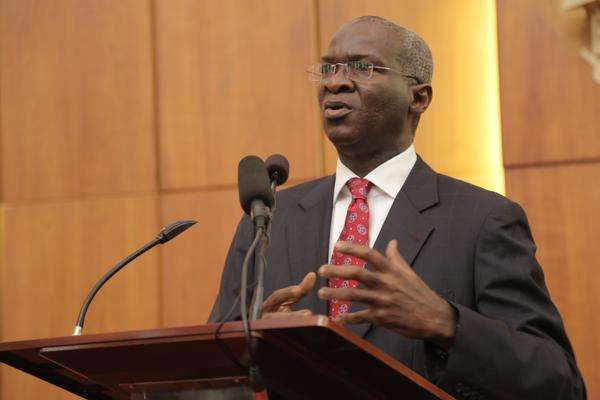
Babatunde Fashola, minister for power, works and housing, says the spokespersons of the House of Representatives and the Senate have shown their lack of basic understanding by resorting to name-calling and abuse over his observations about the 2017 budget.

Fashola had expressed dissatisfaction at the way the budget of some important projects under his ministry were unilaterally slashed by the legislators.

He listed the Lagos-Ibadan Expressway, the Kano-Maiduguri road, the Second Niger Bridge among others, as projects that were altered by members of the National Assembly in favour of boreholes and primary healthcare centres that were never part of the projects presented by the ministry during its budget defence.

However, spokespersons of the Senate and the House of Representatives accused the minister of lying to Nigerians just to save face.

Among other things, the lawmakers said Fashola was nursing anger against them because they “turned down his request for a lump sum of N20 billion without specifying the projects on which the money would be expended.”

But in his reply, which was contained in a press release by Hakeem Bello, his Special Adviser on Media, Fashola said it was unfortunate that spokesmen of the two chambers of the National Assembly displayed “very stark and worrisome gaps in knowledge”.

One of the spokespersons alleged that the provision for the second Niger Bridge in the 2016 budget was not spent and had to be returned, but Fashola explained that “the Ministry of Finance has not yet released any cash for the Second Niger Bridge, so no money was returned”.

“Three phases of Early Works of piling and foundation was approved and financed by the previous government in the hope that a concession will finally be issued, which has not happened because concessionaires have not been able to raise finance.

“The continuation of Early Works IV could not start in May 2016 when the budget was passed because of high water level in the River Niger in the rainy season.

“The contract was only approved by the Federal Executive Council in the first quarter of 2017 and the contractor is awaiting payment.”

On the allegation that the budget for the Mambila Power Project was slashed because it contained a “whooping N17 billion” for Environmental Impact Assessment (EIA), Fashola the said there was indeed a mis-description.

“What was described as a Budget Head for EIA was actually the nation’s counterpart funding to the China-EXIM loan to fund the building of the Mambila Project,” he explained, adding that he got to realise this after the budget had been slashed.

He said if the decision to cut the budget was not unilaterally taken by the lawmakers, it should have been brought to his attention to explain.

“At a joint meeting convened at the instance of the Budget Minister when I complained that the budget was slashed, the issue of EIA was brought to my attention and I explained what it was meant for,” Fashola said.

On the N20 billion which the legislators said Fashola could not explain, the minister said the money was to make provisions for unforeseen circumstances and is not a new development.

He said: “In the 2016 budget, a similar provision enabled the ministry to respond to the failures of the Tamburawa Bridge in Sokoto, the Ijora Bridge in Lagos and the Gada Hudu Bridge in Koto Karfe along the Abuja – Lokoja Highway. Similarly, the ministry was able to pay N1 billion to the contractor handling the Suleja to Minna road.

“The recent failures caused by flooding along Tegina-Mokwa-Jebba road and Tatabu in Niger State could not have been provided for because they were not foreseen and there may be more. “This is what good planning is about.”

Fashola maintained that since the issue was not a personal thing, there would be nothing wrong for government to approach the Supreme Court for clarification “because it is a clear conflict about how best to serve the people”.

“As long as budgets planned to deliver life-changing infrastructure are cut into small pieces, Nigeria will continue to have small projects that are not life-changing, and big projects that have not been completed in 17 years.

“Success should be defined by how many projects an administration is able to complete or set on the path of irreversible completion and not how many poorly-funded contracts are awarded,” he said.

Nnamdi Kanu: Jonathan is my uncle but his wife would have made a better president

0

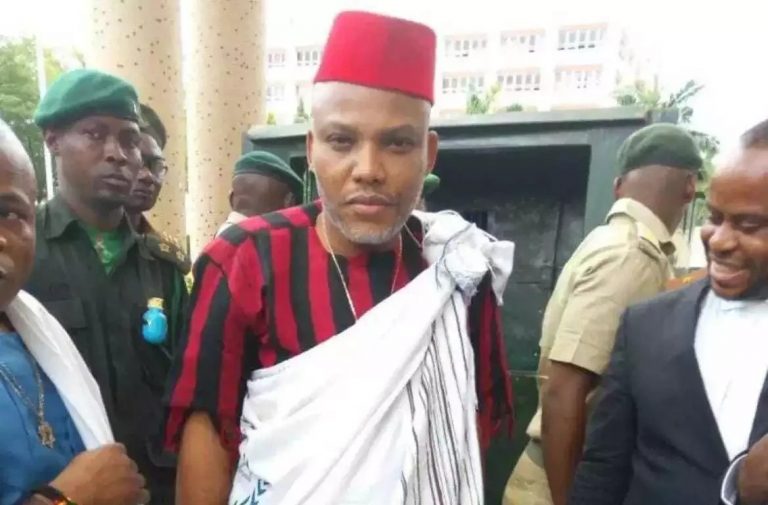
Nnamdi kanu, leader of the Indigenous People of Biafra (IPOB), says former President Goodluck Jonathan was so weak that his wife, Patience, would have made a better president.

Speaking exclusively to Daily Sun, Kanu said Jonathan did nothing for the Igbo, even though the region claimed him as one of their own.

“Jonathan is my uncle, yes. I was one of those who said Jonathan’s tenure was more or less an Igbo presidency; it’s on record I said that. But he knew I never liked his regime because he was weak and incompetent,” he said.

“I don’t support evil. If you do good, I will tell you; if you do bad, I will say it the way it is. I don’t curry favours. He was weak, I said I wish it was Aunty [sic] Patience Jonathan who was in charge; she would have done better.

“Look at where Jonathan dropped us today; he never finished building the East/West Road, but he built railway line from Abuja to Kaduna, so they will love him. Who told you that if they did not love Zik, that they will love you?”

Kanu also said he didn’t hate the north as widely perceived, singling out former Presidents Shehu Shagari and Umaru Yar’Adua as two northern leaders he grew up admiring.

“People think I hate the north; that’s not true,” he said.

“But the only thing is that I say things the way they are, I don’t know how to tell lies to curry favours. People do not know that I love (former Presidents Shagari and Yar’Adua more than I love (former President Nnamdi Azikiwe) Zik.

“I’m saying this because when we were young and were growing up, the only notable person that built any notable infrastructure I saw with my two eyes was Shagari. The Enugu/Igwuocha (that the white man named Port Harcourt) Expressway, was built by the National Party of Nigeria (NPN) government of Shagari and then you can travel with joy because it was smooth and very clean.

“Now, tell me who has ever done that since after Shagari; no, tell me. Which other infrastructure will you be proud of, nobody has ever done anything again?”


National assembly the only institution of our democracy, says deputy senate leader

Bala Na’Allah, Deputy Senate Majority Leader, says the National Assembly is “the only institution” of Nigeria’s democracy.

He also said the framers of Nigeria’s constitution decided for a bicameral system of legislature in order to ensure that the country’s democracy is not abused.

He said this in response to critics who feel the Senate should be scrapped on the argument that maintaining a two-chamber legislature only depletes the nation’s resources.

Na’Allah explained that if there was no Senate, then democracy in Nigeria would be one-sided as the House of Representatives has more northerners due to its population and land mass.

The Senate, on the other hand, is made up of three members from each state, thereby ensuring that there is equality.

“If the senate does not exist, technically, more than 67% of the members of the National Assembly are from the Northern part of Nigeria,” he said.

“Democratically, if everything is going to be put to vote, it means the north would always have its share of whatever it wants in this country. This is not the intention of the framers of our constitution.

On the need for a two-chamber legislature, Na’Allah said: “Bicameral means that no one house can override the other, but that the two houses must agree on one thing.

“The Senate is not bigger than the house of representatives in terms of power. But you see, people who have no idea about how we came about our constitution, what the desire of the framers of our constitution were, will keep on telling you all these things. But what do you do when somebody decides to be exposing his ignorance?”

Na’Allah said by the time the 8th senate completes it tenure, it would have “succeeded in strengthening the only institution of our democracy, which is the National Assembly.

He also spoke on the powers of the Senate to summon government agencies as well as make budgetary inputs.

Watch the videos below: