Home Blog Page 2772

Iran Election: Rouhani Wins Second Term

0

Moderate cleric Hassan Rouhani has won Iran’s presidential election on Saturday, the interior ministry said, scoring a surprising landslide victory over conservative hardliners without the need of a second round run-off.

Interior minister Mostafa Mohammad-Najjar announced on state television that Rouhani secured just over 50% of the ballot based on a 72% turnout of 50 million eligible voters.

“Mr Hassan Rouhani … got the absolute majority of votes and was elected as president,” Najjar said.

Rouhani’s nearest rival was conservative Tehran mayor Mohammad Baqer Qalibaf, a long way behind with less than 16%.

Other hardline candidates close to Khamenei, including current nuclear negotiator Saeed Jalili, scored even lower.

The outcome will not soon transform Iran’s long tense relations with the West, call into question its disputed pursuit of nuclear power or lessen its support of Syria’s president in the civil war there—matters of national security that remain the domain of supreme leader Ayatollah Ali Khamenei.

But the president runs the economy and wields important influence in decision-making and Rouhani’s meteoric rise could offer latitude for a thaw in Iran’s foreign relations and more social freedoms at home after eight years of confrontation and repression under hardline President Mahmoud Ahmadinejad, who was legally barred from seeking a third consecutive term.

Though an establishment figure, Rouhani is a former chief nuclear negotiator known for his nuanced, conciliatory approach.

He has pledged to promote a policy of “constructive interaction with the world” and to enact a domestic “civil rights charter”.

Rohani’s wide margin revealed a broad reservoir of pro-reform sentiment with many voters, undaunted by restrictions on candidate choice and campaign rallies, seizing the chance to repudiate the dominant hardline elite over Iran’s economic woes, international isolation and crackdowns on social freedoms.

In an apparent move to convey political continuity to both domestic opponents and Western adversaries, Khamenei said whatever the result of Friday’s election, it would be a vote of confidence in the 34-year-old Islamic Republic.

“A vote for any of these candidates is a vote for the Islamic Republic and a vote of confidence in the system,” the top Shi’ite cleric’s official Twitter account said.

Iran’s rial strengthened about 4% against the US dollar on Saturday after partial vote tallies pointed to a resounding Rohani victory, web sites tracking the currency said.

Celebratory crowds assembled near Rohani’s headquarters in downtown Tehran a few hours before his victory was confirmed.

“Long live reform, long live Rohani,” a reporter at the scene quoted the crowds as chanting.

“Ahmadi, bye bye,” the crowds chanted in a reference to Ahmadinejad, another witness there told Reuters.

Troops Clear Terrorists From Borno Villages, Rescue 998 Persons

0


Troops of 3 Battalion, 22 Brigade Nigerian Army, has rescued 998 Boko Haam captives from Ndufu, Muktu and Muzuri villages in Ngala, Borno State after engaging the terrorists in a fierce gun battle.

This was made known by the Nigerian Army spokesperson, Sani Usman, a Brigadier General, in a statement made available to Journalists late Friday.

Usman said the clearance operation followed confirmed information about the presence of some Boko Haram terrorists in the villages.

He added that the fighting patrol was carried out alongside some members of the Civilian Joint Task Force, JTF.

“The patrol team had a fierce encounter with the terrorists at Ndufu which they decisively dealt with before proceeding to clear Muktu and Muzuri, as well as nearby communities within the area,” Usman stated.

“Although some of terrorists fled to various directions on sighting the troops, the patrol team was able to neutralize 9 terrorists, destroyed their Improvised Explosive Device (IED) making factory and rescued 998 persons.

“Those rescued were 125 at Ndufu, 802 at Muktu and 71 persons at Muzuri.”

The army spokesman pointed out that despite the heat of the battle, all the children in the community under the age of 5 years were administered with polio vaccines by the soldiers.

“In addition, the troops recovered 1 AK-47 Rifle with registration number 565231515, an AK-47 Rifle Magazine, 2 Boko Haram terrorists flags, 4 Motorcycles, 2 Solar Panels, 2 already prepared IEDs, Detonating cords and other explosive making components,” he added.

Usman also noted that the troops that took part in the operation, the 3 Battalion, “has maintained its status as one of the best fighting unit in the theatre as they did not sustain any casualty or injury during the operation.”

Lagos Govt Blames Developer For Building Collapse

0

The Lagos State Government has said that the developers of the three-storey building which collapsed in the Ilasa area of the State on Thursday had ignored a stop work order, and were therefore directly responsible for the tragic incident.

Three people were killed and 19 others were injured in the unfortunate incident.

This was contained in a statement issued by Olubukonla Nwonah, the chief public affairs officer in the Lagos State ministry Physical Planning and Urban Development.

The statement quoted the commissioner in charge of the ministry, Wasiu Anifowose, as saying that the building was disapproved and sealed off by officials of the Lagos State Building Control Agency, LASBCA, but the developers illegally broke the seal to continue work.

“This particular building had been monitored and sealed off. Our officers had come back to monitor for compliance but they were prevented by hoodlums from carrying out their statutory responsibilities,” Anifowose was quoted as saying.

“Yesterday, before the collapse, our officials were there again but were chased back to the office to reinforce when this tragedy happened.

“We had actually served all the necessary statutory stop work notices and this is evident in our records that the building was sealed off, but this developer broke the seal twice and continued with the illegal development and this is the result of the illegality.”

The commissioner explained that the building was sealed off because officials of the State’s building control discovered that substandard materials were being used in the construction and the developers had no development permit to embark on the construction.

Anifowose urged developers to always abide by the regulations and never to ignore stop work orders as doing that is criminal and could be dangerous.

“Despite deploying officers to monitor developments to prevent such ugly occurrences, some wicked, irresponsible and unscrupulous developers still carry out nefarious illegality,” the commissioner lamented.

Nigerian Officials Stole $582b Since 1960 – Chatham House Report

0

By Yekeen Nurudeen

A report by Chatham House has estimated that about $582 billion has been stolen from Nigerian treasury by public officials since independence,1960.

Specifically, the report revealed that close to $400 billion public money was stolen from Nigeria from 1960 to 1999, adding that between 2005 and 2014 some $182 billion was lost through illicit financial flows from the country.

Chatham House, the Royal Institute of International Affairs, is an independent policy institute based in London.

In the report titled, “Collective Action on Corruption in Nigeria, a Social Norms Approach to Connecting Societies and Institutions,” said acts of diversion of federal and state revenue, business and investment capital, and foreign aid, as well as the personal incomes of Nigerian citizens, contribute to a hollowing out of the country’s public institutions and the degradation of basic services.

The report was launched in Abuja on Thursday barely 48 hours after a report by Oxfam which detailed the level of inequality in Nigeria was released.

Oxfam in its report said the wealth of Nigeria’s five richest persons are enough to end the country’s abject poverty.

And according to Chatham’s report, the stolen common wealth “represents the investment gap in building and equipping modern hospitals to reduce Nigeria’s exceptionally high maternal mortality rates – estimated at two out of every 10 global maternal deaths in 2015; expanding and upgrading an education system that is currently failing millions of children; and procuring vaccinations to prevent regular outbreaks of preventable diseases”.

It argued that corruption remains a destructive and complex practice that is openly acknowledged in Nigeria, but remains ubiquitous in the functioning of society and economic life.

While stating that the consequences of corruption for the country and its people are indisputable, the report however described “corruption, as perhaps the least well understood of the country’s challenges”.

“Corruption tends to foster more corruption, perpetuating and entrenching social injustice in daily life. Such an environment weakens societal values of fairness, honesty, integrity and common citizenship, as the impunity of dishonest practices and abuses of power or position steadily erode citizens’ sense of moral responsibility to follow the rules in the interests of wider society,” it said.

The report, coauthored by Leena Koni Hoffman, an associate fellow of the Africa programme at Chatham House and Raj Navanit Patel, a consultant at the University of Pennsylvania and a Ph.D candidate in the department of Philosophy, suggested policy approaches to dealing with corruption and offered methods of integrating behavioural insights into anti-corruption strategies.


Abuja Suspends Tenement Rates Collection

0

By Yekeen Nurudeen

The Federal Capital Territory Administration has approved the temporary suspension of tenement rates collection in FCT.

This is to allow the National Assembly fix rates to be paid on tenements in the nation’s capital, a circular issued by the Permanent Secretary of FCT, Babatope Ajakaiye said.

According to the circular, the suspension was necessitated by the need to sanitize and streamline the tenement rates collection process, as well as ensure compliance with relevant provisions of the Constitution of the Federal Republic of Nigeria.

The Permanent Secretary emphasized the constitutional responsibility of the National Assembly which makes law for the FCT to prescribe rates to be paid on tenements in the FCT and disclosed that the FCTA is liaising with the Legislative Body for the enactment of the requisite Act.

He noted that the process of property valuation and gazetting at the FCT Administration and FCT Area Council levels is ongoing, while submissions from the Area Councils are being collated for onward transmission to the National Assembly.

“This suspension is also in consonance with a resolution of the House of Representatives on the matter and decisions reached at a subsequent meeting with the leadership of the House Committee on FCT, held on Monday, 31st October, 2016, which are deemed to remain in force until the National Assembly concludes the enactment of the requisite legislation”, the circular stated.

Before now, tenement rates were charged and collected by the Area Councils in the FCT.


READ ALSO:


Acting President Osinbajo Receives 2017 Budget

0

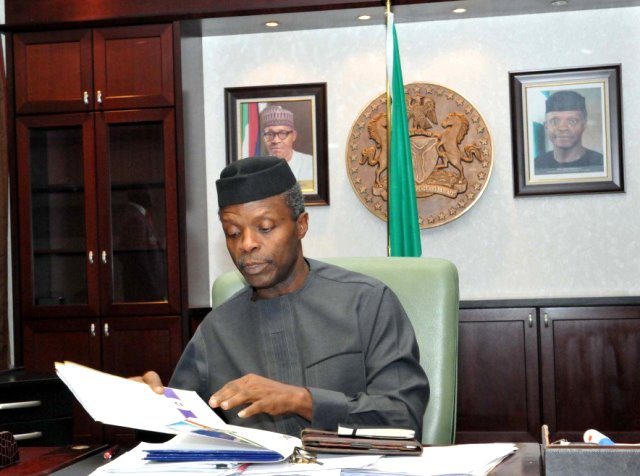
Acting President Yemi Osinbajo has received the details of the 2017 appropriation bill which was passed by the National Assembly last week.

The document was delivered to Osinbajo on Friday by the special adviser to the President on National Assembly matters – Senate, Ita Enang, behind closed doors.

Speaking to State House correspondents after submitting the budget, Enang said: “The budget as passed by the National Assembly has just been transmitted to the Acting President. I just delivered it.

”Enang also cleared the air on reports quoting him as saying that the passed budget will only be assented to by President Muhammadu Buhari.

“Let me use this opportunity to clarify an issue. The Acting President has the power to assent to the budget and he will assent to it when the processes are completed.

“The Acting President has the power to assent to the budget. In February, he assented to seven or eight bills. Those that he didn’t agree with, he wrote the Senate and House of Representatives that he had withheld his assent from them.

“He has the power of the president to assent to it. But the assent to the Appropriation Bill will be after the completion of the standard operation process.

“The bill has 30 days within which it will be assented to but the process can be completed within two or three days.

“So, it is not possible to say it will be assented to in so, so and so day or in two or three days.

“It’s upon the completion of the process that it will be assented to by the president and the president here now is the acting president.”

Also, Presidential spokesman, office of the Vice President, Laolu Akande confirmed that Osinbajo has received the 2017 budget.

“2017 Budget-Appropriations bill now officially received in the Acting President’s office and undergoing very prompt and diligent consideration,”Akande tweeted.

Osinbajo had on Wednesday said that he would sign the budget once he is satisfied with its contents.

Court Orders Permanent Forfeiture Of Money Found In Lagos Mall

0


The federal high court, Lagos, has ordered that the N449,597,000, found by the Economic and Financial Crimes Commission, EFCC, in a Shopping mall located at Victoria Island, Lagos, be permanently forfeited of to the federal government.

The EFCC had on April 8 said it uncovered a large sum of N448,850,000, which is suspected to be proceeds of crime.

It then approached Justice Rilwan Aikawa on April 19, who issued an interim order of forfeiture of the said sum, giving room for any interested party to come forward with evidence why the money should not be permanently forfeited to the government.

However, at the resumed hearing on Friday, counsel to the EFCC, Idris Mohammed, urged the court to issue a permanent forfeiture order of a total sum of N449,597,000.

It is not clear what led to the increase of the said sum by N747,000 given that the EFCC had initially announced the discovery of N448,850,000 but was now asking for the forfeiture of N449,597,000.

Delivering his final ruling, Justice Aikawa said: “I have perused the motion on notice and as far as my records show, neither the respondent nor any other interested party has filed any affidavit or any other process to show course why the interim order should not be granted.

“I have no other option but to grant the motion as prayed.

“I hereby order that the sum of N449,597,000 found in the possession of the respondent which is believed to be proceeds of unlawful activity be finally forfeited to the Federal government of Nigeria.”

It would be recalled that four days after the discovery, on April 12, the EFCC uncovered another huge amount of money in foreign and local currencies at another highbrow residential building in Ikoyi Lagos.

The money, totaling $43.4 million, £27,800 and N23.2 million has since been claimed by the National Intelligence Agency, NIA, who said it was meant for some “covet” operation the agency was undertaken.

Also, on March 14, the EFCC said it found a total of N49 million abandoned in sacks at the Kaduna Airport.

Fears Of Coup D’etat In Nigeria Over Buhari’s Illness

0


By Ludovica Iaccino

Fears of a possible coup d’etat in Nigeria have emerged as President Muhammadu Buhari is in the UK, for the second time since the beginning of 2017, for medical check-ups.

The 74-year-old head of state spent nearly two months on medical leave in London earlier this year. He left again on 7 May, handing over powers to Vice President Yemi Osinbajo.

Buhari’s medical trips, and mystery surrounding his medical conditions, are sparking speculations on his health and the future of one of Africa’s largest economies.

Analysts have previously warned Buhari’s prolonged absence could spark a power struggle ahead of 2019 presidential elections, should the leader become incapacitated.

Matthew T Page, analyst and former US intelligence expert on Nigeria, told IBTimes UK earlier in May that ruling party elites were “already quietly positioning themselves to be named vice president if Osinbajo becomes acting president.”

The Chief of Army Staff, Tukur Buratai, has now warned army officials against becoming involved in the country’s politics. He made the remarks on 16 May after the Nigerian army received information that “some individuals have been approaching some officers and soldiers for undisclosed political reasons,” according to Nigerian site Premium Times.

Some Nigerians have drawn similarities between Buhari’s medical leave and that of deceased former president Umaru Yar’Adua, who was admitted to a hospital in Saudi Arabia in 2009.

The country experienced a power vacuum filled only when the senate approved a Doctrine of Necessity to allow the then vice-president Goodluck Jonathan to be sworn in as president. Yar’Adua returned to Nigeria in February 2010 and died at the presidential villa in Abuja in May that year.

“[A coup] is not likely to happen given the precedent. There was similar pressure in 2010 with Yar’Adua terminally ill, but the soldiers stayed in their barracks,” Adedayo Ademuwagun, Lagos-based analyst at Songhai Advisory, told IBTimes UK.

Osinbajo has won praise for the leadership skills demonstrated during Buhari’s absence.

However, the army’s statement has highlighted ongoing tensions in the country. Buratai’s statement prompted the UK embassy in Nigeria to issue a warning against “non-democratic” change of government in the country.

“There are elections. If you’re not happy with your leaders then you should change your leadership through the democratic process and through elections,” the UK High Commissioner to Nigeria, Paul Arkwright, said on 17 May.

Although analysts seem to believe a coup is possible but unlikely, there are fears politicians loyal to Buhari, a Muslim from the north, could obstruct Osinbajo, a Christian from the south.

“Northern leaders will try to get a concrete deal that will, at best, see Osinbajo step down for a northern candidate to run in the 2019 poll,”Ademuwagun said.

“If that agreement cannot be reached, some figures may resort to extreme measures to get their way, and so a coup isn’t ruled out considering the top military establishments are in the north and northern soldiers dominate the army.”

UK-based security analyst and counter-terrorism expert David Otto believes a coup could succeed only if Northerners were behind it, given the perception that top positions within the army are covered by people from northern Nigeria.

“If a coup were to occur in Nigeria, with the composition of the military, it will not be successful if a Southerner was behind it,” he told IBTimes UK.

“There could be genuine fear from the so called ‘Northern Cabal’ (elite from northern Nigeria) that what happened with the previous leader Yar’Adua could happen to President Buhari: Leaving Osibanjo, a Southern Christian, to take charge and maybe run in 2019.

“The fact that Buhari is out of the country indefinitely is not good for Nigeria stability. President Buhari must either return to Nigeria, disclose what’s wrong with him or put the interests of the country (first) and resign as a result of his unfortunate ill health,” Otto concluded.

Ludovica Iaccino writes for International Business Times, UK

Suicide Bombers Hit University Of Maiduguri Again

0

There has been another suicide bomb attack on the University of Maiduguri, the second time this week.

Two bomb explosions were reported at the university premises; the first at about 11 pm on Thursday and the second at about 12 am Friday.

The University’s Student Union Government, SUG, President Abu Hanifa Babati, confirmed the attacks, saying one of the attacks “occurred around the Faculty of Veterinary Medicine, after the bomber detonated the bomb before being accosted by soldiers.”

He said the second explosion occurred around a female hostel called BOT.

Spokesperson of the Borno police command, Victor Isuku, also confirmed the attack via a statement on Friday.

“On 18/5/2017 at about 2350hrs, three male suicide bombers with IEDs strapped to their bodies, gained entry into the premises of university of Maiduguri,” the statement read.

“In an attempt to enter the female hostels, they were intercepted by security operatives. One of the bombers hurriedly detonated his IED vest, killing himself instantly.

“The other two bombers detonated theirs near a construction site also within the proximity of the University premises, killing themselves alone.

“Three university security personnel were reported injured.”

Isuku said the scene of the attacks has been visited by EOD personnel and that normalcy has been restored.

It would be recalled that a similar attack occurred in the same university five days ago in which a security guard was killed and a soldier was injured.

IGR Probe: Varsities Accuse Senators Of Demanding Bribe

0


By Stanley Melikam

There is a brewing crisis of confidence between tertiary institutions and federal lawmakers looking into the Internally Generated Revenues, IGRs, of Ministries, Departments and Agencies, MDAs, and whether or not they remit the surpluses into the federal purse as stipulated by the Fiscal Responsibility Act 2011.

Several senior officials of universities invited by the committee, including a Vice Chancellor, allege that members of the committee demanded bribes of up to N10 million from the institutions in order to cover up alleged fraud discovered in their finances.

The committee, in turn, alleges that the universities are trying to discredit it to divert attention from the fraud perpetrated by the institutions’ officials.

The fiscal responsibility Act stipulates that 80 per cent of the surplus of IGR, must be remitted into the Consolidated Revenue Fund after all operational costs have been removed,.

The Senate Ad-Hoc Committee on Alleged Misuse, Under Remittance and other Fraudulent Activities in Collection, Accounting and Remittances of Internally Generated Revenue, IGR, by MDAs was constituted on November 30, 2016, but had to delay work till March, 2017 to allow MDAs defend their budgets.

The committee of eight has Solomon Olamilekan as chairman. Other members are Usman Bayero Nafada, Yusuf. A. Yusuf, Joshua Dariye, John Enoh, Fatimah Raji Rasaki, Andy Uba, Yahaya Abdullahi and Rafiu Ibrahim.

In its wisdom, the committee, decided to include federal government tertiary institutions in the country in the probe, in addition to the 601 agencies of the federal government.

On Wednesday May 17, chairman of the committee, Olamilekan accused university administrators of cooking up figures in their yearly accounts to evade payment of operating surpluses, adding that the money involved runs into hundreds of millions of naira..

Speaking during the committee’s investigative hearing of Federal University of Technology, Minna, Niger State, he said the universities failed to pay the money to the government as revenue as required by the Constitution and the Fiscal Responsibility Act.

While it is possible that some of the MDAs, including tertiary institutions, might have engaged in fraudulent diversion of revenues, the lawmakers are using the opportunity to enrich themselves and sacrificing the need for accountability and transparency in the finance of these institutions.

However, sources in some of the tertiary institutions alleged that the committee is demanding huge sums from the institutions in order to cover up alleged fraud.

A Vice Chancellor in one of the affected universities who spoke to www.icirnigeria.org in confidence disclosed that the senators asked him to bring N10 million.

“Senator (name withheld) asked us the first day we met them what we brought for the committee. It was strange to us because we were not expecting such request considering that universities are not revenue generating agencies. He asked us to bring N10 million. We said we couldn’t afford it but he insisted saying he was preparing for the next election,” he explained.

A senior accountant in another university corroborated this disclosure, saying the committee requested N5 million from them. “I think what they do is to look at your IGR files and then decide how much you should be asked to pay. The larger your revenue size, the bigger your bribe.”

Our reporter was told that the committee wrote all the affected institutions requesting them to appear before it on stipulated dates with their IGR files for five years (Jan 2012-Dec 2016), and list of projects executed within the same period.

Our sources claimed that some of the institutions were intimidated and paid the bribes demanded by the committee.

“Some of the institutions with enough funds paid, but those like us with little funds are finding it difficult to meet their demand. They asked for N10 million but we pleaded that they should accept N3 million they still said No,” a bursar in one of the universities told the www.icirnigeria.org.

When our reporter asked for comments from a member of the committee, John Enoh, he said he was not aware of any such demands made on the institutions.

“I am not aware of this. May be you should direct this to the chairman,” Senator Enoh said.

Efforts to reach the chairman were unsuccessful as his phone line was busy. He did not reply a text message sent to his phone. But Kayode Odunaro, media adviser to the chairman of the committee, dismissed the allegation as panic move by those involved.

He said the committee had not yet reached the stage of writing a preliminary report of the probe when such allegations could be credible.

“They are still at the stage of trying to reconcile figures. Some of the institutions were presenting conflicting figures. You have a situation where the money collected from students did not correspond to number of students. There was even a Vice Chancellor who said he did not know the number of students in his university. So these people are afraid of what may come and so they want to discredit the committee.”

So far only 12 federal universities have appeared before the committee. Chairman of the committee, Olamilekan, said on Wednesday that the universities presented “obviously fictitious documents and figures all in an attempt to exonerate themselves from non-remittances of revenue generated while completely expending all revenues generated on sometimes frivolous expenditure heads.”

The Vice Chancellor of one of the universities that have appeared before the statement said Olamilekan’s comments were meant to put more pressure on the institutions to pay the bribes demanded of them.

Some of the universities that have appeared include: University of Abuja, University of Nigeria Nsukka, University of Ibadan, Federal University Gusau and Federal University of Technology Minna.