Home Blog Page 2859

Okobo, The Kogi Village Where Coal Mining Is Killing The People

0


By Kolapo Olapoju

In Okobo, life revolves around endless machine grunts, a never-settling haze of dust and a seemingly hopeless battle for crops, rights and sanity.

The young, old, senile, and children walk around with a defeated gait, like a people facing an immovable wall who still must try to survive.

“They are cheating us… they are cheating us,” a teenage boy says with agitated fervour, perhaps hoping it would help drive home his anger about the “injustice”.

Huddled in a bunch across the village square were elderly women who clasped their palms, and stretched them towards the sky in supplication — in sheer hope that the presence of the visitors could herald the beginning of the end of a long list of injustices they had suffered.

But, will it?

Pains, Diseases, Sleeplessness, Deaths

“If I keep looking at my people like this, we will die in vain. We are now in danger over this matter,” said AngeyiOnegema, the community head.

In the sparsely-populated community, coal is more a curse than a blessing.

The five-year presence of Eta Zuma mining company in the community, located in Ankpa local government area of Kogi state, has brought with it deaths, diseases, pains and sleeplessness.

The town’s water supply has been contaminated by mining. Babies and little children are hardly able to sleep at night. Elderly women are left awake with series of internal and external pains, while coal dust periodically swirls around the town as trucks trudge in and out.

Presently, the only health facility is the ETA Zuma company-owned staff clinic, which community members lack access to. Consequently, those who fall ill are often transported to the poorly-equipped general hospital in Ankpa — a journey of more than two hours.

In five years, Okobo people have not seen the benefits of the company that makes its bread from their land.

Crushed To Death

Everyone in Okobo appears to have a personal tale about the effects of mining activities. One by one, they had all been affected; not even the community head had been spared of the ripple effects of coal mining.

Every question elicited a chorus of responses, each listener struggling to paint their version of events of the last five years.

Onegema said the vibrations of heavy equipment used in the mine led to the collapse of the only primary school in the community. His son, Adamu, was one of the casualties of that incident.

As a result of the continuous excavating of coal with heavy equipment, it was only a matter of time before cracks began appearing on some structures in the village. The foundation of the school weakened gradually, and ultimately collapsed, killing Adamu.

The school was eventually rebuilt but Onegema’s son was gone for good.

“We are here living just like the colonial times. They didn’t build the school to compensate us. They built it because their machines destroyed the old one. Their heavy equipment killed my boy,” Onegema said.

“The company refused to build borehole. There’s nothing like hospital. The company even planned to set me up.

“Water from our stream can’t even be used for bathing. When they employ our boys, they turn them against us or threaten to sack them.”

For a few seconds, everyone remained still, as though digesting Onegema’s account.

No Quiet, No Sleep, No Peace

To sleep seamlessly, many who reside in Okobo often go into neighbouring communities to find quiet and peace — away from the grinding noise of the coal-processing machines.

The Eta-Zuma coal mine is said to work round the clock, so it’s virtually impossible to catch a break or have a quiet nap.

Such free gifts of nature have become unaffordable luxuries to the Okobo people. The women bitterly complained that they were no longer able to farm on their lands, as they were gradually becoming fruitless.

“No water, land to farm, no job, no support from the company. We are very sad. It’s too much to bear,” said SalamatuSule, the woman leader.

Their economic crops, which were almost due for harvesting around the time Eta-Zuma arrived Okobo, were taken from them because they fell within the confines of the mine location. The crops — cashew nut, Kolanut, etc — were later harvested and sold to the real owners by representatives of the mine company.

Children Can’t See, Read Or Sleep Well

Adamu Muhammad Lawal, father of six-month-old Hauwa, contends with the daily struggle of getting his baby to sleep at night.

Lawal is worried that his baby, like other little children, would find it hard to see properly, owing to the effects of the dust. Even the children who manage to sleep, he said, often wake up abruptly at night.

“Immediately my wife put to bed, the pain was more than normal. All what this company is doing is affecting our sight seriously,” he said.

“Their activities are not good for our life. This dust affected my baby when he was born. It resulted in sickness for the baby. Later on, some of these children, when they start growing, they cannot read, sleep or see anything.”

MuhammedAbubakar, a youth, sharply interjected, saying: “Their lasts 24 hours a day. If six trucks pass at once, it takes almost 30 minutes for the dust to settle. Whenever we write to the company, they won’t answer us.”

Abubakar attended the former primary school that collapsed and killed the son of the community head. At the new school built as replacement, he said there were only three class rooms.

Pupils in Primary 1 and 2 were merged; just as those in 3 and 4, and those in 5 and 6.

As is the case in many rural communities in northern Nigeria, only few of the people could converse effectively in English.

Even the trio of Abubakar, Lawal, and HuduArome, the resident translator, who could communicate effectively, did so with a great deal of difficulty.

Years Of Torture

Maryam Alidu, an elderly woman, suffers from occasional back and chest pains, while TayeYakubu has a constant case of coughing, fatigue, and headache.

Rabiu Muhammad has similar conditions as those of Maryam and Yakubu, but she also has a niggling eye problem triggered by the dust generated by moving heavy-duty vehicles.

The discomfort of Juliana James varies from the other women’s; she often feels heat coming from within and always sweats profusely.

“We are very sad. It’s too much to bear,” James said while complaining that she had no money to go to the hospital.

Curiously, even the security officials at the outer entry of the mine had facial masks on, to protect themselves from dust inhalation. But the villagers didn’t.

Doomed: Soil, Water, Air

Over time, coal mining activities in Okobo have caused heavy metals to dissolve into the water bodies around the mine site, rendering the water acidic and highly toxic.

The condition of the water makes it unsafe for domestic use and consumption and the villagers – those who can afford it – are forced to survive on sachet water.

The metallic elements found in their water have dangerous effects on the human body, animals, micro-organism, and ultimately plant life.

An analysis by Global Rights found a high level of copper, cadmium, chromium, phosphates, manganese were found in soil samples within 10 metres of the mining pit in Okobo for both dry and wet season.

These elements could lead to kidney damage, liver damage, anemia, liver disease, muscle pain, eczema, gastro-intestinal disease, hypoglycaemia.

Simon Adogba, an environmentalist, conducted an air quality report during the visit facilitated by Global Rights, particularly monitoring the concentration of carbon monoxide, hydrogen sulphide and nitrogen dioxide.

“The monitoring points were in three places represented as MP1, MP2 and MP3 for the three gases. The compound of the chief is represented as MP1, the village stream is MP2 while the security gate of Eta Zuma Group is represented by MP3,” Adogba’s report stated.

“The concentration of carbon monoxide obtained for each of the monitoring point was between 187 and 208ppm, which is higher than the United States national ambient air quality standard of 35ppm for an hour’s exposure.

“According to the United States national ambient air quality standard, at concentration higher than 200ppm there is possibility of recurring headache, drowsiness, shortness of breath and nausea.”

Similarly, the concentration of hydrogen sulphide was between 0.9 to 1.2ppm, well above the 0.03ppm national ambient air quality standard for hydrogen sulphide.

For nitrogen dioxide, the concentration ranged between 3.8 to 2.5ppm while the standard concentration by the United States Environmental Protection Agency (USEPA) is 0.0533ppm.

According to the report, “exposure to concentration higher than 0.0533ppm could lead to acute or chronic lung problem”.

Youth Leader Shot In The Eye

Idris Ibrahim, youth leader of Okobo, presently lies in the general hospital in Ankpa after escaping an attempt on his life by armed men.

Onegema said the youth leader was targeted for advocating justice and fairness to ensure his people benefit from their resource.

“Idris was waylaid and shot multiple times, losing an eye in the process. The company is now trying to rescue suspects of Idris’ attack,” he said.

“When they employ our boys, they turn them against us or threaten to sack them. There’s no levy being given to the community so we don’t have money to fight for our rights.”

At the palace of OnuEnjema (Adoga), traditional ruler of Enjema, who has spent about a year on the throne, there was a more vivid description of the attack on Idris.

“The person who was fighting for us has been shot down,” the king said.

“Some elements took it upon themselves to eliminate him but God Almighty intervened. He was shot, they used axe to cut him. We don’t have the money to even fight them.

“Some of my people have even abused me that billions of naira is leaving my community and I can’t do anything about it.”

Abubakar made it clear that he was not adverse to development, but only against oppression of his people.

“Any community that doesn’t want strangers cannot grow but you are not to come and oppress us.”

The Contentious CDA

The minerals and mining act of 2007 mandates mining companies to reach a community development agreement with a prospective host community.

This CDA should have, in writing, the terms of agreement that will ensure that the community benefits socially and economically from the exploration of its resource.

In Okobo, the leaders said their CDA was signed by someone who is not a member of the community. This was after signing an initial CDA of 99 years with the company, which was later revised in 2014 and reduced to five years.

They refused to sign the revised CDA because of some terms they were against but somebody, a foreigner, signed on their behalf.

Reacting to the plight of Okobo, Gabriel Yakubu, an assistant director at the ministry of solid minerals, said the community should have lodged a complaint.

“There should be a functioning CDA in place,” he said. “The terms of the CDA should be measurable, time-bound and result-oriented.”

Yakubu decried the problem of manpower and lamented the unavailability of a mines environmental compliance officer in Kogi.

He promised the community that his department would take immediate action to address their situation.

Looming Danger

At the moment, Okobo is like a kettle of hot water that whistles upon reaching boiling point. After whistling for so long and left unattended to, the water dries up. Now, the kettle is all heated up and could potentially spark a fire outbreak.

Okobo is that whistling kettle that may ultimately explode.

Due to the disenfranchisement of the people, tensions between villagers and mine workers are high, while the open disgruntlement of the villagers could snowball into clash with the workers.

In several underdeveloped parts of Nigeria, neglected youths often resort to militancy and in a bid to demand respect for their rights. Many a story of aggression and uprising in Nigerian communities started like Okobo’s.

Already, there’s a gradual migration of Okobo people to communities in its environs; many occasional nightcaps in another village to avoid the coal crusher’s noise have led to quite a few permanent relocations.

As Nigeria intensifies its effort to make coal a major source of power, what will become of the community and many others in the state if status quo is maintained? Diseases, deaths and extinction?

This investigation was first published by TheCable, it is republished here with permission.


We’re Building More Schools To Admit 1.2 Million New Intakes- Tambuwal

0


Governor Aminu Tambuwal of Sokoto State has said that the reason his administration is building new schools across the state is in order to accommodate about 1.2 million new students that are expected to be admitted through the State’s school enrollment drive.

Speaking during an inspection tour of the new Government Secondary School which is under construction in Balle, Gudu local government area of Sokoto State, Governor Tambuwal said the state will cater for its citizens already in schools as well as ensure that those out of school are admitted and given quality education.

He reiterated that the state government’s commitment to improved education will not waver, appealing to the people to support the initiative to enable it achieve its objectives.

Sokoto state government had recently announced plans to build 160 new primary and secondary schools across the state, having voted a substantial amount of the state’s 2017 budget to the education sector.

Spokesman to Governor Tambuwal, Imam Imam, in a statement made available to newsmen, said that a breakdown of the figure indicates that “100 new primary schools will come on stream in 2017, while 45 new senior and 15 new junior secondary schools would be built to cater for the expected increase in the number of students.”

Giving his view on the quality of work at the site he inspected, Tambuwal commended the contractor for sticking to specifications, and hailed supervisors from the state ministries of work and education for ensuring adherence to quality.

The governor said with what he has seen on ground, he is confident that academic activities would begin in the structures in the coming months.

Recall that the Sokoto state government had announced that it would conduct an assessment test for all the teachers in its public service.

Imam said that the exercise will ensure that teachers in the state were adequately qualified while those who did not pass the assessment will not be sacked but rather deployed to other sectors of the public service where their services would be required.

Obama Presidency Created 11.3 Million Jobs

0


11.3 million new jobs were created in the United States of America under President Barrack Obama.

In a letter to the American people earlier in the week Obama wrote: “Businesses that were bleeding jobs unleashed the longest streak of job creation on record”

The US economy has added jobs for 75 straight months, although his overall jobs gains aren’t as strong as some prior presidents.

The U.S. added 15.9 million jobs under former President Ronald Reagan and a whopping 22.9 million under former President Bill Clinton if you look at how many Americans were employed in the last full month they were in office versus the January when they were sworn in.

But President Obama did outshine former President George Bush who is in the back of the pack among recent presidents who served two terms. Only 2.1 million jobs were added during Bush’s full tenure.

Obama’s supporters note that he faced a severe challenge that other presidents did not, having assumed office in January 2009 – in the depths of the Great Recession – when the U.S. was bleeding nearly 800,000 jobs a month.

It was the worst economic hole America had seen since the Great Depression of the 1930s, and Obama himself called it a “moment of peril unlike any we’d seen in decades.”

Congress and President Obama acted swiftly with a stimulus package that spent big money on roads and other projects and also gave people tax cuts.

The goal was to get people back to work and it worked after some time.

Businesses finally started adding jobs by the end of 2010. Since then, the gains have accelerated: 2014 and 2015 turned out to be the best years for jobs gains since the late 1990s.

The unemployment rate peaked at 10% and is now back down to 4.7% – a level many consider normal for a healthy economy.

There is an ongoing debate about how “good” the jobs added were. Almost all of them were so-called service jobs. Some of those are high-paying like nursing and tech. Others are low-wage, like retail and restaurant jobs.

In the letter, President Obama noted that one of his biggest regrets is that he wasn’t able to do more to reduce inequality in America.

“We have to acknowledge the inequality that has come from an increasingly globalized economy while committing ourselves to making it work better for everyone, not just those at the top,” he said.

Rivers Election Violence: Police Sack Wike’s Details

0


Six police officers attached to the security team of Rivers State Governor, Nyesom Wike, have been dismissed for causing chaos during the legislative  re-run election in the state on December 10, 2016.

Force Public Relations Officer, Don Awunah, disclosed this while addressing newsmen at the Police Headquarters in Abuja on Friday.

He said the affected officers acted against the directives of the Inspector General of Police, Ibrahim Idris that no police personnel should interfere in the electoral process.

Awunah said that investigations carried out by the force revealed that the dismissed officers while in the convoy of governor Wike on the date of election “misused the firearms in their possession contrary to the provisions of Force Order 237.”

The officers allegedly joined in storming the Port Harcourt City Council Secretariat and prevented the movement of election results of Emouha polling unit to the appropriate collation centre designated by INEC, disregarding and disobeying senior Police officers present at the venue.

According to Awunah, “the officers became overzealous, took laws into their hands and opened fire, causing panic in the crowd.”

The names of the officers were given as: Eyong Victor, Peter Ekpo, Oguni Goodluck, Orji Nwoke, Okpe Ezekiel and Tanko Akor.

The police spokesman added that the six Police officers, “after the conclusion of investigation into their actions, were subjected to internal disciplinary measures, found guilty and consequently dismissed from the Force.”

He said that they will be prosecuted under the Electoral Act to serve as a deterrent to others.

The legislative re-run election in Rivers state was, as predicted by many political watchers, characterized by massive violence and killings.

A police Deputy Superintendent was beheaded by a cult group alongside his orderly in one of the many instances of brutality that accompanied the election.

The struggle for power in River State is mainly between the Peoples Democratic Party, PDP, led by governor Nyesom Wike, and the All Progressives Congress, APC, whose leader is former governor and current Minister of Transportation, Rotimi Amaechi.

Independent reports after the December 10 rerun elections blamed both parties as well as security agencies for the killings and destruction that marred the entire process.

Police Arrests Daredevil Robbers In Port-Harcourt

0


The Nigerian Police Force has revealed how its personnel foiled a robbery attempt on one of the branches of Access Bank in Port Harcourt, the Rivers State capital.

Force spokesman Don Awunah in a press statement on Thursday, narrated that the robbery was masterminded by one Samuel Ndudiri, a senior staff of the bank, adding that an ex-sergeant with the Nigerian police was also actively involved in the robbery.

According to Awunah, the suspects arrested include: “Samuel Ndudiri – staff of the Bank and principal suspect; Ex SGT Promise Ukwuoma – a dismissed Policeman; Samuel Nwala; Lucky Ukwuoma and Kaale Taagabah.

The police PRO stated that the armed robbers had successfully broke down the security doors, taken over the banking hall, and were almost pulling down the vault and other strong rooms in the bank “before the joint Police Teams of IGP’S Intelligence Response Team and Policemen from Rivers state Police Command swiftly moved in and dislodged them.”

He said that 3 of the suspects were arrested at the scene of the incident, adding that further investigation led to the arrest of the principal suspect “who is a staff of the Bank and the master mind of the armed robbery attack.”

“The arrest of the principal suspect led to the arrest of Ex SGT Promise Ukwuoma who participated actively in the armed robbery attack on the Bank,” Awunah stated.

“All the suspects have volunteered confessional and useful statements to the Police about the various criminal roles they played in the commission of the crime.

“However, concerted efforts are being intensified to arrest other suspects still at large and bring them to justice.

“The case will be charged to court on completion of investigation,” he said.

Items recovered from the suspects include: Two (2) AK 47 Rifles and magazines fully loaded with Ammunition, a welding machine, Two (2) Gas cylinders and iron cutters, a big Chisel, Cutting saw, a Hammer and Acetylene gas power.

Airlines Insist Shutting Abuja Airport For Rehabilitation Not Necessary

0


Airline Operators in Nigeria have told the federal government that shutting down the Abuja airport in order to effect repairs on its runway was unnecessary.

Chairman of Airline Operators of Nigeria, Noggie Meggison, made this known during a stakeholders’ forum organized by the Minister of state for Aviation, Hadi Sirika, adding, however, that the association will accept any final decision taken by the government on the matter.

Meggison suggested that the repairs could be carried out at night, between 6 pm and 6 am, while flights will be allowed to operate during the day.He cited an instance with the Gatwick airport in the UK, which he said has only one runway just like the Abuja airport has only one runway.

According to Meggison, the airport did not shut down when repairs were carried out on its runway, despite the fact that Gatwick has more than 10 times the volume of air traffic that the Abuja airport has.

Meggison also commended the aviation minister for the zeal and sincerity with which he has run the ministry since assuming office.

He added that his association was in total support of government’s plans to repair the Abuja airport runway, but wants government to reconsider shutting the entire airport down for six weeks.

In the same vein, a representative of foreign airlines in Abuja, Osho Joseph, said that “the Kaduna may be an alternative for local operators but definitely not for international airline operators.”

Also speaking at the meeting, the Deputy British High Commissioner to Nigeria, Harriet Thompson, said it is not true that Britain plans to shut down its embassy in Abuja because of the proposed airport closure, adding that the country will support Nigeria at all times.

Representative of Governor Nasir El-Rufai of Kaduna State, Gambo Hamza, gave assurances that the state government will ensure smooth operations during the period.

He revealed that the state government had begun cleaning up of the airport, as well as putting adequate security arrangement in place.

According to the plan by the federal government, while the repair works are being carried out at the Abuja airport runway, Abuja-bound flights are expected to land at the Kaduna airport and passengers subsequently transported in secure buses to Abuja.

Red Cross Says Humanitarian Crisis In Chad Basin Hopeless

0


The International Committee of the Red Cross, ICRC, has described the situation faced by millions of people, especially women and children, in the Lake Chad basin as hopeless.

According to the charity organization, the devastation caused by the Boko Haram insurgency has forced a lot of women and girls into prostitution just to be able to provide for themselves and their children.

More than 2 million people have been displaced and forced to settle in camps across the swamp lands of Lake Chad, where the borders of Chad, Cameroon, Niger and Nigeria meet.

The United Nations also estimates that up to a million people have been cut off from humanitarian aid due to continued fighting in spite of a regional military offensive against the Islamist militants.

Simon Brooks, leader of the ICRC delegation in Cameroon said: “It’s extraordinary to see a woman and her family and they have nothing other than what they have been given.

“The children are clearly malnourished and it’s just hopeless.

“When you don’t have the means to survive, you’ll go begging for it.”

Brooks acknowledged that most of the women are the head of their households, having lost their husbands to the insurgents; and since there are no other means with which to provide for their families, they are forced to resort to prostitution.

“It’s a loss of dignity when you’re having to resort to something like that just to keep your children alive – fraternising with people who have money,” he said.

The crisis in the Lake Chad basin was named the most neglected crisis of 2016 in a poll of aid agencies by the Thomson Reuters Foundation.

“Overshadowed by the wars in Syria and Iraq and the global refugee and migrant crisis, Lake Chad has barely made the headlines,’’ Brooks said.

“Half a million children are severely acutely malnourished and on the brink of death if they are not treated.

“This area has suffered from decades of chronic neglect (and) if it continues to be under-funded and under-reported, then millions of people will continue to suffer,” Brooks said.

DHQ Seeks Partnership With Media

0

The Nigerian Defence Headquarters, DHQ, has called on the media to join hands with it in ensuring the safety of lives, property of citizens and critical national infrastructure.

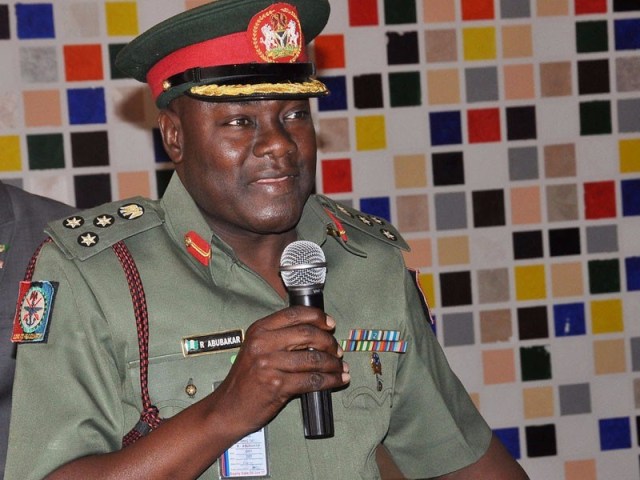
Spokesman of the DHQ, Rabe Abubakar, made the call during a session with Journalists in Yenagoa, the Bayelsa State Capital, where he had visited as part of a media tour across the country.

Abubakar, who met with the leadership of the Nigeria Union of Journalists, NUJ, in the oil-rich state said that the era of secrecy in the Nigeria military was over.

He added that he was touring media houses in the six geo-political zones in Nigeria, interacting with relevant stakeholders in the media industry in efforts to getting them to partner with the military for the greater good of the nation.

The DHQ spokesman said: “From north-east, I moved to the north-west, where I interacted with all the media houses there.

“Now I am in the Niger Delta to have a chat with the media executives and members of the Nigeria Union of Journalists.

“There is a policy shift in the military now; the days of secrecy are over.

“In view of this, we decided to extend a hand of fellowship to stakeholders, especially the media.”

Abubakar also urged media practitioners in the Niger Delta region to contribute their quota towards ensuring that the military succeed in its operations in the region.

“We need ourselves for this great country to move forward,” he said.

“We have responsibility to protect the lives of innocent citizens. It is only then that we can move the country away from crisis.

“Our duty as military is to ensure total peace not only in the Niger Delta, but in all areas where we have operations.”

On the military operation that is currently ongoing in the region, “Operation Delta Safe”, Abubakar said it was launched in order to check the activities of militants who engage in destruction of critical oil and gas facilities.

He also re-echoed the stance of the Nigerian army that own troops have “finished Boko Haram” with the capture of the Sambisa forest.

The military spokesman urged the media to lead a campaign that would produce lasting peace in the country.

Chairman of the Bayelsa council of the NUJ, John Angese, commended Abubakar for his visit, while also eulogising the Nigerian armed forces for their sacrifices and efforts at ensuring that Nigeria remained a united country.

Angese assured that the NUJ in Bayelsa will always support the Nigerian armed forces in their responsibility of protecting the territorial integrity of the country.

FG Commences Payment Of Ex-Militants’ Stipend

0


Payment of stipends to former Niger Delta Militants who were captured in the 2009 Presidential Amnesty Programme of the federal government has resumed.

Piriye Kiyaramo, an officer in the Amnesty office, told journalists on Thursday that the ex-militants started receiving two months arrears of their stipends on Wednesday.

Recall that the federal government had initially slashed the budget allocation for cash payments to militants as part of efforts at fighting corruption but had to resume the payments following series of pipeline attacks in the region.

There have been talks in recent times between the government and representatives of the Niger Delta with the aim of stopping the attacks which had reduced the nation’s oil output by 700,000 barrels a day for several months last year.

Kiyaramo said: “Two months of the ex-militants’ stipends were paid yesterday … The rest of their stipends will be paid later in batches by (central bank) CBN.”

He added that the paid stipends covered August and September 2016.

According to the amnesty deal, each former militant is entitled to N65,000 monthly plus job training.

The ex-militants had in late 2016 protested the non-payment of over five months arrears of their Stipend, calling on the head of the Amnesty Office, Paul Boroh, to live up to his responsibility.

Eric Omare, spokesman for the Ijaw Youth Council, IYC, had also complained on behalf of the former militants about the payment delays.

Stakeholders in the oil-rich Niger Delta region want more control of the resources available in their domain, saying that the federal government has not paid adequate attention to the sufferings of the people in the area, which were largely caused by oil exploration activities.

The Niger Delta has witnessed high level of environmental degradation following series of oil leaks in the region.

Water bodies have been contaminated and arable lands rendered un-cultivatable, leading to hunger, disease and death in the region from where flows the resources on which Nigeria largely depends.

Troops Rescue Another Chibok Girl

0


Another of the kidnapped Chibok School girls has reportedly been rescued on Thursday.

The girl, Rakiya Abubakar and her baby were said to have been rescued by troops of 27 Brigade around Alagarno area near Ajigin in Damboa Local government area of Borno State.

The Nigerian army also confirmed the development in a post on its official twitter handle, but added that more information will be made available later.

Later, The Director, Army information, Sani Usman, said: “Troops of Operation LAFIYA DOLE during investigation of arrested suspected Boko Haram terrorists discovered one of the abducted Chibok School girls, Rakiya Abubkar, with her six months old baby.

“According to preliminary investigation, it was discovered she is the daughter of Abubakar Gali Mulima and Habiba Abubakar of Chibok.

“She further stated that she was a student of Senior Secondary School Class 3B before her abduction along with her colleagues on 14th April 2014 by the Boko Haram terrorists.

“Rakiya Abubakar is presently undergoing further medical investigation and would soon be released to the Borno State Government,” Usman added.

Details of the development are still of the rescue are still not very clear at the time of this report.

Recall that the Nigerian Army captured Alagarno more than six months ago.

Sunday, January 8, will mark the 1000th day since more than 200 school girls were abducted by the Boko Haram terrorists from their school dormitory in Chibok, Borno state, on April, 2014.

The Bring Back Our Girls campaigners, led by former minister of Education, Oby Ezekwesili, have continued to hold sit-outs everyday at the unity fountain in Abuja, demanding that the Nigerian Government act fast to rescue the girls.

The group later posted on its twitter handle that it was on the process of verifying the true identity of the rescued girl.

Ezekwesili, at the group’s sit-out on Thursday, was quoted as saying, “how I wish we will gather here on day 1000 to dance and rejoice that our girls have all been rescued.”

It would also be recalled that 21 of the girls were recently released by the insurgents following a mediation brokered by the International Committee of the Red Cross, in conjunction with the Swizz Government.