Home Blog Page 2861

Troops Repel Boko Haram Attack In Madagali

0


Troops of the Nigerian army successfully repelled an attack by some Boko Haram terrorists who were believed to be fleeing from the military onslaught in the North East.

The attack occurred in Dar village in Madagali Local Government Area of Adamawa State.

Chairman of Madagali Local Government, Yusuf Mohammed, told newsmen that the attack was repelled because of the prompt response of security operatives in the areas.

He praised the gallantry of security personnel and local vigilantes in the area and called for more support to keep the region secure.

Akintoye Badare, an Army Major and Spokesman of the 28 Task-Force Battalion, Mubi, confirmed the development adding that there were no casualty on the military side during the operation.

“All I can confirm to you now is that there was an attack on Dar village but we successfully repelled it; no casualty on our side, ” Badare said.

He said that the situation in the area had since normalized while soldiers remain on full alert.

Minister Warns Against Inciting Further Violence In Southern Kaduna

0

Minister of Interior, Abdulrahman  Dambazau, has called on‎ religious and political leaders in the country to refrain from making inciting statements and giving religious connotation to the crisis between herdsmen and farmers in Southern Kaduna.  ‎

In a statement on Tuesday by his press secretary, Ehisienmen Osaigbovo, Dambazzau called on well-meaning Nigerians to join hands with government to end the perennial problem rather than engage in comments capable of heightening the crises.

The minister said that true religious leaders should not‎ fan the embers of hate, but ensure that communities live in peace and harmony, wondering why some people always look for ways to further create division along religious or ethnic fault lines for their selfish interest.

Dambazzau said that given the fact that there are over 500 ethnic groups and multiple religions in the country, unless Nigerians resolve to live amicably as a people with a common destiny, “Economic growth and development will remain a mirage for Nigeria.”‎

According to him,‎ ‎criminals who perpetrate violence against innocent, law-abiding citizens do not discriminate along religious and ethnic lines, as communities in Zamfara, Katsina, Taraba, Enugu, Lagos and Niger had witnessed  violent crises at one time or another.

“A criminal should be treated as such, whether he is involved in armed robbery, drug trafficking, homicide or cattle rustling,” the minister’s aide stated.

“People should avoid honouring criminals with religious or ethnic attachment,” he added. ‎

He called on political and religious leaders to “focus on the real enemies of our society, who illegally acquire weapons to terrorise Christians and Muslims communities alike.”

The minister said he had directed the Nigerian ‎Police to be more pro-active in ensuring the maintenance of law and order and to arrest and prosecute anyone involved in criminal activities across the country.

He ‎urged citizens to assist the police by providing valuable information that would ensure that peace and normalcy is restored in the community.

Meanwhile, Senate President Bukola Saraki has said that the Senate on its resumption from the Christmas break would launch an investigation into the crisis in Southern Kaduna.

According to Saraki, “Once we resume, this issue (southern Kaduna crisis) will be addressed to get a clearer picture.

“Every Nigerian life matter and the Senate will work to ensure that the rule of law is always upheld as prescribed by the Nigerian Constitution.”

Katsina Permanent Secretary Arraigned For Fraud

0


The Economic and Financial Crimes Commission, EFCC, has arraigned Sule Saulawa, a Permanent Secretary attached to the office of the Katsina State Deputy Governor, on a one count charge of Obtaining by False Pretense.

Saulawa was alleged to have collected the sum of N2.5 million from a contractor after promising to secure him a contract to supply fertilizer to every local government in the state.

According to the EFCC, the crime is contrary to section 1(1)(a) of the Advance Fee Fraud and Other Fraud Related Offences Act, 2006.

Saulawa was alleged to have obtained the money under the guise that it is for the purchase of bidding documents for the contract, after which he cut off all contacts with the complainant.

The EFCC stated that during its Investigation, one Kabiru Dan-Asali disclosed in his statement that he was present at the time the complainant, Musa Baba, gave one Nasiru who is a boy to the complainant, the said amount on behalf of the accused person.

According to the anti-graft agency, “The accused person also confirmed this in his voluntary statement he made to the EFCC, but still “pleaded not guilty to the charge when it was read to him in court.”

Prosecution counsel, Sa’ad Hanafi urged the court to fix a date for trial to commence, as well as for the accused person to be remanded in prison custody.

But counsel to the accused person, Bashir Mohammed, prayed the trial judge,Sanusi Tukur, to admit his client to bail pending the determination of the case.

The bail application was objected to by the prosecution who argued that the accused would likely jump bail because he had once dishonored the administrative bail granted to him by the EFCC.

Hanafi asked that the accused be remanded in prison custody, urging the court to order a speedy trial of the matter.

Justice Tukur subsequently remanded the accused person in prison custody and adjourned the matter to January 6, 2017 for ruling on bail application and commencement of trial.

Ekweremadu Calls For Caution Over The Gambia

0


Former Speaker of the ECOWAS Parliament and Deputy President of the Nigerian Senate, Ike Ekweremadu, has called on the Economic Community of West African States, ECOWAS, to have a rethink on its decision to deploy soldiers to The Gambia if incumbent President Yahya Jammeh refuses to step down at the expiration of his tenure on January 18.

Ekweremadu, in a statement issued by his Special Adviser on Media, Uche Anichukwu, on Tuesday in Abuja, warned that taking military action in the Gambia could plunge the country into bloodletting and threaten the security of the entire sub-region.

He however advised that the ECOWAS Heads of State and Government, as well as the international community should continue to employ the use of dialogue and to allow Gambian laws to prevail as a sovereign nation.

He also said that in the event that dialogue and judicial options fail, sanctions should be considered in line with the traditions and relevant Protocols of ECOWAS,

“We must all acknowledge the fact that Gambia is a sovereign state,” Ekweremadu stated.

“If her Constitution and electoral laws allow for judicial role in resolving electoral disputes, then the Gambian constitutional courts must be allowed to count in resolving the political impasse.

“If the Gambian laws are preempted and her sovereignty breached, it could set a bad and crisis-triggering precedence.

“The sub-region must uphold the rule of law for the sake of the peace, stability and prosperity of Gambia.

“We must take all necessary steps as a sub-region to steer the West African nation and indeed the entire community away from any looming bloodshed and monumental destruction,’’ he warned.

The deputy Senate President, however, commended ECOWAS Heads of State and Government for the concern and commitment toward resolving the political situation in Gambia.

He commended President Muhammadu Buhari especially for his determination to resolve the political situation in that country.

But he warned against actions that could further deteriorate the already precarious security in the West African Sub Region.

Ekweremadu stated: “From Liberia to Sierra Leone, Cote D’Ivoire, among others, West Africa has seen so much bloodletting and political instability.

“Heavy destruction of lives and property has been visited on the sub-region by insurgency and terrorism, which remain present danger to the peace and security of West Africa.

“Instructively, what normally started like child’s play often resulted in protracted, but avoidable political upheavals and fratricidal wars.”

The former ECOWAS Speaker called on Gambian authorities to ensure the protection of the fundamental and political rights of all Gambians and the opposition, to avoid escalation of the crisis.

Sokoto State To Screen Public School Teachers

0


The Sokoto State government said it will conduct proficiency test for all teachers working in public schools in the state.

Governor Aminu Tambuwal said this during a meeting with Riskuwa Shehu, Chairman of the Sokoto State Committee on Emergency in Education.

In a statement issued on Tuesday, Imam Imam, spokesman to governor Tambuwal, said that the committee had in November 2016 conducted a  needs assessment of public schools in the state and is expected to present its report soonest.

Imam stressed that the proficiency test is part of efforts to ensure that teachers in the state are appropriately qualified to drive the state’s education sector as well as to provide credible data on the number of teachers in the state’s public service.

He said: “The test will improve our data base on the number of teachers in public service which will in turn be used to harmonise records available with different agencies and departments of government.

“This is also part of measures taken under the emergency on education initiative to shore up standards.

The governor’s spokesman however added that the test was not designed to sack teachers who fall below the required standard.

“Alternatively, we will redeploy them to other sectors befitting of their qualifications and expertise,” he said.

“Government will continue to benefit from their services as to the terms of their employments.’’

Imam stated further that governor Tambuwal was determined to bring about a positive turn-around in the standard of the education in Sokoto state.

According to him, the governor’s resolve to improve education in the state was underscored by the fact that education retained the highest allocation in Sokoto State’s 2017 budget.

“Our thinking is that no amount of money allocated to the education sector is too much and we will not waver in this direction,” Imam quoted governor Tambuwal as saying.

Jammeh Clamps Down On Media In The Gambia

0

The authorities in The Gambia have shut down a radio station known for its criticism of President Yahya Jammeh.

Head of the Gambia Press Union, Emil Touray, said that Intelligence agents ordered Teranga FM’s closure without giving reasons.

This is the first sign of a crackdown on the media since Jammeh rejected defeat in the  December presidential election.

Jammeh first seized power in a bloodless coup in 1994.

He initially conceded defeat to his opponent, Adama Barrow, but then launched court action to annul the result, saying the poll was marred by irregularities.

The electoral commission has insisted that the poll was free and fair.

A staff member of the radio station, Teranga FM, told journalists on condition of anonymity that four Gambian National Intelligence Agency operatives and a police officer visited the station and demanded its closure.

There has been no official comment from the government.

The 2016 Reporters Without Borders’ World Press Freedom Index ranked the Gambia 145 out of 180 countries, adding that there was “a climate of terror around anything remotely to do with journalism” in the country.

The UN and West African regional body, ECOWAS, have urged Jammeh to respect the will of the people and step down when his term ends.

Ecowas officials say that neighbouring Senegal’s troops are ready to intervene if he refuses to hand power to Barrow on 19 January.

But Jammeh said that any deployment would be an “act of war”.

Barrow caused a major upset by defeating Jammeh by 43.3% to 39.6%.

The Gambia has not had a smooth transfer of power since independence from Britain in 1965.


Borno Clarifies Arrest Of LG Boss Detained On Suspicion Of Shielding Wanted Terrorist

0

The Borno State Government has clarified the arrest and detention of the Chairman of Mafa local government area of the state, Shettima Lawan, who was falsely reported by some media outlets as having links with the Boko Haram terrorists.

Commissioner for Local Government and Emirate Affairs in the state, Usman Zanna, in a statement, explained that  the council boss had voluntarily presented himself to the military to assist in ongoing investigations of one of the kingpins of the insurgency group.

Zanna expressed surprised at  the “very worrisome twist in the case,” noting that the detained council chairman  was renowned for his  courage in the counter insurgency campaign as he has worked closely with hunters and military commanders in Mafa to lead community fight against Boko Haram.

The ‎commissioner stated that his ministry would not have made public comments about the ongoing investigation as it “neither questions the judgment and authority of the military nor exonerates the chairman of any wrongdoing in order not to preempt the outcome of ongoing investigation.”

He added, however, that “It has become necessary that this statement is issued in order to put some records straight.

“First of all, contrary to media reports, the caretaker chairman in question was not arrested. He actually reported himself to the military command in Maiduguri after he got information that he was needed by the military.

“Secondly, contrary to reports by the media that he was arrested at the 1,000 Housing Estate along Maiduguri-Damaturu road … the Chairman lives at 505 Housing Estate which is located on an entirely different route, along Dikwa and Mafa which is the way to the Chairman’s office in Mafa.”

Zanna explained that it is a norm with almost every adult living in Maiduguri that they have relatives who had been displaced by the Boko Haram insurgency taking shelter at their homes.

He said: “The Chairman recently got involved in assisting some citizens trapped in a village within his local government area and he is believed to have Internally Displaced Persons living in his residence at 505 Housing Estate like most adults in Maiduguri, Jere and parts of Konduga do have fleeing relatives and friends living with them.”

But “There is an information that a certain suspected member of the Boko Haram might have joined some of the citizens he helped last week but whether he knew the identity of the suspect and deliberately hid him and for whatever purpose is what we look forward to being determined by the military.”

The commissioner further explained that “It is a twist because, for years, the caretaker chairman has been known for his courage in joining hunters to go into front lines to battle Boko Haram fighters.

“His commitment in the fight against insurgents is known to different Army Commanders that served in Mafa local government area in the last two years.

“The likes of Major Manga can bear testimony to this.”

Zanna pointed out that “it is mainly due to his passion for the fight against insurgency that he has been successively  reappointed as caretaker Chairman of Mafa for renewable term of six months as provided by laws of Borno State.”

He noted that his ministry was in full support of the investigation “because it affects the safety and integrity of the Ministry.”

“It would amount to seating on a keg of gun powder if anyone dealing with the Ministry, involves in harbouring any criminal, especially insurgents that have killed our parents, wives, sons and daughters in addition to sending our families out of their communities to now live with us in pains,” he said.

The commissioner stressed that the State government is “usually very thorough in identifying those appointed either as local government chairmen, ward councillors, traditional rulers, vigilantes and members of the Civilian JTF deployed to the 27 local government areas of Borno State.”

He assured Borno State citizens as well as the generality of Nigerians and the International Community that the military would come with the true position of things and would make its findings public.

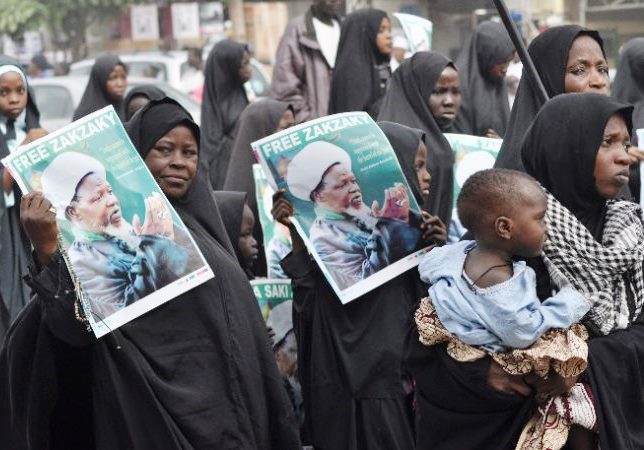
Obey Court Order, Free El-Zakzaky, IMN Urges Buhari

0


The Islamic Movement in Nigeria, IMN, has called on President Muhammadu Buhari to obey the rule of law and release its leader, Ibrahim El-Zakzaky.

The group was responding to the president’s New Year message where Buhari referred to the shiite sect as “brothers and sisters”, urging them to  “accept the laws of the country”.

President of the media forum of IMN, Ibrahim Musa, in a statement on Sunday, said that on the contrary, it is the federal government, led by President Buhari, that must obey court orders and release El-zakzaky.

“We call on the President to stop beating around the bush. He must release Sheikh Ibrahim Zakzaky immediately as ruled by the Court of the land,” Musa said.

The Shiite spokesman added that the President should also “order for the immediate release of all those who are still being held in various places of detention across the country since the brutal attack on us.”

“We expect him to take bold steps against the officers that massively killed citizens in Zaria, Kaduna, Kano, Funtua and Sokoto since the onset of the attacks on us in December of 2015.

“We expect actions to address the matter of victims secretly buried in mass graves.”

The group also demanded “for payment of compensation for lives and property destroyed in the ill-conceived attacks”, as well as “words of condolences in relation to those extra-judicially killed since the pogrom started.”

Musa recalled that the IMN had “challenged all acts of brutality and extra-judicial killing of our members in our law courts peacefully” and had refused to take the laws into their own hands “even in the face of extreme persecution and provocation.”

“On the contrary, Mr President, you are yet to obey the court order to release our leader, Sheikh Ibraheem Zakzaky, whom you have held in illegal detention, without charges, for more than a year now despite a court order for his release,” he said.

According to Musa, the group’s lawyer, Femi Falana, SAN, had written through the Attorney General, to remind President Buhari of the court order yet nothing has happened.

He also reminded the president that members of the Shiite are “embedded into all aspects of the society, contributing positively in various ways to its success.”

“We have built bridges across both intra and inter-faith divides. We have been bridging gaps across tribal and regional divides.

“We have been exposing the evil machination of authorities against its very citizens.

“Is that not the very reason the authorities seek to curtail what they perceive as our growing influence and impact on the society?” he asked.

The shiite spokesman advised Buhari to stop relying on “cooked up reports, which you call “intelligence” based on private prejudices that do not reflect reality to formally crystallize into official resentment and hate for a group and its leadership.”

Recall that El-zakzaky had remained in the custody of the Department of State Services, DSS, since December 2015, following a deadly clash between members of the IMN and Nigerian soldiers in Zaria, Kaduna State.

The clash led to the death of more than 300 shiite muslims while one soldier also died.

Kaduna Attacks: Police To Set Up Squadron In Kafanchan

0


The Nigeria Police has announced a plan to set up a squadron made up of over 700 mobile personnel of the force in Kafanchan, Kaduna State.

The move is part of efforts at stemming the tide of attacks in the Southern part of Kaduna state, northwest of the country.

Similarly, the force has inaugurated a committee to investigate the attacks on Goska, Ninte and other villages in the area.

Inspector General of the force, Ibrahim Idris made the disclosure on Saturday when he led other personnel of the force on a fact finding mission to Kafanchan, headquarters of Jema’a local government area in Kaduna state.

Having gone round, the Police boss noted that the unrest had more of political than religious undertone.

He commiserated with those who have lost loved ones and properties to the unrest, but added that the situation has been blown out of proportion.

Ibori And A Nation United By Corruption

0

By Chido Onumah

One of the highlights of the year that has just ended was the release from a British jail of one of Nigeria’s most notorious politically exposed persons (PEPs), James Onanefe Ibori.

Ibori’s rap sheet is as long as the 338km East-West Road in Nigeria’s Niger Delta region, but the reason for his latest freedom was the conviction and sentencing—13 years in prison—by a Southwark Crown Court in April 2012 after he pleaded guilty to a 10-count charge of money laundering, corruption and conspiracy to defraud.

Of course, it wasn’t Ibori’s release that dominated the news, as newsy as his expected release was. Rather, it was his triumphant return to the warm embrace of his kinsmen, supporters and well-wishers.

James Onanefe Ibori or James Onanefe Ochuko Ibori, depending on if you are appearing before the Supreme Court of Nigeria, is an enigma. He was governor of Delta State from 1999-2007. He and his bosom friend, Bukola Saraki, Nigeria’s current senate president, bankrolled the political machine that led to the emergence of Umaru Musa Yar’Adua as president in 2007. And if not for providence—the death of Yar’Adua in May 2010—Ibori, who up until then was the de facto vice president of Nigeria, would have succeeded Yar’Adua.

Yar’Adua died and Nigeria dodged a bullet or so we thought! Ibori was subsequently jailed in 2012, two years after he was arrested – and extradited to the UK – by the Interpol in Dubai, the United Arab Emirates, where he was hiding after fleeing Nigeria.

Even in prison, he maintained his godfather role and from the public admission of one of his surrogates played a key role not only in the emergence of high-ranking public officers in Delta State but the leadership of the National Assembly.

For the trajectory of the Ibori saga and persona, readers will find this piece, “The welcome party for Ibori” by Simon Kolawole, instructive.

Depending on where you come from, perhaps your political affiliation and how much you benefitted from the Ibori heist in Delta State, either directly or through a third party or even tangentially as a hanger-on, the celebratory Mass held in honour of Ibori’s release from prison, though detestable, was quite understandable.

After all, there is an Ibori in many of us. There are countless Iboris in the National Assembly, criminals making laws and posing as “distinguished senators” and “honourable members”.

There are Iboris in various government houses across the country; scoundrels posing as executive governors. There are Iboris in the Army, Air Force, Navy, Customs, Immigration, Prisons, Police, our universities and sundry public institutions where those who have been kept in charge of what Peter Ekeh in his seminal essay, “Colonialism and the Two Publics in Africa: A Theoretical Statement”, referred to as “civic public” conveniently and unconscionably steal from it and divert their loot to the “primordial public”.

That is the sorry state of Nigeria. And it explains the Ibori conundrum. According to Ekeh, “A good citizen of the primordial public gives out and asks for nothing in return; a lucky citizen of the civic public gains from the civic public but enjoys escaping giving anything in return whenever he can. But such a lucky man would not be a good man were he to channel all his lucky gains to his private purse. He will only continue to be a good man if he channels part of the largesse from the civic public to the primordial public. That is the logic of the dialectics. The unwritten law of the dialectics is that it is legitimate to rob the civic public in order to strengthen the primordial public.”

So, just as it is often the case where one person’s freedom fighter is another person’s militant, as a people, Nigerians seem not to be in agreement on what constitutes corruption or who a corrupt person is.

What one Nigerian sees as corruption, another sees it as “blessing from God”, their own opportunity or “turn to eat”. The national cake is there for the taking.

The state has abdicated its responsibilities—roads, water, school, health, sanitation, etc—and instinctively we have learned to “manage” by helping ourselves to as much as the national pottage, in the “civic public”, as we can lay our hands on.

Take the ongoing spat between the current Inspector General of Police, Ibrahim Idris, and his predecessor, Solomon Arase, who has been accused of making away with over 20 police vehicles when he retired in June 2016.

Arase didn’t deny carting away police vehicles. He is just piqued that when it was his “turn to eat”, the police authorities suddenly became amnesic. To show his righteous anger on an issue that has caused public discomfiture, Mr. Arase’s reminded the all-righteous police authorities that there is nothing new in Inspectors General of Police making away with enough vehicles to open a car shop when they retire.

“I expect that former occupants of the office of the Inspector-General of Police should not be demeaned. This explains why Force Order 295 was emplaced by the force management under my leadership as acknowledged in your letter in reference,” Arase wrote to his predecessor in his defence.

“In spite of the emplacement of this order and despite the fact that my two immediate predecessors left office with 13 and nine vehicles of different makes and models respectively, I never pressurised either of them to return any of such vehicles neither did I engage in any act that was capable of bringing them to ridicule as being done to me of late by a force I dedicated my life to serving up to the highest level.”

Clearly, pubic office in Nigeria is simply a sinecure and your kinsmen and associates would eternally excoriate you for not taking advantage of a life-changing opportunity.

As someone once reminded me, public office in Nigeria is like climbing a mighty tree with lots of fruit. Once you climb, you are required to get as much as you can because you may not have a second chance.

So, we are all ceaselessly engaged in the race of getting a nibble at the cake. To appreciate the Ibori phenomenon, you must understand Nigeria. Here, the best private schools, including universities, are owned by those whose responsibility has included how to make our public schools functional. It is the same story for the health, transport, and indeed, every sector of the Nigerian society.

It is as if Nigerians, wherever we find ourselves in the “civic public”, are in a race for a medal on how best to pillage the country. The “Villa Repair Heist”, as someone has described it, provides a fitting example of this brazen larceny that is called public service in Nigeria.

The 2016 budget for repairs and rehabilitation of Nigeria’s Presidential Villa, Aso Rock, was N642.5 million.
By 2017, the budget had shot up to N5.6 billion.

“Was the Villa hit by a bomb or earthquake unbeknownst to us citizens?” “Was there a war akin to Aleppo in the place?” one commentator asked.

No, there wasn’t. It is simply “their time to eat.”

In the same budget, there is a provision of N2.3billion for the Defence Headquarters to clear backlog of electricity bills that is budgeted for every year.

In July 2012, I was part of an audience at Chatham House, London, where an ex-governor of Niger State and Chair of the Northern States Governors Forum, Dr. Mu’azu Babangida Aliyu, was guest speaker.

Dr. Aliyu spoke on “Nigeria’s Unity and Regional Socio-Political Groups: Influence and Impact of the Northern States Governors Forum (NSGF).”

He noted that “corruption was the single unifying factor of the elite in Nigeria and that the way to deal with it was to reduce the focus on the centre.” Aliyu is right in many ways. But it is not just the elite. It is about Nigeria.

Today, if someone is robbed, we no longer get jolted. The refrain will be, “Thank God he is alive.” “We praise God the robbers took his possession and spared his life.” “God bless those robbers.”

It is the same response you get when kidnappers strike. We no longer bother to interrogate armed robbery, kidnapping and other vices that have become part of our national ethos.

The celebration of Ibori’s return from prison, therefore, provides an opportunity to interrogate what Nigeria means to us as Nigerians. The problem is not really with Ibori or those who have elected to celebrate him. The problem is with Nigeria, a place where allegiance is to the “primordial public”, where rulers live in mansions and religious centres luxuriate in splendor while public schools and hospitals wallow is squalor.

Onumah is the author of We Are All Biafrans Contact him on conumah@hotmail.com; Follow him on Twitter: @conumah


read also: