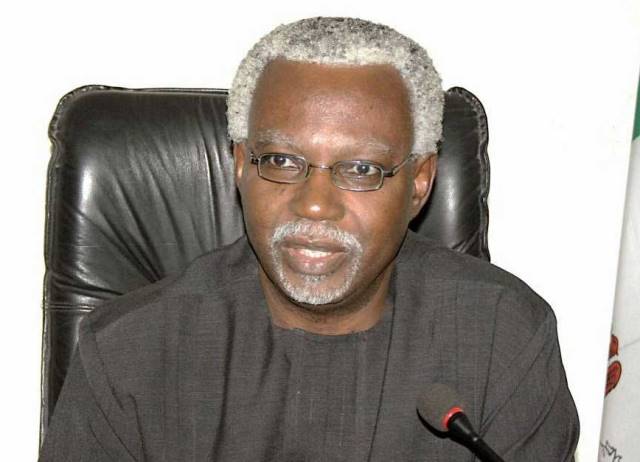
The Presidency and the Economic and Financial Crimes Commission, EFCC, have denied claims that Ibrahim Magu, acting Chairman of the Economic and Financial Crimes Commission,EFCC, was sacked this morning, December 31.
In a brief statement by Garba Shehu, Senior Special Assistant to President Muhammadu Buhari on media and publicity, the Presidency said it was unaware of the purported sack of Magu.
“We are reading reports that the EFCC Chairman, Ibrahim Magu has been sacked. No report has been made available to the Presidency by the Attorney General of the federation over the matter. The report of his sack is therefore speculative and preemptive,” Shehu stated.
Wilson Uwujaren, spokesman of the anti-graft agency who spoke with www.icirnigeria.org, had also denied the report.
“The report is not true. Yes, it is true that he received a query from the Attorney-General and Minister of Justice. But any other story is not true. He is still in charge,” Uwujaren stated.
A report published by the Guardian on Saturday quoted an unnamed source as disclosing that Magu has been redeployed back to Nigerian Police Force “to pave way for a fresh person to be presented by President Muhammadu Buhari as the nominee to head the anti-graft agency before the Senate.”
The paper also said it “reliably gathered” that the Attorney General of the Federation and Minister of Justice, Abubakar Malami, had already issued a letter to Magu on the development and directed that he hands over to the director of operations in the Commission.
Some online publications, quoting the Guardian, had also reported Magu’s sack.
Magu has been in the eye of the storm since the Nigerian Senate recently rejected his nomination to head the EFCC and failed to confirm him as substantive chairman of the commission.
The senate, which did not hold any confirmation hearing for Magu, but discussed his confirmation at a close door executive session, said Magu’s confirmation was rejected because of a security report by the Department of State Services which allegedly levelled allegation of graft against him.
Magu has however repeatedly denied any wrong doing. Itse Sagay, Chairman of the Presidential Committee on Anti-Corruption, in a recent interview had said the presidency would continue to re-present Magu for confirmation as EFCC chairman.
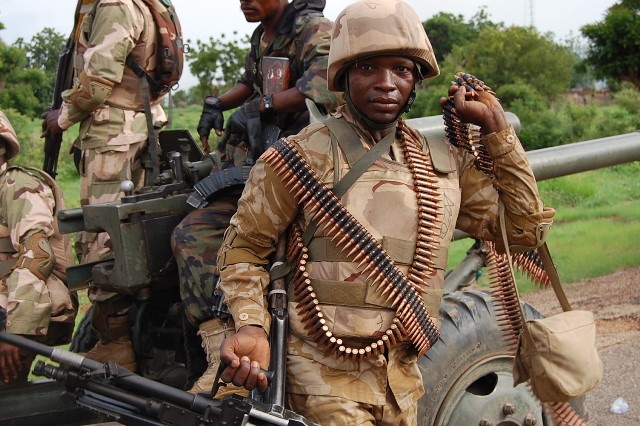
No less than 15 Boko Haram fighters were reportedly killed when they engaged troops of the Nigerian Army in a fierce gun battle in Borno State on Friday.
Military sources told newsmen that the attack began very early on Friday and lasted more than three hours.
The terrorists were reported to have launched the surprise comeback attack on troops’ location in Rann, northern Borno, where soldiers from 3 Battalion and 112 Task Force Battalion are stationed.
According to the military sources quoted by online newspaper, PREMIUM TIMES, the soldiers responded promptly, killing many of the terrorists while several others escaped with bullet wounds.
One of the sources said that more than 15 of the Boko Haram fighters were killed in action; another said the figure was much higher.
However, four Nigerian soldiers were reportedly wounded in action.
Military authorities had since contacted the nearby 22 Brigade to send air ambulance to evacuate one of the soldiers who was critically injured.
According to sources, many arms and ammunition were recovered from the terrorists including: two AK47 rifles, four FN rifles, one M21 rifle, 110 X 7.62MM NATO ammunition, 20 X 7.62MM special,, 40 X M21 rounds, 4 X FN extra magazine and two locally made explosives.
The battle is coming a day after a new Boko Haram video was released on the internet where the leader of the Boko Haram sect, Abubakar Shekau mocked President Muhammadu Buhari and the Nigerian military.
Shekau said the claims that Sambisa forest has been captured and the insurgents decimated were false as they were safe and would continue to fight.
The Nigerian army however urged Nigerians to disregard the new video, as it was mere propaganda by an already defeated Boko Haram.
The United Nations Secretary-General, Ban Ki-moon, will end his tenure on 31 December 2016, bringing to an end a double five-year tenure at the helm of affairs in the world body.
The South Korean began his first term as Secretary-General on 1 January 2007, and was unanimously re-elected by the General Assembly to a second term on 21 June 2011.
In his last remaining days at UN Headquarters, the Secretary-General spoke with journalists on a range of topics, including his service with the world body, the impact that war had on his decision to pursue a career in public service, and his next steps.
According to him, “It has been a great privilege for me to serve this great organization. My motto was that I will make this “most impossible job” into a “possible mission.”
“I have been trying during the last ten years, devoting all my time, passion and energy.
“It’s been very tough, very difficult. But, however difficult or challenging it may be, if you have strong commitment and a sense of balance and focus on your job, I think nothing is impossible.”
Ki-Moon attributed the successes recorded during his tenure to the support he received from member-countries, as well as from the entire staff of the UN whom he said demonstrated passionate commitment to their responsibilities.
“I am deeply grateful to our dedicated staff who have been working day and night – in many cases, in very dangerous circumstances,” he said.
“Whatever successes or achievements there may be, they are the outcome of joint efforts – not by me alone.
“The Secretary-General, however capable or willing, cannot do it alone. No single country or person can do it alone without support,” he added.
When asked about what stood out among the achievements recorded by the UN during his tenure, Ban Ki-Moon cited the Paris Climate Deal and the 2030 Agenda for Sustainable Development Goals.
“We achieved very important visions – like the Sustainable Development Goals covering all spectrums of life and the Paris Agreement on climate change – these are two very important, ambitious and far-reaching achievements,” he noted.
The outgoing Secretary General also added that his legacy on gender empowerment was worth mentioning as part of successes recorded during his time at the helm of the UN.
He said: “When I first became Secretary-General, there were just a few women staff at the senior level.
“But I have been trying to appoint as many capable and committed women to senior positions.
“I hope my successor, António Guterres, will build upon this.”
On the issue of incessant crises around the world, Ki-Moon said world leaders are to blame.
“My observation as Secretary-General during the last ten years … is that all these issues, these conflicts, have not been caused by the people.
“Most of these conflicts, unfortunately I have to say, were caused by leaders – because leaders have not shown strong commitment to the goals and ideals of the Charter of the United Nations, to basic human rights.
“Had all of these leaders shown more solidarity and empathy and compassion to their people, we would have much less conflict at this time.”
He urged leaders to “put the public common good ahead of everything else, ahead of your personal, narrow or regional perspectives.”
He also expressed deep gratitude for many UN workers “who work day and night on the scene of conflicts and humanitarian disasters,” adding that “Without them, I think that many more people might have died.”
The UN Boss said what he would miss the most is “the solidarity which our staff show for humanity,” while also expressing optimism that the incoming Secretary General, being “a man of compassion” would do even more for the organization.
When asked what he would do next after retiring from the UN, Ki-Moon replied, “Whatever would be necessary, wherever it would be necessary.”
“I will not spare any effort to do something that is right for my country, or an even greater community, beyond my country. I think it’s proper for any former Secretary-General to render his or her support to a common cause,” he said.
The current prosecution of some judges for alleged corrupt practices and the ongoing trial of some politicians and public functionaries in the immediate past administration on allegations of diverting some funds meant for arms procurement have left Nigerians and the world in no doubt that President Muhammadu Buhari’s anti-corruption war is on course.
Many Nigerians are pleased by these actions especially the one which touches a section of the public service hitherto thought to be shielded by the system from external scrutiny.
Coming on the heels of this development was the disclosure by the Independent Corrupt Practices and other Related Offences Commission,ICPC, of a massive corruption ring around some Ministries, Departments and Agencies,MDAs, of the Federal Government and the recovery of over 100 exotic vehicles including amoured bullet proof sport utility vehicles,SUV, involved, worth over N450 million.
Any observer following the activities of the ICPC can easily recall that the recovery of looted public assets including money and property worth billions of naira, has been a consistent achievement of the Commission in its interventions over the years. Another achievement is the high success rate of its prosecution of suspects in the corruption cases it has handled. Virtually all its cases decided so far in the courts ended in the conviction of the suspects. This feat is largely credited to its painstaking investigation process and diligent prosecution.
However, the Commission is simultaneously pursuing a more ambitious plan to weed out corruption from the body politik of the nation by the institutionalization of the anti-corruption fight in every segment of the society. This tall but achievable dream was launched some years ago by a former chairman of the Commission, Justice Emmanuel Ayoola JSC rtd. His successor, the current chairman of the Commission, Ekpo Nta has now carried it far. The focus of the initiative is to prevent corrupt acts from even taking place at all or to expose them before they could be perpetrated full blown.
The preventive option is a way of reinforcing the anti corruption war by enlisting the support and participation of every section of the citizenry and it is considered by the United Nations Convention on Corruption,UNCAC, as the most innovative and proactive way of fighting corruption down to the roots within and across national borders. This is the area where the ICPC is uniquely making the difference in the fight against corruption in Nigeria. It is anchored on three main strategies. They include advocacy against corruption, building of formidable coalitions of various segments of the society to fight it in both public and private sectors and strengthening of institutions to withstand and rebut corruption.
Advocacy against all forms of corruption is one of key strategies of the Commission’s operations and it is one of its core mandates. Through conferences, seminars, workshops, town hall meetings and other relevant fora, the Commission has consistently sought to create public awareness on what constitutes corruption in our day to day living ranging from the big issues of looting, embezzlement, misappropriation and abuse of position to issues of gratification often taken for granted as normal favours, or perks of position and issues of dishonesty for gain often explained away in such terms as “everybody does it”.
In this regard, the Commission has been able to sensitize, enlighten and educate various groups of stakeholders on the dangerous implications of such corrupt acts on the society and why people should refrain from engaging in them. In addition, the Commission regularly issues statements of caution to warn people against acts of corruption that many often confess ignorance.
The second corruption prevention strategy operated by the Commission is the engagement of various groups of stakeholders in different sectors for concrete actions against corruption through active collaboration and partnership with the Commission. This endeavour which is steadily building a formidable coalition against corruption in every sector and facet of the Nigerian society is being prosecuted on many platforms.
They include the Integrity First Initiative which is a collaboration with the business community to fight corruption and the National Anti-corruption Coalition which is a partnership with Civil Society Organizations,CSOs, against corruption. Others are the Local Government Integrity Initiative to institutionalize the fight against corruption in Local Government administration, the Religious Leaders Forum which is carrying anti-corruption outreaches to the churches and mosques and the National Assembly Forum which so far has been used to prosecute the integrity campaign in both the National Assembly and in 30 state assemblies.
ICPC also operates the National Anti-Corruption Volunteer Corps,NAVC, in all local government areas of the federation and they monitor both the public and private sectors. More significantly, the Commission operates what could be called anti-corruption warriors in the various ministries, departments and agencies of government at various levels. These are the Anti-Corruption and Transparency Monitoring Units, ACTUs, which monitor compliance with regulations and report violations and infractions promptly to appropriate authorities.The whistle blower role of the ACTUs has helped on several occasions to nip corruption in the bud or expose it in the MDAs.
Perhaps the most ambitious engagement with stakeholders that is very dear to the Commission is its bid to inculcate hatred for corruption of any kind in the mindset of the up and coming generations of Nigerians from their formative years to adulthood. In this regard the Commission has set up Anti-Corruption Clubs in secondary schools. It also operates Students Anti-Corruption Vanguards,SAVs, in tertiary institutions across the country.
In addition, the Commission has, in collaboration with the National Educational Research and Development Council, NERDC, developed a curriculum to teach integrity values of honesty, discipline, fairness, contentment and patriotism in secondary schools. At the tertiary level, the Commission is also collaborating with some universities in this regard. One of them, the University of Calabar has approved a general studies course in corruption studies which is a compulsory course for all students. The Commission also collaborates with the National Youth Service Corps, NYSC, through seminars at the orientation camps to prepare fresh graduates for integrity challenges of employment.
The third major strategy of the preventive option is the strengthening of institutions and establishments, especially the ones prone to corruption, to prevent them from being manipulated to commit corrupt acts. In this regard, the Commission has carried out system study reviews on many institutions to check areas of leakages facilitating corruption and strengthen in-built mechanisms for compliance with due process and other regulations. For instance, this has proved to be very effective in the aviation sector and has curbed corruption at the nation’s airports.
In realization of the need for anti-corruption fighters to have requisite knowledge and skills to prosecute the war successfully, the Commission runs a world class anti-corruption academy. The Anti-Corruption Academy of Nigeria, ACAN,training programmes have empowered various categories of the Commission’s staff with modern up to date knowledge and skills in anti-corruption fighting, including forensic science. The academy is also involved in training various groups of stakeholders in the public as well as private sectors such as banking and finance professionals to effectively deal with corruption issues.
The scourge of corruption may appear to be a monumental threat in Nigeria today. However, as these systemic and structural measures being put in place by the ICPC increasingly find expression in the minds and practices of the citizenry, the decline of corruption and its eventual rejection by the Nigerian society’s is just a matter of time.
Folu Olamiti, a Media Consultant, writes from Abuja
The Nigerian Army has described the new video released by the Boko Haram terrorists as “mere terrorist propaganda.”
Abubakar Shekau, the leader of the sect, was heard in the video saying that they have not been flushed out of the Sambisa forest as claimed by the military.
Shekau said President Muhammadu Buhari should “stop lying to the people.”
“If you indeed crushed us, how can you see me like this? How many times have you killed us in your bogus death?” he asked.
“We are safe. We have not been flushed out of anywhere. And tactics and strategies cannot reveal our location except if Allah wills by his decree,” Shekau added.
However, the Army authorities in a statement maintained its stance that it “captured and occupied the last known stronghold of the terrorists group in the Sambisa forest,” adding that the said video clip will undergo “further forensic analysis” to ascertain its authenticity.
The statement read in part:“We would like to reassure the public that this video is nothing but mere terrorists propaganda aimed at creating fear in the mind of people and to remain relevant.
“Therefore, there is no cause for alarm, more so as concerted effort in clearing the vestiges of Boko Haram terrorists wherever they might be hiding is still ongoing.
“Our gallant troops deployed in various parts of the north east have continued to intensify search for all persons associated with Boko Haram terrorist group with a view to bring them to justice.”
Recall that President Muhammadu Buhari, on Christmas Eve had announced that troops of the Nigerian Army has captured the Sambisa forest, which is the final and major stronghold of the Boko Haram terrorists.
Army authorities also said that over 1000 terror suspects were arrested after the fall of Sambisa, while many others surrendered to troops of Niger Republic.
Chief of Army Staff, Tukur Buratai, also said that the army would convert the Sambisa forest into a training ground to make sure that the terrorists do not regroup to cause more havoc on Nigerians.
The United States has expelled 35 Russian diplomats as punishment for alleged interference in last month’s presidential elections, giving them 72 hours to leave the country.
Russian intelligence compounds in New York and Maryland will also be closed.
President Barack Obama had vowed to take action against Russia amid accusations that it directed hacks against the Democratic Party and Hillary Clinton’s campaign.
The US State Department declared the 35 Russian diplomats from the Washington DC embassy and the consulate in San Francisco “persona non grata”, and gave them and their families 72 hours to leave the US.
The move follows calls from senior US senators to sanction Russian officials who are believed to have played a role in the hacking, which some lawmakers referred to as America’s “political Pearl Harbor”.
Republican senators John McCain and Lindsey Graham, who led the calls for sanctions, said they “intend to lead the effort in the new Congress to impose stronger sanctions on Russia”.
A Kremlin spokesman told journalists in Moscow that President Vladimir Putin would consider retaliatory measures.
Dmitry Peskov said the actions were “a manifestation of unpredictable and aggressive foreign policy”, and called them “ungrounded and not legal”.
President-elect Donald Trump, who will take over from President Obama next month, has dismissed the hacking claims as “ridiculous”.
Sanctions have also been announced against nine entities and individuals including Russian intelligence agencies, the GRU and the FSB.
In a statement, President Obama called the moves a “necessary and appropriate response to efforts to harm US interests” and said, “all Americans should be alarmed by Russia’s actions”.
Obama also announced that the US would declassify technical information related to Russian cyber activity to “help network defenders in the United States and abroad identify, detect and disrupt Russia’s global campaign of malicious cyber activities”.
Speaker of the House Paul Ryan said in a statement that despite the measures being overdue “it is an appropriate way to end eight years of failed policy with Russia”.
Democratic Senator Ben Cardin, who is from Maryland, called for Congress to take action separately from the White House, and plans to introduce legislation to establish a committee “to further examine the attack and Russian’s efforts to interfere in our election”.
In a joint statement by the Department of Homeland Security, the Office of the Director of National Security, and the FBI, US officials appeal to companies to “look back within their network traffic” and report any signs of “malicious cyber activity” to law enforcement.
Emails stolen from Hillary Clinton’s campaign manager and from the servers of the Democratic National Committee were released during the 2016 presidential election by Wikileaks.
Several US agencies, including the FBI and CIA have concluded that the hacked information was released to cause damage to Clinton and the Democrats in order to favour Trump.
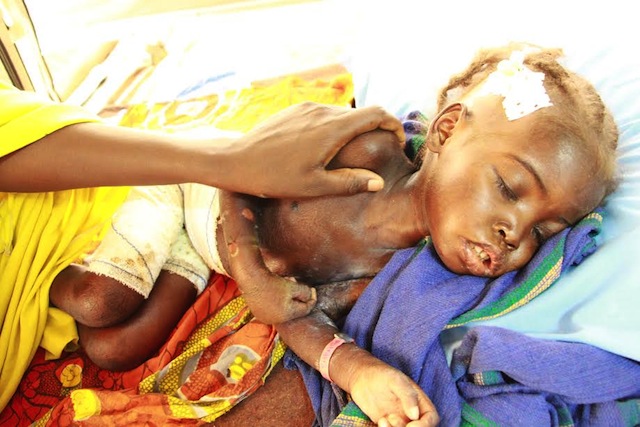
At the tender age of three, Halimat is experiencing a torture that even a 30-year-old would struggle to withstand. At the 110-bed Inpatient Therapeutic Feeding Centre (ITFC) of the Médecins Sans Frontières (MSF) in Gwange, Maiduguri, where she was first spotted in early November, Halima lets out a cry every time she turns on her sick bed.
Almost every part of her slender body is swollen, wrinkled or bruised; half of it is bandaged. She is suffering from severe acute malnutrition, worsened by constant diarrhoea and oedema — a buildup of body fluid that results in a swollen body and causes severe pain.
A doctor painstakingly examines her body to find a vein through which to catheterise her since she cannot eat manually. After 10 minutes of fruitless search, he settles for a spot on her head just by her right temporalis.
It’s all part of a string of medical processes aimed at preserving Halima’s life, but it first causes her excruciating pains. Her mother, Yagana, watches in despair, arms akimbo, tears coursing down her cheeks in utter helplessness.
Little Halima in pain
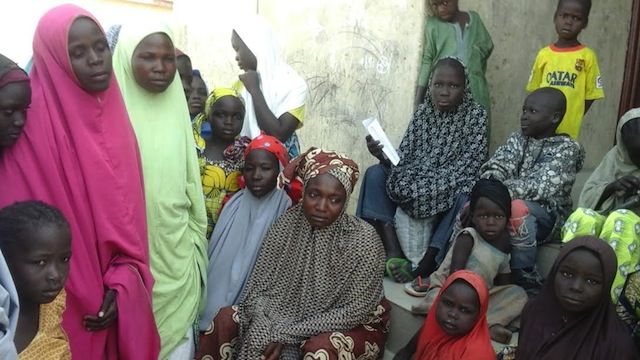
To be clear, Halima is in this state of pain for two reasons: first, she was let down by her country, which failed to protect her when Boko Haram insurgents attacked her household in Bama in 2014; next, she found food hard to come by, not just because of the enormity of the feeding burden on the government but because of the inhumanity of emergency managers and camp officials who “keep diverting” IDP foodstuffs.
Three days after arriving the medical facility, Halima gave up the ghost. Those who saw Yagana on the day of her daughter’s death said she was disconsolate. Amidst her wails, she was quoted to have said she had “lost all hope for the future”.
Not a difficult image to picture, really. When Boko Haram raided her village, the 100 cows that constituted her means of livelihood were seized. More than 20 of her relatives, including her husband, were killed, leaving her with six children — all severely acutely malnourished — who eat nothing other than maize porridge only every other day. Now, one of those, the youngest, had just died in the most harrowing of circumstances.
THE STATISTICS BEHIND THE CRISIS
Halimat and Yagana are not alone in their misery. According to an MSF survey of the humanitarian crisis in Borno, shown to TheCable by a presidency source, 3.7 per 10,000 children under five years old died per day between December 2015 and September 2016.
The sheer scale of this crisis forced the federal government, in June, to belatedly declare a nutrition emergency in Borno — belatedly because the United Nations-recommended emergency threshold is 2.1 deaths per 10,000 under-five children per day, and also because it took a survey by a foreign aid agency for the government to take the step.
The displaced persons alive are faring only slightly better than the dead. In mid-June, after 1,200 people, mostly women and children, were evacuated by the army from Bama to the Nursing Village camp in Maiduguri, MSF screened 466 children from six months to five years of age; it was discovered that 39% of them were suffering from severe acute malnutrition.
Also in Bama, a rapid nutritional screening of more than 800 children showed that 19% were suffering from severe acute malnutrition.
Epicentre, MSF’s epidemiological centre, conducted retrospective mortality surveys and nutritional assessments from August 19 to September 9 at Muna Garage camp, and from September 23 to 29 at Custom House camp.
At the latter, severe acute malnutrition among the children under five years old (the most severe form of malnutrition exposing children to a high risk of death) was estimated at 4.3% and moderate acute malnutrition at 15.6%.
At the former, 9.5% of the children under five were affected by severe acute malnutrition and 15.4% by moderate acute malnutrition. Therefore, a total of 24.9% of children under five years old were affected by general acute malnutrition — a rate well above the 20% emergency threshold.
All these statistics point towards a population of IDPs in severe pains, due particularly to a food-shortage crisis. Being the ones in closest contact with the displaced persons, the SEMA and camp officials ordinarily ought to be the most sympathetic about the people in their care. Sadly, findings from visits to the groups showed otherwise.
DIARY: UNDERCOVER EXPEDITION TO BAKASSI IDP CAMP
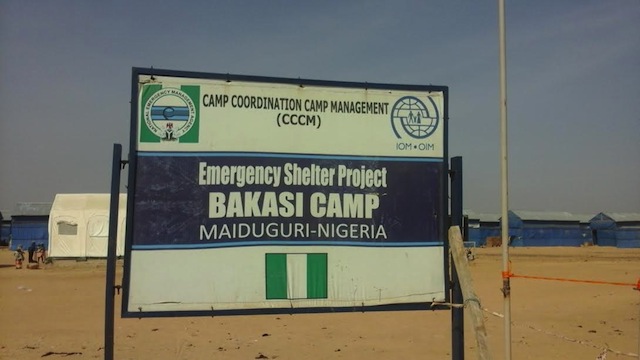
Bakassi Camp
Camp and Borno state government officials have invented an ingenuous way of keeping journalists off IDP camps. No journalist is allowed entry upon arrival at the camp. Instead, he is first directed to SEMA to submit an application letter that finds eternal abode in one of the dusty files at the relief agency.
The practice is to direct the journalist from one office to another, on and on until frustration sets in and he is forced to abandon the mission.
But after five days of relentless failing and retrying, I finally make my way into Bakassi IDP camp, located on Damboa Road — not as a journalist but as a potential donor of relief materials to the displaced population. I explain to the camp officials that I need to first see the camp to be able to assess the needs of IDPs, and then return at a later date with a reinforcement of relief items.
I expect them to immediately facilitate my movement into the camp, but surprisingly four of them ease me out of the general office into a ramshackle, deserted room where all sorts of irrelevant questions are asked.
“How much exactly is the worth of the donation you’re planning?” one asks. I ignore him the first time but he doesn’t give up. Instead, he adds: “I ask so that I can tell you the kind of materials that you should go for.”
When I mention some figure in the region of thousands of US dollars, his face brightens. He dips his hand into his pocket but I notice he doesn’t immediately withdraw it. “I think we should allow him enter,” he tells his colleagues.
And just as the trio face the door to take their exit, he quickly slips his complimentary card into my hands. We all leave, the other three oblivious of what had just transpired.
‘WE ARE IN EXTREME HUNGER’
Bakassi IDPs say they are in extreme hunger
One camp official was instructed to follow me in all my movements but Bakassi camp is such expanse that I knew the official would soon tire and would in no time sit somewhere and allow us move freely.
By land mass, it is the biggest of a dozen official IDP camps in Borno state. Set up on January 25, 2015 with a population of 4,763 IDPs from Monguno, Gwoza, Guzamala, Marte and Nganzai local governments, Bakassi IDP camp has grown in approximately two years to its current population of 21,202. The bulk of the population, though, lives in extreme hunger.
Asked what kind of support a relief agent could render, the first batch of IDPs on ground choruses: “food!”
“The food here is not enough for us; we are in extreme hunger,” says the slender mother of four who acts as their mouthpiece. “To compound our woes, we sometimes have no choice but to sell a part of the food to people outside the camp in exchange for other things we need.”
There isn’t so much she can say, it would seem, with the prying eyes of the camp official roving from one IDP to another. Half-an-hour into the fact-finding mission, the camp official motions me to himself.
“Let me sit down over there while you finish your work,” he says, pointing at a nearby pavement. “I’ll be waiting there till you’re done.”
“LET ME TELL YOU HOW SEMA DIVERTS FOOD”
Before walking towards the spot that he had marked out for rest, the camp official explains why it is natural that IDPs will continue complaining of hunger.
“You see, let’s face it, it is extremely difficult to satisfy millions of hungry people. It is impossible to feed millions of displaced persons and expect all of them to be satisfied. But at the same time, the food entering the camp from SEMA is lesser than what has been passed on to them from NEMA,” he says, unaware that he is actually talking to a journalist.
“Let me tell you what SEMA does. They divert food meant for IDPs to private quarters. They actually re-bag grains meant for IDPs and re-sell at the open-air market. These bags of grains that are diverted, they claim that they are giving them to IDPs in host communities.
“It’s very smart move from these SEMA officials because they know that there’s no documentation for IDPs resident in host communities. Of course, this particular IDP population exists, but you can’t track their number. It is this loophole that SEMA exploits to divert aid meant for IDPs.”
‘THEY DON’T GIVE US ALL THE FOOD THEY GET’
Although the next woman asks to remain anonymous for fear of being victimised, she discusses not only the problem but the reason it exists.
“We don’t have enough food,” she says through an interpreter, her forlorn look and gnashing of teeth making an unsavoury combination.
“Our children are living here with us without food. They give us rice without firewood; no medicine to take care of ourselves during ill-health. Please come in and see where we sleep; just floor without mattress.”
The blame, she maintains, is the camp officials’.
“It is true that there’s some hanky-panky with food items. When food arrives the camp, they don’t give us everything,” she says.
“They give us some and keep some back. The foodstuff that they hold back in the store, they do not share for us until another batch of food arrives at the end of the month.”
‘SEMA IS THE MAIN PROBLEM’
These claims were corroborated by another displaced person, although he thinks the theft of food items in IDP camps is “child’s play” compared with the happenings at the state emergency management agency.
“If you can give 25kg of rice (which is 7.5modules) to a man with nine family members to care for, for one month or for 45 days, what is that?” he asks, visibly miffed.
“What do you call that? How would you give someone five modules of corn to eat for one month? No charcoal, no firewood. They have to sell three to five modules of the rice to buy charcoal.”
The “main problem”, he says, is that the food entering the camp is inadequate despite the huge food inflow to SEMA.
“In fact, in this camp, there are people from Gwoza who have never received food since they came in. People are saying that they don’t know what to do. They can’t return to Gwoza; they are not comfortable here. They have to stay back here and just manage it.
“The bulk of the food theft is from SEMA. Before, if you were a family of nine to 10, you would get 100kg of rice. But they later reduced it to 50kg.
“The national chairman of NEMA came to this camp in October and said that they were bringing food for us. In fact, he said they had food that could last us for two months. So, if they had surplus of two months, how is it possible that our rations have been cut by half? He said it that NEMA was giving enough food to SEMA. So the question to ask SEMA is: why they are reducing our food?”
IS THIS A SIGN?
During a visit to the Women Development Centre, Post Office area, opposite General Hospital, to discuss the possibility of entering IDP camps, a bag of beans, another bag of an unidentified product and two sewing machines, were easily noticeable in an office marked ‘Assistant Director’. The sight would have made no meaning but for two reasons.
One, the scheduled meeting was with a SEMA top shot. What was a bag of beans doing in the office of a man whose job directly relates to the distribution of an item like this to IDPs?
Two, it isn’t once — not even twice — in 2016 that IDPs in Borno had received the donation of sewing machines from public-spirited individuals and organisations.
The source of the items was not established, but their presence surely raised suspicions.
IDP CAMP OFFICIALS WITH ‘BAD CHARACTER’
According to a member of the Civilian Joint Task Force (JTF), whose work covers the Muna Garage IDP camp, relief materials generally — not only food — do not get to IDPs because of the “bad character” of the men in charge.
This wasn’t the first time that camp officials were being spotlighted. In August, displaced persons from two different camps blocked the highways linking Borno to adjoining states in protest of “poor feeding and ill-treatment” at the camps. The IDPS at the Arabic Teachers College Camp were the first to protest, on August 26, and they were followed by those from the Bakassi Camp on August 30.
The protests prompted the state government to scrap its central feeding programme, under which food was cooked at the central kitchen and shared to IDPs, and adopt the household sharing system that allocated raw food to family heads according to family sizes. The IDPs may have succeeded in sacking the central feeding committee, but it appears the problem runs deeper.
“There are IDP camp officials who have bad character; when some donors bring relief materials, these officials pass them on to their families rather than the IDPs who need them,” the Civilian JTF member says.
“Instead, they will hoard it — and in the night, they will take the items to their families and friends. We have that problem in many camps, especially the NYSC Camp, Muna Garage Camp and Bakassi Camp. In these three camps, I have seen this happen. It’s a very terrible problem how officials hoard donations to IDPs.
“This is why IDPs protested recently. They said that people were coming to camps to bring relief items, but these were not getting to them. That is why we need good officials at IDP camps.”
“SEMA SHARES HALF AND STEALS HALF”
The civilian JTF member concludes by saying SEMA has a policy of dividing into two, the foodstuff it receives from the National Emergency Management Agency (NEMA). Half of this, he claims, actually goes to the IDPs; the other half, nowhere!
“If SEMA collects 100 bags of rice from NEMA, it distributes 50 and keeps 50 in its office,” he says.
“But after a while, they will tell NEMA to send more foodstuff, claiming that they had distributed all the food they got. Even after they have brought the food — thank you — no water! How do you give someone food and you don’t provide water as well?”
3,000 BAGS OF SUGAR ‘DIVERTED’ DURING RAMADAN
That weighty allegation was corroborated by someone who once worked as a driver at the SEMA office where relief materials are stored. In fact, he says there are times whenSEMA receives aid and keeps all — not just half — of humanitarian aid to itself.
“Let me tell you, they gave SEMA about 3,000 bags of sugar during the Ramadan period. We brought it and they didn’t make use of it; they just kept it till after the Ramadan period and the sugar became solid,” he says.
“Then they started to break the sugar and change the sacks. Then they loaded it in the cars at night, and took it to the flour mill to sell.
“Then they brought people to come and sew the new sacks. When we all left to go home in the evening, they went back to load the trucks at night and head to the flour mill.
“It also includes groundnuts. There’s one that Dangote brought, supplies for the fasting period. They called him [the SEMA chairman] and gave him but he didn’t share it to the people.”
The diversion of these materials, he adds, were perpetrated under the cover of darkness, usually late in the night but sometimes in the wee hours of the day.
“I saw them more than 10 times when they were moving the sugar out of the SEMA office. Most of these were very early in the morning, like 5:30am to 6am, and some were in the night,” he says assuredly.
“Every month, the former SEMA chairman gave at least 300 bags of rice to each IDP camp. But now, each camp gets 50bags/month. In the night, they cart the food way and nobody knows where they move it to. Always in the night.
“There was a time that they would send wrappers, cloths from the US…. These people just held everything for themselves. They refused to give people and they were selling the clothes.
“If SEMA will ever agree to open its store, you will see many things inside, many kinds of foodstuff: beans, rice, sugar, Tuwo Shinkafa, noodles, cloth. But if you go to IDP camps, you will never find these things there.”
Although he is unaware that he is talking to a journalist, he prods his listener to confront the SEMA chairman with these “facts”, saying: “When you meet the chairman of SEMA, you can ask him about it.”
TheCable was denied entry to the Maiduguri Flour Mill in an attempt to verify the claim that it collaborated with SEMA to divert the bags of sugar. “We don’t entertain journalists here and we also don’t engage in any sugar business,” the gatekeeper says.
Similarly, the NEMA chairman ignored all calls and the text message to his phone number.
MEANWHILE, IDPS ARE SUFFERING…
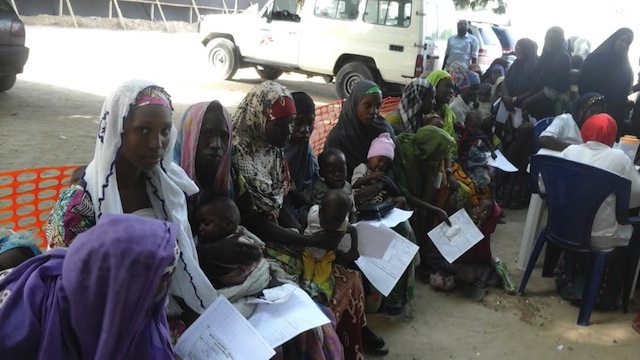
Displaced women queue for food at an MSF facility
Had we truly been prospective donor of relief items to IDPs, we would have been frustrated by Satomi. Yet millions of IDPs remain in dire need of every help they can possibly get.
For example, 26-year-old Fatima Adamu of the Bakassi IDP camp is struggling to keep her twins, Hassana and Husseini, alive. Both babies are severely acutely malnourished and are now fighting for their lives at the MSF health centre.
Originally from Gwoza, Fatima left Yola in 2013 after one of Boko Haram’s numerous raids. She was initially at the Arabic Teachers Camp (ATC), but two years ago, she was relocated to Bakassi Camp.
In the two years I spent at ATC, we had food prepared for us but now at Bakassi we get food rations,” she says.
“The problem is that at Bakassi, the children don’t get milk. When I accosted SEMA officials to ask why we weren’t getting milk, they said the supplier of the milk had been busy with other things.”
Yagana Bura, 30, from Dikwa LG would also be grateful to receive the kind of aid that Satomi didn’t seem to bother about. Moved from ATC to Bakassi Camp, Yagana has never had enough food at any of the IDP camps she has lived in. As a result, her child is on admission for complications from malnutrition.
“When we were in ATC, they gave us a cup of ground corn just once in a day. Usually, it wasn’t enough, so what I did was hand it over to my children while I sorted myself out,” she says.
“At Bakassi we get food but it is never enough, so it finishes before the end of the month. When food finishes, we go outside the camp to beg. In Bakassi, four people get 1bag of rice (25kg) and 1 bag of beans.”
… AND THEIR CHILDREN ARE FIGHTING FOR THEIR LIVES
At the Isolation Unit of the MSF ITFC, where the most severe malnutrition cases are being managed, Mohammed Lawan Tijani, the nurse, says the major complications are measles and chicken pox.
Tijani cites the case of siblings Umar, Fatima and Hussein Hudu who are all hospitalised for measles. “One person got it and the others contracted it,” he says.
There is also Fatimat Usman, aged just 22 months, suffering from whooping cough as a result of malnutrition. In the five days that Fatimat has been there, her mother, Khadijat, has known virtually no sleep.
On the next bed are Abdullahi and Ali Abubakar from Gudumbali in Guzamala local government. Ali, just four, arrived the facility in great discomfort.
“His case was really serious,” says the nurse. “He was restless; he could neither stand nor sit; he couldn’t even walk; he couldn’t eat. But now, there is remarkable improvement.”
*This report was first published in TheCable, the online newspaper. It is published here,with a new headline, with permission.
The Nigerian Navy says it has intensified the clampdown on crude oil thieves, illegal refineries and other related crimes in the maritime areas.
Director of Naval Information, Cor Ezekobe, said this in a press release issued on Thursday in Abuja, adding that vigilant Naval personnel also discovered 47 stowaways who had attempted to leave the country illegally on board some merchant vessels.
He also stated that a naval patrol team deployed by NNS DELTA arrested the Captain of a merchant Vessel, one Solomon Perebo, for his alleged involvement in pipeline vandalism.
He added that 23 illegal refinery sites were raided by various Naval patrol teams “mainly in Obodo, Ajosolo, Isaba and Olakpashe creeks in Warri South West LGA of Delta State.”
“During the raid, about 396 Metric-Tons (MT) of suspected illegally refined AGO and about 1,060MT of suspected stolen crude oil were destroyed, 3 suspects linked to the sites were also apprehended,” he added.
Ezekobe further stated that patrol team deployed by NNS JUBILEE in conjunction with other security agencies “raided an illegal refinery site at Ibeno community in Ibeno LGA of Akwa Ibom State” where “2 cotonou boats, and 6 drums containing suspected illegally refined AGO” were destroyed.
The Navy spokesman also disclosed that “operatives of NNS PATHFINDER intercepted a wooden barge conveying about 110MT of suspected illegally refined AGO around the Federal Ocean Terminal/Federal Lighter Terminal (FOT/FLT) anchorage in Onne Rivers State.”
“This feat is sequel to the interception of another barge laden with about 50MT of suspected illegally refined AGO around Ikpokiri in Onne Rivers State,” he said.
According to Ezekobe, the Chief of Naval Staff, CNS, Ibok-Ete Ibas commended the efforts of the Naval personnel in driving the process of clearing illegal refinery sites and mitigating other security threats in the maritime areas.
The CNS urged Captains of merchant vessels and all seafarers to be vigilant and report any suspicious movement around their vessels in order to prevent illegal migration out of the country by desperate stowaways as well as to enhance the security of their vessels.
Abubakar Shekau, the leader of Boko Haram, has surfaced in a new video on Thursday to refute claims by the Nigerian government that the sect has been decimated and flushed out of the Sambisa forest.
In the 25-minute video, Shekau, flanked by armed fighters and speaking in Arabic and Hausa said, “We are safe. We have not been flushed out of anywhere. And tactics and strategies cannot reveal our location except if Allah wills by his decree.”
Referring to President Muhammadu Buhari’s speech on Christmas Eve that the insurgents has been defeated and driven away from Sambisa, Shakau said the President “should not be telling lies to the people.”
“If you indeed crushed us, how can you see me like this? How many times have you killed us in your bogus death?” he asked.
It could not be ascertained when or where new video was shot, but Shekau said it was filmed on Christmas Day.
He vowed that the sect would continue fighting until an Islamic state was imposed in northern Nigeria.
“Our aim is to establish an Islamic Caliphate and we have our own Caliphate, we are not part of Nigeria,” he declared.
On Wednesday, Lucky Irabor, the Theatre Commander of the counter insurgency operations in the North East, ‘Operation Lafiya Dole’, said that over one thousand suspected members of the Boko Haram sect, including women and children were arrested after the capture of Sambisa forest.
He added that many more of the insurgents had surrendered to troops of neighbouring Niger Republic as they could no longer withstand the firepower of the military.
Irabor also said that the troops recovered a Quran and a Boko Haram flag, which he said were abandoned by Shekau as he fled from troops of the Nigerian army.
He added that the items would be presented to President Buhari as a sign that the Boko Haram insurgency has finally ended.
However, despite the claims by the Military authorities, there has been criticism in various quarters over the rather hasty celebration of an end to insurgency in the North East by the Nigerian government.
This is because President Buhari on numerous occasions had reiterated that the war against the Boko Haram terrorists will not be said to have been won if the abducted Chibok School Girls have not been rescued and returned to their various families.
Critics wonder why the President and the military authorities are declaring victory when the leader of Boko Haram, Shekau, has not been captured, nor the Chibok Girls rescued.
Minister of Information and Culture, Lai Mohammed has said the present administration led by President Muhammadu Buhari is not only fighting corruption, but also taking steps to make corruption unattractive.
The minister said this in a statement released in Lagos on Thursday on theeffectiveness of the anti-corruption strategy of the government.
According to Mohammed, “the government was not just fixated on only prosecution, but in taking preventive measures to make corruption unattractive.”
He stressed that “the strict enforcement of the Treasury Single Account, TSA, has largely reduced the diversion of government funds into secret accounts,” adding that the “TSA has also reduced the constraints in fishing out ghost workers in the public service in most states in the country.”
The information minister also pointed out that the anti-corruption campaign of the present administration is being guided by a “well-articulated strategy … contrary to the misconception in certain circles that the government is fighting corruption without a strategy.”
He noted that government’s anti-graft strategies have yielded positive results, leading to, among others, “the recovery of 40 brand new SUVs and other vehicles from one former Permanent Secretary who single-handedly appropriated the vehicles to himself when he left office.”
“Other measures to strengthen the anti-corruption fight included the establishment of Presidential Committee on Asset Recovery, Asset Tracing Committee, Asset Register, and the Whistle Blower Policy,” he said.
Mohammed also disclosed that government has finalized plans, through the Code of Conduct Bureau, CCB, to begin the test run of electronic asset declaration starting in 2017.
According to him, the new method would enhance compliance and as well as search and retrieval of data on the assets of public officers.
The minister also said that the Presidential Advisory Committee Against Corruption, PACAC, is working together with other government bodies, especially the National Bureau of Statistics, to improve data collection on corruption indicators.
He said that when the process is completed, “the data will be shared with government, periodically if possible, as regularly as government receives data on inflation and unemployment trends.
“The data will indicate trends in corruption and influence government measures to correct the situation before it gets out of hand as we have now,” he said.
Mohammed further explained that the Presidential Committee on Asset Recovery will meet regularly to collate reports from key law enforcement agencies on government’s anti-corruption effort.
He added that the recent approval of the Whistle Blower policy was designed to further enhance government’s effort to recover looted funds.
“People who give credible and useful information to government that leads to recovery of stolen public assets will be rewarded with between 2.5 per cent to 5 per cent of the recovered fund.
“Government will keep the identity of the whistle blower absolutely confidential,” he said.
Mohammed said the government is finalizing the constitution of an Asset Tracing Team to work with internationally reputably bodies to trace and recover public assets in private hands.
“In this regard, government will also escalate the use of non-conviction-based asset recovery methods to boost revenue and diminish corruption and the perception that crime pays or criminals can keep their loot,” he said.
The minister disclosed that the administration is collaborating with Nigerians in diaspora and international civil society organizations in the campaign for the return of looted assets.