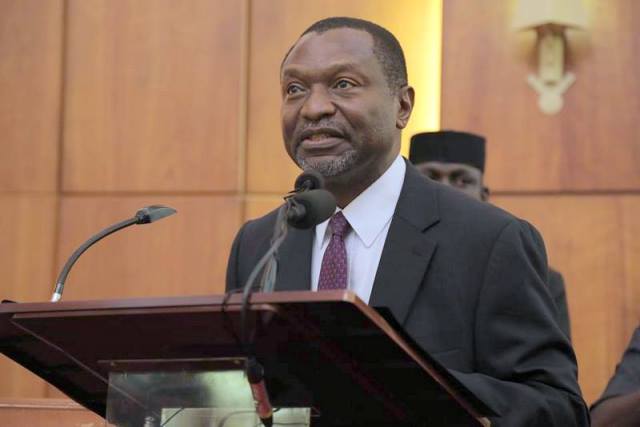
Minister of Budget and National Budget, Udoma Udo-Udoma
The Federal Government has said that the proceeds from the proposed sale of some of the country’s national assets would be used to fund the expenditure of government as contained in the 2016 budget.
Minister of Budget and National Planning, Udoma Udo-Udoma stated this in a statement issued by his Media aide, Akpandem James, explaining that the government had lost almost half of its expected revenue this year.
According to the statement, government had mapped out key projects that would support its economic diversification agenda, but the decline in the country’s revenue had made it difficult for these projects to be executed.
Udo-Udoma explained that the unfortunate reality was the reason the Economic Management Team urgently worked out a fiscal stimulus plan to generate large funds to be injected into the economy.
He said the funds would be injected through proceeds of asset sales, advance payment for license rounds, concession of infrastructure, and use of recovered funds among others, to reduce the funding gap.
He clarified that the primary objective of government’s fiscal stimulus plan is not to sell off all major critical national assets, but to source immediate funds to reflate the economy to the path of recovery.
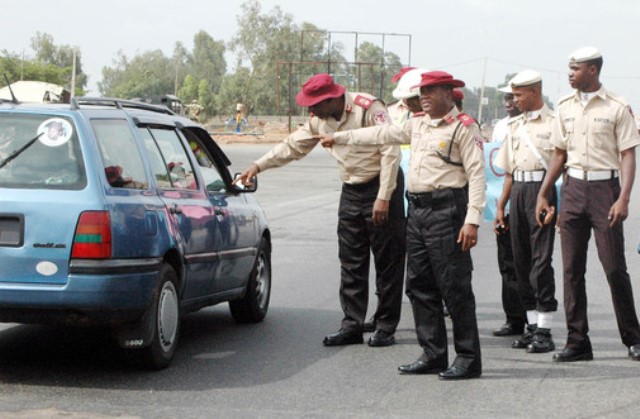
The Federal Road Safety Commission, FRSC, has insisted that there is no going back on the October 1 deadline for the enforcement of the speed limiting device in commercial vehicles.
Wobin Gora, sector commander of the Bayelsa State command, told the News Agency of Nigeria, NAN, on Saturday in Yenagoa, that the FRSC was committed to the enforcement of the directive, urging commercial drivers in Bayels State and across Nigeria to install the device before the deadline day.
“The campaign for installation of the speed limiting device has been going on for quite some time.
“Let me emphatically warn commercial drivers in the state that there is no going back on the Oct. 1 deadline.
“My advice to them is to install the device in their vehicles as anybody who failed to do so is doing that at his own risk,’’ he warned.
Gora said the FRSC was optimistic that installing the speed limit device would not only reduce crashes that occur as a result of over speeding, but would also reduce fuel consumption in vehicles.
“When speed is reduced, it saves cost of fuel consumption; it saves cost of repairing vehicle and reduce fatality to the barest minimum,’’ he said.
It would be recalled that the Bayelsa Chapter of the National Union of Road Transport Workers, NURTW, had urged the FRSC to extend the deadline for the enforcement exercise citing the current economy situation in the country.
The NURTW spokesperson had explained that transportation business no longer flourish as it used to, adding that extending the deadline would enable commercial drivers to save money in order to purchase the device.
The Niger Delta Avengers announced it has bombed the Bonny crude export line in Rivers State.
A statement on the group’s website said its “strike team” has “brought down oil production activities at the Bonny 48 inches crude oil export line.”
The statement noted that the attack was a “wake up call” for the government, which according to the militant group, has been intimidating youths in the region since the ceasefire began.
The Militants, however, said that they were “still in favour of dialogue and negotiations”.
This is first pipeline attack in the oil-rich region since the so-called Niger Delta Avengers declared a ceasefire in order to negotiate with the federal government.
Attacks such as this have adversely affected Nigeria’s crude oil production and exportation, leading to huge loss of revenue.
The Niger Delta Avengers have claimed responsibility for most of the attacks on the oil facilities.
The militants also accused the federal government of violating the ceasefire agreement by sending Nigerian troops to the region on the disguise of a special military training codenamed ‘Operation Crocodile Smile’.
They claimed that the military exercise in the creeks of Ijaw communities was pre-determined genocide in Niger Delta.
The former governor of Adamawa State, Bala Ngillari, former secretary to the Adamawa State government, Ibrahim Welye and former commissioner for finance, Sanda Lamurde have been remanded in prison custody following the failure of their bail applications.
Justice Nathan Musa of the Yola High Court who presided over the case said the accused persons could not convince the court why the bail application should be granted.
The former governor and the two others, both former members of his cabinet, are facing an eight-count charge bothering on corruption and abuse of office.
The charges include purchase of 25 units of operational vehicles without obtaining certificate of no objection from the Adamawa State Bureau of Public Procurement and lack of due process in the award of a contract worth N165.8 million to one El-Yadi Motors Limited.
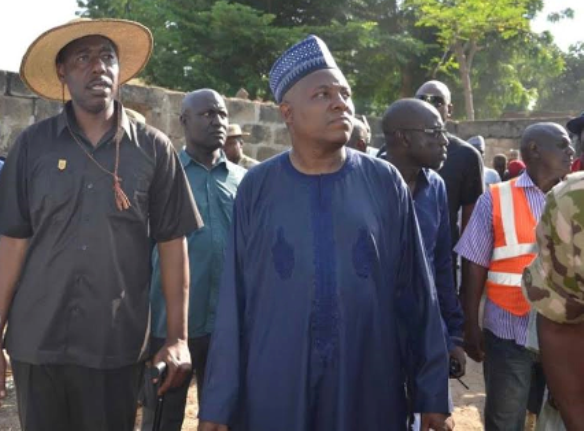
Governor Kashim Shettima had temporarily relocated his office to Bama to personally supervise reconstruction works in the area
The Borno State Environmental Protection Agency, BOSEPA, has declared that Bama, one of the towns ravaged by the Boko Haram insurgency, would be ready for re-occupation in two weeks.
Sole Administrator of the Agency, Nassir Surundi told newsmen on Saturday that massive clean-up and fumigation exercise was ongoing in the town which at the peak of the insurgency was referred to as Boko Haram’s “killing field”.
It was reported that the insurgents killed thousands of people in Bama, throwing their bodies into the Yedzaram River while both human and animal carcasses littered the streets.
The town was however reclaimed by the Nigerian military sometime in 2015.
Surundi said the exercise was directed by governor Kashim Shettima, who had relocated to Bama to personally supervise the ongoing reconstruction works.
He said 17 streets have so far been cleared of giant weeds while fumigation and other sanitation exercises were being carried out against snakes and other reptiles.
“We hope to clear 17 additional streets by tomorrow (Sunday) and I promise all of you that within the next two weeks Bama will wear a new look different from the bush and the debris you see around.
“Without us clearing the roads, workers wouldn’t have access to reconstruction sites while the town will continue to look like a war zone, we are committed to Governor Kashim Shettima’s mission of changing Bama from what the insurgents turned it into,” Surundi said.
He noted that the Agency has been well funded by the state government and equipped with specialized trucks and chemicals to fasttrack its work.
He also added similar clean-up exercises had been carried out in order parts of the state, including Dikwa, Magumeri, Konduga and some parts of Maiduguri Metropolitan Council.
The embattled former chairman of the House of Representatives’ Committee on Appropriations, Abdulmumin Jibrin, has said that he would not appear before the House Committee on Ethics and Privileges except it’s hearing is public, adding that he does not have assurances of a fair hearing.
Jibrin said in a letter written to the committee he was shocked that he was being probed for a “so called breach of privilege of members and misconduct by me” and not to probe whether the allegations he made against the speaker was true or not.
He said going by the actions of the committee members, it was clear that they were already one-sided and would not be fair to him
He stated: “Mr. Chairman, what further deepens my pessimism is the fact that in your letter, you indicated that you were inviting me to appear before your committee on Monday 26th September, 2016, but surprisingly you announced to the press that I shunned your invitation.
“This is clear indication that the outcome of your “investigation” is already predetermined.
“You also did not find it worthy to investigate the grievous allegations I made against Mr Speaker and few others or even why the Speaker is yet to address all the allegations I made against him and submit himself to the security and anti-graft agencies to clear his name two months after I submitted my petitions.”
In his letter, he told the committee members they must make a choice to either stand with Speaker Yakubu Dogara or stand with Nigerians.
“A stand with Dogara is a stand with fraud and corruption. I stand with Nigerians,” he said.
Part of the letter he wrote to the committee reads: “You will recall that when you called me on 21st, you tried to assuage my doubts and encouraged me to appear.
“I told you clearly I will appear under the condition that the proceedings will be public with access given to both print and electronic media, Civil Society Organisations, Non-Governmental Organisations, Nigerian Labour Congress, Nigerian Bar Association, Academic Staff Union of Universities, National Association of Nigerian Students and the general public.
“I made it clear to you that it is under such arrangement that I will feel comfortable that the investigation, proceedings and outcome will not be manipulated or compromised.”
Jibrin had accused the Speaker and four other principal officers of corruption with regards to the 2016 budget.
On resumption of the House plenary on Wednesday, Dogara mandated the Committee on Ethics and Privileges to investigate Jibrin, following a motion moved by another lawmaker who said Jibrin’s accusation had brought the entire House to disrepute.
The motion threw the House into a rowdy session with pro-Dogara lawmakers displaying mufflers and caps with the inscription: ‘I Stand with Dogara’.
The Kano state lawmaker maintained that his campaign is to “expose corruption in the House and push for reforms that will clean up the House for the Nigerian people” adding that “there is no going back.”
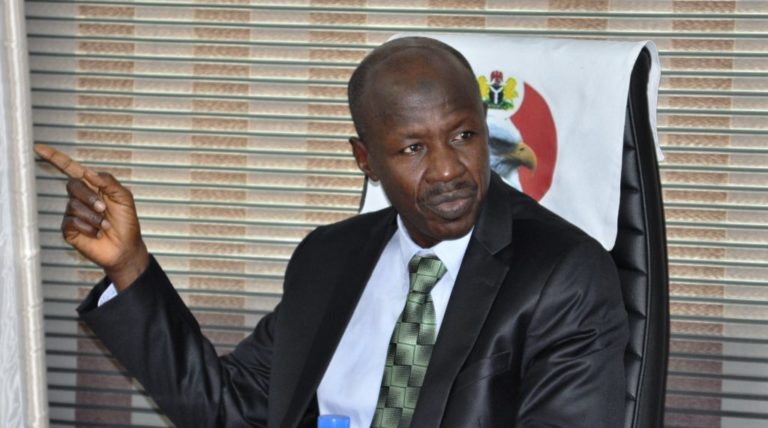
The Economic and Financial Crimes Commission, EFCC, has arrested one of its officials for allegedly collecting a N15 million bribe.
Spokesman of the commission, Wilson Uwujaren, disclosed this in a statement issued on Friday.
Uwajuren stated that Uzodinma Agbazue, a deputy detective superintendent in the agency, was arrested after a lawmaker who is under investigation brought a complaint against him.
According to the EFCC spokesman, the complainant had alleged that Agbazue approached him, saying that he had been mandated by the officer handling the case to discuss and reach an agreement on how to “kill the case”.
“Following the approach, a sum of N15 million was given to Agbazue whose game plan collapsed after the Investigating officer, who was ignorant of his scheme, refused to do his bidding,” Uwujaren stated.
“With the investigation gathering increased momentum after parting with the hefty sum, the complainant became uncomfortable and demanded a refund.
“The complainant stated that, when he requested for the refund of his money, Agbazue only returned N5 million claiming that the balance of N10 million had been given to someone ‘to kill the case from the top’.”
Uwajuren also stated that the lawmaker claimed that Agbazue had on a different occasion collected N1 million from him as assistance to settle his wife’s medical bill.
He said the agent’s action contravened the commission’s “mandate and ideals as the EFCC will not solicit or accept gratification from a suspect to compromise a case under investigation,” EFCC said.
“The suspect will be subjected to administrative action as precursor to possible prosecution at the end of the investigation,” the statement concluded.
Yahoo has announced that the account information of at least 500 million of its users was stolen by hackers two years ago, describing the stolen data as “critical.” The attack is now being considered as the biggest act of hacking of a company’s computer network.
In a statement, Yahoo said user information including names, email addresses, telephone numbers, birth dates, encrypted passwords and, in some cases, security questions was compromised in 2014 by what the company believed to be state-sponsored cyber-attack.
Experts in the Information and Communication Technology, ICT, industry remain baffled at why it took two years before the hack could be detected.
Yahoo remains one of the internet’s busiest sites with one billion monthly users, and recently one of America’s largest companies, Verizon Communications, began a process of acquiring it for $4.8 billion
It’s mail services, Yahoo Mail, is one of the oldest free email services, and many users have built their digital identities around it, from their bank accounts to photo albums and even medical information.
The company is advising owners of a Yahoo accounts to change their passwords and also ensure that passwords used on those sites aren’t too similar to what they were using on Yahoo.
Yahoo also said it was working with law enforcement in their investigation and encouraged people to change up the security on other online accounts and monitor those accounts for suspicious activity as well.
It stated: “The stolen Yahoo data is critical because it not only leads to a single system but to users’ connections to their banks, social media profiles, other financial services and users’ friends and family,”
“This is one of the biggest breaches of people’s privacy and very far-reaching.”
Yahoo said it learned of the data breach this summer after hackers posted to underground forums and online marketplaces what they claimed was stolen Yahoo data.
But what they eventually found was worse: a breach by what they believe was a state.
Two years is an unusually long time to identify a hacking incident.
According to experts it takes organizations to identify such an attack in 191 days, and the average time to contain a breach is 58 days after discovery.
President Buhari in a group photograph with some of the Nigerian professionals in the US
President Muhammadu Buhari has accused people he described as “past looters of the treasury” of supporting and sponsoring militancy in the Niger Delta region.
“Those who stole Nigeria dry are not happy. They recruited the militants against us in the Niger Delta, and began to sabotage oil infrastructure,” the president said.
“We lose millions of barrels per day, at a time when every dollar we can earn, counts. It is a disgrace that a minimum of 27 states, out of 36 that we have in Nigeria, can’t pay salaries.”
According to a statement by Presidential spokesman, Femi Adesina, the president made the remarks during a meeting with a select audience of Nigerian professionals living in the United States of America.
The meeting was put together by, Abike Dabiri-Erewa, Senior Special Assistant to the President on Diaspora Matters and International Relations, who described participants at the audience as“15 of the best people God ever created.”
They include Top flight aeronautics engineers, physicians, I.T experts, a Judge, a top policewoman, entrepreneurs, an Import Specialist at Customs and Border Protection, professors, two straight A students, and others.
President Buhari briefed the audience on how and why Nigeria got into trouble, assuring them that together with Nigeria’s best brains in the Diaspora, the country’s economic challenges would soon be over.
He said: “We got into trouble as a country, because we did not save for the rainy day. For example, between 1999 and 2015, when we produced an average of 2.1 million barrels of oil per day, and oil prices stood at an average of $100 per barrel, we did not save, neither did we develop infrastructure. Suddenly, when we came in 2015, oil prices fell to about 30 dollars per barrel.
“I asked; where are the savings? There were none. Where are the railways? The roads? Power? None. I further asked; what did we do with billions of dollars that we made over the years? They said we bought food. Food with billions of dollars? I did not believe, and still do not believe,”he declared.
Buhari noted that failure to invest in infrastructure was one of Nigeria’s greatest undoing.
He reminded his listeners that the Nigerian military earned respect in places like Burma, Zaire, Sudan, Liberia, Sierra-Leone, “and then, suddenly, that same military could no longer secure 14 out of 774 local governments in the country.”
The president added that his administration has restored the pride of the military with help from some western countries, by changing the leadership, re-equipping and retraining them, which has culminated in the decimation of terrorists in the Northeast.
Buhari said he was committed to bringing positive change to Nigeria because “I prayed so hard for God to make me President.”
“I ran in 2003, 2007, 2011, and in 2015, He did. And see what I met on ground. But I can’t complain, since I prayed for the job.”
The president narrated that he rose from 2nd Lieutenant to Major-General in the army, and even became military governor in 1975 “over a state that is now six states”; got detained for three years, and headed the Petroleum Trust Fund (PTF).
“After 16 years of a different party in government, no party will come and have things easy. It’s human. We need quality hands to run Nigeria, and we will utilize them. I will like to welcome you home when it’s time. But I’ll like you to be ready.”
The Nigerian professionals promised to do their best to help the government of the day in its efforts to return Nigeria to the path of growth.
Chairman of the Senate Committee on Foreign and Local Debts, Shehu Sani, has strongly criticised those calling for the sale of the country’s national asset, describing them as “economic predators and profiteers who want to take advantage of the situation in the country.”
The Kaduna State senator told the media on Friday that capitalist forces who “raped Nigeria to recession” now want to “kill and bury it.”
The call for the sale of some of the Nation’s assets gathered steam following comments attributed to Aliko Dangote, Africa’s richest man, suggesting that the federal government should sell off the Nigeria Liquefied Natural Gas Limited, NLNG, and the Nigeria National Petroleum Corporation Joint Ventures, so that the proceeds would help the country out of recession.
The suggestion was supported by some prominent Nigerians including the Senate President, Bukola Saraki, and the Governor of Central Bank, Godwin Emefiele; however majority of Nigerians seem to be against the idea.
Sani said the idea was clearly not in the best interest of the nation as experience had proven that privatization in Nigeria has only enriched a few of the so-called ‘big men’, but has not in any way benefitted the masses.
He said: “There is currently nothing to show for the sale of government houses, (and) firms.
“The advocates of sale of our collective national asset simply want to dispossess Nigerians and expand their business empire.
“They call themselves private sector and business men; they refused to invest in agriculture, solid minerals or science and technology, they simply want to buy off profitable public assets.
“There are no captains of industry in Nigeria other than crony businessmen, rent seekers, commission agents who depend on patronage from government,” he said.
The lawmaker accused Nigerian businessmen of preferring to buy off “ready-made” assets instead of investing in ventures that could potentially yield even bigger dividends.
“They don’t want to buy Ajaokuta steel company because it’s not profitable; they don’t want to invest in solid minerals, Agriculture or science and technology, they don’t want to invest in the exploration of oil in Chad basin or Benue trough; They want to buy NLNG and NNPC.”
“Selling our national asset to stem recession is like selling ones lungs to buy food,” Sani said.
“Recession should excite innovation and ideas and not justify roguery.
“Nigeria’s poor have always lived under systemic recession and depression and on the edge of extinction,” he added.
The Lawmaker called on all Nigerians to reject any attempt at selling any of the Nation’s asset.