The Federal Capital Territory, FCT, Police Command has called on all residents of the nation’s capital city to be vigilant during the eclipse that has been forecast to occur on Thursday, as miscreants could take advantage of the situation to commit crime.
The police also warned anybody or group that is planning to exploit the climatic condition for criminal purposes to desist as security men would deal decisively with anyone arrested breaking the law.
FCT Police Commissioner, Muhammad Mustafa assured FCT resident that the Command has put in place adequate measures to provide water-tight security across FCT.
He said residents should report any suspicious movement to the nearest Police Station or contact the FCT Police Command 24/7 Emergency Help Lines, including 08032003913, 08061581938, 07057337653 and 08028940883.
Governor Kashim Shettima of Borno State has raised an alarm over plans by alleged beneficiaries of corruption in the state’s civil service to cause breach of peace and security.
The governor who made a broadcast on Wednesday explained that the state recently discovered over N1 billion fraud in its wage bill after a biometric capture of the state’s civil servants.
Shettima said that he had constituted a high powered committee headed by the Secretary to the State Government, SSG, Usman Shuwa, to carry out the screening exercise of the civil service in fulfillment of his promise during the 2016 budget presentation to the State Assembly.
According to him, the verification committee discovered that of the over 25, 000 workforce on the payroll of the state government who are paid about N2.7 billion monthly in salaries, only 19,763 workers collected verification forms.
However, after the verification exercise and the biometric capture of data of the 19,763 workers was conducted, only 11,327 workers were captured while over 7,342 workers are yet to be captured due to one irregularity or the other.
Shettima said that government had to stop payment of salaries for two months to give room for the audit.
He added, however, that the State Ministry of Finance had been directed to commence immediate payment of N2,258,641.912.00, representing the two months salaries of the verified civil servants for July and August 2016.
The governor vowed that any bank found to be involved in the ghost workers’ fraud will be blacklisted and all government accounts with it will be closed or terminated.
He also commended the state leadership of the Nigerian Labour Congress, NLC, for its role and cooperation as well as participation in the verification and biometric data exercise.
Governor Shettima said those who feel aggrieved by the exercise and are planning to cause disorder in the state in the name of protest can go ahead with their plan, adding, however, that security operatives have been directed to deal decisively with anyone found disturbing public peace or causing public disorder.
The governor insisted that he will sacrifice anything to ensure transparency and accountability in the state civil service.
With regards to many Internally Displaced Persons, IDPs, in the state, Shettima said plans have already been put in place to relocate the IDPs from Mafa, Dikwa and Konduga council areas to their communities within the next seven days from Wednesday.
He said the IDPs willing to return to their homes after the liberation and rehabilitation of the areas will be supported and encouraged by government to settle down, adding that those who do not want to return home can rent houses in Maiduguri but will no longer live in IDP camps.
Brazil’s Senate has voted to remove President Dilma Rousseff from office for manipulating the budget; an accusation the president firmly denied.
It puts an end to the 13 years her left-wing Workers’ Party has been in power.
Sixty-one senators voted in favour of her impeachment with 20 against, meeting the two-thirds majority needed to remove her from the presidency.
Acting President, Michel Temer will serve out Rousseff’s term, which ends on 1 January 2019.
Rousseff was suspended in May after the Senate voted to go ahead with with impeachment process.
She was accused of moving funds between government budgets, which is illegal under Brazilian law.
Her critics said she was trying to plug deficit holes in popular social programmes to boost her chances of being re-elected for a second term in October 2014.
Rousseff fought the allegations, which she said amounted to a coup d’etat.
She argued that her right-wing political rivals had been trying to remove her from office ever since she was re-elected.
“From the day after I was elected, several measures were taken to destabilise my government. And you have been systematically making accusations against me,” she said when she defended herself in the Senate on Monday.
She said that she was being ousted because she had allowed wide-ranging corruption investigations to go ahead which resulted in many high-profile politicians being charged.
But senators who voted in favour of her impeachment said it was Rousseff and the Workers’ Party who were corrupt and needed to go.
Her policies, her u-turn on the economy after the election and corruption in her party were constantly part of the debate.
Temer will be officially sworn in on Wednesday and has promised to boost Brazil’s economy, which is going through its longest and deepest recession in the past quarter of a century.
His critics have already warned that he plans to cut many of the popular social programmes introduced by the Workers’ Party.
Dr. Yemi Kale, Statistician-General of the Federation
The National Bureau of Statistics, NBS, has released data suggesting that the growth rate of the Nigerian economy is likely to beat the IMF prediction of -1.8% for the full year 2016.
This is because as emphasis on capital expenditure by the Federal Government begins to yield results with investment/GDP numbers increasing, the growth rate of the economy is expected to improve.
Although the recent data released from the Bureau shows that the GDP declined by -2.06%, it noted that the picture that emerges, barring unforeseen shocks, points to the fact that the areas given priority by the Federal Government are beginning to respond to policy initiatives.
While presenting the Second Quarter Economic Data on Tuesday to the Economic Management Team, EMT, the Statistician General of the Federation, Yemi Kale, said though the inflation rate remains high, the month-on-month rate of increase has fallen continuously over the past three months.
For the rate of unemployment which still remains high, he explained that that it is of a structural nature and is usually the case during growth slowdowns.
According to him, past vulnerabilities of the economy combined with the short term effect of some of the structural changes to complicate the trajectory of growth and inflation, pointing out that this formed the background to the slower growth and increasing inflation figures seen in Q1 and Q2.
“However, the rest of the Q2 data is beginning to tell a different story. There was growth in the agricultural and solid minerals sectors which are the areas in which the federal government has placed particular priority.
“Agriculture grew by 4.53% in the second quarter of 2016 as compared with 3.09% in the first quarter. The metal ores sector showed similar performance with coal mining, quarrying and other minerals also showing positive growth of over 2.5%.
“Notably also, the share of investments in GDP increased to its highest levels since 2010, growing to about 17% of Gross Domestic Product.”
Kale told the EMT that the manufacturing sector, though not yet truly out of the woods, is beginning to show signs of recovery while the service sector similarly bears watching; as he disclosed that available data already shows a reduction in imports and an increase in locally produced goods and services.
He was optimistic that the trend will be maintained, although it will start off slowly in the initial stages before picking up later.
Explaining the GDP decline in the second quarter, Kale said a close look at the data reveals that the outcome was mostly due to a sharp contraction in the oil sector due to huge losses of crude oil production as a result of vandalism and sabotage; but he quickly added that there is room for optimism that the recent commitments to stop attacks on oil installations in the Niger Delta will help to resolve this situation, while also improving government revenues.
He said: “With crude oil contributing 8 to 12% of GDP and up to 50 to 53% of the non-oil sector dependent on the oil sector, it is clear that the fortunes of up to 60% of the Nigerian economy rested on a volatile sector. This shaky foundation was masked in the past by high oil prices and reasonably high foreign reserves.
“Again with the availability of foreign exchange it was possible to drive growth in national income through consumption without feeling the fall out of such structural weaknesses”.
The Statistician General said these vulnerabilities were exposed when oil prices collapsed at a time the country did not have adequate revenues and reserves to cushion the effect, a situation further complicated by loss of production.
The Federal Government therefore took policy actions to promote sectors like agriculture, solid minerals, manufacturing and services and to boost public and private investment in infrastructure and housing.
It also acted to remove supply constraints with regard to foreign exchange and the supply of premium motor spirit while encouraging the private sector to add value to crude oil through refineries, petrochemical plants, fertilizer plants and gas infrastructure.
In an attempt to maintain consumption demand in the short term, the Federal Government also assisted States to pay salaries and to encourage a private sector supply response by bringing about improvements in the ease of doing business.
Young girls are made to undergo breast ironing when they reach puberty to make them sexually unattractive to the opposite sex
Victoria Oseyande Ikearu-Udoh
Globally, female genital mutilation, or cutting, which is one of the many harmful cultural practices against the girl child, has witness tremendous awareness, outcries and measures established to eliminate the practice in all regions and countries of the world.
Unfortunately, breast ironing, though still practiced, has remained unknown to many. Breast Ironing, also known as breast flattening, is a cultural practice of flattening or crushing the breast of an adolescent girl to disguise the signs of development.
This ritual is mostly performed on the breast of the young adolescent between the ages of 10 to 19 by her mother through the use of a hard or heated object to flatten the breast, stop the breast from developing, or better still make them disappear. It can also be performed by any close female relative of the girl like the grandmother, aunty, sister, etc.
According to the perpetrators of this practice, the goal of this destructive female breast mutilation is to delay the girl’s development thus making them unattractive and less desirable to the opposite sex. This is aimed at preventing them from being sexually active, thus protecting her from rape, teenage pregnancy and other forms of sexual activity.
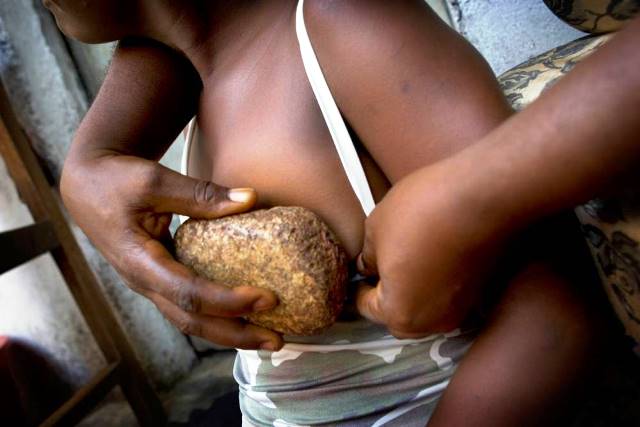
Breast ironing ranges from using heated leaves to massage and knead the breasts, to the use of baked grinding stone to crush the girls’ budding breasts. There are however two widely used methods in carrying out this inhumane practice. The first involves heating tools like metal, sticks, heavy stone, pestles, spatulas, spoons, rocks, grinding stones, hot coconut shells, leaves, and hammers over hot charcoal fire, and then pressed on the young breasts, with the aim of flattening them or stunting their growth.
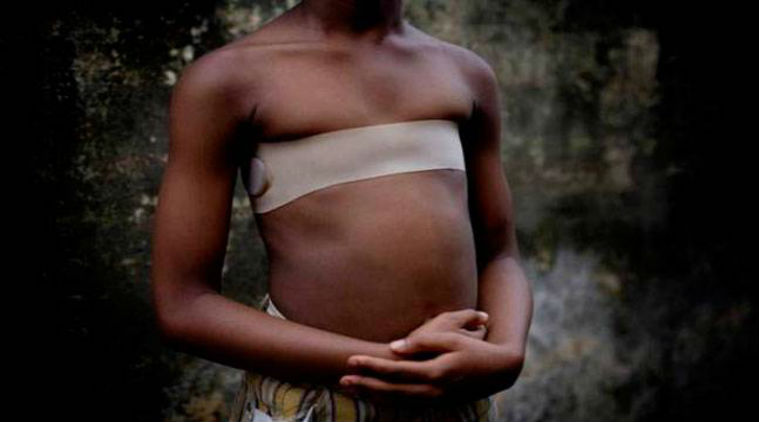
The heat from the tools is required to melt the fat on the breasts, so as to stop them from growing or bulging. The second involves wrapping the girl’s chest very tightly with an elastic bandage overnight for a long time; sometimes as long as a year. This latter method is less preferred as it makes the girl uncomfortable for a long time.
The heat from the stone is required to melt the fat on the breasts, so as to stop them from growing.
Breast ironing is mostly practiced in Cameroon and some African countries like, Central Africa Republic, Benin, Chad, Ivory Coast, Guinea-Bissau, Guinea-Conakry, Kenya, Nigeria, Togo and Zimbabwe. According to a report by the United Nations, breast ironing affects about 3.8 million women around the world, with Cameroon having the highest number of cases in the world.
In spite of this, Cameroon also regrettably has one of the world’s highest rape incidences with almost half a million rape cases recorded yearly (this excludes cases not reported as a result of stigmatization).
Unfortunately, contrary to the beliefs of the perpetrators of this practice, breast ironing has not in any way prevented the young adolescent from being sexually active, nor has it stopped them from becoming victims of sexual violence or in any way prevented teenage pregnancy.
Several reports have shown examples of girls who experienced breast ironing but still got pregnant in their teens. A typical example is the story of Susan (pseudonym), who according to a study by Thomson Reuters Foundation, started developing breast at age 10 and thus was becoming very attractive.
In an attempt to protect her from the opposite sex (both young and old), her mother performed the breast ironing ritual on her and thus made the breast disappeared and unattractive. Three years later, Susan was raped by her uncle. At 14 she became very sexually active; at 16 she became pregnant and gave birth to her first child.
The health consequences of breast ironing are enormous. Although there are no extensive studies on breast ironing at the moment, medical expert are of the opinion that it can be detrimental to the health of the young adolescent even up to her old age. Some of these health hazards include breast tissue damage, breast cancer, cysts, lesions, itching, trauma, depression, breast infections, formation of abscesses, inability to produce breast milk later in life, malformed breasts and the eradication of one or both breasts.
According to one of such girls, breast ironing is extremely painful and more painful than childbirth.
In December 2015, a new report revealed that some mothers from neighbouring countries to Nigeria have intensified the practice of breast ironing for their young girls in order to protect them from being abducted, raped or harmed by the Nigeria terror group, Boko Haram.
Another method involves wrapping the girl’s chest very tightly with an elastic bandage overnight for a long time; sometimes as long as a year.
Although this practice was not common in Nigeria, there are however reports that it is being practiced in some parts of the country. With child violations, rape cases, teen pregnancies, girls’ abductions, etc. on the rise, this may not be far from the truth.
Parents and relevant authorities should know that breast ironing is a poor alternative to sex education and does not in any way curb teenage sex or pregnancy. Rather it is an inhumane practice that brings about physical and emotional torture.
It is a form of child abuse, gender inequality and a deformation of the girl child. Mothers, nannies, aunties, grand mothers, fathers, relevant government agencies, Human Rights Commissions, and NGOs need to exercise vigilance and take necessary actions against breast ironing in its entire ramification. It should not be allowed to strive nor spread in Nigeria.
Victoria Oseyande Ikearu-Udoh is a development worker with a passion for gender and people-centred issues. She can be reached via victoriaoseyandeudoh@gmail.com.
The www.icirnigeria.org has learnt that in spite of improved security in the northeast, particularly in Borno and Yobe States, internally displaced persons, IDPs, who had returned home are still reluctant to go back to the farmlands they left in the wake of the Boko Haram insurgency for fear of landmines and further attacks by the terrorists.
According to a team of assessors, who visited communities in Borno, Adamawa and Yobe states, from the Centre of Democracy and Development, CDD, an Abuja-based civil society organisation, displaced persons are concerned about their safety on their farms, even though they wish to return to the farms.
CDD is currently working on De-radicalisation, Counter-Terrorism and Migration, in the northeast, a project funded by the Japanese government through the United Nations Development Programme, UNDP.
“The only places in these communities you see people farming are along the roads, all within the heart of towns. They told us they don’t go to the hinterlands of their communities to farm because they are afraid of landmines or attacks, so they restrict their farming activities to the peripheries of their communities,” Idamwenhor Napoleon Enayaba, a Senior Programmes Officer with CDD stated.
Napoleon headed a team to Maiduguri, Kaga, Jere, and Konduga local government areas of Borno State and said the humanitarian situation in these places is pathetic and inhuman, with economic activities barely picking up.
“Seeming economic activities going on are just at the level where you can barely make anything that can add to the value of life because you can only actually sell in a community where people have the capacity to buy. So, the capacity for demand is high but the capacity to pay for those demands is just not there,” he pointed out, adding, “People just roam around within a confined area.”
Hours after the team left Mandari in Konduga, a community that lives largely on fishing, a nearby village was attacked.
“We learnt that Yari, a village just behind the river in Mandari, was attacked on Friday night, hours after we left,” Napoleon stated.
In Yobe State, home to 134,415 IDPs, the humanitarian situation was no different and the team leader had to escape from a large number of hungry children surging towards him at Pompomari in Damaturu, the state capital. They had sighted him with snacks and drinks but lacked the patience to wait for the distribution.
Buni Yadi is one of the worst hit towns in the northeast
“Despite the fact that I wanted to give them some, they rushed at me and collected some of the snacks. I had to run into the car when I saw their number swelling. That was a scary experience,” Amuda Stephen Jakande, a Programmes Officer also with CDD, told the reporter.
He added that the IDPs too are unwilling to return to their farms, possibly fearing for their safety as well. Thus, many depend on relief materials from both government and non-governmental organisations. With majority of IDPs living outside camps, Stephen said it was easy to see IDPs from outside trooping into the camps during meal time.
This confirmed what a staff of the National Emergency Management Agency, NEMA, told our reporter about the possible reason why food is not enough for IDPs in camps.
“A woman held me by the trouser, begging for food saying she had not eaten since morning, so I had to give her some loafs of bread and some money. It was sad to see.”
“When it is time to serve food, you see many IDPs coming into the camps from outside. They know the time when food is shared and when they come, you cannot stop them because you know they are hungry,” Garba Abdullahi Sirajo said.
This is understandable, especially given that only nine percent of the about two million displaced persons in the northeast are sheltered in IDPs camps and the camps get more attention with regards to relief materials than communities housing majority of the people.
In Buni Yadi, one of the worst hit towns in the northeast, hunger walks the streets.
“A woman held me by the trouser, begging for food saying she had not eaten since morning, so I had to give her some loafs of bread and some money. It was sad to see,” Jakande narrated.
In Adamawa State, the security situation is far better than in the other two states and people go about their normal activities. In Mubi, Gulak, Madagali, Michika, and others, businesses have picked while people go about their farming activities with little fear.
Displaced persons depend largely on handouts from government and other organisations
However, there are cases of attacks in villages in these areas, especially where there are no security personnel.
During a funeral in June at Kuda-kaya, a village in Madagali, suspected Boko Haram insurgents stormed the place and shot dead 18 women, wounding others and setting houses on fire.
When our reporter visited some liberated communities in Borno and Adamawa states in June, the Emir of Mubi, Abubakar Ahmadu, told the General Officer Commanding, GOC, 7 Division Nigerian Army, Victor Ezugwu, a Brigadier General, that while peace had returned to his emirate, some villages were still witnessing occasional attacks from Boko Haram members who cross from neighbouring Borno State.
Ahmadu specifically mentioned Bebel, another village in Madagali, which he said was recently attacked before the arrival of the GOC.
The intense campaign from the Nigerian military has forced Boko Haram out of towns it once controlled. Some of the remnants of the insurgents now resort to targeting villagers and other soft targets. This has forced many displaced persons to seek refuge in towns, and are unwilling to return to their homes.
The National Automotive Design and Development Council, NADDC, has said that the Federal Government will soon launch a Vehicle Credit Acquisition Scheme to help Nigerians purchase locally assembled vehicles.
The Director of Policy and Planning in the NADDC, Luqman Mamudu, said this during an interactive session with journalists in Lagos on Wednesday.
He said that a South African company would provide more of the funds for the scheme in conjunction with the African Development Bank, AfDB, while the NADDC would contribute about N7.5 billion interest free fund to the scheme.
Mamudu pointed out that Nigeria had the capacity to produce 384,000 units of vehicles annually but “Unfortunately, the country only produced 25,000 units in 2015.
He added: “We have been in talks with the Central Bank of Nigeria, CBN, to also source for funds to support the credit scheme being planned by the Federal Government in conjunction with our council.
“We are also glad to announce that three testing laboratories for locally-assembled vehicles are also in the works and these are not just for motorcars alone, but for tractors and heavy-duty vehicles.
“We have not reached our potentials as a nation for locally-assembled vehicles, but we have the capacity to do so,” Mamudu said.
He added that the NADDC was working on a partnership with the Nigerian Customs Service to stop importation of used cars through the borders.
Aminu Jalal, Director-General of the NADDC, had in June, said that the council was targeting 40 per cent local content development for the automobile sector by 2021.
Jalal said that the mission of the council is to develop capacity of plants in Nigeria to produce the automotive components to achieve this.
File: President Buhari signing the 2016 budget, flanked by Vice President Yemi Osinbajo and Ita Enang
President Muhammadu Buhari has assented to the Federal Capital Territory Appropriation Act 2016 passed by the National Assembly.
This was made known by the Senior Special Assistant to the President on National Assembly Matters (Senate), Ita Enang, on Wednesday in Abuja.
“The legal implantation of the budget therefore comes into effect, which will result in employment in the formal sectors and informal sectors through projects implementation and employment therefrom arising,” Enang said.
The Senate had passed the N241.5bn budget in July.
Chairman of the Senate Committee on FCT, Dino Melaye, while presenting the report of his committee on the floor of the chamber, had clarified that the sum of N52.9bn was for personnel cost, N34.4bn for overhead, while N154.1bn was for capital expenditure.
He explained that 80 per cent of the amount for capital expenditure was for the completion of abandoned projects.
Melaye pointed out that FCT’s 2015 budget recorded 61 per cent budgetary performance, but the committee had projected a minimum of 85 per cent to 90 per cent budgetary performance in 2016.
While explaining the rationale behind the laying of the budgets of statutory corporations before the National Assembly for consideration and passage, Enang said that the Fiscal Responsibility Act 2007 states that “the budget of the underlisted agencies, among others, be laid before the Assemblies by Mr. President, in addition to, and independent of, the annual Appropriation Act.”
The departments, corporations and agencies include the Nigerian National Petroleum Corporation; the Nigeria Deposit Insurance Corporation; the Bureau of Public Enterprises; the Nigerian Agency for Science and Engineering Infrastructure; and the Nigerian Social Insurance Trust Fund.
Applicants in all the 44 Local Government Areas of Kano State are to benefit from a N2 billion interest-free loan to be given by the state government.
This is to alleviate the economic challenges people in the rural areas of the state are facing.
Commissioner of Finance, Kabiru Dandago, stated this on Wednesday during a meeting with all micro finance Directors across the 44 Local Government councils.
Dandago said the loan is interest- free loan and all service charges will be settled by Kano state Government
Speaking, Chairman Board of Directors, Kano State Micro-finance Agency, KASMA, Mai Kano Rabiu said the loan should be seen as a desire for development not only for the beneficiaries but for Kano State in general.
He also urged the beneficiaries to be honest to avoid difficulties in repaying the loan.
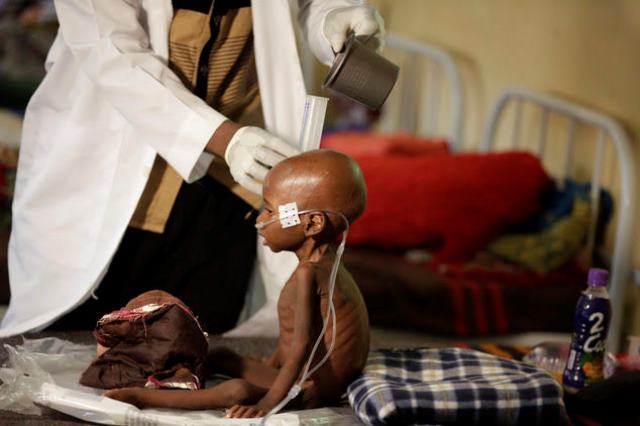
A malnourished child receives heath care at a feeding center run by Doctors Without Borders in Maiduguri Nigeria, Monday Aug. 29, 2016. Children who escaped Boko Haram’s Islamic insurgency now are dying of starvation in refugee camps in northeastern Nigeria’s largest city as the government investigates the theft of food aid by officials. (AP Photo/Sunday Alamba)
Children who escaped Boko Haram’s Islamic insurgency now are dying of starvation in refugee camps in northeastern Nigeria’s largest city as the government investigates the theft of food aid by officials. Refugees have staged near-daily protests over the past week. In one, women blocked the main highway linking Maiduguri, the Borno state capital, to Kano city for five hours, shouting that their children are starving and they have no drinking water as temperatures soar above 40 degrees (104 Fahrenheit). Between 10 and 25 percent of children in a 110-bed feeding center are dying, said Doctors without Borders spokeswoman Shaista Aziz. She called that a high percentage even in an emergency. Most of the dying are from refugee camps, she said. Dozens of babies and children with matchstick limbs and protruding rib cages fill the tents of the feeding center visited by The Associated Press. Families cannot leave the camps, “so they are completely reliant on food distributions,” said Dr. Natalie Roberts, deputy emergency desk manager for the medical aid group. Doctors without Borders’ therapeutic feeding program in Maiduguri, where the most malnourished children are treated, “has quadrupled in size in the last weeks, but each time it expands it becomes rapidly full,” Roberts said. In one local camp, Muna Garage, 20 children under the age of 5 died in a single week last month, she said.
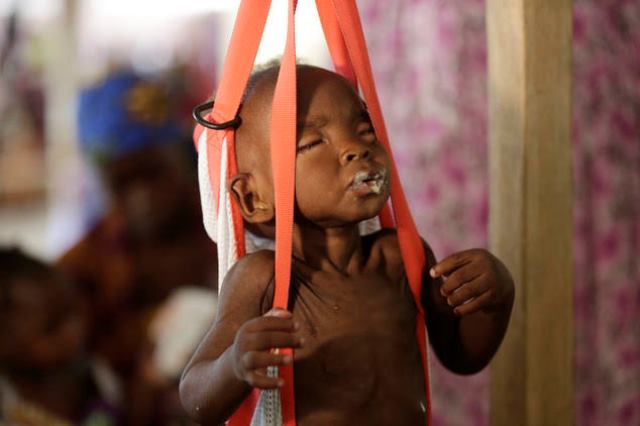
A malnourished child is weigh on a scale at a clinic run by Doctors Without Borders in Maiduguri Nigeria, Monday Aug. 29, 2016. Children who escaped Boko Haram’s Islamic insurgency now are dying of starvation in refugee camps in northeastern Nigeria’s largest city as the government investigates the theft of food aid by officials. ( AP Photo/Sunday Alamba)
At Farm Centre Camp, on Maiduguri’s outskirts, residents said they had received no food in more than one month. They and refugees at other camps said that when they do get meals, it consists only of rice and beans. They get one shovelful a day — literally delivered from a shovel — whether a household has six people or 12, they said.
“We and our children, for about four to five days now, they are not giving us food because when they bring the food items, they (officials) take it to the room and share among themselves instead of giving us what belongs to us,” said one refugee, Binta Lawal.
Maiduguri is estimated to host 1.2 million to 2 million refugees but only a fraction stay in the camps because, as The Daily Trust newspaper reported Tuesday, “Most of the camps have become centers of hunger, malnutrition and communicable diseases.” Nigeria’s Senate last week announced it was launching an investigation into allegations that food aid is being diverted, and the Economics and Financial Crimes Commission weeks ago said it was doing the same. The governor of Borno state, Kashim Shettima, last week accused rival politicians of instigating the protests. Shettima has been publicly booed by refugees and residents, with some shouting “Rice thief!” when his convoy passes, several residents told the AP. Shettima last week abruptly disbanded his government’s committee to feed refugees, which is supposed to provide cooked meals. Shettima’s office said refugees will now get food directly to cook themselves. That poses challenges, as the refugees will need charcoal for fires, cooking oil and clean water. Angry refugees took to the streets to protest because of several deaths from starvation, said a spokesman for the refugees, Umar Abdulsalam.
“The camp officials have been restricting some of us who are strong from going out. We have been living as prisoners, and the food meant for our care is being sold in the open market,” he told a news conference, accusing government officials, camp officials and the military guarding the camps.
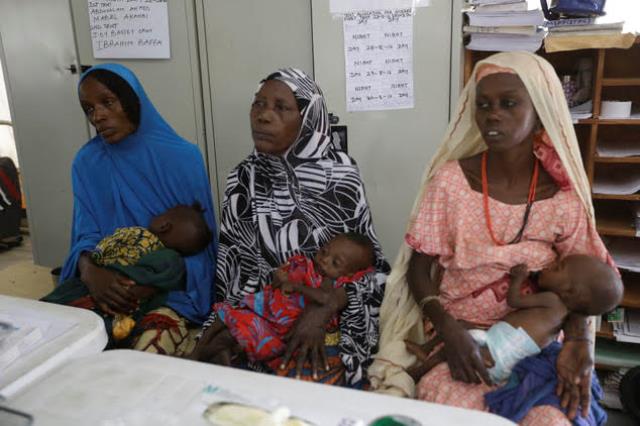
Mothers with their malnourished children wait for treatment at a clinic runs by Doctors Without Borders in Maiduguri, Nigeria, Monday Aug. 29, 2016. Children who escaped Boko Haram’s Islamic insurgency now are dying of starvation in refugee camps in the biggest city in northeast Nigeria because officials are stealing food aid, workers say. (AP Photo/Sunday Alamba)
The camps are supposed to be run by the Borno state Emergency Management Agency. Last week, local reporters and refugees watched as soldiers and local self-defense vigilantes shoved blankets and other aid meant for refugees at Dalori Camp into a tricycle taxi and took off. Irish rock star Bono and Nigeria’s richest man, multibillionaire Aliko Dangote, visited Dalori on Sunday. A businessman who was there the day before said he watched a truckload of food aid arrive, wait and then leave with all the food. When he questioned a camp official, he was told the food could not be distributed until Bono and Dangote arrived. The businessman spoke on condition of anonymity for fear of losing his government contracts. The crisis in Maiduguri, where markets are filled with fresh vegetables and fruit, is in addition to what the U.N has called a “catastrophic humanitarian crisis” in northeastern areas of Nigeria recently liberated from Boko Haram, where 2.5 million malnourished people have no access to food and drinking water. Those areas are still dangerous to reach.