President Muhammadu Buhari and his host, Governor Rauf Aregbesola
The All Progressive Congress led Federal Government is committed to the fight against corruption and bringing about positive change in the country, President Muhammadu Buhari has restated.
The president restated his commitment during his one-day official visit to Osun State to inaugurate the magnificent Osogbo High School, as part of activities to celebrate the 25th anniversary of the creation of Osun state.
Buhari noted that change cannot be achieved on a bed of roses, adding that the challenges facing the country require patience and perseverance and would soon become a thing of the past.
“We are determined to implement our change agenda by curbing excessive waste in government,” he said.
“We shall restore integrity to governance through the fight against corruption.
“We are determined to deliver and rescue the country from bad governance.”
The President commended Governor Rauf Aregbesola of Osun for providing a good learning environment for students in the state.
He said that the Osogbo High School should serve as an example to other governors in the country, stressing that the school project was part of APC’s agenda on education.
Buhari pledged that the APC government would continue to implement education policies that would be cost effective.
“The essence of the state’s creation was to bring government closer to the people and to provide good governance just like Gov. Rauf Aregbesola has done,” President Buhari said.
“Government at all levels must continue to channel their energy toward education because this is the only way we can secure the future of our children.”
Governor Aregbesola said that building the school was part of the state government’s efforts toward the development of education in the state.
He said that the 3,000-capacity school, with 72 classrooms and a multi-purpose hall among other facilities, cost the state government N1.35 billion to complete.
“We are producing the new man intellectually, morally and socially through education,” the governor said.
“We want to determine the next 15 years of the state through education because education is the path to development.’’
President Buhari Commissioning the Osun High School Osogbo
The Peoples Democratic Party in Osun State has urged President Muhammadu Buhari to help Osun State with resources to complete the many abandoned projects in the state.
The party also advised the state governor, Rauf Aregbesola, to use the opportunity of the president’s one-day visit to request for assistance to enable his administration complete all the projects it started.
Diran Odeyemi, Spokesman for the PDP in Osun State, said the governor should lead the president to the many abandoned projects scattered all over the state, perhaps Buhari may assist the state to complete them.
“The president if allowed to inspect Ido Osun Aerodrome, the International market in Dagbolu, Osogbo/ Kwara Boundary road and Osogbo/Gbongan road among other abandoned projects may wish to assist the state in resuscitating them for the benefit of the citizens,” he said.
The PDP spokesman however alleged that Governor Aregbesola earmarked N340 million for the President’s visit at a time when the state is finding it difficult to pay workers.
He also criticised the governor for alleged failure to constitute his cabinet.
Semiu Okanlawon, the Director, Bureau of Communication and Strategy in the Office of the Osun State Governor, had released a statement Wednesday saying that President Buhari is expected to commission the newly built 3,000 students capacity Osogbo Government High School, Osogbo, which he said mirrored the “magnitude of our ideas and interventions in the education sector.”
Okanlawon also said the state remained unrelenting in its “assault on delayed infrastructure in our education sector and all other sectors.”
Heavy Military equipment were deployed to the Niger Delta as part of ‘Operation Crocodile Smile’
Members of Kokodiagbene community in Gbaramatu kingdom, Warri South West Local Government Area of Delta State, have cried out over the heavy military presence in their communities.
Chairman of the community, Sheriff Mulade, said the presence of military personnel in gun boats, purportedly in search of hoodlums in the creeks, has forced his people to be relocating deeper into the swamps in fear.
He said the community was not against the military exercise codenamed ‘Operation Crocodile Smile’ going on in the area, “since it will help to protect oil installation, facilities and creeks” as well as “prevent pirates attacking traders; reduce crime and eradicate illegal bunkering activities in the creek of the Niger Delta.
“But, we want to strongly advise the military authorities to apply professionalism and diplomacy,” Mulade added.
He said the heavy deployment of military personnel and equipment in the area has raised unnecessary tension as residents now live in fear.
“Most of our people are now relocating to nearby communities for safety due to the rumour of military invasion of flow stations and oil installations in host communities particularly in Gbaramatu kingdom.
“The people have therefore appeal to President Muhammadu Buhari and the military authority to direct the military personnel not to invade Kokodiagbene and other riverine communities in the name of illegal oil bunkers, criminals and militants,” the community leader said.
He advised the military authorities to go after the criminals in their hideouts as Gbaramatu kingdom does not harbour militants and pipeline vandals.
But the military authorities have urged members of the communities where the operation is on-going not to panic as it is only a “training” operation for soldiers.
The Federal Capital Territory, FCT, Police Command has called on all residents of the nation’s capital city to be vigilant during the eclipse that has been forecast to occur on Thursday, as miscreants could take advantage of the situation to commit crime.
The police also warned anybody or group that is planning to exploit the climatic condition for criminal purposes to desist as security men would deal decisively with anyone arrested breaking the law.
FCT Police Commissioner, Muhammad Mustafa assured FCT resident that the Command has put in place adequate measures to provide water-tight security across FCT.
He said residents should report any suspicious movement to the nearest Police Station or contact the FCT Police Command 24/7 Emergency Help Lines, including 08032003913, 08061581938, 07057337653 and 08028940883.
Governor Kashim Shettima of Borno State has raised an alarm over plans by alleged beneficiaries of corruption in the state’s civil service to cause breach of peace and security.
The governor who made a broadcast on Wednesday explained that the state recently discovered over N1 billion fraud in its wage bill after a biometric capture of the state’s civil servants.
Shettima said that he had constituted a high powered committee headed by the Secretary to the State Government, SSG, Usman Shuwa, to carry out the screening exercise of the civil service in fulfillment of his promise during the 2016 budget presentation to the State Assembly.
According to him, the verification committee discovered that of the over 25, 000 workforce on the payroll of the state government who are paid about N2.7 billion monthly in salaries, only 19,763 workers collected verification forms.
However, after the verification exercise and the biometric capture of data of the 19,763 workers was conducted, only 11,327 workers were captured while over 7,342 workers are yet to be captured due to one irregularity or the other.
Shettima said that government had to stop payment of salaries for two months to give room for the audit.
He added, however, that the State Ministry of Finance had been directed to commence immediate payment of N2,258,641.912.00, representing the two months salaries of the verified civil servants for July and August 2016.
The governor vowed that any bank found to be involved in the ghost workers’ fraud will be blacklisted and all government accounts with it will be closed or terminated.
He also commended the state leadership of the Nigerian Labour Congress, NLC, for its role and cooperation as well as participation in the verification and biometric data exercise.
Governor Shettima said those who feel aggrieved by the exercise and are planning to cause disorder in the state in the name of protest can go ahead with their plan, adding, however, that security operatives have been directed to deal decisively with anyone found disturbing public peace or causing public disorder.
The governor insisted that he will sacrifice anything to ensure transparency and accountability in the state civil service.
With regards to many Internally Displaced Persons, IDPs, in the state, Shettima said plans have already been put in place to relocate the IDPs from Mafa, Dikwa and Konduga council areas to their communities within the next seven days from Wednesday.
He said the IDPs willing to return to their homes after the liberation and rehabilitation of the areas will be supported and encouraged by government to settle down, adding that those who do not want to return home can rent houses in Maiduguri but will no longer live in IDP camps.
Brazil’s Senate has voted to remove President Dilma Rousseff from office for manipulating the budget; an accusation the president firmly denied.
It puts an end to the 13 years her left-wing Workers’ Party has been in power.
Sixty-one senators voted in favour of her impeachment with 20 against, meeting the two-thirds majority needed to remove her from the presidency.
Acting President, Michel Temer will serve out Rousseff’s term, which ends on 1 January 2019.
Rousseff was suspended in May after the Senate voted to go ahead with with impeachment process.
She was accused of moving funds between government budgets, which is illegal under Brazilian law.
Her critics said she was trying to plug deficit holes in popular social programmes to boost her chances of being re-elected for a second term in October 2014.
Rousseff fought the allegations, which she said amounted to a coup d’etat.
She argued that her right-wing political rivals had been trying to remove her from office ever since she was re-elected.
“From the day after I was elected, several measures were taken to destabilise my government. And you have been systematically making accusations against me,” she said when she defended herself in the Senate on Monday.
She said that she was being ousted because she had allowed wide-ranging corruption investigations to go ahead which resulted in many high-profile politicians being charged.
But senators who voted in favour of her impeachment said it was Rousseff and the Workers’ Party who were corrupt and needed to go.
Her policies, her u-turn on the economy after the election and corruption in her party were constantly part of the debate.
Temer will be officially sworn in on Wednesday and has promised to boost Brazil’s economy, which is going through its longest and deepest recession in the past quarter of a century.
His critics have already warned that he plans to cut many of the popular social programmes introduced by the Workers’ Party.
Dr. Yemi Kale, Statistician-General of the Federation
The National Bureau of Statistics, NBS, has released data suggesting that the growth rate of the Nigerian economy is likely to beat the IMF prediction of -1.8% for the full year 2016.
This is because as emphasis on capital expenditure by the Federal Government begins to yield results with investment/GDP numbers increasing, the growth rate of the economy is expected to improve.
Although the recent data released from the Bureau shows that the GDP declined by -2.06%, it noted that the picture that emerges, barring unforeseen shocks, points to the fact that the areas given priority by the Federal Government are beginning to respond to policy initiatives.
While presenting the Second Quarter Economic Data on Tuesday to the Economic Management Team, EMT, the Statistician General of the Federation, Yemi Kale, said though the inflation rate remains high, the month-on-month rate of increase has fallen continuously over the past three months.
For the rate of unemployment which still remains high, he explained that that it is of a structural nature and is usually the case during growth slowdowns.
According to him, past vulnerabilities of the economy combined with the short term effect of some of the structural changes to complicate the trajectory of growth and inflation, pointing out that this formed the background to the slower growth and increasing inflation figures seen in Q1 and Q2.
“However, the rest of the Q2 data is beginning to tell a different story. There was growth in the agricultural and solid minerals sectors which are the areas in which the federal government has placed particular priority.
“Agriculture grew by 4.53% in the second quarter of 2016 as compared with 3.09% in the first quarter. The metal ores sector showed similar performance with coal mining, quarrying and other minerals also showing positive growth of over 2.5%.
“Notably also, the share of investments in GDP increased to its highest levels since 2010, growing to about 17% of Gross Domestic Product.”
Kale told the EMT that the manufacturing sector, though not yet truly out of the woods, is beginning to show signs of recovery while the service sector similarly bears watching; as he disclosed that available data already shows a reduction in imports and an increase in locally produced goods and services.
He was optimistic that the trend will be maintained, although it will start off slowly in the initial stages before picking up later.
Explaining the GDP decline in the second quarter, Kale said a close look at the data reveals that the outcome was mostly due to a sharp contraction in the oil sector due to huge losses of crude oil production as a result of vandalism and sabotage; but he quickly added that there is room for optimism that the recent commitments to stop attacks on oil installations in the Niger Delta will help to resolve this situation, while also improving government revenues.
He said: “With crude oil contributing 8 to 12% of GDP and up to 50 to 53% of the non-oil sector dependent on the oil sector, it is clear that the fortunes of up to 60% of the Nigerian economy rested on a volatile sector. This shaky foundation was masked in the past by high oil prices and reasonably high foreign reserves.
“Again with the availability of foreign exchange it was possible to drive growth in national income through consumption without feeling the fall out of such structural weaknesses”.
The Statistician General said these vulnerabilities were exposed when oil prices collapsed at a time the country did not have adequate revenues and reserves to cushion the effect, a situation further complicated by loss of production.
The Federal Government therefore took policy actions to promote sectors like agriculture, solid minerals, manufacturing and services and to boost public and private investment in infrastructure and housing.
It also acted to remove supply constraints with regard to foreign exchange and the supply of premium motor spirit while encouraging the private sector to add value to crude oil through refineries, petrochemical plants, fertilizer plants and gas infrastructure.
In an attempt to maintain consumption demand in the short term, the Federal Government also assisted States to pay salaries and to encourage a private sector supply response by bringing about improvements in the ease of doing business.
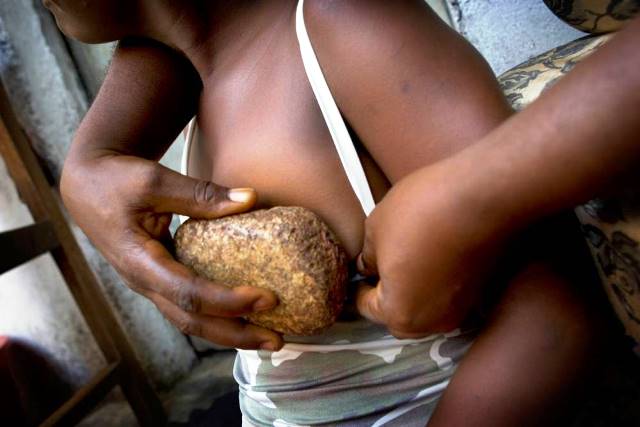
Young girls are made to undergo breast ironing when they reach puberty to make them sexually unattractive to the opposite sex
Victoria Oseyande Ikearu-Udoh
Globally, female genital mutilation, or cutting, which is one of the many harmful cultural practices against the girl child, has witness tremendous awareness, outcries and measures established to eliminate the practice in all regions and countries of the world.
Unfortunately, breast ironing, though still practiced, has remained unknown to many. Breast Ironing, also known as breast flattening, is a cultural practice of flattening or crushing the breast of an adolescent girl to disguise the signs of development.
This ritual is mostly performed on the breast of the young adolescent between the ages of 10 to 19 by her mother through the use of a hard or heated object to flatten the breast, stop the breast from developing, or better still make them disappear. It can also be performed by any close female relative of the girl like the grandmother, aunty, sister, etc.
According to the perpetrators of this practice, the goal of this destructive female breast mutilation is to delay the girl’s development thus making them unattractive and less desirable to the opposite sex. This is aimed at preventing them from being sexually active, thus protecting her from rape, teenage pregnancy and other forms of sexual activity.
Breast ironing ranges from using heated leaves to massage and knead the breasts, to the use of baked grinding stone to crush the girls’ budding breasts. There are however two widely used methods in carrying out this inhumane practice. The first involves heating tools like metal, sticks, heavy stone, pestles, spatulas, spoons, rocks, grinding stones, hot coconut shells, leaves, and hammers over hot charcoal fire, and then pressed on the young breasts, with the aim of flattening them or stunting their growth.
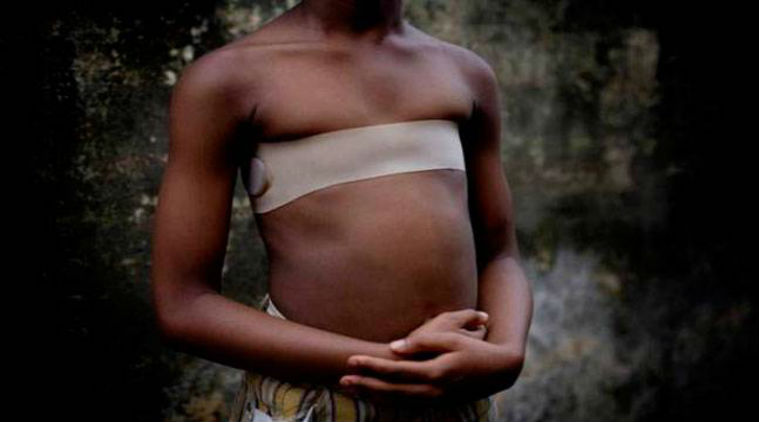
The heat from the tools is required to melt the fat on the breasts, so as to stop them from growing or bulging. The second involves wrapping the girl’s chest very tightly with an elastic bandage overnight for a long time; sometimes as long as a year. This latter method is less preferred as it makes the girl uncomfortable for a long time.
The heat from the stone is required to melt the fat on the breasts, so as to stop them from growing.
Breast ironing is mostly practiced in Cameroon and some African countries like, Central Africa Republic, Benin, Chad, Ivory Coast, Guinea-Bissau, Guinea-Conakry, Kenya, Nigeria, Togo and Zimbabwe. According to a report by the United Nations, breast ironing affects about 3.8 million women around the world, with Cameroon having the highest number of cases in the world.
In spite of this, Cameroon also regrettably has one of the world’s highest rape incidences with almost half a million rape cases recorded yearly (this excludes cases not reported as a result of stigmatization).
Unfortunately, contrary to the beliefs of the perpetrators of this practice, breast ironing has not in any way prevented the young adolescent from being sexually active, nor has it stopped them from becoming victims of sexual violence or in any way prevented teenage pregnancy.
Several reports have shown examples of girls who experienced breast ironing but still got pregnant in their teens. A typical example is the story of Susan (pseudonym), who according to a study by Thomson Reuters Foundation, started developing breast at age 10 and thus was becoming very attractive.
In an attempt to protect her from the opposite sex (both young and old), her mother performed the breast ironing ritual on her and thus made the breast disappeared and unattractive. Three years later, Susan was raped by her uncle. At 14 she became very sexually active; at 16 she became pregnant and gave birth to her first child.
The health consequences of breast ironing are enormous. Although there are no extensive studies on breast ironing at the moment, medical expert are of the opinion that it can be detrimental to the health of the young adolescent even up to her old age. Some of these health hazards include breast tissue damage, breast cancer, cysts, lesions, itching, trauma, depression, breast infections, formation of abscesses, inability to produce breast milk later in life, malformed breasts and the eradication of one or both breasts.
According to one of such girls, breast ironing is extremely painful and more painful than childbirth.
In December 2015, a new report revealed that some mothers from neighbouring countries to Nigeria have intensified the practice of breast ironing for their young girls in order to protect them from being abducted, raped or harmed by the Nigeria terror group, Boko Haram.
Another method involves wrapping the girl’s chest very tightly with an elastic bandage overnight for a long time; sometimes as long as a year.
Although this practice was not common in Nigeria, there are however reports that it is being practiced in some parts of the country. With child violations, rape cases, teen pregnancies, girls’ abductions, etc. on the rise, this may not be far from the truth.
Parents and relevant authorities should know that breast ironing is a poor alternative to sex education and does not in any way curb teenage sex or pregnancy. Rather it is an inhumane practice that brings about physical and emotional torture.
It is a form of child abuse, gender inequality and a deformation of the girl child. Mothers, nannies, aunties, grand mothers, fathers, relevant government agencies, Human Rights Commissions, and NGOs need to exercise vigilance and take necessary actions against breast ironing in its entire ramification. It should not be allowed to strive nor spread in Nigeria.
Victoria Oseyande Ikearu-Udoh is a development worker with a passion for gender and people-centred issues. She can be reached via victoriaoseyandeudoh@gmail.com.
The www.icirnigeria.org has learnt that in spite of improved security in the northeast, particularly in Borno and Yobe States, internally displaced persons, IDPs, who had returned home are still reluctant to go back to the farmlands they left in the wake of the Boko Haram insurgency for fear of landmines and further attacks by the terrorists.
According to a team of assessors, who visited communities in Borno, Adamawa and Yobe states, from the Centre of Democracy and Development, CDD, an Abuja-based civil society organisation, displaced persons are concerned about their safety on their farms, even though they wish to return to the farms.
CDD is currently working on De-radicalisation, Counter-Terrorism and Migration, in the northeast, a project funded by the Japanese government through the United Nations Development Programme, UNDP.
“The only places in these communities you see people farming are along the roads, all within the heart of towns. They told us they don’t go to the hinterlands of their communities to farm because they are afraid of landmines or attacks, so they restrict their farming activities to the peripheries of their communities,” Idamwenhor Napoleon Enayaba, a Senior Programmes Officer with CDD stated.
Napoleon headed a team to Maiduguri, Kaga, Jere, and Konduga local government areas of Borno State and said the humanitarian situation in these places is pathetic and inhuman, with economic activities barely picking up.
“Seeming economic activities going on are just at the level where you can barely make anything that can add to the value of life because you can only actually sell in a community where people have the capacity to buy. So, the capacity for demand is high but the capacity to pay for those demands is just not there,” he pointed out, adding, “People just roam around within a confined area.”
Hours after the team left Mandari in Konduga, a community that lives largely on fishing, a nearby village was attacked.
“We learnt that Yari, a village just behind the river in Mandari, was attacked on Friday night, hours after we left,” Napoleon stated.
In Yobe State, home to 134,415 IDPs, the humanitarian situation was no different and the team leader had to escape from a large number of hungry children surging towards him at Pompomari in Damaturu, the state capital. They had sighted him with snacks and drinks but lacked the patience to wait for the distribution.
Buni Yadi is one of the worst hit towns in the northeast
“Despite the fact that I wanted to give them some, they rushed at me and collected some of the snacks. I had to run into the car when I saw their number swelling. That was a scary experience,” Amuda Stephen Jakande, a Programmes Officer also with CDD, told the reporter.
He added that the IDPs too are unwilling to return to their farms, possibly fearing for their safety as well. Thus, many depend on relief materials from both government and non-governmental organisations. With majority of IDPs living outside camps, Stephen said it was easy to see IDPs from outside trooping into the camps during meal time.
This confirmed what a staff of the National Emergency Management Agency, NEMA, told our reporter about the possible reason why food is not enough for IDPs in camps.
“A woman held me by the trouser, begging for food saying she had not eaten since morning, so I had to give her some loafs of bread and some money. It was sad to see.”
“When it is time to serve food, you see many IDPs coming into the camps from outside. They know the time when food is shared and when they come, you cannot stop them because you know they are hungry,” Garba Abdullahi Sirajo said.
This is understandable, especially given that only nine percent of the about two million displaced persons in the northeast are sheltered in IDPs camps and the camps get more attention with regards to relief materials than communities housing majority of the people.
In Buni Yadi, one of the worst hit towns in the northeast, hunger walks the streets.
“A woman held me by the trouser, begging for food saying she had not eaten since morning, so I had to give her some loafs of bread and some money. It was sad to see,” Jakande narrated.
In Adamawa State, the security situation is far better than in the other two states and people go about their normal activities. In Mubi, Gulak, Madagali, Michika, and others, businesses have picked while people go about their farming activities with little fear.
Displaced persons depend largely on handouts from government and other organisations
However, there are cases of attacks in villages in these areas, especially where there are no security personnel.
During a funeral in June at Kuda-kaya, a village in Madagali, suspected Boko Haram insurgents stormed the place and shot dead 18 women, wounding others and setting houses on fire.
When our reporter visited some liberated communities in Borno and Adamawa states in June, the Emir of Mubi, Abubakar Ahmadu, told the General Officer Commanding, GOC, 7 Division Nigerian Army, Victor Ezugwu, a Brigadier General, that while peace had returned to his emirate, some villages were still witnessing occasional attacks from Boko Haram members who cross from neighbouring Borno State.
Ahmadu specifically mentioned Bebel, another village in Madagali, which he said was recently attacked before the arrival of the GOC.
The intense campaign from the Nigerian military has forced Boko Haram out of towns it once controlled. Some of the remnants of the insurgents now resort to targeting villagers and other soft targets. This has forced many displaced persons to seek refuge in towns, and are unwilling to return to their homes.
The National Automotive Design and Development Council, NADDC, has said that the Federal Government will soon launch a Vehicle Credit Acquisition Scheme to help Nigerians purchase locally assembled vehicles.
The Director of Policy and Planning in the NADDC, Luqman Mamudu, said this during an interactive session with journalists in Lagos on Wednesday.
He said that a South African company would provide more of the funds for the scheme in conjunction with the African Development Bank, AfDB, while the NADDC would contribute about N7.5 billion interest free fund to the scheme.
Mamudu pointed out that Nigeria had the capacity to produce 384,000 units of vehicles annually but “Unfortunately, the country only produced 25,000 units in 2015.
He added: “We have been in talks with the Central Bank of Nigeria, CBN, to also source for funds to support the credit scheme being planned by the Federal Government in conjunction with our council.
“We are also glad to announce that three testing laboratories for locally-assembled vehicles are also in the works and these are not just for motorcars alone, but for tractors and heavy-duty vehicles.
“We have not reached our potentials as a nation for locally-assembled vehicles, but we have the capacity to do so,” Mamudu said.
He added that the NADDC was working on a partnership with the Nigerian Customs Service to stop importation of used cars through the borders.
Aminu Jalal, Director-General of the NADDC, had in June, said that the council was targeting 40 per cent local content development for the automobile sector by 2021.
Jalal said that the mission of the council is to develop capacity of plants in Nigeria to produce the automotive components to achieve this.