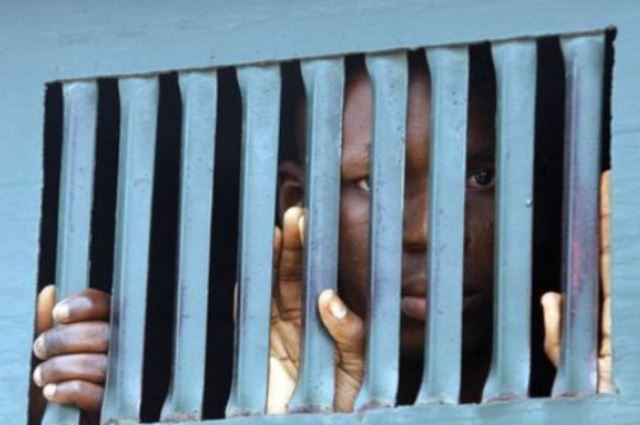
The Enugu State Controller of Nigeria Prisons Service, Isaiah Amariri, said that six of the prisoners that escaped from Nsukka Prisons on Tuesday night, have been re-arrested.
Amariri gave the figure to journalists in Nsukka, but declined to give the exact number of inmates that escaped from the prison.
He said the prison service is collaborating with security agents and community groups to recapture the remaining escapees.
“There was a jail break in Nsukka prisons on Tuesday night between 12pm and 3am, in which many inmates escaped, though six of them have been re-arrested.
“I cannot give the exact figure for now as investigations are still on. We will send our findings to the Controller General of Prisons who will make public the exact number and cause of Nsukka prisons jail break.
“The service is liaising with security agents and community vigilante groups to know the hideout of those still on the run in order to re-arrest them,” Amariri said.
He also assured that “After investigations on the jail break, any person in the service found to have been involved or aided the Tuesday jail break will be arrested and prosecuted no matter his or her position.
The prison Controller said “The prisons authorities are on top of the situation and will put measures in place to avoid a repeat of what happened on Tuesday night in Nsukka.”
He called on individuals who might have any information on the whereabouts of the fleeing inmates, to report to relevant security agencies, promising that “such information will be given the confidentiality it deserves and source identity will be fully protected.”
According to Amariri, the Nsukka Prisons was established a hundred years ago with the original capacity of 168 inmates, but currently harbours 264 prisoners.
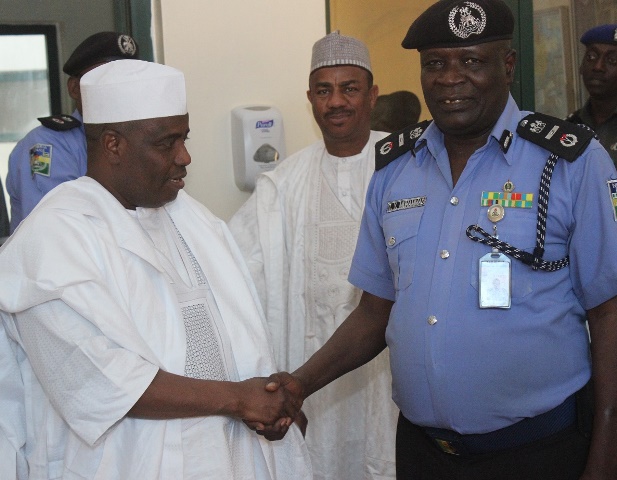
Gov. Aminu Tambuwal with former AIG zone 10 Tambari Yabo
Governor Aminu Tambuwal of Sokoto State has expressed concern over the likely influx of cattle rustlers and armed bandits, who are being dislodged by the Army from neighbouring Zamfara and Kebbi States.
The Governor said this on Wednesday when he received the Assistant Inspector General of Police, AIG, in charge of Zone 10, Yakubu Usman and the newly deployed Commissioner of Police, Abdulkadir Muhammed.
He charged the police chiefs to increase their surveillance activities in the state, concentrating more on border Local Government Areas of the state.
“As you are aware, the massive operation embarked upon by the Nigerian Army in our neighbouring states is achieving success. Many of those bandits have been killed in action or arrested, but many ran away, and we suspect that their first port of call would be neighbouring towns and villages in the conflict areas,” he said.
“We appeal to you and other sister security agencies to double surveillance in such areas and ensure that lives and property are adequately protected. Sokoto is one of the most peaceful states, if not the most peaceful in the country.
“So we encourage you to sustain that peace for the benefit of the people,” he added.
Tambuwal promised the AIG that the three states which make up Zone 10 will support him, adding that the states had also resolved to support the Federal Government’s efforts in enhancing security and tackling corruption in the country.
“Sokoto, Kebbi and Zamfara States are fully behind President Muhammadu Buhari’s drive to rid our country of insecurity and corruption. We will work together to ensure your success in this Zone,” he said.
CAS Sadique Abubakar with the Emir of Minna, Umar Bahago
Following the killing of 11 military personnel by illegal gun dealers in Bosso, Niger state, the Chief of the Air Staff, CAS, Sadique Abubakar, on Thursday paid a visit to the Nigerian Air Force Quick Response Force in Minna.
The slain military men comprised of 2 airmen and 9 Army personnel who were deployed on Internal Security Operation in the State, code-named “OPERATION MESA”.
Abubakar said the purpose of his visit was to enable him commiserate with the families of the slain airmen, hold durban with troops, and inspect facilities on NAF Base, Minna.
He also used the opportunity to visit the Governor of Niger State, Abubakar Bello, as well as paid homage to the Emir of Minna, Umar Bahago.
The air chief appealed to both the political and traditional leadership to call on the people to support Security Agencies in the State in carrying out their duties, noting that security is everybody’s business.
Governor Bello, expressed regrets over the unfortunate incident, and called on citizens of the State to remain calm even as his government has commenced an investigation into the incident.
He expressed appreciation for the efforts of the Security Agencies in the State towards maintaining law and order, while promising to continue to work with them to ensure that Niger State, and the Country at large, is well secured.
The U.S. Agency for International Development, USAID, has donated $37 million dollars to assist Nigeria in the humanitarian crisis in the country’s Northeast region.
Director-General of the National Emergency Management Agency, NEMA, Muhammad Sani-Sidi, made this known when he received, a team led by Jeremy Konyndyk, the USAID Director of Foreign Disaster Assistance in Abuja on Wednesday
Sani-Sidi expressed the Nation’s gratitude to the aid agency for its generous donation, adding that the Federal Government had done a lot to respond to the situation in the Northeast and would continue to collaborate with international agencies in that area.
He said the NEMA would also require the support of USAID in the rehabilitation of the people and their communities as well as in the reconstruction of infrastructure destroyed by Boko Haram Terrorists.
“We look forward to further collaboration with USAID in the areas of provision of psycho-social support to the traumatised people, reconciliation and peace building. Provision of assistance to the youths in form of skill acquisition, training and development of Nigerian Incident Management System,’’ he said.
Leader of the USAID delegation said that the donation was to support those in the Lake Chad Basin region and people affected by the Boko Haram insurgency in the North-East.
“I am here today with my colleagues to offer assistance, after our visit to the North-East to assess the situation of the IDPs and understand better the crisis caused by Boko Haram.
“It is a very difficult situation and we are concern and sad by the condition we saw, the U.S. government is very focus on the Boko Haram crisis,’’ he said. (NAN)
NIMASA DG, Dakuku Peterside poses with WISTA Members
The Director General of the Nigerian Maritime Administration and Safety Agency, NIMASA, Dakuku Peterside, has commended the contribution of women to the development of the Nigerian maritime industry while pledging to involve more women.
Peterside said this while hosting the President and members of the Womens’ International Shipping and Trading Association, WISTA, Nigeria who paid him a familiarization visit at the Maritime House in Lagos.
He expressed happiness that the women in the industry have united under a common umbrella, noting that there could be no real growth for the sector if critical segments of the population like the women were excluded.
“We cannot talk about growth in the maritime industry if we exclude over 50% of those who should drive growth.
“By the latest statistics, women constitute over 50% of the world population. Even if you extrapolate it to Nigeria, women constitute close to 60%, I think 55% of the population in Nigeria.
“And so if we exclude 55% and have 44% or so compete for the available spaces, we have excluded the majority of Nigerians from the maritime industry, you cannot expect growth in the maritime industry if you exclude women.”
Peterside charged the women to continue to contribute their quota to the development of the Nigerian maritime industry.
While pledging the Agency’s commitment to partner with WISTA Nigeria for the growth and development of the industry, Peterside observed that the Nigerian maritime industry is set for a historic growth that will be globally acknowledged.
In his words, “the maritime industry is the next big thing that will happen to Nigeria. We are a littoral state and we have all the trappings to excel in the industry and if we have our women on board we can sail to the top of the mountain”.
President of WISTA Nigeria, Mary Hamman acknowledged the efforts of the DG in repositioning NIMASA and the maritime industry and pledged their support for his leadership.
She said the association would require some support from NIMASA for some of its empowerment programmes for women and children impacted by the activities of shipping and related businesses.
Senate President, Bukola Saraki cuddles a baby during one of his visits to an IDP camp in Maiduguri
Senate President, Bukola Saraki, has called on security agencies to investigate the reports of Boko Haram recruitment in Internally Displaced Persons, IDP, camps in the Northeast.
The former Kwara State Governor made this known in a statement by his media aide, Yusuph Olaniyonu,on Wednesday.
Saraki said such reports should be treated with all seriousness by the nation’s intelligence outfits taking into consideration that such recruitments by terrorist groups like ISIS and Al-shabab have been reported in refugee camps around the world.
“Seeing that ISIS has been recruiting members from European refugee camps, and the Kenyan government recently had to shut down the world’s largest refugee camp because Al-Shaabab was using the place to train and recruit young people as extremists, it is important that we take the rumours about Boko Haram recruiting from IDP camps seriously,” the statement read.
The Senate president also called for a more detailed probe into the alleged diversion of relief materials meant for the IDPs.
He commended the Economic and Financial Crimes Commission, EFCC, for the arrest of a contractor, who allegedly diverted 60 trucks of grains, which the federal government had approved for IDPs in Borno state.
“I have been to the (Northeast) zone twice in the past 14 months and I have experienced firsthand that the IDPs need as much food and health supplies as they can get. It is utterly immoral for someone to withhold food – in an attempt to enrich himself – while women and children are starving,” he said.
Saraki said government must do its best to provide the enabling environment in order to encourage willing donors, especially from the international community.
“What is clear right now is that we cannot do this alone. This is why we need to ensure that we put everything that we can in place to ensure that the international community is involved at maximum capacity,” he said.
He also expressed optimism on the passage of the North East Development Commission, NEDC, bill, saying the senate will use the period of the recess to finalise work on the bill.
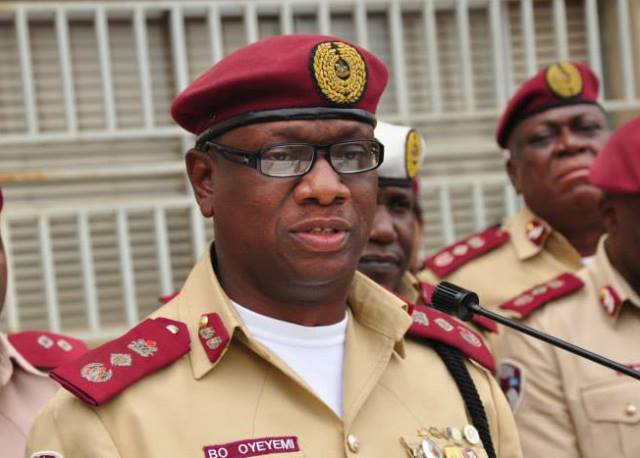
The Federal Road Safety Corps, FRSC, says the implementation and enforcement of the Speed Limit Device will kick-off on October 1.
Boboye Oyeyemi, Corps Marshal of the FRSC, made this known during a meeting in Abuja on Wednesday, adding that the directive was from the presidency.
“The final directive from the presidency is clear; the enforcement date for the implementation of the speed limiting device is on Oct. 1 and we have had series of stakeholders meeting.
“The essence of today’s meeting is to finally convey the directive of the federal government to the stakeholders that with effect from Oct. 1, the implementation and enforcement would commence,” he said.
He explained that motorists who fail to comply with the new policy will have their cars impounded, adding that the initiative will help reduce the rate of car crashes in the country.
“We already have the portal that we will use to monitor this, we don’t need to pursue any vehicle, we will just stop you like we verify licence.
“On the tablet we will check whether your vehicle has been installed with the device, if it has not, we will impound the vehicle and we make sure that you do the right thing.
“We are not talking about fines now ,it’s to save lives so we will impound the vehicle then the owner of the vehicle will be made to install the device before the journey continues,’’ he said.
The corp marshal said that the implementation and enforcement of the device witnessed four postponements from its initial launching date of June 1, 2015, before its final approval by the presidency.
He explained that the FRSC was only concerned about commercial vehicles installing the speed limit device for now, adding that with time the enforcement would extend to private vehicles so as to cut down crashes on the road.
Oyeyemi said that the speed limiter device was available in the market and that the FRSC had a list of the companies trading in the device on its website and urged vehicle owners to visit the site so as to purchase genuine ones.
He however urged the Standard Organsiation of Nigeria to ensure that importers complied with the standard for the device.
The Secretary to the Government of the Federation, SGF, Babachir Lawal, who was present at the meeting commended the FRSC for the initiative and thanked the National Assembly and the President for endorsing it.
Lawal said the project would help in saving the lives of Nigerians by cutting down speed which was a major killer on the nation’s highways.
Representatives from the National Assembly, the SGF’s office and the Department of State Security, DSS, were present at the meeting, as well as members of transport associations in Nigeria who also pledged to support the initiative.
The Federal Road Safety Corps, FRSC, says the implementation and enforcement of the Speed Limit Device will kick-off on October 1.
Boboye Oyeyemi, Corps Marshal of the FRSC, made this known during a meeting in Abuja on Wednesday, adding that the directive was from the presidency.
“The final directive from the presidency is clear; the enforcement date for the implementation of the speed limiting device is on Oct. 1 and we have had series of stakeholders meeting.
“The essence of today’s meeting is to finally convey the directive of the federal government to the stakeholders that with effect from Oct. 1, the implementation and enforcement would commence,” he said.
He explained that motorists who fail to comply with the new policy will have their cars impounded, adding that the initiative will help reduce the rate of car crashes in the country.
“We already have the portal that we will use to monitor this, we don’t need to pursue any vehicle, we will just stop you like we verify licence.
“On the tablet we will check whether your vehicle has been installed with the device, if it has not, we will impound the vehicle and we make sure that you do the right thing.
“We are not talking about fines now ,it’s to save lives so we will impound the vehicle then the owner of the vehicle will be made to install the device before the journey continues,’’ he said.
The corp marshal said that the implementation and enforcement of the device witnessed four postponements from its initial launching date of June 1, 2015, before its final approval by the presidency.
He explained that the FRSC was only concerned about commercial vehicles installing the speed limit device for now, adding that with time the enforcement would extend to private vehicles so as to cut down crashes on the road.
Oyeyemi said that the speed limiter device was available in the market and that the FRSC had a list of the companies trading in the device on its website and urged vehicle owners to visit the site so as to purchase genuine ones.
He however urged the Standard Organsiation of Nigeria to ensure that importers complied with the standard for the device.
The Secretary to the Government of the Federation, SGF, Babachir Lawal, who was present at the meeting commended the FRSC for the initiative and thanked the National Assembly and the President for endorsing it.
Lawal said the project would help in saving the lives of Nigerians by cutting down speed which was a major killer on the nation’s highways.
Representatives from the National Assembly, the SGF’s office and the Department of State Security, DSS, were present at the meeting, as well as members of transport associations in Nigeria who also pledged to support the initiative.
The Commonwealth Election Observer Group to Zambia has urged the people of the Southern Africa country to play their part in ensuring peaceful and credible elections on Thursday.
Kenneth Tsekoa, former Cabinet Minister of Lesotho and Vice Chair of the observer group, said this in Lusaka, Zambia’s capital.
He said the group’s role as independent observers is to scrutinise the entire election process, then take a view whether it has been conducted to the national, regional, Commonwealth and international standards.
The Commonwealth Observer Group is led by former President of the United Republic of Tanzania, Jakaya Kikwete.
Various observer groups have received series of briefings from political parties, civil society, women’s and youth groups, and the media to enable them to get a sense of the mood in the country ahead of the elections.
They will make detailed observations to assess the pre-election period as well as visit polling stations on Election Day and during the post-election environment.
Since 1980, the Commonwealth has observed more than 130 elections in 36 countries.
This is the sixth General Elections to be held in Zambia since the introduction of multi-party democracy in 1991.
Zambians will be voting for the President, 156-member National Assembly and over 1,600 local government councils.
Also, for the first time, Zambians will also directly elect Mayors or Council Chairs and vote on a referendum on the Bill of Rights, making a total of five ballots per voter.
Former President Goodluck Jonathan is also leading the African Union, AU, election observer group in Zambia.
He arrived Lusaka on August 6 and has been engaging stakeholders in the country on the need for a peaceful, free and fair electoral process.
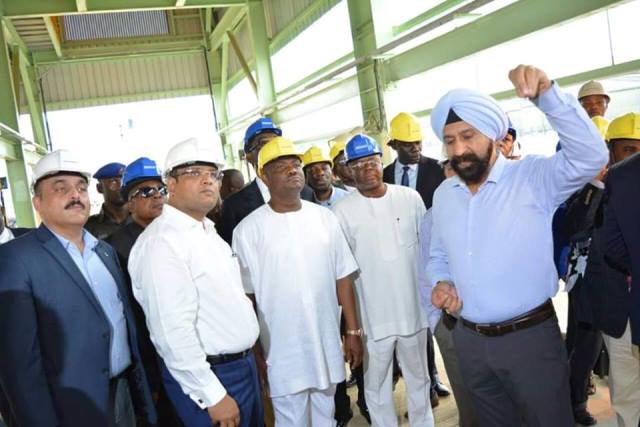
Gov. Nyesom Wike of Rivers State during a Visit to the Indorama Eleme fertilizer plant
The Management of Indorama Eleme Fertilizer & Chemicals, IEFCL, has denied allegations that the company and another fertilizer firm are sabotaging the economy and security of the nation through their export of fertilizers at the detriment of farmers in Nigeria.
In a statement issued signed by Jossy Nkwocha, the company’s head of Corporate Communications, all domestic supplies to customers so far are in accordance with the approval of the Office of the National Security Adviser and the Farm Input and Supply Services department in the Federal Ministry of Agriculture and Rural Development.
“Indorama Eleme Fertilizer & Chemicals Limited (IEPL) and its sister companies in Nigeria are NOT, and HAVE NOT, and would NEVER be directly or indirectly involved in any activities to undermine or sabotage the economy or security of the nation,” the statement read.
The Management noted that the its plant started pre-commissioning production just recently at only 75% capacity, and in the past one month has been giving priority to the domestic market.
“Our brand-new fertilizer plant has capacity for 1.5 metric tons of fertilizers per annum which is designed to serve Nigeria’s entire domestic requirement and the surplus is for export markets.”
“However, our primary focus is to serve the interest of our domestic market and this we have been doing with great sense of responsibility and commitment to the Nigerian economy” the company stated.
Nkwocha said the company was proud that its production surplus would be for export in order to generate foreign exchange for the Country at this time of huge deficit of forex.
She added that exporting fertilizer would put Nigeria among the league of producers and exporters of petrochemicals and fertilizers, thereby encouraging more foreign investors to come and invest in the countrya”
“Indorama-Nigeria is 100 percent committed to the growth and development of the Nigerian economy; and has in the past ten years demonstrated such TOTAL commitment and loyalty by providing more than 85% domestic needs of polymers which were hitherto imported into the country at huge foreign exchange cost,” Nkwocha said.
The fertilizer firm expressed disappointment over the publications which, according to him, gave misleading impression that the two fertilizer companies were sabotaging national security by distributing fertilizers within the country, which were being used by some undesirable elements to make explosives.
“The publications further mentioned an unnamed organisation involved in commercial explosives and accessories whose activities were sabotaging national security”.
“This mix-up has caused great embarrassment and distress to our company, which over the past ten years has the unblemished reputation of adding great value to the Nigerian economy and society,” it said.
The Management of Indorama Fertilizer restated its total commitment to the economy and security of the country, especially in ensuring that farmers across the country have unhindered access to its high quality fertilizers.
It also expressed readiness to collaborate with the office of the NSA and Federal Ministry of Agriculture and Rural Development to ensure that all
identified concerns about availability of Indorama fertilizers by farmers and dealers are addressed as quickly as possible.
Recall that the National Security Adviser, NSA, Babagana Monguno, had on Thursday, threatened that government would withdraw the licences of fertilizer plants for allegedly involving in illegal exports that had resulted in the scarcity of the product.
He also accused the companies of complicity in the renewed attacks on Nigeria’s oil and gas infrastructure in the Niger Delta.
According to Monguno, discoveries showed that Improvised Explosive Devices, IEDs, used by terrorists were developed mainly from certain grades of fertilizer which contained nitrate using Urea Nitrate.
Notore Petrochemical and Indorama Eleme Petrochemical are the only companies licensed to manufacture fertilizer in the country following a recent ban on importation.