Saraki carrying a recovering baby at a health facility in Borno State, as the State Governor, Kashim Shettima looks on
Senate President Bukola Saraki has described the present malnutrition challenge being witnessed in Borno State as a national problem which deserves the attention of everyone.
So serious is the problem that the Senate President has promised to raise the issue on the floor of the upper legislative chamber of the National Assembly soonest.
Saraki made this declaration while in Maiduguri, the Borno State capital, on a condolence visit to the people of the state over the death of Shettima Monguno, a first republic minister and the first African head of the Organisation of Petroleum Exporting Countries, OPEC.
The Senate President also used the opportunity to visit the centre for the treatment of people suffering from severe malnutrition.
During his interaction with journalists at the Maiduguri International Airport after the visit, Saraki said that Borno State has been left to carry too much of the burden of the Boko Haram insurgency, adding that it has become pertinent for others to give the people there a helping hand.
“I am happy I am here with the leadership of the Senate. Before we break we will definitely discuss it (the Borno malnutrition crisis) on the floor and see what we can do,” he said, adding that the federal government and all concerned agencies need to do more to remedy the situation.
“I think it is not good for a country like ours, we are a rich country, it is just an issue of organizing ourselves and getting the fund to support the state government. The state has been carrying too much of the load on their own,” Saraki said.
“We all need to put in our effort and see how we can address the (malnutrition) situation because it is the women and children that have suffered most from this. We must do our best to play a role and support the state in doing that,” he added.
The Senate President was accompanied on the visit by the Majority Leader of the Senate, Mohammed Ali Ndume, Abubakar Kyari, Baba Garbai and Adamu Aliero.
He said the visit to Borno was an eye-opener as it has offered the team the opportunity to see first-hand the extent of the malnutrition crisis.
He however commended that state government for the work it has been doing in managing the crisis.
Saraki said that the senate is almost at the last stage of passing the law on the North East Development Commission.
“We believe that the institutional framework is necessary to start to address the situation and once we pass the bill the commission can start to work and begin to register the issues of rehabilitation and reconstruction that is important.”
To prevent past practices where funds meant for fighting insurgency in the northeast were embezzled, the Chief of Army Staff, Tukur Buratai, a Lieutenant General, has ordered the Military Police to carry out a forensic audit of all formations and units in the northeast, Daily Trust has reported.
Buratai said the success recorded by the army in the counterinsurgency operation owes to the prudent application of resources, adding that the audit, which also involves other army formations across the country, is aimed at ensuring that money allocated to the army is judiciously utilised.
“The military police is presently carrying out a forensic audit of every formation in the Nigerian Army and, in particular, our operations in the northeast.
“We are looking into the details of how funds were utilised in all our operations, especially in the northeast, in order to ensure that we justify what has been given to the Army,’’ Buratai said when Ugochukwu Osuagwu, Principal Partner of St Francis Xavier Solicitors paid him visit.
Ugochukwu had written to the Code of Conduct Bureau to get the details of Buratai’s asset declaration form in the wake of allegations that he bought properties in Dubai as Chief of Army Staff.
According to Ugochukwu, his letter to the CCB was borne out of the need to unearth the truth and now that it has been established that the properties in question were declared, the matter should be rested.
“When this issue came up I felt there was a need for the central body, which is the Code of Conduct Bureau, to put an end to this matter.
“My firm wrote to the CCB and in the letter of July 11 it was clearly stated that the said asset was in his asset declaration form and the said property was declared in his wife’s name,” he said.
Buratai commended the lawyer’s action and urged Nigerians to follow his example, adding that the army remains committed to transparency and the fight against corruption.
Speaker Dogara delivering his welcome address at the Summit
Speaker of the Federal House of Representatives, Yakubu Dogara, has promised that the he would work together with his colleagues in the green chamber of the national assembly to pass the Petroleum Industry Bill, PIB, in order to enhance and ensure better oil exploration and production in the country.
Dogara made this pledge during his welcome address at the National stakeholders’ summit on Petroleum industry reforms, organized by the House Committee on Petroleum, in Abuja on Monday.
He said that Nigeria, as one of the richest petroleum regions of the world, has not been able to maximize effectively its immense oil and gas potentials and the revenue accruing from it, due to inefficient infrastructure and inadequate legal framework.
“The result is that Nigeria is both one of the world’s largest producers of crude oil, and one of the world’s leading importers of petroleum products, a dependency that has enriched the elite at the expense of the increasingly impoverished masses,” Dogara stated.
The speaker said that the aim of the summit was to make participants put heads together and find ways of avoiding pitfalls in the efforts to pass the PIB into law.
“This is why we are here today. Most of us have been co-travellers on the journey to pass the bill into law, and have the requisite experience to avoid pitfalls ahead, hence this resolve to seek proper consultation with you and build confidence amongst us,” Dogara said.
He also said that there was no pending executive bill on the PIB on the floor of the National Assembly as being insinuated by the media, adding that he had on three occasions requested the Executive to as a matter of urgency send an executive bill on intended reforms in the petroleum sector, with the hope to avoid the situation in the 6th and 7th National assembly where the PIB was sent too late and could not be passed.
Dogara however said that two members of the house have come up with draft bills. He asked participants at the summit “to familiarize themselves with the bills and make necessary inputs at the public hearing stage of the bills.”
“We also hope that this summit will craft its own version of the PIB for the attention of the National Assembly, taking into consideration all the existing drafts and also the pending bills,” he said.
Speaker Dogara said the House of Representatives is committed to making robust laws that will impact positively on the people and he expressed their readiness “to completely overhaul and transform the Nigerian Petroleum industry, particularly the institutional framework which is believed to be the key to any meaningful reform in the sector.”
Minister of Budget and National Planning, Udoma Udo Udoma
The Ministry of Budget and National Planning says the 22nd edition of the Nigerian Economic Summit, which has been scheduled to hold in Abuja by October this year, will focus on the need to strongly market and patronize Made-in-Nigeria goods.
Udoma Udo Udoma, the Minister of Budget and National Planning, disclosed this on Monday while inaugurating the Joint Planning Committee, JPC, for the Economic Summit, with the theme: Made-in-Nigeria.
The minister said the Summit will be used to galvanise support from stakeholders on the need to commit to changes required to strengthen the Nigerian economy, beginning with a change in the mindset of Nigerians by shifting their preference for anything foreign to patronizing made-in-Nigeria products.
Though he acknowledged that there are challenges in promoting Made-in-Nigeria products because of quality and standard issues, he nonetheless said Nigerians must challenge themselves; as “we have the ability in Nigeria to make products of the highest quality”.
Udoma explained that by encouraging patronage, manufacturers will be challenged to invest in technology required to upscale quality.
The minister said he was optimistic that the Summit will serve as a strong platform to sharpen the focus of conversation and extract tangible commitments and outcomes from participants, adding that “the key thrust would be to facilitate stakeholders’ discussion and agreements on the practical issues, opportunities, policies and regulations needed to allow ‘Made-in-Nigeria’ a success in the country.”
He stated that many of the recommendations from last year’s summit were reflected in the 2016 Budget and the Strategic Implementation Plan for Budget 2016.
He therefore enjoined the planning committee to take cognizance of the current Administration’s commitment to repositioning of the economy, creating jobs for the youths, as well as supporting the vulnerable groups.
Asue Ighodalo, Vice chairman of the Board of Directors of the Nigerian Economic Summit Group, NESG, added that this year’s edition of the Summit is expected to convey the need for Nigerians to urgently “turn our consumption pattern from negative economic impact into being an asset through assuring a focus on “Made-in-Nigeria.”
Hadiza Usman, the newly appointed Managing Director of the Nigerian Ports Authority, NPA, has assumed duties at the NPA headquarters in Lagos, with a call on her colleagues to join hands with her to make the agency more efficient.
She made the call during a resumption speech on Monday and stressed that her priority was to make NPA a model agency.
In her speech during a brief handover and take-over ceremony, Usman expressed her appreciation to her predecessor and promised that under her leadership, the agency will strive for enhanced operating efficiencies to facilitate improved revenue generation and inflows into the national treasury.
“We will listen to our customers, importers, exporters and other agencies working in the Ports to improve on our service delivery to the nation, anything less than world-class services is simply not acceptable; attaining such heights is a mission to which I am certain we can all subscribe,” she said.
She reminded the staff of the ports authority that it was their duty to ensure that the operators deliver port services at the standards that the country deserve in the 21st century in support of the present administration’s agenda of economic diversity.
“As team leader, I have come to add my best efforts to yours so that we can collectively achieve results for our industry. We must work as a team, pursuing common goals with professionalism and diligence,
“We shall prioritize investment in primary equipment and infrastructure and services committed to by NPA in the concession agreements to hasten clearance of imports and exports from the ports,
“As we collaborate in the best traditions of public service, I believe that with commitment and diligence our hard work can position NPA as a model agency,” she sid.
Usman reminded the workers that all hands must be on deck in promoting best practice, upholding governance standards and delivering quality services, insisting that work hard and integrity would not be compromised, before adding that there would be “zero-tolerance for corruption.”
She also promised to listen and pay attention to workers’ concerns and welfare in order to bring out the best in them.
Our reporter, SAMUEL MALIK, was embedded in military convoy that recently toured towns and villages recovered from Boko Haram insurgents in the North east. Below is his report on efforts to make residents return to the liberated communities.
Less than two years ago, major towns such as Bama, Banki, Pulka, Gwoza, Bita, Askira-Uba, Damboa, Chibok, and Bulabulin in Borno State and Michika, Madagali, Gulak, and Mubi in Adamawa State were all occupied by Boko Haram insurgents, one of the deadliest terrorist groups in the world.
Having invaded the communities, killing innocent people and burning properties, lucky residents fled to other states to seek refuge. Over 20,000 people, including children and women were reportedly killed by the group in the last seven years while more than two million are displaced.
Initially believed to be on a mission to Islamise the north when it targeted churches and Christians, Boko Haram soon showed it cared less for Islam and the welfare of Muslims as it became less discriminatory in its attacks killing followers of both religions and attacking churches and mosques.
Banks, schools, hospitals, worship centres, and other infrastructures were not spared.
A bullet-ridden Nigeria Legion building in Gulak, Adamawa State
But months of intense military onslaught has weakened and decimated the group, and forced its members to flee territories they hitherto occupied. Having secured the communities from the terrorist group, government has said the process of reconstruction had taken off. With the towns now rid of insurgents by the military, the government is encouraging civilians to return to their communities and get back to their lives.
A recent visit to the liberated towns by our reporter showed that the civilians are heeding the call to return home. With the exception of Bama, Banki and Bita, many people are returning to their homes, particularly in towns in Adamawa State, where life and business activities have fully resumed.
Traders are opening their shops, closed for more than a year, and life is beginning to look normal for many. Hawkers, a common sight in these communities before Boko Haram invasion, have returned to the streets and calling attention to their wares. Men, women and children could be seen in their farms or going about their daily chores.
Bama: A symbol of Boko Haram’s carnage in the North east
In Bama, one gets an insight into the astonishing level of destruction Boko Haram visited on the North east.
Less than 70 kilometres from Maiduguri, Bama is the second largest town in Borno State after the capital. According to the 2006 census, the town has a population of 269,986 people.
The first large scale attack on Borno by Boko Haram was visited on Bama on May 7, 2013, when about 200 heavily armed insurgents in 18-seater buses and six Hilux vehicles mounted with anti-aircraft guns invaded the town. The target was the 202 Battalion of the Nigerian Army, Police station and barracks and other government buildings.
Armed with rocket propelled grenades, general purpose machine guns, anti-aircraft guns, improvised explosive devices; the insurgents razed the police station and barracks, the local government secretariat, Independent National Electoral Commission, INEC, office, magistrate court, a primary school, and other structure.
At the end of the attack, 53 people were left dead and 105 prisoners freed from the Bama Prison.
Although the army barracks survived the attack, the marker was laid for future incursions.
On September 1, 2014, the group launched its deadliest attack and this time around it took over the town, with security agents joining civilians to flee. People were rounded up and shot, including elderly people who were too weak to escape. Many were simply slaughtered.
“The rain helped to wash the town clean. What you saw there was nothing. If you went there last year before rain started, the whole place reeked of decomposing bodies. There was blood everywhere,” a soldier said.
According to Mohammed Ibrahim, an indigene of Bama and also a health worker, the town has been attacked 12 times by Boko Haram.
“In October last year, we were on our way to Bama when we decided to stop at the bridge that leads into the town. It was said that was a place where people were slaughtered. We decided to check around if we could find any corpses for burial. Just as we descended down the bridge, to my surprise, I saw the skeleton of my colleague at the office with his ID card. At the end, we retrieved 56 such skeletons without even going further into the surrounding bush,” Ibrahim said.
What is left of the town, after its recapture by the military on March 17, 2015, are the relics of the multiple attacks – dilapidated buildings, charred vehicles and empty streets, save for soldiers. The once economically thriving town, Bama is now a ghost town, where 26,000 displaced persons are sheltered in horrible conditions on a hospital compound.
The only sign of life in the once bubbling town are soldiers keeping watch. The movement of people in the IDP is still limited to their camp.
In the other towns, especially in Adamawa State, the scale of destruction is not the same with Bama, as the insurgents mainly targeted banks, power installations, places of worship, and government properties. Many houses are still intact. but empty, perhaps, signifying some reluctance by residents to return home.
Civilians appreciate the military
Residents gather to greet soldiers in Mubi
In all communities visited where civilians had returned, they trooped out at the sight of the long military convoy led and trailed by the impressive looking Mine-Resistant Ambush Protected REVA III left behind by South African mercenaries contracted by former president, Goodluck Jonathan’s administration, cheering, waving ecstatically and rushing to call their neighbours.
“God bless you, victory is yours, we are grateful,” excited residents shouted in Hausa and whatever English they could manage, as they waved at the soldiers, some of who responded.
“They are appreciative of what the military has done,” Mustapha Anka, a Colonel and spokesperson for 7 Division in Borno State, said.
Even children seemed to understand and recognise the significance of the military’s intervention in their communities. Some of them, as young as three, shouted greetings to catch the attention of troops. They waved, shouted and threw out the soldiers’ salute as a mark of respect for the troops.
“Peace has returned, as people are going about their normal activities without fear. Businesses have returned while famers are back to their farms. Also, you can see children playing in the open. All this is made possible by the sacrifice of soldiers with support from other security agencies,” the Emir of Mubi, Abubakar Ahmadu, said when the General Officer Commanding, GOC, 7 Division of the Nigerian Army, Victor Ezugwu, paid him a courtesy visit.
In Borno towns of Damboa, Askira-Uba, Chibok and surrounding villages, like in Adamawa State, life has fully returned. Elderly people were seen sitting outside in the night due to the heat while youths take a stroll. Children were seen playing under the moonlight. Business centres were lit by generators, with phones and batteries brought for charging. Young girls and women sold gruel while some sold bean cake for breaking of Ramadan fast.
Damboa Motor Park after opening of Maiduguri-Damboa-Biu Rd
The opening of the Maiduguri-Damboa-Biu Road by the military has also proved vital in getting people to return to their communities. This important road had been closed for three years because it was one of the most dangerous roads in the northeast, as it separates Sambisa and Alagarno, the hitherto spiritual and military base of Boko Haram.
To keep the military at bay, Boko Haram planted numerous improvised explosive devices both in the middle and by the side of the road. The military anti-bomb team had to clear the mines and patch up the damaged road, which took quite some time.
“All these patches you see on the road were done by our men. They were holes made by IEDs and we had to fix them because we were using the road,” Anka, who was also the former media co-ordinator for the counterinsurgency operation, said.
Opened four months ago by the Chief of Army Staff, Tukur Buratai, a Lieutenant General, the army is not taking chances despite absence of attacks. Escorts are provided daily for motorists from Maiduguri to Damboa and back.
Vehicles now ply Maiduguri-Damboa Rd
All vehicles plying that road from Maiduguri gather together in a convoy and are escorted by soldiers, while the road is patrolled by men of the Motorcycle Battalion. Those leaving Damboa to Maiduguri wait at the motor park to be escorted by the same team after the arrival of those from the state capital.
“Between 230 and 250 vehicles ply this road daily to Maiduguri while as many as 300 come from there. There has been no attack since the road was reopened three months ago because the army provides security for us,” Bukar Kolo, deputy chairman of the National Union of Road Transport Workers, NURTW, noted, adding that peace has returned to the town.
Also working with the military in Damboa is the youth vigilante group, Civilian JTF, with offices is located within the motor park, and its men constantly walk around the park as a way of surveillance. The leader of the group in Damboa, Alarama Mohammed, said the synergy between the C-JTF and the military has been key to ensuring safety of civilians in the town.
The significance of this is not lost on the military and Ezugwu told the www.icirnigeria.org why it is important for civilians to return to their communities.
“Borno state was facing a food crisis. There was a time that we were losing IDPs due to shortage of food. (But I have seen) peace and security being restored in local governments and villages, I saw markets and places of worship and business activities springing up, I saw farming activities.
“Now that I have seen farming has picked up, it is a guarantee that next harvesting season, there will be enough food for people to eat and this is closely linked to the security provided by soldiers. So, it gives me a lot of joy. I feel satisfied and fulfilled that peace is actually beginning to return to hitherto troubled places,” Ezugwu explained.
Not yet Uhuru
Civilians are yet to return to some parts of Gwoza
Apart from Bama, Banki and Bita, there are still communities in Pulka, Gwoza and Damboa completely deserted due to pockets of attacks by insurgents once in a while. This is even evident in places where there is no military presence or buildings and infrastructure have completely been destroyed, leaving civilians with nowhere to stay if they decide to return.
In Banki, a key border town recaptured from the insurgents 10 months ago, there were no civilians in sight, and most of those rescued were taken to Bama IDPs camp. The insurgents are not giving up this important town without a fight and thus, it is unsafe for the return of civilians.
Capturing this town and Banki Junction along Bama-Gwoza road has seriously affected the activities of Boko Haram, which used the junction as a major access point to Sambisa Forest and Gwoza.
It is the same thing in Bita, which was recaptured by men of 114 Task Force Battalion on May 15, 2015, after troops of 81 Battalion were dislodged two weeks earlier. Since the recapture, there have been about 30 unsuccessful attacks by Boko Haram to reclaim it. This has also made the town a no-go area yet for civilians.
“Civilians have not started returning because here is not safe now for them to return,” Monday Daniel, a Corporal and member of the taskforce, said.
Despite the significant success against Boko Haram, the military admits there are areas civilians are yet to return. One of the reasons, according to Ezugwu, has to do more with the destruction of infrastructure rather than the presence of insurgents.
“Much as I am satisfied that peace is returning to some areas, there are still some areas that we do not have our citizens in those places, where their houses that have been destroyed are yet to be reconstructed,” the army chief stated.
What manner of reconstruction?
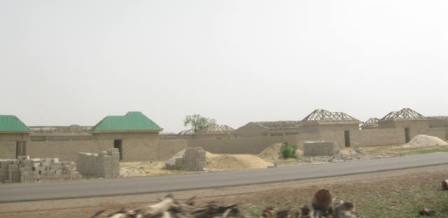
Some houses undergoing reconstruction works in Borno State
In September 2015, Borno State created the Ministry of Reconstruction, Rehabilitation and Resettlement to take charge of rebuilding destroyed communities and resettling displaced persons. But nine months after, our reporter observed that there are no signs of communities being reconstructed yet in the places visited.
In the towns visited, the only visible structure reconstructed was a school in Adamawa State by the Presidential Initiative on Northeast, PINE.
In Borno State, aside moulded blocks, there were no signs that reconstruction work had started in Bama, Pulka, Gwoza, Chibok, Askira-Uba, Damboa, etc.
There is a massive rebuilding work, however, taking place in communities and settlements along Damaturu-Maiduguri road, which is understandable. It is the gateway to Borno state and would give travellers the impression that work may be going on elsewhere.
There have been serious allegations that the southern and central zones of the state are being neglected by the state government.
“You have been to these places and seen for yourself. So, you are in a better position to say whether or not work is going on,” a displaced person from Gwoza told our reporter.
The government did not respond to our inquiry, as Isa Gusau, spokesperson to Governor Kashim Shettima, did not reply an email requesting information about areas under reconstruction.
Justice Nnamdi Dimgba of the Federal High Court, Abuja, has granted former Governor of Imo State, Ikedi Ohakim, permission to travel abroad for medical treatment.
This follows an application by Gordy Uche, SAN, Ohakim’s counsel, asking the court to release Ohakim’s passport to enable him travel for routine medical checkup; an application that was not opposed by the prosecution.
Ohakim is expected to return his passport to the court not later than 48 hours upon his return in August.
According to the News Agency of Nigeria, NAN, the substantive case against the former governor is before Justice Adeniyi Ademola but he approached Justice Dimgba’s court because of the court’s vacation.
Ohakim was arraigned by the Economic and financial Crimes Commission, EFCC, in July 2015 for allegedly purchasing a house in Abuja with a cash payment of N270 million, which he paid in dollars in November 2008, during his time as Governor.
The case has been on since then. The ex-governor filed a no-case submission on June 30 this year, asking the court to strike out all the charges against him. But Justice Ademola dismissed the application and directed Ohakim to open his defence.
The case was adjourned till October 10 and 13 for the defence to call its witnesses.
President Mohammadu Buhari has urged the judiciary to remain impartial and non-partisan in the fight against corruption.
The President said this while declaring open an international workshop on the role of the judiciary in the fight against corruption, which held at the national judicial institute, on Monday in Abuja.
He acknowledged that the responsibility of the judiciary in a democratic society is critical as the Judiciary is one of the three pillars of the modern democratic nation state and is essential to the process of checks and balances, which are fundamental to the way societies are meant to operate and function.
President Buhari, while recognizing the tremendous efforts the judiciary is making to foster justice and accountability in Nigeria, also pointed out that there are persisting challenges that confront the criminal justice system.
He added that corruption is a global phenomenon which knows no boundaries as it exists in and affects all countries and is a threat to peace, stability, sustainable development, democracy, and human rights around the globe.
“Therefore, a fair and efficient judiciary is the key to all anti-corruption initiatives,” he said, and added: “The Judiciary must take steps to ensure that it is not seen as being partisan. As such, it must be aware of the sensitivities of the public and take steps towards avoiding even a shred of a doubt as regards its independence,
“In justice, integrity is necessary. Hence, Judicial Officers and all other members of this profession must always demonstrate manifest integrity,” the President said.
Buhari also urged the judiciary to make sure that justice is never delayed, especially with regards to criminal matters.
He said: “Critically important also, is the sacred duty of the judiciary to ensure that criminal justice administration is not delayed,
“I am worried that the expectation of the public is yet to be met by the judiciary with regard to the removal of delay and the toleration of delay tactics by lawyers.
“When cases are not concluded, the negative impression is given that crime pays. So far, the corruption cases filed by government are not progressing as speedily as they should in spite of the Administration of Criminal Justice Act of 2015 essentially because the courts allow some lawyers to frustrate the reforms introduced by law.
“This certainly needs to change if we have to make success of our collective effort in the fight against corruption,” He lamented.
President Buhari added that the “eradication of corruption is a joint task involving not only judges and members of the legal profession, but all stakeholders, including all branches of Government, the media, the civil society and the general citizenry.”
Police and members of the public mourn the dead officers
US President, Barack Obama has called on all Americans to unite and refrain from divisive language in the wake of another gun-related violence in which three police officers were killed on Sunday.
In a live broadcast from the White House, President Obama said that “nothing justifies violence against law enforcement”.
This is coming as more revelations are beginning to emerge about the gunman behind the attack.
The man identified as Gavin Long, a 29-year-old ex US marine had posted videos on YouTube in which he complained about police treatment of African Americans and urging them to “fight back”.
Long, a Marine from August 2005 until August 2010, rose to the rank of sergeant and served in Iraq from June 2008 until January 2009, earning a number of medals and commendations before he received an honourable discharge.
The ex-Marine, who was later killed by police during the attack on Sunday, stressed in one of the video posts that should “anything happen” to him, he was “not affiliated” with any group.
“I’m affiliated with the spirit of justice, nothing more nothing less. I thought my own thoughts, I made my own decisions,” he said.
Tension has been high since the police shot dead a black man in Baton Rouge two weeks ago.
That death – and a second police shooting in Minnesota – sparked protests across the United States and triggered a revenge attack by a black army veteran who shot dead five officers in the city of Dallas.
Sunday’s attack reportedly took place on Long’s birthday. It is unclear why Long was in Baton Rouge and officials say his motives for the attack have not been determined.
The dead officers were named as Montrell Jackson, 32, and Matthew Gerald, 41, of the Baton Rouge police department, and Sheriff’s Deputy Brad Garafola, 45. All three men had families.
It has emerged that just days before the attack Jackson posted an emotional message on Facebook about how hard it was to be a black police officer in Baton Rouge.
“I swear to God I love this city but I wonder if this city loves me,” he wrote.
“In uniform, I get nasty hateful looks, and out of uniform some consider me a threat.”
President Obama said “Everyone right now focus on words and actions that can unite this country rather than divide it further,” he said, as the US begins two weeks of political conventions with Republicans meeting in Cleveland later on Monday.
“We need to temper our words and open our hearts… all of us,” said the president.
Morocco has formally announced its wish to re-join the African Union, 32 years after it left the organisation.
Morocco left the AU in 1984 after the organisation recognised the independence of Western Sahara, an area Morocco describes as part of the country’s “southern provinces”.
In March this year, the country had threatened to pull its soldiers out of the UN global peacekeeping missions because of the dispute.
In a message to the AU summit in Rwanda, Moroccan King Mohammed VI said the time had come for his country to retake its place within its institutional family.
A special envoy was sent to lobby African leaders at the summit in the Rwandan capital, Kigali, which held on July 17 and 18.
The AU has, however, said that it will continue to push for the rights of the people of Western Sahara to hold a self-determination referendum.
Morocco is the only African country that is not an AU member.