The Nigerian army on Sunday announced the release from detention of 249 suspected Boko Haram members after they were investigated and cleared by the Joint Interrogation unit in Borno State.
Army spokesperson, Sani Usman, a Colonel, said in a statement that the release followed the approval of Chief of Army Staff, Tukur Buratai, a Lieutenant General.
“Those cleared and released include 169 males, 46 women and 34 children.Further breakdown shows that 203 of them were from 18 Local Government Areas of Borno State, while 44 were from other States as follows; Adamawa 2, Jigawa 2, Lagos 1, Oyo 1 and Yobe 38. However, 2 of them were from the Republic of Cameroon,” the statement read, adding that the two foreigners were handed over to the Borno State command of the Nigerian Immigration Service.
The suspects were handed over to the state government through the Commissioner for Local Government by the General Officer Commanding 7 Division, Victor Ezugwu, a Brigadier General.
The state government’s representative urged those released to remain lawful as they go about their normal activities. He also commended the Nigerian military for its efforts in bringing peace to the state while also respecting human rights.
Each of suspect released was said to have been given the sum of N3,000.
A suicide bomber who cleverly concealed improvised explosive devices in a stabiliser case was arrested by soldiers in Borno State.
Army spokesperson, Sani Usman, a Colonel, in a statement on Sunday said the suspect, who gave his name as Yusuf Tasiu, was arrested in Sabon Gari Jidari by troops of 101 Battalion, 7 Division, with the assistance of Civilian JTF, while on foot patrol.
“He was dispossessed of the explosives while the Nigeria Police Explosive Ordnance Devices expert safely detonated it. The suicide bomber is currently being interrogated,” the army said.
In a another development, some members of the Civilian JTF at Njidari, a village in South-east Damboa, carried out some clearance operations against Boko Haram members in a hideout close to Ngwalimeri, a village east of Bale.
“The vigilante destroyed the camp and recovered 1 AK-47 rifle with registration number 565203224 with locally fabricated 5 rounds of 7.62mm (Special) ammunitions and a pair of military uniform. The leader of the vigilante handed over same to the Headquarters of 25 Task Force Brigade in Damboa,” the army added.
President Muhammadu Buhari has directed the Senate of the Obafemi Awolowo University, OAU, Ile-Ife, Osun State to immediately recommend a qualified person for appointment, as acting Vice Chancellor for the university.
This was contained in a letter addressed to the Executive Secretary of the National Universities Commission, NUC, urging the Senate of the university to immediately implement the president’s directives and report back to the Federal Ministry of Education.
The President also directed that all the candidates that had earlier contested for the position may not be considered for nomination.
Workers and students of the university had expressed happiness following the dissolution of the university’s governing council by the federal government on July 1.
The dissolution of the governing council was said to have been announced on the Nigerian Television Authority.
According to the staff and students, the decision was a step towards the redemption and integrity of the institution, which had been hit by internal conflicts following the exit of the immediate past Vice Chancellor, Bamitale Omole.
Presidential spokesperson, Femi Adesina, has said that there are other factors to consider other than federal character when the President makes his appointments.
Adesina said this during a Television programme on Sunday in a bid to provide the presidency’s perspective over the concept of federal character which many Nigerians believe has not been fairly followed in President Buhari’s appointments.
Statistics show that the South-east region has had 12 appointments while the South-south has 17, with the South west producing 16 appointees, while the North-west has the largest number of appointees with 34, the North-east has 25, while the North central has 16.
The appointment of security chiefs seems to have generated even more controversy, same as the makeup of the President’s key staff.
Adesina explained that the case of security chiefs is a peculiar one because hierarchy has to be followed in such appointments.
“The security system oftentimes operates on hierarchy and efficiency. So if you have a senior person who is also efficient and because he comes from a certain region, you bypass him, I think you are being unjust and unfair to somebody,” he said.
While admitting that the appointments are indeed more in some regions, Adesina explained that the exercise is an ongoing process in governance and more appointments would still be made.
He appealed for patience from Nigerians with the promise that appointments made by President Buhari would soon cover all regions of the country.
“At the end of the day, every part of the country is going to be taken care of,” he added.
Asked when the President would be making the so-called upcoming appointments, especially with the dissolution of the boards of some government agencies, Adesina said that the process had been concluded and was just waiting to be unveiled.
“It is the prerogative of the President to make some appointments when he deems fit to make such appointments and you can be sure that the appointments will come,” he said.
The presidential spokesman also defended the President on criticisms regarding his reactions to international tragedies and those happening within the country.
Some Nigerians have criticized the president for not doing enough to condemn the issue of herdsmen/farmers clashes in various regions of the country, but does not hesitate to condemn ugly developments that occur in foreign countries.
Adesina said: “It amazes me when people say they have not heard (the President) on this and that. What they expect is that the President will come out personally to talk on those things, which I don’t think is the thing to do.
“Why does the President have aides? Why does he have ministers? Why do we have officials in government? When they have spoken on those issues, I think we should consider that government has spoken on them,” he said.
President Muhammadu Buhari has directed the acting Inspector-General of Police, IGP, Ibrahim Idris, to reopen investigations into the murders of former Attorney-General of the Federation and Minister of Justice, Bola Ige, and one time Deputy National Chairman, South-South, of the Peoples Democratic Party, PDP, Aminosari Dokubo, in order to bring perpetrators of both crimes to justice.
It would be recalled that Bola Ige was murdered in his home in Bodija, Ibadan, on the evening of December 23, 2001, after his security details had sought permission from the former Attorney General to go and eat.
The Vanguard newspaper reports that IGP Idris has assembled a crack team to be headed by an Assistant Inspector General of Police, AIG, in order to unravel the mystery behind the death of the politician and former governor of Oyo State.
Several unsubstantiated allegations were made against several politicians and interest groups following Ige’s murder, with some saying that he was killed to halt the rise in his political profile, while others said it had to do with his impending probe of the corruption in the power sector of the nation’s economy.
The late PDP Deputy National Chairman, Aminosari Dokubo, on the other hand, was said to be returning to his base from Abuja on October 22, 2004 when he was waylaid and killed by suspected assassins near Asaba, the Delta State capital.
Dokubo’s assassination at the time was alleged to have been caused by certain disagreements with the powers that be in his political party, prior to the general elections.
Reacting to the development, Ige’s son, Muyiwa, said that it would be a thing of joy if the family could get justice 16 years after their father’s murder, adding that he was certain from the advent of the present administration that the matter would be resurrected.
“To God be the glory. It’s a new day; we are happy, we will get justice after 16 years. We are happy that all those who murdered our father, including the star witness, will be brought to justice. It’s good news,” Muyiwa said.
The killing of the two personalities sparked national outrage at the time, with Nigerians calling on the then Olusegun Obasanjo-led administration to fish out the killers who, sadly, are still at large.
Gbaramatu women protesting the continued detention of youths from the community
The people of Oporoza community, headquarters of Gbaramatu Kingdom, Warri South West local government area of Delta State have staged a protest to demand the release of some youths in the area who were allegedly taken away by the Nigerian Army several weeks ago.
They said the military invaded their community under the guise of searching for members of the Niger Delta Avengers, destroying and carting away valuables as well as capturing some youths.
They also claimed that their captured loved ones were neither directly nor indirectly connected to the Niger Delta Avengers, and appealed to President Muhammadu Buhari to order the military to release the youths.
A source at the Nigerian Army 3rd Battalion in Warri, Delta State, has confirmed that the youths were indeed arrested but were being interrogated for various offences.
He said their friends and families need not entertain any fears as they have not been killed as alleged but were merely going through routine investigation.
The Gbaramatu community has been in the limelight in recent times following speculations and allegations that one of its indigenes, Government Ekpemupolo, popularly known as Tompolo, is connected to the Niger Delta Avengers.
Founder of Microsoft and Philanthropist, Bill Gates says African leaders must harness the power and ability of youths to drive innovation in the continent. He said African leaders must encourage the youths and provide opportunity for them to thrive.
He said this during the 14th Annual Nelson Mandela Foundation Lecture in Pretoria, South Africa, where he was the keynote speaker.
Gates acknowledged some young Africans who have created groundbreaking innovations, though he admitted that economic, social and health challenges prevailing in the continent are some of the factors that could hinder development of the youth and that of the future of Africa.
He emphasized the need for African leaders to multiply the talents for innovation by the whole of Africa’s growing population, and that depends on whether all of Africa’s young people are given the opportunity to thrive.
“Nelson Mandela said poverty is not natural, it is man-made and it can be overcome and eradicated by the actions of human beings. We are the human beings that must take action and we have to decide now because this unique moment won’t last,” Gates said.
He added that “We must clear away the obstacles that are standing in young people’s way so that they can seize all their potential,
“If young people are sick and malnourished, their bodies and brains will never fully develop. If they are not educated well, their minds will lie dormant. If they do not have access to economic opportunities, they will not be able to achieve their goals,” he added.
When ThisDay newspaper on July 12, 2016 broke the news of Hadiza Bala Usman , then chief of staff to Governor Nasir El-Rufai being considered by President Muhammadu Buhari to head the Nigerian Ports Authority(NPA) based on the recommendation of Rotimi Amaechi, the Minister of Transport, I was very happy and optimistic for three reasons.
I felt Buhari has finally seen reason to do the needful by bringing more young people on board, that the Nigerian project under the change mantra was on course and, most importantly, Nigeria is moving away from ethnic politics.
That an Ikwerre man is now recommending a Hausa woman to the President for a very sensitive and tedious national assignment is gratifying. This is because the Buhari cabinet has been bogged down by criticism of having too many ‘’dead wood’’ in its fold. This, according to critics, is because some of the ministers are too old to cope with the demands of governance in a digital age.
Second, some of them have been part of past governments that have taken the nation to its present state where Nigeria is still learning to crawl at 56.
Few hours later, her appointment was confirmed by the federal government. I am at a loss why some Nigerians have continued to criticize Usman’s appointment on the basis of where she comes from. It is gratifying that no-one, to the best of my knowledge, has talked about her capacity to do the job, which is a plus for her.
This, to me, should be the focal point. Her appointment signifies a paradigm shift by government and a ray of hope for our generation that the much talked leaders of tomorrow slogan of many years is finally materializing.
The NPA is also too strategic in these lean times to be left in the hands of some political god fathers who consider juicy appointments their birthright.
I believe her critics are missing the point. The founding fathers of Nigeria have always stressed the need for us to emphasize issues that bring us together rather than those that divide us.
The question is should Hadiza Bala Usman reposition NPA in the next 24 months, up its revenue base just like Hammed Ali has done for the Nigerian Customs; will the money go to Northern Nigeria or federation account?
It is an undisputed fact that our infrastructure have gone so bad that one will think there is no government in place to fix things. This is why many Nigerians have become their own government fixing their roads, drilling boreholes for their homes in the absence of public water supply, paying vigilante watch to guard their houses due to inefficiency of the Nigerian Police and relying on generators as an alternative to Disco’s ‘’festival of darkness’’.
All these challenges underscore the fact that the system is not working due to weak institutions. I see a new NPA as a partial step towards ending budget deficit that has become Nigeria’s middle name in the last few years.
I guess this is what the president had in mind when he accepted Amaechi’s recommendation. Then, why the issue of where she comes from? I believe many years of nepotism have so much blinded some us that we find it difficult to see the larger picture in any situation.
Any attempt to talk about her state of origin amounts to throwing away the baby with the bath water. It is unprecedented for an average Nigerian to recommend someone outside his/her ethnic stock for sensitive political appointment.
Rotimi Amaechi could have used his position by recommending someone from Rivers State and the candidate will still scale through. He chose merit over ethnic solidarity and political patronage.
I have lived in the Commonwealth of Massachusetts on the East Coast of the United States for the past six years where I went to graduate school. I have never experienced power failure for a second, never driven on a road ridden with potholes or has my tap run dry.
The power in my house is a supplied by a company popular on the East Coast called National Grid. I have never thought or heard someone raising the issue of where the Chief Executive of National Grid should come from. Or whether he is black, African American or Hispanic?
This is because it is irrelevant as what matters is service delivery and people knowing that they have a government that is caring and responsible. What has made the United States great is the focus on what one is bringing to the table, rather than his color of skin or state of origin.
Why can’t we begin to have a civilized conversation about how to move this country forward without bringing ethnicity or religion?
Since my sojourn in the US, I have been to Nigeria over a dozen times, especially in the last two years. One thing that makes me sick is the epileptic power supply as someone who has an aversion for generators.
I also pity people who do business in Nigeria due to the high cost of powering generators and double taxation. Why then should we rubbish a bold attempt to move the nation away from its sordid past?
There is the need for us to do away with this Nigerian mentality that makes us look at things as Igbo, Yoruba, Hausa or Idoma. This mentality has done so much damage to our psyche that Nigeria is today more divided than we were during the civil war. I have never been a fan of federal character or quota system.
It is responsible for the rot in the civil service today that a barber or welder gets the job of a permanent secretary without having the requisite experience to do the job.
I have never met Hadiza Bala Usman, but only read about her at the early stages of Bring Back Our Girls Group (BBOG) and her stint as Chief of Staff of ‘’Chief Feather Ruffler’ of Kaduna state, Nasir El-Rufai.
I see her as someone with vision. Hence, I do not care where she comes from, knowing what transpired at the NPA during the Goodluck Jonathan years. All that I care about is the repositioning of this strategic parastatal for improved revenue generation as a place where every Nigerian will be proud of.
On the other hand, I never met her late father, Bala Usman, either but was opportune to be at an event where he presented a paper at one of the Northern states some years back. I had to go to the mini secretariat of the event organizers within the same premises to ask for a copy of Usman’s paper.
As I entered the room, a Yoruba woman who was manning the computer told another young man who was making photocopies in Yoruba, “Can you imagine this Baba from Ahmadu Bello University came with his return ticket, when other resource persons were waiting on government to pay for their flights? He is just too principled and honest that he never wants to take anything that is not for him’’.
The young man beamed and said ‘’Olododo ni Baba yi’’. This means Dr Bala Usman is a man of integrity. I could see admiration and respect in the eyes of these two people while the conversation lasted. Inside me, I shared the same respect for Bala Usman’s conduct.
It is a radical departure from the culture I know as a journalist where resource persons invited by governors bill upfront regardless of how important is the presentation to the people and wanting their host to pay for everything including the polishing of their shoes.
The import of this flashback is that in Hadiza I see her late father or what some call a chip of the old block. I see determination, courage and a change agent. Thus, she should be given a chance to justify the confidence reposed in her by President Buhari.
Hadiza should see the criticism trailing her appointment as a shot in the arm to prove her critics wrong, by surpassing everyone’s expectation at NPA. The organization as it is today is in dire need of reforms that even an “F’’ candidate in school knows the NPA is sick, malnourished and infected with the disease of Nigerian mentality. Her appointment among the many qualified persons is a litmus test for our generation and a challenge to test whether the Nigerian youth is still his own worst enemy.
Go, Hadiza, as the torchbearer of this generation and the daughter of a comrade who never had the word ‘’impossible’’ in his dictionary, change the face of Nigeria Ports Authority (NPA) just like your father brought Faculty of Arts and Social Sciences (FASS) at Ahmadu Bello University (ABU) from relative obscurity to a center of academic excellence of national and global significance.
Lawal, a public commentator writes from Boston, United States. He can be reached at rafla2002pl@yahoo.com
Acting Inspector General of Police, IGP, Ibrahim Idris, has assured Internally Displaced Persons, IDPs, in Borno State of adequate security to enable them return to their homelands.
The IGP gave the assurance during the flag-off ceremony of the police medical outreach and distribution of relief materials to IDPs at the Muna camp in Maiduguri.
Idris said that Borno State is the second state he is visiting since his appointment, noting that the state remains dear to his heart as he had spent over five years there as mobile police force commandant.
The acting IGP was accompanied to the camp by the Comptroller General of Nigerian Immigration Service, NIS, Mohammed Babandede, the Commandant General of Nigerian Security and Civil Defence Corps, Mohammed Gana Amadu and Comptroller General of Nigerian Prison, Mohammed Japana.
He said that he came along with the other security chiefs in order to facilitate the deployment of security personnel back to the liberated areas so as to help the troops on ground in maintaining order and restoring civil authority in the areas.
He said that the medical outreach is to provide succour to the IDPs.
Idris said in order to effectively fight crime and criminality, the police is going to establish forensic laboratory in all police divisions, create data base and work closely with the National Identity Management Commission.
The security heads had earlier paid a courtesy visit to the Borno State governor, Kashim Shettima, at the Government House where the governor commended the unity of purpose among the security agencies, demonstrated by the visit of their various heads to the state.
Shetima lamented that Borno State was treated as if it was not part of the nation during the government of former President Goodluck Jonathan, adding that at a point 22 local government areas were taken by the insurgents and that the state capital, Maiduguri, was at the verge of falling under Boko Haram as they repeatedly attacked the town.
He said the trend however changed with the coming of President Muhammadu Buhari as the military started recording successes and reclaiming all the occupied communities.
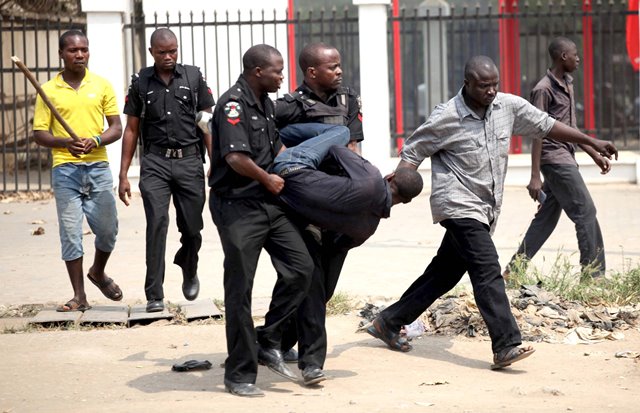
Civil society organisations in Bayelsa have condemned increasing incidence of human rights abuses by security operatives in the state against residents.
The groups, including the Bayelsa Non-Governmental Organisations Forum, BANGOF, Civil Liberties Organisarion, CLO and the International Federation of Women Lawyers, FIDA, whose leaders addressed journalists in Yenagoa, the Bayelsa State capital on Sunday, said that there had been a “geometric spike in cases of extortion and brutality against the people.
Chairman of BANGOF, Robinson Kuroghobogha, , who read a prepared statement of the groups, expressed worry at the increasing spate of human rights violations by men of the Nigeria Police, the armed forces and other security agencies, noting that that, rather, they are meant to provide security for citizens.
“It has come to the notice of the civil society that the rate of assault, harassment, intimidation and unlawful extortion of law-abiding citizens in Yenagoa by armed security personnel has been on a geometric increase,” Kuroghobogha said.
Continuing, he said that “several cases of brutality by armed security personnel have been reported to various institutions with no tangible response from them.”
The activist cited as examples of human right abuses by security operatives, the recent assaults on a reporter with Radio Bayelsa, Tonye Yemoleigha, by an Air Force rating and a student, Philomena Briggs, by five policemen.
Kuroghobogha observed that such acts are human right abuses and a violation of their fundamental human rights guaranteed in the Constitution of the Federal Republic of Nigeria, 1999, the Universal Declaration of Human Rights and the African Charter on Human Rights.
“The human rights community and indeed all law-abiding citizens of Bayelsa are seriously concerned with the excessive conduct of armed security personnel, he states, adding that the primary duty of the police and other security agencies is “protection of lives and property and ensuring the rights of law-abiding citizens are not violated.”
“Therefore, policemen acting with impunity and violating the fundamental rights of law-abiding citizens is a deliberate call to chaos and anarchy and no sane society will approve of that”, he said further.
The groups appealed to the heads of security agencies to address the situation and halt the human rights abuses on citizens.