Home Blog Page 3006

Forget The Law, Take Care Of The Poor

0

Lagos Street
-By Abdul Mahmud

Lagos is a fascinating city that holds immense imaginations, dreams and possibilities for many who encounter it.

It is the place where hopes are born, where hopes die, and dreams yield to the geniuses of those who overcome bitter warts and ends to live the good life and attain the level of grace by merely knowing and encountering the wealthier Lagos.

Ask those, who, having fled the poverty and misery of their birthplaces, are drawn to the klieg lights, welcomed by the statue of the Eyo masquerades to the vast opportunities the city offers. And they seize them. These are the rag-to-riches folks who render testimonies of their conquests, sing and dance to praise songs, roll on altars in appreciation of what God and Lagos have done to them in mega churches.

This is the Lagos of Linda Ikeji.

Yet, there are those who abandon their birthplaces in search of the Golden Fleece who end up in shanties erected on stilts raised above the brackish waters of the lagoon, or in the margins of the metropolis that are merciless as they are punishing.

Lagos isn’t idyllic, even by the most liberal meaning one gives to the adjective, idyllic.

Visit Lagos you’ll find what passes as sad antonyms of the idyllic: the chaos of the Lagos traffic, the Venice of Lagos- the slum dwellings of Ijora-Badiya, Otto Ilogbo and Ajegunle and the floating shanty of Makoko- brackish waters, shunned by sunlight and befriended only by human waste at night. There are criminals, prostitutes, petty thieves, burglars, carjackers, armed robbers, pickpockets, swindlers, money-doublers, area boys- those left behind by the wealthier Lagos- here, who morph into pretend beings at dawn, and there are those who hustle in the streets- they are neither criminals nor area boys- by hawking wares. God bless their hustles.
This Lagos of Ijora-Badiya is akin to the one that the famous American journalist, John Gunther described in his famous work, Inside Africa, as the “catacombs of filth”.

A word here. One can forgive John Gunther for extrapolating the “cardboard city” he viewed from the old Carter Bridge. Perhaps he didn’t catch a glimpse of Ikoyi of colonial Lagos when he described the city as the catacombs of filth.

The poet, Femi Fatoba, once described Lagos thus: “Lagos is like crab/in a basket/each stepping in the other/each pulling the other down/in order to get up/that is how Lagos is/tough is Lagos/difficult is Lagos”.

The crab mentality is ever pronounced in places where resources are scarce, where opportunities are limited and folks get by, struggle to climb the food chain by pulling each other down, by stepping on each other.

Getting by and surviving Lagos is a bruising experience even in the best of times. Climbing or reaching the summit of the food chain is even more bruising for those who crouch at the foot, without strength, without courage, without the belief that they can reach the summit of the food chain and don’t come crashing into their miserable earth like Humpty Dumpty.

Lagos state, for all its claim to excellence, subtly implicated in Fatoba’s poetic rendering, is as guilty as the crab in the basket. The toughness and difficulties of Lagos are often quadrupled by the sinister actions of the government of Lagos state.

Take the decision to forcefully remove traders and hawkers from the streets of Lagos as one of the many difficulties poor folks who fight for better life for their families and dependents by eking out their livelihoods on bitter streets- just to place food on the dinner table- have to contend with.

Lagos state is a basket case of how a state becomes repressive, shows no compassion in the way it deals with those who cannot run the rat race, cruel in its public policies, brutal with its legal regimes, when so much is needed to relieve the poor of the pain they feel each day in our country.

When Lagos state chooses to remove beggars from the streets of Lagos, as it shamefully did a few years ago as part of the enforcement of its environmental law and the beautification of Lagos, and embarks on the more devious task of removing street traders and hawkers from the sources of their livelihoods, one is assured that it is madness that is at work.

The poor of Lagos can only be cautioned, warned to be afraid, be very afraid, here.

Environmental laws proceed from the public policy idea that street trading and hawking blight the beauty of our cities. While it is conceded that street trading and hawking have negative implications for the environment and urban beauty, our public policy-makers neglect or willfully refuse to balance the gains of the informal market against social policy needs. The problem, here, is the lack of creative thinking inside the governments of our country.

Elsewhere, we see how the gains of the informal market are balanced against social policy needs. Take Vietnam, a country with one of the highest FDIs and GDPs in Asia, where public areas, streets and the inner rings of cities like Hanoi and Ho Chi Mihn are mapped out and marked for street vendors and traders thereby enhancing great trading experiences, businesses, economic activities, urban and city life. There, deliberate legal and policy regimes allow trading on named streets and fixed sidewalks in a regulated way.

Walk the street of Nguyen Van Chiem in downtown Ho Chi Mihn City, you will witness how the legal regime of street trading makes public health and safety regulations, public policy on streets management more effective.

By allowing street trading in a regulated way, ancillary policies on revenue generation emerge as well. In England that I am well familiar with, street trading licenses are issued by local councils to traders and it is for this reason one finds street traders hustling during the Nottinghill Carnival and at the prestigious horse racing event, The Royal Ascot, where Kebabs, racing annuals, hats, betting coupons, hospitality packages and sometimes unofficial tickets are hawked and sold under the very eyes and noses of officers of the Thames Valley Police.

Imagine the revenue that accrues to the local councils from licensing and think about the internally generated revenue profile Lagos state would acquire if street traders were licensed. Think: ancillary legal and policy regimes would emerge to safeguard public health and safety.
The regulated regime of street trading is a WIN-WIN for all- the government and the governed, and not the blanket ban Governor Ambode insists on.

Lagos state government, far from the excellence it attaches to itself, is emerging as the most dangerous enemy of the poor- an enemy whose objective is to wipe the poor out of the face of Lagos.

There is no logic in seeking to wipe out poor street traders, or restrict their trade, when the Constitution of the Federal Republic of Nigeria, 1999 ( as amended) provides that “the state shall direct its policy towards ensuring that all citizens, without discrimination, have the opportunity for securing adequate means of livelihood as well as adequate opportunity to secure employment”. The operative phrase here is: all citizens have the opportunity for securing adequate means of livelihood; but, then, the forceful removal of street traders and hawkers raise the questions: how does the removal of street traders and hawkers enhance the opportunity for securing adequate means of livelihood? What will become of these street traders and when they are removed from their sources of livelihood?

Governor Ambode has not provided identifiable figures of jobs he has created since he assumed office, instead he exhibits a Promethean behavior towards the poor and displays scant regard for the urgency of the problems that confront them.

There is a wider point on the purposes of government here.

Government exists for two important purposes: first, to secure the prosperity of every citizen; and, second, to provide “suitable and adequate food” for all citizens. For the Lagos state government the best way to secure suitable and adequate food for the poor of Lagos is to remove food from the mouths of those who secure their adequate means of livelihood by hawking wares in the streets. What an irony!

Governmental actions shall be humane, says the Constitution.

Even where governmental laws and policies demand enforcement and implementation, those who run governments in our part shouldn’t have the luxury of willfully enforcing and executing laws and policies in a manner that robs poor citizens of their humanity, nor does power entitle them to turn the arc of governance away from poor folks writhing under the weight of poverty and hunger to wholly evil ends.

The arc of governance should rightly bend towards that benign place where life remains the true living of it and happiness, peace and comfort are purchased at a giveaway price- or for free!

Every anti-people law, every anti-poor policy, not only pushes the masses of the people to the wall, it carries with it the danger of revolt. Remember: when the poor are shoved and pushed, they don’t wait for Moses to help them cross the Red Sea of pain. They seize the moment, parting the Red Sea to reach their destinies.

The Lagos State Street Trading and Illegal Market Prohibition Law does not serve as a source of comfort to those poor street traders and hawkers whose livelihoods are ruined when they are forcefully removed from the streets, or jailed.

It is sad that those who ruin the livelihood of the poor often insist on removal as an inescapable demand of the law.

Forget the law, take care of the poor in our midst.

More Setback For Boko Haram As NAF Pounds Location

0


OPERATION GAMA AIKI, The Air Component of the ongoing clearance operations against Boko Haram Terrorists, also called OPERATION LAFIYA DOLE, recorded major successes on Thursday in its air campaign against the insurgents as two fighter aircraft struck a terrorists’ location at Northern Borno state.

Ayodele Famuyiwa, a Group Captain and Director of Public Relations and Information in the Nigerian Air Force, NAF, in a statement said the target location lies between Tumbum Rego and Malkonory, about 25 kilometres from Kangarwa, and harbours Boko Haram’s makeshift structures and about 4-6 clusters of solar panels which are used by the Terrorists to power communications equipment and for lighting.

Famuyiwa stated that the latest strike was part of the air operations conducted by the NAF in support of efforts by the Nigerian Army and the Multi National Joint Task Force, MJTF, to rid the northern part of Borno of the remnants of the Boko Haram Terrorists.

“The location, prior to the strike yesterday, had been under surveillance for sometimes but was reported active by a NAF Beechcraft aircraft on Intelligence, Surveillance and Reconnaissance (ISR) mission. Thereafter, the Fighter aircraft were immediately scrambled for interdiction,” he added.

Famuyiwa believes that the success of the latest air strikes meant a major setback for the terrorist group, adding that the NAF will intensify such air operations in order to flush out the insurgents within the shortest possible time.

Aisha Buhari’s Decries Rate Of Divorce In The North

0
Aisha Buhari
Aisha Buhari

Wife of the Nigerian President, Aisha Buhari has lamented the alarming rate of divorces in Kano State and some other parts of northern region, calling on the Emir of Kano, Mohamed Sanusi and the state governor, Abdullahi Ganduje, to do something in order to reduce the scourge to the barest minimum in the region.

She made this known on Thursday during a visit to the Kano State Government House, urging the leaders to design some enlightenment programs aimed at educating the people on what Islamic religion says about marriage

Aisha Buhari expressed belief that if such campaign was started from Kano, the other 19 northern States would emulate.

While distributing food items including Rice, spaghetti, macaroni, semovita, and sugar to the people of Kano during the visit, the wife of president said the gesture was to appreciate the people for their support to the Muhammadu Buhari-led administration.

She also visited the Kurmawa prison within the metropolis where she distributed drugs and food items to the prison inmates.

The Emir of Kano, Mohamed Sanusi commended the wife of the President for her unrelenting efforts towards taking care of children in various Internally Displaced Persons, IDPs, camp in Borno and Yobe States.

Emir Sanusi noted that Aisha Buhari’s intervention have helped many families out of difficulty and urged her not to relent.

Revisiting The Dialogue Of The Deaf And The Damned: For Edwin Madunagu @ 70

0
Edwin Madunagu
Edwin Madunagu

By Chido Onumah

It is not very often that I find myself writing a tribute considering that ours is a country where heroes and heroines are in short supply. But I couldn’t allow this particular occasion to pass without reflecting on what Edwin Madunagu, popularly called Eddie by friends and comrades, means to me, to Nigeria and the international socialist movement. Eddie has been described by one of his contemporaries and closest comrades, Biodun Jeyifo, Harvard University’s Professor of African and African American Studies and Comparative Literature, as “the greatest materialist historian and archivist of socialism and the Left in Nigeria’s political history”.

Edwin Ikechukwu Madunagu was born on May 15, 1946, in Ilesha, in present Osun State. He attended Obokun High School, Ilesha, and later studied mathematics at the universities of Ibadan and Lagos. He taught mathematics at the universities of Lagos and Calabar before he and other radical lecturers were sacked in the late 70s by the egotistic military dictator, Gen. Olusegun Obasanjo, for teaching what they were not paid to teach. Eddie has published many works, including The Philosophy of Violence (1976); The Tragedy of the Nigerian Socialist Movement (1980); Human Progress and Its Enemies (1982); Problems of Socialism: the Nigerian Challenge (1983); The Political Economy of State Robbery (1984); The Making and Unmaking of Nigeria (2001); and Understanding Nigeria and the New Imperialism (2006).

In The Nigerian Left: Introduction to History, Eddie says of himself: “I am a Marxist and a socialist and have been so since 1973. I am also strongly influenced by anti-sexism, humanism and revolutionary internationalism. I have remained committed to what Karl Marx called the categorical imperative, that is the struggle to overcome all circumstances in which the human being is humiliated, enslaved, abandoned and despised…As I have said publicly on several occasions, this commitment comes before everything else, including family, ethnic group and nationality.”

I wanted this tribute to coincide with Eddie’s 70th birthday on May 15, 2016, but the vicissitudes of life in Nigeria made that task practically impossible. Ever since, that responsibility has weighed on me. Last September, during a conference in Calabar, I made out time, as I always do anytime I am in Calabar, to visit Eddie and his spouse, Comrade Bene. Such visits, even if for an hour, are usually tutorials in radical politics, history, political economy and the struggles of the working class and the “wretched of the earth” in Nigeria.

During that visit, I had asked Eddie what he planned to do on his 70th birthday. The short answer he gave was, “Nothing”. And then he muttered something to the effect that he would be doing a lot of reflection. It occurred to me that I had posed the wrong question; and that instead of asking Eddie what he planned to do, I should have confronted him with what we planned to do in return for what he has done us, particularly those of us he worked with closely as students at the University of Calabar. I immediately made efforts to bring together some of our comrades in the radical student movement for whom Eddie was a towering source of inspiration and support to do something to honour him. Unfortunately, that effort did not yield the desired result. But it is not too late!

Twenty years ago, in 1996, when Eddie turned 50, I wrote a tribute and journeyed to Calabar to join friends and comrades in celebrating this iconic newspaper columnist, mathematician, author and socialist internationalist. I first met Eddie on the pages of The Guardian newspaper where he maintained a must-read Thursday column for almost three decades before I met him in person. Eddie was among those – others were Profs Biodun Jeyifo, Chinweizu, Godwin Sogolo, Femi Osofisan, Olatunji Dare and Onwuchekwa Jemie – whose writings in The Guardian shaped the thinking and writing of many of my generation. Humanist per excellence, Eddie brought panache and mathematical meticulousness in explaining even the most complex of historical, political and ideological issues. I not only read Eddie religiously, I made sure I preserved all his writings, first in hard copies, and subsequently in soft copies when The Guardian joined the Internet revolution.

Ten years ago when Eddie turned 60, I was away in the US. As his birthday approached, I contacted Comrade Bene, herself a radical socialist and feminist activist, a founding member of Women In Nigeria (WIN), Girls’ Power Initiative (GPI) and now a retired professor of botany, on the possibility of putting together Eddie’s articles into a book to mark his birthday. Comrade Bene jumped at the idea. But there was the little problem, considering the shortness of time, of how to compile and type Eddy’s articles in The Guardian spanning 21 years.

What I told Comrade Bene next was music to her ears. I informed her that I not only had copies of Eddy’s articles from when he joined The Guardian in 1985 but that I also kept soft copies from the moment The Guardian went online. That effort culminated in the publication of a 573-page book titled Understanding Nigeria and the New Imperialism: Essays 2000-2006, a collection of Eddie’s articles in The Guardian edited by Prof Biodun Jeyifo, Prof Bene Madunagu, Kayode Komolafe and myself. That intervention spurred my interest in documenting my own essays which appeared first in The Punch in 1991 and subsequently with Eddie’s encouragement in The Guardian and much later in other newspapers and online platforms. The result has been three published works of essays: Time to Reclaim Nigeria (2011); Nigeria is Negotiable (2013), and We Are All Biafrans (2016).

Understanding Nigeria and the New Imperialism is a book I find myself referring to each time I want to understand the many problems confronting our country and our world. On page 338 of the book is what I consider one of Eddie’s most endearing reflections on the Nigerian crisis – a tribute to Peter Ayodele Curtis Joseph – which was an essay in The Guardian of June 27, 2002, under the title, “To Remember and to Honour”. Eddie wrote, “Of all the contemporary social developments that currently sadden me, one of the most painful is the disconnection of Nigerians, especially the younger ones, from their own history, including the history of their own immediate environments. I can put my finger on a number of interconnected factors responsible for this historical connection. Our educational system pays little attention to our history. Most of the current generation of teachers are products and carriers of this deficiency, so what do you expect from the new products? Our media, print and electronic, from time to time, put out historical materials and programmes. But many of them are disgustingly eclectic, distorted and full of errors of fact and sequence. Our post dependence history is short, just 42 years. But you are asking for a heart if you dare ask any final year undergraduate or young politician to name, in historical sequence, the regimes that this country has had since independence.”

Thanks to social media and the rise of religious fundamentalism, among other factors, the condition Eddie described above has worsened in the last decade. Young Nigerians are not only disconnected, they are tragically disinterested in the history and future of the country as well as in socio-political events that shape their material conditions. And when they attempt to “confront” these issues, what you get is what Prof Biodun Jeyifo describes in the foreword to the book Understanding Nigeria and the New Imperialism, as “a dialogue of the deaf and the damned”. Of course, this attitude is not limited to our youth. As Prof Jeyifo notes, it finds expression “within the community of Nigerian radicals and leftists and the broader community of the national intelligentsia – of all shades of ideological opinion”.

Essentially, what Prof Jeyifo is saying in describing Eddie’s vast and complex body of work is that he (Eddie) shows us that “no meaningful conversation exists” among Nigerians about the future of the country. “What we have is a dialogue of the deaf and the damned. A dialogue of the ‘deaf’ because interlocutors and disputants in our national conversation don’t take the time to listen at all to one another, let alone hear one another as the same issues, the same ideas are repeated and recycled again and again. And a dialogue of the ‘damned’ because we seem headed for a catastrophe that we might not survive this time around as we survived – after a fashion, at least – our Civil War of 1967-70.”

“The eloquence, clarity and force with which he advances (his) theses mark Eddie out as perhaps the revolutionary conscience of our generation,” notes Prof Jeyifo. In a country in crisis like ours, it is the likes of Eddie that we should turn to for guidance. Sixteen years ago (May 4, 2000), in an essay in The Guardian on the Biafra agitation titled “Settling accounts with Biafra”, Eddie wrote, “The young Nigerians now threatening to actualise Biafra should forget or shelve the plan. In place of ‘actualisation’ they should, through research and study, reconstruct the Biafran story in its fullness and complexity and try to answer the unanswered questions and supply the missing links in the story. This is a primary responsibility you owe yourselves: you should at least understand what you want to actualise. If 30 years after Biafra, you want to produce its second edition, you need to benefit from the criticism of the first. History teaches that a second edition of a tragic event could easily become a farce – in spite of the heroism of its human agencies. On the other hand, those who enjoy ridiculing Biafra – instead of studying it – are politically short-sighted. My own attitude to Biafra is neither ‘actualisation’ nor ridicule. I propose that accounts should be settled with Biafra.”

In another essay titled “Sovereign conference or civil war?” (March 16, 2000), Eddie observed: “Nigeria has been reprieved from civil war several times in the past decade. The point is that this reprieve cannot continue indefinitely. Sooner or later history may give Nigeria what the powers-that-be have been reckoning.” If Eddy were still active as a columnist, I wonder what he will make of the depressing news that in a country where the minimum wage is N18,000 ($50) a month, a career soldier, a serving general, in the country, could save enough money to buy not one but two houses in Dubai, one of the swankiest real estate markets in the world.

There are many today, even in the midst of mounting despair and alienation, grinding poverty, hopelessness, terrorism and violence, inextricably linked to the renewed onslaught of capitalism, who still have doubts that a post-capitalist world is possible. To such people, I recommend this extract from a tribute to Eddie by Prof Biodun Jeyifo (The Nation, May 15, 2016): “Let us put away the fears, the worries of the faint-hearted among us that socialism is dead in our country and our world. Indeed, without being in the least complacent about the challenges ahead of us, let us rest assured that prospects for a post-capitalist era of political, economic and social justice for the vast majority of our people in Nigeria and the peoples of our planet are as good now as they were more than forty years ago when, in the Anti-Poverty Movement of Nigeria (APMON), we first became, instantly and forever, lifelong comrades in working class activism.”

Apart from my father, perhaps no other person has had as much influence on my life as Comrade Edwin Madunagu and I am proud not only to be associated with him for three decades but to be his protégé. At 70, Eddie spends his “retirement” running the Calabar International Institute for Research, Information and Documentation (CIINSTRID), a free research institution and public library of the Left, which he set up in 1994 in collaboration with other comrades.

I conclude this homage to Eddie by returning to Prof Jeyifo’s tribute. “It so happens that the prospects for a post-capitalist future are indeed much brighter in many other parts of the world than in our country at the present time,” he wrote. “But we are part of the world at large, thanks in part to global capitalism. No comrade that I know understands and appreciates this contradiction better and keener than Edwin Madunagu.”

There is nothing more to add other than to say that the mission of the generation of Nigerians under 40 is to renew the progressive, radical and popular-democratic traditions of struggle in Nigeria which Comrades Eddie and Biodun Jeyifo (who turned 70 on January 5, 2016) exemplify. You betray that mission at your own peril!

Onumah’s latest book is We Are All Biafrans – A Participant-Observer’s Interventions in a Country Sleepwalking to Disaster. He can be reached through: conumah@hotmail.com; Twitter: @conumah

Oil Workers Postpone Strike Temporarily

0
File: President Buhari meets with leaders of NUPENG, PENGASSAN

Nigerian oil workers under the umbrella body of the Nigeria Union of Petroleum and Natural Gas Workers, NUPENG and the Petroleum and Natural Gas Senior Staff Association of Nigeria, PENGASSAN, have postponed their proposed strike until Monday when negotiations will be opened with the federal government.

Leaders of the oil workers union say the action is being put on hold until they are  able to meet with the government delegation to table their grievances.

That meeting was originally scheduled for Thursday but was moved to Monday because of the three day public holiday this week to celebrate Eid El Fitri.

The Ministers of Labour and Employment, Chris Ngige and Petroleum Resources counterpart, Ibe Kachikwu, will represent the federal government at the meeting which is expected to hold at the NNPC Towers in Abuja.

The unions had earlier on Wednesday declared that it would halt the supply of premium motor spirit, PMS, popularly called petrol, across the country from Thursday.

It also threatened to ground activities at the NNPC, all PMS depots, refineries and International Oil Companies, IOCs, where it had members.

The public relations officer of PENGASSAN, Emmanuel Ojugbana, said the union was not happy at government’s seeming inability to address the lingering industry issues despite the notice given by the union.

“The strike will hold,” he said, “It is going to be a total shutdown and, of course, will cause fuel scarcity. Our members at the depots have all shut down and nothing will work once we start the strike in full; you will see.”

Among the issues PENGASSAN wants government to sort out is the settlement of cash call indebtedness by the federal government to the IOCs, which has grown to about $7 billion.

Ojugbana said the huge debt had made it impossible for some of the IOCs to pay the salaries of their workers, and many had told PENGASSAN that the option before them was to sack their Nigerian employees.

“We are tired of the level of redundancy in the sector. In fact, our major work in the last two to three months has been to fight against redundancy from one company to the other. And the cause of this is that the government is not keeping to its part of the joint venture funding and cash call obligations with the IOCs,” he said.

Protest In Ekiti As Citizens Seek Fayose’s Ouster

0
Protesters in Ado-Ekiti

A huge protest broke out in Ado Ekiti, the Ekiti State capital on Thursday, as excited crowds of residents shut down business and commercial activities, declaring their support for the Economic and Financial Crimes Commission, EFCC’s probe of Governor Ayodele Fayose.

The protesters, comprising of youths, market women, members of the civil society and the organized labour, brandished placards with anti-Fayose inscriptions and demanded the resignation of the governor.

The protesters gathered at the Fajuyi Park area, near the Governor’s Office and went round major streets in Ado Ekiti, before converging at the popular Ijigbo junction where they held a rally and were addressed by many activists who echoed support for the anti-corruption drive of the President Mohammadu Buhari’s administration.

Omotunde Fajuyi, a leader of the All Progressives Congress, APC, in EKiti State, supported the efforts of the EFCC to probe Fayose, saying that the embattled Governor must forfeit the funds in his already frozen Zenith Bank Account to the State Government.

Gboyega Adeoye, an indigene and one of the protesters said, “I saw all these coming long ago. There is a limit to grandstanding, particularly when one is with little or no reputation. It is a case of over stretched luck. And it is sad that one can have two undue chances and squandered them.”

Fayose’s headache began when the EFCC froze his bank accounts with Zenith Bank Plc, alleging that it contained proceeds of crime.

He immediately went to court seeking for an order to unfreeze the accounts and claiming that he was protected from any prosecution as provided for in the 1999 Nigerian Constitution as amended.

The court then asked the EFCC and Zenith Bank to provide reasons why it should not grant Fayose’s plea.

The EFCC promptly filed documents showing details of how governor Fayose, received N1.2 billion from former National Security Adviser, Sambo Dasuki, a retired Colonel, through former Minister of State for Defence, Musiliu Obanikoro.

Recall that Dasuki is currently facing trial for alleged misappropriation of $2 billion meant for the purchase of weapons for the country’s Armed Forces.

Avengers Again Blow Up Chevron, NNPC Pipelines

0


Pipeline-Explosion

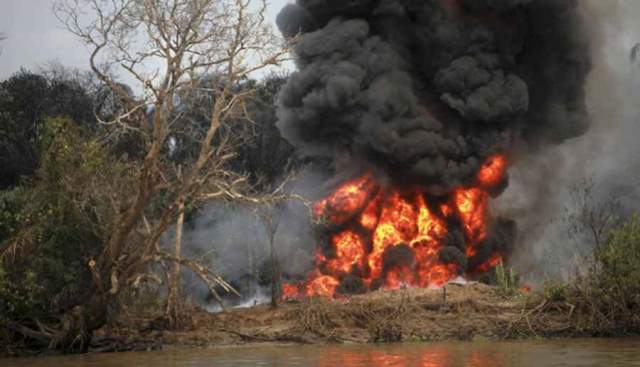
The Niger Delta Avengers has yet again blown up oil pipelines belonging to Chevron and the Nigerian National Petroleum Corporation, NNPC in Rivers State.

The attacks were carried out between Wednesday night and the wee hours of Thursday.

The group revealed this through its website and Facebook accounts as Twitter had suspended the militant groups’ account on Monday, July 4.

The statement by the group’s purported spokesman, Mudoch Agbinibo read: “Between the hours of 10.50pm to 11.10pm our (Niger Delta Avengers) strike team blew up Chevron Manifolds. The manifolds are RMP 22, 23 and 24,”

“By 3.00 am, yesterday, strike team 2, carried out a major strike, bombing NNPC pipeline at Eleme leading to NLNG. You won’t stop us,” another post on the group’s facebook page read, before wishing their Muslim brothers Eid Mubarak.

There have been renewed attacks by militants on the country’s oil installations despite pleas from the federal government for an amicable resolution of whatever the grouse the militants have with the government.

On Wednesday, President Muhammadu Buhari called on leaders and stakeholders in the Niger Delta to work for cessation of hostilities in the region, as well as strive for the unity of Nigeria, insisting that the unity and oneness of the country is not negotiable.


Read also:

Us To Fund  Research on Zika Virus During Olympics

0

Zika

The U.S. National Institutes of Health said it will fund a study to monitor U.S. athletes, coaches and members of the Olympic Committee staff for exposure to Zika virus while in Brazil, with the hope of gaining better understanding of how it persists in the body and the potential risks it poses.

The study, announced on Tuesday, seeks to determine the incidence of Zika virus infection, identify potential risk factors for infection, evaluate how long the virus remains in bodily fluids, and study reproductive outcomes of Zika-infected participants.

Brazil, which has been hardest hit by the mosquito-borne virus spreading across the Americas, will host the Summer Olympics in Rio de Janeiro next month.

The virus has caused concern because it causes potentially severe birth defects in babies whose mothers were infected during pregnancy, including microcephaly – a birth defect marked by small head size that can lead to developmental problems.

The study, which hopes to enroll at least 1,000 subjects, is being led by Carrie Byington, a Doctor at the University of Utah.

“We will follow individuals who have exposure to Zika virus for up to two years,” Byington said, “Because the cohort is anticipated to include primarily individuals in their reproductive years, we will be able to study reproductive health outcomes, including pregnancy outcomes.”

“We hope to identify risk factors and protective measures that may help other travelers avoid infection,” Byington said.

The connection between Zika and microcephaly first came to light last fall in Brazil, which has now confirmed more than 1,600 cases of microcephaly that it considers to be related to Zika infections in the mothers.

Zika is the first known mosquito-borne virus that can also be transmitted via unprotected sex with an infected male partner, leading to imprecise recommendations of how long couples should abstain or refrain from unprotected sex if the woman is pregnant or hoping to become pregnant.

The U.S. Olympic study could help answer some of the big questions surrounding Zika, particularly how long the virus remains present and transmittable in semen.


No Nigerian Bank is in Distress – CBN

0
godwin emefiele
CBN Governor, Godwin Emefiele

The Central Bank of Nigeria, CBN, has urged Nigerians to ignore speculations and rumuors that some banks in the country have gone or may be going into distress.

This was contained in a statement by the apex bank’s Acting Director, Corporate Communication, Isaac Okorafor, describing the rumuors as malicious and unfounded.

Okorafor reiterated the CBN’s position do that the speculations do not reflect the actual health of the individual banks and, indeed, the entire banking industry.

He stated that the infusion of a new Board and Management for Skye Bank Plc is a proactive regulatory action meant to ensure that the bank does not continue to fail in its relevant prudential ratios, insisting that neither Skye Bank nor any other bank in the industry is in distress.

“The CBN would like to request the general public to ignore speculations or rumours to the contrary as they could only be the handiwork of mischief makers who do not mean well for the Nigerian banking system and its economy,” Okorafor stated.

“As the regulator of the industry, the CBN hereby reassures the banking and general public that their deposits remain safe in any   Nigerian   bank.”

Okorafor advised that there is no need for panic withdrawals from any bank as “going by both the CBN’s Examination Reports as well as analysis from market watchers, International Credit Rating Agencies, and Development Finance Institutions, the Nigerian banking industry remains strong in spite of the global economic challenges emanating from the collapse of global commodity prices.”

He urged the banking public to remain calm and not panic as there was no cause for alarm.


Borno State Witnesses Most Peaceful Sallah In Five Years

0
Tukur Buratai and Governor Shettima at the Eid prayer ground in Maiduguri

Borno State, North-East Nigeria, for the first time since 2011, witnessed a very peaceful Sallah celebration following the decision by the state government and security agencies not to restrict movement as security situation in the region improves.

The state, which is worst hit by the Boko Haram insurgency, had been closed to vehicular movements and out-door celebration during all festivities, be it Islamic and Christian, due to fear of terror attacks.

Residents were compelled to celebrate religious festivals under curfew or restriction of movement following incessant bomb attacks and other violent acts by the Boko Haram.

Governor Kashim Shettima had made the announcement Monday July 4, allowing all citizens of the state to have a fresh breath of air during the festival.

“After extensive deliberations, the key actors in security in the state unanimously resolved that we want to give our people dignity. We want them to have a feel of what it was to celebrate and we have resolved not to restrict movement during this year’s Eid-el-Fitri,” he announced.

Shettima disclosed that the decision to allow people roam freely on the streets this year was due to an improvement in the security situation in the state in recent times.

He added that security would be intensified as security agencies and the Civilian JTF had been directed to conduct thorough search and checks on the people.

In a similar development, the Nigerian Army has reopened the Maiduguri-Mafa-Dikwa-Gamboru/Ngala road; a key road that links Borno with Central African countries.

The 138-kilometer road is of great economic importance to Borno State and the nation but has been closed for three years by the military, no thanks to the activities of the Boko Haram terrorists.

The reopening of the road was witnessed by Chief of Army Staff, Tukur Buratai and Governor Shettima as part of activities to mark the 2016 Army day celebration in Borno State.