Brigadier General Victor Ezugwu addresses troops at Pulka, Borno State
The General Officer Commanding, GOC, 7 Division of the Nigerian Army in Borno State, Victor Ezugwu, a Brigadier General, recently embarked on a four-day elaborate tour of brigades and units under his command in Borno and Adamawa States. Despite an attack on his convoy in April along Maiduguri-Bama road, which led to the death of a soldier and injuries to two others, the army chief took to the same road when he could opt to take a helicopter ride.
That is the daring spirit that oozes when one encounters troops fighting insurgents in the Northeast. Our reporter, Samuel Malik, had a first-hand encounter with soldiers and their commanders during a trip to the frontlines of the war against insurgency. He got the rare privilege to speak with the GOC during one of his numerous tours of duty.
It was a brief encounter that was quite revealing. The GOC, fondly called ‘zuma’ by soldiers due to his connection and camaraderie with the troops, speaks about the insurgency and efforts to ensure civilians are safely returned to their communities. He says troops are winning the war due to the inspirational leadership of the current Chief of Army Staff, Tukur Buratai, a Lieutenant General.
What inspired you as the General Officer Commanding to embark on such an elaborate tour?
What inspired me is the inspiration I get from the leadership style of the Chief of Army Staff, Lieutenant General T.Y. Buratai. Each time he comes to visit us in the front lines here, he goes to every unit within the AOR (area of responsibility) and he spends quality time with the troops and he tranverses through all these our locations. So, having been inspired by his sacrifice as head of the army, I said ‘ok, as a divisional commander I should be able to also go round and see my soldiers. So, particularly, what is unique about this tour is that it is the first time that I am taking a cross-country tour of my brigades.
What I want to achieve by this is to get to see my soldiers at every point. The idea is that even if I did not get to stop at each checkpoint to see them, if they heard that GOC was passing, as they saluted and I reciprocated, it would still be appreciated that at least the GOC passed through here. I wanted to get to know them closely and make myself available to them rub minds with them and hear their problems so that I can do whatever I can to solve them.
What are the takeaways you are leaving with from the tour?
The takeaway has been quite enormous, as it has been an eye opener. I have seen that my troops are in very high spirits. I have seen that the objective of the army headquarters to make sure that insurgency is brought to a successful conclusion has started yielding result. I saw motivated soldiers, I saw peace and security being restored in local governments and villages, I saw markets and places of worship and business activities springing up, I saw farming activities. Borno state was facing a food crisis. There was a time that we were losing IDPs due to shortage of food.
Now that I have seen farming has picked up, it is a guarantee that next harvesting season, there will be enough food for people to eat and this is closely linked to the security provided by soldiers. So, it gives me a lot of joy. I feel satisfied and fulfilled that peace is actually beginning to return to hitherto troubled places.
The GOC visited soldiers deployed at Banki Junction, a key part in cutting supplies to the insurgents
One statement you have reiterated to your troops in every location is, ‘We have won the war, it is the peace that we are after’. What do you mean by that?
What I mean is that war is about flexing muscles, pitching your equipment against the enemy’s, pitching your tactics against the enemy’s. These are the physical components of war. That is, immersing your arsenal against the enemy. In that case, the enemy has not been able to stand and face us and fight any longer. We have been destroying them. They come to attack us, we defeat them. We go to attack them, we defeat them. Casualty rate has dropped in my division but enemy casualty rate has tripled and quadrupled. So, if you allow me to say, I will say that particular aspect of the war, fighting, we have an upper hand against enemy.
Why I said peace is left for us to win is because much as I am satisfied that peace is returning to some areas, there are still some areas that we do not have our citizens in those places, where their houses that have been destroyed are yet to be reconstructed.
Thus, peace will be won when there is absolute or near absolute return of citizens to their abode and full commencement of economic life and restoration of government activities. You saw broken down bridges, you saw there is no power, you saw hospitals dilapidated and almost out of existence. These are the ingredients of peace that are still eluding us. It is not only about the presence of the military. Remember, there are other elements of national power that come into play in things like this when you are fighting insurgency. Military is a line of action. The political, the diplomatic, the economic, the information are all channels that you employ to fight insurgency.
The military aspect is what I am telling you that we have done reasonably very well. Now, for political stability, economic restoration, for ease of communication – you have seen that you cannot use your phones in certain places. The presence of these is what will show that peace has been won. It will take time but eventually there is light at the end of the tunnel, meaning we will get there.
So, I hope and dream that in no distant time, government will step up their activities in all other aspects, including the negotiation that the President keeps talking about, ‘If I see credible leaders of the insurgents, I will negotiate with them.’ It is an option that is open for us to win the war because every battle ends up on a talking table. After the war-war, you do the jaw-jaw. The jaw-jaw aspect of it is key to peace and I am praying and recommending that sooner or later when that is done, everything will come to a favourable conclusion and that is when Nigeria will declare herself free of insurgency.
Brigadier General Ezugwu in a group photograph with troops in the front lines
In every location you have been to, troops kept calling and shouting ‘Zuma’. Where and how did you come about that name?
When I was a Lieutenant Colonel, I was posted to 35 Battalion in Katsina State as a Commanding Officer, CO, and, you know, command at battalion level is very critical in the military. If you make a successful battalion commander, you can as well make a successful brigade commander and as well a successful higher commander.
So, when I took over the battalion, the first address I gave to my soldiers – after telling them my mission, what I wanted us to do and how I wanted to run my battalion, discipline and a lot of other issues – that first address is very key because the soldiers are watching your lips, they are watching your body language and idiosyncrasies. These are the things they use to assess their commander and say, ‘E be like say this CO wey come, you sure say na better CO come so?’ Then same way, if your speech, that first speech, is inspirational, they can say, ‘Kai, the way wey we dey see this CO, the way him talk to us e be like say better CO don come’.
So, when I finished the address, I told them I came with two gifts. In my left hand I told them I had whip and in my right hand was a bottle of honey. I asked for the Hausa name for honey and they said Zuma. So, I told them those who wanted whip would get enough of it while those who wanted Zuma would equally get enough and we departed.
The day I held my first durbar, a soldier stood up to ask a question and he said, ‘Sir, when you took over this unit’, immediately he said that, my heart jumped because during durbar the soldiers have immunity and they can say anything without fear because there is no officer present, it is the commanding officer and them. He continued, ‘You told us that you came with Koboko (whip) and Zuma but sir, the way I dey see am now e be like say you don throw away the Koboko, na two Zuma dey your hand now’. They felt that I was beginning to give them a new lease of life and that was how they started calling me Zuma. I think that was their way of giving me a pass mark for the little effort I put in.
Many Nigerians in Europe have expressed disappointment over the decision of the United Kingdom to leave the European Union.
Britons had on Thursday voted 52% against 48% to leave the EU with England and Wales voting for BREXIT while London, Scotland and Northern Ireland backed remaining in the EU.
In telephone interviews conducted by the News Agency of Nigeria, NAN, respondents described the outcome of the referendum as a catastrophe for ethnic minorities in Europe.
Raymond Aste, a lawyer and political analyst who stays in London, said “I can understand concerns by white supremacists to stem the flow of immigrants into their country, but for the immigrant communities, it beats me as to how they considered voting to leave the EU.”
John Duniya who is resident in Scotland, said the Leave EU outcome meant ethnic minorities would not have protection from the EU especially on human rights issues.
“Secondly, the argument put forward by the leave campaigners on immigration control and better welfare for commonwealth citizens is just deceit. I bet you, their idea of commonwealth means Australia and Canada, not Nigeria, Ghana, India and Pakistan,” Duniya added.
Similarly, Yetunde Olivier, a member of Nigerians in Diaspora Organisation, France, said the development was bad for Europe.
“Britain should have pushed for renegotiation in areas it is not comfortable with rather than seek for exit. This is not only about immigration; it is about trade, currency, law and above all, supremacy. I hope at the long run Nigerians and others would not be kicked out of the UK,” she added.
Uche Obiano, a systems analyst who spoke from Switzerland, stressed the need for Nigerians in the diaspora to start considering going back home and contributing to nation building.
Obiano said “all this fear about uncertainty in the UK can be addressed if we start considering going back to our fatherland.”
“If Europeans developed Europe themselves, we can also go back home and contribute to nation building. Britons do not do cleaning, care-giving or security jobs. These can be very tasking and degrading but at the same time immigrants are seeking these jobs for survival. My opinion is that if you find life tough abroad, then go back home and hustle,” he concluded.
Embattled National Chairman of the dissolved National Working Committee of the Peoples Democratic Party, PDP, Ali Modu-Sheriff has asked the Independent National Electoral Commission, INEC, to disregard the Edo State Governorship Primary organized by the Ahmed Makarfi-led faction of the party.
He said this during a press conference at his private residence, adding that he has set-up a committee to conduct fresh primary election in the state.
The former governor of Borno State announced that, Hope Uzodinmma and Ahmed Gulak will be the chairman and secretary of the fresh exercise.
He also named a three man Ad-Hoc delegate panel with Hazeem Gbolarumi, former Oyo State Deputy Governor, as Chairman and Bala Aboki as secretary.
Modu-Sheriff restated that he is the authentic national chairman of the PDP, claiming that the primary election conducted on Monday was not monitored by INEC.
He further claimed that the INEC has handed over to him, guidelines for the conduct of the party primaries for him to conduct a proper one.
He assured his supporters that he would produce a candidate for the party by next Thursday to beat the July 10th INEC deadline for the submission of party candidate for the elections.
In its reaction, the Makarfi committee cautioned chieftains of the party not to play any part in the purported fresh primary election in Edo state and not to take any appointment offered by Modu-Sheriff.
Dayo Adeyeye, spokesperson for the Makarfi committee, in a statement re-echoed sentiments that Modu-Sheriff is conniving with the All Progressive Congress, APC, to completely cripple the PDP.
“It is now very clear that Senator Ali Modu Sheriff is working very hard for the enemies of our great party. First, the Edo primary election and all the processes leading to it thereof were properly conducted, monitored and observed by INEC. Edo PDP Chairman has warned Sheriff to steer clear of their affairs as the party in the state is resolutely united behind Pastor Osagie Ize-Iyamu, the Candidate of the PDP”.
The caretaker committee further warned that any of its members serving in any committee set up by Senator Sheriff will be engaging in anti-party activities and will face disciplinary action.
It dismissed Senator Sheriff’s claim of a court pronouncement empowering him to conduct a fresh primary election in Edo State.
Before traveling to Borno state, I dodged nearly everyone who matter in my personal life. There was no way I was going to tell my siblings or friends outside the media that I was travelling to Borno, stronghold of Boko Haram and former hotbed of terror.
It may no longer represent the theatre of war that it was once, but it remains the only state where insurgency still thrives. I was not prepared to subject them to the kind of fear that daredevil journalism had made me accustomed to. But make no mistake: this was a trip I wanted badly. I had wanted it for exactly two years.
If iron sharpeneth iron, as it is said, it must be that daredevilry begets more daredevilry. In the first week of May 2014, I travelled to Chibok, Borno state, shortly after the abduction of nearly 300 girls from the Government Girls Secondary School in the town. (Having witnessed the anguish of parents of the abducted girls and the horror in the eyes of three escapees from the incident, I think it is the joke of the century when some people continue to stubbornly claim that the whole Chibok saga is a scam.).
The Maiduguri airport was still closed at the time — it is now open and there are only two flights daily, save Saturdays — so I flew to Yola instead before connecting Chibok by road.
Maiduguri itself was my original destination, but a young man named Jasini who was to be my guide (to help circumvent geographical and language encumbrances), withdrew at the 59th minute of the eleventh hour, citing the danger of such trip. It was hard for me to take because Jasini agreed to my proposal two full weeks earlier and he could only wait for me to arrive in Maiduguri before reneging.
It turned out a blessing in disguise, though, as making an about-face to head towards Chibok meant I had covered substantial geographical ground in Borno.
From Biu to Damboa and Askira/Uba, I was awestruck by the sacrifice of soldiers on guard in the sweltering sun, searching vehicle after vehicle to pick out insurgents before they could wreak havoc.
Each time the car I was travelling in was stopped at a checkpoint, I made sure to exchange banters with the soldiers and put in a word of gratitude for their sacrifice to fatherland.
One told me of how he hadn’t seen his parents in four years, and how they would joke that they had “donated” him to Nigeria. That was at a time when Boko Haram had the edge over the army, so I wondered what would happen to those soldiers if they sustained injuries.
I hadn’t left Borno when I decided I would surely be back someday. So, as the only Azman Air Lagos-Maiduguri flight for the day touched down in Maiduguri last month, I was glad to be finally fulfilling a dream.
Soldiers know they signed for death
The airplane tyres had barely screeched to a halt when I made my most important discovery of my stay: the average Nigerian soldier at the theatre of war is desperate to fight, to “finish off” Boko Haram and restore peace to all of Borno and the entire north-east region.
I didn’t immediately know that the young man who occupied the window seat beside me was a soldier — until I needed to speak with a local for directions and I struck up a conversation with him.
“I am here for a national assignment,” he would say when I asked to know what he was doing around. “I am a soldier; and I won’t leave this state until we’ve finished off these stupid Boko boys.”
In my weeklong stay in the state, I spoke with more than 30 soldiers and not one expressed a different sentiment.
“I will be alive to witness the end of this war,” another one told me. And when I asked how he managed the thoughts of possible death, having initially admitted losing “a couple of friends and colleagues” to mines and gun shots, he added: “Look, I signed for it; I am not going to run away because I knew from start what I was signing for.”
So close to danger
Scene of a bomb blast
Although people in the south-west typically consider Maiduguri unsafe (so long it is a part of Borno), I honestly thought the risks were minimal. That was the fifth month of the year and no single bomb blast had been recorded, in contrast to 2015 when there were series of attacks, including one, the deadliest, that killed 26 people at a mosque.
But days after I entered town, Boko Haram launched its maiden Maiduguri strike in 2016, injuring four in a bomb blast at a mosque. Since there was no way I could have been at a mosque at 5:45 am when the blast occurred, I didn’t feel at all threatened.
But a second blast did send shivers down my spine. Close to noon on Thursday May 12, a suicide bomber pretending to be a staff of the state secretariat failed to gain admittance into the premises but succeeded in detonating an improvised explosive device all the same, killing four and injuring at least 19.
I shuddered when I received a call from Seyi Awojulugbe at the Lagos office of TheCable, seeking confirmation of the blast. My guide and I were at the Post Office area of the city, where the secretariat is located, just two days before. Was that close? Maybe not.
An acquaintance had volunteered to link me with an injured soldier, who was recuperating at the University of Maiduguri Teaching Hospital (UMTH), and we were to meet in front of the secretariat on Thursday morning. But for no reason, after parting company with my guide in the morning, I went out for breakfast and decided against meeting up with my acquaintance. For no reason. Instead, I spent the rest of the day indoors, studying the videos I recorded undercover. In my nine days in Borno, that was the only day I spent indoors.
Found out by a soldier
Were the army looking after its soldiers well, I would surely be dead by now. Wherever I went in daytime, I always made a stopover in the evening at the Soldiers’ Club inside the Maimalari Barracks, where soldiers, downing bottles of beer and gobbling plates of pepper soup, usually retired to from the forests to keep up with normal living. It was the most exciting part of my Maiduguri stay, and I always looked forward to it because it helped me know what soldiers truly thought about the army’s war against insurgency. I discovered so much, because it was always a gathering of soldiers participating in no-holds-barred conversations.
For example, I learnt from them that while soldiers — the ones who were directly confronting Boko Haram on the battlefield — were desperate for the sect to be wiped out, the same could not be said of the officers, the senior men in the army hierarchy.
“Our bosses in the army know what they are doing,” one told his colleague on my first day at the relaxation centre. “Go and make your research very well: it is in moments of war that dishonest officers make the most money for themselves.”
A third soldier could agree no less, and he cited an example. He was part of a group of soldiers that found an SUV stashed with cash inside Sambisa Forest. Once sighted by troops, the driver of the vehicle made no effort to escape. Instead, he pled for mercy. Well, by this soldier’s account, it was a matter that was “killed” by the intervention of some officers. “This man went scot-free,” he lamented. “Now, tell me, who was he working for? And why was it easy for the matter to be killed?”
On Day 3 of my routine visit to the place, a soldier found me out. My guide, a civilian with strong ties to the army, was with me on the first day, but he was nowhere this day. Tall, dark, brawny — and obviously brainy — this soldier, as he would later admit, found out I was “too interested” in the matters of the insurgency. When I asked questions, they were too deep for “an ordinary civilian” to ask; and when others talked and I kept quiet or looked away, my body language still showed I was following the conversation. When he laid hands on Karl Maier’s This House Has Fallen, with which I kept myself company, he branded me a “culprit”.
Two minutes to save my life
Diary Maimalari Barracks
“You better start explaining your mission here before I throw you into the guardroom,” he said with a softness that screamed both anger and danger.” And when it was clear to me that I had been found out, I sought to speak with him privately. “I do not have much time, just two minutes, and you had better say the truth,” he warned as we exited the room.
Of course I said the truth, beginning from how my 2014 Chibok trip sparked a desire to find out what was happening to injured soldiers. Did he throw me into the guardroom? No chance, because in me, he found a friend to whom he could unload the burden of soldiering in Nigeria. He spoke with me for 15 minutes after getting me to promise that I would not tape our conversation. I obliged, and it turned out one of my most revealing interviews in Maiduguri.
Losing my manliness… a journalist is first a human, after all
You may have already read the story here, but reading can never be comparable with hearing, firsthand, the moving story of Hamidu’s battle with death, from which he emerged with life.
I was close to tears — but I wasn’t quite there — when the brainy soldier told me about life in the forest, how a group of six soldiers could be together and five would be blown to death by explosive mines, how soldiers were killed in battle and their bodies were left to “rot away”, how they lost their homes due to years in Borno without rotation, how soldiers were dealing with the psychological trauma of the gory happenings on the battlefront.
The only other time I could have shed a tear was when I ran into the soldier who lost his right eye to fragments of a Rocket-Propelled Grenade (RPG). Sadly, I met him in a situation that made it impossible for me to request for an interview, and all I could do was make do with a video recorded undercover. That eye injury is now 26 months old, and all I saw was a plastered eye and a victim “awaiting referral” abroad. What exactly has the army been doing on this eye for two years and two months?
But it was far more heartbreaking to learn that a soldier lost his limbs and was disemboweled by a bomb blast, and then on arriving at the hospital, he was left for dead, dumped at the back of the hospital. Had some soldiers not gone there to urinate, and had he not mustered all the strength he had left to shake his legs to prove that he still bore life, he would surely have died. The tears were coursing down my cheeks before I knew it. Thankfully, I had a handkerchief handy.
Double-crossing the journalist
There were numerous impediments to reporting a sensitive story as this, and there would have been no story to tell had I failed to surmount most of them. But one major failing of this work was my inability to get just one wife of a slain soldier. And I came close a number of times.
One interesting prospect was the case of a soldier killed in battle on June 2, 2015. On June 1, 2016, a friend linked me with the slain soldier’s wife; and even though it was most inconvenient, I offered to travel to Ilese Barracks, Ijebu-Ode, Ogun state, to interview her the following day. I thought it would be significant for me to talk with the woman on the first death anniversary of her husband. It was one full year of chasing yet not getting her husband’s death benefits.
A few hours after speaking with the woman, a native of Plateau state, I received a phone call from a random number; it was from the army headquarters in Abuja and it was to warn me against embarking on the trip.
“We are not saying you should not go but the army will not comfortable with that kind of trip,” he said in the doublespeak and subtle intimidation that had become the hallmark of public relations in the army.
The army not wanting you in their territory and a source not trusting you were a difficult combination. Trip over!
But before the caller hung up, he had betrayed the army’s laxity in compensating families of its fallen heroes. In advancing his argument for opposing my trip, he had said: “We would not want you to do anything that would jeopardize the woman’s chances of collecting her entitlements. When she came to Abuja, I personally supervised the processing of the relevant documents and I am hopeful that by 2017, she would get what is due to her.”
Two full years to settle a woman who had a contact at the army headquarters! What then would happen to the ordinary woman, the one who has no friends or uncles or fathers in Abuja?
Missing the wife of a missing-in-action soldier
There were three more cases where an interview with a slain soldier’s wife was scuppered. One was not exactly a wife; the wedding was a few days away when her husband-to-be was killed in battle. It was her friend who obstinately blocked all chances of an interview. As for the second woman who lost her husband in battle, it was her late husband’s friend who ensured the interview never materialized.
The third and most painful miss was that of a woman whose husband I knew; I never met him really but we often spoke on phone for the latter part of 2014 and much of 2015. It is now nine months since I or any other member of his family has heard from him. Judging by all the interactions I had in Borno, this is a typical case of a Missing In Action (MIA) soldier. It is unlikely the young man is alive.
The younger of his two brothers had graciously offered to facilitate the interview, to hold at Odogunyan Barracks on the outskirts of Lagos, when the older called to call it off at the last minute.
“Look, you cannot go there!” he blurted on phone. “I am the one who has been taking care of the two children he left behind. If you have anything to give the family, give it to me or give it my brother. But I warn you: you cannot go there!”
It was clear that his dissent was never about the interview; he simply believed I had “something” to give the family and I should be handing it to him, not the woman. The difficulty in getting the wife of a fallen soldier was no coincidence. As an investigative journalist, I know that the more some people are desperate to shield a matter from the media, the bigger. Hopefully, I have done enough to provoke someone to unearth this story someday.
You can read the first four parts of the Forgotten Soldiers series here, here, here and here
Prime Minister David Cameron is to step down by October after the UK voted to leave the European Union.
Speaking outside his office at 10 Downing Street, he said he would attempt to “steady the ship” over the coming weeks and months but that “fresh leadership” was needed.
The PM had urged the country to vote Remain but was defeated by 52% to 48% despite London, Scotland and Northern Ireland backing staying in.
Cameron said he had informed the Queen of his decision to remain in place for the short term and to then hand over to a new prime minister by the time of the Conservative conference in October.
“It would be for the new prime minister to carry out negotiations with the EU and invoke Article 50 of the Lisbon Treaty, which would give the UK two years to negotiate its withdrawal,” he said.
“The British people have voted to leave the EU and their will must be respected. The will of the British people is an instruction that must be delivered,” he added.
The referendum turnout was 71.8% – with more than 30 million people voting – the highest turnout at a UK-wide vote since 1992.
Meanwhile, Nigel Farage leader of the UK Independence Party, UKIP, has hailed the decision to leave the EU describing it as the UK’s “independence day”.
Farage – who has campaigned for the past 20 years for Britain to leave the EU – told cheering supporters “this will be a victory for ordinary people, for decent people”.
Pro-Leave Conservatives including Boris Johnson, former Mayor of London and Michael Gove, a popular conservative MP had signed a letter to Prime Minister Cameron, urging him to stay on whatever the result.
The European Parliament is to hold an emergency session on Tuesday, June 28, to discuss the referendum result.
However, Scotland’s First Minister, Nicola Sturgeon said that the EU vote “makes clear that the people of Scotland see their future as part of the European Union” after all 32 local authority areas returned majorities for Remain.
Sturgeon says the option of a second referendum on Scotland’s independence “must be on the table” because the country faces the prospect of being taken out of the EU against its will.
She says a “significant and material change in circumstances” had occurred since Scotland voted to stay in the United Kingdom in 2014.
But since the UK had voted to leave the EU, the Scottish government “will begin to prepare the legislation required” for a second referendum to take place.
The BREXIT vote does not immediately mean Britain ceases to be a member of the 28-nation bloc.
That process could take a minimum of two years, and “Leave” campaigners are suggesting that it should not be completed until 2020, the date of the next scheduled general election.
Commander, Operation Lafiya Dole, Maj. Gen. Lucky Irabor
The Nigerian military said it has instituted an investigation into allegations that some of its officers and men illegal receive money from civilians to serve as escort in the North east.
Addressing a press conference in Maiduguri, the commander of counter-insurgency operation in the North east, Operation Lafiya Dole, Lucky Irabor, a Major General, said he has received reports that some of his men collect money from travellers to escort them through some major routes.
“I wish to use this opportunity to state that we have received reports that some personnel are in the habit of collecting money to escort civilian motorists and goods along the major routes,” Irabor said.
“These allegations are currently being investigated. However, should there be any officer or soldier who is seen collecting money, please do not hesitate to report such to the Theatre Command.”
He assured that the military has a responsibility to protect and assist Nigerians and must do their jobs with dedication.
Irabor urged the public not to pay for such escort duties, warning that “whoever is caught doing that will face the full weight of the law either military or civilian.”
He said any illegal activities involving the military should be reported using the following mobile phone numbers: 09028101021 and 08082252400. The lines would be available for between 9am and 7pm daily, he stated.
Some soldiers and policemen were reportedly involved in a fracas at the Borno State Government House in Maiduguri on Thursday over rice meant for Internally Displaced persons, IDPs.
Trouble started Thursday morning when some soldiers allegedly wanted to force their way into the Government house which was packed full with Internally Displaced Persons, IDPs, who had gathered to benefit from the distribution of bags of rice by the state government.
The distribution started last Monday and thousands of IDPs daily thronged the venue, leading to a serious traffic gridlock around the area. Many of them would return home without their share of the rice.
According to eye witnesses, the policemen who were in-charge of the distribution took offence at the soldiers for trying to cause more chaos in an already rowdy situation. This infuriated the soldiers who allegedly started shooting into the air to disperse the crowd in their determination to have their way.
The policemen, refusing to be cowed, allegedly returned the gesture by also shooting into the air and throwing canisters of tear-inducing gas.
The helpless IDPs scampered in different directions, with many of them sustaining various degrees of injuries, even as one policeman was shot in the leg.
It took the intervention of Major-General Lucky Irabor, the commander of counter-insurgency operation in the North east known as Operation Lafiya Dole, for the situation to be brought under control.
It was gathered that Irabor and Aminchi Baraya, Borno State commissioner of Police, later visited the injured policeman at the University of Maiduguri Teaching Hospital where he was taken to for treatment.
The Police and the Army in a joint statement later said that the situation has been brought under control.
The statement explained why the distribution exercise was moved to the government house in the first place, saying it was because some thugs had overpowered the committee saddled with the responsibility of getting them to the IDPs and carted away with the food in some communities.
It read: “The distribution was meant to take place at 28 wards of the two local government areas unfortunately, when the exercise was launched in old Maiduguri ward for Jere local government area and at Shehuri north ward for Maiduguri on Sunday, hoodlums overpowered the committee in both instances and made away with many bags of the rice meant for the displaced persons.
“As a result, officials tasked with the distribution shifted the exercise to two premises around the office of the Deputy Governor outside the Government House in order to ensure security of the food items while beneficiaries were identified and issued with allocation notes to give them access to the distribution centers. The exercise had gone smoothly since Sunday with some wards covered, until the unfortunate development today.”
“The Army and the Police are jointly investigating the cause of the fracas with a view to ensuring that anyone found culpable amongst the security men are made to face disciplinary measures in line with laid down rules of the Nigerian Armed Forces. Findings and measures taken will be brought to public knowledge as soon as possible,” the statement concluded.
Following the recent decision by members of the Peoples Democratic Party, PDP, in the Senate, to withdraw their support for the President Muhammadu Buhari-led administration, Senators from the All Progressive Congress, APC, and the Labour Party have declared total and unflinching for the president.
In a communiqué released on Thursday, the joint APC and Labour party caucus in the senate said their support for the president was aimed at actualizing the promised change that Nigerians voted for during the last general election.
The statement signed by Sola Adeyeye on behalf of the APC/Labour Party Senate Caucus reads, “We are shocked at the totally partisan reaction of our colleagues from the minority party, PDP, to the on-going investigations and recovery of public funds meant for the prosecution of the war against insurgency,” adding that the current anti-corruption drive was not a partisan affair as the PDP alleged.
The communiqué went further to say, “Seeking to recover diverted public funds is neither dictatorial nor against the rule of law. In all the actions, programmes and policies of the PMB-led APC Federal Government, no PDP member has been unjustly arrested or imprisoned on mere allegations,
“As law abiding and patriotic citizens, we cherish the rule of law and the separation of powers among the different arms of government. Political interference based on partisan consideration must be eschewed.”
The members of the joint caucus of the APC and Labour Party promised to always give their best in support of the President, and urged their PDP colleagues to rise above partisan inclinations in order to deliver to Nigerians the change they earnestly desire.
El Niño, bringing more heat and less rain, has been blamed for the late onset of the wet season in West Africa this year. However, budgetary cuts due to the current crash in the price of crude have reduced public expenditure on water supply in Ibadan, the capital of Oyo State of Nigeria. The result is water stress in the country’s third largest metropolis, and grave implications for health and hygiene for three million people.
By Kolawole Talabi
In 1997, when Sifawu Fatoke left her home in Ibadan for a year working in Europe she had to ensure her household of three children, four relatives and one middle-aged guardian were prepared for her absence. So, she started digging a well. Since the previous year, the supply of potable water from the Water Corporation of Oyo State (WCOS) had become too erratic.
Once her major source of water, aside the heavy rains which usually fell between early April and late November every year, the unstable water supply from WCOS had made Sifawu turn to another source — a community well sited about 50 metres from her residence. But there was a problem with getting clean water from this particular deep well.
“The community well had been dug by the local council for the entire neighbourhood,” Sifawu recalled.
“But the man who was placed in charge of the project had used his influence to ensure the well had been dug in front of his property. He would later make illegal demands on the rest of the community, dictating when and how much water each household could get per day.”
Frustrated by the inconvenience of having to fetch water so far from her house and by her neighbour’s unscrupulous behaviour, Sifawu began to enquire how much it would cost to dig a well on her own property.
After a few weeks, 13 rims of cast concrete, each 3-foot deep, were fitted into a circular pit dug within her compound. The project cost her 40,000 naira, a sizable amount at that time but she did not mind the expense. All she wanted was clean water for her family while she was away.
Running dry
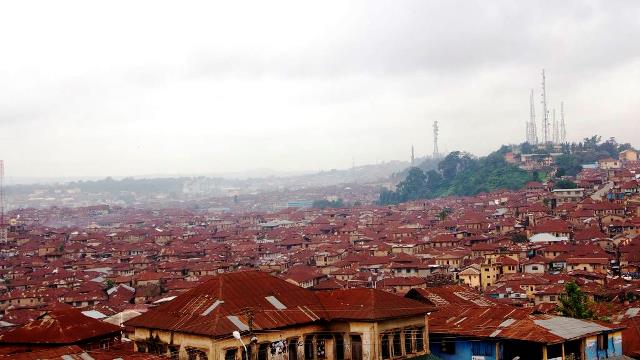
Whilst the United States has its ongoing public water crisis in Flint, Nigeria’s version of public water gone awry is Ibadan. Unlike Flint, a small town in the state of Michigan, Ibadan is Nigeria’s largest city by area. It ranks third in population; only Lagos on the Atlantic coast and Kano by the fringes of the Sahara desert have more people.
Founded in 1829, the sprawling municipality of Ibadan sits delicately on seven hilly ridges between the verdant expanse of dense tropical rainforest to the south and the relatively drier savannah that dominates the country’s northern hinterland.
The city’s ubiquitous hills hint at the region’s geology. Much of Ibadan is underlain by impervious basement complex formations, the hardest kind of rocks. Little wonder inner-city districts are named Oke Ado, Oke Are, Oke Bola and Oke Padi — Oke means hill in Yoruba.
The municipality is among the earliest beneficiaries of public water supply in Nigeria, says the Water Supply and Sanitation Interim Strategy Note. In the early days of colonial rule, public water schemes were maintained by selling water with almost no financial support from the local administration.
By the middle of the 20th century, the newly created regions took over the development and management of water projects in their respective jurisdictions.
Unwilling to relinquish control, the regional governments continued to operate their water supply even as Nigeria attained independence.
Later, in 1966, the old Western region took the lead when it established Nigeria’s first water corporation. Afterwards, the various States of the Federation and the Federal Capital Territory began to set up their own public water boards or corporations.
The irony is that, with the entrance of state control, public water supplies gradually became erratic and in some cases moribund. In the early 1970s, the Ibadan Municipal Government invested heavily in public water projects.
Eleiyele Reservoir. Pix by Tobenna Okoye
Major pipelines were laid and the Asejire waterworks was commissioned. Successive administrations, mostly military regimes, were unable to build upon those achievements due to corruption. By the 1990s, taps across the city were beginning to run dry.
Despite the huge potential of the Asejire and Eleyele waterworks, these reservoirs have been largely underused. With a capacity of 186 million litres per day, Asejire can conveniently meet the domestic water needs of the estimated three million people of Ibadan.
The World Health Organisation (WHO) says the minimum water requirement for short-term survival for individuals per day is 20 litres. This figure doubles if personal hygiene needs — bathing and washing clothes are included.
Although the metropolitan population has increased in the last four decades, poor city planning is by far the biggest challenge facing the provision of potable water to the city. The Ogunpa River which could have provided the residents with fresh supplies of clean water is heavily polluted with domestic refuse.
As the city expanded, the river’s catchment areas were cleared to build roads and houses. Rainwater should have seeped through the soil to recharge the underground water system, but is now mostly lost as surface run-off, increasing the risk of floods in low-lying areas.
Worse still, an ill-planned channelization project in 2003 turned the river bed into a concrete alley. The channel quickly became an improvised dumpsite for human waste. The government claims that extensive renovation works have been carried out on the Asejire Reservoir, yet only a negligible fraction of Ibadan’s three million residents are connected to the public water mains.
This forces most people to depend on wells, boreholes and water vendors for their daily supply of water. In the course of this reporting, not one person I spoke to had access to the city’s water supply. Two doctors, four homeowners, one academic, and even a retired civil servant all decried the lack of portable water in their respective neighbours.
The 2015 estimates for capital expenditure on water resources in the Oyo State budgetary allocation totalled 2.2 billion naira — that’s 82% less than what was spent in the previous fiscal year. These subventions are yet to yield significant results.
Rising demand, falling supply
Since Sifawu dug her well 19 years ago, two boreholes and four deep wells have sprung up in her neighbourhood in the Ring Road district of the city. She says her taps have been completely dry for over a decade now.
In fact, Mr. Owolabi, an ex-commissioner, who served during the first term of the current Oyo State governor — Abiola Ajimobi, also had to drill a borehole when he moved into his residence in the same neighbourhood about three years ago.
The former cabinet member now supplies his neighbours with fresh supplies pumped from his own borehole on a daily basis.
Nonetheless, access to clean water is still a challenge for low-income tenants who lack direct access to deep wells on the same street where Sifawu lives. Out of the 12 houses in her neighbourhood, only six have a reliable source of water. Sifawu now jealously guards her well from intruders.
Recently, a hostel opened across her residence to provide accommodation for members of the National Youth Service Corps, Nigeria’s mandatory civil service draft for university graduates.
“Despite knowing that the water level had dropped due to the dry season, those corpers would not desist from coming here to draw water before dawn,” Sifawu lamented when I spoke to her in mid-April. “By the time they are done, the well has become too silty and the water is unusable for cooking for the rest of the day. I have told them not to come here again!”
She reasoned that if the rains had come earlier this year, the water table in her well would not have dropped so low. In fact, she claimed she had never experienced such a low level since she dug the well.
She added that while three wells in her neighbourhood had dried up due to the prolonged dry season, hers is one of the few that still supplied water.
She seemed satisfied that she had insisted that three additional rims of concrete be added to deepen the well, instead of stopping at ten rims when the diggers struck water at 30 feet.
Digging deeper
As more and more boreholes are drilled, the water table drops. The direct result is that new boreholes must be drilled deeper to reach the water table.
“In 1998 when I returned from Germany after my studies, you would generally hit water at a depth of 120 feet for boreholes,” explains Moshood Tijani, a professor of geology at the University of Ibadan.
“These days, especially in some parts [of Ibadan], you would need to go to depths of 180 feet before you get to the water table.”
Ibadan receives, on average, 1,420 millimetres of precipitation each year. Most of this comes as rainfall during the wet season, a period in which the city witnesses record showers — 29 days of precipitation between June and July.
These showers usually end as run off and the water finds its way into rivers and reservoirs such as the Asejire.
Still, some of the rains goes through the soil and becomes underground water, thus recharging the water table. This is the water source upon which Sifawu and most residents of Ibadan depend.
This year the rains came rather late as predicted by experts. The March to June 2016 Predictions for West Africa by the UN Office for the Coordination of Humanitarian Affairs says “below average precipitation is very likely over southwestern Nigeria.”
Water means health
“El Niño-induced weather extremes have especially affected…health and water, sanitation and hygiene,” said UN Under-Secretary-General, Stephen O’Brien in a speech in Geneva, Switzerland on April 26. “There are very worrying increases in acute malnutrition among children under five as well as water- and vector-borne diseases.”
Bolaji Durodola, a medical officer at Oni Memorial Children’s Hospital in Ibadan, agrees: “Diarrhoea is usually associated with poor hygiene practices.” In the last nine months, the pediatric hospital where Durodola practices, witnessed nearly 70 cases of gastroenteritis, mostly in children under the age of five.
Diarrhoea is, in actuality, a disease of the poor. It is estimated that 1.7 billion people suffer from it each year with just over half a million deaths in children in 2015 alone. Most of these deaths occur in sub-Saharan Africa and especially in Nigeria where 57 million people lack access to safe water. It begins when water which contains germs is ingested through drinking, and in some cases, via recreational sports such as outdoor swimming.
Urban streams are oftentimes polluted with human waste; so when children swim in such dirty water, they become exposed to the germs that can cause diarrhoea.
Rotavirus is the commonest germ that causes diarrhoea in children. This virus infects the cells lining the intestines and destroys them. The damage caused to these cells reduces the capacity of the intestines to absorb water, hence the watery stools observed in patients.
The result of this frequent passage of watery stools is dehydration. When the body loses a lot of water (and salts), the blood pressure falls dangerously low. Fainting spells and a rapid but weak pulse often precedes death. Rehydration, via oral intake of water, sugar and salts, is the standard method of treating the disease.
Dirty water
Two years ago while I was reporting on public hygiene in the city, I had spoken to Achiaka Irabor, a family health physician, who is now head of the Total Quality Management department at Nigeria’s foremost medical institution — University College Hospital (UCH). Inside Irabor’s consulting room, a public health nurse who requested anonymity summarily narrated how three newborn infants from an orphanage had been rushed to the emergency unit of the hospital. The fourth child had been brought in dead.
They all suffered from gastroenteritis; a diarrhoeal disease that is common in areas where access to clean water and sanitation is either lacking or inadequate. Together with her team, the nurse had visited the orphanage and discovered that the facility’s location on a hill had put it at a disadvantage in terms of accessing clean underground water.
All efforts by the management of the orphanage to dig a well had proved abortive since they couldn’t reach the water table. Lacking funds to opt for the rather expensive alternative, a borehole, they turned to private vendors for their supply of water.
Irabor recounted how she regularly saw faecal matter in the water her family bought from private vendors. The vendors, she added, sourced directly from the Eleyele waterworks. According to UNICEF, one gram of faeces can contain up to 10 million viruses, one million bacteria, 1,000 parasite cysts and 100 parasite eggs.
A tiny amount of faeces, when mishandled, is potent enough to kill many people. The risk therefore multiplies when sanitation is inadequate and in many poor communities, completely unavailable.
Thus, the hidden problem associated with overreliance on underground water is contamination from untreated sewage. Like most unplanned settlements, Ibadan lacks a central sewage system that collects human waste for treatment.
Most homeowners build septic tanks underneath their property, and from time to time, pump the raw sewage into holding trucks for onward disposal at undesignated locations, sometimes in streams and dumpsites. This usually results in algae bloom which can further reduce the quality of the rivers and streams.
Apart from the pollution of surface water such as river channels and their associated wetlands, there is also a higher tendency for leakages of sewage tanks into underground water.
Seeking solutions
“It is generally recommended that deep wells be sited 15 metres uphill from the location of a septic tank to reduce the risk of contamination,” explains Motunrayo Fagbola, a doctor who practices community health medicine at UCH.
Fagbola advises homeowners to test the quality of water obtained from underground sources for the quantity of certain chemicals.
“There are other properties of water that people do not consider when drilling for water. The general assumption is that water from a borehole does not need to be tested [because it is clean]. We tend to focus only on biological properties but high levels of fluorine in groundwater can cause fluorosis especially in children.”
Although Sifawu treats the water from her deep well from time to time with chlorine granules, she doesn’t use the water for drinking. She buys water from a borehole vendor, instead. In the first week of May, she called on her family doctor to complain about rashes on her body.
For as long as she could remember she has had skin irritations but she’s not certain if the water from her well is responsible for these skin problems. Yet she is on medication to ease the rash on her skin.
Kazeem Sanni, one of the relatives who still lives with Sifawu complained that he always has skin irritations whenever he bathes with water from the well.
“If I don’t boil the water to a high temperature, I will itch for at least 30 minutes after taking a bath,” Kazeem said.
“Even though the water is clean, I think something is wrong with it because I don’t itch whenever I visit my friends in Lagos and bathe with tepid water there. I can’t bathe with tepid water from our own well.”
Drawing from his experience while he was a doctoral student in Germany, Moshood Tijani recommends a return to the policy where public water is sold on a ‘pay-per-use’ basis because water has economic value. He argues that the socialist belief that water should be made available freely to the public is highly unsustainable and generally leads to wastages.
He went further by saying, “Privatising the water corporation is the only way of overcoming the longstanding problems associated with public water supply in Ibadan. We can also borrow a leaf from the Germans by constituting those privatized [water] corporations as non-profits.”
Now a grandmother, Sifawu is once again preparing to travel abroad this June, but this time around she has no dependents to worry about at home. Instead she’s visiting four of her grandchildren in North America.
She believes she won’t need to take her medication along on this trip. But as I watched her return it to the safety of her medicine box, it seemed she knows she would need it, again, when she returns home.
Kolawole Talabi works as an independent investigative journalist and he currently covers topics on the environment, science, culture and development.
Former National Security Adviser, Sambo Dasuki, has told a federal high court in Abuja that some persons in government were punishing him for perceived grievances they hold against him while he was in active military service many years ago.
Dasuki, who did not name any particular person, said that the punishment being meted on him was out of mere vendetta.
In an emotion laden submissions while reacting to the government request for his secret trial, Dasuki who spoke through his counsel Joseph Daudu, SAN, told the court that he would leave his persecutors to the judgment of God.
“It is crystal clear that the defendant (Dasuki) is being punished by the powers that be for the perceived offences committed long before… we leave them to the Almighty God for his ultimate judgment”.
Dasuki had been arraigned before three different high courts for various allegations and was granted bail but was rearrested in December last year by the federal government and has since been held incommunicado.
At the resumed trial today, the federal government had approached the court, seeking secret trial of Dasuki who is facing charges of unlawful possession of firearms, money laundering and breach of trust.
In the fresh motion argued by the prosecuting counsel, Dipo Okpeseyi,SAN, government prayed the court to allow witnesses give evidence behind the screen to be provided by the court.
He held that the request hinged on the fact that Dasuki as a former top security chief has large loyalists across the country who may jeopardize the trial if done in the open.
He further submitted that Dasuki has in the recent past held the highest security office in the country and has loyalists in the security circle whose loyalty has been transferred to personality and whose actions might be inimical to prosecution witnesses some of whom are still in the service.
Okpeseyin cited the case of the government witness who was involved in a serious accident, resulting in multiple fractures and injuries, and said the incident has heightened the need to have the witnesses protected by the court.
He further submitted that in the highest military office where Dasuki served last, loyalty was the first, second and the last rule and because of the peculiar nature of loyalty some persons have for him within the military and beyond, those to give evidence in the trial were at one time or the other, staff of the defendant.
He stressed that since the witnesses are those of the court whose primary duty was to assist the court arrive at a just conclusion, the issue of security must be viewed with a serious concern.
He therefore urged Justice Adeniyi Ademola to screen the witnesses from the public in the interest of justice, and to protect them, their families and career.
But Counsel to Dasuki vehemently opposed the request for secret trial of Dasuki.
His argument was that it will breach the principle of fair trial.
He added that contrary to the position of the government, Dasuki cannot be a threat to the witnesses as he has been in the custody of the federal government since December last year.
Daudu argued that open trial is the minimum requirement in a criminal trial and as such, any attempt to opt for a secret trial in the instant case, which was not a capital offense will run contrary to Section 36 of the 1999 Constitution on fail trial.
The Defence counsel therefore asked the court to discountenance the claim made by the prosecution on the issue of loyalty in the military circle, stressing that such claim was a mere speculation and not backed up by facts.
On the accident of the witness, Daudu told the court that the accident would not have been caused by Dasuki, who has been in the government custody for almost a year.
He said that the alleged accident has no bearing with the request for secret trial.
He therefore urged the court to dismiss the application for secret trial as such will trample on the rights of the defendant to fair trial.
After taking argument from both parties, Justice Ademola fixed ruling and continuation of trial for September 13, 14 and 15.