The federal government has signed a tripartite agreement with the United Nations High Commission for Refuge, UNHCR, and the Republic of Cameroun that would ensure the safe return of Nigerian refugees who had fled to Cameroun for refuge due to the Boko Haram insurgency.
The Director General of the National Emergency Management Agency, Muhammad Sani Sidi, disclosed this when an African Union Humanitarian Mission led by Dr. Aisha Laraba Abdullahi, Commissioner Political Affairs, visited the headquarters of the agency at the weekend.
He said there were about eighty thousand displaced Nigerians currently taking refuge in Cameroun and that the federal government has been making efforts to cater for all their basic needs.
He said the federal government and governments of states affected by the insurgency, United Nations Organisations, International Non-Governmental Organisations and the private sector had done a lot in the past four years to manage large numbers of internally displaced persons in the North East, adding that “we have moved from the emergency response stage to recovery and resettlement of the IDPs.”
He urged the visiting Commissioner to use her office to seek for more assistance and support for the affected persons and the states.
He thanked all the development partners, UN agencies, Civil Societies for working tirelessly in supporting the IDPs and Government of Nigeria.
Earlier, the Commissioner said they were in Nigeria to assess the situation of IDPs and to discuss areas of possible support. She added that displaced Nigerians were of concern to the African Union, as records available to AU indicate that there were about 13 million displaced persons and 3 million refugees on the continent.
She commended the efforts of the Nigerian government and the military for degrading and minimizing the activities of the insurgents in the northeast.
She said with the large number of displaced persons living in the camps, the AU will continue to give more attention to the issues of displacement through interaction and focus on addressing the root causes of conflict in Africa.
This report on the North West by Agbo – Paul Augustine of Leadership Newspapers is the third in our special investigations on ecological funds. The project is funded by Ford Foundation
In spite of huge sums of money spent on ecological projects across the federation, to the tune of over N400 billion from 2005 to 2015, the people of the North-West are still at risk from more environmental hazards caused by flood, drought, desertification and shallow dams, LEADERSHIP Weekend checks have revealed.
A recent document obtained from the Ecological Fund Office of Nigeria (EFO) indicates that contracts for 231 projects were awarded across the federation with the North-West having about 44 projects in the seven states worth over 10 billion naira between 2005 and 2015. But this has not solved the environmental challenges faced by the people.
According to report by the Nigeria Extractive Industries Transparency Initiative (NEITI) 2007 to 2011 on the Share of Derivation and Ecology, EFO received about 217 billion from the federation account.
By the count of projects under the same period, the EFO had about 139 projects across the federation valued at 40.7 billion. Amount paid to contractors was N24.2 billion with only 36 projects completed with 101 ongoing projects and 2 stalled.
Also, as at August, 2015 the EFO share of derivation was about 201 billion with dozens of projects claimed to have been completed in several states of the country.
Figures from the Federation Accounts Allocation Committee (FAAC) indicated that the EFO in 10 years has received over 400 billion naira as its share of 2% Ecological Fund and 1% Derivation under Special Funds.
The 231 projects were awarded at different times under the administration of Presidents Olusegun Obasanjo, Umaru Musa Yar’Adua (Late) and the immediate past President of Nigeria, Dr Goodluck Jonathan address various ecological challenges faced by millions of Nigerians across the country.
The Ecological Fund was originally established in 1981 through the Federation Account Act, 1981 based on the recommendation of the Okigbo Commission. The Act has subsequently been modified by Decrees 36 of 1984 and 106 of 1992 respectively; and further modified through the Allocation of Revenue/Federation Account etc (modification) order of 8th July 2002. The Fund is an intervention facility established to address serious ecological problems across the country.
At inception, the Fund was 1% of the accruals into the Federation Account and later reviewed to 2%. From its inception in 1981, it has been a first line charge which provides handy resources for amelioration of ecological problems such as soil erosion, flood, drought, desertification, oil spillage, pollution, general environmental pollution, storm, tornadoes, bush fire, crop pest, landslide, earthquakes etc.
Consequent on the directive of President Olusegun Obasanjo in July 2002, for a review of the Modification Order of May 2002, following the Supreme Court ruling on the Resource Control case in April 2002, the 2% Ecological Fund and 1% Derivation hitherto under Special Funds were shared among the three tiers of government.
LEADERSHIP Weekend in a bid to trace the disbursement of the fund, undertook an on the spot special report on the impact of some of the projects in five states of the north west, including Kaduna, Kano, Katsina, Kebbi and Sokoto States. When our correspondents assessed some of the projects in Kaduna State, not a few persons expressed their frustrations in some of the projects executed so far.
“How can government just take almost a billion naira of public funds and dumped in the bush for three years without any return to the people?” This was the question LEADERSHIP Weekend had to confront from a visibly angry local farmer, Bitrus Yakubu in Rijana, an agrarian community on Kilometre 44 along the Abuja-Kaduna Expressway in Kachia local government area of Kaduna State.
With a chewing stick in his mouth, Yakubu appeared fed up with the lockdown of the federal government funded Rijana Dam project completed in 2015 under the Ecological Fund Office (EFO).
One of such projects is the rehabilitation of the Rijana Dam which cost the federal government N952, 442,910.80, even though N942, 873,844.50 was approved by the President. According to the EFO document, the Rijana Dam contract was awarded on December 13, 2013 to M/S Foundation Years Nigeria Limited.
Like Yakubu, Silas Bako said he could understand why the Dam remained unused after rehabilitation. “Please tell me sir, why would this dam remain like this and this is the second farming season? Bako queried.
Rehabilitation of Rijana Dam, Kachia LGA, Kaduna State
Findings by LEADERSHIP Weekend revealed that the dam could not be utilised by the community because of a number of factors, including insecurity and land ownership.
For fear of intimidation, local farmers who spoke to LEADERSHIP Weekend at the site pleaded anonymity, revealed that the dam site is part of the property of ex-Senator Haruna Azeez who once represented Kaduna South Senatorial District in the National Assembly.
“Since he claimed ownership of the land, we are waiting for him to share the land for us to start farming. For now the dam is just there, people just go to get water and do a few other things,” a local resident said.
When our reporter arrived at the site, a few motorcyclists were seen washing their bikes and some water vendors drawing water into a tanker. It was also observed that some locals have started some sort of quasi agricultural activities with the planting of a few vegetables.
Village head of Rijana, Ayuba Dodo Dakolo, said the access road on the embankment had to be blocked to avoid heavy trucks damaging the dam. He, however, hinted that a foreign investor had shown interest in the area, promising to generate 500 jobs for the people.
When LEADERSHIP Weekend visited Senator Azeez at his Kaduna residence, he denied holding the community to ransom over the dam. “Why agricultural activities have not started around the dam is that we are scared of kidnapping which has taken a worrisome dimension. We have the equipment to start but for the security situation in the area especially threats from herdsmen,” Azeez said.
He further disclosed that he had an understanding with the local community, noting that no compensation was collected for siting the dam on his property.
In spite the EFO document which indicated that the project has been completed over a year ago, Azeez said the project has not been officially handed over to him or the community.
He said the dam was initially constructed by the federal ministry of Agriculture during the Olusegun Obasanjo presidency but collapsed due to shoddy job. Even with the recent work at the dam, Azeez said the job was not well done.
It was observed that the dam may soon require the attention of the government as the work done so far cannot really stand the test of time. Unlike the Rijana Dam where agricultural activities had been stalled since completion, the Kargo Dam located in Jaji, Igabi local government area enjoys full agricultural activities.
Contract for the rehabilitation of the dam was awarded on December 13, 2013 at the cost of N856, 883, 573. 07 and same amount paid to the contractor M/S Seeder Construction Nigeria Limited as approved by the President.
When LEADERSHIP Weekend toured the project site, residents of Kargo community in their various reactions demanded that the dam be reworked. This is coming barely two years after it was commissioned by the former Vice President, Namadi Sambo on July 14, 2014.
It was also discovered that work started at Kargo Dam in 1975 and was designed to, besides agricultural purposes, supply portable water to the vast military facility located in Jaji.
Before rehabilitation, residents hinted that the dam used to be filled with debris which prevented it from collecting enough water for irrigation and may have informed the decision to rehabilitate the project.
Speaking on the matter, Sarki Kargo, Alhaji Ibrahim Ahmed, said his community had expected a complete dredging of the dam but were disappointed to realise that the contractor only succeeded in removing the overgrown weeds and left.
“The only work done was the removing of overgrown weeds without dredging, this would have allowed more water,” Ahmed lamented. He also decried the shoddy work on the only access road to the dam site which he said was far below the impression given them. He said the design of the road was to include a standard single line asphalt laden road with various covets and pedestrian lane.
LEADERSHIP Weekend only saw a tiny road that hardly can contain two passing vehicles at a time.
The Ciroma Kargo, Yakubu Ahmed, also lamented the lack of portable water in the community as the 400, 000 litre water treatment plant located near the dam was out of service as at the time LEADERSHIP Weekend went on assessment visit.
The inability of the tank to hold water has forced the military facility in Jaji to rely on water tanks to supply water to the military community, while residents of Kargo collect water directly from the dam.
Meanwhile, residents of Ungwan Bashir in Zaria are about to see the graves of their love ones washed away if nothing is done to control the gully erosion that is threatening the cemetery in the area.
The EFO had intervened with a N42, 000, 000 contract awarded in September, 2011 to M/S Temcom Engineering Company Limited. With the poorly executed job labelled ‘completed’ and N28, 163, 303.32 already paid to the contractor, residents still lamented about the way the project was done.
Ungwar Bashir flood control site
The EFO document indicated that N31, 959, 225. 90 was the actual contract amount and the job was to be completed in July, 2012 under the Upper Niger River Basin Development Authority (UNRBDA) as executing agency.
“The flood control works is just about 150 meters in length and yet was badly done,” complained Mohammed Ladan, a resident of the area.
At the Ahmadu Bello University Teaching Hospital in Zaria, students in front of whose hostel incinerators were installed expressed disappointment at the quality of work done. LEADERSHIP Weekend had visited the location to see the N85, 000, 000 contract that got the nod of the president on July 30, 2009.
The EFO document shows that the contract for the building of the incinerators was awarded to Dinat Ventures Limited at the cost of N83, 738, 500 but N70, 580, 018.43 was the actual amount paid to the firm and job completed in June, 2012.
Waste disposal incinerators at Ahmadu Bello University
What LEADERSHIP Weekend saw was a small incinerator built with brick blocks opposite the male hostel of the medical college. Students at the hostel confirmed the date of job done as claimed in the EFO document but were amazed at the amount of money it cost the government.
Our reporter met a brick wall at the Kaduna Refinery where the Ecological Fund Office is financing a remediation of Sludge Pits at the state owned oil firm.
With the federal ministry of Environment as executing agent, the contract got a presidential approval of N2, 500, 000, 000 and was awarded to Osprey Investment Group Limited at the cost of N1, 811, 975, 000, about N700, 000, 000 less than approval the sum.
The job was to last for 43 weeks and as at when the contract was stalled, N810, 048, 904. 25 had been paid out, with the work only 47 percent completed.
The EFO remarked that the project has been ‘’temporarily suspended due to some problems”. The manager, Public Affairs, Kaduna Refinery and Petrochemical Company Limited (KRPC) Mr. Abdullahi Idris confirmed the existence of the project and the issues but declined to make further comment on the matter.
He rather demanded from LEADERSHIP Weekend request letters from stakeholders’ and the agency involved in the work.
Kano: Non Existing Projects And Poorly Executed Jobs Put Many Lives In Danger
Kano: Non existing projects and poorly executed jobs put many lives in danger
Meanwhile, in Kano State, projects visited by LEADERSHIP Weekend under the EFO leave much to be desired as residents and community leaders continue to lament even after contractors claimed to have finish their jobs.
The village head of Rimi Gado in Rimi Gadolocal government area, Ibrahim Yusuf, expressed dismay when LEADERSHIP Weekend visited his palace. He lamented that the N215, 683, 291. 06 Rimi Gado Erosion Works Phase 1 project has not solve their problems.
The contract under the executing agency of the Hadejia Jama’are River Basin Development Authority (HJRBDA) was awarded to Messrs Saami Nigeria Limited in 2005 at the sum of N265, 568, 601. 32 approved by the president.
Residents and motorists in Rimi Gado are deeply concerned over the surging erosion on the Kano-Rimi Gado federal road which also connects Kebbi and Zamfara states with Kano.
Rimi Gado Erosion works
For Yusuf, the inability of the Rimi Gado Dam to hold much water has put about 15 villages in dire straits. The dam is the source of water for the villages and their animals. He told LEADERSHIP Weekend that “at the peak of rainy season, the highway is threatened. What we want is dredging of the dam to hold more water”.
To make matters worse for the people of the area, it was observed that excavation of land close to the road by an unknown persons has further worsen the state of the erosion work, making nonsense of the efforts of the federal government.
The Rimi Gado Erosion Works Phase 1 was initiated to help control the excess water coming from the dam which also served several purposes to the communities.
Mallam Sule Lado, a farmer in one of the communities warned that if nothing is done within the next few months, the erosion with destroy the historic road linking Kano to other States.
However, the search by LEADERSHIP Weekend for projects executed with the Ecological Fund took a surprised turn in Tofa local government area as the N38, 873, 0833 Drought and Desert Control Project awarded in October 2012 could not be found.
Even with several local fixers, LEADERSHIP Weekend could not ascertain the location of the project done by Gafam Nigeria Limited with the federal ministry of Agriculture as the executing agency.
According to the EFO document, the contractor had been paid N27, 262, 619.00 and the remarks indicated that the job was completed. The contract includes the planting of drought resistant trees.
A search of the company at the Corporate Affairs Commission (CAC) shows that Gafam Nigeria Limited with RC No – 260197 was incorporated in December, 1994.
It has registered address at 63, Hausawa layout, Kano, Kano State and it main objective among others is to carry on business as property owners and developers in Nigeria.
When LEADERSHIP Weekend made effort to reach the contractor whose new Kano State house numbering is now 152, Garba Ahmed Bago Street, Hausawa Layout, Kano the contractor who just arrived from the airport declined to speak on the matter even after proper introduction was made.
LEADERSHIP Weekend only saw at the said site, a 2013 MDG project housing the National Youth Development Centre constructed by the federal ministry of Youth Development completed but it remains unused.
In the neighbouring Dawakin Tofa local government area, it was anguish and total dejection as about 40 percent of Dawakin Tofa community is sitting on the edge of disaster.
The huge gully erosion that has cut the community into two halves is too much a burden on the agrarian community.
The Dawakin Tofa Gully Erosion and Flood Control Project under the executing agency of Hadejia Jama’are River basin Development Authority (HJRBDA) [D1] had presidential approval of N220, 000, 000 and contract awarded in August, 2013 to M/S Sky Technical Construction Company Limited at the sum of N176, 204, 302.31.
Dawakin Tofa flood control project
The contractor has so far been fully paid and the EFO report indicated a completed project. But residents were shocked to know from LEADERSHIP Weekend that the abandoned project has been deemed completed.
The bewildered residents took LEADERSHIP Weekend round the entire stretch of the gully which they feared may wipe out substantial part of the community in no distance time.
It was observed that even with the dry season in place as at the time LEADERSHIP Weekend visited[D2] in April 2016, there were signs of recent collapse into the gully.
Shehu Dauda, a resident said the entire area is “a no go place during the rainy season”.
“You need to see the volume of water gushing down into the gully, the entire flood in Dawakin Tofa drains down to the gully and we fear the worst this year as several solid ground are being lost to the gully,” Dauda revealed.
The drainage line done by the contractor was just a “shoddy job” according to Salisu Mairiga, a resident of Dawakin Tofa. The poorly constructed road to the site is gradually being washed away by the floods.
Another resident, Abubakar Galadima told LEADERSHIP Weekend that the contractor on realising that it lacks the capacity to carry out the job, simply just packed its equipment and left.
While the Dawakin Tofa people are left with the fear of being washed away by erosion, the residents of Sharada area in Kumbotso local government area in Kano City are lamenting a different kind of threat.
The N84, 587, 210. 25 Sharada Flood Control Project awarded in 2008 to AMG Worldwide Limited could best be described as a good job executed.
But the sooner the contract was executed came a new wave of problems and this has to do with industrial pollution.
The location of industries close to the community has brought an unbearable hardship to the people with heavy stench coming from the liquid waste which flows directly into the drainages constructed within the community.
The stench was so strong that our reporter had to leave within minutes of arriving at the site. Residents who recounted their horrific experiences, lamented that many people have been forced to relocate to other parts of the city.
Another ghost project in Kano State is the construction of Erosion Measure for Channelization of Jakara River in Dala local government area. The N299, 362, 817. 25 project awarded to Messrs Associated Rehabilitation Company Limited in April, 2006 was not found.
No chanelisation project of Jkata River Dala LGA, Kano State
Checks by LEADERSHIP Weekend revealed that the project which was aimed to put an end to the environmental challenges of the people failed to achieve its objectives.
Realising the level of challenges, the Kano State government, LEADERSHIP Weekend, learnt floated a fresh project that enveloped the EFO funded project.
Sources at the Kano State ministry of Works said the project cost the state government about N8.5 billion naira. A tour of the area revealed a new problem as the recently constructed channels risked been blocked by the increasing refuse pilling up in the area.
Sokoto: EFO constructed drainages serve as toilets and refuse dumps
The situation in Shagari local government area of Sokoto State is more of a problem solved. ‘
“Most of our houses would have collapsed by now were it not for the intervention by federal government ecological fund,” said the Alhaji Sani Abdullahi, Magajin Shagari in his response to LEADERSHIP Weekend.
Shagari LGA erosion problem developed gradually over the years until it eventually affected a large portion of land, which should have been inhibited by the locals.
Sokoto State government made efforts at mitigating the menace by initiating drainages. The effort, however, made no much impact as the state government project never made adequate provision for long-term solution, locals confirmed.
The contract awarded in 2011 to M/S Yahaya Buhari and Sons Nigeria Limited seems to put a permanent end to the erosion threat. The Shagari Soil Erosion and Flood Control Work was said to have be awarded at the sum of N94, 971, 252, 04 even though the project got N118, 000, 000 presidential approval.
The Soil Erosion and Flood Control Works was supervised by the Sokoto Rima River Basin Development Authority (SRRBDA).
When LEADERSHIP Weekend visited the area, , it was discovered that the erosion and flood that hitherto constituted great worries to the locals were excellently controlled.
The drainages were expertly channelled to the adjacent Shagari Earth Dam upon completion.
Commenting on the project, Mallam Ibrahim Shagari said the people will forever remain grateful as they were able to erect structures on the some of the abandoned plots for fear of been washed away by the initial ravaging erosion.
According to him, the project was a right step in the right direction as it addressed the most pressing ecological challenge of the people of Shagari council are.
He, however, lamented that a good number of the locals who had no functional toilets have resorted to defecating inside the drainage, while others freely dump refuse without recourse to the implication of such an act.
Also speaking in the same vain, the District Head of Bodinga, Alhaji Muhammad Bello Abdulrauf observed that the time has come for federal government to insist on getting certification letter from traditional leaders before admitting that any contract is well executed.
Speaking on the project cited in Bidinga, the monarch also advised that the federal government should inquire to know the basic priority of the locals before approving any contract.
The Bodinga Drought and Desertification Control project was awarded in 2012 to Gwangwaja Nigeria Ltd, Abuja at the sum of N41, 413, 832, 10 and was supervised by the federal Ministry of Agriculture and Rural Development.
It was further learnt that, of the contract sum, only but 28, 413, 832. 10 has so far been paid to the contractor.
The project was designed to be cited in Shyar Aisha Bodinga but when LEADERSHIP Weekend visited the area, it was discovered that the project was rather cited in Toma area of Bodinga.
Commenting on the change of site , the District Head, Abdulrauf said that neither he as the traditional custodian of the place nor any of his cabinet members was informed about the project. According to him, they only saw people coming to work in their jurisdiction saying they came from Abuja.
The District Head said however that had the people had a say in the matter, they would have gone for something that would have brought more positive effect on the generality of the locals while they do the tree planting themselves.
“Agreed, we face desertification issue. Nevertheless, we would have appreciated it better if we are given the opportunity to decide. After all, the state government is equally trying in ensuring shelterbelt across the state, Bodinga inclusive.
“Our priority [D3] project is earth dam because our people want to improve on their agriculture. And you know, agriculture is the only provider of income and employment for a large number of our people.
“At least, our LGA have some water ways which when channelled to earth dam, it will be of better advantage to us than the drought and desertification control project which up till now, I have not even known nor seen the contractor”
In the same vein, the citing of a medical waste incinerator at the Usmanu Danfodiyo University Teaching Hospital, Sokoto (UDUTH) since 2012 has been described as a misplaced priority. The project, however, was simply but a duplication of effort and waste of resources as UDUTH had two functional incinerators before then.
Though UDUTH management declined comment on the status of the already completed project, LEADERSHIP Weekend, however, gathered that of the two incinerators in the hospital, only one is in use as the other still remains useless for now.
The contract awarded since 2009 has long been completed but still awaiting commission till date. The contract was awarded to Bosket Nigeria Ltd with Federal Medical Centre (FMC) [D4] Sokoto as the executing agency.
The contract as approved by the Presidency was put at N170,000,000 and actual contract amount at N85, 000, 000 while the sum of N63,750, 000 was said to have been paid to the contractor till date. As at November, 2013, the completed project still awaits commissioning going by the EFO document.
Commenting on why the contract has not been commissioned, a source who preferred anonymity said that aside the fact that they were not carried along in the execution or monitoring of the project, they were asked to shoulder the financial implication of the commissioning and they out rightly objected.
Giving reasons for their objection despite the project was cited in their hospital, the source said they consider the project simply a waste of resources in the first place because they had two other medical waste incinerator which are very much enough for the hospital.
Secondly, they considered it as rather a misplaced priority or an attempt to wet the pocket of some individuals via awarding contract that had no impact on the people.
Minister of Budget and National Planning, Udoma Udo Udoma
The Minister of Budget and National Planning, Udoma Udo Udoma, has said the implementation of the provisions of the 2016 budget will lead to a sustainable turnaround for the Nigerian economy in spite of the prevailing challenges.
He said the budget was designed to, among others, stop the economic decline and restore the economy to the path of growth.
The Minister made the revelation while interacting with Old Boys of Kings College on the 2016 Budget, in Lagos on Saturday.
He explained that the 2016 Budget was designed to actively pursue macroeconomic policies and growth strategies that will reflate the economy, by investing in key infrastructure and social development.
The decision to adopt the Zero Base Budgeting, ZBB, system was also deliberately taken to complement this objective because it requires Ministries, Departments and Agencies, MDAs, of government to carry out fresh evaluation of all projects/programmes based on the priorities of government, he added.
He noted that the drop in the price of crude oil had given the economy a bashing and added that disruptions caused by the activities of militants have led to significant revenue shortfalls.
The Minister said, “since 2014 the economy has been experiencing continuing decline in revenue, weakening balance of payments, declining foreign reserves, rising public debt, weak capital market, rising inflation, increasing infrastructure and housing deficits, rising unemployment… leading to declining GDP”.
Apart from the challenges on the local front, the Minister said the situation was further compounded by the general weakening of economic growth in emerging market economies and security challenges in different parts of the world as well as the local security challenges, ranging from the Boko Haram insurgency in parts of the North East, militant activity in the Niger Delta, ethnic agitations in the South East, clashes with Fulani herdsmen in different parts of the country and other acts of criminality, such as kidnapping.
The federal government has disclosed that it plans to provide financial relief to state governments if the states meet some stringent fiscal conditions.
According to a statement released by the finance ministry, a conditional Budget Support Facility was being put in place to this effect.
State governments would be able to access the facility if they meet a 22-point reform agenda known as the Fiscal Sustainability Plan, FSP, which was approved at the National Executive Council meeting last in May.
The FSP is a framework of reform measures which includes a requirement for states to publish audited financial statements and budgets, biometric and Bank Verification Number payroll review exercises to sanitise payroll costs, as well as limits on recurrent expenditure levels.
The FSP also requires that states be able to set and meet targets to improve their Internally Generated Revenue, IGR. Other requirements contained in the FSP include, the establishment of efficiency units to bring down overhead costs, Privatisation of state-owned enterprises, domestication of the Fiscal Responsibility Act and limitations on securing bank loans.
The federal government agreed to develop an International Public Sector Accounting Standards, IPSAS, compliant software for states to use.
The Ministry of Finance said the relief funds will be disbursed to states that meet their agreed targets and will be subject to monitoring and evaluation by independent monitoring agents.
Governor of Yobe state, Ibrahim Gaidam has revealed how his government spent the N10 billion bailout fund from the Federal Government.
According to a statement signed by the Director of Press Affairs to the Governor, Abdullahi Bego, N4.4 billion have been expended on various capital projects in the health, roads and agriculture sectors of the economy.
The following is the breakdown of how the N4.4 billion was utilized:
Payment of CV 8 & 9 for construction of Kanamma-Kafiya road by CGC amounted to N725, 804, 568.32.
Payment of CV No. 3 for the construction of Nguru-Machina road by RRC Ltd stood at N439.31 million.
Payment of CV No. 3 for construction of Yunusari-Yusufari road by the EEC Intl amounted to the sum of N370, 075, 100.03.
The payments of CV No 5 for the construction of Gadaka-Godowoli road by Rick Rock Construction Ltd gulped N467.76 million.
Payment of CV No. 3 for construction of Kafiya-Yunusari road by CGC N145, 038, 887.15.
Payment of CV No. 4 for the construction of Yunusari-Yusufari road project: N1, 042, 141, 987.70.
SDGs Counterpart Fund for the rehabilitation of Potiskum, Gashu’a and Gaidam General Hospitals: N600 million.
Part payment for the supply and installation of additional equipment at the 200-Bed Capacity Hospital, Damaturu went for N150 million.
Payment to Task Force on Irrigation Farming for the clearing of sites for take-off of special irrigation projects at N88.97 million.
Payment of 30% advance for drilling of two boreholes at Irrigation Project sites totalling N11.13 million.
The governor reassured citizens of the state that his administration will continue to use the ‘bailout funds’ to carry out projects that will impact meaningfully on the lives of the people.
Another Former coach of the Super Eagles, Shuaibu Amodu, has died at the age of 58.
The Nigerian Football Federation, NFF, announced this on Saturday morning via its official twitter handle posted on the of on Saturday morning.
According to the brief statement, Amodu, a four-time coach of the national team, died on Friday night shortly after complaining of chest pain.
NFF secretary general, Mohammed Sanusi, also confirmed the sad development.
“That is correct,” Sanusi said, “He slept and he could not wake up.”
Reports say Amodu complained of chest pains before he went to sleep the previous night.
Until his death, Amodu was the Technical Director of the NFF.
His death is coming just as the nation is still mourning the departure of another ex-Super Eagles’ coach Stephen Keshi, who on died in Benin City on Wednesday, aged 54.
Amodu and Keshi worked together as Nigeria’s head coach and assistant coach respectively at the 2002 edition of the Africa Cup of Nations in Mali.
Amodu took charge of the Super Eagles on four occasions in 1994 and 1995 as well as in 1997, 2001 and 2002 and then between 2008 and 2010.
Highlights of his career include winning the African Cup Winners Cup – known now as the CAF Confederation Cup – with BCC Lions in 1990 and also guiding the Super Eagles to the 2002 FIFA World Cup finals when it seemed impossible to qualify following a poor start to the qualification series in Africa.
Amodu’s burial is scheduled to hold later today according to Islamic rites.
The Nigerian Army has announced that a number of senior officers, mostly major generals, brigadier generals, colonels, lieutenant colonels and a major has been disengaged from service.
Acting Director of Army Public Relations, Sani Usman, revealed this in a statement.
The officers were retired for displaying partisan interest in the 2015 general elections.
The statement said some officers were investigated for their role during the election.
Others were indicted by the Presidential Committee that investigated Defence Contracts under the Goodluck Jonathan administration.
The army stated that some officers had already been arraigned for prosecution by the Economic and Financial Crimes Commission, EFCC.
Although the names of those affected were not mentioned, the statement said they were retired based on “Service exigencies” and added that the army must remain “apolitical and professional at all times.”
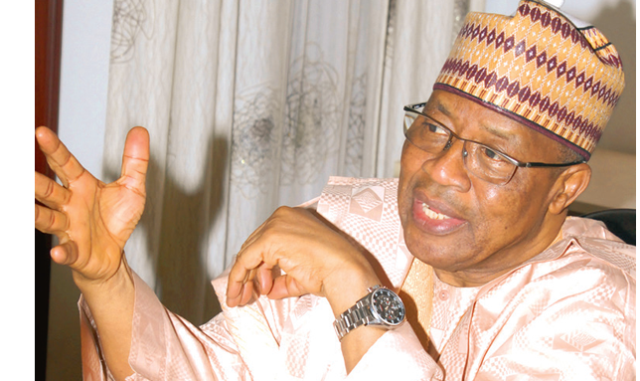
Former military President, Ibrahim Babangida, who was rumoured dead in the media early this week, returned to the country on Friday after a three-week medical trip to Germany.
Babangida landed at the Minna International Airport, Minna, Niger State, at about 3:30pm on Friday and was welcomed by a crowd of well-wishers and a state delegation led by governor of Niger State, Abubakar Bello.
Governor Bello praised Allah for preserving the life of the former military leader, noting that wise counsel of distinguished leaders like Babangida are needed at this time when the country is going through challenging times. “Despite unfounded rumour about the life of our national icon, General Ibrahim Badamasi Babangida, we are grateful that it pleases Allah to preserve his life and bring him back safely and healthier to continue in the good work of nation building. General Babangida remain one of the few leaders in this country that we still need around to tap from their wealth of experience and knowledge and we are grateful he is back and kicking like the old soldier he is,” the governor said.
Rumours of Babangida’s death had been all over the social media for about a week but it was refuted by his son, Mohammed Babangida.
Governor Bello expressed displeasure at the media reports of the former leader’s death describing them as reckless, unethical and unwarranted.
A suspect being investigated by the Economic and Financial Crimes Commission, EFCC, Desmond Nunugwo, has died few hours after he was taken into custody by operatives of the anti graft agency on Friday.
He was confirmed dead at the hospital where he was rushed after he suddenly took ill.
According to EFCC’s head of media and publicity, Wilson Uwajuren, late Nunugwu was alleged to have fraudulently obtained the sum of N91 million from an acquaintance after he tricked her into believing that he had high net worth business associates in Dubai, United Arab Emirates.
She wired the said amount into Nunugwo’s nominated account in Diamond Bank.
Shortly after the funds were transferred, Nunugwo became evasive, forcing the complainant to report the transaction to the EFCC.
Consequently, Nunugwo was arrested in Utako, Abuja on Thursday.
He admitted receiving the money from the complainant, adding that he had transferred N30m to Norway, but he could not explain the whereabouts of the balance of N61m.
The suspect was detained and about six hours later he started complaining of discomfort and was rushed to the hospital where he was pronounced dead.
According to Uwujaren, the incident has already been reported at the Wuse Police Station, where investigation into the cause of the sudden death has commenced.
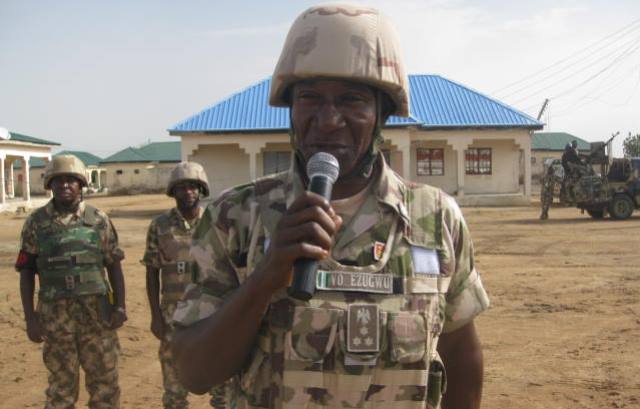
Brigadier General Victor Ezugwu addresses troops at Pulka, Borno State
By Samuel Malik, Maiduguri
The Nigeria army has warned troops involved in the fight against terrorism in the North east that it would be firm and swift in dealing with any of its men involved in human rights abuses.
General Officer Commanding, GOC, 7 Division Nigerian Army, Victor Ezugwu, a Brigadier General, gave the warning when he paid a four-day operational visit to troops under his command in the frontline to assess their performance and boost their morale.
He said that soldiers should treat civilians they deal with in the region with respect, reasoning that residents have to have confidence in them to help in the fight against terrorists.
“We have to treat them with respect, as that is the only way to differentiate us from Boko Haram. You cannot afford to make them go through the horrible abuses they suffered in the hands of the terrorists. You must focus on what brought you here, which is the fight against insurgency.
He also admonished the troops to stay away from civilians as much as possible and particularly warned about dire consequences if any of them is caught in any irresponsible acts with women in the locations where they serve.
“Do everything you can to stay away from civilians. If someone is hungry and you have food, share with them. If someone asks you for money and you have, share with them. However, you must not because of the compassion you show take advantage of them. I don’t want to hear that my soldier is involved in anything untoward with a woman,” Ezugwu said.
The Nigerian army has come under sever criticisms following accusations of serious human rights violations, the latest of which is Amnesty International’s report of deaths of babies and children in Giwa detention centre in Maiduguri.
It said that the death in the detention facility, particularly of women and children, were harrowing, adding that it was a place of death.
“The discovery that babies and young children have died in appalling conditions in military detention is both harrowing and horrifying. We have repeatedly sounded the alarm over the high death rate of detainees in Giwa barracks but these findings show that, for both adults and children, it remains a place of death,” Netsanet Belay, Amnesty International’s Research and Advocacy Director for Africa, said during the launch of the report titled “If you see it, you will cry” in last month.
With President Muhammadu Buhari repeatedly assuring that his administration would respect human rights abuses, the army, it seems, wants to work hard to redeem its image.
During the four days visit, which saw the GOC visit troops in Bama, Banki Junction, Pulka, Gwoza, Bita, Chibok, Damboa, and Bulabulin in Borno State and Michika, Madagali, Gulak, and Mubi in Adamawa State, he warned that any soldier found to be involved in maltreating civilians not only jeopardises his/her career but also risks going to jail.
In each of the locations visited, the army chief used two on-going cases to remind troops what would befall any culprit. According to him, two soldiers are currently in detention, one for beating a civilian to death and the other for tying an 11 year-old boy’s hands so tight that he had to be amputated due to resulting injury he sustained.
“How could a soldier that has successfully fought Boko Haram and when it was time for him to rest go to town and beat a civilian to death? Another one accused an 11 year-old boy of stealing his money and tied the boy’s hand so hard that blood stopped flowing and leading to injuries, which led to hands being cut off. How can you do that to a child?” he said.
“I can assure you that their careers are over; aside their prosecution and punishment. I’m begging you men to be careful and remember your loved ones back home before doing what bring shame both to them and the army.”