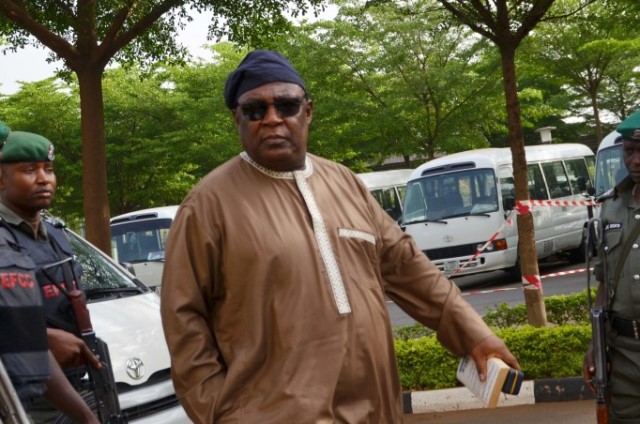
The trial of a former Chief of Defence Staff, CDS, Alex Badeh by the Economic and Financial Crimes Commission, EFCC, before Justice Okon Abang of the Federal High Court sitting in Maitama, Abuja continued on Thursday, June 16, 2016 with further cross-examination of prosecution witness, Mustapha Yerima, PW4, a builder who allegedly assisted Badeh in procuring a piece of land and building a plaza in Abuja.
During cross-examination by the defence counsel, Akin Olujimi, SAN, Yerima maintained his earlier statements that he was given the dollar equivalent of N304m, which he gave to Bureau de Change , BDC, operators who credited his accounts on different dates.
He said: “I had prepared the schedule of payment, which I gave to PW1 (Yushau). I requested for N480m, but PW1 (Yushau) gave me about N300m in dollar equivalent, which I gave to the BDC to change for me.
“Air Commodore Salisu Yushau, who testified as PW1, told me that my payment would come from the Nigerian Air Force, NAF. He introduced me to Air Commodore Sinni who happened to be the CFO in charge of payment.
“The balance of the N450m, in its dollar equivalent, was paid by Air Commodore Yushau in cash, which I received at his house and took to the BDC to convert to Naira.
“All payments made to our company’s accounts were as a result of the meeting with PW1 (Yushau) and Sinni, where PW1 told Sinni to pay a total of N865m.”
Yerima, who also recalled expressing his surprise at the fact that Badeh never visited the site during construction, added: “Perhaps he visited the site after closing hours because you can’t inject such money and not see what you are paying for.”
“At each stage of construction, I submitted site progress pictures to Yushau. He said he would show them to his boss. I recall that I submitted copies of those progress pictures to the EFCC.
‘‘When EFCC operatives came to the site of the construction, I called PW1 (Yushau) who said I should protect him and that I should get in touch with Alex Jnr., who will link me up to his father, Air Marshal Badeh.
“I spoke to Alex Jnr., who told me that his father wasn’t around. He told me he would call me back. I believe that after he had communicated with his father and PW1 (Yushau), he called to tell me that Yushau would call me with instructions on what to tell the EFCC.
“Soon after that, Yushau, conveying the outcome of their meeting, called and told me to find a way to claim the property.
“As a good businessman, the first thing that comes to mind in this situation is to protect your client. But when it is deemed necessary, you say the facts as it is. One will be left with no choice, but to tell the truth. It is not an easy thing to face the EFCC.
“After all of this, we rendered technical support to the Nigerian Air Force on a contract basis. We were engaged under the administration of Air Marshal N.D. Umar and were paid strictly on valuations.”
However, counsel to the prosecution, Rotimi Jacobs, SAN, intervened, saying, “The way he (Olujimi) is questioning the witness is an attempt to get contradictions at all costs!”
The matter has been adjourned to June 28 and 29, 2016 for further cross- examination and continuation of trial.
The Economic and Financial Crimes Commission, EFCC, on Thursday June 16, 2016 obtained conviction on a case of suspected Money Laundering brought against one Samuel Duru before Justice M.N Yinusa of the Federal High Court, Enugu.
Duru was charged for failure to declare the sum of $86,000.00 out of a total sum of $96,000 in contravention of Section 12 of the Foreign Exchange (Monitoring and Miscellaneous Provisions) Act, 2011.
The accused was arrested by officers of the Nigeria Customs Service at the Akanu Ibiam International Airport Enugu while travelling to China in December 2015 and was subsequently handed to EFCC for further investigation and prosecution.
When the case came up today, Duru pleaded guilty to the one count charge preferred against him.
The defence counsel Ikuka Kennedy pleaded with the court to temper justice with mercy since the convict had shown remorse and was a first time offender that had no past criminal records.
Justice Yinusa subsequently convicted and sentenced the accused to six months imprisonment from the date of arrest.
He further ordered that the undeclared $86, 000 be forfeited to the federal government, while the $10,000 and his international passport be returned to the convict.
The charge read:
“That you Duru Samuel Ikechukwu sometime in December 2015 at Akanu Ibiam International Airport, Enugu within the Jurisdiction of the Federal High Court of Nigeria while transporting in cash the sum of ($96,000) Ninety six thousand United States Dollars only from Nigeria to China, falsely declared to the Nigeria Customs Service the sum of $10,000 (ten thousand United States Dollars) only instead of Ninety Six Thousand United States Dollars ($96,000) as required under Section 12 of the Foreign Exchange (Monitoring and Miscellaneous Provisions) Act, 2011 and thereby committed an offence Punishable under Section 2 (5) of Money Laundering Prohibition Act 2011 as amended by Section 2 of the Money Laundering Prohibition Act 2012”.
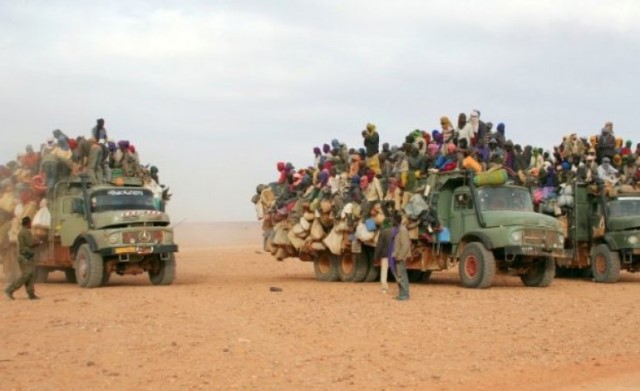
Thirty-four migrants, including 20 children, have been found dead in Niger’s desert after they were abandoned by their smugglers.
The government of the Niger said this in a statement read on national television on Wednesday.
Agadez in the landlocked country’s arid north is a popular way station for migrants attempting to traverse the Sahara Desert and reach Libya and eventually Europe.
Interior Minister, Bazoum Mohammed, said of the adult migrants, nine were women and five were men. They died between June 6-12.
He added that President Mahamadou Issoufou expressed his condolences to their families.
He also disclosed that two of the victims were identified as citizens of Nigerian, adding that the nationalities of the other victims were not immediately clear.
The International Organisation for Migration estimates that 120,000 people crossed through Agadez last year. IOM also recorded 37 migrants died in the desert last year.
The Nigerian Senate has set up a nine-member ad hoc committee to examine the financial losses and leakages contained in the 2013 Nigeria Extractive Industries Transparency Initiative, NEITI, audit report.
The Executive Secretary of NEITI, Waziri Adio, had earlier on Wednesday briefed the senate on the content of the report.
The lawmakers subsequently resolved to investigate loss of revenue contained in the report.
In his remarks, the President of the Senate, Bukola Saraki, announced the Chairman, Senate Committee on Petroleum (Downstream), Jibrin Barau, as chairman of the ad hoc committee.
Barau said that the “outrageous’’ amount of money lost in the oil and gas sector as contained in the report would be taken seriously by the National Assembly.
He said the committee will scrutinize the financial loss and leakages to government and come up with measures to tackle the problem.
“The terms of reference are that the committee is to re-examine the financial processes and the fiscal audit report of the NEITI, the financial loss and leakages to government and all its ramifications.
“The others are remedial measures and sanctions where necessary, and of course and more importantly, any relevant legislative action that will be required to block all forms of leakages,’’ he said.
The members of the committee are Senators Tayo Alasoadura, who is the Chairman, Petroleum (Upstream); Bassey Akpan, Chairman, Committee on Gas and John Enoh, Chairman, Finance Committee.
Others are Senators Chukwuka Utazi, Chairman, Anti-Corruption Committee; Kabir Marafa, Solomon Adeola and Bukar Mustapha.
The committee is expected to complete its assignment and report back to senate in four weeks.
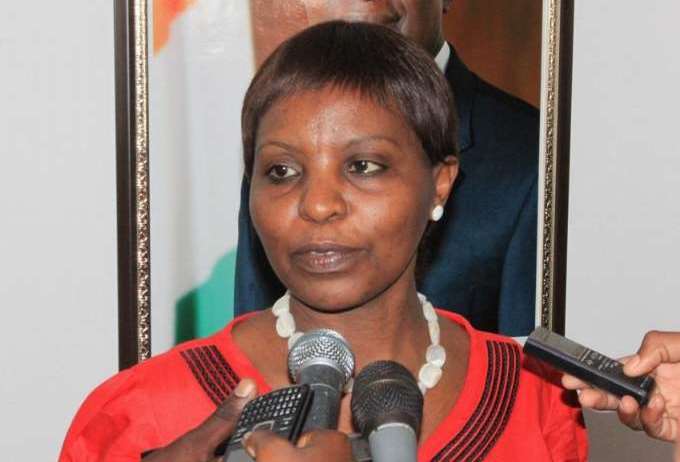
Chantal Uwimana, Director for Africa, Transparency International
Transparency International, the global anti-corruption movement, has called on the Nigerian government to strengthen its anti-corruption agencies and show more transparency in on-going effort to recover stolen assets.
Chantal Uwimana, Director of Africa for Transparency International, made this call at a workshop to follow up on the commitments made by the Nigerian government at the Anti-Corruption Summit in London in May on fighting corruption in the country.
She said: “The people of Nigeria are suffering from the economic downturn. They need to know that the government is using all of its resources to benefit public services. This requires a serious crackdown on corruption, as well as transparency when it comes to how recovered stolen assets will be used. Words are not enough,”
The Nigerian government has announced that more than US$10 billion in looted cash and assets have been recovered.
“We need to know who stole the money and when they will be brought to justice. There should be no impunity for the corrupt,” Uwimana stressed.
She said the anti-corruption agencies need to speed up the process of investigations so that the suspects can be formally charged and their identities made public, after which the judicial process should be expedited so that the funds can be released and made available for public spending.
In London, Nigeria committed to the transparency and accountable management of stolen assets and greater cooperation to uncover and stop international enablers of corruption in the global financial system.
“We want to see progress on this in Nigeria and with the law enforcement authorities in other countries. This is not a problem specific to Nigeria. The global financial system has to tackle this by holding the enablers of corruption – the lawyers, bankers, accountants for example – to account,” Uwimana said.
Nigeria also committed to signing on to the Open Government Partnership as a means of increasing openness, transparency and accountability in government. Transparency International called on the government to follow through with this commitment without delay.
It also called on the government to commit to a timetable for introducing legislation to strengthen the Proceeds of Crime Bill, currently in draft, and enact whistle-blower protection legislation.
It added that greater transparency would send a strong signal to citizens about the seriousness of government in terms of translating these commitments into concrete action.
TI said 75 per cent of Nigerians surveyed recently felt that corruption had increased in the period 2014 – 2015 while 78% felt their government was doing badly in the fight against corruption. This points to very low levels of public trust in government.
TI said it would also like to see the adoption of a national anti-corruption strategy with a clear vision for change and targets to guide and ensure the sustainability of the current anti-corruption drive.
“This will provide a much needed framework for coordinated action between State and non-State actors both nationally and internationally in the fight against corruption. It will also help ensure that the country’s anti-corruption agencies are adequately resourced to carry out their mandate,” she stated.
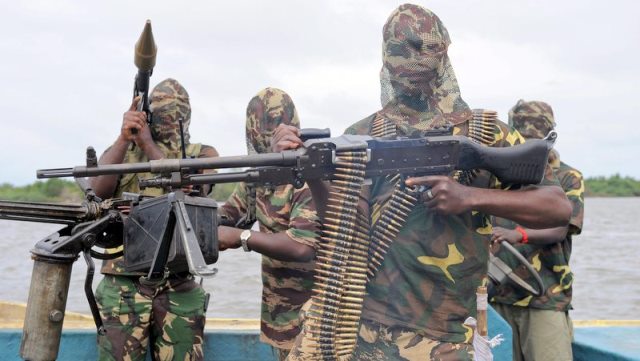
The Niger Delta Avengers has blown up another pipeline belonging to the Nigerian National Petroleum Corporation, NNPC, in Oruk Anam Local Government Area of Akwa Ibom State.
The group revealed this on Thursday via its twitter account @NDAvengers.
The militant group had rejected any form of dialogue with the federal government but on Monday, 13 June, made a U-turn and stated a number of conditions to be met before any form of negotiations would commence.
The conditions include the involvement of the home countries of the international oil companies operating in the Niger Delta region as well as sincerity on the part of the Nigerian government.
The Avengers also warned against any repair works on damaged oil installations and “ordered” suspension of transactions on crude oil from the Niger Delta areas pending the creation of what it called “the right atmosphere that will engender genuine dialogue.
According to a report by the Organization of Petroleum Exporting Countries, OPEC, the recent resurgence in attacks on oil and gas infrastructure in the Niger Delta has led to Nigeria’s oil production falling to a historic low of an average of 1.4 million barrels per day in May this year.
Four persons accused of the abduction and murder of Samaila Yinusa, a Nigerian Army Colonel, have been arraigned before a magistrate court sitting in Kaduna.
Yinusa was allegedly abducted and killed on March 27 in Kaduna State. His body was later discovered along the Abuja-Kaduna highway two days after he was kidnapped.
The four suspects are: Emeka Okeke, Kabir Ibrahim, Chijoke Ugwuanyi and Ebele Precious.
When they were paraded by the Kaduna State Police Command, they confessed to kidnapping and stealing the army officer’s car but Okeke, the gang leader, denied killing him, saying the colonel died from a gunshot he fired himself.
They were charged with criminal conspiracy, kidnapping, illegal possession of firearms, armed robbery and culpable homicide which is punishable by death under certain sections of the penal code.
The Magistrate said the court lacks the jurisdiction to try such cases but he added that the purpose of bringing the suspects before him was for them to be remanded in prison pending when investigations will be completed by the police, and they could be charged before a court of competent jurisdiction.
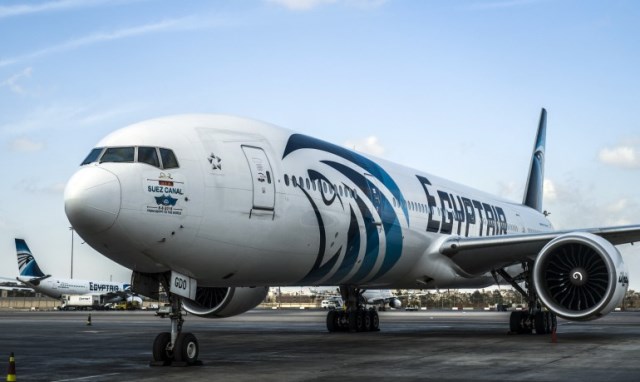
Egyptian investigators say they have identified several locations of wreckage of the EgyptAir flight that went missing over the Mediterranean last month.
A statement said a deep sea search vessel had also sent back the first images of the wreckage.
The EgyptAir flight MS804 was flying from Paris to Cairo on May 19, with 66 people on board when it vanished from Greek and Egyptian radar screens without having sent a distress call.
The Egyptian investigation committee said it would now draw up a map of the wreckage distribution to be able to determine exactly where every single piece of the aircraft ended up.
Investigators are of the opinion that if the plane debris is spread over a large area it tells them the plane broke up in mid-air but if it is more intact, it suggests it hit the water then broke up.
But the wreckage would have to be retrieved for investigators to know exactly what brought down the plane and that could take weeks or even months.
The trial of former Chief of Defence Staff, CDS, Alex Badeh continued at the federal high court in Abuja on Wednesday with the testimony of another prosecution witness, Mustapha Yerima.
Yerima, the Managing Director, Ryte Builders Nigeria Limited, further explained how monies were allegedly diverted from the Nigerian Air Force account to construct a shopping mall for Badeh.
At the resumed hearing before Justice Okon Abang, Yerima, who had previously narrated how he purchased the 3060sqm land on which the shopping mall is built at the sum of N650million, explained that he made the purchase in the name of his company, and later transferred the documents following directives from another aide of Badeh named Yushau.
Yushau had earlier testified against Badeh as Prosecution Witness, PW 1
According to Yerima, “They (Yushau and Badeh) did not want to get involved directly, so they asked me to purchase the land for them.
He added that the land had previously belonged to one Fayose Ayodele when they obtained the Certificate of Occupancy but he could not remember the name of the company that the land documents were transferred to because Yushau had deliberately refused to give him the name.
Yerima explained how the shopping mall was built, saying he submitted a bill of N1.2 billion to Yushau for the construction of the plaza.
“Yushau gave me N408 million, at first, and another N300million in dollar equivalent as mobilization costs. He explained that subsequent payments would be made from the Nigerian Air Force. I also received N9million for pre-contract expenses,” Yerima added.
He also said that he had given the EFCC a list of the payments he received from the Nigerian Air Force, which totalled N864 million.
Badeh is standing trial alongside Iyalikam Nigeria Limited for allegedly abusing his office as Chief of Defence Staff, CDS, by using the dollar equivalent of the sum of N1.4billion removed from the accounts of the Nigerian Air Force to purchase properties in choice areas of Abuja between January and December, 2013.
Urgent intervention is required to forestall a humanitarian crisis of grave proportions at the Internally Displaced Persons Camp in Bama, where hundreds are at the risk of dying.
By Samuel Malik
On May 5, 2016, health workers were alerted that some people needed help within the Internally Displaced Persons, IDP, camp in Bama, 70 kilometres from Maiduguri, the Borno State capital.
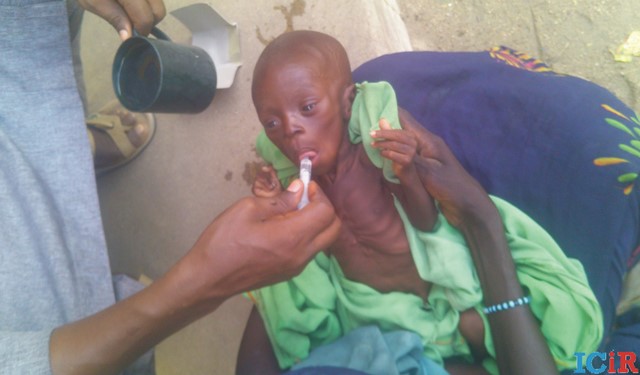
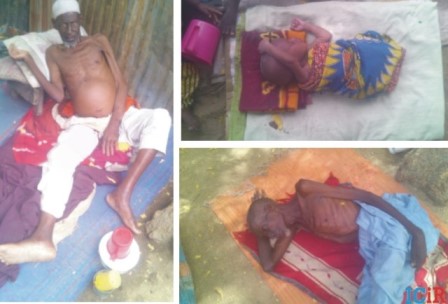
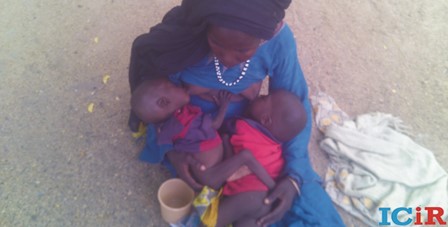
On getting there, five women were seen lying on the ground, some gasping while the others were barely conscious. Three of the women were with children, including a little girl sucking her mother’s breast while her brother lay on the ground with his head on the mother’s leg.
The only means of transportation in the camp are handcarts but by the time some were brought to transport the women to the clinic, two of them had died, one of them being the woman whose daughter was still sucking her breast.
The little children were separated from the dead mother and handed over to their grandmother, an elderly woman sitting nearby, who herself was so weak that she could only watch helplessly while her daughter died. The little boy died the following day.
The women’s corpses were left there in the open and only buried after 24 hours. This was because the men who were called to prepare the bodies for burial refused, as there was no water to wash the corpses and bathe themselves after the burial.
“They told me they had not had water to drink since morning and were dehydrated and too weak to do anything,” a health worker in the camp told the www.icirnigeria.org on condition of anonymity.
Health workers, camp officials and security agents said displaced persons in Bama face serious humanitarian crisis unless something is done urgently.
Both old and young need urgent help
According to a report by a local non governmental organisation, NGO, Bama Community Peace Initiative, BAM-COPI, to the Protection Sector Working Group of Borno State under the United Nations High Commission for Refugees, UNHCR, a daily death toll of 18 to 21 is recorded in the camp due to starvation, thirst and lack healthcare and poor hygiene.
“Food is cooked on a day in a very poor quality and low ration in all the six designated kitchens (each) with an average population of about 4,000 and above eating virtually once a day,” the report, signed by Ibrahim Mohammed, stated.
It added that from May 4 – 20, when the report was written, around 11 children aged between 0 – 15 were buried daily.
Following the report, the www.icirnigeria.org learnt that a meeting was called by the UNHCR protection officer, with the National Emergency Management Agency, NEMA, in attendance. At the meeting, a taskforce named Operation Save Bama was formed.
The taskforce met with the Borno State Emergency Management Agency, SEMA, on June 1 and the following day the state emergency agency increased its presence in the camp.
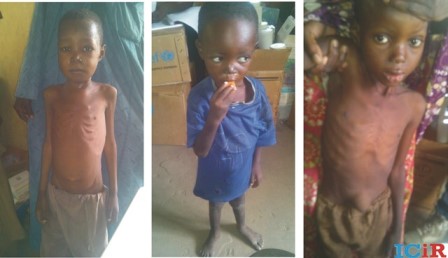
Our reporter saw some trailers of relief items when he visited Bama on June 6, including one containing pots, but in spite of this, feeding has remained once a day. Most children in the camp look very malnourished and unkempt.
Malnourished children in the campA hungry woman breastfeeds her twins
The three functioning boreholes are not enough to serve the 26,000 population, more than half which are children. Women and children queue for long hours to get water, sometimes with cups and small bowls but there is no guarantee that they will get it. Thus, they sometimes have to go outside the camp to fetch water from a stream.
Hygiene and sanitation in the camp is horrible. The environment is filthy, with faecal matter littering the whole place because, unbelievably, there are no toilets. When people need to use the toilet, they just go behind their makeshift shelter to ease themselves.
The shelters are made by the displaced persons themselves with zinc, which they get from dilapidated buildings in the town. There is inadequate ventilation and when it rains, it is a sorry sight as the shelters can hardly protect them from the rain.
Majority of the IDPs live in these shelters while few lucky ones live in some quarters within the hospital. The quarters were used by Boko Haram when they occupied Bama, the reason they were not destroyed.
Investigations showed that there are no international humanitarian organisations in the camp, while running it is left to respected elders who themselves are IDPs.
There are six such leaders, called Bulamas, each in charge of a kitchen that feeds about 4,000 persons.
Since the liberation of the town more than a year ago, IDPs have found life difficult due to neglect and insiders said the daily death toll of 21 was an understatement.
“Between October last year and March this year, there was almost no intervention, save for the military,” a camp volunteer, himself a displaced person said, adding that on several occasions soldiers had to share their food with IDPs.
Some of the soldiers who spoke to our reporter said they still share food once in a while with IDPs, especially women and children.
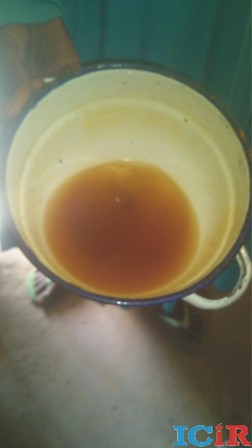
Soup meant for seven people
The NGO’s report also indicates that sexual and gender-based violence occur in the camp but Mohammed said it has been difficult to authenticate.
“As a health worker interacting with the IDPs, you see the signs and know clearly that they have been abused but if they refuse to open up, there is nothing you can do,” he said, adding that cultural practices, especially relating to sex, make people reluctant to report abuses because of fear of stigmatisation.
In April this year, Governor Kashim Shettima appealed to the United Nations and donor agencies to come to the aid of Bama when he visited the town.
“I want to appeal to donor agencies to come to our aid because almost the whole town was destroyed,” he said.
The Brigade Commander in the town, A.G. Laka, a Colonel, had told the governor that there was need for immediate intervention in the camp, especially in the areas of water, shelter and healthcare.
“Sir, we have three challenges. As you are aware, our job is to provide security, but there were no health workers at the camp to render such services to the IDPs. The second challenge is lack of water, and the third is lack of shelter for the IDPs,” Laka explained.
Shettima also threatened to stop the salaries of the local government health workers if they did not return to the town to help out.
Despite these pleas and threat, the condition in the camp has remained the same as the local government health team is overwhelmed by the situation.
The Borno State government did not respond to our enquiries, as spokesperson to the governor, Isa Gusau, did not reply to an email seeking to find out if the government is doing anything about the condition in the camp.
Also, the zonal coordinator of NEMA, Mohammed Kanar, did not respond to our email, phone call and text message seeking to know whether it was aware of the condition in the camp and what is being done.