The Nigerian Navy is planning to set up an operational base along the Lake Chad Basin as a strategy to effectively defeat Boko Haram terrorists.
Chief of Naval Staff, Vice Admiral Ibok-Ete Ekwe Ibas, made this disclosure on Monday at one of the activities to mark the Diamond Jubilee celebration of the Nigerian Navy in Maiduguri.
At the event held at one of the Internally Displaced Persons (IDPs) camp in Maiduguri, The Chief of Naval Staff who was represented by the Chief of Navy Admin., Rear Admiral Obiara Medini said that as part of the ongoing counter-insurgency war, fleeing elements of the Boko Haram terrorist group from the Sambisa Forest must be arrested.
“In order to achieve this, the Nigerian Navy is setting up ‘Operational Base’ along the off shores of Lake Chad Basin area purposely to apprehend these terrorists from their hideouts,” he said.
The Navy Chief also paid a courtesy visit to the Government House Maiduguri where he was received by Alhaji Usman Durkwa, Borno State Deputy Governor.
The Naval Officer said he was in the state to officially launch and inaugurate the 2016 Medical Rhapsody at Dalori Camp II, where over 5,000 orphans and widows are accommodated as a result of Boko Haram insurgency.
He said: “In continuation of the Nigerian Navy Diamond Jubilee Celebration Medical Rhapsody, the Chief of Naval Staff has chosen Dalori Camp II in Maiduguri as venue for the event this year,
“We are giving IDPs free medical services in camps, drugs, food items, clothing materials and other relief materials as part of our corporate social responsibility and civil relations.”
He added that “the Nigerian Navy has concluded arrangement for the establishment of its Operational Base in Lake Chad Basin area purposely to address the issue of Boko Haram in our territories.”
Responding, the Deputy Governor thanked the Navy for identifying with victims of insurgency in the state, particularly now that most IDPs are warming up to return to their liberated communities, and promised that the state Government will continue to support the military to end the Boko Haram menace.
The Deputy governor thereafter accompanied the Naval Team to Dalori Camp along Maiduguri- Bama road were the programme was officially flagged off with the treatment and presentation of drugs to IDPs.
Governor of Borno State, Kashim Shettima is in Istanbul, Turkey, attending a summit organized by the United Nations Office for the Coordination of Humanitarian Affairs (OCHA), where he is scheduled to address the international community with the aim of attracting development into the insurgency-ravaged state.
The Summit which began on Monday, May 23, 2016 is being attended by international donor agencies and humanitarian organisations.
The United Nations had described the problems caused by the Boko Haram insurgency around the Lake Chad region as one of the most neglected major crisis in the world.
According to a statement by the Special Adviser to the Governor on Communications and Strategy, Isa Gusau, Governor Shettima will serve as a panelist in a side event on the Lake Chad with the theme: “How to end suffering in the Lake Chad basin: A dialogue between local communities and the aid community”, with participants expected from different countries around the world.
Other panelists at the conversation will be the Director-General of the International Committee of the Red Cross and Red Crescent, Mr Yves Daccord and the Executive Director of the United Nations World Food Programme, Ertharin Cousin.
Bulama Mali Gubio, patron of the Red Cross in Borno State and elder statesman is one of the dignitaries who accompanied Governor Shettima on the trip. He will also feature as a panelist in one of the events.
Borno is one of the states badly affected by the Boko Haram crisis and statistics indicate that it will require over $6 billion (about N2 trillion) to rebuild infrastructure in the state.
There have been notable efforts lately by the President Muhammadu Buhari-led administration to begin the reconstruction and rehabilitation of the Northeast region of the country, especially with the North-East Development Commission Bill that has been sent to the national assembly, which has passed the second reading.
But many agree that with the current economic situation of the country, there is need to approach international donor agencies and foreign governments for assistance – one of the reasons why Governor Shettima embarked on the trip.
An Abuja High Court has ordered the Federal Government to allow detained former National Security Adviser (NSA), Retired Colonel Muhammed Sambo Dasuki, access to his lawyers at a neutral place other than the premises of the Department of the State Security Service (DSS), so as to enable him prepare adequately for his defence in the ongoing trial over arms purchase scandal.
Justice Husain Baba Yusuf on Monday, 23 May 2016, directed that the former NSA should be allowed by the DSS to meet with his lawyers within the premises of the Federal Capital Territory Judiciary Headquarters in Maitama, Abuja, between Monday, 23 May to Friday, 27 May, 2016.
This directive was as a result of a complaint by Dasuki’s lawyer, Mr Adeola Adedipe, that the legal team for Dasuki had not been allowed to have direct access to him in spite of a court order made on April 6.
When trial resumed on Monday, counsel to the Federal Government, Mr Rotimi Jacobs, SAN told the Judge that he was fully ready with his witnesses that will testify in the case.
But, Adedipe informed the court that he was not ready for any trial because the DSS has refused to comply with the ruling of April 6 which ordered them to allow Dasuki access to his lawyers for briefing so as to prepare his defence.
Adedipe explained that on April 13, Dasuki’s lead counsel, Joseph Daudu, wrote a letter requesting the DSS to allow him meet with Dasuki outside the DSS office as stated in the court ruling, but they were surprised to receive a reply from Mr Rotimi Jacobs on April 18 saying that Dasuki can only be allowed to talk with his lawyers at a special room at the DSS headquarters.
The counsel maintained that due to the confidential nature of such a briefing between a client and his lawyer, the DSS letter could not be acted upon, hence the defence was not ready for trial until it has been afforded opportunity to access Dasuki on a neutral ground for proper briefing.
Chief Akin Olujimi, SAN, Solomon Umoh, SAN and Abioldun Layonu, SAN who are counsels to other defendants in the case, took the same position, saying that in order for the trial to be fair, Dasuki must be allowed access to his lawyers in a neutral place.
Justice Baba Yusuf, who agreed with the submissions of the defence counsels, asked the prosecution counsel to prevail on the EFCC to always respect court orders so as not to impede the criminal trials pending in the court of law.
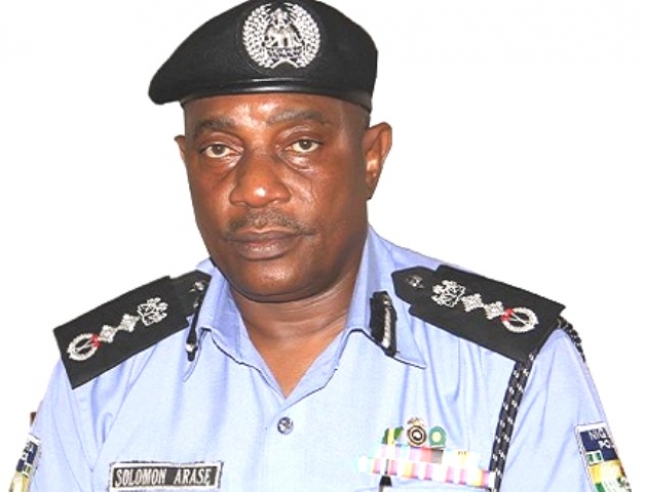
The Inspector General of Police, Solomon Arase has warned all the parties in the ongoing crisis rocking the Peoples Democratic Party, PDP, as well as their loyalists to desist from any act capable of threatening public order in the Federal Capital Territory, FCT, or any other part of the country, as the Police shall deal, firmly and decisively with such persons or group in line with their legal obligations.
In a press release by the Force Public Relations Officer Olabisi Kolawole, the police said it was aware that following the on-going intra-party leadership crisis in the PDP, some aggrieved factional leaders and members of the Party planned to engage thugs from across the country to threaten public peace and security in Abuja.
Their plan, according to the police, is to infiltrate Abuja and attack the National Headquarters of the Peoples’ Democratic Party with intent to forcefully occupy the facility.
The statement said credible Police sources confirm that these aggrieved PDP members planned to mobilise with effect from Monday 23rd May 2016 and then march through major streets in Abuja before proceeding to the PDP Secretariat to carry out their attack.
The Inspector-General of Police has therefore directed the deployment of Police assets to secure the PDP Secretariat and protect the staff until the threat is contained.
The force PRO stressed that the police action was a proactive initiative in keeping with the statutory Mandate of the Nigeria Police to prevent breakdown of law and order and protect lives and property.
In what is seen as a major coup in the counterinsurgency war, Boko Haram’s chief bomb maker has been shot dead by a security detail of the group’s leader, Abubakar Shekau, the Nigerian Army has reported.
To make matters worse for the sect, the man billed to take over the bomb making responsibility, simply identified as Julelebeeb, has gone blind from shrapnel wounds as he tried to impress his leaders by assembling an improvised explosive device, IED.
According to a statement by army spokesperson, Sani Usman, the chief bomb maker, whose name was not given, was killed because he tried to desert the group, possibly sensing that the military was closing in.
“The chief bomb maker, apart from his high status in the command structure of the Boko Haram terrorists, was one of their capable hands involved in making Improvised Explosive Devices (IEDs), coming after their chief scientist, called Abu RPG (who has been killed long ago).
“The chief bomb maker was killed by one of the body guards of the Boko Haram terrorists leader, Abubakar Shekau, as he was about to run away just like several others are doing because of the intensity of Operation CRACKDOWN,” the statement read.
While admitting that these incidences have greatly affected Boko Haram’s ability, especially in the area of explosive devices, the army said it is not relenting in its efforts to clear out remnants of the group.
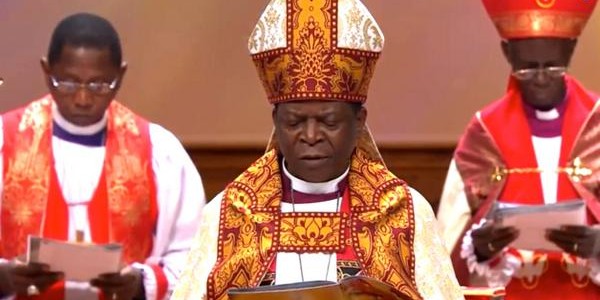
The Primate Of The Church Of Nigeria (Anglican Communion) and Archbishop of Abuja Diocese, The Most Rev’d Nicholas D. Okoh, has called on Niger Delta Avengers, the militant group that has claimed responsibility for the bombing of oil pipelines installations in the region, to embrace peace and dialogue with government if they have grievances.
The Primate made this remark in his Presidential Address to the 3rd Session of the 9th Synod of Abuja Diocese, held at All Saints Church, Wuse, Abuja.
He noted that the renewed pipeline vandalism in the Niger Delta, was not in the best interest of Nigeria, and urged those behind the bombings to desist from the act forthwith.
The Church called on the Niger Delta Avengers to cease hostility against the government while embracing dialogue, noting that Nigeria, which is currently engaged with too many battles cannot afford to start another one with militants in the oil producing areas of the federation.
While urging the Federal Government to tread cautiously in its attempts to resolve the growing crises in the Niger Delta, the Church called on it to seek collaboration with the host communities in its efforts to secure oil pipelines.
He also urged the Federal Government to open the space for immediate revival of the dwindling Nigerian economy by creating investment friendly atmosphere to attract investors.
He lauded the efforts of President Muhammadu Buhar’s administration at diversifying the Nigerian economy, urging his government to initiate more cutting-edge approaches aimed at a meaningful engagement of foreign investors for revival of the economy of the country.
He said, “Creating an investment friendly environment in the country will more pragmatically give us what we need. Factors that investors will need to thrive, especially security, power and other amenities should be made available, while investors would be naturally attracted.
The Primate also urged the Federal Government and Nigerians in general should collectively find lasting solutions to the problem of insurgency, killings by herdsmen, fuel scarcity, pipeline vandalism and wide spread corruption, all he noted, are factors that often inhibit the growth of economy, and the nation in general.
On the menace of herdsmen across the federation, the Primate said, “The Federal Government should make a policy to deliberately disarm the herdsmen” as a means of preventing the springing up of ethnic militias in all the regions of the federation in attempts to resist the rampage by herdsmen”
He advised the government against the plan to set up grazing reserves for herdsmen across the country, stating that the Synod was of the view that such reserves should be built in regions where the Fulanis are more familiar.
He said: “The herdsmen are private businessmen who take away all proceeds of the business, not sharing with either their host communities or the government. We wish to re-echo to the government, state and individuals involved, the recommendation made earlier, that ranches should be built in Fulani localities for modern animal husbandry,
“In some parts of Nigeria, people are already grappling with high population growth and land does not expand. Nobody’s land should, therefore, be given forcefully to anybody in any guise.”
The Synod calls on the National Assembly to drop the plan to propose a bill on grazing reserve as the issue has started heating up the polity.
Primate Okoh also commended the anti-corruption war by the President and its efforts to block all leakages in the country’s revenue, stressing that the war against corruption was a noble cause.
The Synod urged the government to ensure that its scope is widespread across all the tiers and arms of government at the Federal, State and Local Government areas in Nigeria.
The governor of Bayelsa State, Seriake Dickson, has threatened to sack any civil servant in the state who fails to resume for work on Monday as strike action by workers completely crippled government business last week.
Workers in the state commenced a strike action on Thursday to compel the Bayelsa government to pay four months’ salaries owed them. The action forced activities in public schools, commercial banks and state secretariat on to a halt on Friday.
In a broadcast on Sunday, the governor explained that the state was nearly broke because of dwindling revenue from the Federation Account and swore that any worker who does not work would not be paid.
Dickson, who referred to the strike as political and unpatriotic, said that he had explained to labour leaders in the state the true state of the government’s finances.
“This strike is unpatriotic, political and uncalled for because we are working to ensure that the salary arrears are cleared, we have an over bloated workforce and our wage bill is unwieldy at over N4 billion monthly.
“I have held several meetings with labour leaders and disclosed the revenue that we get for all to see, we have also offered to pay 50 per cent to ameliorate the sufferings but they turned it down
Continuing, the governor warned: “I am giving the workers up till Monday to resume work or they forfeit their salaries, it is no work, no pay and anyone that refuses to report for work on Monday should consider himself fired.”
An attempt by the Radio and Television Workers Union, RATAWU, to shut down the station to prevent the governor’s broadcast was thwarted by stern looking policemen who dispersed the angry workers
The Bayelsa State Commissioner for Information, Jonathan Obuebite, who accompanied the policemen, thereafter mobilised some workers who secured the station and prepared it for Dickson’s broadcast to the people.
However, regular programming was suspended by the station as soon as the governor finished his address as only music was played on the station for hours.
Minister of Justice and Attorney General of the Federation, Abubakar Malami
By Tajudeen Suleiman
The decision of the Minister of Justice and the Attorney General of the Federation, AGF, Abubakar Malami, a Senior Advocate of Nigeria, SAN, to take over the prosecution of one Bello Akano, by the Independent Corrupt Practices and Other Related Offences Commission, ICPC, is generating debate among lawyers and members of the civil society.
There are suspicions that the accused person, who has evaded prosecution since last year, allegedly boasting that his trial will go nowhere, might have used his influence to initiate the takeover of the case, prelude to the withdrawal the charges against him.
Akano, who claims to be a travel agent, is facing criminal charges relating to visa procurement scam at the Federal Capital Territory High Court, Abuja. He was arraigned on November 30, 2015 on a 7-count charge bothering on possession of forged documents contrary to Section 368 of the Penal Code Act and making false statement to a public officer contrary to Section 25(1)(a) of the Corrupt Practices and Other Related Offences Act 2000.
The case has suffered several adjournments because Akano failed to show up in court, forcing the trial judge, Justice U.P Kekemeke, of the Federal Capital Territory, FCT, High Court, to order the ICPC to arrest and produce him in court.
However, to the utmost surprise of many lawyers, including the prosecutor and the judge, when the case came up for hearing on May 12, M.C. Obilor, a senior counsel who represented the Attorney General of the Federation, AGF, told the court that the office of the AGF was taking over the prosecution of the case.
Obilor said that the Attorney General had written to the ICPC to handover Akano’s case file to the ministry and hands off. Appearing for the ICPC, Isaac Jiya, confirmed to the court that the AGF had, indeed, earlier written the commission asking it to hand over the case file.
The development got many tongues wagging as some lawyers said it was curious that the Attorney General would be interested in this kind of criminal case, particularly as it involves diplomatic relations with foreign countries.
The taking over of Akano’s case is even more curious as he is said to have boasted that the case against him will not “go far”.
The Ministry of Justice has some supervisory powers over the ICPC as far as prosecution of criminal cases is concerned and it is not unusual for the AG to ask that some case files be handed over. Constitutionally, the AGF has the power to initiate, take over or terminate legal proceedings in any law court in the country, except military tribunals. But such powers are so open to abuse and can be easily misinterpreted and are sparingly evoked.
Isa Salisu, Special Adviser to the Minister of Justice, told the www.icirnigeria.org that “as the chief law officer of the country, the minister of justice could request for any case file when he’s not satisfied with the way it is being prosecuted.
“I am not saying that is the case here, but he must have done it in the interest of the country,” he added.
Wahab Shittu, a Lagos – based lawyer and human right activist, agreed with Salisu that as the chief prosecution officer the federation, the AGF has the constitutional right to take over the prosecution of any criminal case.
“The reality is that the Attorney General of the Federation, being the Chief Law Officer of the federation, has the right to initiate, discontinue, or take over any case from any other agency. ICPC is an agency under the direct supervision of the AG, they prosecute at the pleasure of the AG, In fact when you see ICPC or EFCC prosecuting a case, they execute their prosecutorial powers on behalf of the AG. When the AG feels that a case can be better prosecuted from his office, he can request that such a case be transferred back to his office,” he observed.
He stated further: “It is only when, in the exercise of powers of the AG , he decides to enter a Nolle prosequi , which is a discontinuance of further proceedings in court that you can now begin to allude to such suspicion. But where he merely says he wants to take over the case, it might even be for the progress of the case because he can now directly oversee the case, particularly in the light of the anti-corruption crusade of this administration. So it would be too early to begin to speculate over his action, because his action is lawful, constitutional and within the ambit of the law.”
However, another lawyer, John Ihedioha, observed that though it is within the ambit of the law for the AG to request for transfer of case files, it is usually done with the intention to “kill the case.”
Ihedioha stressed that when the AGF starts getting interested in a case, it is usually because it may not be going the way he want it to go.
As if to make matters worse, a source in the minister’s office informed our reporter that the Attorney General would be asking for many files to be handed over by many government agencies, including the ICPC, Economic and Financial Crimes Commission, EFCC, and even the police, as the government might not be satisfied with the way they are being handled.
The source said that the federal government will soon set up a National Prosecution Coordinating Committee to take care of such cases and that it would be inaugurated by President Muhammdu Buhari before the end of the year.
The investigation against Akano started in March last year following intelligence reports and complaints by some embassies about his activities. Operatives of the ICPC secured a court warrant on March 13 2015 to search his Abuja residence which led to the discovery of several forged documents meant to facilitate issuance of travel visa to France, United Kingdom and Italy, among others.
The documents found in his residence include a letter of introduction to the French Embassy allegedly written by former National Chairman of the Peoples Democratic Party, PDP, Bamanga Tukur; a request for Note Verbale in the name of a member of the House of Representatives, Moshood Bakare and a fake staff identity card of the Federal Ministry of Aviation.
Other fake documents recovered from his house are letters to the British Embassy purportedly written by the Principal of Government Secondary School, Wuse 2, Abuja introducing certain persons as students of the school seeking travel documents to the UK, and pre-signed official letter head papers of the Federal Medical Centre, Lokoja, Kogi state.
Operatives also found several pay slips, birth certificates as well as forged correspondences, including a letter of request for passport purportedly written by the State House, Abuja.
In the letter purportedly written by Turkur, dated January 8, 2014, and addressed to the French Embassy, Abuja, a Miss Enabulele Choice Aimaimiye was introduced as secretary to the PDP chairman and a visa requested for her to travel to Paris.
Upon enquiries, Tukur’s office denied knowing Aimaimiye, saying that the letterhead on which the letter to the embassy was written was forged.
The charges against Akano include: “That you Bello Raufu Akano(M) on 10th March 2015 or thereabout at No. 23 Ibn Haruna street Utako, Abuja, Federal Capital Territory, had in your possession a forged document knowing same to be forged with intention to use same as in order to dishonestly obtain a France entry Visa a copy of letter dated 8th January, 2014 addressed to the Consular Officer, French Embassy Abuja titled “Letter of Introduction And Request For Visa” in favour of one Miss Enabulele Choice Aimaimiye purporting to be the Secretary to Ambassador Bamanga Tukur, National Chairman PDP was found in your premise at No. 23 Ibn Haruna Street Utako, Abuja when in actual fact the said Miss Enebulele Choice Aimaimiye was not a staff of Ambassador Bamanga Tukur in any capacity, and you thereby committed an offence contrary to and punishable under Section 368 of the Penal Code Act, Laws of the FCT CAP 532.”
Justice Kekemeke has discharged the ICPC from the case and adjourned till July 4.
The name Sir Henry Willink (1894-1973) does not ring a bell in the modern day Nigeria. It was not so about fifty-nine years ago.
Sir Willink was a British Politician and public servant. He rose to be British Minister of Health from 1943-1945. He later became Vice-Chancellor University of Cambridge between 1953 and 1955. His papers are held till today at the Churchill College Cambridge.
Background to minority issue in Nigeria
On September 2, 1957,Sir Abubakar Tafawa Balewa(1912-1966) deputy leader of the NPC and Federal Minister of Transport was appointed Nigeria’s First Prime Minister by the then second Governor General of Nigeria, Sir James Wilson Robertson(1899-1983), who served from June 15,1955 to November 16, 1960.
On September 26, 1957 the British government appointed Sir Henry Willink to chair a commission to inquire into the fears of Nigerian minorities and means of allaying them. The commissioners arrived in Lagos on November 23, 1957 and between that date and April 12, 1958 they held public sittings and had private meetings and discussions in each region, in Lagos and in the Southern Cameroons. They returned to London on April 12, 1958.
In its report published on July 30, 1958 the Commission stated that although real fears existed in every region, it was satisfied that setting up new states would create problems as great as those they sought to eliminate.
In every region the fears expressed were of a government based on a tribal, or in the North a religious, majority. Rightly or wrongly, it was feared that the regional governments, secure in their majority, would not be ready to respond to criticisms or to meet the wishes of the minorities.
Other members of the Commission were Gordon Hadow, Phillip Mason, J.B. Shearer while K. J. Hilton served as the Secretary. The Commission published 108 pages of its conclusions and recommendations.
The Commission’s recommendations
In paragraph 26-30, the Willink recommended as follows: “We were impressed in both the Western and Eastern Regions, with the special position of the people, mainly Ijaw, in the swampy country along the coast between Opobo and the mouth of the Benin Rivers. We were confronted, first, with their own almost universal view that their difficulties were not understood at headquarters in the interior, where those responsible thought of the problems in quite different forms from those they assumed in those riverine areas; secondly, with the widespread desire of the Ijaws on either side of the main stream of the Niger to be united”
“We cannot recommend political arrangements which would unite in one political unit the whole body of Ijaws; we do however consider that their belief that their problems are not understood could be largely meet without the creations of a separate state which have rejected for the reasons mentioned elsewhere. 27- This is a matter which requires a special effort and the co-operation of the Federal, Eastern and Western Government; it does not concern one Region only. Not only because the area involves two Regions, but because it is poor, backward and neglected, is the whole of Nigeria concerned. We suggest that there should a Federal Board appointed to consider the problems of the area of the Niger Delta. In this we would include the Rivers Province without Aboada or Port Harcourt and would add the Western Ijaw Division. 29-
“We suggest that constitutionally it would be necessary to place on the concurrent list a new subject which might be “The Development of Special Areas”. It would be open to the Federal Government to announce in the Gazette that a certain area had been classified as ”Special” and from that moment special plans for its development would become a Federal as well as a Regional Responsibility. The Board would be required to submit its annual reports to each of the three Governments, Federal, Western Region and Eastern Region, and it would be necessary to make provision of time in each House for discussion of the report of this board. We do not contemplate that the Board should carry out the works which it recommends; this would be left to the Regional Government (except in the case of exclusively Federal schemes) and the annual report of the Board would include a report on actual progress.
“We consider that this arrangement should be temporary and it should be the object of the Board to conclude its work within ten or twelve years when provision for development had gone far enough to make it possible for this arrangement to be abandoned. It would then be for considerations whether the Area should become a Minority Area as discussed below”. 30-
“We consider that when the Board has drawn up the schemes it considers desirable and possible, it should place them in an order of priority and endeavor to obtain the agreement of the Governments concerned. We do not recommend powers of compulsion, which we believe would defeat their own object. Our proposal would provide some financial inducement to the Regional Government, but its sole ultimate sanction is the working of the domestic machine and the value of votes; it is more likely to be successful if there is such a balance in the Federal House of Representatives that every seat is of importance.
“The declaration of the Ijaw country as a Special Area would direct public attention to a neglected tract and give the Ijaws an opportunity of putting forward plans of their own for improvement. It would be difficult for either Government to justify to the electorate either a blank refusal to accept a plan recommend by the Board or a failure to implement an accepted plan; in this, as in all our recommendations, we assume a desire to continue with democratic institutions;it is on this assumption that all the steps leading to independence are based.”
We cannot but make reference to the British in discussing our national problem because they created Nigeria along with the mess that we are still coping with. It should be noted that the first discovery of oil in Nigeria in-bloc OML 29 onshore at Oloibiri in Ogbia Local government of the present Bayelsa state was made on January 15, 1956 and production did not start until 1958. I am not sure Sir Willink was aware of the discovery of oil before making the suggestion.
But the 1963 constitution married the suggestion of Sir Willink.
Section 159 of that constitution states: “(1) there shall be a board for the Niger Delta which shall be styled the Niger Delta Development Board. (2) The members of the Board shall be- a person appointed by the President, who shall be chairman; a person appointed by the Governor of Eastern Nigeria; a person appointed by the Governor of Mid-Western Nigeria; and such other persons as may be appointed in such manner as may be prescribed by Parliament to represent the inhabitants of the Niger Delta.
(3) A member of the Board shall vacate his office in such circumstances as may be prescribed by Parliament. (4) The Board shall be responsible for advising the Government of the Federation and the Governments of Eastern Nigeria and Mid-Western Nigeria with respect to the physical development of the Niger Delta, and in order to discharge that responsibility the Board shall—cause the Niger Delta to be surveyed in order to ascertain what measures are required to promote its physical development; prepare schemes designed to promote the physical development of the Niger Delta, together with estimates of the costs of putting the schemes into effect; submit to the Government of the Federation and the Governments of Eastern Nigeria and Mid-Western Nigeria annual reports describing the work of the Board and the measures taken in pursuance of its advice, Parliament may make such provision as it considers expedient for enabling the Board to discharge its function under this section, In this section, ”the Niger Delta” means the area specified in the Proclamation relating to the Board which was made on the twenty-sixth day of August, 1959 and lastly this section shall cease to have effect on the first day of July, 1969, or such later date as may prescribed by Parliament.”
No region in Nigeria has so far been designated as “special areas” except the Niger Delta and no region also has suffered environmental calamity as Niger Delta now with no land and no water with heavy military presence.
It was the spirit of Willink report that gave birth to Decree 22 of 1992 which led to the creation of Oil Minerals Producing Commission (OMPADEC). Same for the Niger Delta Development Commission, NDDC. Same for the Niger Delta Amnesty programme. However, contrary to recommendations of Sir Willink, states and local governments have been created in the region yet the problem persists.
Nigeria cannot be free until the Niger Delta I free
When you read about oil fields being bombed in Niger Delta and ugly incidents, one is bound to ask, ‘what do these people really want?’ We need to go beyond asking such a question. There seems to be a disconnection between them and us. We don’t seem to understand them and they don’t understand us. At times they don’t understand themselves. The situation in the region is much more complex than imagined.
One of the region’s leaders, Major Isaac Jasper Adaka Boro (1938-1968), while being sentenced to death by hanging for fighting the cause of Niger Delta as the leader of the Niger Delta Volunteer Force by Justice Phil Ebosie in Port Harcourt on March 27 1966 under the regime of General Thomas Johnson Umanakwe Aguiyi Ironsi(1924-1966) said his people “had long sought to separate not because they loved power but because their conditions were peculiar and the authorities did not understand our problems. There is nothing wrong with Nigeria. What is wrong with us is the total lack of mercy in our activities”.
To the people of Niger Delta, I plead that violence has never solved and will never solve any problem.
I have visited the Niger Delta area several times and with billions of naira poured into that region by the central, states and local governments and oil companies also for developments, it is still the same old story-misery, frustration, poverty, neglect, militancy, etc.
A leader that emerged from there recently failed to address the chronic problems of the region and made worse their plight by distributing massive wealth to just few who eventually lost focus. Pity!
In spite of that, the central government cannot give up on Niger Delta which at present provides most of Nigeria’s wealth, just like the government cannot give up on other parts of the country too including the North east region that is completely devastated today as a result of religious insurgency.
In the words of James Baldwin (1924-1987), the black American novelist in his essay titled, My Dungeon Shook, ”We cannot be free until they are free”.
Eric Teniola, former Editor of The Punch and a former director at the Presidency, resides in Lagos.
Some of us Nigerians are a disingenuous lot. We are known to speak from both sides of our mouth. And when it comes to the fate of our country, we are wont to make decisions based on emotions, ethnicity, and for other pedestrian reasons. Yet, we expect Nigeria to achieve greatness. However, you don’t achieve greatness. You plan it.
Crowded out by the recent pump price imbroglio, the call by certain sections of the country on federal authorities not to arrest former President Goodluck Jonathan is emblematic of our duplicitous nature. Sometime last month, a certain Joseph Hayab, representing the Christian Association of Nigeria (CAN) in the Northern states warned that there will be trouble if Jonathan is arrested.
In his poorly-reasoned monosyllabic statement, Hayab, a member of the clergy said: “Let me warn that such a misadventure will set a wrong precedent and only open the door to mischievous people to throw this nation into confusion. What Nigerians need urgently is availability of fuel, electricity, prompt salary, security of lives and property, among other issues that are begging for urgent answers.
“If the purported plan to arrest him is to please the international community and prove to them that we are fighting corruption, then let us know that this same international community is busy celebrating him as a hero of democracy and even those who seriously wanted him to go for a change to happen are now singing a new song about him.
“Former President Jonathan is deservedly seen in Nigeria and beyond as a hero of democracy because of his actions before, during and after the 2015 elections. As such, it will be an ill-advice for the Muhammadu Buhari administration to initiate the arrest of such a statesman at this time and with the current realities.
“Our government must know that there are individuals serving today that are also being accused of corruption but since there are claims that nothing has been established against them, they are walking and speaking like saints. While ignoring all these, government wants to arrest a man of peace like Jonathan? CAN Northern States wishes to advise that such an action, if actualised, has the capacity to lead to serious confusion that will affect Nigeria economically and otherwise.
“We believe former President Jonathan deserves praise and should receive gratitude from those in power today and not scorn. We believe at this time and with the current realities that our former president must not be denigrated but honoured because honour must be given to whom is due”, Mr. Hayab stated.
Prior to Hayab’s cautionary tale, was the much more virulent rant of Udeng Eradiri, the President of the Ijaw Youth Council (IYC), at a news conference to mark the burial of Diepreye Alamieyeseigha, the hopelessly corrupt former governor of Bayelsa State. In a foolhardy display of brinkmanship, Eradiri threatened that he and his cohorts will “make the nation ungovernable for the administration of President Muhammadu Buhari” if Nigeria’s anti-graft body, the Economic and Financial Crimes Commission (EFCC) dares to arrest former President Jonathan.
According to him: “They have arrested almost all our people. Azibola (Robert) was arrested by the EFCC and we are calling on the EFCC to stop persecuting him further and charge him to court if there are issues. They detained him for a long time, forcing him to make statements to indict former President Jonathan.
“We noticed that the same way they persecuted Alamieyeseigha has continued. After Goodluck Jonathan, our people who contributed to that administration, are being persecuted by this government. The recent one is the ploy to arrest Goodluck Jonathan, which is unfolding everyday. This must stop”, he warned.
On face value, both gentlemen came across as idiotic. First off, what gives them the audacity to think that former President Jonathan is above the law? For a man under whose watch the nation witnessed some of the worst cases of stealing of public funds ever in our history – the sort that has literally bankrupted Nigeria, he has a case to answer. And the heavens will not fall if Mr. Jonathan is arrested. Not even the pre-emptive acts of aggression and war against the state by emergent fringe groups in the Niger Delta basin with such fiendish names as Red Egbesu Water Lions and the more notorious Niger Delta Avengers will derail the momentum of the current anti-corruption campaign.
The other day while the pump price crisis lingered, we were told that Nigeria is broke. And that is a statement of fact. Only those who for political expediency, will question the broken state of our treasuries which had over time become the piggy-bank of politicians, party chieftains and emergency contractors who ran the show under Goodluck Jonathan.
Earlier this month, Vice President Yemi Osinbajo told a book launch audience in Ibadan that Nigeria lost about $15 billion to fraudulent and corrupt practices in security equipment spending during the last administration of Goodluck Jonathan. “When you look at the sheer amount of money that has been embezzled,” he lamented, “the sheer amount of money lost from any of these various cases of corruption, you will find that far too much has been lost.
“It was discovered a few days ago that the total amount of money lost to just corruption in part of and provision of security equipment in the military is closer to 15 billion US dollars.” He said the amount “is more than half of the current foreign reserves of the country”, currently at about $27 billion. I believe strongly that it is important to send a message that no public officer can steal the resources of this country and expect to escape”. So far, some of the peripheral characters in the looting orgy during the life of the last administration are currently being systematically and clinically ferreted out while the EFCC makes a case against them in court. All the hue and cry about the lop-sidedness of the campaign simply bespeaks the disingenuity of the usual suspects and their army of apologists. And as President Buhari had told CNN’s Christine Amanpour last July, his administration will not spare even his own party members in the current war against corruption. That is why we have since seen the President tactically distance himself from the trial of the Senate President, Bukola Saraki.
On the charge that the Buhari administration’s fixation on the last government is a cop-out for its inability to deliver on its election promises, I think that such a position is as premature as it is unreasonable. Here is a government that inherited an empty treasury, with mounting debts and with reports of departing officials literally dismembering valuables, carting away government property like a retreating army and reluctantly handing over to incoming officials. In the process, it took the new administration months after the swearing-in ceremony to settle down to the business of the state.
From all indications, and as I had stated in an earlier piece, Jonathan had no choice than to concede defeat against the majority will of his coterie of supporters (remember the Godsday Orubebe outburst?) who had fantastically benefited from the filthy lucre of the era and hated to see the gravy train derailed. With the dire consequences of circumventing the electoral process staring him in the face, the former President knew better and wisely threw in the towel. That is why I believe that all the talk of Jonathan’s demonstration of statesmanship is over-rated. Believe me when I tell you that he had no choice. On its own merit, I think his election day gesture still remains commendable.
However, that Jonathan willingly handed over power to the victorious candidate should not in any case exculpate him from arrest and prosecution if the State establishes a case against him. With overwhelming evidences now pointing at him as the ultimate source of the hierarchical breakdown that led to the monumental squandering of the nation’s resources, I believe that Goodluck Jonathan should be arrested and charged accordingly.
To serve as a deterrent, Jonathan should join the likes of former Brazilian President Luiz Inacio da Silva, Philipines Gloria Macapagal – Arroyo and such others in facing charges for stealing from their own people or to have been seen to have aided and abetted corrupt practices. Perish all these talk about reaching back in time to investigate and arrest others before Jonathan. That is only a call to mischief and anarchy. For now, we have to start somewhere. With someone. And that someone is Goodluck Ebele Jonathan, the immediate past president of Nigeria.
Only there and then will Nigerians get the message – that never again will it be business as usual. And that we have entered an era when sacred cows must be slaughtered.
That is my story. And I stand by it.
Charles Anyiam is Editor-In-Chief,The African Times-USA.