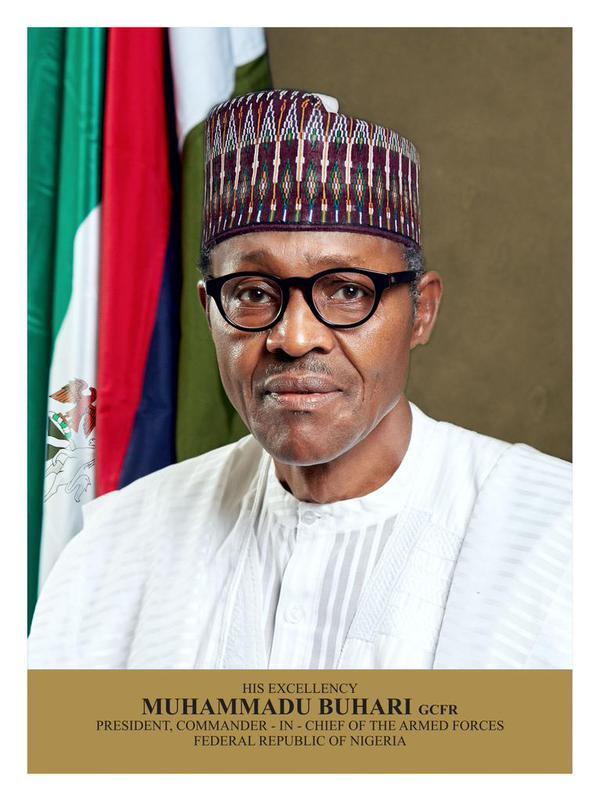
Although datails had already been reported in the media, Senate President Bukola Saraki has announced the 21 ministerial nominees sent to the red chamber by President Muhammadu Buhari last Wednesday, after over three months of waiting.
The Senate President, who received the list after the chamber’s sitting last Wednesday, opened the sealed envelope at 10:45 am on Tuesday
As previously reported by the media, nominees include former Lagos State governor, Babatunde Raji Fashola, former Abia State governor Chris Ngige, former Ekiti State governor, Kayode Fayemi as well as former Rivers State governor, Rotimi Amaechi.
Also listed were Abubakar Malami; Abdurahman Bello Dambazzau; Aisha Jumai Al Hassan; Lai Mohammed, the national publicity of the All Progressive Congress, APC; Adebayo Shittu; Solomon Dalong; and Audu Ogbeh, former Peoples Democratic Party, PDP, chairman.
Others are Emmanuel Kachikwu, Group Managing Director of the Nigerian National Petroleum Corporation, NNPC; Amina Ibrahim; Osagie Ehaneri; Suleiman Adamu; Kemi Adeosun; Ogbonnaya Onu; Ahmed Musa Bello; Ibrahim Usman Jubrin; Hadi Serika; Udoma Udo-Udoma.
Saraki said that the President sent the ministerial list to him through the Chief of Staff, Abba Kyari, adding that the list contained the first batch of nominees.
The Senate President, who disclosed that the Senate would commence screening next Tuesday, said that President Buhari had told him that subsequent names would be submitted shortly.
The Borno State governor, Kashim Shettima, on Monday announced former Commissioner for Poverty Alleviation and Youths Empowerment, Usman Mamman Durkwa, as the new deputy governor of the state.
Durkwa will take over the deputy governor’s office following the death of Zannah Umar Mustapha who died on August 15 in a hotel while on an official assignment in Yola.
A letter signed by his spokesman to the governor, Isa Gusau, indicated that Durkwa’s name was on Monday sent to the Borno State House of Assembly for confirmation.
“I have the honour to convey vide this letter the name of Hon. Usman Mamman Durkwa for confirmation as Deputy Governor of Borno State following the demise of Alhaji Zannah Umar Mustapha on 15th August, 2015,” the governor stated in the letter.
The governor’s spokesman further said that his boss was sure that the Assembly would quickly consider his nomination considering “the very respectful and cordial working relationship between the executive and legislative arms of government in Borno State.”
The governor reassured on his pledge to stand by the late deputy governor’s family and urged youths not to take advantage of the appointment to erupt crisis under the guise of celebrations, warning that any act of lawlessness will not be tolerated by security agencies.
Durkwa, a seasoned politician has been in the corridors of power since 2003 when he was first appointed as a commissioner by Senator Ali Modu Sheriff.
He has headed different ministries, which include land and survey, environment and religious affairs, since his first appointment.
Workers in the aviation sector on Sunday gave the Nigeria Civil Aviation Authority, NCAA, a 14 day ultimatum to sort out approvals for the promotion of its workers, threatening to ground activities if their demand is not met.
The National Union of Air Transport Employees, NUATE, and Air Transport Senior Staff Services Association of Nigeria, ATSSSAN, unanimously issued the ultimatum in Lagos.
The unions criticized the NCAA leadership over its nonchalance in approving promotion due their members since January 2015.
The NUATE General-Secretary, Olayinka Abioye, told aviation correspondents that the unions were prepared to ground activities in the sector if the concerned authority failed to yield to their requests.
Abioye said that it was a worrisome development that those that were due for promotion were yet to be interviewed years after they were due for elevation.
He recalled that at its congress on September 30, the NUATE had issued an ultimatum which expires on October 14 to the NCAA management to effect the promotion of the concerned workers
Abioye urged the management of NCAA to respect the terms and conditions of employment of the workers as contained in the condition of service entered into by all parties.
Senators congratulating Senate President Bukola Saraki after a vote of confidence was passed on him recently
The National Assembly may be contemplating a constitution amendment in the quest to provide immunity for the heads of the legislative and judicial arms of government to bring them at par with the President and governors, the Vanguard newspaper has reported.
The Minority Leader of the House of Representatives, Leo Ogor, reportedly dropped the hint, reasoning that “if the head of the executive arm, the President, and his vice should enjoy immunity, the heads of the other two arms of government, the legislature and the judiciary should also benefit from the immunity”.
The Vanguard quoted Ogor as saying that granting immunity to the head of the National Assembly “would reduce distractions and crisis in the National Assembly as well as put a stop to the frequent change of the presiding officers as a result of external influence.”
Potential beneficiaries of the proposed immunity clause amendment are the Senate President, Deputy Senate President, Speaker of the House of Representatives, his deputy and the Chief Justice of Nigeria, CJN.
Senate President Bukola Saraki, who does not have immunity under the present constitution, was recently docked by the Code of Conduct Tribunal, CCT, for alleged false asset declaration.
Saraki’s trial is seen in some quarters, particularly among his colleagues who have passed a vote of confidence on him, as being politically motivated because of his insistence on contesting the position of Senate President in spite of the opposition of his party, the All Progressive Congress, APC.
The British National Crime Agency, NCA, may have seized £27,000 from the former petroleum minister, Diezani Alison-Maduekue, when she was arrested on Friday, the www.icirnigeria.org has learnt.
The NCA seized the money from the former oil minister under Section 295 of Proceeds of Crime Act and has applied to a court to detain the cash until April 5, 2016.
The application was made at Court 10 of the Westminster Magistrates Court at about 10 am on Monday.
From all indication, the money must hast have been seized from Alison Madueke on Friday as the agency by law has to apply to a court for a cash seizure or forfeiture within 48 hours after its discovery.
Alison Madueke was arrested with four other persons whose identities are still unknown on Friday by the NCA for bribery and money laundering. The NCA has said that it has been investigating the former minister since 2013.
Although she was later released on bail on Friday, Alison Madueke is expected to report to the NCA on Monday. Checks in London courts indicate that she has not yet been charged yet. It also not known what charges would be brought against her.
Following her arrest, it was gathered that operatives of the Economic and Financial Crimes Commission, EFCC, have already moved in to seal her properties in Lagos and Abuja.
The chairman of the Economic and Financial Crimes Commission, EFCC, Ibrahim Lamorde, has added his voice to calls for the setting up of special courts to handle corruption cases, saying that it would expedite trial processes.
He said that setting up of special anti-corruption courts would not only expedite these cases but also benefit judges, who will be able to remain focused knowing they have no other cases to distract them.
Lamorde made his view known in EFCCALERT, an in-house monthly publication of the anti-graft agency.
“I think it will be very helpful; it will improve the anti-corruption drive tremendously if dedicated courts or specialised courts are created or we designate certain courts specifically for economic and financial crimes and corruption. I think it will also give room for specialisation, making them proficient in what they do,” he stated.
“In a situation whereby a judge listens to a case of divorce and then the next case is armed robbery, the next one is rape, then they go into corruption, then he must have lost concentration because judges are human beings, no matter how good they are. So it will be very good if we can get a court designated for corruption and related cases,” he added.
In the same issue of the in – house magazine, the EFCC boss also address other issues, including recent allegations that the commission had failed to remit proceeds of property forfeited to government by corrupt public officials and the seeming unimpressive conviction record of the agency.
Alluding to the Senate probe of allegation of diversion of money and assets recovered from corrupt individuals by the commission, he observed that those who fritter away public funds put in their trust often look at other people as capable of doing the same,
A whistle blower, George Uboh, had petitioned the Senate accusing the EFCC chairman of failing to remit money recovered from corrupt Nigerians, including former governor of Bayelsa, Diepreye Alamieyeseigha, to the federal government, an accusation that led to the invitation of the EFCC chairman by the Senate in August.
Reacting to Uboh’s accusations, Lamorde said: “You see, people judge others by their standards. If they are entrusted with public funds, they will misuse it, so they just assume every other person can do the same. So they look at you from their own perspective of what they may do or what they are doing. I think that is what is happening,” anti-corruption czar noted.
According to Lamorde, the EFCC has engaged an audit firm to go through the books of the commission since inception with a view to producing a comprehensive report of the agency’s war against corruption, to which the public will have access and which they can challenge if they are not satisfied with any aspect of it.
He also talked about selective investigation and witch hunting, two issues that have contributed to the poor perception people have of the agency, particularly with very few high profile cases successfully concluded in 12 years since it was created by former president, Olusegun Obasanjo.
On the perception that the agency has prosecuted only a few high profile cases successfully, Lamorde said suspects have the wherewithal to get the best defence lawyers, who deliberately prolong the cases using interlocutory injunctions and other delay tactics.
“When you say people want to see certain individuals being convicted, I think we are taking it away from the EFCC as an investigating body to the judiciary. For us, our duty is to investigate and charge people to court. I’m not looking at judicial officers, but the system itself. We have had instances where individuals that have been charged to court since 2006, we are still in court because of interlocutory applications they have been making.
“In a particular case, we went to Supreme Court twice on some of these applications, and anyone who is familiar with the judicial system in Nigeria will tell you how hard it is to go from a High Court to Court of Appeal to be heard and then judgment given; and then from there you proceed to Supreme Court, get listed and you are heard and judgment given. It takes not months but at times years. So when you go twice depending on how long it took you, you may take more than five to six years to do that. So there is nothing we can do as an organization to fast track the process,” Lamorde explained.
Due to limited funds, Lamorde said the commission has had to streamline its operations, including prioritising cases to be investigated.
The Nigerian government has admitted collaborating with the United Kingdom’s National Crime Agency, NCA, in the investigation of former oil minister, Diezani Alison-Madueke, for bribery and money laundering in London.
Alison-Madueke, who was arrested in the United Kingdom Friday along with four other unnamed people suspected to be her family members on allegations of money laundering, was later released and charged to court Monday.
“Nigeria is aware of the arrest of the former petroleum minister in London on money laundering charges,” presidential spokesman Garba Shehu told AFP.
“The government has been informed and the DSS (Department of State Services) is collaborating with the relevant security agencies in the UK to handle the matter,” he said.
The NCA said it had detained five people on suspicion of bribery and money laundering but later released them on bail. But the agency did not disclose the identities of the suspects.
“All five people arrested were released on conditional bail later that evening, pending further investigation both in the UK and overseas,” a statement issued by the agency said.
“The investigation commenced in 2013 under the Proceeds of Corruption act, and transferred to the NCA earlier this year.”
Nigeria’s Economic and Financial Crimes Commission, EFCC, refused to confirm the arrest but was reported to have sealed her home in Nigeria’s capital, Abuja.
Alison-Madueke aged 55 who was the first female petroleum minister in Nigeria — Africa’s largest producer — and the first female president of the global oil cartel OPEC, served under the immediate past administration of Goodluck Jonathan which left office in May.
She had previously been accused of large-scale fraud in the management of the country’s multi-billion-dollar oil wealth but denied any wrong-doing.
As far back in February 2014, the Nigerian National Petroleum Corporation, NNPC, then supervised by Alison-Maueke was accused of failing to remit to government coffers about $20 billion in revenue by the former governor of the Central Bank of Nigeria, CBN, Lamido Sanusi.
The Independent National Electoral Commission, INEC, yesterday raised an alarm over the level of insecurity in the Kogi State following last Thursday’s troubling attack on the office of the Department of State Security, DSS, and calling for a security beef–up. It would be recalled that near 60 unknown gunmen suspected to be members of Boko Haram attacked the DSS last week but were unsuccessful thanks to the intervention of the military.
Ahead of the Kogi State governorship poll scheduled for November 21, the Resident Electoral Commissioner, REC, of INEC in the state, Haliru Pai, expressed the fear during a dialogue session on the forthcoming governorship election in the state organised by the Nigerian Civil Society Situation Room in Abuja.
The REC also said that over 308,149 voters are yet to collect their permanent voters cards, PVCs.
“Security in Kogi State is really a matter of concern to us,” Pai declared at the dialogue.
“What has happened recently, like the attack on the Department of State Security, DSS, is a pointer to how volatile Kogi State is. No matter the extent of our readiness, there are serious concerns to the successful conduct of free, fair and credible elections in the state,” he said.
He stated further that the electoral body could not afford to gloss over the security challenges as they would not allow it to provide a level playing field for candidates in the election.
“Security agencies should brace-up to ensure that security issues are thoroughly dealt with before, during and after the forthcoming election,” he admonished.
“I’m more afraid of militancy in Kogi State than Ekiti State; I have been to the two states, I know what I am talking about. There is need to beef-up security. Let me tell you for just National Assembly election alone that has just 21 local governments in Kogi State, we recorded inconclusive elections in seven local government areas.”
He also appealed for more funding, saying that it was also a major challenge.
“Funding is also regarded as another challenge as election is generally capital intensive and there is the need for timely and adequate funds for logistics and other expenses.”
Pai said that based on the PVC audit conducted in the state to find out the status of the cards produced and distributed, it showed that of the 1,317,672 PVCs were in the state, and 308,149, representing 23.4% PVCs are yet to be collected as at the time the audit was concluded.
The INEC commissioner also pleaded for support from all the stakeholders in the state for the election to be successful.
Also speaking at the occasion, the Kogi State commissioner of police, Emmanuel Ojukwu assured that the polls would hold peacefully despite increasing concerns, adding that no amount of threat would stop the election.
He said the police is fully prepared and is doing everything possible to ensure free and fair election in the state.
“Yes, there are security issues in Kogi State, but our job is to make sure that we minimise the threat to life and property and to give every Nigerian, every ‘Kogite’, the enabling environment to exercise their franchise. We are aware of issues like kidnapping, robbery, and right now, police are handling the issues as professionally as we can,” he said.
Ojukwu said some flashpoints have been identified and that the police are up to the task to ensure peaceful polls in those areas.
He also called on the people of the state to be vigilant and cooperate with the security agencies to ensure a free and fair election.
Some 197 Nigerians displaced by the crises in Central African Republic, CAR, have returned home after first taking refuge in Cameroun, the National Emergency Management Agency, NEMA, has announced.
The director general of the agency, Muhammad Sani Sidi, who received the displaced Nigerians at a border post in Mubi, Adamawa State, said that the Nigerian government had evacuated its citizens in CAR following the escalation of the conflict in the country but could not help the 197 who had crossed into Cameroon under the International Organization for Migration, IOM, agreement.
Sidi explained that the Nigerians were free to decide when to return home especially given the cover of the IOM, which had opened camps for them in CAR.
The NEMA boss explained further that the IOM was closing the camps and had informed Nigeria of the plan and had transported the 197 displaced persons to the Sahuda, in Mubi and that the agency was receiving them on behalf of the government
Sidi, who was represented by the director of NEMA’s Search and Rescue, Charles Otegbade, an Air Commodore, said the returnees were fully screened by security agencies at the border before being allowed into the country.
The IOM Chief of Mission of IOM Cameroun, Roger Charles Evina who brought the accompanied the returnees to Mubi expressed appreciation for the cooperation shown by the Nigerian government through NEMA in receiving the displaced persons.
The 197 returnees from 12 states have since been transported back to their homes states.
While 64 of them are from Adamawa State, 40 are from Borno State, 29 from Yobe State and 15 are from Bauchi State.
There are also 16 from Gombe State, 13 from Kano State, sic from Taraba State, two each from Sokoto and Plateau states and one from Kaduna State.
Simon Ateba, reports on the lot of Nigerian refugees in Cameroon and Chad
BY SIMON ATEBA
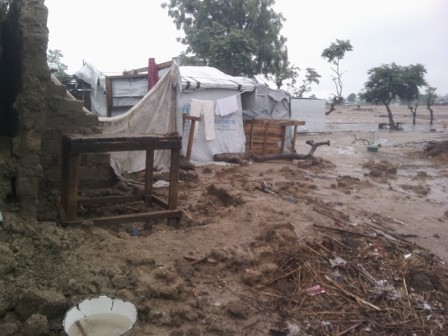
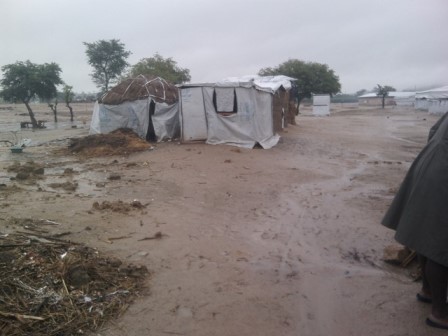
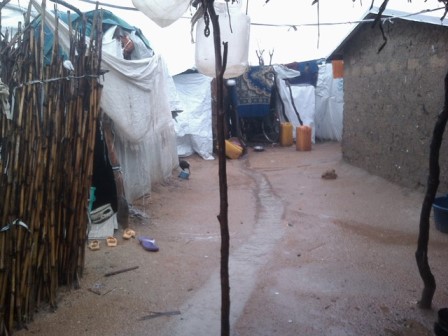
As heavy rain fell on August 28, many refugees stood under a temporary shelter barely covering their heads and upper bodies at the Minawao camp in Cameroon’s far north region.
Their legs were wet and stained as drops of water hit the ground and lifted mud onto them. They wrapped their arms around their chests to shield themselves from the peltering cold.
The new sets of refugees had arrived from North east Nigeria where a Boko Haram insurgency has wreaked havoc since 2009, and their belongings were still scattered on the muddy ground as they waited desperately to be admitted into the unfenced camp located in the bush, seven kilometres from the nearest tarred road.
It was a familiar scene to gendarmes protecting the camp and humanitarian aid workers catering for the ever growing number of Nigerians rendered helpless by the insurgency.
That insurgency has killed more than 23,000 people since it began six years ago and displaced 2.3 million others in Nigeria, Cameroun, Chad and Niger since May 2013.
In the past five months alone, 500,000 children have been uprooted, bringing the total number of minors on the run in Nigeria and neighbouring countries to over 1.4 million. Many of these children are out of school.
As the violence persists, fathers, mothers, children of all ages and families of all economic backgrounds flee from towns and villages under attacks and attempt to cross the Nigeria-Cameroon border.
Those who are successful arrive there tired, sick, hungry, thirsty and desperately looking for help.
The displaced persons first spend weeks or months in Cameroonian villages or towns along the border and then trek for several more weeks or even months to reach the Minawao camp where 96 percent of the population comes from Borno State, two percent from Adamawa State and another two per cent from elsewhere.
There at the Minawao camp, stranded in the bush of Cameroon’s far north region, and surrounded by a hostile environment with a weather that easily switches from too hot to too cold, about 45,000 refugees live in makeshift shelters, 70 kilometres from the border with Nigeria in the district of Mokolo, the department of Mayo-Tsanaga.
The refugees, most of them women and children (53 percent of the population in the camp consists of women, while 61 percent are children under the age of 18 years of age) arrive with no money, food, water or even clothes other than the ones on their backs. On arrival, it takes them many days to be screened before they are admitted into the camp and several more days to receive their first ration of food, water or medication as many arrive there sick.
They wait for many more days to receive utensils, blankets and any other basic thing from the United Nations Refugee Agency, the UNHCR, which has run the camp since 2013. Until that happens, they fend for themselves or hope that those who have been in the camp for a longer period will share from their little leftovers, if there is any.
The location of the unfenced camp makes many refugees fear possible attacks from wild animals or even from potential invaders as the camp has only one police post with about ten gendarmes protecting tens of thousands of people.
Because instability has persisted in North east Nigeria for six years and many areas had fallen into the hands of Boko Haram for a long time, the health system has nearlycollapsed and many of the refugees had been living without proper medical care for years. They arrive sick and in need of medical check ups. As newcomers flock in, the pressure on the health services at the Minawao is increasing.
In August, about 2,671 women had serious medical complications while 1,007 persons who were living with various disabilities had no wheelchairs and walking aids, hearing and vision aids, artificial limbs and surgical appliances as well as communication aids.
There were also no elastic stockings, appliances for colostomies, some types of trusses or wound dressings, urinary catheters, pressure relieving cushions and mattresses or continence pads for people with disabilities.
The main hospital in Mokolo district where the camp is located did not have equipment to cope with patients with special needs nor were there qualified medical personnel there to efficiently monitor the 269 refugees who have been suffering from mental illnesses.
There were also in the camp more than a thousand elders with various health challenges. With the rainy season, overpopulation and scarce water, there were fears of a cholera outbreak.
As at August, the camp had two health centres with not many beds and one maternity unit. It had only 2,555 toilets for all the refugees. This had some health implications, especially because each refugee has right to only 17 litres of water every day to drink, cook, wash and bath.
The Minawao camp was established in 2013 to house up to 20, 000 people escaping Boko Haram violence in North east Nigeria, but with no end to the conflict in sight, there were, as at August 18 this year, 44, 889 Nigerian refugees crowded in the camp and sharing 11,954 shelters.
A minimum of four persons were sharing each shelter, but about 5,000 refugees still lived in classrooms and community shelters, and many displaced persons remained stuck in border towns and villages with no international help.
Between January and August, more than 22,000 new refugees had already been registered, and by the end of the year, it is projected that the number of refugees in the camp may shoot up beyond 50,000 people.
And as more people troop into the Minawao camp and the surrounding bushes and classrooms, the needs of these new arrivals are growing fast but the availability of basic services such as the provision of water, sanitation, education and food is shrinking and the living conditions of refugees are worsening.
Médecins Sans Frontières, for instance, is struggling to bring in new staff to give more consultations, vaccinations and treatments.
Education is also provided in dire circumstances. The camp has two primary schools with 24 classrooms for over 6,000 (out of 11,000) children between the ages of six and 13. There are also about 2,000 students in secondary school between the ages of 14 and 17.
Cameroonian curriculum, not Nigerian, is taught as there are scarcity of good teachers who could provide education in English. Teaching equipment and learning materials such as exercise books were also missing and the number of classrooms is not enough.
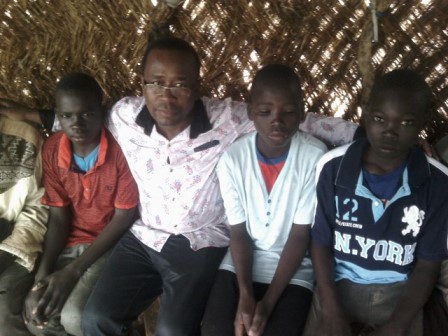
Simon Ateba and some children at the Minawao Camp
The 79 unaccompanied children who lived in the camp as at August 28 away from missing or dead parents were also a concern to humanitarian workers.
For now, the capacity of the Minawao camp has reached its limits and new needs have been created.
The fresh needs include the construction of shelters at a new camp to decongest Minawao and accommodate newcomers, the deployment of more security operatives from the current single security post, the supply of more water as well as the implementation of new measures to prevent cholera outbreak among others.
These challengers are worsened by the dilapidated road between Zamai, the nearest town, and the camp. Many trucks had broken down along the way with provisions in them and many humanitarian aid workers had been stranded and forced to turn back as they were trying to reach the camp. The road is often over flooded during rainy seasons and our correspondent had to be carried by two men to cross some parts of that road.
The increased needs, however, require enormous resources. But money is what is lacking the most, UNHCR says.
In its “2015 Refugee Response Plan” interagency report, made available on August 9, and which covered the period between 20 and 26 July 2015 , the UNHCR and partnering agencies disclosed that out of 62.7 million dollars needed to tackle the refugee crisis in Cameroon, only 29 percent of the cash has been made available.
“What is really worrisome is that despite the growing number of refugees and their needs, donors do not seem to understand the urgency,” an official said.
The investigation was cut short as Simon Ateba was arrested on 28 August and kept in a cell for three nights and day on suspicions that he was a spy for Boko Haram.

 Although datails had already been reported in the media, Senate President Bukola Saraki has announced the 21 ministerial nominees sent to the red chamber by President Muhammadu Buhari last Wednesday, after over three months of waiting.