The efforts by Senate President Bukola Saraki to avoid appearing before the Code of Conduct Tribunal, CCT, to face corruption charges was dealt a blow when the Court of Appeal on Monday refused his application to have the arrest warrant issued by the tribunal set aside.
The court told Saraki that appearing before the tribunal is not a death sentence.
The Senate President refused to appear before the CCT for his trial on Friday, prompting the tribunal to issue a bench warrant against the Senate President.
However, Saraki’s counsel, Adebayo Adelodun approached the Appeal Court to prevent the police from or other security agents from arresting him.
While striking out the application on Monday, Justice Morrie Adumein said: “By Section 15 of the Court of Appeal Act 2004 as amended, the court has the general powers to interim injunctions.
“However, by Order 7 Rule 1 of the Court of Appeal Rules for us to exercise our general powers the application shall be by way on notice. It is not in the habit of this court to interfere in the proceeding of a lower court when the other parties have not been heard.
“The end of the matter is that this application is hereby refused.”
The Code of Conduct Tribunal meanwhile has insisted on Saraki’s appearance to answer to the 13-count charge latest by Tuesday (tomorrow).
“It is in the interest of justice that this tribunal must take a position. Our position is that the accused must be compelled to appear before us.
“In this regard, we reaffirm our order on bench warrant that the Inspector General of Police or any other security agents must arrest and produce the accused in court tomorrow (Tuesday),” DanladiUmar, chairman of the tribunal said.
Children besiege the kitchen at Dalori Camp, Maiduguri
In spite of the best efforts of government, persons displaced from their homes by Boko Haram insurgency suffer hunger and other deprivations in IDP camps in the North East
By Samuel Malik
Zainab Yusuf (not real name) had just given birth at the Internally Displaced Persons, IDP, camp inside the Arabic Teachers College, ATC, in Maiduguri, Borno State capital. But the poor woman was in an embarrassing situation that nursing mothers hardly ever find themselves. She could not fulfil the first duty of motherhood which is to feed her new baby because she had no milk in her breast.
Looking at the new mother, she too looked greatly in need of a good meal. At about noon when this reporter met her, a visibly hungry looking Yusuf was yet to eat breakfast and was forced to feed on gruel, popularly known as kunu in Hausa.
For her new baby, Yusuf had to resort to feeding her with powdered milk, sold for less than N50, even though the mother knew her baby was too young for such a meal.
“I could not watch him cry because of hunger, so I had to give him the milk,” she said. By now, the little baby was fast asleep in his makeshift bed – a wrapper spread over an old mat – under a mosquito net while the mother drank from her pot of gruel under the watchful eyes of her other roommates.
At the camp, there is no facility for maternity or delivery services, so Yusuf was delivered of the baby the traditional way, helped by other women. In fact, it was gathered that the camp secretary was not even away that she had delivered a baby. So, no provisions were made for the mother or the baby.
Zainab Yusuf did not have milk in her breast to feed her baby
Yusuf and her child are not the only ones who suffer hunger in IDP camps in the Boko Haram ravaged North east. Feeding is one of the major challenges discovered in the camps as the government tried to cope with providing for an ever increasing number of displaced persons.
At all the camps visited in two states of Borno and Yobe, as a standard, displaced persons eat only twice a day, with breakfast not available before 11am. And the diet is boringly repetitive – rice mixed with oil, salt and seasoning. Occasionally, however, beans is added.
“It is rice in the morning and rice in the evening,” Umaru Yaga, a camp secretary at the ATC IDP camp, told our reporter, adding that although the people have no choice, they would prefer a more balanced diet. “The only difference is that some days there is beans in the rice, which is better.”
Monday, July 29, 2015, was one of the days when the IDPs were fortunate to enjoy the luxury of beans in their rice. According to them, that day’s food was the best they had been served for some time, not only because of the beans but also the vegetable oil used in cooking the food.
“We prefer vegetable oil because it does not taste like the palm oil they most times use, which is usually not properly fried or cooked,” one of the women said.
Despite the delay in getting breakfast, when the food eventually arrives, it is severely inadequate and sometimes does not go round. Our reporter witnessed the sharing of food at one of the women’s hostels at the ATC camp. This particular camp is made up of sub camps which take care of IDPs from different local governments. The sub camps are made up of hostels, which in turn are made up of blocks of living quarters (rooms) for the displaced persons.
Food was delivered to each block in a basin, which was then dished into smaller containers and plates belonging to members of that block. Each plate or container of food belonged to a minimum of four persons, while a small aluminium pot was said to serve 15 people.
The food in the pot was for 15 people
The woman tasked with sharing the food said the basin of food was meant for 174 people.
“This is the basin the food was brought in and it was barely full,” she said, pointing to a nearby steel container. While the food was shared, a woman from a different block came to see if she could get some food for her child. According to her, those in her block were not lucky enough to get food that morning.
“We were told that food was finished and you can hear children crying because they are hungry,” she explained. But nobody even listened to her. The food was not even enough for members of the block to which he had come to beg.
Another day, at the Dalori camp, along Bama road in Maiduguri, by 1pm when the reporter visited, they were yet to eat breakfast. A camp official, who spoke on condition of anonymity, said sometimes they eat their first meal of the day around 3.00 pm and even so, the food is hardly enough.
“Those buckets you see there are used in serving food and 12 people share a half full bucket,” the official said.
“They eat twice a day and it is always rice, sometimes mixed with beans, like today.”
A cook at the kitchen said it is very challenging to prepare food in the camp because it is difficult to have everything required in place at the same time.
“It is either there is no firewood or there is no water. When one is available, the other will be missing and that is why there is always delay in preparing the food,” she explained before breaking into laughter when asked if there was meat or fish in the food.
“We cannot remember when last we ate meat,” one of her colleagues said.
The only source of protein available to the IDPs is beans and this is usually in small quantity. Fish and meat, they said, were luxuries they could only dream of. According to them, the last time they ate meat was Eidel-Fitr, when the state governor, Kashim Shettima, gave them two cows. “Throughout Ramadan, we did not eat fish or meat,” one displaced person said.
A cook mixing food on fire at Dalori Camp
The food crisis in refugee camps, it appears, is not limited to Borno State as visits to the two IDP camps in Adamawa State, both in Yola, the capital, showed that the displaced persons are also fed daily with rice. Although the movement of people was more restrictive in the IDP camps in Yola, our reporter still managed to access the camps and observe conditions there.
Although no feeding went on during these visits, our reporter accessed the kitchen of one of the camps where he saw women cooking rice. One of the women told him that the only meal served in the camp was rice and that there had hardly ever been provisions made for meat or fish.
Camp officials accused of taking relief items out of camps at night
In Borno State, our findings revealed that NEMA delivers food items and other relief materials directly to the state government through a committee on IDPs set up by the government.
“Most items are brought directly to the state government and when they are brought, we have stores where they are taken to. And for each of the camps, the committee that is in charge under the deputy governor knows the total number of bags of food items that are required for each of the camps,” Isa Gusau, spokesperson to Governor Kashim Shettima, said.
The committee, first headed by the late deputy governor, Zannah Umar Mustapha, has the responsibility to ensure that the relief items received get to the IDPs camps based on their needs. At the camps, there are also stores where the items approved by the committee are stored, from where the IDPs are meant to get them.
According to Gusau, the committee knows the precise quantity of food needed in each camp over a period. This means that the committee members have to visit the camps and interact with the people to find out their needs.
However, the IDPs say the committee no longer goes to the camps because it (committee) did not like the way they complained.
“They say we complain a lot, so they stopped coming to the camps. We are tired of complaining,” Yaga explained.
The IDPs themselves see different relief items delivered to their camps but that is where it all ends. “We do not have access to the stores because the food items are given to us by the officials in charge of the stores,” a cook said.
Our reporter observed a truck belonging to the Borno State Emergency Management Agency, BOSEMA, offloading food items in one of the camps, including cartons of tomato paste and fish, two particular items one does not find in the IDPs food. Inside the store, there were bags of rice, sugar, cartons of vegetable oil, several jerry cans of palm oil, and cartons of noodles.
Despite these assorted food items, for the two days our reporter visited the camp, rice was the only food the people ate and when the reporter tasted it, there was just salt and seasoning in addition to the vegetable oil used in cooking it.
When confronted with this development, NEMA’s North east coordinator, Mohammed Kanar, told out reporter that his agency cannot be held responsible if these items are not given to the people, even though it is NEMA’s responsibility to supervise how the people are fed.
“We have a MoU with the Borno State government and we deliver all the food – rice, beans, maize, guinea corn. We do our part 100 per cent. So, it is their duty to deliver the food (to the IDPs),” he said.
Kanar added that fish is delivered on a monthly basis to the camps and wondered why the IDPs are not getting it. “I am sure there must be some problem somewhere but I do not know exactly. Every month we give them 900 cartons of fish. We have delivered 900 for last month (July) and as I speak to you we are sorting another 900 cartons to be delivered.”
A volunteer in a camp in Borno State told the www.icirnigeria.org in confidence that those in charge of the stores should be held responsible because they connive with other camp officials to gradually move these items out of the camps.
“They do not take the items out in large quantities so as not to raise suspicion. What happens is that when someone is leaving the camp at the close of work, they tell one or two of the boys in the store to put a carton of bottle water, noodles or any other item in their vehicle,” the volunteer said.
“It is not as if they pack everything in a truck and drive out of the camp in the full glare of people.”
“If the trunks of officials’ cars are inspected, especially in the evening when they are going home, you will be amazed what will be inside,” the official said before querying, “Why let the people see these items brought into the camps if you know you won’t give them?”
A government official, who did want his name mentioned, said earlier this year that he was at the BOSEMA offices and was shocked to see officials sharing items donated to the IDPs, including toys for children.
“You ought to see how they shamelessly behaved. They were so excited to get the items, including children’s toys,” the official said.
The Borno state government denies allegations of diversion.
While admitting that there are challenges, Gusau said he had never heard of diversion of relief items and said the allegations are “basically assumptions.”
In another twist, Gusau said someone once brought to his attention a list of alleged beneficiaries of diverted food items but after investigations it was discovered that most of the suspects were people that the governor said food items should be given to them because they had displaced persons staying with them.
But Gusau admitted that the committee on IDPs was constituted following the reports of spies who uncovered aberrations perpetrated in the camps when they were sent by the governor.
“The governor constituted a team of spies made up of some senior special assistants and assigned to them what we call special duties. One of these duties was to spy on certain things and give him certain information. So, I think there was a time some of these special assistants brought a certain report to him about developments in one of the camps and then the governor sent some people to other camps and I think about four camps were discovered to have this problem and that was why the governor reconstituted the committee and brought the deputy governor to supervise it,” he explained.
But the Borno State governor himself gave an indication that he had received reports of diversion of materials meant to IDPs on Wednesday when he threatened to sack any public officer caught diverting materials meant for IDPs.
The governor, who gave the warning in Maiduguri while swearing in 21 newly appointed commissioners and 27 local government caretaker chairmen, added that henceforth security agents, including the military, will be deployed to monitor distribution of items to the IDPs and report back to him.
“Let me warn all of you, I will not even think twice in removing any chairman and commissioner found wanting in the discharge of his duties. If anybody, be it a commissioner, local government chairman or member of the state House of Assembly or any government official tampers with foodstuff meant for the poor, he will incur the full wrath of the law,” Shettima said.
In Yola, Turai Kadir, project coordinator for Centre for Women and Adolescent Empowerment, CWAE, said a guard told her camp officials take items from the IDPs camps at night. “He (the guard) told me that people running the camps take these things at night.”
One of the security agents at one of the camps, who spoke on condition of anonymity, told the www.icirnigeria.org that many officials leave the camp at night and that their vehicles are never searched. This is in spite of the fact that closing time for camp officials is 5.00 pm.
“We do not see any need to check their vehicles because they are in charge of the camps,” the security agent said when asked if the vehicles were inspected.
Inside the Malkohi camp store, our reporter saw different bags and brands of rice and other grains, cartons of bottled water, mattresses, sanitary pads, diapers, detergents, etc. Most of these items were from companies like Dangote, Honeywell, Faro, BUA, Indomie, Vitafoam etc.
The Vitafoam mattresses, which are of superior quality, were separated from other mattresses and it was obvious that these were not given to the IDPs. Blankets were seen spread over some, indicating that camp officials lay on them. The reporter saw children bringing into the store mattresses used by the refugees deported from Cameroon, who had since returned to Borno State, and none was a Vitafoam product.
Mattresses like these are a luxury IDPs cannot afford
While our reporter was at the camp, he observed as camp officials gave out five cartons of bottled water to security agents – police and army personnel got two cartons each while the civil defence officers got one.
This confirmed what Kadir said about IDPs drinking water from the tap while empty water bottles are seen all over the camp.
“We are yet to learn how to give good services to human beings,” Kadir complained. She went on: “There are enough grains to nourish the people. They can mix corn with groundnut and soya beans to make gruel for the people in the morning, which is good for a malnourished person, but they prefer to give them jollof rice on daily basis.”
Hygiene and medical condition
One positive thing observed in many of the camps visited is the availability of portable water and toilet facilities provided by government with help from NGOs like Doctors Without Borders, though the boreholes require electricity to pump water. This is no problem, though, as fuel is provided by camp officials.
However, the sanitary condition in some of the rooms where the IDPs sleep is really bad. The whiff coming out of the rooms is so terrible that a visitor is readily discouraged from going in. Children and young girls share rooms with older women and this makes the rooms more crowded than the men’s.
In one room visited, over 50 women and children were said to sleep there. In a hall converted to a room, 300 people were said to sleep inside, including children.
A hall in the ATC camp where 300 people sleep
Women and their children also have to contend with mosquitos because of a lack of mosquito nets.
“Our major problem after food is mosquito nets for women and children and even when you have the nets, there are no places to tie them because they sleep on the floor,” Ahmadu Umaru, an IDP and a businessman, said, adding that he and his family had spent more than N50, 000 to treat malaria.
The IDPs also complain of lack of drugs at camps clinics, saying the only drugs they get is paracetamol.
“No matter you complaints, all you get is paracetamol and when we go to hospitals in the town, they ask for money,” one woman explained.
This explains why the IDPs sell relief items given to them and when they do not have items to sell, they improvise, according to Yaga, by drying the food they are served, especially when it is poorly cooked, as it is most times, sell it in the market and use the money to meet some of their needs.
NEMA is aware that IDPs sell relief items to meet some pressing needs, but the agency turns a blind eye.
“When someone does not have money, it is what they have that they use to raise some money to meet their special needs. So, sometimes they sell these things (but) we don’t mention it and when they need it, we give them again, even though we do not give room for items to be sold,” Mohammed Kanar said.
The inadequacy of clinics in the camps means some cases have to be taken to hospitals outside the camps.
When a nine years old girl, Hafsatu Adamu, was raped at the NYSC IDPs camp in July by 35 years old Dada Bakura, also a displaced person, she had to be rushed to a hospital outside the camp in spite of how late at night it was.
For other vulnerable IDPs, including children, who need specialist attention, the camps have no provision for them
There was a traumatised boy of about seven year, who camp officials said was found wandering around the camp. The boy could not speak and looked confused, refusing to associate with people.
According to the camp chairman named Khalid, the boy was taken to other camps to see if anyone recognised him but no one did, so he was returned to the NYSC camp. It is believed that the boy might have witnessed something gruesome, which affected his mind, though he is now gradually opening up.
The www.icirnigeria.org found out that no form of treatment or counselling was given to the boy.
There was also Ali Mai Gadi, an 80 year old man from Gwoza, who our reporter found in a very bad state. He was so weak that he found it difficult to sit straight at the ATC camp. Having survived 18 months with Boko Haram members, who invaded his village in Gwoza, Ali has seen it all. He depends on a little boy to bring him food daily at the camp and when the boy is unavailable, he either stays hungry or feeds on anything he can find, including food from several days before.
Ali, the 81 year old IDP
When the reporter met him, he had not eaten for almost a day because he could not find the little boy. By his side was a half – cut jerry can with rice inside, food from the previous day, which was left uncovered with flies all over it. Merely looking at it, the reporter nearly vomited.
“This is the food I will eat today,” the old man said.
His present situation, he said, reminded him of his time with the dreaded sect, when he had to rely on his grandniece, who was married to one of them, for food.
“They said they would not give me food but I told them I could not care less because there was no difference between being dead and alive in that condition, having lost everything. I told them they could kill me if they chose to,” he explained.
When the military liberated Gwoza and rescued Ali, he had a really good time because the soldiers took care of him for 17 days before he was brought to the camp.
“They gave me food, water and four injections but after 17 days they got tired of taking care of me because of their movement, so I was brought here,” he said, adding that since coming to the camp, he had neither been given medical attention nor any form of counselling.
Pretence by government officials
According to the Borno State coordinator of Women in the New Nigeria and Youth Empowerment Initiative, WINN, Lucy Yunana, the only time the IDPs get a good treat is when a dignitary visits because officials do everything possible to prevent the dignitary from seeing the real condition of the people.
“Once a dignitary is scheduled to visit, you see how they put everything in order but immediately the visit is over, it is back to the status quo,” she told our reporter after donating clothes and other non-food items to some nursing mothers at the ATC camp.
Few days after Vice President Yemi Osinbajo visited displaced persons camps in Maiduguri, pictures emerged from the camps showing the poor food given to the people and this prompted a pro-democracy campaigner and social media activist, Kayode Ogundamisi, to write an open letter on behalf of some whistle blowers in the camps, who felt the Vice President was not told the truth.
“The food provided is sadly insufficient and does not meet the requirements for proper growth and development of young children or the sustenance of adults,” Ogundamisi said in the letter.
The Vice President responded by assuring that the federal government was determined to solve the problem. “President Muhammadu Buhari is deeply concerned about the IDPs and the living conditions in their camps,” Laolu Akande, spokesperson to the Vice President, said, adding, “Restoring the dignity and material wellbeing of these citizens is a key objective of the Buhari presidency.”
Local NGOs worried while journalists are denied free access
Locally based nongovernmental organisations have continued to raise concern about the poor feeding and hygiene of IDPs and the nonchalance displayed by officials.
Thus, when the NGOs take items to the camps, rather than allow them to be taken to the stores, they prefer to distribute them directly to the displaced persons.
“Why should the items be taken to the store when the people they are meant for need them?” Kadir said, adding that her organisation gives items directly to displaced persons in Yola.
In Maiduguri, Fatima Kyari, whose organisation, Likeminds Project, focuses on providing relief materials to displaced persons in the host communities, said when she heard of the plight of the IDPs in camps, she had to break tradition to bring items to them.
“Our focus is the host communities but when I heard about what the IDPs go through in the camps, I had to personally come to make sure we bring relief materials to them,” Kyari said while monitoring the distribution of flip-flops and blankets to children at the Dalori camp, which reportedly contains 17, 000 IDPs. “Yesterday we donated food items given to us by Dangote Foundation to 2, 000 households.”
Journalists are finding it increasingly difficult to get access to the IDPs camps because officials are determined to ensure that whatever happens in the camps does not get out.
In Maiduguri, journalists are not allowed to enter the camps unless they have “full authorization”.
Recently, the Buhari Support Organisation in Borno state described as “unfortunate” the banning of journalists from the camps when it donated non-food items to IDPs. The group had taken with it some journalists when it donated items in some of the camps but the journalists had to wait outside while members of the group went in.
Speaking to the journalists after the donation, the group expressed its surprise to realise that the displaced persons’ problems go beyond non-food items.
“We brought these cartons of soaps, detergents and pomades to the IDPs because we have been receiving complaints on poor hygiene in the camps, but when we got here we found out that there is even serious problems in the form of poor feeding of the IDPs,” Muhammed Nuhu Idris, BOS director of finance, said.
“Most of them lamented barely eating once in a day. Many said they were being denied freedom to move out to the town to seek for means of sustenance.”
In Yola, journalists are not allowed free movement in the camps without at least one NEMA official accompanying them and they are prevented from taking pictures or privately speaking to IDPs. There was surprisingly a military officer of the rank of lieutenant, who was said to be the head of security at the NYSC camp in Yola, unlike other camps visited.
According to Kadir, the IDPs should take it upon themselves to ensure that items are not taken out of the camps by officials. “They are sometimes at fault. Why can’t they close the gates and prevent these people from taking their materials out?” she queried.
But Yunana believes the only way out is for visits by top government officials and others to be made unannounced as that would catch officials off-guard.
“When they are coming they should not let the camp officials know. From the airport, they should proceed straight to the camps and see for themselves how the people live,” she said.
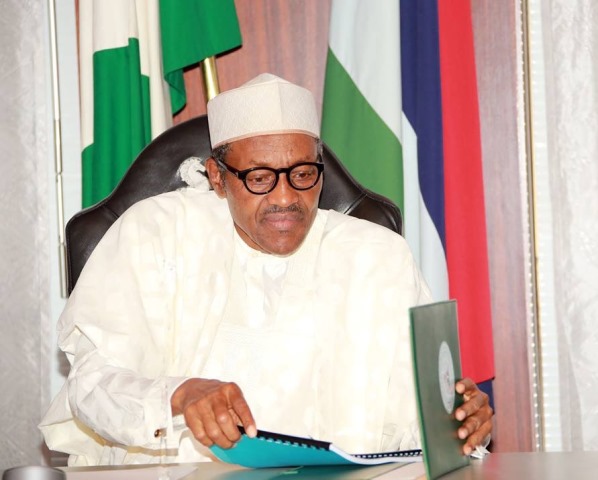
President Muhammadu Buhari and Senate President Bukola Saraki praying together
The presidency has denied insinuations that President Muhammadu Buhari is behind Senate President Bukola Saraki’s trial at the Code of Conduct Tribunal over allegations of corruption, even as it advised him to hire a good lawyer to defend himself.
The Senate President is standing trial on a 13-count charge bordering on anticipatory declaration of assets, false declaration, acquisition of property above his financial capacity as a public officer, among others, to the tune of more than N2 billion.
Saraki is challenging his trial by the CCT, which on Friday issued an arrest warrant against him, terming the case a political witch-hunt, with fingers pointing at President Buhari ostensibly as a result of the cold war existing between the two over how the former emerged as Senate President.
However, the Senior Special Assistant to the President on Media and Publicity, Garba Shehu, on Sunday issued a statement absorbing the President of any role in the trial, calling it a judicial process and advising anyone dissatisfied to follow the same process.
“As an independent institution equal to any superior court of record, the tribunal is set up by the constitution to determine the issue of default, false declaration or forgery in assets declaration. This therefore is purely a judicial process and has nothing to do with the presidency,” the statement read.
“If anyone has an axe to grind with what they are doing, they should do it in a judicial manner by challenging those actions in a proper court of law. Let them hire a good team of lawyers to prove their innocence,” shehu stated further in the statement.
The presidency reiterated that the war on corruption has no sacred cows, adding that there is nothing the President can, even do if he wants to help, as he is determined not to violate his oath to protect the constitution.
For Ogoni people and human rights activists in Nigeria, August 2015 has earned itself a pride of place in Nigeria’s environmental dateline as a month of action. This is the month President Muhammadu Buhari approved several actions to fast-track the long delayed implementation of the United Nations Environmental Programme, UNEP, Report on the environmental restoration of Ogoniland.
Revisiting the UNEP report has yet again put the suffering and struggle of Ogoni people on the front burner of public discourse, twenty years after the brutal hanging of Kenule “Ken” Beeson Saro Wiwa (Ken Saro-Wiwa) and the “Ogoni 8” by the Sani Abacha military regime.
The name Ken Saro Wiwa is almost one and same with Ogoniland and its people; a minority group in Nigeria’s Niger Delta which has repeatedly experienced human rights violations since commercially viable oil field was discovered on their land by Royal Dutch/Shell Petroleum Development Company (SPDC) in 1958.
As is the case with highly oppressive conditions, the Ogoni story has been one of woes amid plenty; the story of a people ruthlessly exploited and denied their right to peaceful and healthy existence. The Ogoni struggle and Ken Saro Wiwa’s part in it is a clear representation of how power imbalance affects society’s helpless and creates unfair suffering for people with no voice.
The history of exploration and drilling of crude oil in Ogoni is all about human rights violations. Activities of oil multinationals in Ogoniland have only produced extreme environmental degradation from decades of indiscriminate petroleum waste dumping – a clear denial of the rights of natives to live in freedom and safety.
August 2015 is doubly special as the month Rivers State government took steps to immortalize the man who lived and died an environmental activist, writer, spokesperson and president of the Movement for the Survival of the Ogoni People (MOSOP). In his non-violent campaign against environmental degradation of Ogoni land and waters by the operations of oil multinationals, Ken-saro Wiwa was an outspoken critic of government institutions seen to be perpetrating human rights abuses.
Though Ken Saro Wiwa was hanged on 10th November 1995 over trumped up charges of allegedly masterminding the gruesome murder of Ogoni chiefs at a pro-government meeting, history continues to hold him up as the voice of Ogoni voiceless, a man who lived all his life fighting a cause he believed in and eventually died for.
In recognition of his selfless service to his people, Rivers State House of Assembly recently passed a bill renaming Rivers State Polytechnic, Bori after the late environmentalist. Record has it that while the honourable lawmakers were debating the Executive Bill sent by Governor Nyesom Wike for the amendment of Section 1, Sub-section (1) of the Rivers State Polytechnic Law, No 2, 1989 to reflect the change in name, they unanimously agreed that Ken Saro Wiwa’s service to old Rivers State as Education Commissioner helped improve the state education system and encourage non-violent struggles for the emancipation of the entire Niger Delta. Everyone who knows or has read about Ken Saro Wiwa and his passion for education would understand the need to name a tertiary institution after this literary giant and great activist.
The renaming of Rivers State Polytechnic, Bori after Ken Saro-Wiwa is indeed very significant as Bori serves as the birth town of the activist and traditional headquarters of Ogoni ethnic nationality.
Many would wonder why so much energy should be dissipated rehashing the Ogoni struggle especially now when government appears to be taking serious actions towards ameliorating the plight of Saro Wiwa’s people.
With recent activities around Ken Saro-Wiwa’s Ogoni struggle, timing may be right to open up discussions on a serious human rights issue within Nigeria’s tertiary education system that Saro Wiwa would have fought against had his life not be prematurely snuffed out.
Perhaps for helpless parents in Nigeria who may not have the wherewithal to embark on oversea tertiary training for their children, Ken Saro – Wiwa’s memory may once again draw government attention to certain happenings in some of our tertiary institutions that are gradually eroding the dignity or self-worth of Nigerian youths and disempowering them.
With the renaming of Rivers State Polytechnic Bori after Ken Saro-Wiwa, there is an urgent need to for the Institution’s governing body to address the oppressive and psychologically dis-empowering treatment female students suffer in the hands of male lecturers. A close friend and lecturer in one of the federal universities recently shared harrowing stories from her niece, of how female students of this citadel of learning are sexually harassed, recklessly molested and made to engage in transactional sex with lecturers in order to earn marks, pass courses or graduate from school.
The stories which initially sounded like something out of a Nigerian home movie were eventually confirmed when my friend interviewed several other students who were friends of her niece from the Polytechnic.
These stories become more discomforting when facts available reveal that most of the students who suffer victimization in the hands of these lecturers are children of poor voiceless parents whose families had to scrimp, save and beg in order to give their children good education. Students are not only denied the right to reject such unfair sexual advances but are stripped of their human dignity by same people who should be seen protecting and promoting such rights.
Opportunities for complaints over lecturer’s misconduct are virtually non-existent and where they exist, they make no room for victim protection or confidentiality. Rejection of such sexual advances adds up to more years of failure, frustration and humiliation for students.
As heart rending as the stories from Bori Polytechnic are, they are not peculiar to that institution alone as most institutions of higher learning in this country have same negative trend of sexual harassment and pressure on students to engage in transactional sex in order to pass exams. The plague has eaten deep into our educational system that even male students sometimes face same dilemma from some of their female lecturers.
One wonders at this point whether institutions of higher learning in Nigeria are not regulated in any way and if they are regulated, what falls under the regulatory radar of relevant authorities. Most Nigerian parents will definitely be interested to know how our children and wards can be shielded from the philandering clutches of some lecturers who by their conduct are not only destroying the excellent work so many of their colleagues are doing but also have no business training the nation’s future leaders.
So many of our tertiary institutions are named after Nigerian citizens who have distinguished themselves through their selfless service to the country, question to ask is how many of such institutions actually hold up the qualities of the personality whose names they bear? How many have structures that could be termed ‘safe’ enough to encourage our wards speak out against sexual harassment from their teachers and not suffer victimization from the system?
The wind of change is still blowing across government institutions; Change in government in Rivers State is already blowing good tidings into Ogoni land with the renaming of the State Polytechnic. Perhaps re-naming this citadel of learning after an Ogoni son and one of Nigeria’s foremost human rights icons is providential. Late Ken Saro Wiwa fought for the rights of the oppressed all his life. He left a legacy that speaks on need to protect the dignity of all human beings especially the vulnerable among us.
An institution that is honoured with Saro-Wiwa’s name has the social responsibility of ensuring that nothing Saro-Wiwa stood against takes root within its walls. Indeed, no person (student or lecturer), in any of Nigeria’s tertiary institutions should have their dignity or freedom compromised.
Perhaps the time has come for the Institution’s governing boards, regulatory agency and Government to take a close look at this plague that is softly eating up our tertiary institutions.
It took twenty years to immortalize Saro-Wiwa, it is my earnest hope that it will not take that length of time also for Nigerian government to focus some attention on plagues that encourage our children to graduate half baked or take up prostitution at an early age.
Nkechi Odinukwe, a lawyer and gender activist, works with Solidarity Center AFL-CIO in Abuja. Email: nkyodinukwe@gmail.com
As troops intensify efforts to clear liberated communities of pockets of Boko Haram members, they continue to rescue victims abducted by the terrorists. This time, however, among the rescued were two sorry looking children desperately in need of medical help as a result of malnourishment and an older man, Bulama Bukar, whose right hand was cut off by the group about a year ago in Sambisa forest for stealing food for his family.
Bukar’s right hand was cut off by Boko Haram for stealing food for his hungry family
In a related development, another batch of eight members of the Boko Haram sect have reportedly handed themselves over to the Nigerian military and are currently being questioned.
The rescued people are being taken care of by the military pending their handover to the National Emergency Management Agency, NEMA.
According to a statement issued by army spokesperson, Sani Usman, troops captured Jerre and Dipchari villages and cleared camps occupied by the insurgents.
“The advancing troops in the Bama axis have rescued yet another 62 people fleeing from Bitti and Pulka. The troops are also combing all known enclaves of the terrorists within Bama, Banki and Pulka general area. In addition, due to the offensive action of the military, another fleeing 22 women, 15 men and 40 children arrived Bama today,” the statement said, adding that the victims are providing useful information to the soldiers.
The eight Boko Haram members surrendered to troops from 21 Brigade Nigerian Army and are being processed for more information, Usman said.
The army spokesman also disclosed that engineers from the Nigerian Army are almost done with the construction of the bridge linking Maiduguri and Gamboru Ngala which was blown by the insurgents.
A team of Army engineers working on the bridge linking Maiduguri and Gamboru Ngala destroyed by Boko Haram insurgents
Borno state government said public schools in the state capital, Maiduguri, will reopen in October after about two years of being closed as a result of the security challenges caused by Boko Haram insurgency, particularly the abduction of Chibok Girls.
Governor Kashim Shettima made this know on Friday in Maiduguri while receiving a report from the committee set up in August to work out ways for the reopening of the schools.
“Our decision to set up the committee was largely informed by the need to radically reinvigorate the sector with a view to making it a formidable model of excellence worthy of emulation,” the governor said.
Chairman of the committee, Gambo Gubio, while presenting the report said upon its inauguration on August 26, the committee immediately swung into action by visiting and assessing the schools occupied by internally displaced persons, IDPs, adding that 15 of the 142 public schools in the state capital are occupied by IDPs.
Gubio added that there is need for nine new schools with 78 classrooms to be built, with the distribution of students to existing schools discussed.
The committee tasked with ensuring that students return to school within a fortnight will be headed by the commissioner for education, Musa Inuwa Kubo, while other members include the commissioner for higher education, Usman Jaha; executive chairman of the State Universal Basic Education Board, Shettima Kullima; chairman of the state Teachers Service Board, Suleiman Bello; the state chairman of Nigerian Union of Teachers, NUT, Justus Zare and representatives of the Commander of the 7 Division Nigerian Army, the state police commissioner, the state director of Department State Security, DSS.
Among other responsibilities the committee is to implement the report of the earlier committee, ensure the peaceful and orderly relocation of IDPs, and unfailingly reopen the schools not later than the first week of October 2015.
The chairman of the Code of Conduct Tribunal, CCT, Danladi Umar, has ordered that Senate President Bukola Saraki be arrested and made available for the next sitting of his trial on corruption charges.
Saraki is facing 13 count charges filed by the office of the Attorney General of the Federation regarding anticipatory declaration of assets, acquisition of properties above his means as a public officer, false declaration of assets, among others.
At the beginning of his trial on Friday, the Senate President failed to appear, prompting counsel to the federal government, M.S. Hassan, to ask the Tribunal to issue a bench warrant for his arrest.
Despite the objection to the application by Saraki’s counsel, Joseph Daudu, the tribunal chairman acceded to the prosecution’s request and ordered the Inspector General of Police to arrest, detain and make the Senate President available at its next sitting on Monday, October 21, 2015, when the hearing proper is expected to begin.
Saraki’s spokesperson, Yusuf Olaniyonu, declined commenting on the matter and directed our reporter to speak with his principal’s lawyer who was still in court.
Burkina Faso interim President, Michel Kafando, was detained by the country’s military following a coup. Photo: afrika.no
Burkina Faso’s interim President, Michel Kafando, has been freed following his detention by the military, which took over power in the West African country on Wednesday night.
Reuters quoted the head of the junta, Gilbert Diendere, a General, as saying on state television that the President is in hale and hearty.
“I confirm that President Kafando has been freed. He is in good health,” Diendere, a former chief of staff to ex-dictator, Blaise Compore, said.
He, however, added that the interim Prime Minister, Yacouba Isaac Zida, has been placed under house arrest.
Burkina Faso was due to hold elections in October, following the ouster of Compaore in 2014 when widespread protests led to his fleeing the country for Ivory Coast, where he has since lived in exile, after 27 years repressive rule.
But the elite presidential guard cut short the transition when it placed under arrest key members of the interim government on Wednesday before announcing the following day that it was taking over the government.
Nigerians waited for so long to get the public declaration of assets of President Muhammadu Buhari and when it came two weeks ago via a press statement by Garba Shehu, his Senior Special Assistant on Media & Publicity, it left much to be desired.
If President Buhari made a false start by not declaring his assets publicly the day he was sworn in on May 29, 2015, he double-faulted with his “public” declaration two weeks ago. For a regime that came to power promoting probity and accountability, I think President Buhari and his handlers did a disservice to open government.
The statement by the presidency on the assets of President Muhammadu Buhari and Vice President Yemi Osinbajo, as declared to the Code of Conduct Bureau, was long on sophistry and short on details; what it revealed was interesting, what it failed to say essential.
According to Garba Shehu, “Documents submitted by President Muhammadu Buhari to the Code of Conduct Bureau (CCB), show that the retired General has indeed been living an austere and Spartan lifestyle, contrary to what many might expect of a former Head of State of Nigeria and one who has held a number of top government positions, such as governor, Minister of petroleum and the head of the Petroleum Development Trust Fund (PTDF).
“The documents submitted to the CCB, which officials say are still being vetted and will soon be made public, show that prior to being sworn in on May 29, President Buhari had less than N30 million to his name. He also had only one bank account, with the Union Bank. President Buhari had no foreign account, no factory and no enterprises. He also had no registered company and no oil wells. President Buhari declared however that he had shares in Berger Paints, Union Bank and Skye Bank. This is entirely unlike what one might expect from a former head of state of a country like Nigeria.
“The documents also revealed that President Buhari had a total of five homes, and two mud houses in Daura. He had two homes in Kaduna, one each in Kano, Daura and in Abuja. One of the mud houses in Daura was inherited from his late older sister, another from his late father. He borrowed money from the old Barclays Bank to build two of his homes. President Buhari also has two undeveloped plots of land, one in Kano and the other in Port Harcourt. He is still trying to trace the location of the Port Harcourt land.
“In addition to the homes in Daura, he has farms, an orchard and a ranch. The total number of his holdings in the farm includes 270 heads of cattle, 25 sheep, five horses, a variety of birds and a number of economic trees. The documents also showed that the retired General uses a number of cars, two of which he bought from his savings and the others supplied to him by the federal government in his capacity as former Head of State. The rest were donated to him by well-wishers after his jeep was damaged in a Boko Haram bomb attack on his convoy in July 2014.
“As soon as the CCB is through with the process, the documents will be released to the Nigerian public and people can see for themselves,” Garba Shehu’s statement concluded.
I sympathize with Garba Shehu. For a man who promised so much and from whom much is expected President Buahri needed to be painted in the brightest of colours using his “modest” asset declaration. It does appear, however, that Garba Shehu wants his statement to be the end of discussion on this issue even though he says the asset will be made public “as soon as the CCB is through with the process.”
And he may have succeeded. Or how else can one explain the hysteria that gripped not just the media, but civil society so-called, that was in the forefront of the quest for the president to honour his campaign promise?
Here are the matters arising from President Buhari’s “public” asset declaration debacle. If the president plans to go the whole nine yards, why tease us? We need to know the president’s liabilities, if any, the source of money, income from property, total value of his assets and those of his wife and children under 18 years, etc.
There is a danger in the Buhari model. As if taking a cue, less than 48 hours after he “publicly” declared his asset, the senator representing Kaduna Central, Shehu Sani, also “publicly” declared his asset.
Sani declared “two wives and six children, a bank balance of N22m, seven houses in Kaduna, Abuja, Niger and Katsina states, several vehicles, two uncompleted office apartments in Kaduna; N5m in shares bought in 2007, 30 books published in Nigeria, the United States and the United Kingdom with royalties; and a community journal titled Peace Magazine.”
Expectedly, the “Teflon Senate President,” Olusola Saraki, will soon make his asset “public” following the example of President Buhari.
It is understandable if President Buhari feels a bit irritated and wants to bully his way out of public asset declaration. But he should remember he brought this upon himself. Nobody forced him to commit, during his campaign, to declare his asset publicly. After all, we have seen distinguished and executive scoundrels across the country who have taken refuge in the law on this issue. It is their prerogative!
Last week, the president told journalists in Accra, Ghana, that he had declared his assets four times since 1975 and challenged journalists to investigate and dig up the records of his various declarations using the requisite law.
“I have declared my assets and all that I have four times, and you (the media) have the right to go and demand for my declaration. Instead, I am being harassed,” President Buhari was quoted as saying.
I hope President Buhari was not expecting Nigerians to clap in adulation for his quadruple asset declarations. The president was only doing what the law required of him as a public officer. If he occupies public office a 1000 times, he has to declare his assets 1000 times.
As a journalist, am more interested in the president invoking the notion of investigative journalism. For the sake of profession and country, this is one challenge the media should take seriously.
For example, it would be interesting to see what President Buhari declared at various stages of his public service vis-à-vis his latest declaration and his job and income during the same period.
Of course, the issue is not as simple as President Buhari presented it. That is why this is as much about him as it is about institutions.We know full well that if we invoke all the laws of the country, including the Constitution and the Freedom of Information Act (FoI), the CCB will not act unless it understands the body language of the president.
I don’t think anybody is seeking to “lynch” President Buhari over his asset, but what is worth doing is worth doing well. If am not mistaken, when former President Umaru Yar’Adua declared his asset publicly on June 28, 2007, a month after he was sworn in, he presented his liabilities, the value of all his assets (includinghousehold furniture) and those of his wife as well as source of money.
We must appreciate the apprehension of Nigerians. Ours is a nation desirous of real heroes and heroines, one in which existential confidence is perhaps at an all-time low, in part because of the banditry of past rulers.
During the reign of General Ibrahim Babangida, the joke was that if the dictator said “good morning” to you, you had to step out to confirm it was really morning. And former President Goodluck Jonathan was forthright enough to tell us that he did not “give a damn” about asset declaration, confirming what many – with apologies to Garba Shehu – expected of him as president of a country like Nigeria: the wholesale looting of the treasury!
The prosecuting counsel for the federal government in the trial of Senate President, Bukola Saraki, M. S. Hassan, has asked the chairman of the Code of Conduct Tribunal, CCT, Danladi Umar, to issue a bench warrant for the arrest of the Senate President for refusing to attend the trial.
Saraki is standing trial on a 13-count charge bordering on anticipatory declaration of asset, false declaration of assets, among others, to the tune of more than N2 billion from 2003 to 2012.
The Senate President was scheduled to appear at the commencement of his trial at the CCT but he failed to show up.
Saraki’s counsel, Joseph Daudu, objected to the prosecution’s application, arguing that a subsisting court case be discharged first before the CCT hearing can begin.
The Tribunal chairman has adjourned trial for two hours.