Home Blog Page 3116

Nigeria Has A Peculiar Displaced Persons Problem – Iveta Ouvry, Country Director, Mercy Corps

1
Iveta Ouvry, Country Director, Mercy Corps


Iveta Ouvry, Country Director of Mercy Corps, an international Non-Governmental Organisation, NGO, that provides assistance to Internally Displaced Persons, IDPs, in the Northeast, has worked in volatile regions like Sudan and Sri Lanka before. She observes, in this interview with Samuel Malik, that humanitarian work in Nigeria throws up many peculiar challenges.

From Mercy Corps’ experience in other countries, is there a difference in the situation in the Northeast of Nigeria?

The one thing that we have observed in Nigeria is that it is very difficult for us to get access into the areas that are under control of Boko Haram because in other places like … for example, I personally worked in Sri Lanka and also in South Sudan many years ago when there was a conflict between the South Sudanese and the North Sudanese, you always were able to access the areas controlled by the other party through negotiations. So, you always knew who to talk to and how to be able to access and provide assistance, even to the population that is out of the control of either party.

But, here with Boko Haram, nobody seems to be able to do that. For us, there is a big kind of border between the areas where we operate and access to population still controlled by Boko Haram.

Does the government not help in that regard?

It couldn’t because government is in conflict with Boko Haram. So, we can (only) access areas controlled by the government but not areas controlled by Boko Haram.

The other difference is that usually in this kind of situation, most of the internally displaced people are in camps. But here, the situation we see is that about 90 per cent of people, depending on what statistics you use, are actually in the host communities (and) it is unusual. So, it is harder to reach people if they are in host communities. It is also harder to explain that there are many IDPs and what their needs are because it is not so visible. You know, like in DRC where you had massive camps and the crisis was more visible. Here, the crisis seems to be less visible because of this situation.

The fact that IDPs survive for so long is because of support of host communities and charitable (organisations), which is really positive for Nigeria. Nigerian society is built in a way that people accept visitors, host and support them as much as they can, even though they are so poor themselves, and this is different to other crises we have worked on.

What inspired the electronic voucher system and how successful would you say it has worked in Nigeria?

The e-voucher, as you might have noticed, was successfully brought to Nigeria for humanitarian services by Mercy Corps and we find it very successful, especially because it is being replicated and used by different actors right now.

The reason behind why we decided to do it, our primary reason was mainly the focus on ensuring that beneficiaries have a choice themselves to be able to access their needs in terms of getting the food requirements. Instead of handing them pre-packaged kits saying, “This is what you should be eating,” it is more about giving them the voucher and saying, “Here is a choice and you can use it to decide what is best for you and your family.” That was our primary reason for the decision behind using the e-vouchers.

Obviously, there come also different factors such as being able to scale up. It is easier to scale up when you have electronic vouchers, especially when you have reduced access management. E-voucher is the right way to go because it allows you to manage from a distance, it allows you to scale up fast and efficiently.

The e-voucher helps us to engage the local community and market. So, it is a boost to the local economy. It also helps vendors to avoid the use of cash, which puts them at risk in the market.

We are also obviously able to monitor trends and prices in the market and that helps to avoid monopoly. It also helps to be able to adjust the voucher value based on the market prices. So, if there is inflation, we can adjust the price because we are able to monitor it.

The system was piloted in other countries like the DRC and Nepal but in Nigeria, this is the first time it was actually built into programme design, and with 4, 100 household beneficiaries, we have been talking to donors to enable us scale up the number.

Can a beneficiary ask a vendor for cash instead of food items using the voucher?

That possibility can exist in any type of programme and, to be honest, this is something that we take into consideration in our planning. The way we do it, whenever distribution happens and we do top up of the vouchers or when beneficiaries get the money into their vouchers and go to the market, we obviously have our team at the market who do the monitoring post-distribution.

A very big part of our agreements with the vendors, we have about 34 in Gombe State, is highlighting this part, that exchanging food items for money using the voucher is not allowed and food items cannot be given on credit.

We have a constant sensitisation of the vendors and have regular meetings. It is not a one-off thing, like we met you six months ago and that is it. If they are getting requests like these from beneficiaries, we expect them to report to us for solution, but so far they have not reported anything of such. We do not promote it, as it is against the rule and it is in our contract with the vendors but I think sometimes, we haven’t seen it, but based on our experience around the world, it probably happens. If we knew about it, we would take action against the offender, so feel free to report to us what you find.

However, we also recognise that we cannot control 4, 100 people and we recognise people are in desperate needs, they need to buy medicine because a child a sick and they will do whatever possible to get a little bit of money to buy the medicine. That is the reality of being an IDP.

Could the IDPs situation in the country have been managed differently, especially with allegations of diversion of relief materials by camp officials?

As you know, in Nigeria Mercy Corps does not work in the camps, even when there was this one camp in Gombe state. We made the decision to work in the host communities. So, we really are not in a position to comment on diversion of items from the camp. The only thing that we can say is that we wish there was more support for IDPs from everybody, including Mercy Corps. We would like to do more.

What is the livelihood support programme all about and how do you go about it, knowing that the IDPs are in their present locations temporarily? Do you take cognizance of the fact that they will have to relocate someday?

Our livelihood programme is an important component of the activity that we are implementing within Gombe state and basically, the purpose of it is to allow people to restore their livelihood and to gain a source of income and not be solely dependent on receiving vouchers or assistance from different sources.

So, the livelihood grant is a modality that we put in place and we basically identify beneficiaries who will fit certain criteria and based on the criteria they will be submitting business plans to us. The plans deal with how you start a business, what type of business are you going into, what is your prior experience in the business, what sort of assets are you bringing into the business, how do you ensure its sustainability, etc. So, it is a basic business plan that fits the primary needs to set up new business, not a plan for opening a company.

On that basis we have a full process of identifying beneficiaries, registering them, approving their application and then it is followed by training. The training they receive is on basic accounting, how you maintain basic accounting book to manage your finance, basic hygiene practices for people who will be undertaking activities that relate to culinary practices, and business sustainability approach. Right after that they receive their grants and we go into our post-monitoring activities to ascertain what the grants are used for. We then follow up on the business itself in three months to see where it stands vis-à-vis how much has been generated and whether there has been expansion, etc.

We take into consideration that we are targeting the IDPs who at some point will be going back home and the purpose of the grant is to provide them with a source of income to be able to restore their livelihood. So, whether they are in Gombe or going back home, they still need the income to be able to sustain their families and their lives.

When we talk about livelihood grants and businesses, they are really small business like a small catering. So the assets they get on the ground are 99 per cent movable. If one day they decide to leave because the condition is right for them to return, it is easy for them to pack and continue the businesses in their next homes.

We have already distributed 794 grants with an average sum of N20, 000 per grant. Our overall target is 3, 000 and in the coming couple of weeks, we are going to be reaching half of the remaining target.

With all these activities happening in Gombe state, are there plans to extend them to other north-eastern states?

We have plans but we do not have funding yet. We work based on donation and grants, so we have applied to donors for funding to enable us move to Adamawa state. We are going to soon conduct assessment in Maiduguri to see what Mercy Corps can do there but we need to get funding before we can actually start a programme. We believe we have capacity and experience to execute programmes but it is a question of funding.

Do you think the Gombe IDPs camp should have been closed, especially with the crisis in the northeast not over and a lot of IDPs still in the state?

Mercy Corps’ position has always been that IDPs should have a choice, you know. If they feel more comfortable in a camp setting, there should be a camp for them where they can access services but if they feel more comfortable in the host communities setting, they should be supported in the host communities.

What other programmes is Mercy Corps executing in Nigeria?

Mercy Corps has four what we call programme portfolios in Nigeria. Our first programme, which is how we came to Nigeria, was actually conflict mitigation programme in the middle-belt. So, we had four different projects that worked with host farmers and pastoralists and we are looking into the conflict between them, what the root causes of this conflict are, because it is not a religious crisis but that of resources and access to the resources.
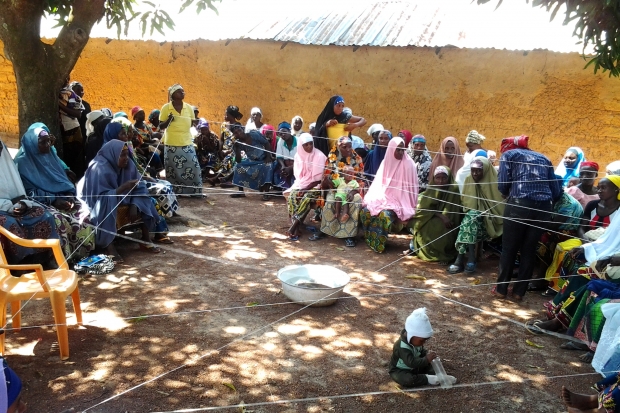
To help mitigate the conflict between farmers and pastoralists in Nigeria, Mercy Corps engages both groups in activities that help them understand one another. In this photo, women from both sides talk about their lives and learn the things they have in common — the string illustrates the connection between them. Photo: Mercy Corps

So, we are working with both sides and working on different skills like negotiation and mediation but we are also looking at specific communities and what the economic roots of conflict exist between them and helping them to address them. We do this in Benue, Nasarawa, Plateau and Kaduna states.

Our second programme is working with 6, 000 adolescent girls in Lagos in the areas of education and economic empowerment. We work with girls in secondary schools and those who have left schools for different reasons, ranging from poverty to marriage. For in-school girls, we work to improve their academic performances while also supporting them with different life skills. For the ones out of school, it is about life skills and economic opportunities. We are working very closely with Coca-Cola and Delight and we are connecting girls into the micro-franchise with these companies, if they want.

The third programme is working with vulnerable families on income generation and this we do in Kaduna, Bauchi, Sokoto and Kebbi states.

The fourth programme is the humanitarian programmes we are executing presently in the northeast.

What has the experience been like for Mercy Corps in Nigeria so far?

Mercy Corps came to Nigeria quite late, in 2012, and we came with development programmes. It is only a year ago that we started our humanitarian programme in response to what is happening in the northeast.

So far, for Mercy Corps, it has been good. We found government supportive in general, we have also found our team members here very dedicated and committed. We have also found that there is a lot of work to be done. Nigeria is not a poor country but it is a country with a lot of poverty. So, we are trying to focus on those poverty issues.


Senate Committee Walks Out EFCC Officials, As Lamorde Fails To Honour Invitation

0


Ibrahim-Lamorde00

By Tosin Omoniyi

The controversy over the alleged diversion of N1trillion recovered proceeds of crime by the Chairman, Economic and Financial Crimes Commission, EFCC, Ibrahim Lamorde, deepened on Wednesday as he failed to appear before the Senate Committee on Ethics, Privileges and Public Petition.

It was learnt that the committee walked out the delegation sent by the commission to observe proceedings at the hearing, insisting that it had not invited any of those on the team.

The committee had invited Lamorde to appear before it to defend allegations of fraud made against him by George Uboh, the chief executive of Public Alert Security Systems.

But a source at the EFCC told the www.icirnigeria.org that the EFCC chairman had sent a letter to the committee asking for another date for its chairman to appear before it, having been committed to a previous engagement.

Even then, the commission sent a team led by its director of legal and prosecution, Chile Okoroma, to observe proceedings.

While stating that the chairman was not afraid of probe, the source added that “Lamorde felt it would be foolhardy to appear before a committee he did not have confidence in and one that already had a pre-planned script it was acting upon.”

The source said that Lamorde’s misgivings about the committee had been confirmed as the EFCC delegation that was sent to observe proceedings was shocked at what it discovered at the venue of the hearing.

“The EFCC boss is vindicated by what transpired at the hearing. He earlier wrote to the committee that he would not be able to attend the hearing. But a delegation led by the head of legal of the EFCC, Chile Okoroma was there to observe. They observed several actions by the committee that showed that the EFCC boss would not have received any fair hearing if he had appeared,” the source said.

It was gathered that Okoroma had observed to the committee members that it was unfair to continue with the hearing and listen to only the petitioner even when the EFCC chairman had asked for another date for him to appear before it.

He also noted that the petitioner referred to several documents none of which had been made available to the Lamorde.

He added that Uboh in his submissions only mentioned the EFCC and not Lamorde although the hearing was designated as a personal probe of the anti-graft agency’s boss.

A member of the Senate committee, Dino Melaye, an avowed supporter of the Senate President, Bukola Saraki, reportedly shut down the observations members of the delegation and subsequently walked them out.

“The petitioner came with a lot of documents, which he was brandishing when he was making his allegations. Strangely, in the invitation sent to the EFCC boss, he was not told to bring along any document to defend himself neither was he told the kinds of documents being brought to the hearing by the petitioner to back the allegations against him so he could bring the relevant ones to counter them. It would have been ill-advised for him to appear before such a compromised committee,” the source stated.

Uboh had sent a petition to the Senate alleging that Lamorde, while he was director of operations between 2003 and 2007 and acting chairman of the anti-graft agency had diverted over N1trillion recovered from the trials of former police boss, Tafa Balogun and former governor of Bayelsa, Diepreye Alamieyeseigha.

He had accused the EFCC boss of illegally operating hidden accounts where the stolen funds were kept for unofficial purposes, which do not reflect in EFCC’s audited accounts.

He also accused Lamorde of trading with the stolen funds through bank deposits and placements; manipulating bank accounts to conceal diversion of funds; and colluding with real estate companies in order to grossly undervalue seized assets before they were eventually sold through illegal avenues.

Uboh also claimed that over half of the assets seized from convicts were not reflected in EFCC exhibit records, while over 95 per cent of EFCC’s total recoveries in foreign currencies had been diverted.

Many believe that the latest development brings to a head the confrontation between the EFCC and the Senate President, who is believed to be tacitly giving his support to the onslaught on the anti-graft agency.

For many also, the recent revelations about the petitioner give ample cause for concern.

Uboh, the petitioner, is a suspected fraudster, who is standing trial before Justice J, Aladetoyinbo of the FCT High Court on three counts of fraud involving theft of properties belonging to the Police Equipment Fund, PEF.

Uboh had been charged by the EFCC on allegations that in 2007 he illegally sold six operational vehicles, including two Hillux vans belonging to the PEF to Muha Motors through one Blessing Egbon.

Despite this revelation, it appears there is more than meets the eye going by other disconcerting revelations about Uboh.

Investigations by another website, Sahara Reporters, reveal other revelations on the petitioner’s past.

It was revealed that a United States court once convicted the petitioner and his younger sister, Doris Uboh, who is a former House of Representatives member, for credit card fraud in 1992.

The Ubohs, and 27 others, in addition, were indicted for allegedly dealing in hard drugs and varying degrees of felony.

The charges on illicit drugs were later dropped, however.

The younger Udoh was later said to have escaped to Nigeria to avoid conviction. She soon contested and won a seat in the House of Representatives.

The case went through the US courts from 1992 to 1998. Although the American authorities issued a motion to dismiss the charges in 1998, the case was re-assigned in 1999.

For critical observers also, the allegations against Lamorde also seem to be a rehash of the same set of accusations levelled against former EFCC boss, Nuhu Ribadu, who was hounded out of office, during the Umaru Musa Yar’adua administration.

It would be recalled that the former anti-graft czar was hounded out of office in 2009, not long after he was accused of embezzling the funds recovered from Alamieyeseigha and Balogun, a charge he had vehemently denied.

In addition to these allegations, Ribadu was also accused of diverting the proceeds from sale of the seized properties recovered from a convicted felon, Emmanuel Nwude, who defrauded a Brazilian national of over $242 million.

Ribadu has consistently stated that though the recovery of funds from Alamieyeseigha had been done under his dispensation, the disposal of the same funds and properties were done by his successor, Farida Waziri.

Waziri is widely believed to have been a stooge of convicted former Delta State governor, James Ibori and Saraki, two prominent governors that were investigated on fraud charges by Ribadu while he held sway as EFCC boss.

Ribadu also said through an order of forfeiture, Nwude’s properties had been given back to the rightful owners he defrauded as a form of restitution and that the disposal was handled by lawyers to the complainants and not the EFCC.

In the case of Balogun, Ribadu had said that a court order was obtained to recover the assets and the process of disposal was handled by leading estate firms in the country, adding that he did not partake in the asset disposal process.

Bukola Saraki
Bukola Saraki

Many see the current travails of the current EFCC boss as an unveiled attempt by Saraki to cut Lamorde to size for daring to launch an investigation into his affairs.

It would be recalled that the EFCC had invited Toyin Saraki, the Senate President’s wife, on July 3 to assist it in an investigation it was carrying out on some of her activities while her husband was governor.

Also invited was the daughter of former President Musa Yar’adua, Zainab.

The invitation had not gone down well with a group of lawmakers, who saw it as an affront on the person of the Senate President.

The EFCC has also reportedly sought the assistance of the London Metropolitan Police in its money laundering investigations into Saraki.

Recently, in reaction to the allegations, Lamorde denied diverting the said N1tr derived from assets recovered from corrupt officials.

He said he was also ready to face probe from any relevant government outfit. He added that for him to appear before such bodies, the invitation must follow due process.

The EFCC boss noted that ironically all the funds it recovered for the past 12 years since it was formed to fight graft in addition to the yearly funds appropriated to it by the government, was not equal to the amount of money he is being accused of embezzling.

In a statement issued by the commission’s spokesperson, Wilson Uwajuren, the EFCC chairman said its invitation to KPMG recently to audit its account was enough proof that it had nothing to hide.

“The EFCC under Lamorde did not need the prompting of anyone, when it commissioned a reputable international audit firm, KPMG to carry out comprehensive audit of exhibits and forfeited assets of the Commission from 2003 to date. The report of the audit will be made public once it is ready. Were the Commission to be jittery about its records, it would not have embarked on such audit,” the statement said.

It added that it was curious that the petition and subsequent invitation to appear before the Senate Committee, came not long after it launched a probe on the wife of the Senate President, Toyin Saraki, which was an offshoot of its investigations into alleged money laundering perpetrated by her husband while he was the governor of Kwara State.

However, Saraki on Wedenesday denied plans of planning to hound the EFCC boss over the current investigations being launched into his affairs.

Saraki, who made the denial through his media aide, Bamikole Omisore, said apart from the EFCC, the Senate was equally launching investigations into the operations of the Customs, Federal Inland Revenue Service, FIRS and the Nigeria Ports Authority, NPA.

He said none of the listed outfits was being unfairly targeted.

“To set the record straight, nobody can rightfully claim that Senator Saraki engaged the services of the petitioner or any other person for that matter. There are about four different petitions from individuals, groups and corporate organisations written against the EFCC and submitted to the Senate,” Omisore noted.

He said his principal would not be browbeaten in his legitimate move to carry out his constitutional functions.

“Senator Saraki is not the same as the Senate or National Assembly as an institution. Imputing sentiment into the legitimate working of any government institution will not augur well for our development and democratic process,” the statement said.

To add a new twist to the saga, in an advertorial on Monday, Senator Godswill Akpabio, leader of the Peoples Democratic Party, PDP, caucus in the Senate, said it was not the appropriate time to embark on the EFCC probe since previous attempts at investigating it had failed at previous plenary sessions.

Akpabio’s statement was also signed by other PDP minority principal officers.

However, in apparent reaction on Wednesday, the chairman, Senate Committee on Ethics, Privileges and Public Petitions, Senator Samuel Anyanwu, said the probe would go on as scheduled on Wednesday.

He said he would not take orders from anyone in carrying out his constitutional duties as chairman of the committee.

“This is a standing committee of the Senate. It is not only the EFCC boss that has been invited, there are other petitions and we have invited the petitioners and those that are petitioned. We are guided by the Senate Standing Rule and the 1999 Constitution to invite anybody when the matter arises,” he said.

He added that the invitation followed due process contrary to accusations made by the EFCC and was not a vendetta against the EFCC boss.

“That (allegation) is not correct. There are ways petitions can come to the Senate. A petitioner can write straight to the Senate President and the President will send it to the appropriate committee that is involved.”

He said the position of the PDP minority leaders was not a reflection of the opinion of the majority of lawmakers.

Our source at the EFCC indicated that with the latest development, it is doubtful that Lamorde would ever honour any invitation to appear before the Senate committee as he does not have confidence that it can give him a fair hearing.


Deadline Approaches For Thompson Foundation FPA Awards


Viscount Chandos, Chairman of the Thomson Foundation (2nd right) presents the Thomson Foundation Award for the Best Young Journalist from the Developing World to Maurice Oniang'o (centre), where he was joined by runners up Priyanka Dubey (right) and Andrew Ochieng (2nd left) at the FPA Media Awards 2014 at the Park Lane Hotel, London
Viscount Chandos, Chairman of the Thomson Foundation (2nd right) presents the Thomson Foundation Award for the Best Young Journalist from the Developing World to Maurice Oniang’o (centre), where he was joined by runners up Priyanka Dubey (right) and Andrew Ochieng (2nd left) at the FPA Media Awards 2014 at the Park Lane Hotel, London

You still have a few days to apply for the Thomson Foundation FPA award which closes on Friday, August 28.

The award provides an opportunity for journalists below the age of 30 to gain global recognition through its annual competition under the banner of the 2015 UK Foreign Press Association, FPA, Awards.

Contestants for the prestigious award must meet certain criteria part of which is that they must be working in countries defined as “developing”, specifically with a Gross Domestic Product, GDP, per capita of less than $20,000.

They must equally have a portfolio of three published or broadcast pieces of work produced in the 12 months preceding the deadline for submissions.

The winner will eventually be chosen from among three finalists, who will each be flown to London to spend two nights and have the privilege of attending a gala award night at the Sheraton Park Hotel on November, 24, 2015.

They will subsequently interact with a host of other potential award winners and leading figures from the world of journalism.

The overall winner, this year would be trailing the path of Maurice Oniang’o, a Kenyan reporter, who won the award last year. Oniang’o, a reporter for Media Development in Africa, MEDEVA, based in Kenya, beat over a 100 reporters last year to clinch the ultimate prize.

The stories, which won him accolades are a feature on two child soldiers who provided security for their village from Ethiopian raiders; a university student who set up a feeding program for street families and food waste in Kenya and its effect on the environment.

Completed entries for this year will go forward to be shortlisted by the staff at the Thomson Foundation, before the FPA judges decide on the three finalists. Details of the award and modalities for selection can be found at Thomson Foundation: FPA Award

Two Journalists Killed During Live Programme

0

Alison Parker

Two journalists working with WDBJ7, a US broadcast station, were killed on Wednesday morning during a live broadcast at Bridgewater Plaza in Virginia, the station has confirmed.

An attacker walked into the studio as the two were interviewing a guest, firing shots that killed the two journalists.

“It is with extreme sadness that we report WDBJ7’s Alison Parker and Adam Ward were killed in an attack this morning,” WDBJ7 announced on its Twitter handle, @WDBJ7.

The station’s general manager, Jeff Marks, described the shooting as a “terrible crime against two fine journalists… who were just doing their job.”


READ ALSO:


Marks said the motive or suspect is not known but reports emerging suggest the attack was carried out by “a disgruntled employee from the TV station.”

Alison Parker, who just turned 24, was interviewing Vicki Gardner, the executive director of the Smith Mountain Lake Chamber of Commerce when the attacker walked in and fired about six shots. Gardner was also wounded in the attack and is said to be in surgery.

The unidentified man escaped after the attack but is being pursued by the police.


5,000 Persons Liberated From Dikwa, NEMA Confirms

0

nema-logo

By Musdapha Ilo in Maiduguri

More than 5, 000 persons, mainly women, children and the elderly, have been liberated from Dikwa, the Borno town recaptured from Boko Haram insurgents by the Nigerian military, the National Emergency Management Agency, NEMA, has confirmed.

NEMA’s North east coordinator, Mohammed Kanar, disclosed in Maiduguri, Borno State capital, that the liberated persons were starved and cut off from the rest of the world by the insurgents, who forced them to depend on little food from the farms and livestock without the freedom to trade with the outside world.

“They explained that they were virtually imprisoned in their communities by insurgents who had cut off their access to the rest of the world,” Kanar told journalists, adding that the agency and state government officials, led by the Secretary to the State Government, Usman Shuwa, delivered relief items to displaced persons, who are camped in a partly destroyed government estate in the town.

Kanar said about 500 of the liberated persons, who were in critical condition, have been brought to Maiduguri and camped at the Sanda Kyarimi IDPs camp while the rest remained in Dikwa, with more relief items expected to be taken to them in the coming days.

Despite the recapture of many communities from the insurgents, there are still pockets of insurgents left with some recently ambushing the advance team of the Chief of Army Staff, Tukur Buratai, who visited troops deployed in the area.


Govt Parleys With 25 Bayelsa Communities To Tackle Pipeline Vandalism

0

oil pipellines

The National Oil Spills Detection and Response Agency, NOSDRA, on Tuesday announced that it had commenced the implementation of community-based Disaster Risk Reduction plan in 25 communities in Bayelsa.

It said the plan was principally aimed at reducing pipeline vandalism in the state.

The Director General of NOSDRA, Peter Idabor, who made this disclosure at a communal forum, through the agency’s Director, Oil Field Assessment, Musa Idris, said that the integration of oil communities in oil spill management would promote a community-driven system of environmental protection.

He said the absence of this strategic means of checking the activities of oil vandals had led to massive economic losses and adverse environmental degradation that consistently threatened the wealth and health of residents.

“This has resulted in the development of Disaster Risk Reduction, DRR plan for stakeholders’ by NOSDGRA in collaboration with UNDP to mitigate environmental problems. The pilot phase of this project was carried out between May 26 and 28, 2014, and the selected communities for the pilot scheme were the Ikarama and Kalaba communities,” Idris said.

He noted that the pilot scheme was a success adding that the project was developed by NOSDRA to collaborate with relevant stakeholders that hitherto had not been engaged in the past in its effort to curb pipeline vandalism.

“While it is true that crude oil is spilled into the environment due to equipment failure and operational negligence, pipeline vandalism by unscrupulous members of host and transit communities also contribute,” he added.

Representatives of the affected communities, the Bayelsa State government, oil giant, Agip as well as Civil Society Organizations attended the forum.

The Bayelsa Commissioner for Environment, Iniruo Wills, who represented the state, restated the resolve of the state government to reduce disasters in oilfields within the state to the barest minimum.

He noted that pipeline vandalism was inimical to the economy as the revenue loss deprives the citizens of social amenities that would have been provided by government while enriching the oil thieves.

In his remarks, traditional ruler of Oluasiri community, Iyerite Awululu regretted the total neglect of host communities and lack of social amenities in the various communities

He noted that the communities had also had to endure negative environmental impact of oil exploration and had to purchase refined products above the recommended process, a development that made illegally refined products attractive.

“Kerosene costs N200 per liter but the ones refined locally is sold for N20 in my community. For petrol from official sources, the price is between N110 and N120 but the ones refined locally sells for N15, that is why people buy,” he said.   He urged the federal government to implement the 10 percent equity proposed in the Petroleum Industry Bill, PIB, aimed at giving oil communities a stake in the oil industry.

NNPC GMD Makes Case For Petroleum Industry Bill

0

oil and gas

The Group Managing Director of the Nigerian National Petroleum Corporation, NNPC, Ibe Kachikwu, has appealed that more seriousness be given to the Petroleum Industry Bill, PIB, so that the oil and gas industry can achieve  needed transformation.

A statement issued on Tuesday by the corporation’s Group General Manager, Group Public Affairs Division, Ohi Alegbe, said the NNPC boss made the appeal while leading a special session on the proposed law at the ongoing 55th Annual General Conference of the Nigerian Bar Association in Abuja titled: Legal and Regulatory Framework of the Petroleum Industry in Nigeria: Review of existing Laws and the Petroleum Industry Bill, PIB.

Kachikwu, according to the statement, said following the recent changes in the sector and the current administration’s drive at repositioning the critical sector, the PIB’s implementation, in the light of the changes was necessary.

“PIB is a serious affair, it is an essential piece of legislation but as we all know a lot of engagement is required to address all the issues because the oil and gas environment has changed. There are issues of cost, with oil going down to $40 per barrel, the PIB cannot be the same.”

He described the bill as a crucial piece of legislation that must be approached with all the seriousness and thoroughness it deserves.

He however agreed that the bill would require more amendments to perfect it.

The PIB has been pending in the National Assembly for seven years.


West African Defence Chiefs Meet Over Boko Haram

0

Gabriel Olonisakin - CDS

The Nigeria Chief of Defence Staff, Gabriel Olonisakin, a General, has stepped up moves for the immediate deployment of the 8,700-strong Multi-National Joint Task Force, MNJTF, by meeting with his other regional counterparts in N’Djamena, the capital of Chad.

The meeting, according to Defence spokesperson, Rabe Abubakar, a Colonel, was attended by Chiefs of Defence Staff from the Lake Chad Basin Commission member countries, MNJTF Commander and other senior military delegates. The LCBC is made up of Cameroon, Chad, Niger, Nigeria and Benin Republic.

Olonisakin’s move is in line with President Muhammadu Buhari’s directive that the Boko Haram insurgency should be put to an end in three months and according to Rabe, there will be two command posts for the operation, in Nigeria and Cameroon.

“Officers seconded to the MNJTF in N’Djamena were ordered to report immediately to their post, as operation at the Force Headquarters has commenced,” Rabe said.


Power Supply To Hit 6,000 Megawatts By Year End- NERC

0
nerc

Nigerians may begin to enjoy more hours of power supply daily in the next few months as the Nigerian Electricity Regulatory Commission, NERC, chairman, Sam Amadi, on Tuesday said that it will strive to increase its current 5,000 megawatts of electricity generation to 6,000 by December.

Amadi, who made this promise at a two-day workshop organized for stakeholders in the sector, said the commission was determined to ensure that generation and transmission companies improved on their services by providing adequate power supply to Nigerians across the nation.

He said the workshop was principally aimed at brainstorming on how the increased power supply can be achieved seamlessly.

He added that the essence of the workshop was to ensure that stakeholders in the industry reinforced their technical capacity on the grid in order to accommodate more energy.

“We saw in June how generation capacity went as low as 2,000mw, but later went up to 4,700 mw. We set a bench mark of at least 5000 mw but today we are at 5,000 mw or more hoping to reach 6,000 mw before December,’’ he said.


READ ALSO:


He said that though the transmission and generation companies faced operational challenges, they could still achieve maximum success in their plans of improving power supply to the people.

Amadi identified poor budgeting, poor project management, and bad procurement strategies as some of the ills affecting the power supply management.

“For instance, if TCN proposed a budget of N50 billion but government approved N30 billion and releases only N10 billion it will stall the implementation of projects in the sector. There is nowhere in the world where projects can be completed with this type of budget provision,’’ he said.


N1 Billion Pension Fraud: The Case Against Oronsaye, Abdulrasheed Maina

1

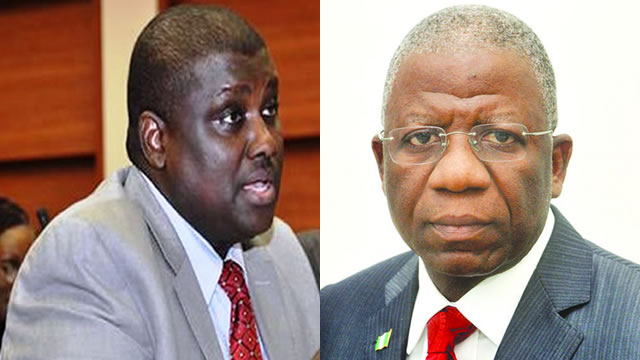
Maina and Oronsaye

The shocking details of over N1 billion fraud allegedly perpetrated by Steve Oronsaye, the former Head of Civil Service of the Federation, and Abdulrasheed Maina, former chairman of the Pension Reform Task Team and others.

By Dayo Aiyetan

In a little over a month, the sparks would start to fly in what might turn out to be the most celebrated trial of this year as the prosecution of the former Head of the Civil Service of the Federation, HOSF, Steve Oronsaye, former chairman of the Pension Reform Task Team, PRTT, Abdulrasheed Maina, and others accused of siphoning over N1 billion from pensioners’ funds, commences.

The Economic and Financial Crimes Commission, EFCC, had on July 10 slammed a 24 count charge on Oronsaye, Maina and Osarenkhole Afe, a consultant who worked with the Task Team, as well as his company, Fredrick Hamilton Global Services Limited, which was used as conduit pipe to siphon funds from the pension unit of the HOSF’s office.

Although Maina is not listed as one of the respondents in the case, his name features prominently in all the charges and he is being prosecuted along with the others.

EFCC sources told the www.icirnigeria.org that his name is not listed among the respondents because “he is at large and cannot be tried in absentia.”

Oronsaye, Maina and the others are accused of using bogus or inflated biometrics enrolment contracts, dubious “collective allowances” and other schemes to steal money from the account in which pensioners’ funds were kept.

Nearly N1 billion is believed to have been illegally taken out of the pension funds at the Pension Office of the office of the Head of Service for dubious biometric enrolment contracts while more than N100 million is believed to have been withdrawn in the name of collective allowances to staff of the pension department travelling on official duty.

Even now, investigators are still digging into the pension fund’s accounts, as it is believed that more of the stolen funds would be discovered.

Specifically, the accused persons allegedly awarded contracts for the conduct of biometrics enrolment of pensioners in several states to front companies owned by them, their aides, friends and cronies.

These companies included Fredrick Hamilton, Innovation Solutions and Projects Ltd, Xangee Technologies and Fatidek Ventures. Others are Obalando Enterprises, Jolance Integrated Concepts, Vivian Ebony Nig. Ltd, MOF Investments and Fesbee Global Resources.

In most instances, the contracts were just schemes for siphoning money as in reality, no jobs were ever carried out yet monies were paid out to front companies which then paid them back to the accused persons.

Oronsaye’s sin is that as Head of Service, he approved the payments for the bogus contracts and also allegedly benefitted from the graft as some of the stolen funds were paid to him.

In fact, the Permanent Secretary, Establishment and Record in the HOSF’s office, Charles Bonat, who supervised the Pension Office, accused Oronsaye of usurping his functions, including the signing of cheques.

Bonat, who indicted Oronsaye for setting up the Task Team without a formal letter, terms of reference or duration and for approving payments contrary to regulations, said the former Head of Service “took away my duties and responsibilities which he now assigned to the task team.

The Permanent Secretary, who has since retired, said further that Oronsaye also took from him the role of being the accounting officer of the pension accounts by making himself and others signatories to the accounts.

Others who implicated Oronsaye in the monumental fraud are Phina Ukamaka Chidi, a former deputy director at the Pension Office of the office of the Head of Service, who has also been standing trial since last year for stealing billions from pensioners’ funds, and Salami Kareem Adesokan, a former stores officer at the Customs Immigrations and Prisons Pension Office, CIPPO.

In 2011, Chidi told investigators that shortly before Oronsaye retired as the Head of Service, she was asked by her boss, the director in the Pension Office of the office of the Head of Service, Teidi Shaibu, who is also being prosecuted for pension fraud, to source for companies to be used to siphon funds for Oronsaye using bogus contracts.

The plan, she said, was to award bogus contracts to such companies which would later return the contract sums to Oronsaye.

“I was asked by Dr Shaibu to source for company names to execute some contracts the proceeds of which should be given to Mr. Oronsaye as the Head of Service then. The proceeds had been given to Oronsaye,” Chidi claimed in her statement to the EFCC on January 1, 2011.

“When the money came in from the contract from Olanipekun, he used to give to Ikenna in Zenith and Benni in UBA for safe custody before they were given to Dr Shaibu to give the former HOS Mr. Oronsaye,” Chidi revealed.

She added that such bogus contracts were thus awarded to about 60 companies for sums ranging from N4 million to N15 milion.

In his own statement to investigators, Adesokan alleged that he was also used to siphon money from pension accounts as he was asked to seek for companies to be used to receive monies for contracts that were never awarded or executed.

Adesokan used three companies, Fatidek Ventures, Obalando Enterprises and Jolance Integrated Concepts, and the 3 firms received a total N147, 019,800 for non-existent contracts. In his statement, he claimed that he was instructed by Maina to withdraw the money and give it to Maina’s secretary, Anne Igwe, who later delivered it to her boss.

However, Adesokan also claimed that each time he withdrew money and handed over to Igwe for delivery to Maina, he had noticed that the money was usually moved to Oronsaye’s vehicle at the car park of the office of the Head of Service.

“When the money were collected and handed over to Anne Igwe, Maina’s secretary, I used to noticed the onward movement of these money again to Oronsaye, the then Head of Civil Service of the Federation, through his then Special Assistant in person of Ayo Otepola and Oronsaye’s driver,” he said.

He added that he was able to notice such movements of cash because “during 6.30 pm to 8 pm because this time I used to be in the mosque by this time and the mosque was such located that you will see anybody entering Block D of the Phase 11 of the federal secretariat.”

“I normally see the handling and movement of bags popularly known as Ghana Must Go,” he further stated.

However, the case against Oronsaye peters into insignificance compared to the accusations against Maina, who was appointed by Oransaye in 2010 to reform the pension administration at the office of the Head of Service.

As chairman of the Pension Reform Task Team, Maina had unearthed the monumental looting of funds from the pension funds and blown the whistle on the likes of Shaibu and Chidi, which led to their prosecution.

Now, Maina is accused of doing exactly as the people he exposed by looting close to a billion naira from money meant for the payment of pensioners.

Several of those who were part of the scheme orchestrated to steal the money have already confessed their role and all pointed at Maina as the architect of the monumental fraud.

The first scheme allegedly employed by Maina was the biometric enrolment of pensioners across the states, which he demanded for in order to sift out fake pensioners. But in most cases, it was alleged, no biometric exercise was conducted, instead contracts were awarded and the monies routed back to Maina.

The first biometric contract that got Maina and Oronsaye into trouble was awarded in June 2010 to Innovative Solutions, a company introduced to the office of the Head of Service by Afe, a respondent in the case. The contract was worth N63, 375,000 (sixty three million, three hundred and seventy five thousand naira).

Although many things were wrong with the process of bidding for this contract, Oronsaye approved it and the contract sum was paid to the contractor. It was later discovered that the said job was carried out at the sum of N35 million by Uptrach Communications Limited and not Innovative Solutions.

The chief executive officer of Innovative Solutions confessed under interrogation that Uptrach Communications did the job for N35 million and that it was Afe who instructed him to work with the company and Fredrick Hamilton, which he (Afe) owns.

Afe told investigators that the remaining N28 million was split between Maina, Otepola (Oronsaye’s Special Assistant), another director in the office of the Head of Service, Karamot Lawal and himself.

But that is just the tip of the iceberg for what would later become a looting spree. After the initial biometric enrolment exercise, Innovative Solutions requested for an extension of the exercise and therefore demanded for the payment of extra N136 million. Afe later confessed that he was instructed by Maina to ask the company to seek for the extension of the exercise for that amount, bringing the total cost of the biometric enrolment contract to N199 million.

However, investigators discovered that the second contract for N136 was never awarded but was a scheme to siphon money. Moreover, rather than being paid a total of N199, Innovative Solutions ended up being paid N224 million, with an excess of N25 million. In all, the company fraudulently received a total of N161.4 million.

According to Afe, the scheme to illegally pay N161.4 million to Innovative Solutions was orchestrated by Maina who also ended up being the sole beneficiary of that monumental fraud.

According to statements made by Afe, Innovative Solutions paid his own company, Fredrick Hamilton, a total of N155, 147,000 from the N161.4 million it received.

“After the exercise, Innovative Solutions Limited transferred the sum of 155.147 million to my Fredrick Hamilton account. I handed these funds over to Mr Maina.

“I wrote blank cheques to disburse the funds in the presence of my Oceanic Bank account officer (name withheld) on 8 July 2010,” he further stated.

Apart from this, Fredrick Hamilton also got paid another N119 million ostensibly for executing a biometric enrolment contract. Yet, there is no existing documentation regarding this contract for which payment was made.

However, in his statement, Afe, the owner of the company claimed that N35 million of the amount was payment for his project management consultancy job and that the balance was paid entirely in cash to Maina.

“The difference made here was at the instruction of Mr Maina and the funds were given to him in cash at my bank, Oceanic Bank, NAOWA Complex branch, Abuja,” Afe said.

However, investigators believe Afe lied about earning N35 million since no such contract was ever awarded, insisting that the entire N119 million was deliberately illegally siphoned.

In all, it was discovered that Afe’s company, Fredrick Hamilton had illegally received payments totalling N280.05 million. In his statement to the EFCC, he claimed that he paid over N250 million to Maina.

The EFCC also alleges that Maina used other people and companies to siphon funds from the pension accounts of the Pension Office at the Head of Service.

One of the persons Maina allegedly used was Adesokan, who worked with him while he was director of CIIPO.

Adesokan used his company, Fatidek Ventures, to obtain bogus biometric enrolment and file jacket supply contracts totalling more than N30 million from the Head of Service’s Pension Office. But it was a ruse. There was no contract at all.

Adesokan confessed under interrogation that the N30, 056,000 obtained by Fatidek Ventures for the bogus supply contract was paid to Igwe, Maina’s secretary.

Adesokan also confessed using other companies to obtain other bogus contracts from the Pension Office.

According to him, these include, Jolance Integrated Concepts and Obalando, both owned by his friends.

“Jolance was awarded feeding contract to the tune of N20,000,000 but actually the company was not the one that provided feeding during the exercise,” he stated.

He further stated that the N20 million was also handed over to Anne Igwe as verbally directed by Abdulrasheed Maina.

Obalando, the other company used by Adesokan got three bogus biometric enrolment contracts for N52,600,000, N9,925,400 and N32,240,000, all totalling N96,765,400. The entire sum, Adesokan said he was instructed to withdraw and hand over to Igwe by Maina, which he did.

Another civil servant used in siphoning money from pension accounts at the office of the Head of Service was Bonat’s secretary, Kate Chinwe Obiekwe, who was personally paid N56 million in the name of collective allowance and biometric enrolment. She claimed that most of the money was withdrawn by her and paid to the secretary of the Task Team, Ibrahim Abdulkareem, whom she said in turn handed it over to Igwe, Maina’s secretary.

Obiekwe added that Abdulkareem also asked her to provide her company’s account details to receive payments for biometric enrolment contracts. She provided her company, Vivian Ebony’s account details, and the company got N16, 786,000 but Obiekwe claimed that she also withdrew and handed over the money to Abdulkareem. For her services, she claimed to have been paid the sum of N50, 000. Other than payments for biometric enrolment, another avenue that was allegedly used by Maina to siphon money from the pension funds was what was known as collective allowance.

These are allowances due to civil servants on official assignment outside Abuja with the voucher raised in one person’s name. It is alleged that names of staff of the Pension Office were drawn up as due for collective allowance for which monies running into several millions of naira were illegally paid out. But in truth, no official ever travelled rather it was a scheme designed to siphon money from the pension funds.

The names of several officials of the Task Team headed by Maina and other civil servants in the office of the Head of Service were used to siphon money this way.

Part of the N50 million paid to Obiekwe was received as collective allowance. In all, she must have received about N15 million into her personal account. She confessed that the money was not used for paying collective allowance to officials on duty outside Abuja rather was expended on such things as purchasing “office consumables,” “running the office”, helping staff and old pensioners return back home after coming to Abuja to pursue their pension and so on.

Abdulkareem was also discovered to have received a total of N80 million as collective allowance from the pension funds, while another staff of the Pension Reform Task Team, Mohammed Abdullahi, also allegedly collected more than N20 million for the same purpose.

When EFCC investigators confronted him with the allegations against him, Oronsaye denied all of them. First, he said that he was not the accounting officer of the pension office, insisting that Bonat held that responsibility.

Oronsaye also denied knowledge of about N500 million and another $2 million being held in trust for him as alleged by Chidi.

“I am told that $2 million and about N500 million are being held in trust for me by Mrs Chidi to be delivered to me at a later date. This is news to me. I could never be part of this,” Oronsaye stated, adding that he had never collected any money from her.

Regarding the illegal payment of N224 million to Innovative Solutions for a N63 million contract, the former Head of Service said that he was advised on the importance of the biometric exercise by Afe, adding that the contract went through the tenders board, although he could not recollect if it was advertised as required by procurement laws.

Oronsaye denied knowledge of the N136 million contract for the extension of the biometric exercise and the other contract for the sum of N119 paid to Fredrick Hamilton, Afe’s company.

In Maina’s case, our reporter was able to reach him through his cell phone at his base in Dubai, where he has lived for about two years now. Maina denied any wrong doing while in office as chairman of the Pension Reform Task Team, insisting that there was an agenda to tarnish his record as the man who saved more than N282 billion that would have been stolen.

He denied collecting monies from Afe, who alleged that he gave him more than N250 million.

“You say somebody said he gave 15 blank cheques to me. So, how did I cash them? Can’t they go to the bank and find out? Come on,” he said when told that one of the contractors alleged that he issued him blank cheques to collect N119 million.

Maina insisted that it was because the EFCC had found no evidence against him that they failed to list him as one of the respondents in the case.

He also pointed out that the EFCC had not been fair to him as the Commission never invited him concerning any of the allegations levelled against him. When he was told that the anti-graft agency had informed our reporter that it had invited him through Igwe, his secretary, he said that only showed the agency was up to some tricks.

“How can they invite me through Anne. Don’t they know my house? Is Anne my mother? Am I in the civil service? Is Anne still my secretary?” he queried.

“How can they say I absconded? Did they invite me? They never invited me.”

Maina insisted that anytime money was collected for biometrics, it was judiciously used, noting that even officials of the EFCC travelled for the exercise and received payments due to them.

He also wondered how the EFCC would turn round and charge him of stealing from the pension funds when he blew the whistle on all those that are now being tried, observing that his team and the EFCC worked together in unravelling the rot in the pension administration at the office of the Head of Service and the Police Pension Office. The former Task Team chairman said that he had nothing to fear and that he was returning to Nigeria soon and would therefore be waiting for the investigators.

For many Nigerians who have followed the unearthing of the corruption that characterised pension funds administration in the country, the allegations must come as a rude shock. And the irony of the situation would also not be lost on them.

It was, indeed, Oronsaye who in 2010 set up the Pension Reform Task Team and invited Maina, then head of CIIPO, to cleanse the Pension Office in the office of the HOSC

In his statement to the EFCC, Oronsaye said that he set up the task team to reform the pension system “as a result of the many pensioners who clustered around the office of Head of Service saying they had not received their entitlements.

Maina rose to prominence as anti-corruption czar when he uncovered the massive looting of pensioners’ funds first in the HOSF’s office and later at the Police Pension Office, PPO.

The disclosure by the Maina – led Task Team uncovered the looting of some N40 billion at the HOSF’s office and led to the prosecution of Shaibu, Chidi and 30 other persons slammed with a 134-count charge of conspiracy, fraud and corruption.

(Read our report on that monumental fraud here

Also, at the Police Pension Office, the task team discovered another N20 billion fraud perpetrated top civil servants and their aides.

In that case, investigations showed that between 2008 and June 2011, the civil servants, in the name of the director of the Police Pension Office, illegally withdrew a total of N18.1 billion from Police pension funds using some 13,874 check leaflets.

They did not even bother to disguise their criminal activities by awarding contracts or making payments to ghost pensioners as others did instead just wrote cheques payable to the director in the pension office.

Those who were arrested and are being prosecuted include Abubakar Kigo, former director, PPO, who retired as a permanent secretary in the ministry of Niger Delta; Esias Dangabar a retired director, PPO; Ahmed Wada, former deputy director, PPO, and Abdullahi Umar, deputy director, Ministry of Works. Others are John Yusuf, an accountant and a lady named Vicky, a cashier, both of whom worked in the PPO.

(Read details of our report published on February 27, 2012 here

In all, the Task Team is also said to have saved the nation about N282 billion which would have been stolen by the pension thieves.

Interestingly, Maina is being accused of borrowing the looting template employed by the pension looters, through bogus or inflated contracts, brazen issuance of cheques to persons for no known jobs done and in the name of collective allowances.

These were the same methods unearthed by Maina as having been used by Shaibu and others to loot pension funds.

When the former Task Team chairman spoke to our reporter on the phone on August 2, he said that he was ready to defend himself and indicated that he would be returning to Nigeria the following week. But three weeks later, at the time of filing this report, he still had not come back home.