Home Blog Page 3362

Thai Prime Minister Dissolves Parliament, Calls For Fresh Election

Embattled Thai Prime Minister, Yingluck Shinawatra, on Monday dissolved the country’s lower House of Parliament and called for a snap election as part of desperate moves to defuse Thailand’s deepening political crisis.

“After listening to opinions from all sides, I have decided to request a royal decree to dissolve Parliament. There will be new elections according to the democratic system,” Shinawatra announced in a broadcast.

Her ruling party won the last vote two years ago in a landslide and is likely to be victorious in any new ballot.

Government spokesman, Teerat Ratanasevi, said the cabinet had proposed that a new vote be held February 2 and King Bhumibol Adulyadej formally endorsed both that date and the dissolution of the House of Representatives via a royal decree.

Shinawatra said she will remain in a caretaker capacity until a new prime minister is named.

As she spoke on Monday, long columns of marching protesters paralyzed traffic on major Bangkok boulevards, filling four-lane roads as they converged from nine locations on the prime minister’s  office at Government House.

The protesters, estimated at about 150,000, vow to oust Shinawatra from office and are pushing for a non-elected “people’s council” to replace her democratically elected government.

Analysts say the dissolution of the parliament may have come too late and is unlikely to satisfy opponents who want to rid Thailand of Shinawatra’s powerful family’s influence.

Leader of the protesters, Suthep Thaugsuban, a former deputy prime minister lashed out against the Prime minister, calling her administration “corrupt” and “illegitimate” as crowds of supporters cheered.

The protest movement does “not consent to allowing the dictatorial majority … to betray the people, to destroy the balance of democratic power,” Thaugsuban said adding that “the people must use “their rights as citizens to take back their power.”

He has repeatedly said that calling new elections and even Shinawatra’s resignation would not be enough to end the conflict.

Many feared the day could end violently and more than 60 Thai and international schools were closed as a precaution. But the marches were peaceful and no violence was reported.

Thailand has been plagued by major bouts of upheaval since Shinawatra’s brother, Thaksin Shinawatra, was toppled in a 2006 army coup that laid bare a deeper conflict between the elite and educated middle class against his power base in the countryside, which benefited from populist policies designed to win over the rural poor.

An attempt by Yingluck’s party last month to pass a bill through Parliament that would have granted amnesty to Thaksin and others triggered the latest round of unrest.

Impunity, Rule Of Law And The Budgeting Process

0

By Eze Onyekpere

A couple of days ago, the Federal Government announced that it had satisfied the conditions arising from its negotiations with the Academic Staff Union of Universities for the later to call off its nationwide strike action. Part of the conditions was the Federal Government’s disclosure that it had deposited N200bn in the Central Bank of Nigeria for distribution to universities to improve their funding. There were also earlier announcements of the offer of N30bn in support of University Councils to settle the earned allowances of university teachers. On the surface of it, these offers and deposit of money in the CBN look like steps in the right direction meant to solve the challenge of the now six months old strike. However, a deeper examination and analysis may prove that the Federal Government is merely compounding an existing problem.

As the title of this discourse suggests, three issues are at stake vis, impunity, neglect of the rule of law and abuse of the budgeting process. The first part of it is impunity. When the Federal Government signed and entered an agreement it had no intention of executing and believed itself to be above the law, this is impunity and this is the foundation of the crisis and prolonged industrial action in the education sector. Many may ask about the relevance of this analysis considering that we are now looking for solutions to the crisis. My honest answer is that if we do not understand the foundations of the crisis, we are bound to repeat mistakes and take actions which ridicule the nation whilst stagnating economic development due to the absence of a sense of history and learning from its teachings. That impunity led to the refusal of the Federal Government to ensure that the provisions of the agreement are made to reflect in the Medium Term Education Sector Strategies, Medium Term Expenditure Framework and the annual budget.

The rule of law is certain as there is no ambiguity that expenditure without appropriation is an unforgivable sin against the Constitution of the Federal Republic of Nigeria 1999. I am not aware that the N200bn deposited in the CBN for the use of the universities was approved in the 2013 Appropriation Act nor has there been any Supplementary Appropriation Bill presented and approved by the National Assembly. Permit my ignorance and accept my apologies if this money was surreptitiously approved by any authority unknown to me. The executive appears to lack the presence of mind to do the right thing as stated in the Constitution. For the members of the National Assembly, they are onlookers who do not ask the right questions or take the right decisions in such matters of urgent national importance. Did the executive vire money from one head of account to an illegal head of account not stated in the Appropriation Act or did the President simply tell the CBN to print new naira notes? Alternatively, did the President dip his hands into the Excess Crude Account or any other fund of the Federation meant for other purposes or did he simply ask the Debt Management Office to secretly raise bonds for this purpose?

Therefore, in trying to purportedly solve the ASUU challenge, the executive has commited a bigger constitutional fiscal felony. In times of national emergency, this kind of expenditure may make sense to save the Federation from a grave crisis affecting its sovereignty, integrity or to avert or ameliorate a physical catastrophe. But the ASUU strike bears no such semblance. It was a battle foretold which as an African proverb indicates does not consume a cripple because he was forewarned to move at his pace to escape the battle. For the past six months, the executive and legislature had ample time to intervene, discuss and approve appropriate sums of money. It was not supposed to be a unilateral action on the part of the executive.

In the budgeting process, the refusal to abide by the rule of law accounts for this industrial crisis and the stagnation of our national economy, which has failed to deliver concrete dividends to the majority of the population. Yes, the statisticians and the World Bank say our economy is growing in unimaginable proportions; but it is delivering the good things of life only for those in the corridors of power and their cronies. If the Ministry of Finance and the Budget Office of the Federation had done the right thing by following the rule of law as defined in the Fiscal Responsibility Act, we would have averted this crisis. The beginning of the MTEF process would have seen Ministries, Departments and Agencies convene a Medium Term Sector Strategies session which would have representation from not just the Ministry of Education and its parastatals but representatives of the legislative committees in the National Assembly which exercise oversight over the ministry, sectoral labour unions (ASUU should be there in education), organised private sector and civil society organisations. At this retreat, there would have been a review of sectoral high level policy documents, ongoing projects; objectives and goals would have been set for the medium term while prioritisation of projects and expenditure heads to fit into the envelope would have taken place.

Can you imagine ASUU at such a meeting on the determination of educational priorities without raising these issues that led to the strike? Can you imagine ASUU that has been complaining about poor funding of universities acceding to the establishment of new ones with the little vote allotted to education? For the education sector, the issues leading to this crisis would have been an in-house affair resolved at the stage of the MTSS before the approval of the MTEF. When some civil society activists queried the rationale for the abandonment of the MTSS process, we were told by the Budget Office of the Federation that it had been overtaken by the Transformation Agenda of the Jonathan Administration. Pray, what did the Transformation Agenda provide for the ASUU crisis or was it steeped in the same impunity of ignoring a signed agreement?

Therefore, the choice is clear on what the executive should do to avoid similar crisis in the future. Let the people have a say in their budget; let them determine their priorities as stated by the Fiscal Responsibility Act. Participation and consultation are fundamental issues. The days are gone when some “wise men and women” lock themselves up in a room pretending they know it all and that they can solve the problems of the country. Those days are gone and gone for good. If those days could deliver anything meaningful, why has the Federal Government failed to improve the living conditions of majority of Nigerians? If the Ministry of Finance had done the right thing by consulting with the National Assembly as indicated by the FRA at the stage of preparing the MTEF, why are we still having this unnecessary benchmark war?

Let no one spend a kobo of public money in the name of responding to the ASUU crisis without getting legislative approval. The year has virtually ended. The executive and legislature should put their houses in order and approve within the confines of the law, the necessary demands of ASUU. For the government, if it continues repeating the same mistakes, it will get the same poor results.

•Follow me @censoj

Niger Bans Motorcycle Operators In Minna

0

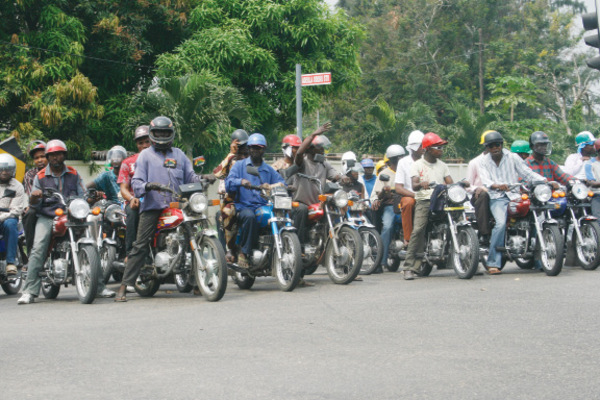
The Niger state government has announced the banning of the operations of commercial motorcyclists popularly called Okada in Minna, the state capital.

In a statement signed by the chief press secretary to the governor, Danladi Ndayebo, the government noted that adequate arrangements had been made to cushion the effect of the ban.

It also added that the state ministry of transportation had taken full delivery of 1000 units of Mahindra Tricycles in addition to 8 units of 18-seater buses and 12 units of 100 capacity Bus Rapid Transport, BRT, buses that have already been put on the roads to ease transportation problems in the state capital.


READ ALSO:


Enforcement of the law would commence from January 2, 2014.

Ndayebo dismissed concerns that motorcycle operators would be put out of job as a consequence of the ban, saying that the newly purchased tricycles would be distributed to okada operators through the Amalgamated Commercial Motorcycle Riders Association of Nigeria, ACOMORAN.

President Jonathan To Attend Mandela’s Funeral

President Goodluck Jonathan will leave Abuja on Monday evening to South Africa to pay last respect to late anti-apartheid fighter and former South African President, Nelson Mandela.

According to a statement issued by the President’s special adviser on media and publicity, Reuben Abati, Jonathan will attend the memorial service for Mandela on Tuesday at the FNB Stadium in Johannesburg and on Wednesday be present at the Union Building, Pretoria, for the lying in state.

The President would depart Pretoria on Wednesday at the end of the event to honour a long-standing invitation to be a guest of honour at Kenya’s 50th Independence Anniversary celebration, in Nairobi.

He will be accompanied on the visit by the supervising minister of foreign affairs, Viola Onwuliri, and is expected to return to Abuja on Thursday.

Meanwhile, prayers of remembrance have been held across South Africa for Mandela.

South African President Jacob Zuma, Mandel’s fomer wife, Winnie Madikizela-Mandela, a large number of family members, Mandela’s grandson, Mandla, dignitaries and friends attended church service at the Bryanston Methodist Church in Johannesburg.

Speaking to the congregation, President Zuma urged South Africans to unite around the ideals Mandela espoused.

Zuma said Mandela preached and practiced peace and reconciliation to make those who had been fighting to forgive one another and become one nation.

In Mvezo, Eastern Cape, where Mandela was born, villagers and well wishers attended prayers service wearing the African National Congress T- shirts.

“Though the village is sad, they are grateful for the changes the that the anti apartheid icon’s freedom had brought to them,’’ one of Madiba’s great grandson, Mayibuye Mandela said.

Mandela died on Thursday evening at his Houghton home in Johannesburg after a long illness. He was 95 years old.

His remains will be laid to rest next Sunday, at his home village of Qunu in the Eastern Cape.

Army Employs New Tactics To Fight Terrorism

0

Musdapha Ilo, Maiduguri

The military says it is evolving new strategies to combat terrorism in the country’s North-east region.

Members of the banned Boko Haram fundamentalist sect have continued to unleash violence on helpless citizens, accounting for the loss of thousands of lives and properties, but the army says it is more determined than ever before to put an end to the terror.

Muhammad Dole, who spoke on behalf of the 7 Division of the Nigerian Army in Borno State, said there are plans to immediately commence patrol of the towns and villages in the state, especially on market days.

He said the army had observed that increased violence is perpetrated on such days and is therefore taking the measure in order to prevent future attacks.

“The new strategy, that we will immediately adopt is the patrol of Borno towns and villages on their market days, including the 454-kilometre Maiduguri-Damaturu, Biu-Maiduguri, and Maiduguri-Gwoza roads of Central and Southern Borno state,” Dole said.

The spokesman urged residents of Bama, Konduga, Damboa, Chibok, Uba/Askira and Gwoza to supply the army with relevant information that will help curb the activities of the group.

“As the insurgents continue to change tactics of attacking our people in these border towns and villages, including the ones that are sighted on the peripheries of Sambisa Forest, our men have to change tactics with the adoption of new strategies to contain the incessant attacks and killing of innocent villagers,” he explained.

Clerk Bags 3 Months For Stealing N8.3 million

0

A Kogi state High Court in Koton-Karfe has sentenced one Modupe Adeyemi, an account clerk at the Federal Medical Centre, FMC, Lokoja, to three months imprisonment without an option of fine for stealing and forgery.

Adeyemi who was arraigned in November 2009 by Independent Corrupt Practices And Other Related Offences Commission, ICPC, on 30 counts charge, was accused of  defrauding the FMC of part of revenues accruing to it up to the tune of N8.3 million between October 2006 and April 2007.

She was said to have used her office to corruptly enrich herself, altering duplicate copies of various bank tellers with the intent to defraud and making false statements on returns contrary to sections 19, section 15 sub-sections (a) & (c) and section 16 of the Corrupt practices and Other Related Offences Act, 2000 respectively.

According to the ICPC prosecutor, Henry Emore, each time the accused person was sent to deposit some money in various banks belonging to the Centre, she would deposit only part of the money and keep part of it to herself.

“She did this successfully by altering duplicate copy of the bank tellers which she returned to the Centre,” he said.

Delivering  judgment, Justice Alaba Ajileye, lamented the delay associated with the case before the sentence and sentenced her to three months in jail.

The accused  person was is now serving her term in Okene Prisons.

ASUU Strike: Senator Condemns FG’s Threat To Lecturers

0
  1. From Jefferson Ibiwale, Benin

A member of the Senate committee on education, Abubakar Bagudu, has condemned the sack threat issued by the federal government to the Academic Staff Union of University, ASUU, over the prolonged shutdown of public universities.

The federal government had announced December 9 as the extended compulsory date for the striking lecturers to reopen all institutions or be sacked.

But speaking with journalists in Ugbegun, Edo state, over the weekend, Bagudu said that issuing threats and deadlines to the lecturers was not the best way out of the problem.

He said his committee has been negotiating with members of the union and that the body has expressed commitment to uplift the education sector in the country.

“I condemn all provocative statements from whosoever. We are all Nigerians, ASUU members are Nigerians committed to the development of the Nigerian state. We have interacted with them, and they are committed to the uplift meant of the education sector along with others who are also committed to the sector. So, issuing threat by whosoever is condemnable,” he stated.

Bagudu, a former lecturer at the university of Sokoto, added that the Senate in a motion had addressed the issue and called for a show of maturity and statesmanship in handling the situation.

“I can assure that the Senate and the committee on education will do their best to get this issue resolved,” he assured.

Auchi Poly To Award Degrees In 11 Courses

0

The Auchi Polytechnic, in Edo state is collaborating with the Nnamdi Azikiwe University, Awka, to commence the awarding of degrees in 11 disciplines.

Rector of the polytechnic, Philipa Idogho, said at the institution’s 21st convocation, that plans for the affiliation, including infrastructure and manpower in the affected disciplines have been completed.

Idogho said the programmes included electrical/electronics, civil engineering, business administration, accounting, building technology, estate management and education/physics, among others.

She said the National Universities Commission, NUC, was expected in the institution later in December to carry out its own assessment of facilities and personnel.

Governor of Edo State, Adams Oshiomhole counselled the polytechnic against deviating from its core mandate of providing middle level manpower for the country.

Represented by his chief of staff, Patrick Obahiagbon, the governor said polytechnics had vital role to play in the country’s quest for technological development and advised that polytechnics be carried along in the federal government’s transformation agenda through improved funding and provision of facilities.

He also urged the graduating students to be good ambassadors of the institution.


READ ALSO:


The supervising minister for Education, Nyesom Wike, who was represented by the executive secretary, National Board for Technical Education, NBTE, Mas’udu Kazaure, commended the management of the polytechnic for its level of infrastructural development.

He said the federal government remained committed to the development of technical and vocational education.

About 5, 678 students received National Diploma and Higher National Diploma, while three persons were honoured with the fellowship of the polytechnic.

Removal of Roadblocks Reduced Corruption By 80 Per cent – IG

0

The Inspector General of Police, Mohammed Abubakar, has said that the dismantling of roadblocks had reduced corruption in the police by 80 per cent.

Abubakar made this known when he presented the Nigerian Police Force Scorecard in Asaba on Saturday.

He said corruption thrives in the country because the people want to cut corners and are disparate and that the police had dismissed thousands of its officers in the past one year for corruption-related issues.

“The essence of roadblocks is for a temporary arrest of crime and as soon as this is done it is dismantled, this is the situation in other countries of the world. Removing roadblocks in Nigeria has reduced corruption in the police by 80 per cent,” Abubakar said.

The police chief also called for support from members of the society, to enable it succeed in its task of crime fighting by being law abiding citizens.

He noted that obeying the law helps to reduce bribery and corruption, adding that the force was making efforts to transforming the Nigerian Police for the better.

He added that the police had purchased no fewer than 2000 vehicles and some helicopters for crime fighting and arrangements are on to procure at least two helicopters for each of the six geopolitical zones.

Abubakar said also that the police was partnering with sister agencies to achieve the organisational goal of providing security for Nigerians and that the partnership was yielding result.

He said that despite the challenges of Boko Haram in the North, kidnapping, armed robbery and other related-crime had reduced.

On the issue of welfare for officers, the police boss said that the force would complete 2,250 housing units in Abuja for officers and men by the end of December.

He said the police authorities were conscious of the fact that for the policemen to be efficient, their welfare must be taken serious, adding that the police needed good salary and other welfare packages to encourage them to remain focused when performing their duties.

Abubakar said the force had secured a mandate to pull out of the general pension fund administration as it could now administer and operate its own pension funds.

“We also ensure that our officers and men are insured because of the challenging job they do,” he added.

Removal of Roadblocks Reduced Corruption By 80 Per cent - IG

The Inspector General of Police, Mohammed Abubakar, has said that the dismantling of roadblocks had reduced corruption in the police by 80 per cent.

Abubakar made this known when he presented the Nigerian Police Force Scorecard in Asaba on Saturday.

He said corruption thrives in the country because the people want to cut corners and are disparate and that the police had dismissed thousands of its officers in the past one year for corruption-related issues.

"The essence of roadblocks is for a temporary arrest of crime and as soon as this is done it is dismantled, this is the situation in other countries of the world. Removing roadblocks in Nigeria has reduced corruption in the police by 80 per cent," Abubakar said.

The police chief also called for support from members of the society, to enable it succeed in its task of crime fighting by being law abiding citizens.

He noted that obeying the law helps to reduce bribery and corruption, adding that the force was making efforts to transforming the Nigerian Police for the better.

He added that the police had purchased no fewer than 2000 vehicles and some helicopters for crime fighting and arrangements are on to procure at least two helicopters for each of the six geopolitical zones.

Abubakar said also that the police was partnering with sister agencies to achieve the organisational goal of providing security for Nigerians and that the partnership was yielding result.

He said that despite the challenges of Boko Haram in the North, kidnapping, armed robbery and other related-crime had reduced.

On the issue of welfare for officers, the police boss said that the force would complete 2,250 housing units in Abuja for officers and men by the end of December.

He said the police authorities were conscious of the fact that for the policemen to be efficient, their welfare must be taken serious, adding that the police needed good salary and other welfare packages to encourage them to remain focused when performing their duties.

Abubakar said the force had secured a mandate to pull out of the general pension fund administration as it could now administer and operate its own pension funds.

"We also ensure that our officers and men are insured because of the challenging job they do," he added.

ICPC Prosecutes 12 Visa Scam Suspects

0

In continuation of its clampdown of visa fraudsters, the Independent Corrupt Practices and Other Related Offences Commission, ICPC, charged eleven persons before a Lagos State High Court in Ikeja, for forgery of documents to procure traveling permits from some embassies.

The twelve accused person was charged before a Federal High Court in Abuja.

Those charged at the Lagos court include Chukwu Daniel Okoro, Sylvester Sunday Aghaonu, Emmanuel Uchenna Okeke, Adline Ifeyinwa Ekekalu, Philomena Nwanorue, Okwara Chidera Oscar, and Kennedy Nwosu.

Others are Ntiedo Uyoata Sampson, Ataine Helen Bando, Samuel Okechukwu Obiakor and Alimi Segun.

The suspects allegedly submitted forged letter of introduction, WAEC statement of result, bank statement of account, sponsorship letter, company registration certificate as well as medical reports to enable them obtain visas.

The twelfth accused person, Matthew Abasi Ifereke, was arraigned before Justice Mariam Anenih of the FCT High Court, Abuja  for allegedly impersonating as a public officer to obtain United Kingdom and India visas.
After his arraignment, he was ordered detained in Kuje prison until January 21 when the prosecution react to his lawyer’s bail application.

The accused who was arraigned before the court on the December 5, 2013 pleaded not guilty to the 12 counts charge preferred against him .

Counsel to the accused person, Godwin Ofou filed an application for the bail of the accused but it was objected to by counsel to the ICPC, Isaac Jiya.

After listening to the argument of both counsel the presiding Judge adjourned the matter till January, while also ordering that Ifereke be remanded at Kuje Prison till the date of adjournment.