Home Blog Page 437

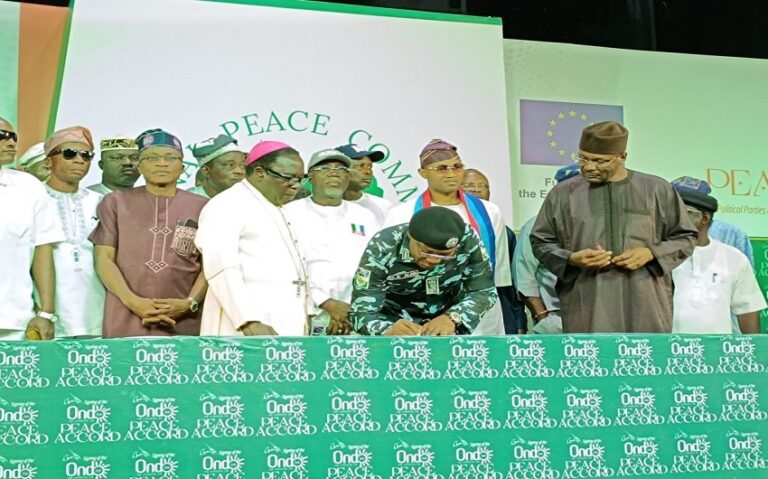
Ondo governorship election: 18 parties sign peace accord

0

EIGHTEEN governorship candidates on Friday in Akure signed a peace accord ahead of the 2024 Ondo State off-cycle governorship election scheduled for November 16 in the state.

Eighteen governorship candidates in Ondo State signed a peace accord in Akure on Friday, November 8.

All the candidates pledged to support a peaceful and credible electoral process in the upcoming election on November 16, 2024.

Chairman of the National Peace Committee (NPC), Abdulsalam Abubakar, oversaw the signing and emphasised the accord’s importance in promoting peace and democracy ¹.

Abubakar urged party leaders and candidates to accept the election outcome, provided it is deemed free, fair, and credible.

He also encouraged them to seek legitimate and peaceful means of addressing any concerns that may arise after the election.

Abubakar, a former military head of state, called on all stakeholders to work assiduously in their capacities to ensure that peace reigns supreme during the election.

“And that the Ondo State off-cycle election sets a precedent for other off-cycle elections to emulate.

He urged all politicians who signed the accord to fully commit themselves and their parties to the letter and spirit of the agreement.

“Shun violence and intimidation and remember that as politicians, you must demonstrate the spirit of sportsmanship, as that is a key trait of good leadership.

“So, it is the sincere hope of the National Peace Committee that the Ondo State election will be free, fair, credible, and peaceful,” Abubakar stated.

Abubakar, who commended INEC for the work done so far, called on them to continuously live up to their responsibilities in ensuring that eligible voters exercised their franchise peacefully.

Earlier, the National Chairman of the Independent National Electoral Commission (INEC), Mahmood Yakubu, praised the NPC’s prompt efforts to unite candidates and parties for peaceful elections in Nigeria.

According to Yakubu, seven peace treaties have been signed in off-cycle elections since its commencement in 2020.

He urged security services, religious groups, traditional leaders, and others to work with the commission to ensure a peaceful election.

He reminded the gathering that signing the peace accord alone cannot guarantee a peaceful election.

“So, you have signed the peace accord; you should commit yourself to implementation and pass the message to your supporters to comply to honour the effort.

“I have said repeatedly that to honour the effort and sacrifices of the chairman and members of the NPC, we must ensure peaceful elections in Nigeria,” Yakubu said.

According to Inspector-General of Police (IGP), Kayode Egbetokun, who was represented by Abiodun Alabi, 36,637 officers would be assigned to all 3933 polling stations and 203 wards throughout the 18 local government areas of Ondo State for the election.

“We are going to deploy four personnel to each of the polling units to protect the INEC materials, officials, and electorate during and after the election,” Egbetokun stated.

Speaking on behalf of the candidates, Ondo state governor, who is also the candidate of the All Progressive Congress (APC), Lucky Aiyedatiwa, pledged to follow the rules and laws governing the electoral process.

The peace accord is a significant step towards ensuring a violence-free election in Ondo State. With eighteen candidates committing to peace, the stage is set for a credible and democratic process.

Botswana’s new president: who is Duma Boko, what does he stand for?

0

By David Sebudubudu, University of Botswana

THE electoral defeat delivered to the Botswana Democratic Party led by Mokgweetsi Masisi was met with incredulity in neighbouring states. Not many expected the party that had run the country comfortably since independence in 1966 to be so roundly defeated in national elections on 30 October 2024. Of the 61 seats in the national assembly, the Umbrella for Democratic Change coalition won 36 seats, the Botswana Congress Party 15. The Botswana Patriotic Front won five seats, the Botswana Democratic Party four, and an independent candidate won one seat. Batswana cast their ballots for opposition leader Duma Boko, who is largely unknown outside the country. Who is he? What does he stand for, what challenges does he face in his new role? We turned to David Sebudubudu, a political scientist at the University of Botswana, for answers.

Who is Duma Boko and what does he stand for?

Duma Boko is the leader of the Botswana National Front and president of an opposition coalition, the Umbrella for Democratic Change. He played a crucial role in the process of forming the coalition in 2012 by three political parties: the Botswana National Front, the Botswana Movement for Democracy and the Botswana People’s Party. For the 2024 elections, the coalition included the Botswana National Front, the Alliance for Progressives and the Botswana People’s Party.

Boko is a human rights lawyer who is considered a social democrat. He read law at the University of Botswana and at Harvard Law School. He was raised in a modest family in Mahalapye, a village 200km from the country’s capital, Gaborone.

The country of 2.5 million has very high levels of unemployment, at 27.6%, as well as poverty, at 38%.

His campaign pledges suggested that he stands for and identifies with the lower economic strata of society.

One of his key messages was a promise to diversify and transform the economy from over-reliance on minerals, particularly diamonds, which account for 90% of exports. He also promised to raise the basic pay, students’ allowances and old-age pensions. He pledged to make matters afflicting the youth a priority as around 70% of the country’s population is below 35 years old.

As a constitutional and human rights lawyer, Boko has emerged as a leader who is keen to advance social justice. And owing to his training, he preaches a humane approach to issues confronting the nation. He has lived and practised respect for human rights, especially the rights of the downtrodden, including the Basarwa (the San) – the indigenous people of Botswana.

What challenges does he face?

Boko’s government is taking charge of a country with underdevelopment challenges.

The two biggest are unemployment and poverty, which intensified under Masisi’s government.

The other critical challenge is corruption, which escalated under Masisi and came to define his time in office as some of his relatives benefited from government tenders. Institutions that were meant to ensure transparency and accountability were muted or ineffective. In addition, the Directorate on Intelligence and Security Services began to operate as a law unto itself and was considered to have gone rogue. There were reports that it obstructed investigations by the Directorate on Corruption and Economic Crime, among others, of those considered politically connected. And there were reports that it had assumed roles outside its mandate, such those of the police, and the corruption and economic crime directorate.

Masisi, who also stood accused of corruption, took no action. He has denied the allegations.

Institutions that were meant to provide accountability, such as the Directorate on Corruption and Economic Crime and the judiciary, were weakened or compromised under his government through interference.

What will it take for Boko to succeed?

Until around the mid-2000s, Botswana was widely lauded by international agencies and observers for its positive economic and social indicators relative to its peers. Yet, a significant proportion of its population has been left out, due to neo-liberal policies pursued by the ruling party since independence.

Boko’s government needs to devise new strategies to fight poverty and unemployment.

Secondly, Boko’s government needs to unite the nation, which became increasingly divided as the ruction between Masisi and former president Ian Khama escalated. The Directorate on Intelligence and Security Services was at the centre of their friction. Masisi was considered in certain quarters to make government appointments on regional (and tribal) lines.

Thirdly, Boko needs to restore trust and credibility in government and its institutions, including the judiciary. Trust is low. This requires revamping institutions that ensure transparency and accountability in government, containing the rogue intelligence directorate and ending wasteful expenditure and corruption.

Fourth, his government needs to transform the economy to create jobs. This is critical as he assumes power at a time when the diamond market is subdued. It is the country’s largest revenue earner.

These challenges do not have a simple solution. They will require that his government consult citizens in order to carry them along. Effective checks and balances must ensure the transparency and accountability that eluded the previous government.The Conversation

David Sebudubudu, Professor, University of Botswana

This article is republished from The Conversation under a Creative Commons license. Read the original article.

Engine failure forces Australian plane to make emergency landing

0

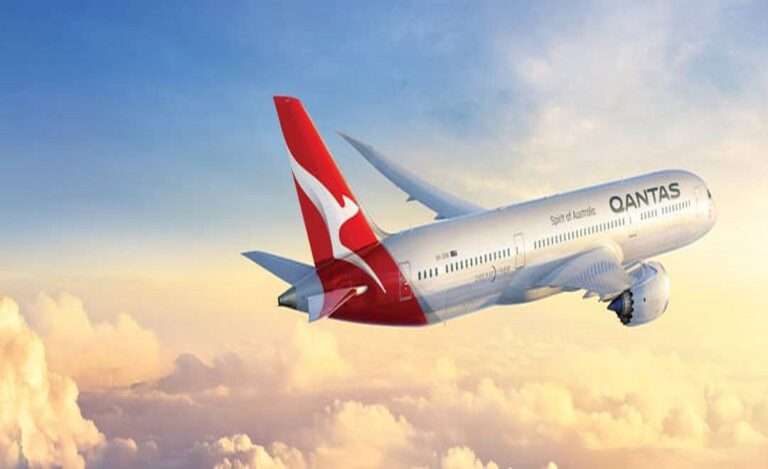
A SYDNEY-bound passenger plane experienced engine failure on Friday November 8, necessitating an emergency landing after circling the area, Qantas confirmed on X.

Meanwhile, Sydney Airport officials reported a grass fire on the runway’s perimeter, but the connection between the two incidents is still unclear.

The fire has been contained, and airport operations are returning to normal, albeit with some expected flight delays.

Qantas did not reveal how many people were on board the twin-engine Boeing 737-800, which was headed toward Brisbane when the engine allegedly failed with a loud noise; however, there were no reported injuries.

“We understand this would have been a distressing experience for customers, and we will be contacting all customers this afternoon to provide support. We will also be conducting an investigation into the cause of the engine issue, Qantas Chief Pilot Richard Tobiano stated.

According to Reuters, a journalist on the flight who worked for national broadcaster ABC said there was a “sharp shudder” aboard the aircraft following the loud noise.

“It was apparent something had happened with one of the engines, then the plane seemed to labour to get off the ground or get any altitude,” Mark Willacy, an ABC reporter, stated.

The airline reported that its engineers had inspected the engine in advance and determined that it was a contained engine failure, which means that the internal engine components remained inside the protective shell intended to keep them securely contained.

Qantas Airways Limited is the flag carrier of Australia, and according to wikipedia, the airline is the largest by fleet size, international flights, and international destinations in Australia and Oceania.

Kano presents N549bn proposed budget, allocates 31% to education, 16.5% to health

KANO State Governor, Abba Yusuf, on Friday, November 8, presented the state’s 2025 appropriation bill, totaling N549.16 billion, with significant portions allocated to education and healthcare. 

The budget proposal, according to the governor, is aimed to tackle critical infrastructure gaps and improve social services in the state.

In his address to the Kano State House of Assembly, Yusuf outlined the breakdown of the proposed budget, which includes N312.63 billion for capital expenditure and N236.53 billion for recurrent expenditure.

The governor noted that the capital expenditure would largely focus on social and economic development, with N461.44 billion earmarked for these sectors.

“Mr. Speaker, Honourable Members, the size of the proposed 2025 Budget is N549,160,417,663.00 billion. The capital component is N312,634,912,672.18 billion, while the recurrent expenditure is set at N236,525,504,990.82 billion.

“The 2025 budget, when approved is projected to have a ratio of capital to recurrent 57:43 percent respectively. Most of the capital spending will be in the social and economic sectors to the tune of 461,447,963,240.86,” the governor said

Education and health take lion’s shares 

While giving the breakdown of the proposed budget, Yusuf noted that education sector received the highest allocation of N168.35 billion, representing 31 per cent of the total budget. 

Yusuf stated, “We have pledged to increase access to quality education despite the meager resources. In line with this, I want to inform this respected chamber that we are considering the resuscitation of Kano Education Development Support, KEDS, under the Ministry of Education. It is our plan to develop it into a functional agency that will support the funding of education specifically for Basic; Upper Basic and Post-Basic Education.”

In addition to education, healthcare received N90.6 billion, making up 16.5 per cent of the total budget.

Sectoral breakdown 

The governor further detailed that the agricultural sector was allocated N21.04 billion (3.8 per cent), while infrastructure development received N70.68 billion (12.9 per cent). 

Other sectors such as manufacturing, commerce, industry, and tourism, as well as environmental and sanitation efforts, were allocated N3.88 billion and N15.52 billion, respectively.

Further allocations included N17.34 billion for women, youth, and people with special needs, as well as N23.46 billion for security, justice, and emergency services. Water supply and rural development are set to receive N27.23 billion, while transport development was allocated N12.8 billion.

Yusuf emphasised that the proposed budget reflects the administration’s primary focus on human capital and infrastructural development, which he described as essential for the state’s progress.

“Therefore, I believe the legislature will give the necessary legal teeth in fine tuning its edict for full implementation,” he added.

Recall, on August 28, the State House of Assembly approved a N99 billion supplementary budget request from Governor Yusuf.

While making the request, the governor stated that the supplementary budget was crucial for fast-tracking priority projects aimed at improving the welfare of Kano’s residents. 

The proposed budget includes N33.76 billion for personnel costs, N34.49 billion for overhead expenses, and N30.97 billion for capital expenditure. Commissioner for Planning and Budget, Musa Shanono, explained that with the supplementary budget, the total 2024 budget would rise from N437.34 billion to N536.56 billion. 

Consequently, the state’s 2024 budget stood at N449 billion after the approval.

Lawyer quits after assaulted cab driver apologises to lawmaker

0

THE law firm of human rights activist Deji Adeyanju has withdrawn from a suit instituted by a Bolt driver, Stephen Abuwatseya, where he charged a lawmaker, Alex Mascot Ikwechegh, to court over assault.

The withdrawal of the law firm from the assault case followed the trending video of Abuwatseya apologising to the lawmaker.

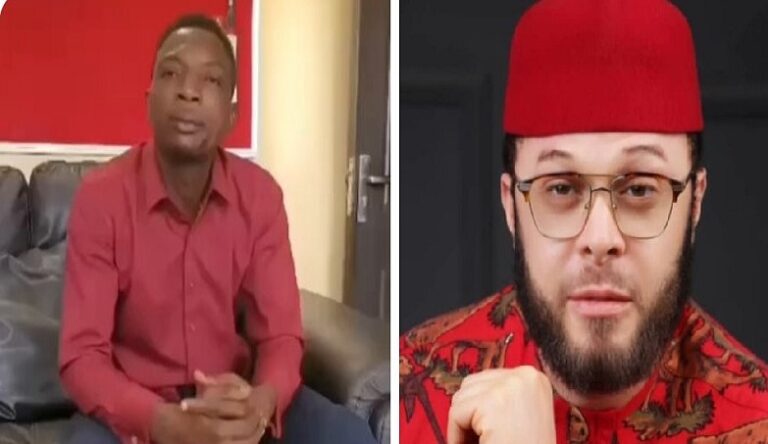
In the video released on Thursday, November 7, Abuwatseya conveyed regret for provoking Ikwechegh and asked Nigerians for forgiveness.

He also urged everyone to move on from the incident.

“Good day, Nigerians. My name is Stephen Abuwatseya. I had a misunderstanding with Rt. Hon. Alex Mascot Ikwechegh a few days ago. I actually want to apologise to him for whatever I must have said or done to provoke him to that level of anger.

“I want to tell Nigerians that it’s not time for us to start dividing ourselves based on religion, tribes, or regions. We should actually come together, see how we can unite this nation, and move it forward.

“Please, Nigerians, let’s forgive and forget, as it’s even contained in our Lord’s Prayer, thatLord, please forgive us, as we forgive those who trespass against us.For there is no justice without forgiveness. Thank you very much,Abuwatseya stated in the video.

However, in a statement posted on X on Friday, November 8 and signed by Zainab Otega, the law firm representing Abuwatseya in the lawsuit, Deji Adeyanju and Partners, announced the withdrawal of their legal representation in the case.

“On October 28, 2024, Mr. Stephen Abuwatseye walked into our law firm, visibly distressed, and sought redress over an alleged assault. Following his complaint and having verified his claim, we took steps to protect Mr. Stephen Abuwatseye’s rights on a pro bono basis, culminating in the arraignment of the alleged assaulter.

“However, in view of recent developments and after careful consideration, we have made the decision to withdraw our legal representation in order to protect our professional integrity and maintain the highest ethical standard in the legal profession,the law firm stated.

The ICIR reported that the lawmaker, who represents Aba North and South Federal Constituency of Abia State, was seen assaulting and threatening Abuwatseya in a video that went viral on Monday, October 28.

The legislator appeared visibly angry in the footage, engaging in a heated exchange with the driver before resorting to physical intimidation and vocal threats and eventually slapping him.

However, he later expressed regrets for slapping and threatening the bolt driver, tendering an apology in a statement titledA Statement of Regret and Commitment to Justice.”

Ikwechegh acknowledged that his actions fell short of what was expected of a public servant.

He pledged to assist the police in their investigation of the attack.

But despite the lawmaker’s apology, the Nigeria Police Force (NPF) charged him to court on Wednesday, October 30.

Ikwechegh was charged before a magistrate court in the Kuje area of the FCT, where he was granted N500,000 bail.

He was arraigned on a three-count charge bordering on assault and threat to life.

The charges were filed by the inspector general of the police’s special investigation unit.

The Cable Foundation opens applications for cllimate journalism fellowship

THE Cable Newspaper Journalism Foundation (CNJF) is now accepting applications for its fellowship programme, Amplifying Climate Storytelling.

Selected fellows are expected to commit to climate reporting within their news organisations.

This initiative, according to the foundation, is aimed to equip Nigerian journalists with the tools and insights needed to report on climate change impacts and resilience efforts across the country.

Recognising that Nigeria is one of the countries most vulnerable to climate change, the programme seeks to build journalists’ capacity to produce in-depth stories on how climate change impacts the country, as well as the local initiatives aimed at adaptation and mitigation.

Selected journalists will undergo a two-day training workshop that includes field visits to affected communities, where they will engage directly with local leaders and subject matter experts. 


READ ALSO:


Fellows will also receive a climate reporting grant of up to N500,000 to support their projects, along with an opportunity to participate in a high-level closing event in Lagos. 

This final convening will bring together local and international voices to discuss Nigeria and Africa’s roles in global climate discussions, especially in the context of the annual Conference of the Parties (COP) negotiations.

Application Requirements

Interested journalists must submit:

– A motivation letter (350 words max) explaining their interest in the fellowship and suggesting a climate topic they feel has received minimal coverage in Nigeria

– A concise resume

– Three samples of published work

– Two professional references

The programme is open to reporters from online and broadcast platforms, with a strong focus on encouraging female journalists and journalists with disabilities to apply. 

Applications are due by November 24, 2024, and can be sent to the CNJF Programme Manager at abiose@cablefoundation.org or The Cable editor Kolapo Olapoju at kolapo.olapoju@thecable.ng.

Knight-Wallace Journalism fellowships open for 2025-2026 applications

THE prestigious Knight-Wallace Fellowships at the University of Michigan have opened applications for the 2025-2026 academic year, welcoming experienced journalists from the U.S. and abroad to apply. 

Since 1973, the programme has provided mid-career journalists a unique opportunity for professional growth, allowing them to engage in a year of in-depth study and reflection on issues impacting their work and the broader media landscape.

International journalists interested in the fellowship must submit their applications by December 1, 2024, while U.S. applicants have until February 1, 2025. 

The fellowship year is set to begin on August 25, 2025, with Fellows required to reside in Ann Arbor, Michigan, for the duration. Fellows are expected to participate fully in program seminars and events, making the fellowship their primary focus.

All Fellows awarded our in-person fellowship must maintain residency in Ann Arbor for the duration of the fellowship, attend all program seminars and events, and make the fellowship their primary professional focus. 

“Applicants working in a newsroom are encouraged to obtain employer consent granting a leave of absence with the understanding that, upon completion of the fellowship and where applicable, the Fellow will return to their place of employment,” the call for application read.

Candidates must also have at least five years of professional experience in journalism and be currently engaged in the field. Eligible applicants include a diverse array of journalism professionals such as reporters, editors, data analysts, visual journalists, audio producers, and others contributing to the media industry.

The programme is particularly interested in applicants working on immersive study projects covering public policy, health, technology, and international reporting.

For the upcoming fellowship year, three specialised fellowship tracks have been introduced for U.S. journalists: the Great Lakes Local News Fellowship, the James S. House and Wendy Fisher Social Science Fellowship, and the Arts Journalism Fellowship.

The selection process emphasised diversity in experience, geography, and journalism focus, aiming to build a cohort that reflects a wide spectrum of perspectives. Up to six international and twelve U.S. journalists will be selected, with international finalists interviewed in early 2025 to accommodate visa processing.

For more information on application requirements and to register for informational webinars with program alumni, prospective applicants are encouraged to visit the Wallace House website. You can apply for the fellowship here 

[EXPLAINER] What Trump’s second presidency means for Nigeria’s economy

ON the heels of Donald Trump’s success in the just concluded US Presidential election, global geopolitics and economic alignments are currently ongoing with Nigeria not left out.

Trump’s victory in key states put him within the reach of the 270 electoral votes needed to secure the presidency.

Already, Trump’s victory and now President-elect has triggered some global economic and geopolitical realignments with Nigeria not being left out.

The ICIR reports that global stock markets, dollar, and oil price appreciations at the international market have all been touted as the major impact of Trump’s electoral victory.

According to Reuters, the victory in the U.S. presidential election “unleashed a massive rally in the dollar, drove stocks to record highs, and punished bond prices as expectations of tax cuts and tariffs on imports drove optimism about economic growth while fuelling worries about inflation.”

The U.S. equity indexes soared, with the benchmark S&P 500 up 2.51 per cent to a record high and huge gains in areas such as small-cap stocks and banks that are poised to benefit from Trump’s expected lighter regulatory touch.

To state the least, ‘Trump’s American First’ philosophy expected to have huge effects on the Nigerian economy with possible withdrawal from the climate change agreement also going to have huge impacts on the Nigerian economy.

In this report, The ICIR looks further into some economic and geo-political implications of Trump’s presidency to Nigeria.

Key economic areas expected to be impacted.

1. A stronger dollar to impact on more weakening of the Naira

Expectedly, the dollar is already strengthening as a result of Trump’s victory. Industry analysts believe a strong dollar would weaken the naira with Trump’s administration expected to deepen homegrown economic policies that would affect import-dependent countries like Nigeria.

Furthermore, Trump’s administration’s proposal to impose  tariff on domestically produced goods will impact negatively again on the naira as Nigeria is largely an import dependent country. This would likely pile up  pressure on the naira while affecting the $10.6 billion trade volume between the two countries.

Already, Nigeria’s naira has depreciated over 45 per cent this year and an appreciation of the dollar will weaken the naira, impacting import costs, inflation, and purchasing power as already being witnessed.

2. African Growth and Opportunities Act (AGOA)’s imminent withdrawal

AGOA is a  piece of legislation approved by the United States of America in the year 2000 which promotes duty-free access to the United States market and has helped to increase trade volume between Nigeria and the United States.

However, this policy which has helped surge Nigeria’s bilateral trade with the United States to over $10.6bn could be halted as a result of Trump’s disposition to discontinue the policy in 2025.

3. Energy Independence

Trump’s coming could also see more exploration of America’s oil and less purchase of Nigerian oil, informed analysts  said. This would inadvertently affect Nigeria’s trade with the United States with oil still serving as the mainstay of the nation’s economy.

4. Reduction of aid to Nigeria and Africa

Trump’s second coming is expected to prune down aid to Nigeria and other African countries with priority on his American first policy. Nigeria largely relies on aid from developed economies such as the United States for most of its polices and programmes.

5. Impact on trade relationship

Furthermore, Trump’s “Buy American” policy has often focused on reducing imports and increasing tariffs, which could impact Nigeria’s trade relationship with the U.S.

In the first half of 2024, Nigeria recorded a trade surplus with the U.S., with imports at N1.9 trillion and exports at N3.1 trillion.

If Trump’s tariff policies discourage U.S. imports from Nigeria, this could negatively affect Nigeria’s export earnings, particularly for sectors like oil, minerals, and agricultural products.

A decrease in exports to the U.S. might impact Nigeria’s current account balance, further complicating its exchange rate and foreign reserve challenges.

Diplomatic experts speak on geo-politics concerns

Some Nigerian diplomats who spoke in response to Trump’s Victor said there’s going to be a global upset in geo-politics.

Former Nigerian Ambassador to the United States, Joe Keshi, who spoke on the development said, “Several world leaders would be strategising on how best to deal with Donald Trump in the next four years.

“For some world leaders  who were around when he did it the first four years might be having some nightmares with his second coming as a result of his approach to governance.

“America has a global influence and most World leaders must find a way to work with him. The truth of the matter is that it’s going to be a stormy four years,” he stressed.

He further said  that some presidents who had worked so well with him in his first tenure and whom he considered as allies may not have issues, adding that, “President of Ukraine would be going through some tough thinking because of his stance on Russian-Ukraine wars.

For Nigeria, Ambassador Keshi notes that Nigeria has a cordial relationship with the United States, adding that nothing will change under the second coming of Donald Trump’s presidency.

“Globally, Africa is at the potpourri of global politics. Nothing will change much under Donald Trump, he said, adding that, “it’s going to still be a stormy four years ”

Keshi recalled how Trump sacked the secretary of State while he was on a visit to Nigeria, adding that, “Africa and Nigeria won’t be on his priority lists.”

For Bolaji Akinyemi-a professor and former Nigeria’s minister of foreign affairs, Trump’s success is “victory of crudity over refinement.”

“I first went to the United States in 1962 and that America is not the America that voted Trump yesterday.

“How can you vote for someone who’s been convicted for over 34 times. How can you vote for someone who upturned an election,” Akinyemi queried.

“For us in Nigeria, in the global south, who are supposed to be fighting for democracy, for decency, for honesty, what can we say about this, “he noted.

He disclosed that Trump will still use the next four years creating chaos around the world which is not good for global politics.

TCN confirms grid collapse, says instability to persist until full repairs

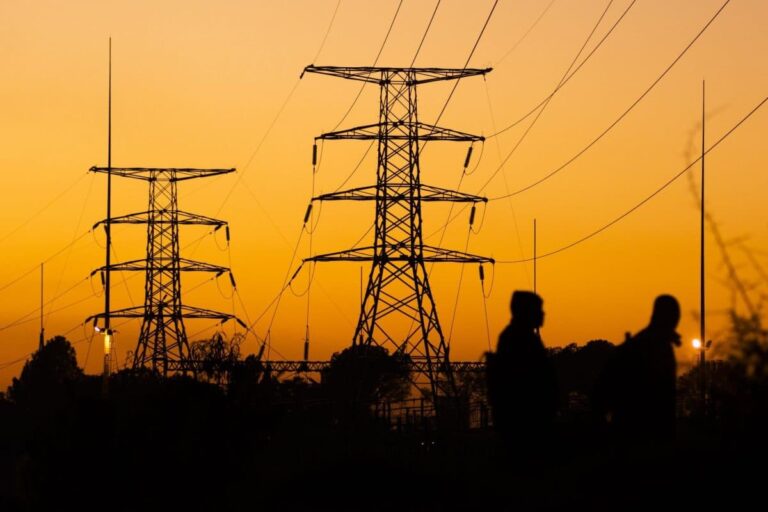
THE Transmission Company of Nigeria (TCN) has confirmed that the national grid experienced a disturbance early Thursday morning at around 11:29 AM, due to a sudden rise in frequency from 50.33Hz to 51.44Hz. 

According to a statement by the TCN Public Affairs’ manager, Ndidi Mbah, on Thursday, November 7, immediate recovery efforts were launched, with the Abuja Axis being restored within minutes. 

However, TCN stated that recovery is ongoing, as the grid faces technical challenges.

The ICIR earlier reported that Nigeria’s national power grid collapsed again, marking the second failure in just three days and the tenth since February 2024.

This latest outage plunged several regions into darkness, disrupting businesses, essential services, and daily life across the country.

According to data from the Nigerian System Operator’s portal, power generation dropped to an unprecedented zero megawatts at 11:30 a.m., affecting all 22 operational generation companies (GenCos) nationwide. Earlier this week, a similar collapse led to widespread outages, with power restored to key areas only after several hours.

The repeated failures have fueled public frustration and raised concerns over the stability of Nigeria’s power infrastructure.

Confirming the collapse, Mbah said the frequency spike was linked to issues at one of the company’s substations, which was subsequently shut down to avert further complications. 

“The frequency spike was caused by issues encountered at one of TCN’s substations, which had to be shut down to prevent further complications. In addition to this, TCN is actively engaged in significant repair work on several critical transmission lines and substations. This includes the 330kV transmission line along the Shiroro–Mando axis, major upgrades at the Jebba Transmission Substation, and the restoration of the second Ugwuaji–Apir 330kV transmission line.

“Furthermore, following the submission of the investigative report on the causes of previous grid collapses, TCN has begun addressing the identified weaknesses in the transmission system. Efforts are being made to close the gaps highlighted in the report and enhance the grid’s overall stability and resilience. These efforts include both technical upgrades and strategic interventions based on the committee’s recommendations,” Mbah wrote.

Despite these efforts claimed to be made, Mbah noted that some level of instability in the power system is expected to persist until all major repairs and improvements are completed. 

Mbah further urged the public for continued patience and understanding during this period of persistent collapse.

“The company remains committed to improving the reliability of electricity supply, recognising the vital role that stable power plays in Nigeria’s socio-economic development. TCN assures the public that all necessary measures are being taken to ensure the grid’s long-term stability, in line with the recommendations of the investigative committee, while also addressing infrastructure damage such as vandalised transmission lines.  “


The ICIR reports that in the past ten months, Nigeria has faced frequent outages, exposing systemic issues within the country’s electricity network. The ICIR reports that each failure affects households, businesses, and critical sectors like healthcare, where a consistent power supply is essential.


This latest collapse adds to an increasingly alarming trend. The first major blackout of the year occurred on February 4, 2024, when the grid’s capacity fell from 2,407 megawatts to just 31 megawatts by midday, eventually reaching zero. 

Since then, breakdowns have recurred, with collapses on August 5 and three times in October. Notably, the October 14 collapse was followed by a partial failure the next day, and another disturbance occurred on October 19, narrowly avoiding a complete collapse.

The ongoing outages are impacting businesses, households, and essential services, highlighting the need for urgent reforms in Nigeria’s power sector.

FG announces free cesarean sections to halt maternal deaths

0

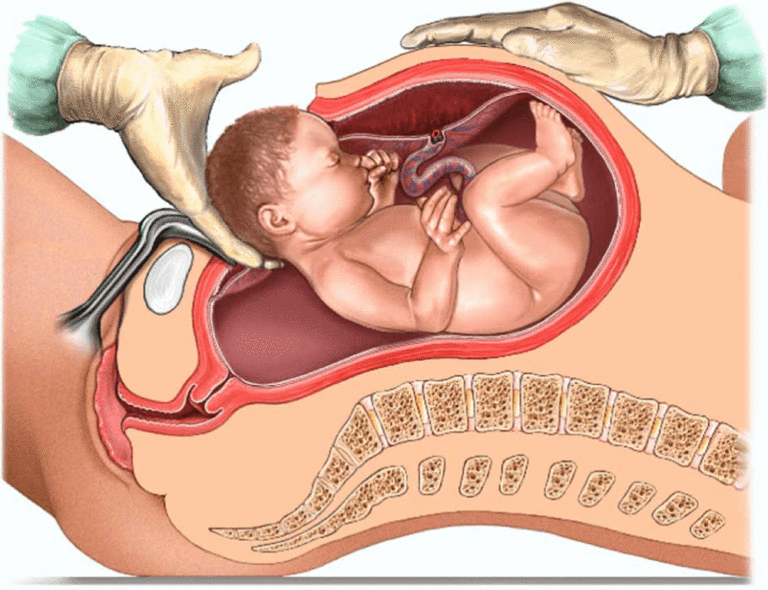
NIGERIA’s coordinating Minister of Health and Social Welfare, Muhammad Ali Pate, announced that Cesarean sections will now be provided free of charge to all Nigerian women in need.

The initiative, the minister said is geared towards pruning down rising figures of maternal and infant mortality in Nigeria.

The announcement was made in Abuja on Thursday, November 7, at the launch of the Maternal Mortality Reduction Initiative (MAMII), during the ongoing Joint Annual Review (JAR) of the Sector-Wide Approach (SWAp) for health.

Pate informed that the initiative, part of the new Maternal Mortality Reduction Innovation and Initiatives (MAMII) project, ” Under the initiative, cesarean sections and essential maternal care would be provided free of charge to eligible women across the country.

“The new policy is designed to ensure that women who need C-sections—either due to complications or as part of planned deliveries—can access the procedure without financial obstacles.”

“The initiatives will also address Nigeria’s high maternal and neonatal mortality rates by improving access to quality healthcare, enhancing primary health care (PHC) services, and increasing community engagement, “he further explained.

He also emphasised that the initiative targets Nigeria’s high maternal and neonatal mortality rates, currently standing at 512 deaths per 100,000 live births and 41 deaths per 1,000 live births, respectively, along with a low uptake of essential health services.

“The Maternal Mortality Reduction Initiative would primarily focus on local government areas reporting over 50 percent of maternal deaths, as many women face barriers such as lack of awareness, spousal consent, and financial challenges.

“The initiative, supported by the National Health Insurance Authority (NHIA) and the National Primary Health Care Development Agency (NPHCDA), aims to make life-saving procedures like cesarean sections accessible to women in need without the burden of cost,” he said.

The World Health Organisation (WHO) country representative in Nigeria, Walter Mulombo, lauded the initiative, underscoring the importance of effective implementation.

“No woman should lose her life simply because she can’t afford a C-section. If implemented right, this initiative will deliver. We’re here to support every step of the way,” Mulombo stated.

Earlier in her submission,the Commissioner for Health in Rivers State, Adaeze Oreh, lauded Pate’s approach, calling it a vital step toward Nigeria’s maternal health goals and advancing universal healthcare coverage.

She highlighted that the success of MAMII relies on the active involvement of communities, healthcare providers, and government agencies. The three-day Joint Annual Review event, where MAMII was launched, will also set priorities for the next phase of Nigeria’s health sector reforms.

The ICIR reports that the  2023 UN Report on Trends in Maternal Mortality from 2000-2020 revealed that nearly 28.5 percent of global maternal deaths happen in Nigeria. The report further states that a woman in Nigeria has a 1 in 19 lifetime risk of dying during pregnancy, childbirth, or postpartum, whereas, in the most developed countries, the lifetime risk is 1 in 4900.

The report noted that the North East zone is reported to experience some of the country’s worst MNH outcomes after suffering from ongoing conflict, primarily driven by Boko Haram. The insecurity has led to significant protection concerns, displacement, disrupted livelihoods, and persistent food insecurity.

Nigeria’s 2023 Humanitarian Response Plan indicates that approximately 8.3 million people need humanitarian assistance in the North East region alone. Women and children represent 80 per cent of the crisis-affected population.