Home Blog Page 524

Electricity Act: NERC transfers regulatory oversight to Oyo electricity commission

THE Nigerian Electricity Regulatory Commission (NERC) has ordered the transfer of regulatory oversight of the electricity market in Oyo State to the Oyo State Electricity Regulatory Commission (OSERC).

This development complies with the amended Constitution of the Federal Republic of Nigeria (CFRN) and the Electricity Act 2023 (Amended).

According to the Electricity Act, the amended Paragraph 14(b) Part II of the Second Schedule to the 1999 Constitution empowers state governments to legislate on electricity provision within their territories.

With the Electricity Act 2023, NERC retains the role as a central regulator with regulatory oversight which oversees the inter-state/international generation, transmission, supply, trading, and system operations.

According to NERC, the Electricity Act also mandates any state that intends to establish and regulate intrastate electricity markets to deliver a formal notification of its processes and requests NERC to transfer regulatory authority over electricity operations in the state to the State Regulator.

Based on this, the Commission said the government of Oyo state complied with the conditions precedent in the laws, duly notified NERC, and requested for the transfer of regulatory oversight of the intrastate electricity market in Oyo State.

The transfer Order by NERC has the following provisions:

“Direct Ibadan Electricity Distribution Company (IBEDC) to incorporate a subsidiary (IBEDC SubCo) to assume responsibilities for intrastate supply and distribution of electricity in Oyo State from IBEDC.

“IBEDC shall complete the incorporation of IBEDC SubCo within 60 days from 6th August 2024. The subcompany shall apply for and obtain licence for the intrastate supply and distribution of electricity from OSERC, among other directives.

“All transfers envisaged by this order shall be completed by 5th February 2025”, it said.

Apart from Oyo state, The ICIR reported that several other states are firming up control of regulatory oversight of electricity business in their respective territory with the support of the Nigerian Electricity Regulatory Commission (NERC).

The states’ control came on the heels of the Electricity Act 2023, signed by President Muhammadu Buhari and later amended by President Bola Tinubu.

The Act removed power generation, transmission, and distribution from the exclusive legislative list, effectively ending the federal government’s sole jurisdiction over these areas.

The development is expected to open up the states for electricity business, energy analyst said.

“This is a good development for states and they will be more than willing to invest in the electricity business in their respective states and firm up control of regulation in their states. They will be able to set up sub-DisCos which would allow for states to get more involved in the electricity business,” the executive director of PowerUp Nigeria, Adetayo Adegbemle told The ICIR.
TCN admits loss of power supply to  Egbin transmission substations

THE Transmission Company of Nigeria (TCN) has admitted experiencing a power failure that caused the loss of power supply to all the Egbin Transmission Substation’s outgoing lines.

It stated this in a statement on Tuesday, August 6 by its Group Managing, Public Affairs, Ndidi Mbah.

It said, “The Transmission Company of Nigeria (TCN), hereby notes that at about 6:10 pm yesterday, 5th August 2024, power supply was restored to areas that had been affected by the arcing on the Benin-Egbin 330kV isolator which caused lines tripping and consequent loss of supply to some areas.”

The TCN claimed that contrary to media reports, the incident did not cause a system collapse.

“The lines tripping started earlier at about 2:47 p.m. yesterday, with a heavy system surge that led to the arcing of Benin–Egbin 330kV line isolator fingers at the Egbin Transmission Substation switchyard.

“This resulted in a tripping at the Egbin Generating Station, which caused the loss of power supply to all the Egbin Transmission Substation’s outgoing lines. The line tripping was quickly rectified, enabling the grid controller to restore full bulk power supply through the transmission lines at about 6.10 pm yesterday,” it added.

Some DisCos cited grid collapse as part of reason for poor supply of power on Monday,August 5.

In a statement on Monday shared on its X handle, the Abuja Electricity Distribution Company (AEDC) said there was a grid collapsed at 2.30 pm.

“We understand that some of our customers are still without power due to a system failure from the national grid at 2.55 pm today, 5th August 2024,” AEDC posted.

The ICIR can report that the national electricity grid collapse has been a recurrent issue, plunging several cities across Nigeria into darkness.

The ICIR reported that there have been concerns over the national grid not being unreliable, failing consumers on more than 141 occasions, despite the government privatising the sector over eleven years ago.

Kamala Harris names Minnesota governor, Tim Walz, as running mate

0

VICE President of the United States (US), Kamala Harris, has named Minnesota Governor, Tim Walz, as her running mate in the upcoming presidential elections.

Harris, the Democratic candidate, is set to face former President and Republican candidate, Donald Trump after she was endorsed by President Joe Biden.

The ICIR reported that  Biden stepped down from seeking re-election, days after testing positive for COVID-19.

He said his decision was in the best interest of his party and country.

The ICIR reports that Walz was picked over other high-profile politicians, including Pennsylvania Governor, Josh Shapiro, and Arizona Senator, Mark Kelly pencilled by bookmakers as nominees.

Walz is serving a second term as governor of Minnesota.

Before becoming governor, he represented a Republican-leaning district in the US Congress for 12 years, after winning the seat in 2006 and being the only Democrat to have won in the mostly rural district over the past three decades.

As the race for the presidential seat continues, Harris aims to make history as the first female president of the United States, as she is currently the first female vice president of the US.

The US election is slated to be held on  November 5.

Nigerian government places hunger protest sponsors on watchlist

0

HEADS of Nigerian security agencies have vowed to unravel the sponsors of the #EndBadGovernance protest and make them face the wrath of the law.

They vowed that the protest sponsors were already on the security watchlist while their accounts were being tracked.

They also said they would continue with the crackdown on criminals who have hijacked the protest in some parts of the nation.

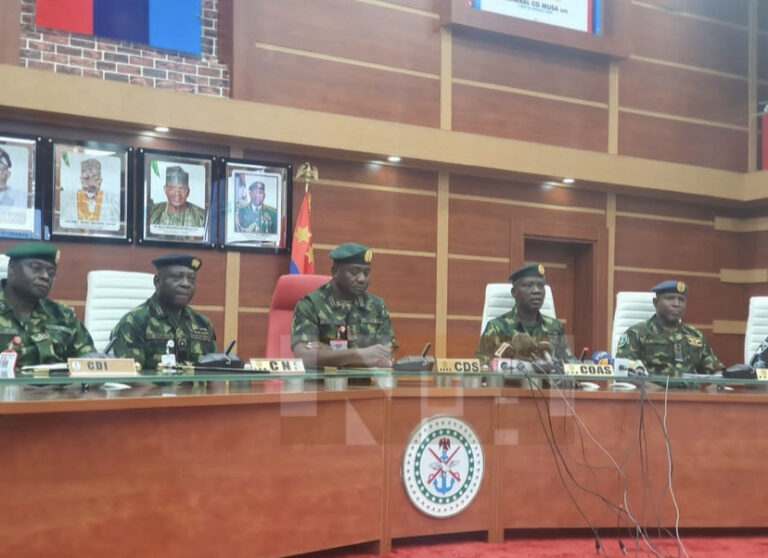
The security chiefs, who briefed newsmen in Abuja on Tuesday, August 6, described the hoisting of the Russian flag by protesters as treasonable, adding that such an attitude could not serve the nation’s interest or be termed as one of the protesters’ lawful demands. 

They vowed to resist any possibility of a coup to remove the democratically-elected government of President Bola Tinubu. They said they had intelligence about the instigators of violence and attempts to forcefully change the government.

Present at the briefing were the Chief of Defence Staff (CDS), General Christopher Musa, the Inspector General of Police, Kayode Egbetokun, Comptroller-General of Customs, Bashir Adeniyi, Comptroller-General of NIS, Kemi Nandap, and the State Security Service spokesman, Peter Ifunaya.

Fielding questions from reporters, Nandap said  “We have diaspora sponsors, they are on our watchlist. They are watchlisted, any attempt they make to come into the country, we’ll be notified and they will be picked up and handed to the appropriate authority.”

She said the government would never allow foreign interference in the country, adding that Immigration had deployed more officers to defend the country’s borders and keep a keen watch on the protest sponsors.

The briefing came hours after Tinubu met with all heads of security agencies in the country on Monday, August 5, to review the state of the nation’s security amid ongoing protests by aggrieved Nigerians.

The ICIR reported that insecurity, inflation, and a hike in the cost of living among others pushed many Nigerians to stage the protest.   

Tinubu had stopped fuel subsidy and devalued the local currency – the naira – thus causing a spiral hike in food and commodity prices.

The protests, which began on Thursday, August 1, have been marred by violence, largely caused by the security operatives in places like Lagos and Abuja, where protesters have been subjected to tear gas and harassment.

In some states, political thugs have hijacked the protest to cause mayhem, attacking demonstrators and looting properties.

Despite attacks on peaceful protesters by security operatives, the security heads said during Tuesday’s briefing that their officers engaged the protesters professionally across the country.

They also noted that their officers used minimal force to disperse protesters from locations where the courts restricted them.

Egbetokun said several arrests had been made from violent protests in some parts of the country, stressing that the police only used tear gas during the protests.

While this is largely true in a state like Lagos, there have been reported incidents of police and SSS shooting at protesters in other states, especially in Abuja and the northern part of the country.

Police, SSS deny using bullets against journalists, protesters 

The Police and SSS denied using bullets on protesters and journalists covering the protest in any part of the country.

Egbetokun and SSS spokesperson, Peter Afunanya, refuted the allegations while fielding questions from journalists.

Besides, Afunanya said one of the protest leaders, Ademoye Michael, reported to have been arrested by the SSS  was not in the secret police’s custody.

Afunanya claimed the SSS and other security operatives conducted themselves professionally during the protest despite evidence of police officers watching when the officers suspected to be the SSS stormed the MKO Abiola Stadium, on Saturday, August 3, and opened fire at journalists and a few protesters left at the venue.

Arrested rioters have been charged to court

Similarly, Egbetokun noted that people arrested during the protest for engaging in criminal activities had been charged in court.

Security chiefs appeal to Nigerians

While the security chiefs reiterated their commitment to preventing anarchy, they appealed to Nigerians to refrain from the protests, which they noted had been hijacked by criminals.

The Chief of Defence Staff, Christopher Musa, emphasised the importance of maintaining public order and ensuring the safety of all citizens.

Similarly, Egbetokun warned citizens to stop accepting foreign flags from “agents of destabilisation.”

He said, “This is not a protest, but an offence of treasonable felony. The police have arrested a number of them and they will be dealt with accordingly. I want to use this opportunity to warn our youth to desist from accepting foreign flags from agents of destabilisation.”

While also appealing to Nigerians, the Comptroller-General of Customs, Bashir Adeniyi, expressed hope that the suspension of duties and taxes on imported food items over some time would help reduce food prices.

Adeniyi said, “The protest was premised on a number of things, one of them being to end hunger. We discovered that a significant amount of food consumed in Nigeria is imported. ‘

“Importation takes some time. So one of the things the President has done to cushion the effects of the cost of importation is to suspend customs duties and taxes on imported food items for a period of time.”

He also called on Nigerians to be patient, noting that some of the imported items already in the country would be cleared without incurring duties and taxes.

University of Michigan offers LSA Collegiate Fellowship

The College of Literature, Science, and the Arts (LSA) at the University of Michigan is offering and inviting applications to its LSA Collegiate Fellowship.

The programme aims to promote an inclusive scholarly environment, recruit and retain exceptional early career scholars, and support outstanding scholars committed to building a diverse intellectual community.

Fellows will devote their time to pursuing their independent research and participate in pedagogical development activities such as the LSA Teaching Academy and classroom teaching or engagement.

Early-career journalism and media scholars interested in teaching and research can apply for a fellowship.

The LSA Collegiate Fellowship provides a starting salary of US$66,000 plus benefits and funds for conference and research expenses, for up to two years.

International applicants must have authorisation to work in the United States.

The submission of the application deadline is September 10, 2024. Interested applicants can apply here.

EndBadGovernance: Police arrest 873 suspects nationwide

0

THE Nigerian Police Force said it had arrested 873 suspected persons who were allegedly engaged in criminality during the ongoing nationwide protest.

The Force Public Relations Officer, Olumuyiwa Adejobi, revealed this at the monthly news conference organised by the Strategic Communication Inter-agency Policy Committee (SCIPC), hosted by the State Security Services (SSS) on Monday, August 6, in Abuja.

Adejobi noted that while there were peaceful protests in some states, there were riots and criminalities in others on the first day.

“So, arrests of certain individuals who have been riotous should not be seen as the arrest of protesters. Let us get it clear. Some states in Nigeria have been having peaceful protests, and security agencies have been engaging them.

“I am sure, and I know you are aware, that some governors and public office holders have been engaging them. You can only engage in a gathering, an assembly that is friendly and accessible, where you have individuals wielding stones, offensive weapons, dangerous weapons and all the likes.

“I don’t think a reasonable man will move close or be in the middle of such a gathering,” he said.

The ICIR reported that insecurity, inflation and a hike in the cost of living among others have pushed many Nigerians to stage the #EndBadGovernance nationwide protest against President Bola Tinubu-led government.

Tinubu had stopped fuel subsidy and devalued the local currency – the naira – thus causing a spiral hike in food and commodity prices.

The protest, which began on Thursday, August 1, has been marred by violence, largely caused by the security operatives in places like Lagos and Abuja, where protesters have been subjected to tear gas and harassment.

In some states, thugs have hijacked the protest to cause mayhem, attacking demonstrators and looting properties.

Meanwhile, despite the attacks by security operatives on peaceful protesters, Adejobi said the police and other security agencies had engaged the protesters professionally across the country.

He said the protesters in Abuja had violated the court ruling that restricted them to the main bowl of the Moshood Abiola National Stadium.

He argued that some persons have deliberately violated the court ruling, adding that the police presence was not to harass or intimidate anybody but to protect the national assets.

He also stressed that the barricade at Eagle Square was to protect the Three Arms Zone.

“You will agree with me that in some areas in Abuja, we recorded riots, and this protest was violent. Anywhere we have these engagements, I don’t think we should refer to such an assembly or a gathering or a procession as peaceful anymore.”

The ICIR, reported how the police used teargas to disperse protesters at the MKO Abiola Stadium, where the FCT High Court had restricted the protesters.

They also shot tear gas canisters on demonstrators who marched towards Eagle Square on the first day of the protest. 

Similarly, security operatives shot at protesters and journalists at the stadium on the second and third day of the protest.

Justifying the arrests of 873 people in relation to the protest across the country, Adejobi said the suspects committed criminal offences, including armed robbery, homicide, mischief, and malicious damage to private and public properties.

“We have arrested 873 suspects so far, and these suspects are those who are directly connected to one criminal offence or the other,” he added.

The FPRO also denied that the police and other security agencies attacked journalists who covered the protests, adding that they only prevented people from gathering at unauthorised places.

This was despite reports of how the security operatives, including the police and the State Security Service (SSS), shot at journalists at the MKO Abiola on Saturday, August 3.

Adejobi further stated the police had also apprehended some individuals for treasonable felony for carrying the flags of a foreign country on Nigerian soil.

“We have been able to arrest 30 of them with the same Russian flags,” he said.

30 protesters regain freedom in Katsina

Meanwhile, a human rights lawyer, Inibehe Effiong, confirmed that no fewer than 64 protesters were arrested and arraigned before different Magistrates in Katsina State on Monday August 5. 

He, however, disclosed that his team of pro bono lawyers under the auspices of  Lawyers for Rule of Law and Human Rights represented the protesters and secured the release of 30 of them.

30 of the protesters have been granted bail and most of the 30 have already regained their freedom. We’re still perfecting bail for the remaining.

“The other set of 34 protesters have been remanded in the Correctional Centre because they were charged with offences that are only bailable at the High Court,” 

IFCN seeks entries for its Global Fact Check fund

The International Fact-Checking Network (IFCN) at the Poynter Institute is seeking applications for its Global Fact Check Fund.

The fund will award grants in an open competition for one or a series of programmes to support third-party organisations in strengthening the capabilities of fact-checking organisations worldwide.

The fund will support verified signatories of the IFCN Code of Principles fact-checking organisations and proposed partner organisations over for three years.

Fact-checking organisations are eligible for an initiative that awards up to US$12 million in grants.

Through multiple grant opportunities, this initiative will offer up to US$12 million in funding to recipients, in three tiers: up to US$25,000, up to US$50,000 and up to US$100,000. The fund has three phases: BUILD, GROW and ENGAGE.

The third phase, ENGAGE, will provide grants up to US$2 million. Each recipient in this phase will receive up to US$100,000.

The deadline for the second phase is September 3, 2024. Interested applicants can apply here.

#EndBadGovernance: No protest at notable locations in Abuja on Day 5

0

It appears the #EndBadGovernance protest in Nigeria’s Federal Capital Territory (FCT) is gradually losing momentum after the President Bola Tinubu-led government sustained its crackdown on protesters.

The protest, which began on Thursday, August 1, had large demonstrators in parts of the city namely the National Stadium, Berger, Eagle Square, Unity Fountain, and Nyanya axis of the city on the first and second days.

Following increasing attacks on the demonstrators and journalists by security operatives who use canisters to disperse them, the protest has continued to ebb.

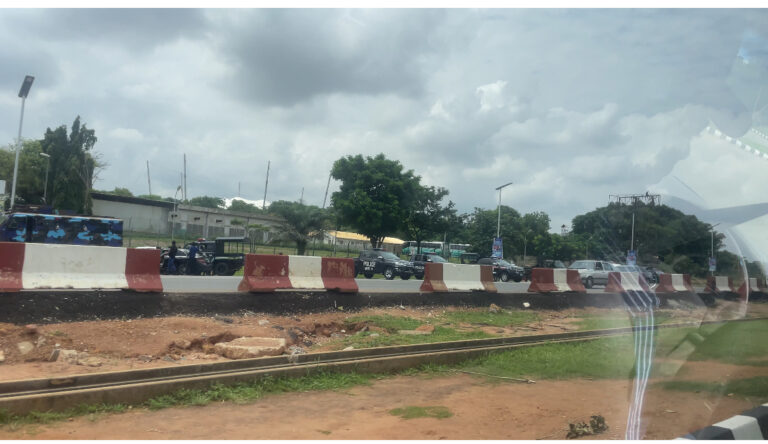
The ICIR crew moved around the city on the fifth day of the protest and could not see protesters in locations where the protests had taken place in the first three days, including the Moshood Abiola National Stadium, Unity Fountain, Eagle Square, Berger and Area 1.

The locations were filled with a heavy presence of security operatives.

People were seen going about their normal businesses and other regular activities, unlike the previous days when everywhere was deserted or filled with protesters.

However, reports indicate that protesters were tear-gassed in the Karu area of the city on Day 5.

While the protest failed to hold, most motorists hung tree branches on their dashboards in solidarity with the protest and to avoid attack from angry protesters.

The northern part of the country continues to see demonstrators on the streets as more state governors impose curfews.

This is coming a day after President Tinubu’s speech to the nation, urging Nigerians to suspend the protest and engage in dialogue.

The President boasted of some strides his administration had made in reforming Nigeria’s economy, despite the hardships many citizens continue to face.

He added that the violent protests that erupted in many states would only set the country backwards and make the government use scarce resources for rebuilding rather than improve on things that already exist.

“As President of this country, I must ensure public order. In line with my constitutional oath to protect the lives and property of every citizen, our government will not stand idly by and allow a few with a clear political agenda to tear this nation apart

“Under the circumstances, I hereby enjoin protesters and the organisers to suspend any further protest and create room for dialogue, which I have always acceded to at the slightest opportunity,” he said.

The ICIR reports that the President’s speech has attracted reactions from Nigerians, including former Vice Presidential candidate Peter Obi, who expressed disappointment over the address, noting that it’s disconnected from the harsh realities faced by Nigerians.

He lamented the lack of empathy towards those injured, arrested, and detained during the protests, citing the approach of security forces as a great concern.

He added that the President should address urgent priorities such as reducing governance costs, combating corruption, tackling the high cost of living, and effectively allocating resources to critical sectors like health, education, and poverty alleviation.

The ICIR reported that insecurity, inflation and a hike in the cost of living, among others, pushed many Nigerians to stage the protest.

Tinubu had stopped fuel subsidy and devalued the naira, thus causing a spiral hike in food and commodity prices.

NNPCL ships newly unveiled crude to Spain despite local demand shortfall

THE Nigerian National Petroleum Company Limited (NNPCL) said it had unveiled and shipped new crude oil grade into the international crude oil market amid demand constraints for crude oil by local refineries.

The NNPCL’s chief corporate communications officer, Olufemi Soneye, disclosed this in a statement on Monday, August 5.

He said, “The new Utapate crude oil blend commenced operations in July 2024, as its first cargo headed for Spain.”

The Utapate crude oil blend is from Oil Mining Lease (OML) 13, fully operated by NNPCL Exploration and Production Limited (NEPL), an NNPCL’s upstream subsidiary.

It is located offshore Akwa Ibom State with a current crude oil production capacity of 28,000 barrels per day (bpd), with the potential to increase it to 50,000 bpd.

According to Soneye, the Utapate crude oil blend has a sulphur content of  0.0655 per cent.

“Spanish oil giant Repsol won the tender for the initial cargo of the new crude blend which is comparable to the much sought-after Amenam crude,” he said.

The  Gulf Transport and Trading, another leading crude oil dealer, has secured the cargoes’ tenders for August and September 2024, Soneye said.

He recalled that during the Argus European Crude Conference in London last year, NNPCL announced the unveiling of Nembe crude oil, produced by the NNPC/Aiteo-operated Oil Mining Lease (OML) 29 Joint Venture (JV).

“Similar to the Nembe crude oil grade, the Utapate crude oil blend has a low sulphur content and low carbon footprint due to flare gas elimination, fitting perfectly into the required spec of major buyers in Europe.

“This remarkable achievement signals the commitment of the NNPC Ltd to increase Nigeria’s crude oil production and grow reserves through the development of new assets,” Soneye said.

However, despite having four refineries, Nigeria exports crude oil and imports refined petroleum products, which has been ongoing over the years.

The country’s inability to refine crude oil production from its soil has negatively impacted its economy.

According to analysts, Nigeria would have earned more foreign exchange if it refined its crude oil rather than exported it, which creates an imbalance in the foreign exchange earnings and leads to volatility in the Nigerian currency market.

The recent outburst between the Nigeria oil and gas regulatory authorities and the management of Dangote Refinery over the secret opening of a blending plant in Malta by some officials of the Nigerian National Petroleum Company Limited (NNPCL), oil traders, and terminals is a concern fresh in the minďs of Nigerians.

The revelation came following the Dangote Refinery’s struggle to get crude oil for its 650,000-capacity built refinery.

The ICIR had reported that the Dangote Group had been at loggerheads over getting crude oil to commence the refining of petroleum products.

The refinery had repeatedly postponed the date for the commencement of refined petroleum products and hopes to start this August.

“If the Dangote Refinery starts to work, it means there will be no business or Malta. Malta is the reason why your naira is weak,” a development economist, Kalu Aja, said in his official X account while reacting to the problems with fuel import, The ICIR reported.

While supplying crude to local refineries seems a recent challenge, a long-time worry has been not meeting its OPEC-assigned crude oil production quota, currently set at 1.5 million barrels per day (bpd).

Nigeria’s daily crude oil production dropped to 1.27 million bpd in the second quarter (Q2) of the year compared to 1.33 million bpd production in the first quarter (Q1), findings by The ICIR show.

The shortfalls in crude oil production directly affect the country’s budgeted revenue from crude oil, which is a major source of income for the government.

Between January and May this year, Nigeria lost over N16 billion in revenue daily from crude oil production, The ICIR reported.

In a recent revelation, Vice-President Kashim Shettima said Nigeria spends $25 billion per annum on the importation of petroleum products.

Tinubu’s economic claims raise concerns amid extravagant, frivolous government spending

0

PRESIDENT Bola Tinubu on Sunday, August 4, boasted of his administration’s achievements in blocking economic leakages and implementing critical reforms, calling on Nigerians to suspend the ongoing nationwide protest. 

In his speech, Tinubu detailed measures he took to stabilise the economy, such as removing fuel subsidies and unifying foreign exchange systems, which he said were important to stop mismanagement that his administration inherited. 

According to him, his government has made significant strides in rebuilding the foundation of Nigeria’s economy to carry citizens into a future of plenty and abundance in the last 14 months that he has led the nation.

“On the fiscal side, aggregate government revenues have more than doubled, hitting over N9.1 trillion in the first half of 2024 compared to the first half of 2023 due to our efforts at blocking leakages, introducing automation, and mobilising funding creatively without additional burden on the people,” he said.

He also noted increased productivity in the non-oil sector with commensurate rise in government revenues and progress in various sectors as evidence of his administration’s success.

“My dear brothers and sisters, we have come this far. Coming from a place where our country spent 97 per cent of all our revenue on debt service; we have been able to reduce that to 68 per cent in the last 13 months. We have also cleared legitimate outstanding foreign exchange obligations of about $5 billion without any adverse impact on our programmes.”

Concerns raised

However, there are concerns over the President’s claims as they do not align with the reality of extravagant government spending and rising economic hardship for many Nigerians.

The trajectory also contrasts sharply with the leaders who many citizens believe show sheer profligacy in utilising national resources – a culture that has stagnated the nation’s progress for decades.

More Nigerians are poorer and hungrier, as food inflation stands at 31. 52 per cent, even as the surge in food prices squeezes an average citizen’s spending.

While the administration over the past year claimed to have rolled out a series of palliatives to alleviate the hardship and suffering that the removal of fuel subsidy has foisted on citizens, many Nigerians didn’t benefit from such interventions.

Similarly, the government’s frivolous and extravagant spending has cast doubts on the administration’s commitment to alleviating hardship in the country.

The ICIR, in March 2024, reported how the country’s 2024 budget has over 512 billion from frivolous line items, according to findings by the Centre for Social Justice (CSJ).

This amount is spread across more than 24 Ministries, Departments and Agencies (MDAs) and could have been saved had the legislature conducted proper oversight.

The ICIR findings from the report revealed that over N358 billion could be saved from the Service Wild Votes; N10 billion from the Federal Ministry of Humanitarian Affairs and Poverty Alleviation, and N2.5 billion from the Federal Ministry of Aviation and Aerospace Development among others.

Recall that the Nigerian Senate suspended a Senator, Abdul Ningi, a senator, for three months over the allegation that the National Assembly padded the 2024 budget.

Worries over Nigerian leaders’ spending spree 

Similarly, in November 2023, The ICIR reported widespread concerns over fiscal rascality by political officeholders in Nigeria, as N1 trillion additional monthly revenue accrual from petroleum subsidy removal was unaccounted for.

Despite being urged by Tinubu to make sacrifices after the fuel subsidy removal, Nigerians are currently under severe economic pains, with the nation’s currency – the naira – galloping from its free fall to the US dollar despite interventions by the Central Bank of Nigeria.

Many economists have argued that a bloated federal executive council of 48 cabinet members has become worrisome for an economy that borrows to fund a large chunk of its national budget.

“Should the government be that large at a time when a lean cabinet seems more needful given the financial state of the country,?” a political economist, Segun Sowunmi, said in response to the development.

The ICIR also reported a huge amount expended on the importation and delivery of 360 sports utility vehicles (SUVs) by the House of Representatives worth N57.6 billion for its members while neglecting indigenous companies and exporting jobs to other advanced economies.  

Also, the dust raised by the N5 billion yacht included in the N2.17 trillion supplementary budget, which many had assumed was for the President, has yet to fully settle, despite borrowing from the World Bank and other multilateral lending institutions to fund the budget.