


By Fatimah Idera
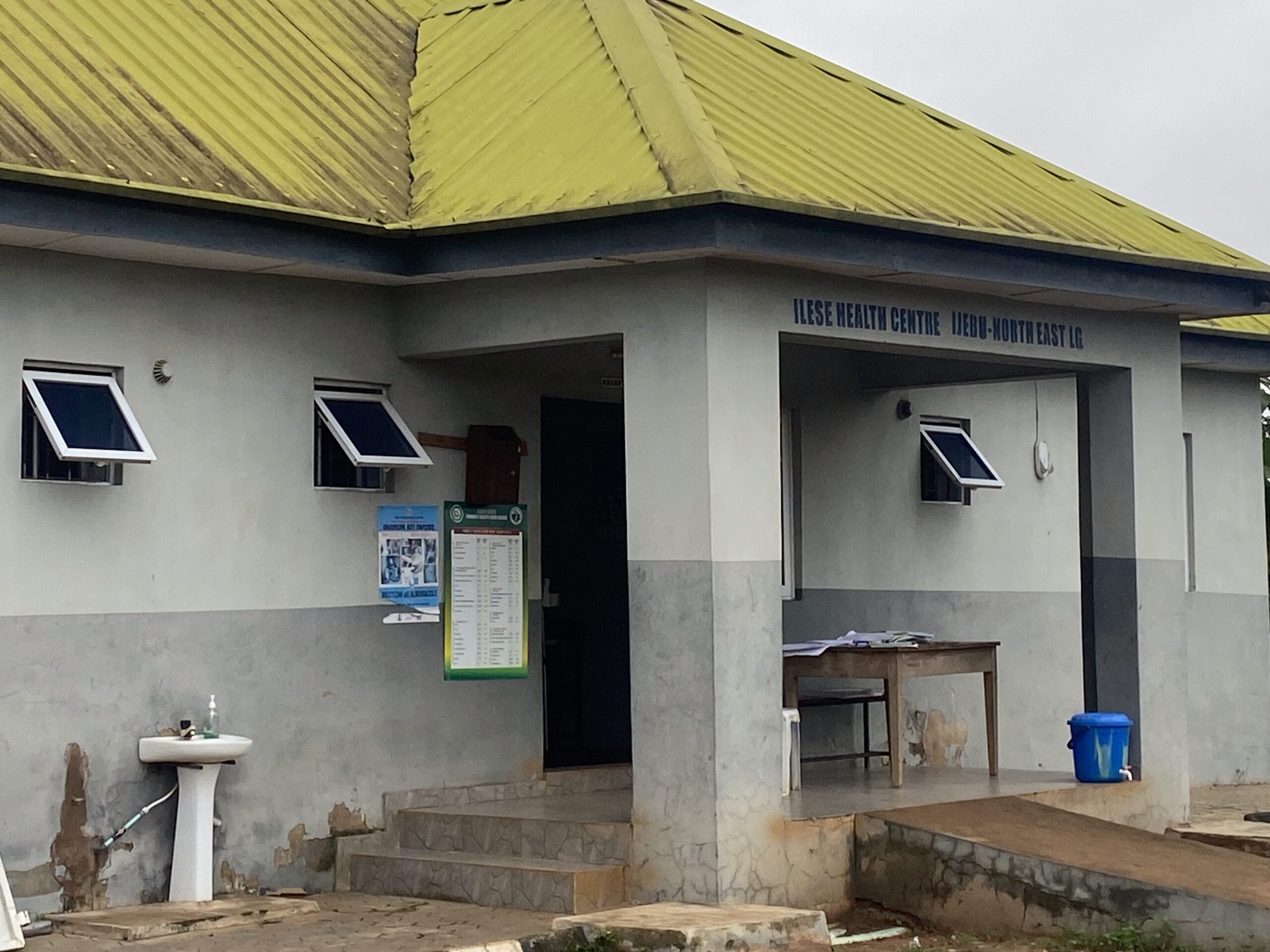
Inside an existing health centre in Ilese, Ijebu-Ode, Ogun State, Nurse Kuye Bello could hardly believe government records showing allocation for the building of a 20-bed primary health facility in the area.
The eight-bed facility she was currently standing in admits about four to five patients weekly, excluding women who come to deliver babies.
Nurse Bello explained that the small facility could never have accommodated the capacity claimed in official records, and checks by this reporter found no other 20-bed facility existing within the hospital premises or around Ilese.
At the eight-bed facility where Nurse Bello works, this reporter observed there was no ambulance. Patients requiring urgent or advanced care are usually stabilised before being referred to hospitals outside the community. For residents across Ilese, Idomila, Idomowo, Odomolasa and Isade, Nurse Bello said the modest facility remains the closest healthcare despite its obvious limitations.
However, to expand healthcare access for residents of the five neighbouring communities, in 2022, the Federal Government released ₦23,570,316.25 to CON-NET Engineering & Material Services Limited to construct a 20-bed primary healthcare centre in Ilese. The following year, the same contractor received another ₦20,796,335.25 for the same project, making it a total of N44,366, 651.


Yet, there is no evidence of the project. Residents of neighbouring communities still rely on the eight-bed health centre, which has no ambulance and limited capacity to manage emergency cases.
During a June visit to Ilese, residents and health workers identified the eight-bed facility as the only government-owned primary healthcare centre. Apart from privately established clinics operating under public-private partnership arrangements, no government-owned 20-bed primary healthcare centre corresponds to the project described in the GovSpend payment records.
An 8-bed facility serving 5 communities
On market days, Simbiat Balogun leaves Ilese for nearby Ijebu-Ode, where she sells foodstuffs to support her family. One day, she developed a high temperature and had to close her store early to get home.
As she journeyed from the market to the hospital, she worried she might be admitted and would have to deal with an aged/tattered mattress at the only community health centre in her area.
Having lived in Ilese, Ijebu-Ode, Ogun State since 2005, Simbiat often relied on the facility and had been occasionally admitted for treatment.
“I spent about two or three days at the healthcare centre when I had malaria, and the bed made my body ache more,” she said.
Beyond the discomfort of the ageing beds, she said the facility does not readily have prescribed medicines.
For Balogun, the health workers’ dedication is not in question. Her concern is whether the centre has the resources to provide the level of care residents need.
Many others who depend on the facility as their first point of contact with the healthcare system share her concern.
Atanda Ibrahim, a patient caregiver, said the health centre cannot handle emergencies, forcing patients with serious complications to seek care elsewhere. “If it is an emergency or accident case, they can’t manage it,” he emphasised.
Families facing complications during childbirth, severe illness or accidents have no choice but to seek care elsewhere, often after an initial assessment at the health centre. Without an ambulance, referrals depend largely on whatever transportation families can arrange themselves, adding time and cost at moments when both can make a critical difference.
Residents praise health workers, but frown at system
Several residents who spoke to this reporter distinguished between frontline health workers’ commitment and the facility’s limitations.
Mrs Titilayo Adebisi, a resident who has used the health centre several times, praised the staff for their patience and professionalism despite limited resources. “They make the best of the little resources available to them”, she said, adding that they distribute medical supplies as fairly as possible.
A 68-year-old resident called “Grandma” also commended the nurses for their commitment, noting that she regularly visits the facility for malaria treatment.
Many residents insist the main problem was not the health workers but the inadequate infrastructure and resources that have failed to keep pace with the growing demand for healthcare in Ilese and neighbouring communities.
Following the money
GovSpend payment records obtained by this reporter show that ₦23,570,316.25 was paid to CON-NET Engineering & Material Services Limited in 2022 for the construction of a 20-bed Primary Healthcare Centre in Ilese.
In the following year (2023), another ₦20,796,335.25 was paid to the same contractor for the same project.
The payment record identifies the implementing office as the Office of the Senior Special Assistant to the President on Millennium Development Goals (OSSAP-MDGs).
A review of publicly available corporate records showed that CON-NET Engineering & Material Services Limited was incorporated on 8 December 2014 with Corporate Affairs Commission (CAC) registration number RC 1229689.

The records list Iwuh Prince Peter and Udemgba Uchenna Kevin as directors and shareholders, with a registered address at 49 Oda Crescent, Wuse II, Abuja.
While the GovSpend records confirmed the release of the amount for the project, they do not establish whether the facility was completed or whether a completion certificate was issued, which agency supervised implementation, or whether the project was formally handed over.
The publicly accessible corporate information platform this reporter checked revealed the company’s status as “Unknown.”
A visit was also made to the available address at 49 Oda Crescent, Wuse II, Abuja on September 11th, but the building could not be located. According to a resident who spoke with this reporter during the visit, the address is wrong and doesn’t exist, while 48B and 50 Oda Crescent, which exist, are residential addresses.
This reporter also reached out to the Senior Special Assistant to the President on Sustainable Development Goals (SSDG), Adejoke Orelope Adefulire, seeking answers to questions about the project by sending a letter as a document to the official email and a call was also placed to the available contact on June 9th and July, but there were no responses
Another message was sent to the same WhatsApp contact, which got the response, “Will revert. Yes, the contract was awarded under the OSSAP-MDGs (Office of the Senior Special Assistant to the President on Millennium Development Goals). I’ve connected you with our team. They’ll review your Freedom of Information request regarding the Ilese Primary Health Centre and get back to you shortly.” A few days later, another response came from the same number saying: “Sorry. This is an automated response. Kindly ignore.”

Similarly, a Freedom of Information (FOI) submitted to the Ogun State Primary Health Care Development Board (OGPHCDB) on 29th of July to the executive secretary, seeking records on the project’s implementation, supervision, completion status and handover, and contractor details was ignored.
While the FOI was acknowledged, no response was received as of the time of filing this report.
The gap between records and reality
On paper, government records indicate that public funds were released to build a 20-bed primary healthcare centre that would strengthen access to healthcare in Ilese and surrounding communities.
On the ground, residents still depend on an eight-bed facility that health workers say lacks the capacity to handle emergencies and was never designed to accommodate the scale of demand it now serves.
The GovSpend payment record shows that ₦23,570,316.25 and ₦20,796,335.25 were released for the project, respectively. What remains unclear is what happened after the payment was made. The records reviewed for this investigation do not answer whether the project was completed, certified or handed over.

But on-the-ground reporting shows the project doesn’t exist, exposing a discrepancy between official records and the reality in Ilese.
For the thousands of residents who rely on the eight-bed facility, however, the unanswered questions have immediate consequences. Their concern is less about what appears in government records than whether the nearest health facility can provide the care they need when illness or emergencies arise.
Experts speak
In an interview with this reporter, a Public Health Consultant and Community Health Physician at the University of Ilorin, Prof. Tanimola Akande, said it is unlikely that an eight-bed health facility would adequately meet the health needs of five communities, particularly considering their combined population and the distances residents may have to travel for care.
He said maternal-related health conditions that require referral must not be delayed, as this could lead to further complications, thereby deteriorating the condition of the patient or the death of the mother or the foetus.
Akande stressed that “In a situation where health workers in a PHC are unable to stabilise an emergency, the health worker is expected to refer such patients to the nearest higher level of health care, like a Comprehensive Health Centre, General Hospital or Teaching Hospital.”
However, he urged the National Primary Health Care Development Agency (NPHCDA) to provide a comprehensive list of the prescribed basic minimum health workforce and material resources for a Primary Health Centre.
“PHCs are therefore expected to have the minimum number of health workers, materials and equipment for that level of health facility,” he said.
On his part, Abuja-based lawyer Hammad Abdulrasheed said section 35 of the Public Procurement Act of 2007 imposes on the supervising ministry or agency the obligation to release 15% as a mobilisation fee for contractors to begin work and a performance guarantee to ensure the contractor delivers the project.
“The public procurement rules state that a contractor who has failed to tender the interim performance certificate based on the 15% that was earlier disbursed would not receive subsequent payment,” he said.
Hammed explained that in a situation like this, the government should enforce the contract and demand repayment of the mobilisation fund. “It is a criminal offence, and an investigation needs to be conducted,” he added
The lawyer explained that a contractor who abandoned a project cannot continue to receive a contract. “If there is a history that a contractor has failed to perform what is expected of them to do based on the contract that was earlier awarded, it can be a condition for denying such contractor further projects and works.”
He added that under the fundamental right principles, section 16 paragraph (b) states that a bidder is excluded “if a supplier or contractor/consultant, during the last three years before the commencement of the procurement in issue, failed to perform or exercise due care in the performance of public procurement.”
Speaking on the inability of this reporter to locate the contractor’s address, Hammad said: “If a contractor put a location on CAC as its home address and such an address doesn’t exist, first it shows that the concerned ministries and agencies have failed to perform their duties and due diligence before awarding such a contractor, which is why they should be held accountable.”
He concluded that the ministry agency department should be investigated on why money was released and the project wasn’t completed.
“In normal circumstances, if 50% of the money was paid, the work is expected to be done, and after filing the performance certificate documents, which is when the remaining funds will be released. If you haven’t executed a project and money was released, that means something is fishy, and a petition could be written to an anti-corruption agency to investigate why money was disbursed before the project was done, and nothing was said,” he said.
This report was funded by the Budeshi Media Grant, an initiative of the Public and Private Development Centre.
This is what they usually do to wave money into their personal pocket. Weldone Fatimah.