
FOR many women with disabilities in Nasarawa State, traditional farming is almost impossible because of mobility challenges, limited access to land, and weak government support. In this report, the ICIR writes on how a farming initiative is helping the women grow food at home, and rebuild independence where the formal system has fallen short.
It was around noon, and the sun scorched the dusty road. Each turn of a passing vehicle lifted a cloud of red dust into the air as Asaba Aversion, a 42-year-old farmer with physical disability, manoeuvred her handcycle, carrying this reporter through the uneven path leading to her home in Gidi Gidi, Lafia Local Government Area (LGA) of Nasarawa State.
Earlier that day, Asaba and her husband, Gambo Anzaku, also physically challenged, had eaten wheat with vegetables and tomatoes from crops they planted in sacks within their compound. They did not have to go to the market. They did not have to beg anyone for help.
A few years ago, life was far more difficult for the couple. They often struggled to reach the market to buy food. Some areas were inaccessible to her handcycle, forcing Asaba to crawl along rough paths. On other days, they relied on neighbours for help, and when no one showed up, they went hungry.
That hardship has now eased. After learning sack farming, Asaba began planting crops such as yams, tomatoes, and vegetables within the comfort of her home. Today, she and her husband grow much of what they eat.
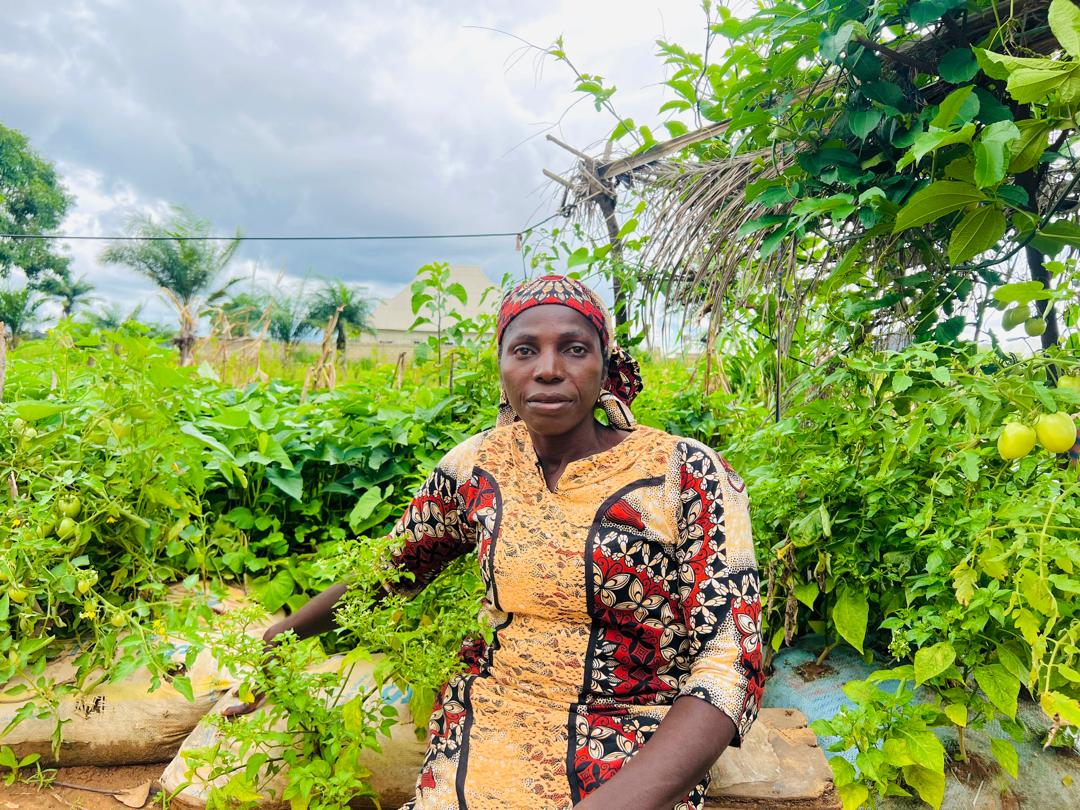
Sitting in front of rows of sacks neatly lined across her yard, she explained how the process works.“First, I mix the soil and sand before putting them into sacks, using the right amount depending on what I want to plant,” she said. “If it’s tomatoes, we use a specific ratio. For sweet potatoes or yams, it’s different. They taught us how to measure everything properly.”
For her, sack farming solves a fundamental problem. Many women farmers with disabilities struggle with the mobility required for traditional farm work. Sack farming brings cultivation to their doorsteps and solves land access challenges. Even when the government provides farm inputs, many smallholder women farmers with disabilities cannot benefit due to a lack of land.
With sack farming, however, “you can plant right in your home,” she explained. “You can place the sack near your doorstep, water it in the morning and go about your day. Anytime you need vegetables, you simply pluck them.”
In Lafia, where she lives, many women in her community are into farming. They plant crops like yams, melons, and potatoes. But even though she possesses the skills and knowledge, Asaba’s condition has always served as a barrier. She had to pay labourers as high as N3,000 per ridge due to lack of government support for disability-friendly farm inputs.
She is one of the hundreds of women trained by Global Initiative for Food Security and Ecosystem Preservation (GIFSEP), a non-profit organisation under the urban farming initiative. Launched in 2024, the sack farming initiative under the project empowers persons with disabilities, especially mobility impairments, by providing them with the skills and resources to cultivate staple crops within their homes.
The training, which targets mostly women, equips participants with practical knowledge to grow their own food and cushion the impact of the worsening food crisis. More than 400 women have been trained under the project, across Nasarawa, Adamawa, Benue States and the FCT under the initiative.
The team lead for the initiative, Michael David, spoke about the emotional and psychological impact of the project, saying it is a way of releasing emotions and depression. “Just because they are physically challenged does not mean they cannot add value to society,” David said. “They can grow food not only to feed themselves but also to feed the nation, especially at this time when the country is grappling with insecurity crises.”
Bridging inequality gap
Sack farming is not a new practice. It is a simple method adopted by many households across Nigeria. However, it requires some practical knowledge on how to plant, nurture and protect the crops from pests. In Nasarawa, it has become a lifeline for smallholder farmers living with disabilities, a group often excluded from access to land, farm inputs, and agricultural support.

The process is straightforward. Farmers fill sacks, usually used rice or fertiliser bags, with a mixture of soil, sand, and organic manure. The sacks are then arranged in small spaces around their homes or compounds, where they can plant a variety of crops such as tomatoes, peppers, yams, and leafy vegetables. With regular watering and minimal maintenance, the crops thrive just as they would in open farmlands.
In Nasarawa State, home to approximately 14,000 smallholder women farmers and 1,217 cooperative groups under the Small-Scale Women Farmers Organisation in Nigeria (SWOFON), women farmers face greater inequalities than their male counterparts, largely due to the government’s agricultural input distribution system, which does not provide equitable access to inputs.
The 2019 National Gender Policy in Agriculture was introduced to bridge this gap by ensuring gender-sensitive planning and equal access to productive resources. But in Nasarawa, implementation has been almost non-existent. Women farmers are often not prioritised in policy and barely represented in input distribution committees, and there is no dedicated budget line for them.
A budget analysis by the SWOFON and the Centre for Social Justice (CSJ) shows that of the ₦5.6 billion expended on agricultural capital expenditure in Nasarawa State in 2024, not a single project was targeted at the specific needs of women, let alone women with disabilities.
Instead, the funds went to the large-scale procurement of tractors, mills, herbicides, and other infrastructure that small-scale women farmers, who typically cultivate less than two hectares and rely heavily on manual labour, cannot access meaningfully.
The Permanent Secretary of the Nasarawa State Ministry of Agriculture, Abdullahi Umar, had acknowledged the inequality in access to agricultural support between male and female farmers.
“What they say is true,” he admitted, adding, “The percentage of men who benefit from farm inputs in the state is higher than that of women.” Umar, however, explained that smallholder women farmers are typically supported through a standing committee at the local government and development area levels.
The committee, he said, is made up of chairmen of LGAs and overseers of development areas, paramount rulers, Divisional Police Officers (DPOs), agriculture coordinators, councillors for agriculture, and heads of security agencies. According to him, women also benefit from intervention programmes such as Fadama III and NG-CARES, and were recently reached directly through ward-level distribution across the state.
He also added that women are usually represented within the existing structures that coordinate farm input distribution in Nasarawa. He, however, did not provide data to back this up.
The coordinator of the Smallholder Women Farmers Association in Nasarawa, Jumai Yohanna, however, disproved this, stating that they are not included in the distribution of inputs.
Tanko Tunga, the Commissioner for Agriculture in Nasarawa State, told The ICIR that the government supports women farmers in various ways, including through cooperative initiatives. He said there is no difference in how the government supports men and women farmers.
“Gender equality is important to us, and we will ensure they are carried along. We are doing our best, and we will continue to do that,” he said.
Despite these assurances, implementation tells a different story. While officials highlight committees and cooperative structures, many women farmers say the support rarely reaches them in any meaningful way.
The situation is even worse for women farmers with disabilities, who face multiple layers of exclusion, including physical, financial, and institutional. Many are unable to access farmland due to mobility challenges, are often left out of farmers’ cooperatives where support is distributed and are rarely considered in official data or empowerment schemes.
For instance, Asaba pointed out that in most cases, out of 100 people, maybe three or four with disabilities are considered for farm inputs, sometimes none are women.
Globally, about 1.3 billion people live with a significant disability, according to the World Health Organisation (WHO). Many of them reside in low and middle-income countries.
Available data from the National Commission for Persons with Disabilities (NCPWD) indicates that 35.1 million Nigerians live with disabilities, representing about 15% of the nation’s population estimated at 237.5 million according to Worldometer.
Nigeria took a major policy step toward inclusion when former president Muhammadu Buhari signed the Discrimination Against Persons with Disabilities (Prohibition) Act into law on January 23, 2019. The Act guarantees the full integration of persons with disabilities into all sectors of society, including agriculture, on an equal basis with others.
International frameworks such as the UN Convention on the Rights of Persons with Disabilities (CRPD) and the Food and Agriculture Organisation (FAO) principles also reinforce these rights, affirming equal access to food, land, water, and agricultural resources for persons with disabilities.
Nasarawa is one of the states that domesticated the Disability Rights Law, prohibiting discrimination against persons with disabilities in all forms and circumstances. However, implementation remains weak, leaving many people with disabilities without meaningful support.
Against this backdrop, sack farming has emerged as a practical alternative for excluded farmers. For people with disabilities, the method removes one of their biggest barriers, which is the need for large farmland and long-distance mobility.
A lifeline for physically challenged women farmers
One of them, Constance Agidi, a woman with physical disability, was seen moving between rows of sacks in her small compound at 500 Estate, Lafia, inspecting the green shoots of tomatoes, sweet potatoes, and yams when The ICIR visited in October. Some of the plants were ready for harvest; others were still sprouting.
The 40-year-old mother of four has witnessed firsthand the struggles many farmers with disabilities face in Lafia.
After showing the sacks, she led this reporter to a corner of her compound where she keeps seedlings in small containers before transplanting them. Her home and the garden have become inseparable. Farming used to be exhausting. She relied on others to dig ridges, prepare the soil, and harvest crops. Most of her income went into paying labourers, and on some days, she returned home with nothing.

“With sack farming, I can plant right in my home,” she said, brushing her hand over a row of leafy greens. “I water them in the morning, and I can harvest anytime I need vegetables. I no longer have to go to the market or depend on anyone.”
Sack farming, she explained, has become a way to claim independence in a system where persons with disabilities are often excluded from government agricultural support.
“Out of 100 people, maybe three or four with disabilities are considered for farm inputs, sometimes none are women. Most of the rest go to able-bodied people,” she said. “They think we can’t manage or will sell the inputs. That perception is wrong.”
Before the sack farming initiative reached her community, Habiba Yahaya, another smallholder woman farmer living with a physical disability, spent years struggling to survive. Being unable to walk meant she could not participate in the traditional farming that sustains most households in her community in Obi Local Government, Nasarawa State.
The labour, such as digging ridges, clearing bush, carrying fertiliser, trekking long distances, was simply impossible.
“Traditional farming requires extensive manual labour,” she said. “As a person with a disability, I can’t do that myself.”
Because she could not farm and had no steady source of income, feeding herself was a daily battle. She often depended on relatives or neighbours to bring food, and she and her family frequently went hungry.
She had never received any form of government agricultural support, despite applying through various channels. She believes people with disabilities are excluded because of a combination of low awareness, inaccessible infrastructure and long-standing stigma.
When she began sack farming, it transformed her routine almost overnight. Today, she grows tomatoes, peppers, bananas, and henna (lele)—a crop that has unexpectedly become her biggest source of income.
With the sacks arranged around her house, she no longer needs to travel anywhere to farm. She waters her crops each morning and harvests them as needed. This has helped her meet up to 70% of her household food needs, cutting food expenses dramatically.
Her income has also improved. She earns from selling henna leaves and occasional harvests of pepper and tomatoes. With this money, she buys basic household items such as soap, salt, kerosene and supports her family with greater confidence.
“Before, even ₦100 could become a problem,” she said. “Now, I can take care of myself and contribute to the family. I feel more respected and valued in my community,” she said.
Another farmer, Joyce Oble, a 49-year-old mother of two from Sabon Pegi in Agwan Tiv, who lives with a mobility-related disability, said she used to depend almost entirely on hired labour for her traditional farm. She paid a minimum of ₦3,000 for planting, ₦4,000 for weeding, and ₦5,000 for harvesting for labourers.
“The money I pay workers is too much,” she said. “But with sack farming, I save that money.”
The savings help her stretch her limited income further.

Joyce noted that during the school term, even a small reduction in food expenses makes it easier to put money aside for her children’s needs. “At least when school starts, I don’t beg anybody,” she said. “Feeding too is easier now.”
Her first attempt at sack farming failed last year. The open space where she planted the sacks was not secure.
“Children used to break them,” she said. “So, everything spoiled.”
This year, she tried again—this time within her compound. It worked. She has already harvested okra and beans, and she plans to expand.
For Joyce, sack farming has restored her dignity and reduced her dependence on labourers. It also gives her the ability to contribute to her household without feeling like a burden.
“With this sack farm, I can do things by myself,” she said. “I don’t need anything heavy. I remove weeds with my hand. I water it from home. It is very simple.”
Her children also spend less time helping her manage long-distance farming, allowing them more time for school and chores.
Joyce believes that targeted support would go a long way.
Asabe Assoloko narrated how sack farming has helped her feed and care for her three children. The 37-year-old, who lives in the Lafia Nugu area, said life was extremely difficult before she learned about sack farming.
“Before the training, it was hard to feed,” she said. “Sometimes my children and I would go hungry because there was no money to buy food, and I have never received any farming support from the government.”

“Some got spoiled,” she said, “but many survived, and that was enough for us to eat.”
She explained that sack farming has helped her save money and feed her family without depending on others.
“Before, I used to buy vegetables and cocoyam leaves,” she said. “Now I use what I grow. The little I would have spent at the market, I use it to buy soap, salt, or small foodstuffs for my children.”
Challenges with sack farming
However, sack farming also comes with its own challenges.
“If you are doing sack farming and you don’t have water around you, as a person with a disability, it’s a challenge,” Asaba Aversion said.
She explained that without water, it is a problem. She often has to think about going to the stream or finding another source, such as a nearby well.
According to her, lack of water is the biggest challenge. The second, she added, is dealing with pests. She, however, said they had been taught how to use nitrate when the plants are affected by pests and how to apply it properly.
For Asabe Assoloko, she said she struggles with limited space, a lack of fencing, and animals often eating her crops.
“Sometimes, fetching water is the hardest part,” she added. “If I have money, I will fence this area because animals sometimes disturb the plants in this open space. We need government support to expand because I want to continue.”
“If the government can help us with funds to get more space, fence it, and buy water containers, it will make things better,” she added. “We are trying our best, but with a little support, we can do more.”
Constance Agidi also shared the challenges she faces, including water scarcity, pest attacks, and poor fertilisers. Even after applying nitrate, she said, her crops sometimes still suffer.
Despite the challenges, she, however, said she will continue.
“It has given me a means of livelihood. I can grow yams, sweet potatoes, and vegetables. Now, money that would have gone into buying foodstuffs goes to paying our children’s school fees and meeting other necessities.”
SWOFON asks government to learn from the initiative
The Smallholder Women Farmers Organisation in Nigeria (SWOFON) called on the Nasarawa State government to learn from the ongoing sack farming initiative and extend similar support to women farmers in Nasarawa, especially for many other women living with disabilities.
The coordinator of the organisation in Nasarawa state, Jumai Yohanna, said many of the women, including those who are blind or physically disabled, face immense barriers to accessing government support.

“Some can’t see, some can’t walk, and most don’t even have money to move from one office to another to complain about what they are going through,” she said.
“Even when opportunities come, they are not included. The government sometimes give the impression that they prefer people to come to their offices and lobby, which is impossible for many of them.”
She noted that initiatives like the one introduced by GIFSEP, which trained women with disabilities in sack farming, have made a huge difference.
“With the help of God, they now find it easier to plant maize, melon, and sweet potatoes, which they use to feed their families,” she explained.
Jumai urged the government to adopt similar approaches and provide mobility aids such as bicycles to help women with disabilities access farmland. She said most of them have nothing to do, and many cannot move around without help.
“We’ve complained to the Ministry of Agriculture to support and train them so they can do things on their own.”
“This year, the prices of things have increased, but the price of farm produce like rice and maize keeps falling,” she said.
“A bag of rice is ₦50,000, manure is ₦52,000, and even hiring labourers has doubled. We are suffering, and the government knows but has not done anything,” she said.
“We need land. If they can give us a place where we all have our own portion, it will help us. We need seeds too. This type of farming does not need chemicals—only support.”

Nurudeen Akewushola is an investigative reporter and fact-checker with The ICIR. He believes courageous in-depth investigative reporting is the key to social justice, accountability and good governance in society. You can reach him via nyahaya@icirnigeria.org and @NurudeenAkewus1 on Twitter.
Awaresome