
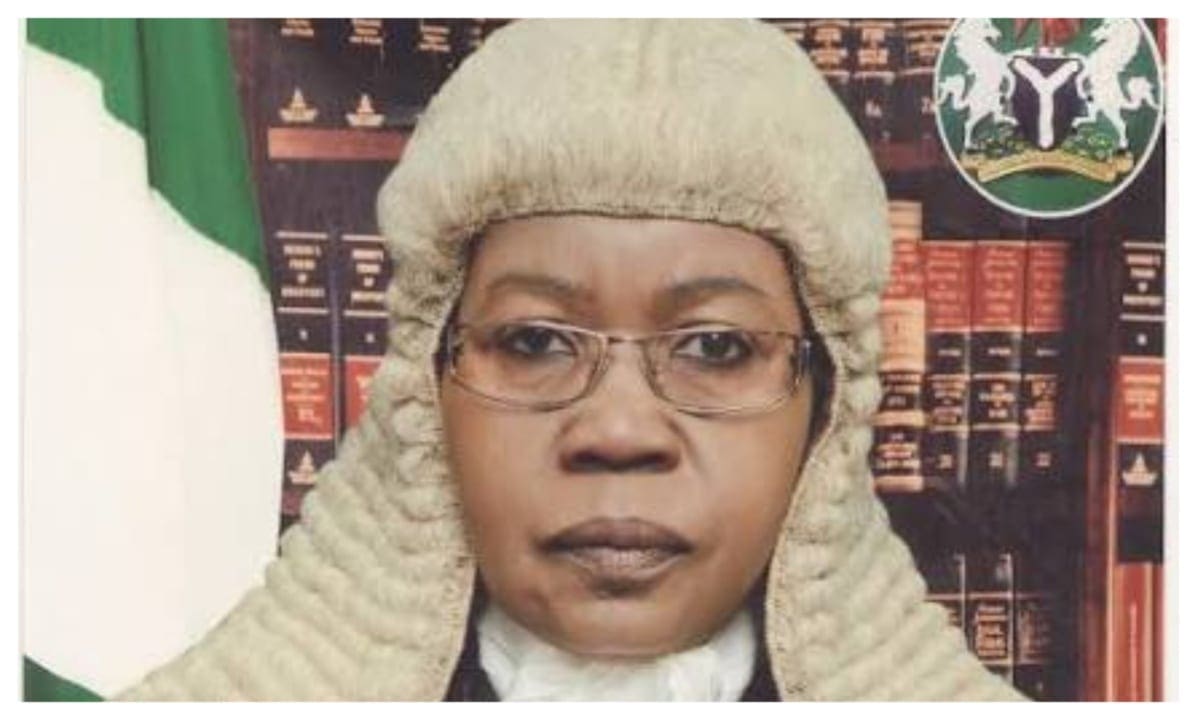
SOME justices of Nigeria’s Supreme Court are still facing travel restrictions imposed by the United States over a controversial judgment delivered by the apex court, a retiring Justice, Uwani Musa Abba-Aji, has disclosed.
Abba-Aji reportedly made the disclosure on Friday, November 6, during a valedictory session held in her honour at the Supreme Court in Abuja, saying the restrictions followed a judgment delivered by a seven-member panel of the court which she described as widely misinterpreted.
She did not identify the judgment or disclose when the US imposed the restrictions.
However, her revelation comes amid previous allegations that the US denied visas to justices who delivered the January 2020 judgment that removed Emeka Ihedioha as Imo State governor and declared Hope Uzodimma winner of the 2019 governorship election.
Former Cross River State Governor, Donald Duke, made the allegation in February 2023, claiming that the seven justices involved in the judgment were denied US visas when they applied to attend a judicial conference in the country.
The panel comprised Abba-Aji, the then Chief Justice of Nigeria (CJN), Ibrahim Tanko Muhammad, the current CJN, Kudirat Kekere-Ekun, as well as Nwali Sylvester Ngwuta, Olukayode Ariwoola, Amiru Sanusi and Amina Adamu Augie.
According to Duke, the justices’ aides who applied alongside them were granted visas, while the judicial officers were denied.
Although Abba-Aji did not expressly identify the Imo judgment as the one that led to the restrictions, she said the consequences of the decision had remained with members of the panel.
“My time on the Supreme Court bench was filled with challenges, some of which have served as additional opportunities to stand firm on the side of justice, regardless of the consequences.
“One of such challenging judgments was widely misinterpreted and led to a travel ban to the United States of America being imposed on all members of the panel, a ban which still holds today,” she said.
The controversial Imo judgement
The January 14, 2020, judgment generated controversy after the Supreme Court overturned the decisions of the Imo State Governorship Election Petition Tribunal and the Court of Appeal, which had upheld Ihedioha’s victory.
Before the judgment, the Independent National Electoral Commission (INEC) had declared Ihedioha of the Peoples Democratic Party (PDP) winner with 273,404 votes, while Uzodimma of the All Progressives Congress (APC) scored 96,458 votes.
However, the Supreme Court, in a unanimous decision by a seven-member panel, held that results from 388 polling units had been unlawfully excluded from the final collation of the election.
The court ordered that the votes Uzodimma claimed to have secured in the affected polling units be added to the results declared by INEC.
Following the recalculation, the court declared Uzodimma winner and directed INEC to withdraw Ihedioha’s certificate of return and issue a fresh one to him.
The decision attracted criticism from opposition figures and civil society groups, some of whom questioned the court’s reliance on the disputed results from the 388 polling units.
Meanwhile, Abba-Aji, who is retiring from the Supreme Court on November 7 after attaining the mandatory retirement age of 70, described the visa restrictions as one of the sacrifices she made in the course of her judicial service.
“Such inconveniences were a small price to pay to preserve the chastity of justice,” she added.
The retiring justice also recalled that in 2016, while attending a programme in Washington DC, she received a call asking her to report to the Economic and Financial Crimes Commission (EFCC) over a petition against her in Lagos State.
She said the petition made her a regular visitor to the commission, where she answered questions about corruption allegations she maintained she knew nothing about.
According to her, the EFCC eventually cleared her of all the allegations after its investigation.
She described the experience as difficult, saying the allegations generated public criticism but the conservative nature of the judiciary prevented her from publicly defending herself.

Mustapha Usman is an investigative journalist with the International Centre for Investigative Reporting. You can easily reach him via: musman@icirnigeria.com. He tweets @UsmanMustapha_M