
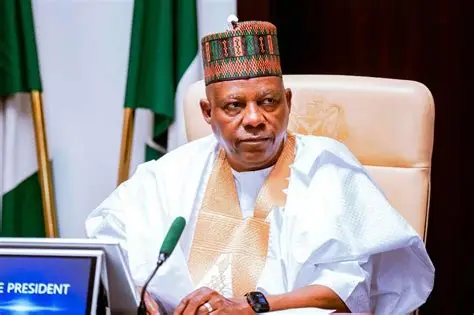
VICE-PRESIDENT Kashim Shettima has urged African countries to stop exporting their mineral wealth as raw materials and instead use it to create jobs and drive industrial growth.
Shettima also said Africa must strengthen cooperation, process more of its minerals locally and build industries around resources increasingly critical to the global economy.
He spoke at the Third High-Level Roundtable of the Africa Minerals Strategy Group (AMSG), held on the sidelines of the 81st UN General Assembly in New York.
The roundtable, themed “From Resources to Wealth: Continental Cooperation for Mineral Value Addition,” brought together governments, investors and mining-industry stakeholders.
Shettima said the real value of Africa’s enormous mineral endowment should ultimately be measured by its impact on ordinary Africans.
He challenged countries to move away from an economic model in which raw resources leave Africa while finished products return at significantly greater value.
According to him, greater continental cooperation on mineral governance would enable Africa to strengthen its negotiating power and capture more value from global supply chains.
The vice-president urged the strategy group members to develop bankable projects capable of attracting investment into processing, manufacturing and other value-adding activities.
He said such projects should create employment, stimulate industrialisation and ensure mineral-producing communities receive tangible benefits from resources extracted from their environments.
Nigeria’s Minister of Solid Minerals Development and AMSG Chairman, Dele Alake, called for urgent reforms to integrate artisanal miners into regulated mining systems.
Alake said governments should distinguish artisanal miners seeking legitimate livelihoods from illegal operators involved in criminal activity.
He argued that artisanal mining should be formalised and properly regulated rather than treated principally as criminal activity.
“Illegal mining must remain illegal, but artisanal miners should have a structured framework that allows them to operate legally and safely,” he said.
The minister said many artisanal miners were breadwinners whose families depended on mining for survival.
He expressed concern over recurring mine-site collapses across Africa, saying preventable deaths demonstrated the urgent need for stronger safety standards and regulatory oversight.
Alake said formalisation could provide miners with safer operating conditions, access to training, equipment, finance and government regulation.
He said it could also improve traceability of mineral production while reducing smuggling, environmental degradation and other activities associated with poorly regulated mining.
Kenya’s Cabinet Secretary for Mining, Blue Economy and Maritime Affairs, Hassan Ali Joho, called for greater sharing of geological and mineral data among African countries.
The AMSG comprises more than 30 African countries and seeks to give the continent a stronger collective voice on mineral governance, local processing and positioning within global supply chains.
The group has advocated harmonised mining policies, shared infrastructure, regional processing hubs and stronger geological data systems as tools for attracting investment and strengthening Africa’s bargaining position.
President Bola Tinubu chairs the AMSG General Assembly and has previously urged members to speak collectively and prevent Africa from remaining simply a source of raw materials for industrialised economies.
Representatives of Tanzania and Chad also made presentations at the event attended by Foreign Affairs Minister Bianca Odumegwu-Ojukwu and Permanent Representative of Nigeria to the UN, Jimoh Ibrahim.
Also present were Governors Babagana Zulum, Abdullahi Sule, Nasir Idris and Siminalayi Fubara of Borno, Nasarawa, Kebbi and Rivers states, respectively. (NAN)

Marcus bears the light, and he beams it everywhere. He's a good governance and decent society advocate. He's The ICIR Reporter of the Year 2022 and has been the organisation's News Editor since September 2023. Contact him via email @ mfatunmole@icirnigeria.org