
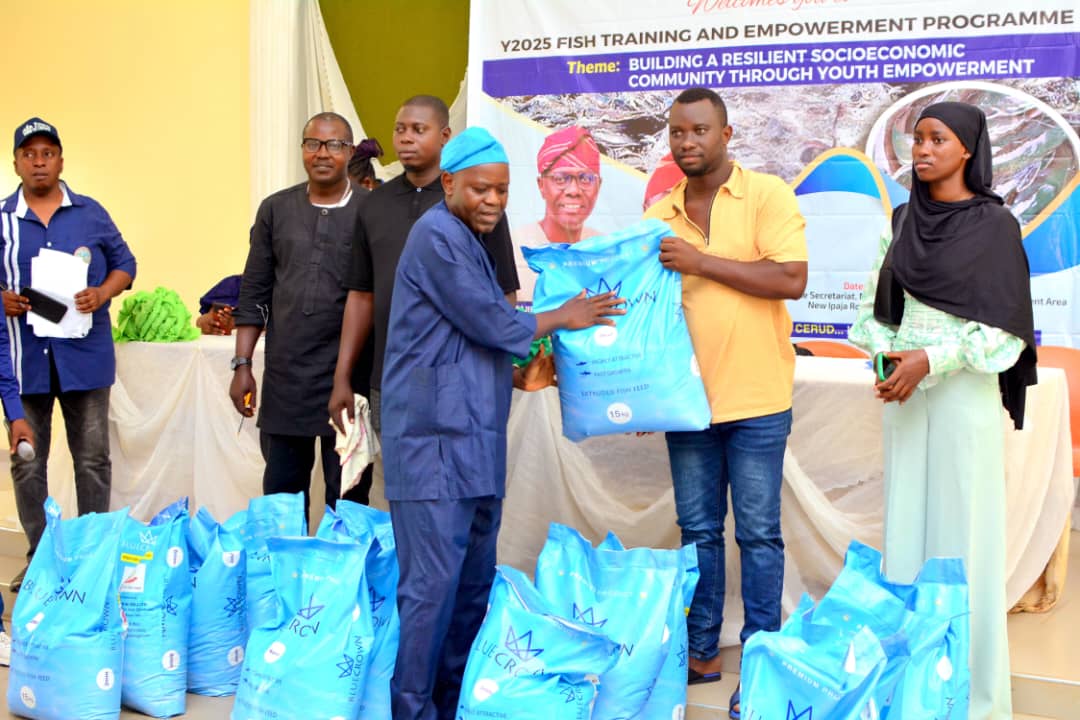

By Moshood Oshunfurewa
Empowerment, at its root, is assumed to be the radical belief that ordinary people are not infants. It holds that the woman in Ajegunle, the roaming youth in Alimosho, the fisherman in Epe and the mechanic in Ikorodu are capable of self-determination, critical thinking, and problem-solving.
They do not need to be spoon-fed like babies or managed like slaves. They need tools, access, and opportunity, so that they can produce, earn, and stand tall. That is the philosophy. It is a philosophy of dignity, of productivity, of human beings treated as human beings.
But what do we see in Nigeria today? A complete contradiction. A daylight robbery of that capitalist idea.
In the hands of our politicians, empowerment has been hollowed out and refilled with poison. Today, empowerment is not a ladder out of poverty; it is a chain around the neck of the poor. It has become the instrument through which politicians mobilise party members for crumbs and use those crumbs as their own personal ATM.
Across the 20 local government areas of Lagos State, chairmen have turned linguistics into fraud. Every programme must carry a grand adjective: “Mega Empowerment,” “Renewed Hope Touch,” “Divine Lift Initiative.” Beautiful names for an ugly transaction, which is the distribution of money to card-carrying party loyalists, not to the poor, not to the needy, but to the party faithful.
And even those faithful are cheated. Here is how the arithmetic of betrayal works. A chairman announces ₦50,000 for each “beneficiary.” The cameras roll, the newspapers report, the social media influencers applaud. Then the beneficiary is quietly summoned.
“Return the money,” the godfather or godmother commands. The ₦50,000 goes back into the pocket of the political machine, and the poor party member is given ₦2,000 or ₦5,000 or nothing at all, except perhaps one miserable cup of garri or one derica of rice.
Multiply this by thousands of beneficiaries across Isolo, Oshodi, Mushin and Ojo, and you understand why poverty in Nigeria has refused to die, no matter how many billions we claim to spend on it.
The numbers themselves sit in judgement. In March 2025 alone, ₦409.26 billion was shared to local governments nationwide through FAAC. Lagos, the richest state, takes the lion’s share; its councils and state treasury received tens of billions monthly, with Alimosho alone collecting about ₦3.56 billion in July 2026, the highest of all 774 councils in Nigeria, roughly ₦1,822 per resident.
Ifelodun LCDA in Lagos State, led by Mr Femi Okeowo, home of Mosafejo-Amukoko residents, collected over ₦2.14 billion in a single month. But walk through those same councils, and what do you find? Overcrowded classrooms, roads that are rivers of mud, no primary healthcare worth the name, and open drains breeding disease. The money is “empowered” into private pockets, and the people are empowered with Garri.
And it is not only at the local level. At the state level, the theatre of the absurd continues. Okada motorcycles are distributed as empowerment, machines whose riders die daily on Lagos highways.
Grinding machines for pepper, deep freezers, and sewing machines are rolled out with fanfare as instruments of liberation, as if a freezer without constant electricity can lift a family out of poverty in a country where 43 per cent of the population lacks access to electricity and some 60 million Nigerians lack clean water.
These are not empowerment programmes; they are election mobilisation kits, rented and returned after every poll.
Now ascend to the national stage, where the contradiction becomes a national embarrassment. In late September 2026, after a three-day APC National Executive Council retreat in Maiduguri, Borno State, the party’s National Chairman, Professor Nentawe Yilwatda, addressed journalists on the federal government’s poverty alleviation efforts.
He declared that more than 10 million vulnerable Nigerians who benefited from the ₦75,000 Conditional Cash Transfer programme do not own mobile phones, television sets, or have access to social media.
Think deeply about what this confession means. In the 21st century, in an oil-rich country, over 10 million of our poorest citizens are so stripped of the basics of modern life that the ruling party can proudly count their destitution as evidence of its programme’s reach. This is not poverty alleviation; it is armed robbery without conscience, a national confession that we have kept tens of millions of our people in darkness while congratulating ourselves for tossing them cash that inflation swallows the very next morning. And because it is a ruling party affair, nobody calls it wrong.
The consequences of this organised deception are written all over our national life. According to the National Bureau of Statistics’ Multidimensional Poverty Index, about 133 million Nigerians, 63 per cent of the population, are multidimensionally poor. The World Bank now estimates that poverty has climbed further, with roughly 140 million Nigerians, again about 63 per cent, living below the poverty line in 2025.
Unemployment stands at around 33 per cent, with youth unemployment exceeding 40 per cent, and about 20 million children are out of school. Two-thirds of Nigerian children are multidimensionally poor. Yet every month, billions in FAAC allocations flow to councils where the chairman’s priority is photographing himself handing out cash to party members.
So, what would genuine empowerment for productivity look like? It would begin by respecting the philosophy it claims to profess. It would mean galvanising the low-income masses and the roaming youths of Ajegunle, Alimosho, Isolo, Epe and Ikorodu into organised, equipped production cooperatives with real capital. Not photo-ops; skill centres wired to markets, not sewing machines without thread; agro-processing hubs in Epe and Badagry that can take raw produce, add value, and pay living wages.
It would mean giving young people machines, land, power, and guaranteed off-takers, so that they produce at scale, earn steadily, and pay taxes back to the council. That is empowerment that creates productivity and productivity that creates prosperity.
Empowerment, in truth, is not the distribution of money. It is the distribution of capacity. Any chairman, governor, or president who gives a man fish every campaign season while starving him of the river, the net, and the boat is not empowering him; he is purchasing him.
Nigeria’s 774 councils receive hundreds of billions every year; Nigeria’s poor receive garri, rice, okada, and promises. Until we elect leaders who understand that the people are not votes to be bought but producers to be equipped, our empowerment programmes will remain what they are today: the loudest, most decorated instrument of looting ever invented, robbery in the name of kindness, and malfeasance in the name of hope. Genuine empowerment begins with dismantling this scam.
Moshood Oshunfurewa is a public affairs analyst. He writes from Lagos and can be reached at:
moshoodho2025@gmail.com | 08035936663