
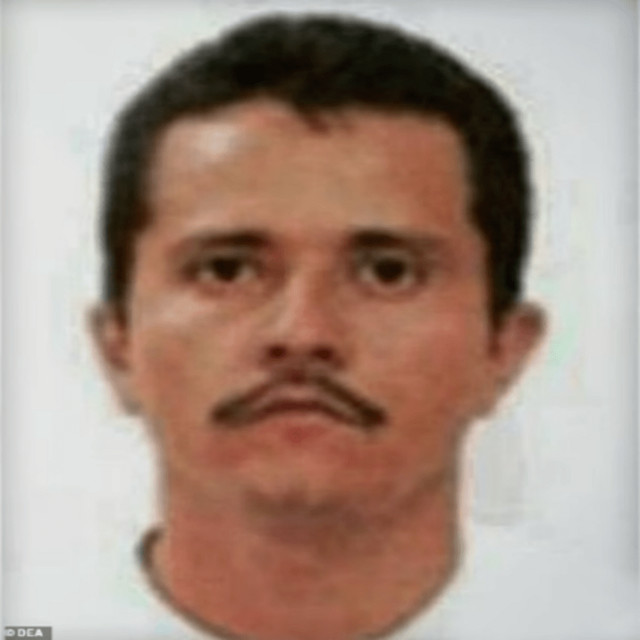
THE killing of Nemesio Rubén Oseguera Cervantes, better known as “El Mencho” has unleashed a wave of coordinated violence across Mexico, plunging large swathe of the country into chaos and stoking fears of a brutal power struggle within one of the nation’s most feared criminal organisations.
El Mencho, 59, was the founder and leader of the Jalisco New Generation Cartel (CJNG), widely regarded as Mexico’s most powerful and militarised drug trafficking group. For more than a decade, he built a sprawling empire trafficking fentanyl, methamphetamine and cocaine into the United States, while orchestrating brazen attacks against Mexican security forces and government officials.
One of the world’s most wanted fugitives, with a $15 million bounty placed on his head by the Drug Enforcement Administration, El Mencho had repeatedly evaded capture. His defiance came to a violent end on Sunday during a high-stakes military operation in the town of Tapalpa.
According to officials. Mexican special forces, supported by intelligence from the United States, moved into a property in rural Jalisco State where El Mencho was believed to be hiding and cartel gunmen opened fire as troops approached, triggering a fierce shootout.
Authorities said four CJNG members were killed at the scene and El Mencho was seriously wounded. He died while being flown to Mexico City for medical treatment.
Officials added that security forces seized armoured vehicles, high-calibre rifles and rocket launchers during the raid.
President Claudia Sheinbaum praised the armed forces, declaring there was “absolute coordination” among federal and state authorities. “We work every day for peace, security, justice, and the wellbeing of Mexico,” she wrote on social media.
Al Jazeera reported that within hours after the news broke, suspected organised crime groups launched coordinated attacks across at least 20 of Mexico’s 32 states. In cities spanning Jalisco, Michoacán, Guerrero, Nuevo León and Tamaulipas, buses were torched, highways blocked with burning vehicles, and businesses forced to shut their doors.
Authorities in Jalisco, Michoacán and Guanajuato reported at least 14 additional deaths in the unrest, including seven members of the National Guard.
In Guadalajara, the capital of Jalisco and a host city for the upcoming 2026 World Cup, streets emptied as residents sheltered indoors. Schools were closed, public transport stalled, and much of the city appeared paralysed.
The United States Embassy in Mexico issued a security alert urging American citizens in several affected states to remain indoors.
With El Mencho gone, uncertainty looms over who will control the CJNG’s vast criminal enterprise. The cartel expanded aggressively under his leadership, moving into new territories and confronting rivals with extreme violence. Without a clear successor, regional commanders could splinter, igniting internal conflict.
Such fragmentation often results in spikes in extortion, kidnappings and forced recruitment as rival cells scramble for resources and dominance.
The timing is especially sensitive as Mexico prepares to co-host the 2026 FIFA World Cup, with Guadalajara among the selected venues. What appears to be a major triumph for the government could evolve into a prolonged security challenge.
The fall of a kingpin has removed one of Mexico’s most wanted men. But in a country long scarred by cartel violence, it may also have opened a volatile new chapter.

Nanji is an investigative journalist with the ICIR. She has years of experience in reporting and broadcasting human angle stories, gender inequalities, minority stories, and human rights issues. She has documented sexual war crimes in armed conflict, sex for grades in Nigerian Universities, harmful traditional practices and human trafficking.