
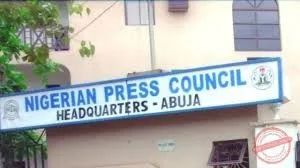
THE Nigerian Press Council, the federal agency established to regulate journalism practice and promote professional standards in the media, was allocated N329 million for classroom projects and another N311 million for streetlight installations across several states in the Federal Government’s 2026 budget.
This raises fresh questions about the growing practice of assigning projects to government agencies outside their statutory mandates.
Analysis of the approved 2026 budget documents by The ICIR shows that the council has become an implementing agency for projects spanning education, healthcare, rural electrification, agriculture and community development despite its statutory functions being limited to media regulation and journalism development.
Established under the Nigerian Press Council Act, the council is mandated to promote high professional standards in journalism, receive and investigate complaints against the press and journalists, monitor developments likely to restrict the free flow of information, conduct research into contemporary press issues, accredit journalism training institutions and uphold ethical standards within the media industry.
The council also maintains records of newspapers, magazines and other periodicals and serves as a mechanism for resolving disputes involving journalists and media organisations.
However, budget records indicate that the agency has been assigned projects more commonly associated with ministries and agencies responsible for education, health, power, agriculture and rural development.
Among the projects allocated to the council are classroom renovation schemes worth hundreds of millions of naira. The agency is expected to undertake the renovation of classrooms and supply of chairs and tables to selected secondary schools across Delta Central Senatorial District at a cost of N140 million. Another N140 million was budgeted for the renovation of selected schools in Ose and Akoko North-West Local Government Areas of Ondo State.
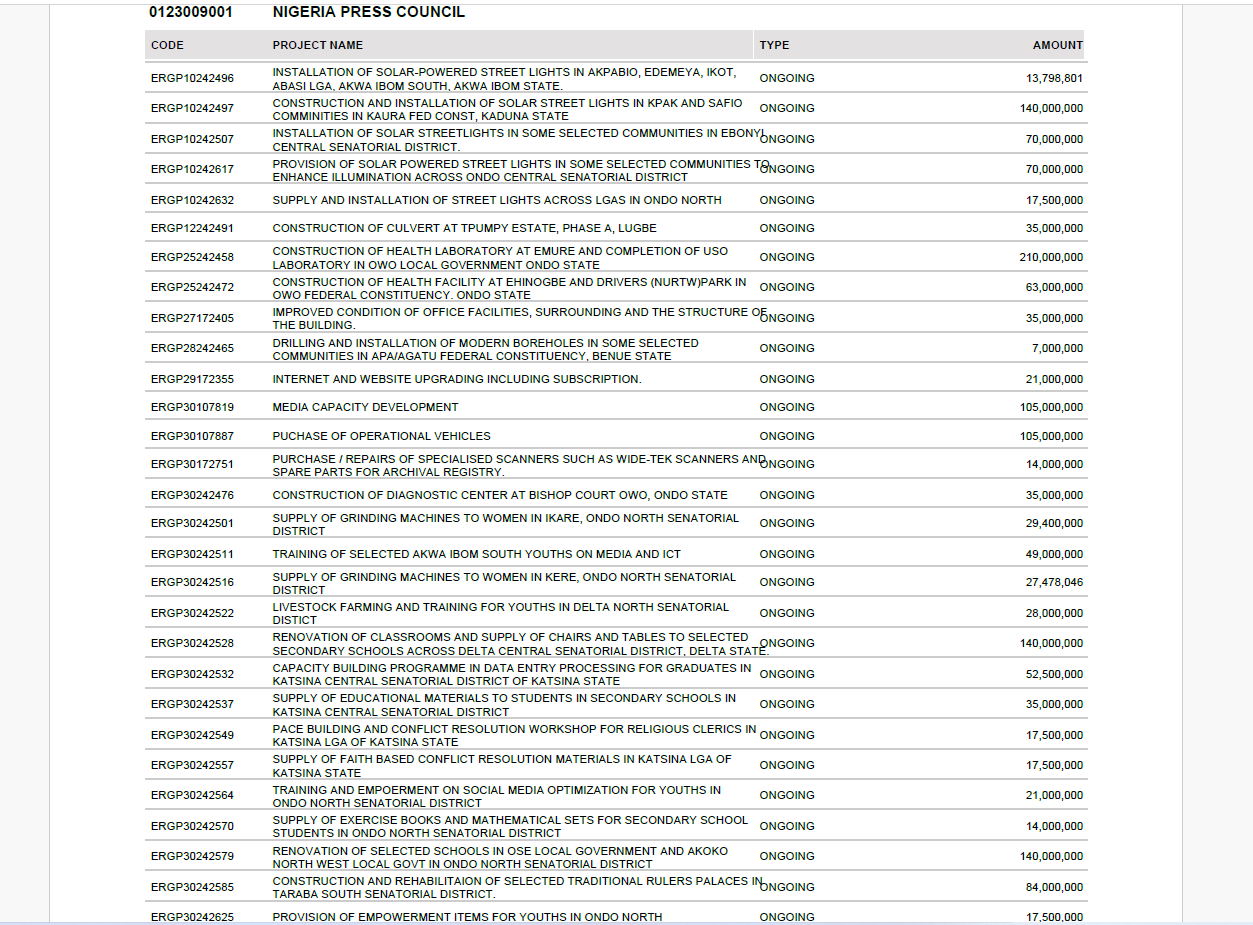
The council is also handling the supply of educational materials to students in Katsina Central Senatorial District valued at N35 million, alongside the distribution of exercise books and mathematical sets to secondary school students in Ondo North Senatorial District.
In total, education-related interventions assigned to the agency total N329 million.
The pattern extends to rural electrification projects.
Budget records show that the council is implementing streetlight projects valued at more than N311 million across different parts of the country. The largest among them is the N140 million earmarked for the construction and installation of solar-powered streetlights in Kpak and Safio communities in Kaura Federal Constituency of Kaduna State.
The council was also allocated N70 million for the installation of solar streetlights in selected communities in Ebonyi Central Senatorial District and another N70 million for similar projects across communities in Ondo Central Senatorial District.
Additional allocations include solar-powered streetlights in communities within Ose Local Government Area of Ondo State and parts of Akwa Ibom State.
Beyond schools and streetlights, the council was allocated N210 million for the construction of a health laboratory and completion of a laboratory facility in Owo Local Government Area of Ondo State, one of the most expensive projects under its portfolio.
Another N63 million was earmarked for the construction of a health facility in Ehinogbe and drivers park, also in Owo.
Other projects domiciled under the agency include borehole construction, livestock farming training for youths, the rehabilitation of traditional rulers’ palaces, women empowerment programmes, conflict-resolution workshops for clerics and the distribution of grinding machines.
The findings come amid heightened scrutiny of Nigeria’s budgeting process following the recent discovery of a non-existent government agency, the Presidential Foreign Intervention Promotion Council, which was allocated N1.3 billion in the 2026 budget despite lacking any legal basis for its existence.
Findings by The ICIR showed that the purported council was listed under the Presidency with ₦802.9 million for personnel costs, ₦200 million for overhead expenditure and ₦300 million for capital projects.
However, the Presidency’s defence, contained in a statement issued on Wednesday, July 1, by presidential spokesperson, Bayo Onanuga, did not explain why the council appears in the 2026 Appropriation Act with a budgetary allocation of more than ₦1.3 billion.
The reaction came days after Adeniyi Adeyemi, who had claimed to be the Director-General of the PFIPC, accused Tinubu’s Chief of Staff, Femi Gbajabiamila, of demanding part of the council’s alleged take-off grant and challenged the Presidency’s claim that the agency did not exist.
Adeyemi had questioned how Gbajabiamila could describe him as an impostor while he was demanding 58 per cent of the agency’s alleged N27.4 billion take-off grant.
He also queried the Presidency how he was able to attend meetings with envoys, head of government agencies and secured approval to recruit 300 employees if his agency were fake.
He further alleged that the Chief of Staff received N400 million through proxies to facilitate his appointment as director-general of the council, with an outstanding balance of N200 million yet to be paid.
Responding to the allegations and ensuing public outrage, the Presidency described Adeyemi as an impostor who had created a fictitious government agency and used forged documents to deceive government institutions, foreign missions and the public.
The ICIR reported that Tinubu ordered the Independent Corrupt Practices and Other Related Offences Commission (ICPC) to probe all issues surrounding the agency and report to him within 30 days.

Nurudeen Akewushola is an investigative reporter and fact-checker with The ICIR. He believes courageous in-depth investigative reporting is the key to social justice, accountability and good governance in society. You can reach him via nyahaya@icirnigeria.org and @NurudeenAkewus1 on Twitter.