

Arinze Chijioke
Chukwuemeka Odumegwu Ojukwu University (COOU) is mired in a governance crisis linked to the appointment of Vice-Chancellor Prof. Kate Azuka Omenugha. Her appointment allegedly bypassed a merit-based selection process, which triggered the dismissals of key figures who challenged or oversaw the process. Allegations of corruption, financial mismanagement, and abuse of office have since deepened concerns about transparency, procurement practices, and conflicts of interest under her watch. This investigation examines Omenugha’s appointment and administration to determine whether due process and standards of good governance were upheld.
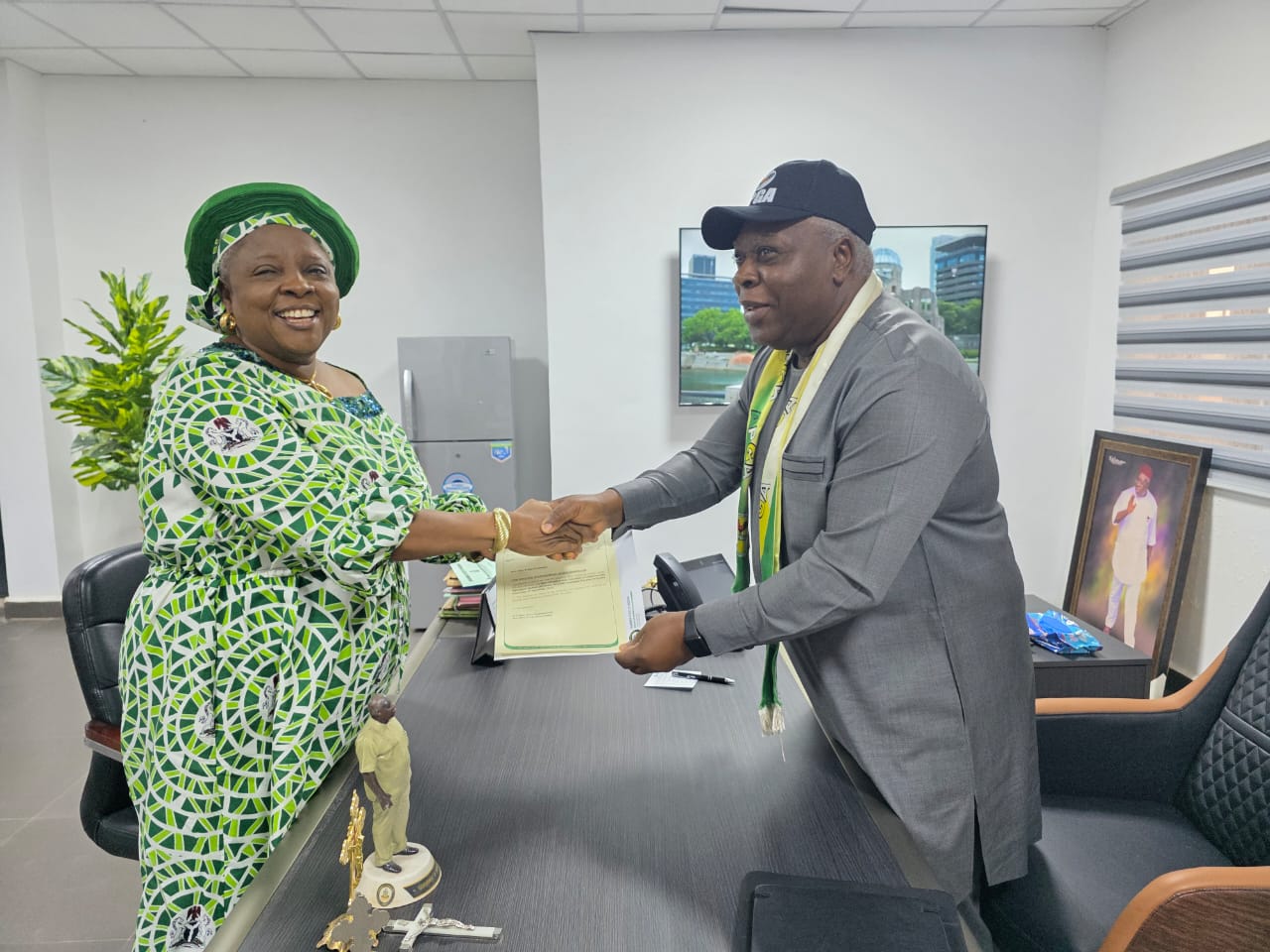
On August 6, 2025, inside the Anambra State Government House in Awka (the Light House), a brief ceremony was held in honour of Prof. Kate Azuka Omenugha, who had just been confirmed as the substantive Vice Chancellor of the Chukwuemeka Odumegwu Ojukwu University by its Visitor and Governor of Anambra State, Charles Soludo. The formal letter of appointment was presented to Prof. Omenugha by the Secretary to the State Government, Prof. Solo Chukwulobelu.
Before her confirmation, Omenugha, a former Professor of Mass Communication at the Nnamdi Azikiwe University, Awka, was appointed by Soludo to serve in an acting capacity from November 29, 2023, after Prof. Greg Nwakoby, the VC, completed his five-year tenure.
But was Omenugha the most suitable candidate for the position of Vice-Chancellor of the University? Available documents from the joint committee that examined candidates for the role, chaired by former Pro-Chancellor, Prof. Chidi Odinkalu, disagree.
The formal vacancy announcement, authorised by the Governing Council, was published on January 2, 2025, after which candidates were given exactly eight weeks from the publication date to submit documents. A joint committee of the council and senate with seven members, including the pro-chancellor, who is the chairman, three members of the council appointed by the council and three members of the senate appointed by the senate, as provided for by the university’s law, was constituted to examine the candidates.
What began as a controversy over the bypassing of a merit-based process in the appointment of Vice Chancellor Prof. Kate Azuka Omenugha has expanded into allegations of corruption, financial mismanagement and more.
Read the full investigation here: https://t.co/VsXQXWhCSB https://t.co/GXU6ZlTqb6 pic.twitter.com/dWIXqmBp2S
— The ICIR (@TheICIR) August 19, 2026
Between July 30 and 31 2025, the committee interviewed nine out of 18 in accordance with the provisions of the university law, which came into force on September 11, 2014. Among the requirements was that the VC applicant must be a professor of distinction with experience demonstrated in leadership record and capabilities.
Committee recommendation to the visitor
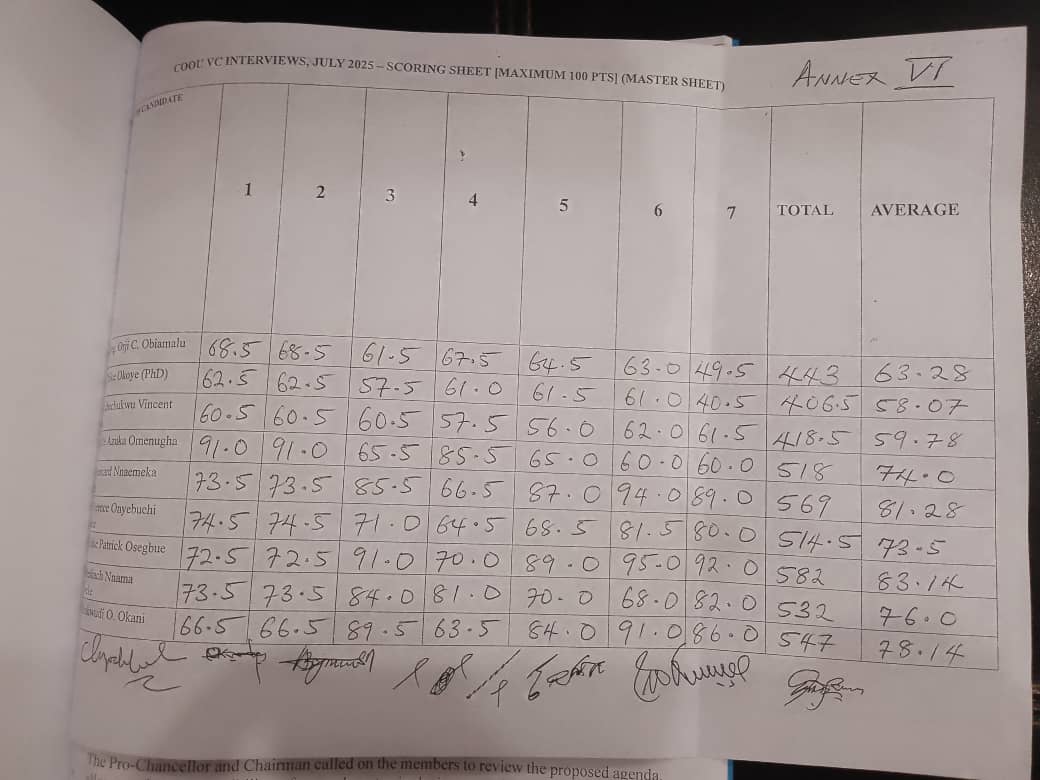
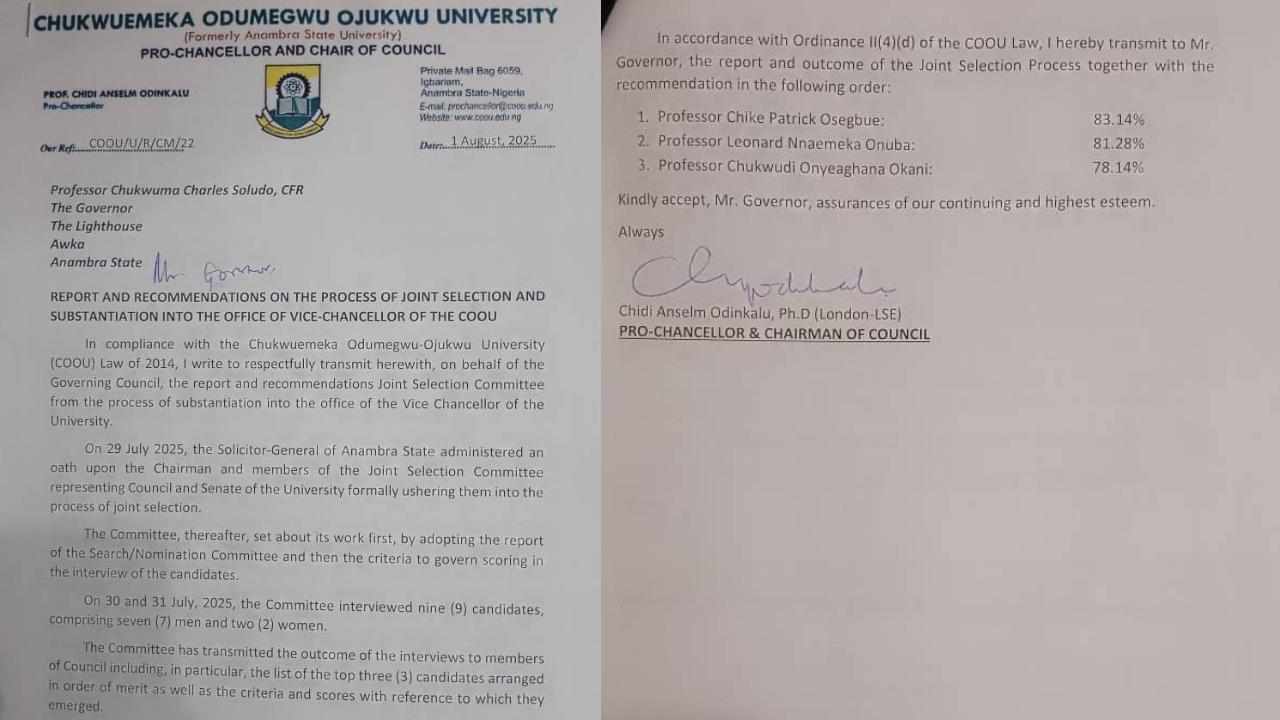
In a recommendation letter dated August 1, 2025, addressed to Soludo and signed by Odinkalu, the committee forwarded the names of the top candidates arranged in order of merit as required by the law. Ordinance (II)4(d) says “the council shall consider the list and arrange the names in its own order of merit guided by the state of the university document and shall recommend the candidate who places first on its own merit to the visitor (governor) for appointment but shall also include the names of the candidates who placed second and third respectively, justifying its order of merit.”
Therefore, topping the list submitted by the committee and seen by the ICIR was Prof. Patrick Osegbue with 83.14 per cent, followed by Prof. Leonard Onuba with 81.28 per cent, and Prof. Chukwudi Okani with 78.14 per cent. Others are Prof. Umenweke Nnanna with 76.0 per cent, Prof. Omenugha with 74.0 per cent, and Prof. Onyebuchi with 73.5 per cent, placed at 4th, 5th, and 6th, respectively, on the scoresheet, and signed by all members of the committee. However, Nnanna, Omenugha and Onyebuchi were not on the list of recommendations.
In a response letter dated August 4, 2025 and signed by Prof. Solo Chukwulobelu, the SSG, Soludo commended the council for what he described as an “elaborate and rigorous process.” He expressed satisfaction with the process, describing it as “transparent and credible.” However, he stated that he was impressed that six of the nine candidates scored over 70%, which is an “A” Grade according to the university’s scoring system. He said the three names in the “recommendation” by the Council, pursuant to Ordinance II(4) (d), simply followed the order of the scores.
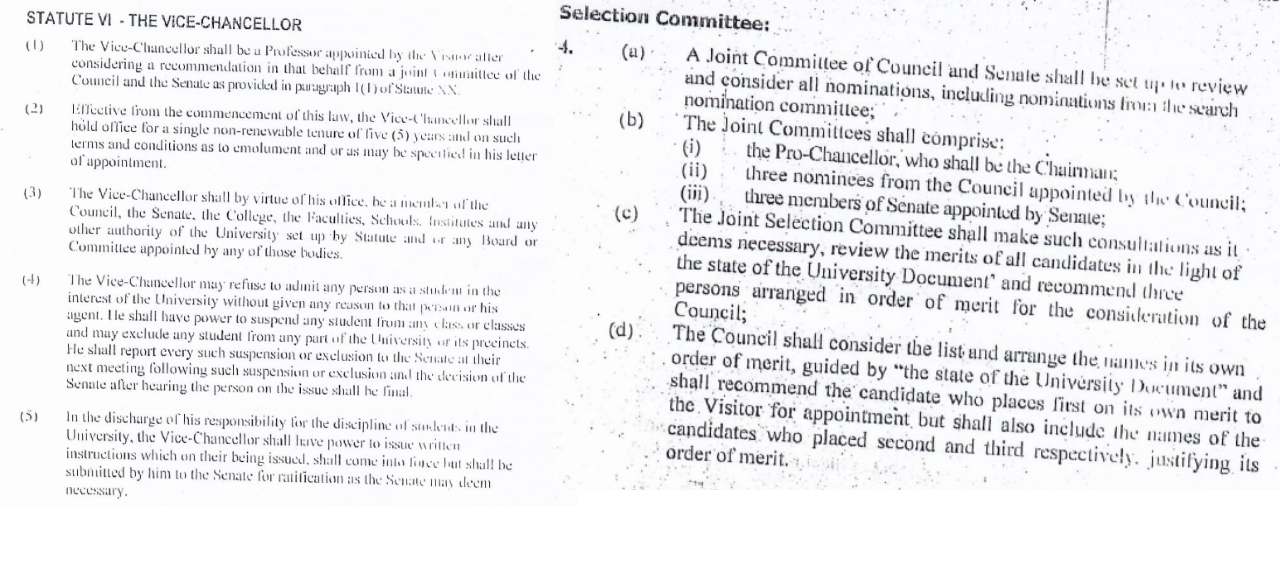
Again, he referred to Paragraph 1 of Statute VI in the First Schedule to the Law, which he said provides that the VC shall be a professor appointed by the visitor “after considering” (but not limited to) the recommendation in that behalf from a joint committee of the Council and the Senate. He added that given his discretionary powers, he is satisfied that any one of the six candidates with A Grade had the competence and qualification to do the job and that in making a decision, he has been guided by the score sheet of the Council, the state of the university and need for fundamental reforms as well as its prospects.
“Coincidentally, among the six candidates scored “A” by the Council and Senate Committee is the acting VC, Omenugha, who has occupied the position since 4th December 2023,” he stated.
“Over the period of her stewardship, she has earned the visitor’s trust and reports from the university indicate that she is doing well. By scoring her an “A” Grade, the governing council and senate committee have confirmed the visitor’s impression.”
“Consequently, the visitor has decided that rather than appointing a new VC, the acting VC, Omenugha, be confirmed as substantive to serve out the remainder of the term of five years with effect from December 4, 2023. In effect, she is confirmed as the VC with a non-renewable five-year term.”
Breach of the university’s established law?
Based on a review of the University law of 2014 and the applicable ordinance governing the appointment of the VC, there is no provision containing the phrase “not limited to the recommendation” or any equivalent language expressly conferring discretion on the Visitor to depart from the governing council’s recommendation as claimed by Soludo in his response.
Paragraph 1 of Statute VI provides that the vice-chancellor “shall be a Professor appointed by the Visitor after considering a recommendation from a Joint Committee of the Council and the Senate.” It does not expressly empower the Visitor to disregard the committee’s recommendation and appoint another candidate.
Ordinance II(4)(d) further requires the governing council to rank shortlisted candidates in order of merit and recommend the first-placed candidate for appointment, while forwarding the names of the second- and third-ranked candidates with reasons for their ranking.
A staff member, who requested anonymity, said the visitor’s powers are defined by university law and must be exercised within its provisions, unless amended by the Anambra State House of Assembly.
Omenugha’s appointment has also drawn scrutiny because of her family’s political connections. Her son, Nelson Omenugha, served as Governor Soludo’s Special Adviser on Youth Empowerment Programmes from April 2022 until March 2026. Before then, he founded the Youth Earnestly Support Soludo (YESS), a political support group that mobilised youth backing for Soludo ahead of the 2021 governorship election. Before becoming acting vice-chancellor in 2023, Omenugha served as Anambra State Commissioner for Education, and between 2014 and 2022, as Commissioner for Basic Education.
At the university’s combined convocation ceremony between 11-15 May 2025, Soludo had said he was resisting, saying that he has confidence in Omenugha because she is “possibly one of the contenders for the substantive position.”
“But I do have confidence in her,” he said. “Let us get this done, and I will pray the governing council to quicken the process and make the appointment before the end of June. “Get me the three names before the end of June; if it gets to my desk today, I will appoint the Vice-Chancellor the same day,” he assured.
Government announced sack, Odinkalu says he walked away
Soludo appointed Odinkalu as Pro-Chancellor of the university in June 2024. In a statement by the governor’s Chief Press Secretary, Christian Aburime, Soludo said that the new council is assembled with a “focus on excellence, integrity, and strategic leadership.”
However, on April 22, 2026, a statement released by Aburime suggested that he had sacked Odinkalu as Pro-Chancellor and Chairman of the Governing Council alongside other members of the council over alleged poor performance.
In an article titled “Deconstructing and Reconstructing Prof. Odinkalu’s Tirades Against Governor Soludo,” Commissioner for Information and Value Reformation in the state, Law Mefor, accused Odinkalu of attempting to manipulate the process for appointing a substantive vice-chancellor by backing a preferred candidate through what he described as a “sham” selection exercise.
Mefor maintained that Soludo intervened to ensure a transparent, merit-based process that led to the appointment of Prof. Omenugha as the university’s fifth substantive vice-chancellor. Mefor argued that despite leading the university council between 2024 and 2026, Odinkalu did not seek government intervention to tackle challenges such as the lack of electricity, water supply, motorable roads and other essential facilities at the Uli campus till the governor personally visited and invested more than N5 billion in infrastructure upgrades.
However, public affairs analyst Onyiorah Paschal argued that it was misleading to blame Odinkalu for the university’s infrastructure challenges, noting that, as Pro-Chancellor, he exercised oversight rather than executive authority.
Odinkalu, for his part, rejected claims that he was removed, insisting that he resigned because remaining in office “would have amounted to abetting illegality and manifest arbitrariness.” He said that the university law required the Joint Council and Senate Committee to recommend the top-ranked candidate for appointment, but that Governor Soludo instead appointed the candidate who placed fifth.
“But the governor goes ahead to select the fifth person,” he said. “What am I still doing as Pro-Chancellor? After that action, I ceased to be and was in no position to keep answering that name. He simply wasted my time.”
According to Odinkalu, the university had long ceased to be governed strictly by its enabling law. “The law has been casualised for a very long time. People are not interested in running it as an institution governed by legality but as some private establishment.”
He said he would have had no objection if the governor had openly indicated from the outset that he intended to appoint a preferred candidate. “That would have been difficult for me to do. I would have accepted or asked him to look for someone else. At least, there would have been clarity. I met with him several times, and he never mentioned that to me.”
Odinkalu said the committee assessed candidates against seven criteria, including academic qualifications, university management experience, integrity, grantsmanship, fundraising and interview performance, which carried 40 points.
“Those criteria were agreed by consensus among the seven members of the committee, and everyone scored the candidates independently. We went through all of that, and somebody believed they could waste your time.”
Another member of the committee, who spoke with the ICIR on the condition of anonymity, confirmed this. He said the visitor had commended the committee and said the selection process was free and fair.
“If the governor had chosen the second or third candidate, maybe there would not be so much complaint. But leaving all of them and choosing the fifth shows corruption,” he said. “We worked with our consciences in making recommendations. It is demoralising, and that is working with impunity,” he added.
Matter goes to court
On August 18, 2025, Prof. Osegbue, who scored 83.14 per cent and was top on the VC recommendation list, filed a case at the National Industrial Court of Nigeria, in Abuja, challenging the appointment of Omenugha as the VC and seeking judicial nullification of her appointment, saying it violates the merit-based statutory process outlined in the University Law 2014.
He also sought an order compelling the state governor to appoint him instead, having legally placed first in the formal selection process. On 9th September, 2025, Osegbue filed an Affidavit in response to the defendant’s counter-affidavits.
However, Odinkalu accused the Anambra State Government of colluding with the university management to undermine the ongoing proceedings at the National Industrial Court. He alleged that, after the case was filed, the government and the university obtained a judgment from the Anambra State High Court in Otuocha on issues already before the Industrial Court. According to him, the suit was filed on September 15, 2025, and Justice Tagbo Anieto delivered judgment on September 26, 2025, affirming Omenugha’s appointment as Vice-Chancellor.
In his judgment seen by the ICIR, Anieto held that the appointment of Omenugha was done in full compliance with Section 38 of the university’s 2014 laws, describing it as “total, absolute, undivided, unblemished, complete, decisive and final.”
“Consequently, the above findings and decision ultimately lead to the irresistible positive affirmation of the suit of the plaintiff,” Anieto said, ordering the members, staff, officers, bodies and organs of the university to desist from all acts that may have the effect of “impeding the duties, functions and office of Omenugha now the confirmed Vice-Chancellor.”
“But the plaintiff in Otuocha did not apply to be VC & had no claim in the process,” Odinkalu observed, referring to Prof. Nneka Nnorom, a lecturer at the Faculty of Education at COOU (who served as plaintiff in the Otuocha case). “The State High Court knows the matter is not one over which it has jurisdiction. If the judge did not know that, he has no business being a judge,” he said.
On his part, Osegbue alleged that Nnorom was promised an appointment if she could allow herself to be used to procure that judgement. She was subsequently appointed the Director of Academic Planning at the university.
However, at the National Industrial Court hearing on July 21, 2026, counsel to Osegbue, J.S. Okutepa (SAN), represented by Kaine Anawune, argued that Omenugha’s appointment violated the university law. He urged the court to dismiss the defendants’ objections and declare Osegbue the duly appointed Vice-Chancellor.
Counsel to Omenugha and Governor Soludo, Patrick Ikwueto (SAN), asked the court to dismiss the suit, arguing that the appointment complied with the university law and that the governor, as visitor, lawfully exercised his discretion in making the appointment.
After hearing both parties, Justice John Tergama adjourned the matter to October 15, 2026, for judgment.
Osegbue suspended, then dismissed
On June 11, 2026, Governor Soludo inaugurated the eighth Governing Council of the University after the dissolution of the seventh, which he accused of remaining dormant for “inexplicable” reasons.
The following day, the Governing Council, led by Prof. Peter Onwualu, dismissed five staff members over alleged misconduct. A statement published on the university’s website said Prof. C.C. Nwabachili, the immediate past Dean of the Faculty of Law, and Prof. Osegbue of the Department of Political Science were dismissed for misconduct, while the others were dismissed over allegations of sexual harassment, intimidation, extortion and other ethical violations. Osegbue had earlier been suspended for six months before his dismissal.
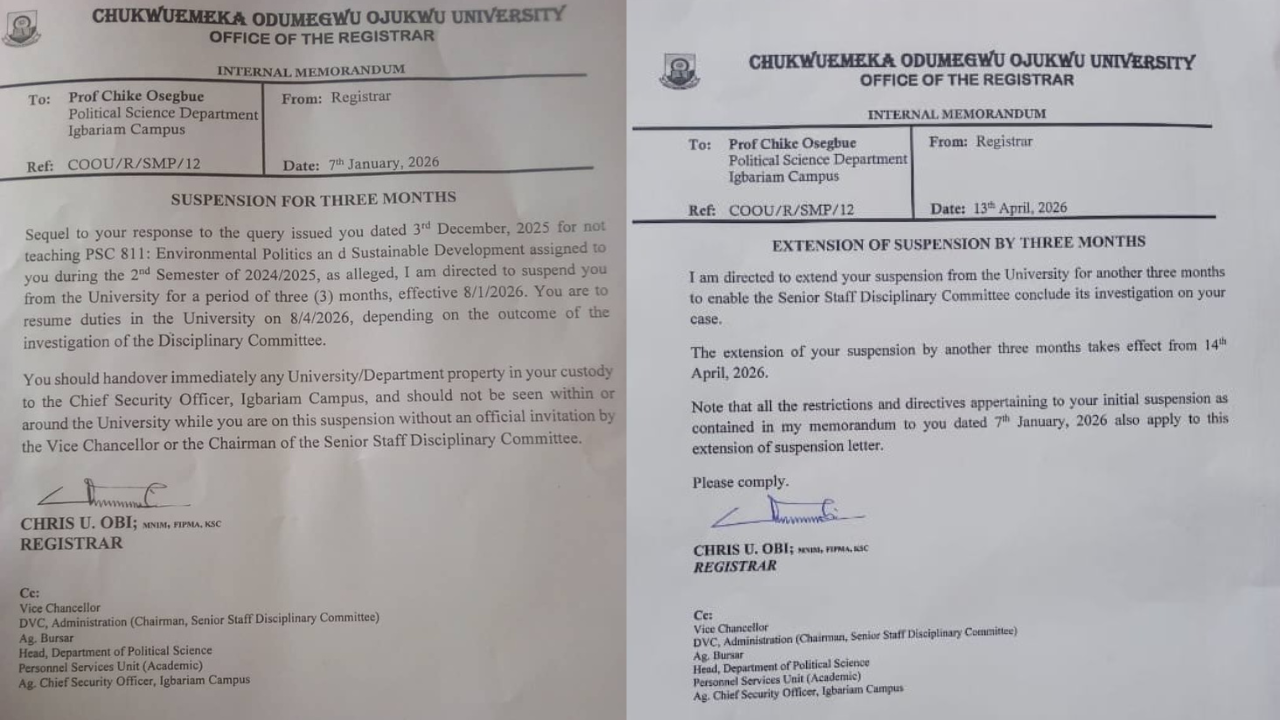
Osegbue told The ICIR that his suspension was linked to his challenge of the Vice-Chancellor’s appointment. He said he was accused of insubordination for refusing to teach PSC 811: Environmental Politics and Sustainable Development to postgraduate students whom he claimed had not met the university’s attendance requirement.
Under the postgraduate regulations, students must attend at least 75 per cent of lectures over a minimum of nine weeks before qualifying for examinations.
Responding to the university’s claim that he failed to examine an eligible student, Osegbue said the student had attended only two lectures, well below the minimum attendance required by the regulations.
“The COOU examination and certification does not measure learning outcomes, but enrolment and certification without demonstrated competence is not mercy but institutional decline,” he said.
Before his suspension, the university’s Senior Staff Disciplinary Committee invited Osegbue to explain his alleged failure to teach the course PSC 811 on January 21 and 28, 2026.
In a letter to the Pro-Chancellor dated January 20, Osegbue’s lawyers, J.S. Okutepa, SAN & Co., argued that the disciplinary proceedings were invalid because the committee was improperly constituted. They contended that the Governing Council had not ratified the appointments of the Deputy Vice-Chancellors, who are statutory members of the committee under the COOU Law 2014.
Several staff members who spoke to The ICIR questioned the speed with which the newly constituted Governing Council dismissed Osegbue, arguing that it should have first conducted a thorough investigation.
The ICIR also interviewed postgraduate students, who confirmed that admission lists were often released shortly before examinations. Documents reviewed by this reporter show that the university published its eighth batch of M.Sc. admissions on August 26, even though examinations began on September 3. For the 2025/2026 session, the 11th batch of admissions was released on July 6, 2026, a day before examinations commenced.
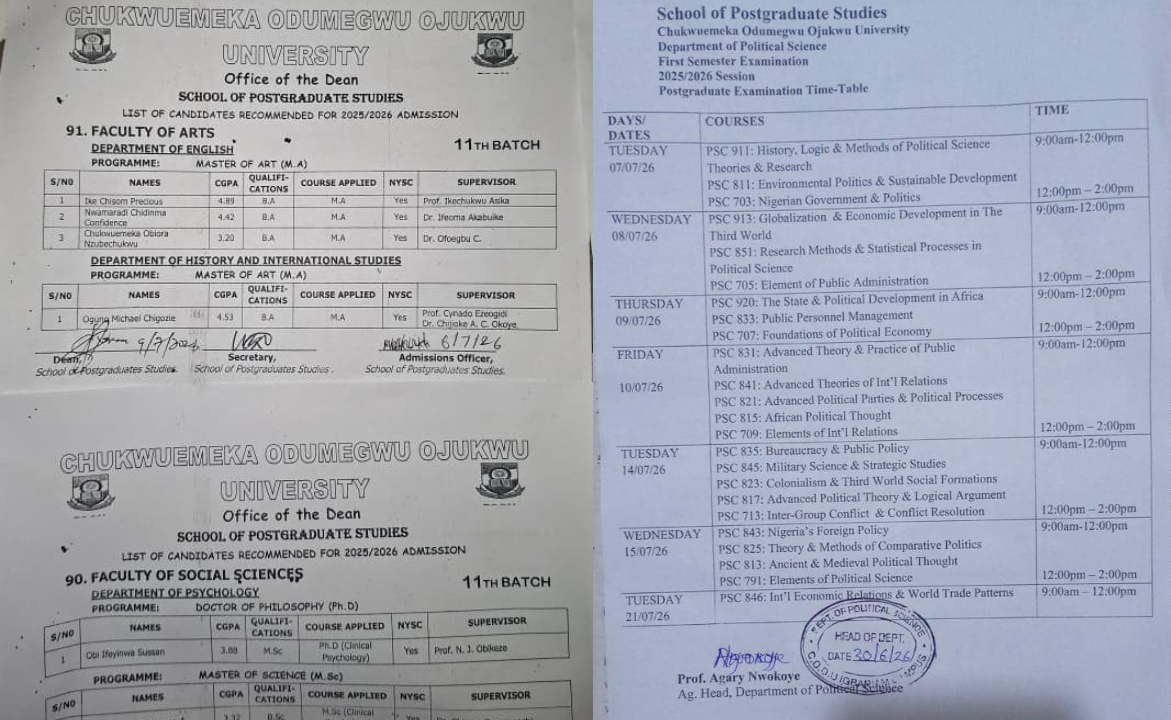
“It is not fair. I got admission less than two weeks ago. No lectures. I have only managed to pay my acceptance fee. I am going crazy,” one newly admitted student said in a WhatsApp message.
Another staff member, who wants to remain anonymous, said the university routinely admitted postgraduate students after the application period had closed, leaving them with little or no time to attend lectures before examinations.
“Some students have approached me wanting to write when they are not fully prepared, but I told them I could not set exams for them as they were not adequately prepared,” he said.
During a mid-term media briefing in July, Omenugha dismissed the allegations that Osegbue was removed because he contested the VC position with her.
She said that other contestants are still serving in key positions under her administration, asking why they have not been victimised too. She reiterated that Prof. Osegbue had postgraduate students preparing for their Master’s programme in Political Science, yet he never appeared to teach them.
Government defends Omenugha’s appointment
Responding to the controversy, Governor Soludo’s Chief Press Secretary, Christian Aburime, told The ICIR that the governor had the discretion to appoint the candidate he believed was best suited to transform the university.
“It is not all about making recommendations,” he said. “The governor knows the person who has the contacts and proven ability to deliver the kind of university he wants. Why should he jettison that person?”
When asked why the governor got the committee to make recommendations since he had a candidate in mind, he said: “The governor did not have any candidate in mind. The candidate that he chose was the best among those presented to him. You cannot blame him for that; he should be commended for doing what is proper.”
He described the governor as a professor who understands how the University system operates, adding that, having conducted his investigation found that the person he chose was the best.
While the debate over whether due process was followed in Omenugha’s appointment remains a matter of competing claims, another set of questions has emerged, not about how she got the job, but about how she has exercised the powers of the office since assuming leadership.
Questions over procurement practices
Under the university law, the Vice-Chancellor chairs the Tenders Board, in line with Section 22 of the Public Procurement Act 2007 and oversees key procurement processes, including bid evaluation and contract awards.
While serving on acting capacity and later as substantive VC, Omenugha allegedly used her position as chair of the board to influence the award of contracts in favour of companies linked to members of her family and close associates.
Among the allegations is that, in March 2024, she oversaw the university’s execution of a Memorandum of Understanding (MoU) granting Koncio Table Water, produced by Koncioo Enterprises Ltd, exclusive rights to supply sachet water at the university’s Igbariam campus.
Corporate Affairs Commission (CAC) records show that Omenugha is a Person with Significant Control in Koncioo Enterprises Ltd, alongside seven of her children, raising conflict-of-interest questions. Both the Anambra State Public Procurement Law, 2011 and the university law require public officers to disclose personal or financial interests in matters before them and refrain from participating in related decisions.
Meanwhile, documents reviewed by this reporter show that Koncioo Enterprises Ltd allegedly ceased supplying sachet water to the university after a disagreement over the terms of their MoU. In July 2024, the university asked the company to assume the cost of transporting water from its factory to the campus, arguing that the arrangement had not been clearly addressed in the agreement. Koncioo declined the request, citing rising production and packaging costs and stating it could not absorb the additional transportation expenses. The company accepted the university’s notice of its intention to terminate the MoU, effectively bringing the business relationship to an end.
But Omenugha allegedly went ahead to introduce another water called B-Orient, produced and packaged by Orient Writers Ltd.
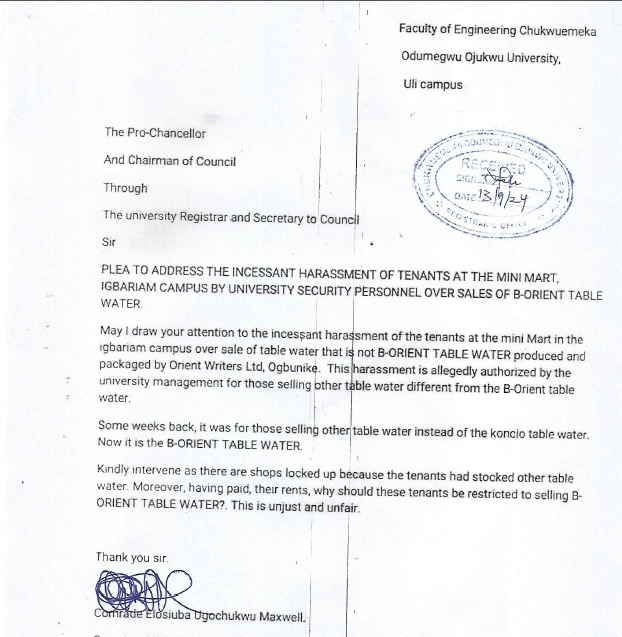
In a letter dated September 13, 2024, signed by Elosiuba Ugochukwu, then Secretary of the Non-Academic Staff Union of Educational and Associated Institutions (NASU), furged the former Pro-Chancellor Odinkalu to intervene in the repeated harassment of tenants at the mini-mart on the Igbariam campus over the sale of table water not branded as B-ORIENT.
“This harassment is allegedly authorised by the university management,” Ugochukwu said, adding that having paid their rents, it was unfair to restrict them to selling B-Orient Table Water.
In 2025, Shield and Sword Consult, a legal consultancy firm representing some staff members, petitioned the EFCC to investigate the Vice-Chancellor over the matter. According to legal representative Joseph Onu, the petition resulted in the suspension of B-Orient table water sales.
Reacting via a statement at the time, Public Relations Officer of the University, Harrison Madubueze, said the institution was not aware of any petition against the VC and that no law enforcement agency had communicated regarding any petition against the acting vice-chancellor.
Questions over TETFund contract awards
COOU received about N4 billion under TETFund’s 2024 Special High Impact Projects Intervention. According to a September 25, 2024 approval letter signed by TETFund Executive Secretary Sonny Echono, the allocation covered N1.456 billion for a 2,000-seat auditorium, N1.431 billion for a library, and N845.7 million for landscaping, furnishing, consultancy, bank and administrative charges. The projects were scheduled for completion by June 2025.
On September 13, 2024, the university’s Tenders Board awarded the auditorium and library construction contracts to Fibelle & Mibble Ltd for N1.457 billion and N1.432 billion, respectively. Landscaping and furnishing contracts were awarded to Humblerock Ltd and Fides Et Ratio Ltd. Corporate Affairs Commission CAC) records reviewed by The ICIR show all three companies are owned by Paul Chukwuma, the 2025 Young Progressives Party (YPP) governorship candidate in Anambra State.
Before the contracts were awarded, Chukwuma had been detained by the Independent Corrupt Practices and Other Related Offences Commission (ICPC) over alleged contract-related offences.
However, documents reviewed show that on September 27, 2024, Fibelle & Mibble requested mobilisation payments of N429.6 million and N437 million for the library and auditorium projects.
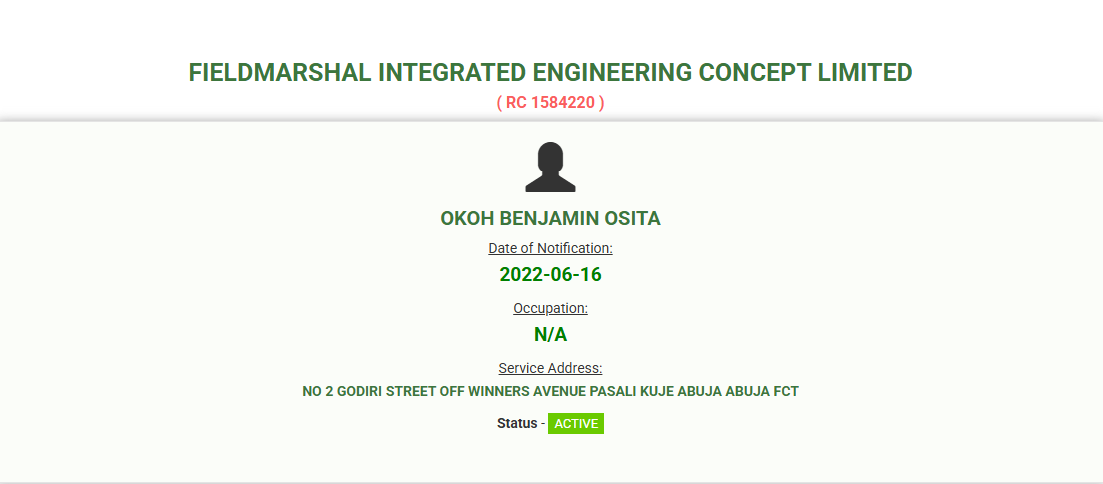
The university also appointed Fieldmarshal Integrated Engineering Concept Ltd as principal consultant for the projects. CAC records show that Okoh Benjamin Osita, Enugu State Commissioner for Works, is a person with significant control in the company, raising questions about compliance with procurement rules that prohibit public officials from holding direct or indirect interests in government contracts.
The awards have also attracted allegations that they were made without competitive bidding or Governing Council approval, contrary to the university law, which assigns procurement functions to the Tenders Board while reserving the authority to enter into contracts for the Governing Council.
Searches found that the auditorium project was advertised only on NigeriaTenders.com, a privately operated tender aggregation website, with no corresponding publication located on an official government procurement portal.
When The ICIR visited the Igbariam campus, both the auditorium and library were only partially completed. The concrete frames, blockwork and much of the roofing had been completed, but windows, doors, internal finishes, building services and external works remained unfinished. Overgrown vegetation and the absence of workers or construction equipment suggested the projects had stalled.
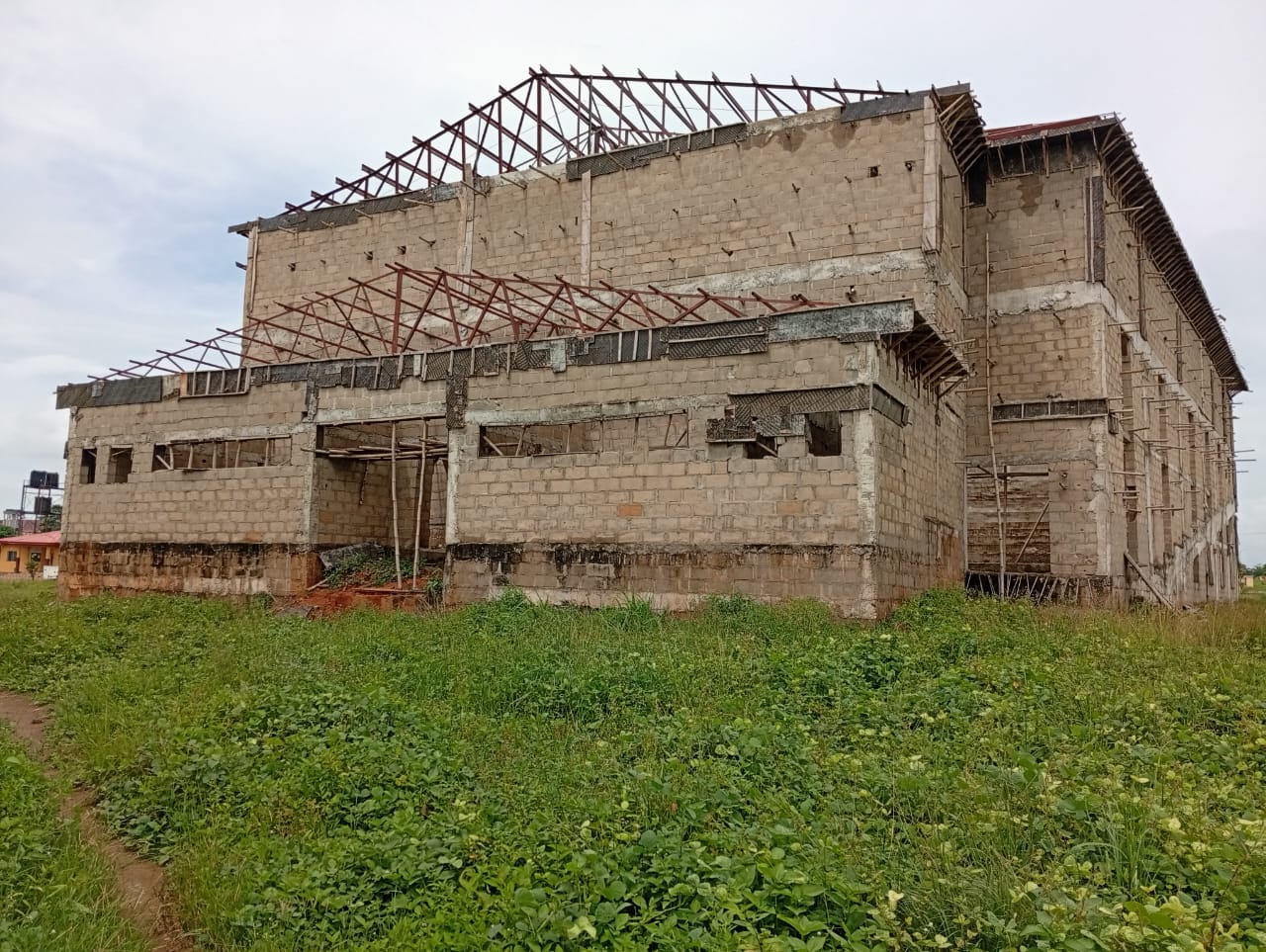
On January 27, 2025, Shield and Sword Consult petitioned the EFCC, accusing Omenugha of disregarding due process by allegedly awarding contracts to companies owned by Paul Chukwuma, which were executing the university’s TETFund projects. The petition also alleged that she awarded a N60 million contract for the facelift of the Igbariam campus gatehouse and a N20 million contract for solar street lighting at the College of Medicine, Amaku, Awka, to her son, Nelson, without input from the Director of Physical Planning or approval by the Governing Council.
Responding on behalf of Nelson via a letter dated February 4, 2025, Lord Brougham Chambers described the allegations as grossly offensive, “baseless, false, malicious and provocative in the extreme which are aimed at inflicting maximum damage to his esteemed person, image, hard-earned goodwill and integrity.’ They demanded a retraction of the publication and a letter of unreserved apology which must be published in three national newspapers and a compensation of N2billion.
Researchers coerced to remit IBR research fund
In 2024, 75 researchers from the university benefitted from TETFUND’s institutional base research intervention fund (IBR). Each of the researchers received between N1.6million to N2million to aid their research projects.
However, after the payment, the Directorate of Academic Planning, headed by Prof Emeka Obi allegedly Invited beneficiaries to a meeting on August 20, 2024, where Omenugha, who was acting VC at the time, allegedly directed all 75 beneficiaries to remit 50% of whatever amounts they received into a personal account and another 10% into a COOU donation account said to be dedicated to tree planting.
Moniepoint account number (6500318770) owned by Uwabunommuta Integrated Services was allegedly used to collect for one of the payments. Checks on the CAC portal show that Uwabunommuta was registered on June 21, 2024 (RC – 7602887) just two months before the funds came. This account name was confirmed by the ICIR.
A First Bank account (2036128244) belonging to Midach Academic Support Services, an educational consultancy firm, was also allegedly used to collect payments from lecturers approved for conference sponsorships. According to the allegations, after making the payments, some lecturers were told not to attend the conferences but were later provided with conference participation certificates, boarding passes and flight tickets to retire the funds. Midach, registered on September 7, 2020 (RC 3180844), could not be found at its registered office address in Enugu during a visit by The ICIR.
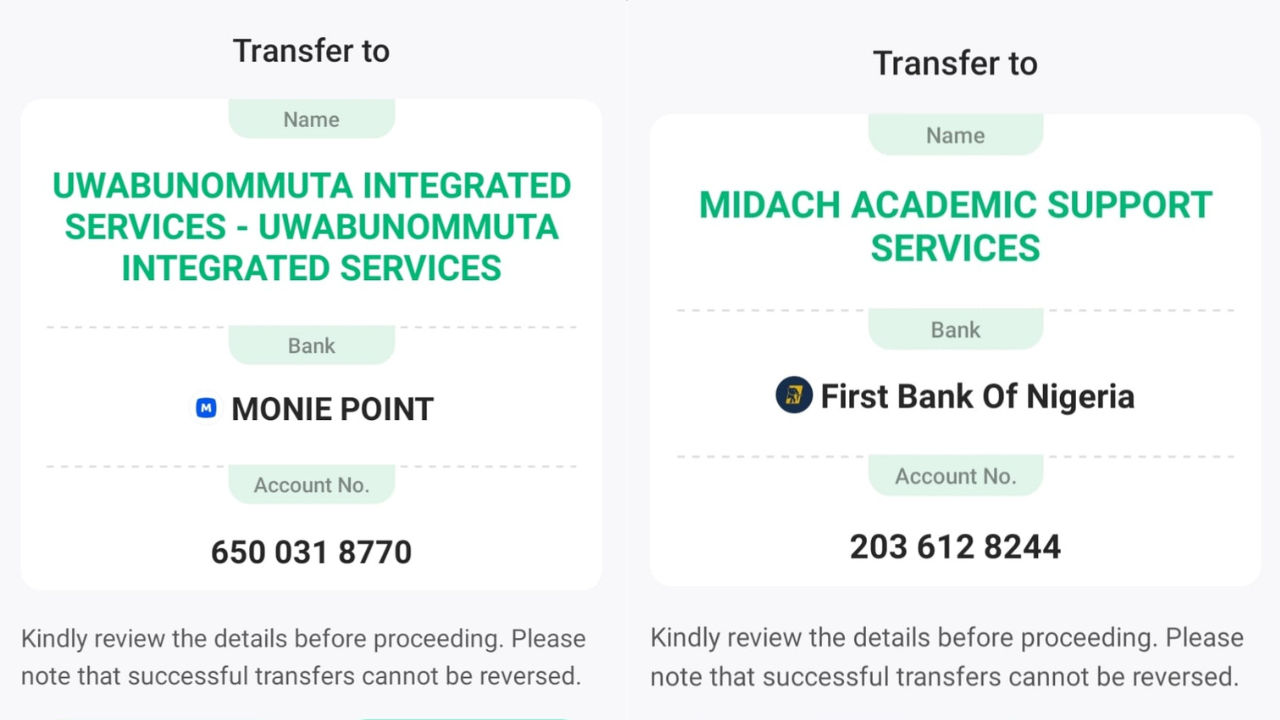
One of the grant recipients (who does not want to be named) confirmed that the grant was released in two tranches and that each time researchers received a tranche, they remitted money as instructed.
He told the ICIR that some of the researchers only paid 10% and have since not received the second tranche. He, however, said that those who paid all percentages have received their second payments.
Another grant recipient who spoke to the ICIR said she received N800,000 as the first tranche of N1.6million. After it came in, she got a text from an unknown number with an account number asking her to pay 50% of the money.
“I called the DAP, but he was not clear that management was behind it, and I could not pay money into an account sent from an unknown number,” she recalled. “So, I kept the money, used it for the research and publication, and did not pay any percentage.”

She said she was subsequently denied the second tranche of the grant, adding that many lecturers who paid the requested percentages were unable to conduct the research.
On May 29, 2025, Inoloji Chambers, a law firm, petitioned the Inspector General of Police, accusing Omenugha of approving payments of N9.9 million to Mabcon Systems Ltd for printing 45,000 student files and N17 million for printing 2,000 convocation brochures. The petition alleged that Mabcon belonged to her relative, Nwagwu Gerald Martins.
The petition also alleged that Chambers Stationery Co. Ltd, linked to Omenugha’s son, Nelson, supplied stationery to the university. Documents reviewed by The ICIR show that the company submitted a N17.6 million quotation for office supplies, which was approved by the university bursar, Dr Nath Udezo.
However, when The ICIR visited the company’s listed address at 144 Zik Avenue, Achara Layout, Enugu, it found that the premises were occupied by Tocee Events World. Residents said Chambers Stationery had ceased operating there several years earlier.
Multiple payments take a toll on students
At Chukwuemeka Odumegwu Ojukwu University, students interviewed by The ICIR described a pattern of multiple and, in some cases, unexpected payments.
An Animal Science student said they were required to pay N10,000 for a departmental brochure containing only an admission list and registration numbers. Students in other departments, including Accountancy and Adult Education, reported similar experiences.
“Just make sure you have money,” the student said. “You’ll always be asked to pay for one thing or another. It is now difficult to save because we are also dealing with transportation costs.”
Students also complained about delays in the release of examination results. A final-year Education student said some students are forced to assume they failed a course and re-register for it before the results are eventually released. Another student said she was yet to receive the results of GS 101, GS 107 and GS 108, despite paying N31,300 for General Studies registration.
The financial burden has been compounded by the university’s Student Life Cycle Portal (SLCP). Shortly after assuming office, the university signed an MoU with APPLEAD Nig. Ltd to develop the digital platform for student registration, fee payments, result checking and other academic services.
Corporate Affairs Commission records show that APPLEAD Nig. Ltd, registered on August 14, 2023 (RC 7094537), is owned by Prof. Ikechukwu Ekene Onyenwe of Nnamdi Azikiwe University, where he previously worked with Omenugha.
Although students acknowledged the portal’s added features, they questioned the annual ₦15,000 charge imposed on more than 30,000 students across the university’s campuses.
“We already had a portal for course registration and checking results,” one student said. “The only difference is that we can now make payments through the app. We thought it was going to be free.”
Responding to the criticism on April 23, 2026, Omenugha described the fee as “a strategic investment” to build the university’s ICT infrastructure, arguing that the long-term benefits would outweigh the cost.
The ICIR found that students also pay multiple General Studies (GS) fees into private accounts. In June 2026, one student paid N20,200 and N5,000 into the account of Edu & GS Services, and another N2,600 into the personal account of MaryJude Igbodika, the university’s Director of General Studies, who is believed to be linked to the company. Corporate Affairs Commission records show that Edu & GS Services was registered only on May 6, 2026 (RC 9526164). However, when The ICIR visited its registered address on University Road, Umuoma, Uli, no such business could be found.
A student, who requested anonymity, said GS payments were previously made through Remita at commercial banks but the process changed in 2025.
“We asked for a refund but didn’t get it. We had to go to the GS office, pay into another account and obtain a receipt.”
The student said she paid more than N20,000 in GS fees this semester and an additional N2,600 for a compulsory novel sold exclusively at the GS office as a condition for sitting the examination. Some 300-level students also told The ICIR that they were introduced to the GS course only in the current semester.
The ICIR contacted Igbodika via WhatsApp, seeking an explanation for why students paid fees into her personal account and whether the funds were remitted to the university, but she neither responded to the questions nor answered repeated calls before publication.
ICPC launches corruption investigation
On July 2, 2026, the Independent Corrupt Practices and Other Related Offences Commission (ICPC) invited the researchers to its office in Awka for interrogation and to determine whether the research grants were used for the purpose they were meant for via a letter addressed to VC Omenugha.
One of the interviewees said he was asked how much he received; how much he paid into the accounts and the reasons for the payments. He said that they had account statements of each of the invitees.
“I told them that I only paid, but never mentioned that I was forced to pay,” he recalled. “I and other colleagues knew it was a directive we had to obey,” he said. “It was clearly corruption; they should have simply asked us to pay 10% or at most 20%, but asking people to pay 50% and another 10% is unfair.”
Findings also showed that some invitees from COOU stopped attending the interview. Addressing journalists in Awka in July, acting Resident Anti-Corruption Commissioner in Anambra, Dio Emmanuel, was quoted as saying that some of the invitees were running to the court to file for fundamental rights and obtain restraining orders instead of going to the Commission to respond to allegations against them. He said that refusal to honour ICPC invitation was an offence with consequences that could be worse than that of the alleged offence.
University leaves key questions unanswered
The ICIR sent detailed questions to the university’s Public Relations Officer, Madubueze, seeking responses to allegations against the Vice-Chancellor, including why the TETFund-funded auditorium and library projects remained uncompleted beyond their June 2025 deadline, whether the contracts were publicly advertised, and claims that contracts, including the university gatehouse facelift and solar street lighting projects, were awarded to companies linked to her son, Nelson.
Responding, the PRO denied that the projects had been abandoned, saying the contractor executed work based on funds released by TETFund. He also maintained that the university was not responsible for advertising TETFund projects, insisting that the responsibility rests with TETFund.
He referred The ICIR to reports of the Vice-Chancellor’s July 2, 2026 mid-term press briefing, claiming they addressed the allegations. However, The ICIR found that the reports largely focused on the dismissal of Prof. Osegbue and other lecturers and did not answer the specific questions raised. Follow-up calls, WhatsApp messages and a text message seeking responses to the outstanding issues were unanswered before publication.
Editor’s note: Names of students and researchers who spoke in this investigation have been kept out to protect their identities.
I really appreciate your efforts in carrying out such painstaking and worthy investigation. Permit me to inform you about my case with Federal University Dutsin-Ma, Katsina State. I will also wish to meet with Prof. Odinkalu whom I admire and acknowledge as one of those credible Nigerians.
COOU is one of the most corrupt universities in Nigeria
Our polithiefcians are learners compared to most COOU lecturers