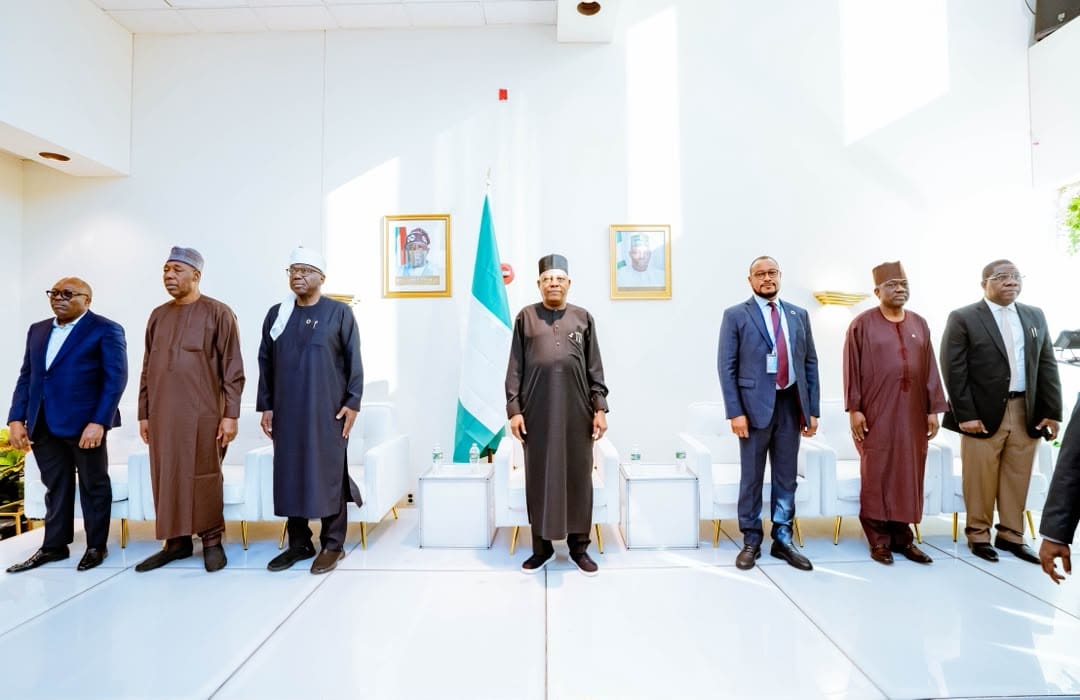
NIGERIA’S participation at the 81st United Nations General Assembly in New York has so far centred on attracting investment, securing partnerships in critical sectors and pushing for greater influence for developing countries in the global system.
Vice-President Kashim Shettima, who is representing President Bola Tinubu and leading Nigeria’s delegation, is scheduled to deliver the country’s national statement later today, Thursday, September 24.
The General Debate, which began on September 22 and will run until September 28, is being held under the theme, “Restoring Trust, Managing Transformation: A United Nations That Delivers for All.”
Nigeria’s delegation has used the gathering and its sidelines for bilateral meetings and discussions on economic development, education, mining, migration and global governance.
Mineral deals
One of Nigeria’s major engagements has been around the country’s solid mineral resources.
On Thursday, September 24, Minister of Solid Minerals Development, Dele Alake, and US Deputy Secretary of State Christopher Landau signed an agreement at the Nigerian Mission House in New York to deepen American investment and cooperation in Nigeria’s mining sector.
According to Alake, the framework covers geological data and exploration, mineral development and processing, infrastructure and technical capacity.
He said Nigeria’s mineral resources, which the government values at about $700 billion, should not remain a source of raw materials for other countries while most of the value is captured elsewhere.
The minister said the government wants the partnership to support local processing, create jobs, strengthen technical skills and expand opportunities for Nigerian businesses.
The agreement followed an earlier African minerals meeting in New York where Shettima called for African countries to stop exporting minerals in their raw form and instead develop processing and manufacturing industries around the continent’s mineral wealth.
At the Third Africa Minerals Strategy Group High-Level Roundtable, Shettima said Africa needed greater cooperation to ensure that mineral resources translate into jobs, industrial growth and improved living standards.
Nigeria, Italy push $5bn education financing
Reports also indicatea that education has also featured prominently in Nigeria’s UNGA engagements.
Nigeria and Italy on Wednesday strengthened their collaboration around a Global Partnership for Education campaign seeking to mobilise $5 billion for education financing worldwide.
The initiative was discussed at a high-level event in New York attended by Shettima, UN Deputy Secretary-General Amina Mohammed, Italy’s Deputy Prime Minister Antonio Tajani, Global Partnership for Education President Jakaya Kikwete and education activist Malala Yousafzai.
Tinubu, in a video message to the event, said the initiative aligned with his administration’s focus on improving educational outcomes through greater access and investment in teacher capacity.
The campaign had been developed ahead of the 2026 Global Education Summit in Rome and was intended to mobilise additional resources for education globally.
Shettima woos Nigerians in US
On Wednesday, Shettima also met Nigerians living in the United States, where he appealed for their support for the Tinubu administration’s economic reform agenda.
Speaking at Nigeria House in New York, the Vice-President described the diaspora community as a major resource for Nigeria and called for greater use of its expertise in education, healthcare, science and technology and agriculture.
Shettima defended the administration’s economic reforms, saying they had helped improve foreign reserves, exchange-rate conditions and investor confidence.
He said foreign reserves had risen from $33.9 billion to more than $55 billion and cited 4.45 percent economic growth in the last quarter.
The Vice-President also highlighted the Nigeria Education Loan Fund, saying more than 1.29 million students in tertiary institutions had accessed N125 billion through the programme.
On security, he acknowledged that Nigeria continued to face challenges but said the government was deploying available resources to address them.
He also urged Nigerians in the diaspora to contribute to national development and called for unity, saying the country’s shared interests should take precedence over its divisions.
Migration and international partnerships
Migration has also featured in Nigeria’s diplomatic engagements during the UNGA.
The Federal Ministry of Foreign Affairs said Nigeria and the European Union renewed efforts to strengthen cooperation on migration and advanced discussions around a readmission agreement.
The agreement concerns the return and readmission of people who do not meet, or no longer meet, the conditions for entry, presence or residence in either Nigeria or the EU.
The ministry has also listed bilateral engagement with China among Nigeria’s UNGA-related diplomatic activities, with discussions covering trade, investment, industrialisation, energy, technology and sustainable development.
Nigeria’s diplomatic agenda has therefore extended beyond the UN General Assembly chamber, with the government using the week-long gathering to pursue bilateral relationships and economic partnerships.
Nigeria secures IAEA board seat
Before the UNGA opened, Nigeria also secured a seat on the International Atomic Energy Agency’s 35-member Board of Governors for the 2026–2028 term.
Nigeria was elected on September 17 alongside 10 other countries during the IAEA General Conference in Vienna.
The Federal Government said the position would give Nigeria an opportunity to participate in global discussions on nuclear safety, security and safeguards, as well as the peaceful use of nuclear technology in healthcare, agriculture, energy, water and environmental management.
UN Secretary-General António Guterres has called for stronger international cooperation on AI, an end to ongoing conflicts and reforms to make multilateral institutions more effective.
For Nigeria, the UNGA week has consequently become both a diplomatic platform and an opportunity to sell its economic priorities — from mining and education to investment, migration and international cooperation — while seeking a stronger voice in global decision-making..

Mustapha Usman is an investigative journalist with the International Centre for Investigative Reporting. You can easily reach him via: musman@icirnigeria.com. He tweets @UsmanMustapha_M