
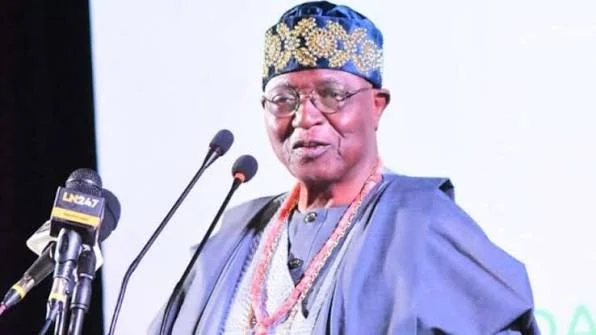
A faction of the pan-Yoruba socio-political organisation, Afenifere, led by Oba Oladipo Olaitan, has called on the Federal Government to reduce petrol price to between N350 and N400 per litre and review the N70,000 national minimum wage to reflect rising inflation.
The group made the demand in a communiqué on Sunday after its monthly National Executive Committee meeting held in Lagos. It noted that the government’s proposed petrol price stabilisation mechanism, which seeks to cap the ex-gantry or landing cost of petrol at N1,350 per litre, falls short of Nigerians’ expectations amid rising living costs.
“The meeting observed the announcement by government through its Minister of Finance and Coordinating Minister of the Economy respecting a putative price modulation mechanism for ensuring petrol price stabilisation at not more than N1,350 as a far cry from the expectation of the people,” Olaitan said in the statement signed by him and the group’s newly appointed substantive Secretary-General, Alade Rotimi-John.
The group’s demand followed the Federal Government’s plan to negotiate a ceiling on the ex-gantry or landing cost of petrol as part of a proposed price modulation mechanism at 1,350 intended to moderate fluctuations in fuel prices.
Minister of Finance and Coordinating Minister of the Economy, Taiwo Oyedele, said the proposed arrangement was aimed at cushioning the impact of rising petrol costs.
However, Olaitan criticised the economic situation under President Bola Tinubu, citing widespread hardship, hunger and high inflation.
“The meeting proposed an immediate review of the fuel price to between N350–N400 per litre so as to ease the general situation regarding the unaffordability of the product. The meeting reviewed the general socio-political and economic situation of the country and observed that a pervasive climate of hardship, hunger and hyperinflation is yet the defining characteristic of the Tinubu presidency,” he said.
Afenifere also called for an upward review of the national minimum wage, arguing that persistent inflation had eroded the purchasing power of workers earning the statutory N70,000 monthly minimum.
“The meeting observed that the statutory minimum wage of N70,000 per month is due for an upward review so as to meet the challenges of the inflationary spiral which has rendered the minimum wage unreasonable and unfeeling in the present circumstances,” the communiqué read.
It also accused the government of failing to adequately meet its responsibilities on security, the economy and the welfare of Nigerians.
On the political situation ahead of the 2027 general elections, the organisation expressed concern over rising intolerance and inflammatory statements by politicians, warning that such conduct could heighten tensions and undermine democratic participation.
The group urged political actors to conduct their campaigns peacefully and in line with democratic standards.
It also called on the Federal Government to guarantee free and fair elections in 2027 by allowing the Independent National Electoral Commission (INEC) to operate independently.
The ICIR reported that Federal Government’s 30-day petrol price intervention has sparked questions over its potential to ease the cost-of-living crisis, particularly for commuters, small businesses and households grappling with high transport fares, rising prices of food and other essential goods.
Many Nigerians have criticised the move, saying they were more concerned about the policy’s practical benefits than the terminology used to describe it.
The ICIR reports that NNPC outlets sold petrol at N1,355 per litre in Lagos and Rivers states, while Abuja was listed at N1,370 per litre on Thursday, October 8 when the decision was announced. From these prices, the maximum motorists could save from buying a litre of petrol might not be up to N50.
For a motorist buying 20 litres of petrol, a N50-per-litre reduction would translate to a saving of N1,000, while someone purchasing 40 litres would save N2,000, assuming the price reduction applies to every litre bought.
For households and businesses that consume substantial quantities of petrol, these savings may provide some immediate relief but may not amount to a significant reduction in transport, food and other essential costs that have already increased.
For many Nigerians who do not own vehicles, the most important measure of the intervention will not be the price displayed at a filling station but the amount they pay to travel to work, school, markets and other essential destinations.
Commercial transport operators may benefit from lower petrol costs, but whether passengers benefit depends on how operators adjust their fares.
In September, President Bola Tinubu renewed efforts to expand compressed natural gas (CNG) transport and called for cheaper energy costs to translate into lower fares.

Nanji is an investigative journalist with the ICIR. She has years of experience in reporting and broadcasting human angle stories, gender inequalities, minority stories, and human rights issues. She has documented sexual war crimes in armed conflict, sex for grades in Nigerian Universities, harmful traditional practices and human trafficking.