
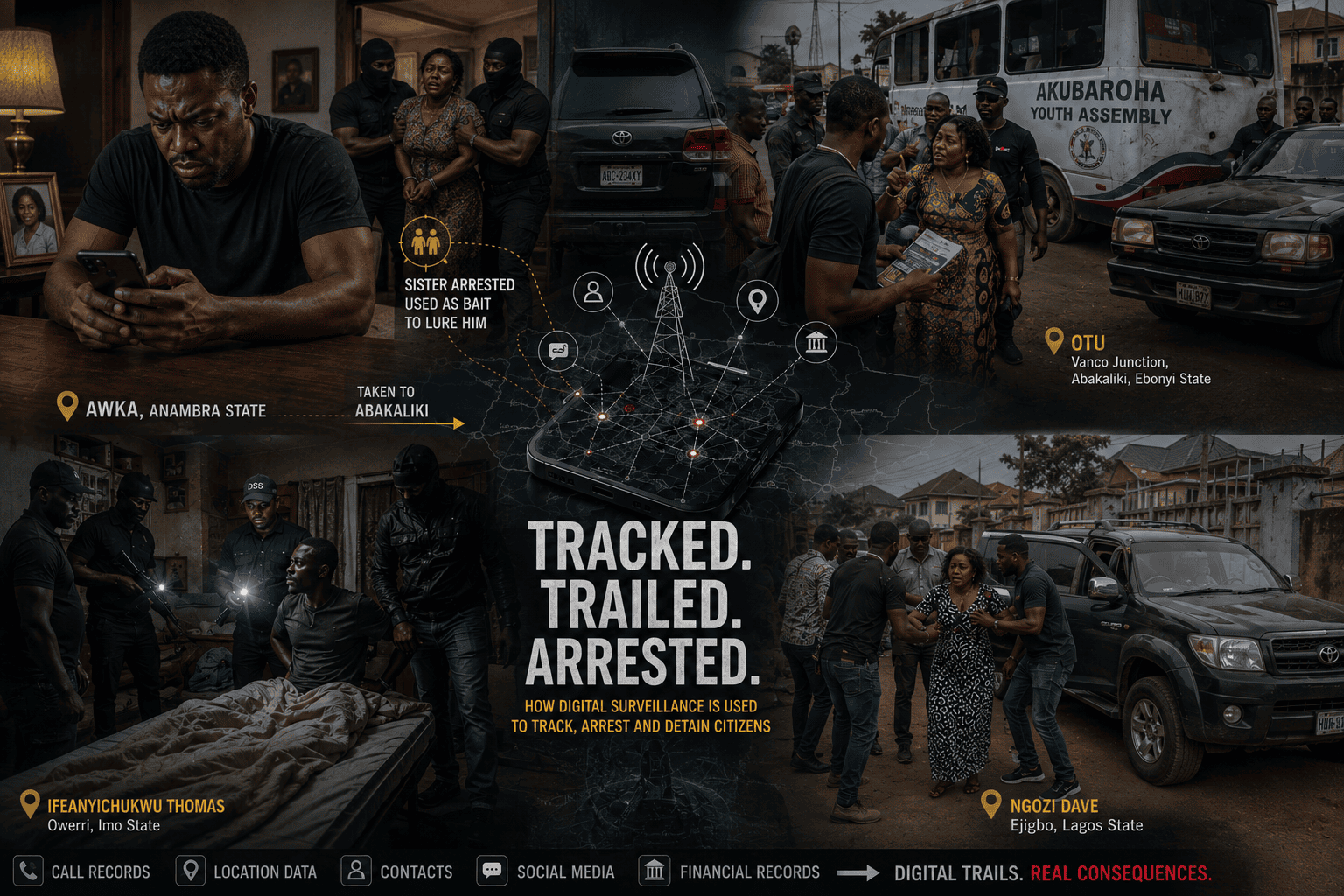

This second part of the ICIR consolidated report reveals more of the findings on how federal and state governments used phone interception tools, call records, CCTV networks, and other monitoring technologies to track, trail, arrest, and detain journalists, activists, political critics, and ordinary citizens.
Accountability and legal gaps
This section includes two investigations: “Without warrants: Illegal surveillance chokes Nigeria’s civic space” and “Inside Enugu’s multi-billion-naira surveillance centre with no oversight law.”
The first report documented cases involving civil society organisations, activists, advocacy groups and media organisations that experienced cyberattacks, monitoring, and harassment after engaging in government accountability campaigns or reports that criticised public institutions and office holders.
The investigation examined links between digital threats and attempts to discourage civic engagement, suggesting that organisations working on transparency, democracy, and human-rights issues are increasingly vulnerable to technologically enabled pressure.
It highlighted allegations of an attack on the website of the International Society for Civil Liberties and Rule of Law (Intersociety) following its criticism of electoral processes and governance issues.
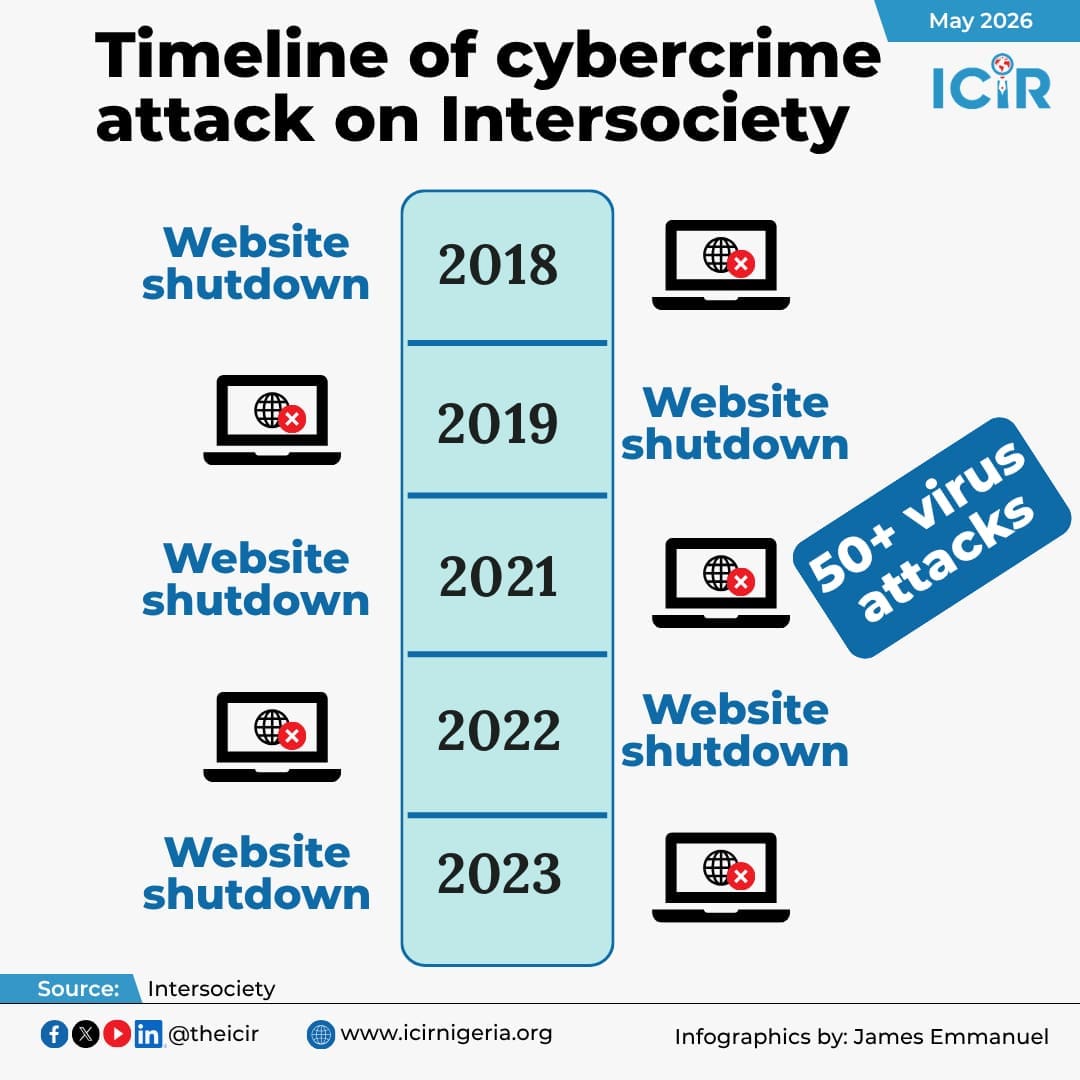
Before the 2023 election, Intersociety had criticised Nigeria’s electoral umpire, the Independent National Electoral Commission (INEC). Soon after the election, Intersociety said its website was attacked and rendered inaccessible. The NGO’s Executive Director, Emeka Umeagbalasi, told The ICIR that the domain host informed them that the website’s hosting was suspended after numerous complaints and petitions originating from Nigeria.
Websites belonging to media organisations such as WikkiTimes and Foundation for Investigative Journalism (FIJ) also experienced takedowns, malware infections, coordinated cyberattacks, and suspected digital tracking after the publication of reports critical of government institutions or powerful individuals.
The ICIR investigation wove patterns of how digital attacks, surveillance activities, and online intimidation contribute to Nigeria’s shrinking civic space and ultimately pose a significant threat to civil society, transparency efforts, and democratic governance. Read the full report here.
The second investigation, “Inside Enugu’s multi-billion-naira surveillance centre with no oversight law,” provides an inside look at Enugu State’s Safe City project, a technologically advanced surveillance architecture designed to monitor public spaces, support security operations, and enable rapid incident response.
The project includes a command-and-control centre, extensive CCTV coverage, drones, facial-recognition capabilities, and real-time monitoring systems spanning the state.
Although government officials present the initiative as a major security innovation, the investigation identified a significant legal gap: there is no dedicated law governing its operations, oversight or accountability of the system.
The ICIR found that though the project possessed the capability to track vehicles, monitor individuals, and collect substantial amounts of data, critical questions remained about who controls access, how information is stored, and what safeguards exist against misuse. The investigation emphasised the need for comprehensive legislation, independent oversight mechanisms, and transparent data governance practices to balance security objectives with the protection of citizens’ rights.
Together, these two reports highlighted concerns raised by legal experts, civil society organisations, journalists, and opposition figures regarding transparency and civil liberties. They also highlighted concerns over the lack of independent oversight and transparency. They call for comprehensive surveillance legislation, independent oversight bodies, transparency on data use and retention, as well as stronger protections for journalists, activists, and civil society organisations.
Surveillance infrastructure and public expenditure
The two investigations under this category focused on investments in surveillance technology, procurement, maintenance, and transparency. The two reports, “Pay to track: Nigerians forced to fund police investigations despite billions on surveillance,” and “Edo’s ‘state-of-the-art’ command centre goes dark amid secrecy over cost,” examined the gap between Nigeria’s significant investment in surveillance infrastructure and the experiences of citizens seeking police assistance, as well as the decline of Edo State’s Solomon Arase Command-and-Control Centre.
In “Pay to track: Nigerians forced to fund police investigations despite billions on surveillance,” the ICIR investigation examined the gap between Nigeria’s significant investment in surveillance infrastructure and the experiences of citizens seeking police assistance.
Despite billions of naira spent on surveillance systems, tracking technologies, and intelligence tools, the ICIR found that victims of theft, fraud, and other crimes are frequently required to pay unofficial fees before police commence investigations or track suspects.
Through interviews with complainants in Kano and the Federal Capital Territory, the report documented cases of individuals asked to fund phone tracking, transportation, fuel, and other operational and logistical costs.
Now these experiences stand in contrast to the official position repeatedly presented by the Nigeria Police Force, especially since Section 4 of the 2020 Police Act mandates the police to prevent and detect crimes, protect lives and property, preserve law and order, and enforce all laws and regulations with which they are directly charged.
The Act places the responsibility for preventing and detecting crimes on the Nigeria Police Force as part of its statutory responsibilities. It does not make crime investigation contingent on victims paying police officers or privately engaged trackers before official investigative steps are taken.
The second report in this category, “Edo’s ‘state-of-the-art’ command centre goes dark amid secrecy over cost,” examined the decline of Edo State’s flagship security project, launched with considerable public attention and promoted as a model for technology-driven policing.
The facility, designed to integrate multiple agencies, provide real-time monitoring, coordinate emergency responses, and improve crime prevention through data-driven operations, was unfortunately abandoned after a new administration came into power.
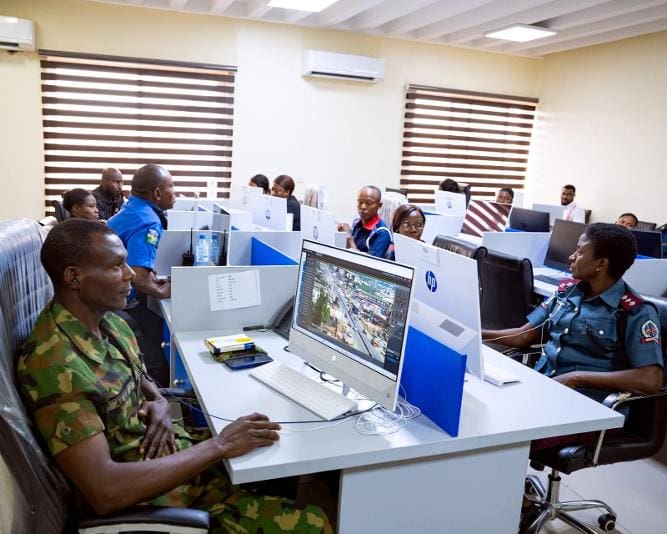
Although certain budgetary allocations were traceable, there was no comprehensive record of the project’s development and operational expenditure. Therefore, the report made its central focus the lack of procurement transparency, operational sustainability, and public accountability.
The investigation argues that the deterioration of a highly publicised surveillance and security initiative raises broader questions about governance, maintenance planning, and value for public funds. Read the full report here.
The findings of these two reports raised concerns about systemic weaknesses in accountability, transparency, and the potential misuse of surveillance resources.
Nigeria’s huge surveillance spending
The analysis of the 12 investigations highlights a stark reality. Growing expenditure on government surveillance technology. Over the years, federal and state governments have justified these budgetary expenditures as necessary measures to combat terrorism, banditry and other forms of organised crime in the country. However, the ICIR reports raised concerns about the scale of spending, lack of transparency, and implications for citizens’ privacy.
For instance, findings of a report by the Institute for Development Studies, titled “Mapping the supply of surveillance technologies to Africa,” revealed that Nigeria is Africa’s largest customer for surveillance technologies, spending at least $2.7bn on surveillance technologies from 2013 to 2022. Much of this equipment was either produced or shipped from Israel, the UK, the US, China, and the European Union.
Among them are multibillion-naira allocations splurged on the Nigerian Police Force between 2020 and 2025 to procure intelligence equipment, tracking technologies and upgrade a strategic surveillance platform codenamed COBWEB.
In 2023 alone, the police budgeted ₦7.5 billion as a Special Intervention Fund to procure the Cyber Intelligence Tracking System (CITS), and another ₦4 billion to activate and upgrade the COBWEB strategic surveillance platform. The system was allocated an additional ₦2.9 billion in 2024 and another ₦2.9 billion in 2025 for further activation and upgrades under the Technical Intelligence Unit.
Other security agencies have also received substantial funding. The 2026 budget shows an allocation of N213.2 million to the State Security Services (SSS) for surveillance equipment and N11 billion for “security equipment.”
Previous spending includes a 2017 budgetary allocation of N648 million to acquire the Athena Forensic Solution and a 2021 National Assembly approval of N4.87 billion to intercept Thuraya calls and WhatsApp messages. Within the same period, the Defence Intelligence Agency (DIA) received an allocation of N7.46 billion for an “independent lawful interception platform.”
State governments were not left behind. For instance, one of the reports revealed that the Kaduna State government, under its immediate past Governor, Nasir El-Rufai, spent at least N4 billion on the procurement of GSM/UMTS systems and installation of CCTV Cameras for monitoring and surveillance between 2016 and 2019. Journalists interviewed during the investigation linked this period to increased harassment and intimidation of journalists by government officials.
In Kogi State, despite vague security-related budget allocations, the investigation exposed large appropriations for broadly described security gadgets, ICT installations, and surveillance equipment with limited public accountability.