
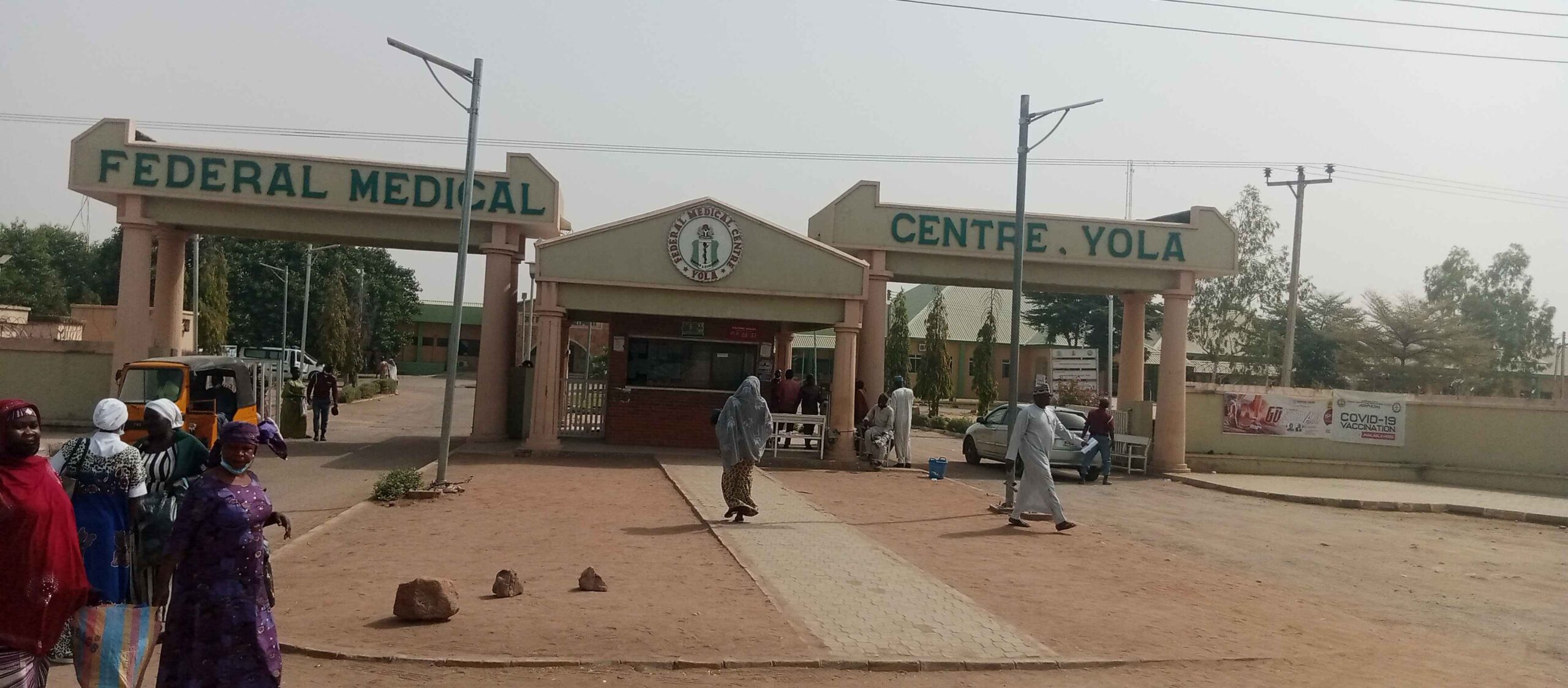
The Federal Medical Centre, Yola, Adamawa State, plans to upgrade into a teaching hospital, but the facility faces three key challenges that may prevent it from achieving the goal. The ICIR’s Senior Investigative Reporter, Marcus Fatunmole, captures these challenges in this report.
The hospital lacks a potable water supply, and it pays millions monthly on diesel and petrol to generate power.
The reporter observed that the challenges are not limited to the hospital; they sweep through and frustrate the nation’s health system.
On February 11, the Federal Ministry of Health officials visited the FMC Yola to check if it met the criteria for upgrading to a teaching hospital.
The outcome of the visit has not been made public.

While medical centres like the FMC Yola offer specialised (mainly tertiary) care, teaching hospitals render specialised care and serve as a learning centre for physicians, nurses, and allied health personnel.
The medical director FMC Yola Auwal Abubakar, a professor, told our reporter that consultants and other workers were leaving the hospital for Saudi Arabia, Europe and other nations to seek a better work environment and enjoy better pay.
According to Abubakar, the facility spends about ten million Naira on diesel monthly because of an erratic power supply.
The amount is different from about six million Naira the hospital spent monthly to get power from the Yola Electricity Distribution Company, which supplies light to the state.

Speaking on water scarcity in the hospital, he said: “We pump water three kilometres away from here. Even if you sink a borehole here, there is no water. Even if there is water here, we use a lot of diesel to pump it.”
When upgraded to a teaching hospital, the hospital will consume more water and power supply. It will also accommodate more people (students and workers).
FMC Yola has a good working environment, but welfare is poor, say workers
The reporter observed that the Yola FMC parades an array of beautiful and massive buildings, but he could not confirm if the hospital had adequate equipment to render optimal services.
Though many of the hospital’s buildings have spanned decades, they looked kempt amid well-landscaped surroundings.

Some of the hospital’s workers who interacted with The ICIR blamed the brain drain on poor pay by the government. They said they could not make ends meet with their wages.
The medical director said consultants were leaving the hospital “en masse,” despite the hospital’s good look.
He said, “Many are leaving. The younger ones are going to the UK, and the other ones are going to Saudi Arabia. There is no month that we won’t have a number leaving. Both doctors and nurses are leaving; it is a problem, especially for some critical departments like anaesthesia.”
Three to four consultants, including doctors and nurses, leave the facility every month. The medical director explained that the government is aware of the problem, which would lead to a lack of enough workers to manage critical departments at the hospital if not addressed.
He, however, noted that improved wages and general condition of service for caregivers could stem the brain drain.
Background to the report

Data on the Nigeria Open Contracting Portal (NOCOPO) showed that the hospital got the largest share of funds the Federal Government allocated to its tertiary hospitals in 2020 as part of its efforts to contain COVID-19.
The hospital got N849.6 million (N849,626,988.50) from about N40 billion support fund contributed by the country’s private sector under CACOVID to combat the pandemic.
In February, The ICIR reporter visited the hospital to check the equipment procured with the fund.
Contracts for FMC Yola funded with CACOVID fund
The Federal Ministry of Health awarded the contract to procure 10-bedded ward equipment for the intensive care unit of the FMC Yola to JNC International Limited at N353.3 million (353,335,898.00).
The same contractor won another contract to procure equipment for the isolation centre for the hospital at the cost of N99.3 million (N99,378,520.50).
The DCL Laboratory Products Ltd won another contract to procure molecular laboratory equipment for the hospital at the cost of N343.7 million (N343,707,570.00).
The contractors were to deliver the projects within a month.
About the contractors

Finding by The ICIR on the Corporate Affairs Commission (CAC) showed that the government registered JNC International Limited as a private unlimited company in September 2003 with registration number RC – 492239. Its office is at 30 Raymond Njoku Street, Ikoyi, Lagos.
Persons with significant interest in the firm are Onuoha Alphansus Reuben, Ajogwu Fabian, Kp Nominees Limited, John Burner, Osita Apah, and Omatseye Clare Adannaya.
DCL Laboratory Products does not appear on the CAC’s ‘public search’ section. But further findings showed it likely runs as a family firm, and it was registered as a private unlimited company with registration number RC 625405 in June 2005.
The company’s address is NO.12, Omimini street, Rumoodumanya, Port Harcourt, Rivers State.
Persons with significant interest in the company are Okechukwu Anyanwu, Anyanwu Celestina, Anyanwu Charles, Ikeh Obinna, Anyanwu Ifeanyi, Anyanwu Anyanwu Charles.
Both firms deal in pharmaceutical products.

The Public Procurement Act 2007 recommends competitive and open biddings for public contracts. It is unclear if there were competitive biddings for the COVID-19 intervention contracts, given that it was an emergency procurement.
This newspaper reported in November 2021 how the National Primary Health Care Development Agency (NPHCDA) hoarded information on the contracts it awarded with its share of the COVID-19 Intervention Fund.
The agency awarded 15 contracts (out of 29) worth over N444 million to Marvelous Mike Press Limited as part of the emergency contracts.
Contractors delivered projects at FMC Yola

Some of the FMC Yola’s management staff led The ICIR reporter to the departments that benefitted from the procurements. The reporter confirmed that the contractors procured the equipment and brought them to the hospital.
The reported checked all the equipment and discovered the COVID-19 Intervention Fund’s label was on them.
Government’s budget for FMC Yola
Out of the 2022 government’s health budget of N724.9 billion (724,924,440,307), the Federal Government approved N6.2 (N6,284,720,823) for the FMC Yola.
Brain drain tops challenges in Nigerian hospitals
In February, The ICIR had reported how consultants and other health workers at the FMC Makurdi resigned despite having new equipment to work.

The hospital got N653 million – the second-largest share from the CACOVID fund – to procure equipment.
Check by this newspaper showed the hospital got the equipment, but many of its workers dumped the facility to take jobs abroad.
The situation was the same at the FMC Jalingo, Taraba State, where the hospital’s medical director said less than 15 consultants remained at the facility.
The ICIR had reported in August 2021 how hundreds of doctors thronged a popular hotel in Abuja when the Saudi-Arabia-based recruiter needed only seven.
Similarly, in October that year, the newspaper reported how the nation lost nearly 9,000 doctors and other health workers to the UK and other countries in two years.
Read the other parts here and here.

Marcus bears the light, and he beams it everywhere. He's a good governance and decent society advocate. He's The ICIR Reporter of the Year 2022 and has been the organisation's News Editor since September 2023. Contact him via email @ mfatunmole@icirnigeria.org