
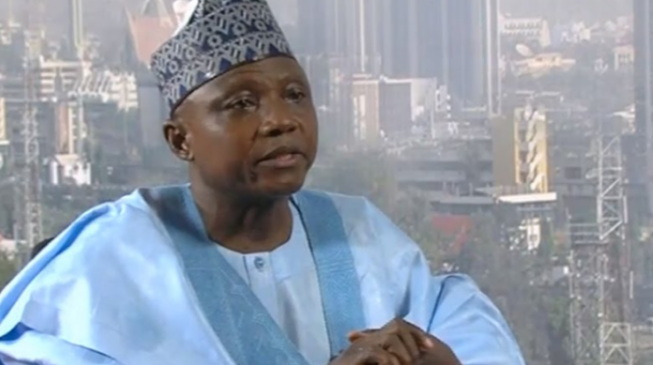
FORMER presidential spokesperson Garba Shehu has rejected claims by ex-President Goodluck Jonathan that Boko Haram once chose the late Muhammadu Buhari to represent the group in negotiations with the Federal Government during the peak of the insurgency.
Shehu, who served as Senior Special Assistant on Media and Publicity to Buhari, in a statement on Friday, October 3, described Jonathan’s remarks as false and politically motivated, linking them to a possible 2027 presidential ambition.
Jonathan, at the public presentation of Scars, a book authored by former Chief of Defence Staff, Lucky Irabor (retd.), in Abuja on Friday, October 3, had said that his administration set up several committees to explore dialogue with the sect, and in one such attempt, the insurgents nominated Buhari as their preferred negotiator.
“One of the committees we set up then, the Boko Haram nominated Buhari to lead their team to negotiate with the government,” Jonathan said. “So I was feeling that, oh, if they nominated Buhari to represent them and have a discussion with the government committee, then when Buhari took over, it could have been an easy way to negotiate with them and they would have handed over their guns. But it was still there till today.”
He recalled that Boko Haram, which became violent in 2009 when he was vice president, carried out some of its deadliest attacks during his tenure, including the bombing of the United Nations headquarters in Abuja in 2011 and the abduction of over 270 Chibok schoolgirls in 2014.
The former president added that Buhari’s inability to defeat the group after assuming power showed that the crisis was more complex than often portrayed.
“I thought that after I left, within a reasonable time, General Buhari would wipe them out. But even today, Boko Haram is still there. The issue of Boko Haram is far more complex than it is often presented,” he said.
Shehu’s rebuttal
Responding to Jonathan’s claim, explained that the speculation about Buhari’s alleged nomination emerged in 2012 when a faction of Boko Haram, through a certain Abu Mohammed Ibn Abdulaziz, announced Buhari’s name alongside other northern leaders as potential mediators.
However, Shehu noted that this claim was disowned by Abubakar Shekau, who said Abdulaziz lacked the mandate to speak for the sect.
“What led to the misleading information was that a faction of the terrorist group, possibly sponsored by Buhari’s opponents, staged a press conference in Maiduguri, Borno State, through a certain Abu Mohammed Ibn Abdulaziz, who claimed to be the Boko Haram commander in charge of Southern and Northern Borno, saying that the sect would prefer the former military leader, General Muhammadu Buhari, ex-Yobe State governor and the then Senator, now late Bukar Abba Ibrahim, first Nigerian Minister of Petroleum, Shettima Ali Monguno, also late, Chairman of the Presidential Committee on Insecurity in the North-East, Ambassador Gaji Gatimari, and other prominent members of the Borno Emirate to mediate between them and the federal government.
“Abdulaziz was roundly condemned by the leaders of Boko Haram who claimed that he had no mandate of their leader, Imam Abubakar Shekau,” he said.
Shehu recalled that in 2014, Buhari survived a Boko Haram-linked bomb attack in Kaduna that left members of his convoy injured.
He stressed that Buhari’s campaigns consistently centred on fighting Boko Haram and restoring security to Nigeria, positioning him directly against the terrorists.
At the time, Shehu explained that Buhari’s party, the Congress for Progressive Change (CPC), also dismissed the claims, adding that the then party secretary, Buba Galadima, said Buhari was unaware of any such nomination.
He also stressed that CPC publicity secretary, Rotimi Fashakin, accused Jonathan’s administration of exploiting the claim to divert public attention from corruption allegations.

Mustapha Usman is an investigative journalist with the International Centre for Investigative Reporting. You can easily reach him via: musman@icirnigeria.com. He tweets @UsmanMustapha_M