
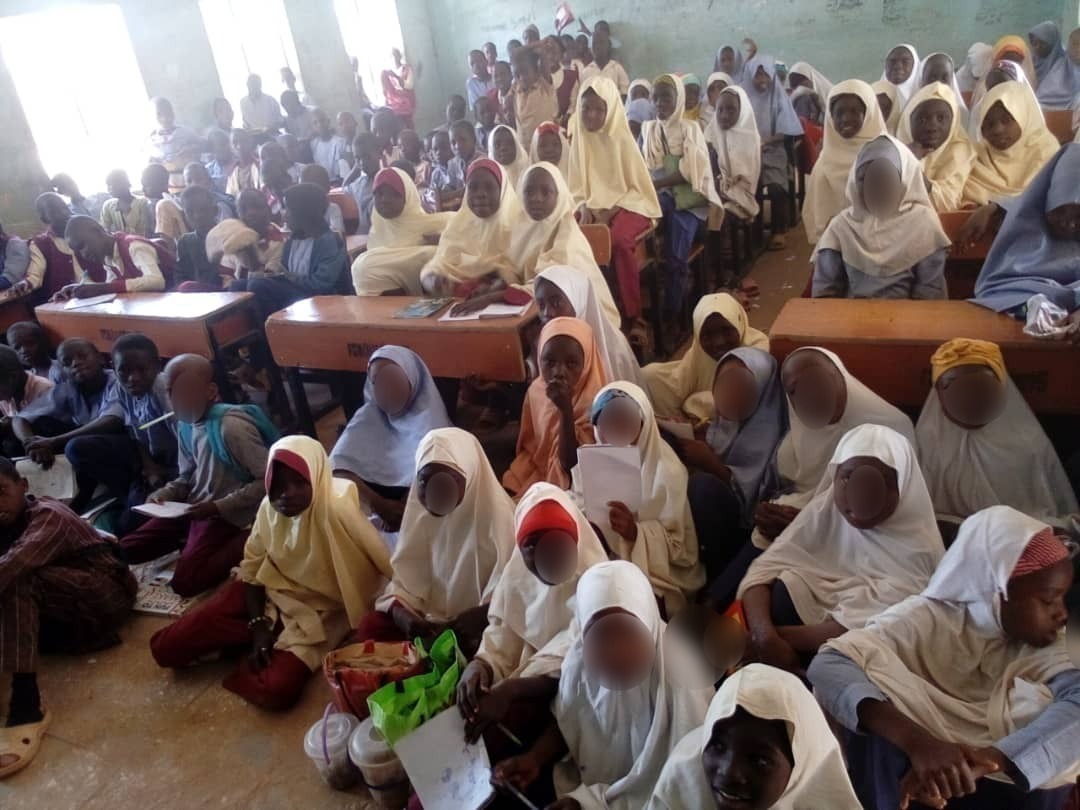
THE Federal Government’s proposal to abolish the separation of junior secondary school (JSS) and senior secondary school (SSS) as part of strategies to address Nigeria’s over 20 million out-of-school children will not address the root causes of the crisis, an education expert, Yomi Fawehinmi, has said.
The expert argued that the country’s out-of-school crisis is driven primarily by poverty, insecurity, child labour, child marriage and other socio-economic factors rather than the administrative structure of the education system.
The ICIR reports that the Federal Government’s proposal comes amid Nigeria’s worsening education crisis. According to the United Nations Children’s Fund (UNICEF), Nigeria has one of the world’s largest populations of out-of-school children, accounting for one in every five globally.
UNICEF estimates that 10.2 million children of primary school age and 8.1 million children of junior secondary school age are currently out of school, while about 74 per cent of children aged seven to 14 cannot read and understand a simple text or solve basic mathematics problems.
It was against this backdrop that the Minister of Education, Tunji Alausa, on June 30, announced plans to phase out the long-standing JSS/SSS structure, describing it as a failed policy that has worsened access to education.
He said Nigeria had about 80,000 public primary schools but only 15,000 junior secondary schools, creating a major transition gap that leaves millions of children unable to progress to the next level.
The minister said the proposal, which will be presented to the National Council on Education (NCE) for approval, forms part of broader reforms to address Nigeria’s more than 20 million out-of-school children and improve learning outcomes.
The ICIR reports that under the current education system, pupils spend six years in primary school, three years in junior secondary school and another three years in senior secondary school.
However, reacting to the proposal, the education expert, Fawehinmi, also a human resources and change management professional, said there was no evidence that separating junior and senior secondary schools had been responsible for the country’s out-of-school crisis.
“I believe that the separation of JSS and SSS is not a critical factor in the situation where we have out-of-school children,” the expert said, arguing that research over the years consistently pointed to three categories of factors responsible for children dropping out of school. The factors, according to him, are: push factors, pull factors and fallout factors.
He said push factors are circumstances that force children away from school, including poverty and the need to seek livelihoods.
“That’s where you have things like poverty and the need to go and get other opportunities,” he said.
He added that poverty also affects children attending public schools despite tuition being free.
“Interestingly, I saw data that actually shows that poverty even makes people leave public schools where tuition is free. While tuition is free, they are still asked to bring a table and chair, or provide blackboards or other materials.”
The second category, which he described as pull factors, refers to external influences that lure children away from education.
“The pull factor is what the child wants to go and do outside. For example, child marriage is an outside factor pulling the child away. Attraction to Yahoo and the world of entertainment is also pulling children from school.”
The third category, the fallout factors, consists of life circumstances that prevent children from continuing their education, including pregnancy and other personal challenges.
He maintained that the administrative separation of JSS and SSS had little or no influence on whether children remained in school.
“There is no place where whether the school is separate or not becomes a determining factor. If you want to stay in school, you will stay in school, whether it’s separate or not.”
He noted that countries such as Canada and the United States also operate separate elementary, middle and high school systems without recording the level of school exclusion seen in Nigeria.
“So, virtually everywhere in the world, or at least in most places, there is a demarcation. If those other countries are not having 20 million out-of-school children, then that cannot be the factor.”
Insecurity deepens school exclusion
Beyond poverty, Fawehinmi, identified insecurity as another major factor worsening Nigeria’s out-of-school crisis, saying attacks on schools and the displacement of communities continue to disrupt children’s education.
According to him, direct attacks on educational institutions, including the abduction of pupils and students, have created fear among parents, learners and teachers, forcing many children to stay away from school.
He added that insecurity also triggered secondary consequences that further increase school dropouts.
He argued that unless insecurity is addressed alongside poverty and other socio-economic challenges, structural reforms to the education system alone would have little impact on reducing Nigeria’s out-of-school population.
The ICIR reported how since the first school abduction that attracted global outrage occurred in April 2014, several schools have been attacked, students kidnapped, including the latest that saw armed men abduct scores of children from Borno and Oyo schools.

Mustapha Usman is an investigative journalist with the International Centre for Investigative Reporting. You can easily reach him via: musman@icirnigeria.com. He tweets @UsmanMustapha_M