


WHEN Merian [surname withheld] lost her job at the Kaduna Electric Distribution Company (KAEDCO) in 2023, she thought she had one small cushion to fall back on – her pension. But when she approached her Retirement Savings Account (RSA), there was little to withdraw.
“For about 52 to 54 months, they deducted from our salaries and didn’t remit it,” she said, “They are supposed to add their own contribution and pay it, but they didn’t remit from 2018 to 2023.”
Under Nigeria’s contributory pension scheme established by the Pension Reform Act 2014, employers are required to deduct a minimum of eight per cent from employees’ salaries and contribute an additional 10 per cent as the employer’s share. Both must be remitted to a licensed Pension Fund Administrator (PFA) within seven days of the payment of salary. Failure to remit attracts penalties, including interest on unpaid sums.
Merian’s problem is not that a PFA failed to manage her funds, but that the money never got to them.
A review of Merian’s pension statement reveals intermittent payments, with some years having just a single payment instead of 12 remittances.
“I want to access my 25 per cent,” she said, referring to the provision of the law that allows a worker who has been unemployed for at least four months to withdraw up to a quarter of their RSA balance. “But if I access it now, it will be something very small.”
With years of contributions missing, withdrawing 25 per cent now would mean collecting a negligible amount. So, she waits.
Her experience is not isolated.
Jade (not real name), who is still employed at KAEDCO, popularly referred to as Kaduna Electric, confirmed that deductions were made from her salary for years without full remittance to her PFA.
“Exactly, 2018 to 2022,” she said when asked to confirm the period affected.
She has been with the company since its days as the government-owned Power Holding Company of Nigeria (PHCN). “I have been working with them since it was with government PHCN. When it was privatised in 2014, they took over in 2015,” she said.
PHCN was unbundled in 2013–2014 into 11 electricity distribution companies (DisCos), including Kaduna Electricity Distribution Company. Others are Abuja Electricity Distribution Company (AEDC), Ikeja Electricity Distribution Company, Eko Electricity Distribution Company, Ibadan Electricity Distribution Company, Benin Electricity Distribution Company, Enugu Electricity Distribution Company, Port Harcourt Electricity Distribution Company, Jos Electricity Distribution Company, Kano Electricity Distribution Company and Yola Electricity Distribution Company. There is also Aba Power (officially Aba Power Electric Company) which operates under a slightly different structure.
According to Jade, the issue has spanned multiple management transitions at Kaduna Electric.
“You know they are taking over from one management to another. The union protested the other time. They promised making the necessary payment, but till now we have not heard anything from them,” she said.
Kaduna Electric began operations in 2015 following the privatisation exercise. According to Jade, in 2018, a new management took over. By 2023–2024, another management transition occurred.
“They are aware and they are informed. It is recorded, it should be on their records,” she added speaking about the pension non-remittance.
Jade was clear that both components of the contributory pension appear affected.
“Our own pension, the one that was deducted from our salary, was not remitted. There is another one separately that they were supposed to remit to our PFA, but they have not remitted that either.”
The first is the employee contribution deducted monthly and reflected on payslips. The second is the mandatory employer contribution required under the Pension Reform Act.
For employees, the concern is not only about present access but future security.
“Even though I am not touching the pension money, at least it should be there. It is supposed to be for our future,” Jade said. “With the way the company is going, there is no reliability, because they employ and sack people at will. If something happens to me, where do I start from?”
She has watched colleagues lose their jobs and struggle. “Some of my colleagues that were sacked are out there. Some of them are frustrated.”
Zayyanu Umar, who left Kaduna Electric in April 2024 after joining in 2015, said his pension backlog was about 54 months.
“It’s a general issue. They are not remitting it,” he said.
Disengaged, but no exit package
Haruna Sufiyanu Sani understands the system from the inside. For ten years, from 2015 to 2025, he worked in human resources department, interpreting and explaining the company’s conditions of service to employees.
“I used to be the one to interpret the condition of service. We are the custodian of it. We interpret it,” he said.
From that vantage point, he understood the company’s obligations including pension remittances and exit entitlements for disengaged staff. He confirmed that management was aware of the pension issue and that the matter had been raised through the union.
“This is the issue that they are aware of. The management is aware of this,” he said. “There were many strides regarding the issue of non-remittance, which the management pledged and promised that they will do.”
Like others, he said some years were paid while others were not.
“Even while we were in service, they paid some years and left other years without payment.”
A review of Sani’s pension statement also revealed large chunks of missing remittances. For instance, 2019 and 2021, recorded only one payment each, while 2020 had no payment.
For Sani, what was once a policy he explained to staff eventually became his own reality when he was disengaged. According to him, under the company’s conditions of service, employees whose “services are no longer required” are entitled to exit tokens. But he, as well as many others, are yet to receive them.
The conditions of service sighted by The ICIR in chapter 13 which spoke about exit token, state that employees who spent five to nine years are entitled to 35 per cent of total annual emoluments per completed year; 10 to 15 years attract 40 per cent, while 16 years and above attract 50 per cent per completed year as exit token.
‘It is criminal’ — Union reacts
Dominic Igwebike, the Acting General Secretary of the National Union of Electricity Employees (NUEE), confirmed that the union had picketed Kaduna Electric over non-remittance of pensions and non-payment of exit benefits.
“ …although they have said they did part payments after our negotiation with the management to pay everybody part of their exit packages and every month they should be paying a certain amount for those who are disengaged staff. On the pension, there is over 80 months pension arrears which they said they cannot clear at once based on the challenges,” he said.
Pressed on why electricity distribution companies appear to default on pension remittances, Igwebike said: “For me, it’s criminal. You don’t collect a worker’s pension contribution and fail to remit it to the PFA. It is not acceptable.”
He said the union had continued to press management to honour agreements and warned that if commitments were not kept, industrial action could resume.
“If they don’t honour the agreement, you go back to the trenches – and the trenches mean strike action, which we are trying to avoid. But we are not keeping quiet.”
The union, in a letter dated February 1, 2025 (Ref: NUEE/ZOS/NW/KD/2025/008), advised staff not to accept correspondence from the company following an emergency meeting in which Kaduna Electric management allegedly disclosed plans to terminate over 900 workers.
Earlier, on January 10, 2025, NUEE had written to Kaduna Electric following a declared redundancy affecting 10 members, demanding immediate negotiations and warning of industrial action.
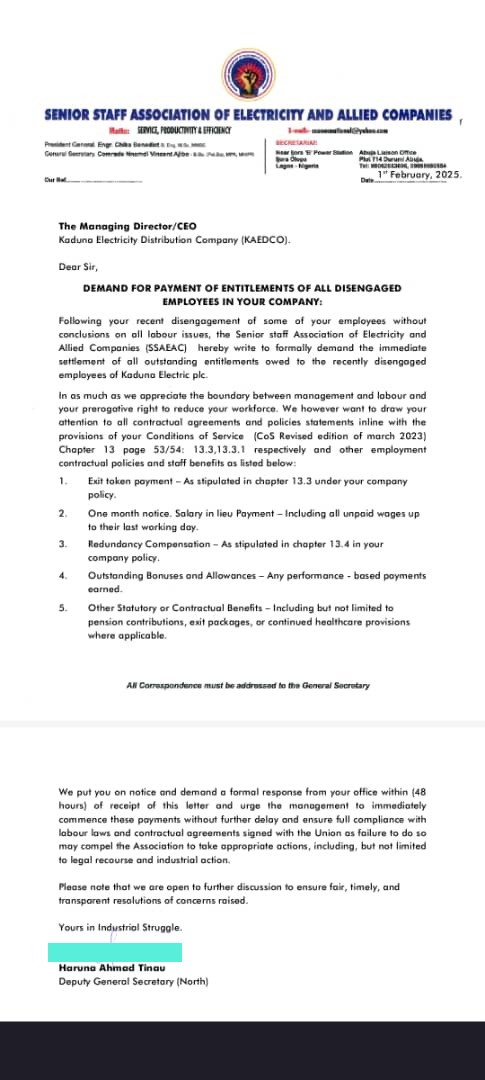
The Senior Staff Association of Electricity and Allied Companies (SSAEC), in a February 1, 2025 letter signed by Haruna Ahmed Tinau, Deputy General Secretary (North), demanded payment of exit tokens, one-month salary in lieu of notice, redundancy compensation, outstanding bonuses and allowances, and statutory or contractual benefits, including pension contributions. The association cited Chapter 13 of the company’s conditions of service as the basis for the demand.
Government intervention, yet payments pending
In early 2025, the crisis escalated into protests and picketing of Kaduna Electric’s headquarters in Kaduna over non-payment of pensions and emoluments.
The Deputy Governor of Kaduna State, Hadiza Balarabe, convened a meeting involving Kaduna Electric management, NUEE and SSAEC. Subsequently, Governor Uba Sani also intervened.
Following the intervention, Kaduna Electric issued a memo stating that mediation facilitated by the governor resulted in a resolution, including a review of the disengagement process.
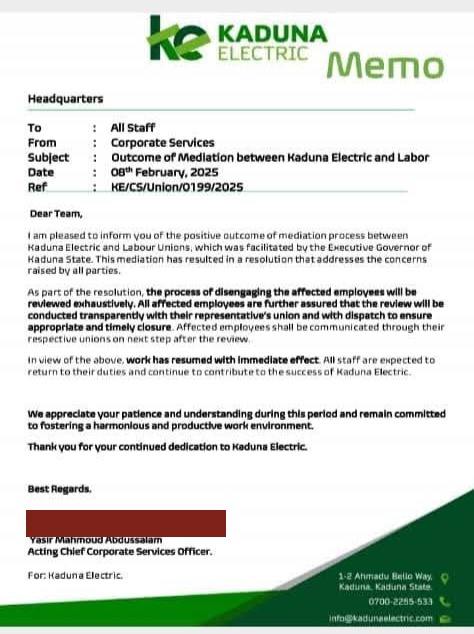
According to a memo from the agreement signed by NUEE representatives and management after a review meeting held on March 6, 2025, it was resolved that 20 per cent of total emoluments, based on years of service for staff with five years and above, would be paid to disengaged staff. The first payment was to commence at the end of April, with subsequent payments made every other month, concluding in August 2025.
However, when The ICIR interviewed affected staff in December 2025, they said they were yet to receive the agreed payments.
Igbwebike of NUEE insists that responsibility ultimately rests with regulators. “The buck stops on the desk of PenCom. They have the power under the law.”
Regulatory oversight questioned
The responsibility for regulating pension compliance lies with the National Pension Commission (PenCom), established under the Pension Reform Act 2014. The law empowers PenCom to investigate, sanction and compel defaulting employers to remit outstanding contributions and a statutory penalty of not less than two per cent of the unpaid amount for each month of default.
The ICIR contacted PenCom’s spokesperson, Ibrahim Buwai, seeking clarification on whether the commission had investigated Kaduna Electric over non-remittance from 2019 to 2025, and what enforcement steps had been taken, including recovery of arrears and penalties.
Buwai said an officer had been assigned to respond. After which the commission responded in a statement.
The commission stated that it is “aware that Kaduna Electricity Distribution Company has defaulted in the remittance of employees’ pension contributions.” Citing the Pension Reform Act 2014 (PRA 2014), PenCom stressed that the law “requires employers to deduct pension contributions at source and remit both the employee and employer portions to the custodian specified by the employee’s Pension Fund Administrator (PFA) not later than seven working days from the date salaries are paid.”
The commission further emphasised that under the Act, “any employer who fails to deduct or remit the contributions within the stipulated time frame shall, in addition to remitting the outstanding amount, be liable to a penalty of not less than two percent of the total unpaid contributions for each month or part thereof that the default continues.” It added that the penalty “is treated as a debt and is credited into the affected employee’s Retirement Savings Account (RSA).”
PenCom disclosed that it “has undertaken a series of regulatory and enforcement actions to ensure Kaduna Electricity Distribution Company complies fully with the provisions of the law,” noting that “the process is ongoing.” As part of these efforts, the commission said it “has appointed Recovery Agents to determine the total unremitted pension liabilities and applicable penalties.”
The commission was, however, silent on the duration and timeline expected to reach a resolution, but assures affected workers, stating that “all recovered pension contributions and accrued penalties will be credited directly into their respective RSAs,” reiterating its commitment to “protecting the rights and retirement benefits of pension contributors in line with its statutory mandate.”
PenCom added that it is engaging the Nigerian Electricity Regulatory Commission (NERC), which regulates electricity matters in Nigeria, to facilitate resolution of the matter.
The NERC, which regulates electricity distribution companies under the Electric Power Sector Reform Act, was also contacted, through its communication officer, Christiana Illiya, for response on what regulatory steps it was taking in light of repeated picketing of Kaduna Electric that could threaten service delivery and consumer protection, and also the status of the inter-agency engagement with PenCom.
After several calls, SMS, and WhatsApp messages for days, Illiya said she does not have the clearance to speak, inquiry should be sent to the head of the unit. Several attempts via calls and SMS and reminders on different days to the unit head, Hafsat Abdullahi Mustapha were not answered.
In an attempt to book an appointment to speak with NERC chairman, Musiliu Oseni, The ICIR was advised to send a Freedom of Information (FOI) request with the questions. This was sent to NERC via e-mail and also a dispatch. The ICIR will report the outcome of the response.
However, a source at the NERC, familiar with the situation, said non-payment of salaries, remittance of pension and emoluments is considered an internal matter between discos and their employees. Notwithstanding that, strike actions by unions often lead to paralysed services which inadvertently leads to service distribution which falls under the regulatory oversight of NERC.
Kaduna Electric silent
The ICIR contacted Abdulaziz Abdullahi, who had previously spoken on behalf of Kaduna Electric, but he said he was no longer with the organisation. Abdullahi’s claim was confirmed by a staff in the company.
In 2024, Abdullahi had described the strike action by NUEE as “illegal” and “unnecessary”.
He told the press that “We woke up this morning to the news that members of NUEE have locked up our offices. We were shocked because there was no need for it. We have a quarterly meeting scheduled for Wednesday. They have told us about the pension remittances, and there is a plan to settle the backlogs.”
“We have a new MD, and he needs time to settle down and then plan on how to gradually offset the historical liabilities. But they chose to do this and have stopped staff and customers from coming in.”
The MD Abdullahi was referring to is Umar Hashidu who was appointed following the resignation of his predecessor.
The ICIR contacted Hashidu, his line was busy and subsequent calls went to voicemail. A detailed WhatsApp message and later an email were sent asking why pension contributions – both employer and employee portions – were deducted but not remitted in apparent contravention of the Pension Reform Act; why exit benefits remain unpaid; and when affected staff should expect full settlement of arrears. Reminders were sent on different days as follow-ups, but as of press time, he did not respond.
The ICIR also reached Asmau Abdullahi who was said to be heading the communication unit, she said the inquiry will be relayed to the appropriate person who is the deputy to the managing director. when a follow-up call was made for update, she said he was not yet on seat but promise to get back as soon as he is available. As of press time, the company had not responded.
Beyond Kaduna Electric – discos getting picketed left, right and centre
Kaduna Electric is not alone in this trend. The power distribution sector has experienced at least eight major strikes and protests since 2019, most of them linked to unpaid pensions, entitlements, and poor working conditions.
In October 2019, workers at the Abuja Electricity Distribution Company (AEDC) staged protests over unpaid allowances, disrupting electricity supply across Abuja and neighbouring states.
By late May 2024, AEDC workers were again on strike, this time over pension arrears, highlighting what union leaders describe as a recurring pattern across several distribution companies.
The following year, in January–February 2025, staff of Kaduna Electric embarked on strike action over a combination of unpaid pension contributions and a mass sack plan affecting over 900 workers. Government mediation in February 2025 led to a staggered payment agreement, but implementation remained incomplete.
In June 2025, AEDC workers issued a fresh strike threat over unresolved pension non-remittance, signalling that previous disputes had not been fully resolved.
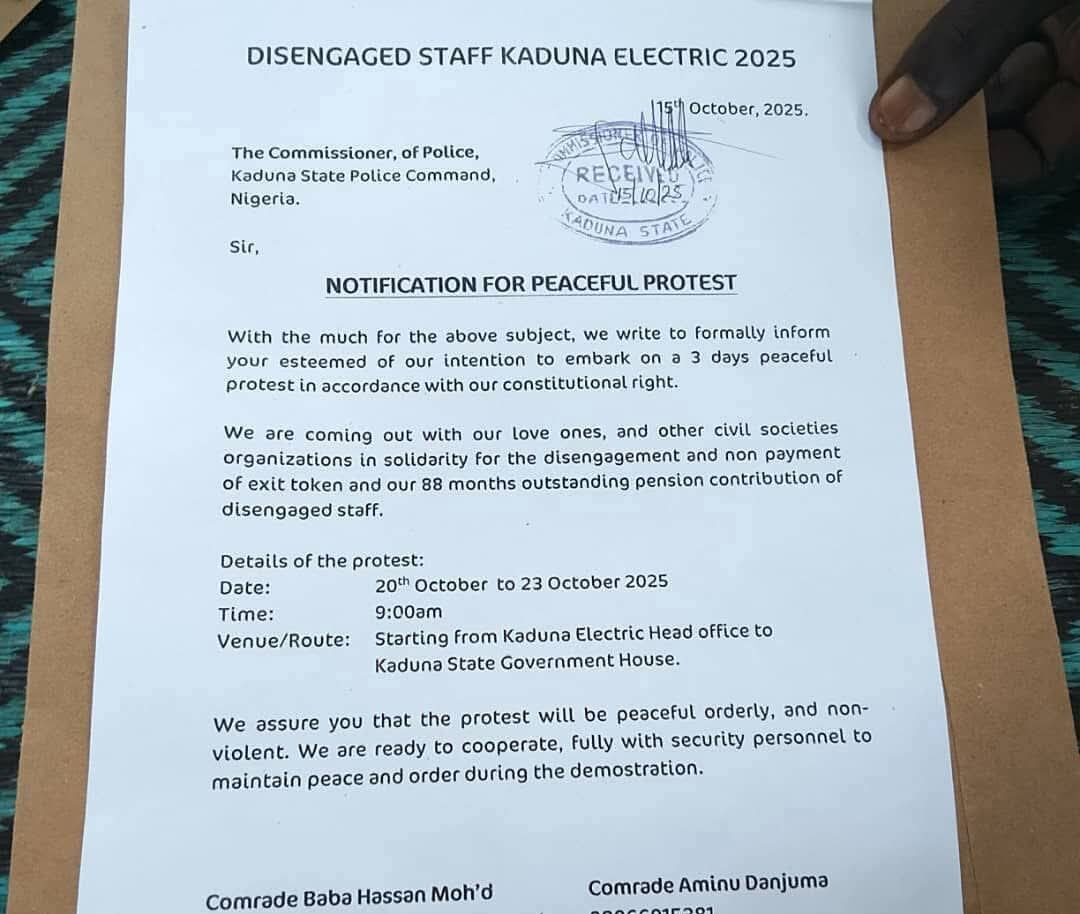
Towards the end of 2025, disengaged Kaduna Electric staff notified the police of a planned protest scheduled for October 20–23, staggered exit payments, pension arrears, and redundancy benefits.
In January 2026, workers at Kano Electricity Distribution Company (KEDCO) commenced strike action over alleged long-standing pension arrears and poor working conditions.
These repeated actions across multiple DisCos illustrate a systemic issue in Nigeria’s power sector, where deductions often appear on employee pay slips but fail to reach PFAs leaving workers uncertain about their retirement security.
On the broader implications, labour leaders warn that recurring industrial actions by electricity workers disrupt operations. For Meriam and others, however, the issue is deeply personal.
“It’s our future,” she said quietly. “We worked for it. We should not have to beg for it.”
Bamas Victoria is a multimedia journalist resident in Nigeria.