Home Blog Page 1044

Nigerians stage protest at London Embassy chanting “give us Obi”

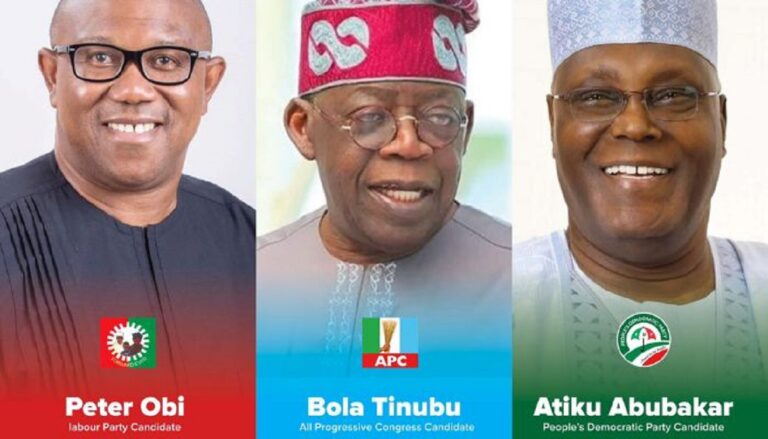
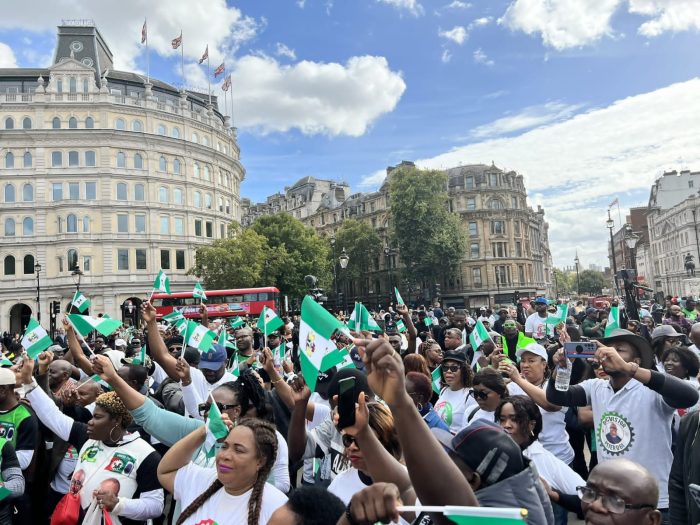
SOME Nigerians staged a massive protest at the Nigerian Embassy in London on Friday, March 3, demanding that the candidate of the Labour Party (LP) Peter Obi be declared winner of the February 25 presidential election.

Chairman of the Independent National Electoral Commission (INEC) Mahmood Yakubu, on Wednesday announced the candidate of the All Progressives Congress (APC) Bola Tinubu, winner of the election with a total of 8,794,726 votes, having also scored over 25 per cent of the votes cast in 30 states.

The main opposition Peoples Democratic Party (PDP) candidate Atiku Abubakar, came second with 6,984,520 votes, while Obi polled a total of 6,101,533 votes to come third place.

“Give us Obi, give us Obi,” the crowd chanted on Friday as they waved the Nigerian flag.

Addressing an international press conference on March 2, Obi had vowed to challenge the electoral process in court, insisting his party won the election but had been robbed of its mandate.

“We will explore all legal and peaceful options to reclaim our mandate. We won the election and we will prove it to Nigerians,” he said.

A coalition of International Election Observation Missions also faulted the process saying that the introduction of the Bimodal Voter Accreditation System (BVAS) and the INEC Results Viewing Portal (IReV) were perceived as an important step to ensure the integrity and credibility of the elections, but noted that uploading of results using the BVAS did not work as expected.

“Logistical challenges and multiple incidents of political violence overshadowed the electoral process and impeded a substantial number of voters from participating,” the coalition said in its official statement.

They, however, called on aggrieved political parties and their candidates to settle electoral disputes through peaceful means and dialogue, in accordance with the law.

Meanwhile, six state governments on Friday dragged the Federal Government to the Supreme Court over the conduct of the exercise.

The six states – Adamawa, Akwa-Ibom, Bayelsa, Delta, Edo and Sokoto – have asked the Supreme Court to nullify the election.

Legal battle: Court grants Atiku, Obi access to election materials

A panel of the appellate court led by Justice Joseph Ikyegh has issued orders following two separate ex parte applications made by the Peoples Democratic Party (PDP) presidential candidate, Atiku Abubakar and his Labour Party (LP) counterpart, Peter Obi.

The applicants had asked the court to allow them to have access to all the sensitive materials the Independent National Electoral Commission (INEC) deployed for the conduct of the presidential election held on February 25.

Respondents in the petition include INEC, the President-Elect Bola Tinubu and his party, the All Progressives Congress (APC).

Atiku and Obi believe the requested documents would aid their petition against the outcome of the presidential contest that was declared in favour of Tinubu.

The applications were based on several legal provisions, including Section 146 (1) of the Electoral Act 2022, Paragraph 47 (1, 2, and 3) of the First Schedule of the Electoral Act of 2022, as well as under the inherent jurisdiction of the court as referenced by Section 6 (6) (a) and (b) of the 1999 constitution, as amended.

Atiku’s lawyer, Adedamola Faloku, sought seven prayers from the tribunal, while Obi, in his application moved by Alex Ejesieme, sought six principal reliefs.

INEC declared Tinubu of the APC as the winner of the presidential poll, ahead of 17 other candidates that contested the election. According to INEC, Tinubu scored a total of 8,794,726 votes to defeat Atiku, who polled a total of 6,984,520 votes and Obi of the LP, who came third with a total of 6,101,533 votes.

Both PDP and LP rejected the outcome of the election and vowed to challenge it in court.

Medical racism: Canada-based Nigerian nurse narrates how negligence led to son’s death

A Canada-based Nigerian nurse Birgit Uwaila Umaigba, is mourning the loss of her son David, whose death was due to the negligence of healthcare givers in an Ontario hospital.

Umaigba said on her birthday, at only 18 weeks of her pregnancy journey, her water broke prematurely (also known as the prelabour rupture of membranes) and she was diagnosed with oligohydramnios, a condition of very low amniotic fluid that occurs in only about four per cent of pregnancies.

She said the first Obstetrician she met hurriedly told her to go home and wait for a miscarriage as there were no beds and sufficient nurses to monitor her.

“When my water broke prematurely, the OB (Obstetrician) told me to go home and wait for a miscarriage. She was cold and detached,” Umaigba narrated.

However, after she pleaded to stay in the Labour and Delivery (L&D) ward, she was sent back to the Emergency Room to be monitored overnight by non-L&D nurses in case she went into labour.

“It was scary, but I complied. I was in too much shock to advocate for myself…The team had no idea what to do with me as the OB didn’t communicate with anyone.

“As a nurse, I felt I was supposed to be having fluid replacements, but then, I forgot to ask the ED nurse. In the morning, the day nurse told me I was supposed to have received intravenous fluid replacement overnight. No one checked.

“I didn’t even have a saline lock for an emergency in case I went into labour. My lips were dry. I felt so dehydrated. No one offered me oral fluids, nor did I receive the prescribed IV fluids. Care was suboptimal. Felt like my life meant nothing,” she recalled.

By the next day, she felt intense cramps and had a fever after she left the hospital. She returned and met another Obstetrician who informed her she had been fully infected and efforts were made to save her life by inducing labour. Her baby was brought out dead.

Umaigba who had previously lost a child added: “Once again, the healthcare system failed us. Baby David came as my birthday present but came too early. He was born at 18 weeks and died at birth”.

Reacting to Umaigba’s ordeal, an Associate Professor of Obstetrics and Gynecology Genevieve Eastabrook admitted there was a knowledge gap among care providers for people experiencing second-trimester pregnancy complications, as well as a lack of infrastructure and medical racism.

“In Canada, Black and Indigenous women have significantly higher rates of maternal morbidity and mortality, as well as higher rates of adverse perinatal outcomes,” Eastabrook said.

According to a study, Indigenous women typically were found to have less access to maternity and infant care, as well as poorer pregnancy outcomes than non-Indigenous women.

There have been recent stories in the news about the horrific treatment of Indigenous women experiencing pregnancy loss.

Last November, an Indigenous woman in Edmonton, Pearl Gambler, filed a $1.3 million lawsuit against the Misericordia Community Hospital, alleging that mistreatment, racism and neglect at a community hospital led to her baby dying after she was forced into labour with no assistance from doctors or nurses.

Hope dims for Atiku’s presidency bid after six failed attempts

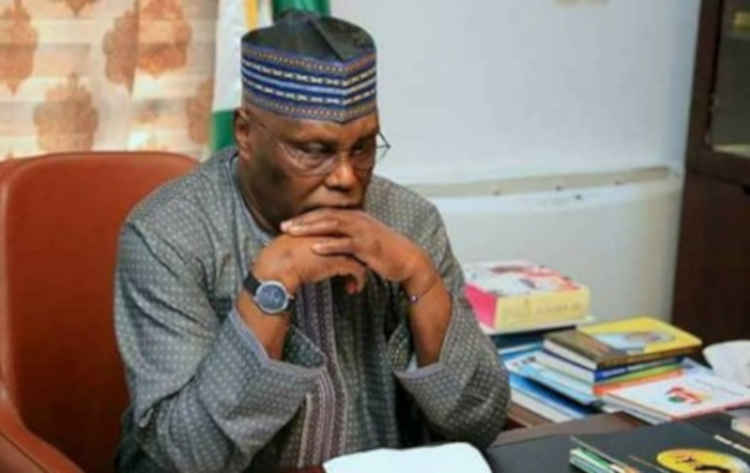
AFTER six unsuccessful attempts, former Vice President Atiku Abubakar becomes the only politician in Nigeria who has sought the presidency the most times and has yet to win it.

He has had two more shots at the country’s most exalted office than incumbent President Muhammadu Buhari, who ran four times before winning it.

Atiku, 76, has contested for the top office for 31 years and has had his hope dashed.

He vied for the presidency on the Peoples Democratic Party (PDP) platform in the election conducted on February 25, 2023.

Atiku came second with 6,984,520 votes, trailing the All Progressives Congress (APC) candidate, Bola Tinubu, who polled 8,794,726. 

He was one of the 18 presidential candidates in the election.

On Thursday, March 2, he vowed to challenge Tinubu’s victory declared by the Independent National Electoral Commission (INEC) on March 1 in court.

While Atiku has failed in all six times he has contested for the seat since 1992, Tinubu only contested once and won.

The ICIR reports that Atiku came into politics about the same time as Tinubu.

Both politicians cut their teeth in national politics through the late Shehu Musa Y’Adua-led Social Democratic Party (SDP) after former military leader Ibrahim Babangida created the SDP and National Republican Convention (NRC) in 1989, preparatory to a planned democratic transition.

Two options that can make Atiku become Nigeria’s President

Two options can now make the Adamawa State-born politician achieve his life-long ambition. The first is to challenge Tinubu in court as he vowed and get the court to reverse Tinubu’s victory or order the Independent National Electoral Commission (INEC) to conduct a fresh election, which he must win.

The second option is for the Waziri of Adamawa to recontest in 2027 for the seventh time. Running for the seventh time for the presidency could be a wild goose chase for him because he would be 80 years by 2027. Many Nigerians now desire a young President, as reflected in the massive support the Labour Party (LP) candidate, Peter Obi, enjoyed in the last election. Obi, 61, came third with 6,101,533 votes.

How rift with Rivers State Governor thwarted Atiku’s presidential dream

Atiku’s loss in the last election arguably stemmed from his rift with five aggrieved governors in his party.

The ICIR reported how the wrangle lingered days before the poll.

Nyesom Wike of Rivers State leads the G-5 governors, namely Okezie Ikpeazu (Abia), Samuel Ortom (Benue), Seyi Makinde (Oyo) and Ifeanyi Ugwuanyi (Enugu).

Atiku’s emergence as the PDP flagbearer angered Wike’s group because the incumbent President Muhammadu Buhari hails from the North like Atiku. Buhari and Atiku are from the Fulani tribe. The G-5 governors see Atiku succeeding Buhari as an injustice to the multi-ethnic Nigerian nation. 

Wike had contested for the PDP’s presidential ticket and lost to Atiku in May 2022.

Many Nigerians hoped Atiku would settle for Wike as his running mate. The former Vice President opted for Delta State Governor Ifeanyi Okowa.

After many appeals by the party stalwarts, Wike agreed to work with Atiku, but on the condition that the party’s chairman, Iyorchia Ayu, who is also from the North, resigns for a party member from the South to lead the party.

Ayu refused to step down. Atiku also said he couldn’t force the chairman to resign.

The G-5 governors insisted they would not support the PDP, which ruled Nigeria between May 29, 1999, to May 29, 2015, when it lost the presidency from the then incumbent Goodluck Jonathan, who was seeking re-election to Buhari, a retired Army General, who led Nigeria through a putsch between December 31, 1983, to August 27, 1985.

Buhari’s two-term of four years apiece ends on May 29, 2023.

The ICIR reports that only Wike and Makinde could be adjudged to have made good their threat not to support Atiku. They supported the APC, which won in their states.

The Labour Party trounced Ortom, Ugwuanyi and Ikpeazu, who were seeking election into the Senate. The Labour Party won in Ugwanyi and Ikpeazu states, while APC took Ortom’s. Ortom had endorsed the Labour Party, which failed in his state.

For information about Atiku’s childhood, education, work experience in the Nigerian Customs Service (NCS), his previous six shots at the presidency, including his leadership roles as Vice President during President Olusegun Obasanjo’s era, family and philanthropic lifestyle, check here and here.

World Bank offers workshop for journalists covering climate change

REVOLVE and the World Bank are seeking registrations for the  Innovate4Climate Journalists Workshop.

The program is slated for May 22, 2023, ahead of the opening of the Innovate4Climate conference in Bilbao, Spain. 

The four-hour I4C Journalists Workshop is designed for international media professionals to delve into the topic of climate finance.

Up to 25 participants will be selected to attend the workshop. Climate communication experts and finance/technical experts will provide a comprehensive picture of the global climate financial landscape and help journalists hone their reporting skills on climate change.

Following the workshop, participants will be invited to attend the three-day Innovate4Climate conference.

Innovate4Climate is the World Bank Group’s annual global conference covering climate finance, climate investment, and carbon markets.

Journalists from the Middle East, Africa, East Asia and the Pacific, Small Island Developing States, Latin America, and the Caribbean can apply for a hybrid workshop on climate change.

The deadline for registration is March 10, 2023. Interested applicants can apply here.

Competition recognises student documentary films

TOURNEZ S’il Vous Plaît (TSVP), in partnership with France 3’s regional network is inviting applications for its Graine de Doc competition.

The program will identify new documentary talent and offer them a springboard into filmmaking.

The competition aims to promote films that take a unique look at France, its society, regions, and upheavals. This year’s theme is ‘Facing the truth’.

The winner will receive a paid contract with TSVP to produce their first documentary starting in September, which will be broadcasted by a partner.

Contestants do not have to be nationals of a French-speaking country but must be able to present their project in French.

Francophone students who are college seniors can compete.

The deadline for the submission of applications is May 14, 2023. Interested applicants can apply here.

Controversy as Oxford terminates association with Onyeka Nwelue, David Hundeyin

OXFORD University has terminated its association with two Nigerian authors Onyeka Nwelue and David Hundeyin, following the latter’s book launch held on 31 January, at the university which has now sparked controversies.

According to a report published by Cherwell, a weekly student newspaper published entirely by students of Oxford University on Thursday March 2, Oxford University has launched an investigation into the misuse of its logos and premises for commercial purposes without permission and allegations of misogyny towards students and the spread of racist, classist, and sexist content online.

“Onyeka Nwelue and David Hundeyin are no longer associated with the University of Cambridge. Their connections were terminated following an investigation into their conduct.” Cambridge reportedly told Cherwell

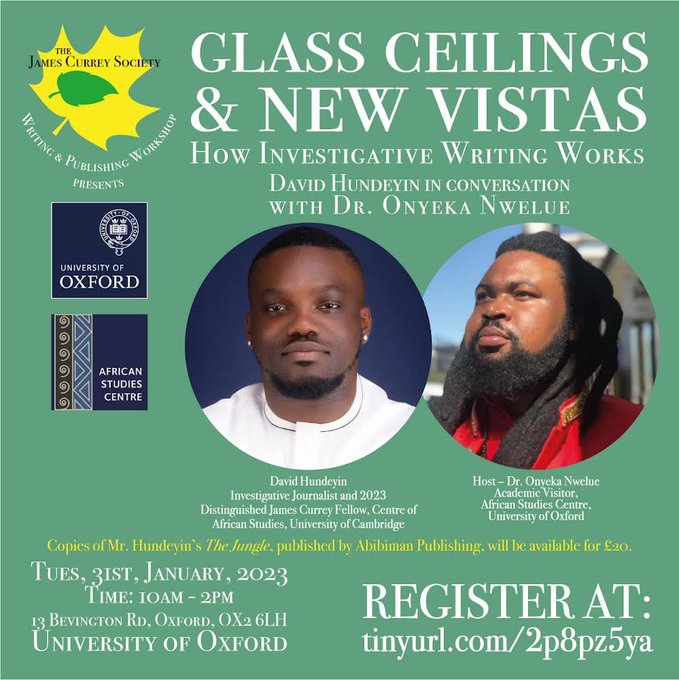
The book titled “The Jungle” which was published by UK-based Abibiman Publishing partly owned by Nwelue, was sold at £20, while tickets for the book launch were marketed through the James Currey Society which was also founded by Nwelue and incorporated as a for-profit company in May 2022, under the name of James Currey International, were priced at £20.

The flyer for David Hundeyin’s book launch who indicated that the book would be available for £20 was published on his Twitter handle 18 days before the event tagging Oxford University.

The book launch was originally advertised as taking place in the African Studies Centre, but the location was changed at short notice to a room in the Faculty of Modern and Medieval Languages at Wellington Square.

According to the publication, attendees of the event alleged that misogynistic remarks made by its organisers and other audience members made them feel “incredibly uncomfortable”.

One student reportedly said to Cherwell: “Explicitly sexist comments were made throughout by the speaker and audience which were not challenged and were in fact encouraged.

“Comments made suggested that women slept their way to the top, which oppressed men, and that marrying a woman held you back in life”.

Hundeyin, a journalist has accused the newspaper of publishing half-baked information, which he alleged was supplied by one Miles Larmer in collusion with a Nigerian governor Nasir El-Rufai.

Sharing email screenshots, he acknowledged he was contacted by the newspaper for confirmation or rebuttal of the accusations on March 1 and despite his response supported with evidence, the newspaper went ahead to publish without any mention of his position for balanced reporting.

“When they reached out for comment, I had informed them that my Fellowship was not terminated, and I showed them the letter above as proof. They nonetheless ran the story anyway and quoted an anonymous source claiming that Cambridge terminated me,” Hundeyin said.

The journalist  said he has a long-standing face-off with Governor El-Rufai of Kaduna state who is a member of Oxford’s African Studies Centre’s International Advisory Board inaugurated on 12 October 2018 by Nigeria’s Vice President Yemi Osinbajo.


The African Studies Centre’s International Advisory Board was inaugurated on Friday 12 October by the Nigerian Vice President, Professor Yemi Osinbajo.

Hundeyin accused the Governor of trying to thwart his book launch at the University after the initial venue secured was cancelled without any plausible reason, and added that he had reasons to believe that recent accusations and developments at the university were orchestrated by El-Rufai in a bid to silence him.

“This once again makes the point to me that salvation for Africa will only ever come from within. If the legendary, venerated Oxford University is reduced to acting as Nasir El-Rufai’s personal fixer, then there are truly no institutions that Nigerian politicians cannot corrupt,” he said.

Meanwhile, Cherwell said when it confronted Nwelue about complaints from attendees at the book launch, he responded: “I am very sorry if the students felt uncomfortable. About sexism and misogyny, I will never condone that. I am apologetic if that happened. Really sorry.”

Nwelue studied sociology and anthropology at the University of Nigeria, Nsukka, and earned a scholarship to study directing at the Prague Film School in Czech Republic.

Although Nwelue had established The Henry Louis Gates Jr Fellowship at the University of Cambridge and worked as an Academic Visitor at the African Studies Centre, University of Oxford, he is now being labelled as a fraud by the University’s newspaper.

At Oxford, Academic Visitorship is set up on terms agreed between an individual and the University. Cherwell said Nwelue denied ever posing as a professor at Oxford and Cambridge.

“My card says I am an Academic Visitor and that is exactly what I tell people. The accusation that I say I am a professor at Oxford is baseless,” he was quoted as saying.

The University of Oxford has not confirmed whether any background checks were carried out on Nwelue before he gained status as an Academic Visitor.

Nwelue’s Twitter account as now been deleted. Cherwell said Nwelue locked his Twitter account on Thursday after tweeting: “I am leaving social media this evening. It will be for long. [sic]. I might delete all my accounts as well. Bless you all!”


Supreme Court nullifies FG’s naira redesign policy, orders old notes valid till Dec 31

0

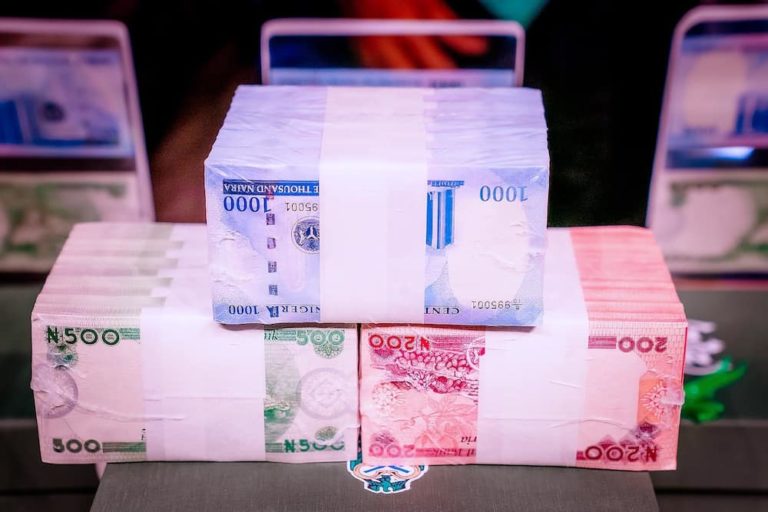
A SEVEN-MEMBER Supreme Court panel has nullified the Federal Government’s naira redesign policy.

The apex says old N100, N500 and N200 notes are valid till December 31

The court made the declaration on Friday, March 3, while delivering judgment in a suit filed by three states of the federation.

The Supreme Court ruled that although President Muhammadu Buhari had the authority to act as the federation’s executive, he was still required to give the federating units adequate notice before implementing the new monetary policy through the Central Bank of Nigeria (CBN).

The court said that before the old naira notes were withdrawn, the states had not received reasonable notice as required by section 20(3) of the CBN Act.

As a result, the Supreme Court ruled in its lead decision, which was written by Justice Emmanuel Agim, that Buhari’s authorisation for the CBN to withdraw the old banknotes was illegal.

The Supreme Court had on February 22 adjourned judgment on the new naira policy suit to March 3.

The court had earlier on February 8 restrained the Federal Government from implementing the February 10 deadline for swapping the old naira notes with new ones.

The injunction was a sequel to a suit filed by Zamfara, Kogi and Kaduna state governments against the implementation of the naira redesign policy.

In his arguments on Wednesday, February 22, counsel for the Federal Government, Kanu Agabi, said that all reliefs were rooted in Section 20 of the Central Bank of Nigeria (CBN) Act.

Agabi argued that the apex court had no jurisdiction to hear the suit as the action could not commence with an Originating Summons.

In addition, he argued that despite mentioning the CBN 32 times in their original summons, the plaintiffs thought it inappropriate to have the apex bank appear in court as a respondent.

He said Nigerians were already refusing the old notes in response to Buhari’s order.

Agabi argued that the President followed the court’s ruling when he asked Nigerians to deposit their old naira notes at CBN-designated locations and that the President had the constitutional authority to reject any law.

He requested that the lawsuit be wholly dismissed.

Counsels for Edo and Bayelsa states also agreed that the suit be dismissed for lack of jurisdiction.

However, the Attorney General of Kano State, a co-plaintiff, claimed Buhari ignored the National Economic Council’s members and only followed the CBN governor’s advice when implementing the monetisation strategy.

He stated that in contrast to what the law demanded, the President chose to act without consulting the state governments.

A nine-member panel led by Justice John Okoro adjourned the case and announced March 3 as the date after taking final arguments from lawyers to parties in the cases.

The ICIR had reported that the Supreme Court had on February 8 stopped the plan by the Federal Government to ban the use of the old naira notes from February 10.

A seven-member panel of justices of the apex court ordered the suspension of the plan while ruling on an exparte motion filed by the Kaduna, Kogi and Zamfara state governments.

Three All Progressives Congress (APC) controlled states had dragged the Federal Government before the Supreme Court to halt the full implementation of the naira redesign policy that the CBN introduced.

Governors Nasr El Rufai of Kaduna State, Yahaya Bello of Kogi State, and Bello Matawalle of Zamfara State, who filed the suit, expressed concern about the impact of the CBN policy on citizens of their states.

Other states like Ekiti, Ondo and Kano applied to join the suit.

The CBN had earlier fixed February 10 for the expiration of the old N200, N500 and N1,000 banknotes.

But President Buhari, while, in a nationwide broadcast on Thursday, February 16, approving the use of the old N200 note till April 10, declared the old N500 and N1000 notes illegal tender from February 10.

The governor of Kaduna State, Nasir Elrufai and the governor of Kogi state, Yahaya Bello, were present at the Court’s proceedings today.

Presidential poll: 6 states drag FG to Supreme Court, want election nullified

THE controversy surrounding the just concluded Presidential and National Assembly Election in Nigeria has escalated with six state governments dragging the Federal Government to the Supreme Court over the conduct of the exercise.

The six states – Adamawa, Akwa-Ibom, Bayelsa, Delta, Edo and Sokoto – have asked the Supreme Court to nullify the election.

The states which are controlled by the opposition Peoples Democratic Party (PDP) want the Supreme Court to rule that the declaration of the candidate of the All Progressives Congress (APC), Bola Tinubu, as the winner of the February 25 presidential election is null and void.

They added that the whole results of the presidential election, as announced by the Chairman of the Independent National Electoral Commission (INEC), Mahmood Yakubu, violate provisions of the Electoral Act.

They further demanded a declaration that the refusal to upload the results of each of the 176,974 Polling Units nationwide, in respect of the Presidential and National Assembly Election, was not in accordance with the provisions of the Electoral Act.

The ICIR reported that INEC on Wednesday, March 1, declared APC candidate, Tinubu, winner of the Saturday, February 25, presidential election.

According to figures released by INEC, Tinubu polled 8,794,726 votes to defeat the candidate of the Peoples Democratic Party (PDP), Atiku Abubakar, who came second with 6,984,520 votes.

Labour Party (LP) candidate Peter Obi came third with 6,101,533 votes, according to INEC’s official result.

Many feared dead in Rivers crude oil explosion

0

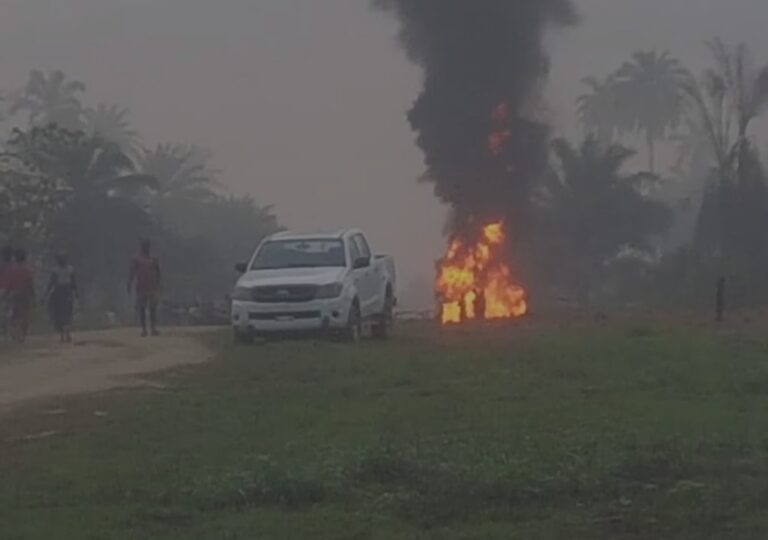
MANY residents of Rivers State are feared dead following an explosion at an illegal crude oil refinery in the Emuohu Local Government Area (LGA).

The incident occurred in the early hours of Friday March 3, as a vehicle loaded with crude oil burst into flames while attempting to navigate the refinery, located in the Rumekpe community of the LGA.

While the number of casualties is still unclear, Police Public Relations Officer in the state Grace Iringe-Koko confirmed the incident to journalists on Friday.

“The Divisional Police Officer is already on his was to the scene,” she said.

Many lives have been lost due to illegal tapping and refining of crude oil in Nigeria.

In April 2022, at least 100 people died at an illegal crude oil refining depot located on the border between Rivers and Imo states.

Beyond causing several deaths in the past, air pollution, including the black soot plaguing residents of Rivers State, has been attributed to illegal oil refining.

Illegal crude refining also has adverse effects on Nigeria’s economy, as an estimated $4 billion is being lost yearly to the activity.

Nigerian President Muhammadu Buhari had described the situation as a national disaster and vowed to intensify his administration’s clampdown on illegal tapping and refining of crude oil.