Home Blog Page 2146

TIMELINE: Nigeria records 1,300 percent increase of COVID-19 confirmed cases in one week

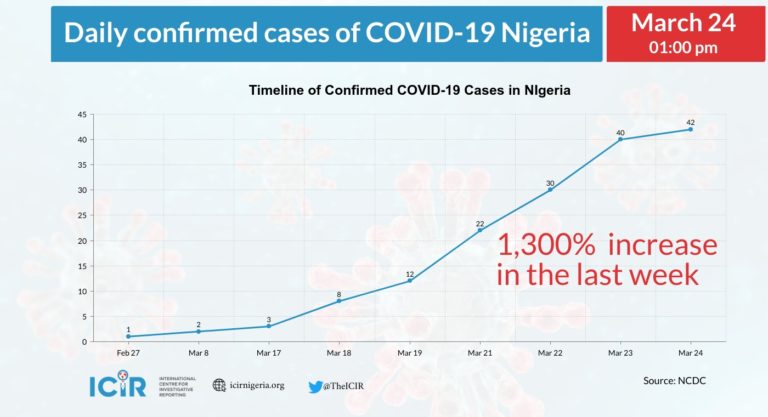
THE pandemic Coronavirus is fast spreading in Nigeria more than expected—the spread is unprecedented — the country has recorded over 1,300 percent increase of confirmed cases of the disease in just one week.

The number of confirmed cases of  COVID-19 in Nigeria was just three as of March 17, but the figure has increased to 40 as 37 cases were confirmed last week.

A timeline of the COVID-19 in Nigeria shows that Nigeria recorded its first case of the pandemic on February 27 after a 44-year old Italian businessman tested positive for the virus.

He was later discharged on March 20 after receiving treatment at an isolation centre in Lagos and had tested negative to the virus. The second confirmed case was recorded on March 8. A contact of the Italian who tested positive in Ogun State, but has since been discharged after testing negative for the virus.

On March 17, the Federal Government announced the third case. The case was a Nigerian who returned to Lagos from the United Kingdom and developed symptoms during her 14-day self-isolation.

However, 24 hours after, the number of confirmed cases rose to eight after five new cases were reported on March 18. A day after, another four new cases were confirmed and brought the total to 12 confirmed cases in the country.

The first highest number of confirmed cases of the COVID-19 was reported on Mach 21. The Federal Government announced 10 new cases. Seven in Lagos and three in the Federal Capital Territory (FCT).

A day after, the Federal Government announced  another eight new confirmed cases, with three in Lagos, two in the FCT, one in Ogun, Ekiti, and Oyo states, bringing the total to 30 confirmed cases as of March 22.

On Monday, March 23, the country recorded its second-highest of confirmed cases in a day. A total of 10 new cases and one death were recorded. Six in Lagos, three in the FCT, and one in Edo. As of 11:00 pm, March 23, there were 40 confirmed cases, two discharged and one death.

At the time of writing this report, two new cases were reported. One in Lagos and one in Ogun State. This brings the total number of confirmed cases in Nigeria to 42, two recoveries and one death as at 01:00 pm, March 24. So far in March, Nigeria has recorded more than 40 cases.

To curtail further spread of the virus, the Federal Government through its Presidential Task Force on COVID-19, chaired by the Secretary to the Government of the Federation, Boss Mustapha has made several recommendations such as banning international flights from high-risk countries, shutting down all airports to international flights, and closure of all land borders.

The Task Force also recommended through a directive to the Head of Civil Service of the Federation that all federal workers below grade level 12 should stay back and work from home.

Several states of the federation have given several directives also to curtail the spread of the virus. Most state governments have shut down schools, banned gatherings of more than 50 persons. They also emphasised on the practice of  social distancing.

On the regional level, As of March 17, the African continent had just recorded 228 confirmed cases with only four deaths.

A week after, according to the daily situation report of the World Health report on COVID-19 of March 23, confirmed cases in African stand at 990 and 23 deaths representing an increase of more than 300 percent.

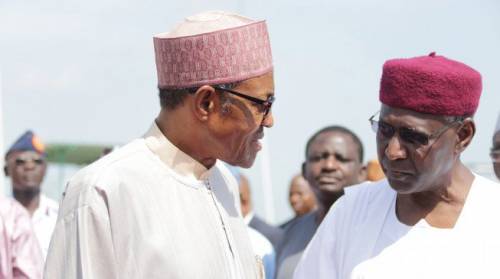
BREAKING: Abba Kyari tests positive to Coronavirus, Buhari tests negative

CHIEF of staff to the president, Abba Kyari, has tested positive to Coronavirus, while his principal, Muhammadu Buhari, has tested negative for the deadly virus, This Day reports.

It was gathered that the Nigeria Centre for Disease Control (NCDC) carried out a test on the president on Monday, and informed him of the result on Tuesday, following the test result of his Chief of Staff which turned out positive.

According to reports, Kyari traveled to Germany on Saturday, March 7, to meet with officials of Siemens in Munich on the Nigerian electricity expansion programme, where he spent a week before returning to the country on Saturday, March 14.

The World Health Organisation (WHO) says Germany has recorded over 29,000 cases of the virus and nearly 120 deaths, with over 400 reported to have recovered.

ThisDay reports that Kyari attended a meeting the next day, March 15, after arriving Nigeria, where he and those in attendance discussed containing the COVID-19 pandemic in Nigeria.

It was at the meeting, Kyari was said to have started showing symptoms  of COVID-19 when he coughed intermittently.

He then submitted himself for a test, which came out positive.

This is coming shortly after the Presidency in a letter signed by Kyari wrote to the leadership of National Assembly, asking that it directs its members who recently returned to the country from abroad to report themselves at the nearest test centre of NCDC.

Kyari noted in the letter that “airport screenings are our primary line of defense and refusal by any citizen to subject to these tests is a threat to our nation.”

So far, Nigeria has recorded 40 confirmed case of Coronavirus and one death.

Globally, the deadly virus has infected over 380,000 people and killed over 16,000 persons, according to John Hopkins Coronavirus Resource Centre.

FACT-CHECK: Will survivors of COVID-19 permanently suffer almost 50 per cent lungs damage? Placed on lifetime medication?

AS of Monday 23rd March, over 2,182 deaths have been recorded in Spain due to the coronavirus pandemic.

Globally,  World Health Organisation (WHO) put the casualty figure at over 9,000 deaths, and 210,000 cases.

Nigeria has just recorded one death and 36 cases.

CLAIMS

But, the claim recently flying across the social media, as a result of the increasing number of cases is that the survivors of  COVID-19 would suffer almost 50 per cent lungs damage.

The claim which allegedly came from an unidentified consultant at the Infectious Disease Unit of  Lagos State University Teaching Hospital (LUTH) stated that the survivors would be placed on medication for the rest of their life.

“…those who recover from COVID-19 suffers close to 50 per cent of lungs damage, permanently, which means they will be on medication forever or they may die from complications in a few years after recovery from COVID-19,” the unidentified source stated, attributing the claims to an unknown medical practitioner.

“Covid-19 will almost certainly be fatal to anyone who has respiratory illness, kidney or liver disease before infection because the organs are usually its target.”


Findings

Medical experts since the COVID-19 outbreak have expressed concerns on likely adverse effects on survivors  of the virus infection. They are worried about the strength of the lungs and its functionality aftet victim’s recovery.

But a forensic pathologist, Dr. Michael Baden in a recent report says it would be too early to determine the future impact of the COVID-19 infection on the survived cases.

Though, he was worried there could be wounds on the lungs of the lucky survivors, there are no clear proofs from the WHO to affirm the permanent damage to the respiratory organ.

“Those who will die will largely die from lung infection,” Baden said as reported by FOX News.

“We don’t know how many people will have scarring from the lungs that will be present five, 10, 15 years from now, and cause shortness of breath and illness then.

“We only have about a month of experience here.”

A different report, detailing how experts in the United Kingdom Faculty of Intensive Care Medicine (FICM) maintained an almost similar position that victims of the COVID-19 virus would develop Acute Respiratory Distress Syndrome (ARDS).

As a result, it might take up to 15 years for the lungs of COVID-19 survivor to heal.

The syndrome, the report revealed, prevents the victim’s lungs from providing sufficient oxygen to other vital organs in their body system.

“Like many other viral conditions, the effects of coronavirus are not just limited to the lungs. The heart can also be affected, ranging from inflammation (myocarditis) to heart failure,” FICM stressed.

Also, findings based on a study of 12 patients who recovered from the COVID-19 virus in Hong Kong revealed that about three persons had reduced lung function.

But, there are concerns it could be too early to conclude on the long-term implication.

“In some patients, lung function could decline by 20 to 30 per cent after recovery,” Tsang ak-yin, Medical Director, Infectious Diseases Centre at Princess Margaret Hospital, Hong Kong said.

This finding also aligns with the outcome of a study held in Wuhan, where Zhongnam Hospital Wuhan University reportedly analysed 140 lung scans of COVID-19 patients and discovered ‘ground-glass opacity in both lungs of each patient.’

But, it is expected that with further investigations on the recovered COVID-19 patients, it would establish whether the victims have developed scars in the lungs, otherwise known as pulmonary fibrosis or otherwise.

“Over time, the scar tissue can destroy the normal lung and make it hard for oxygen to get into the blood. Low oxygen levels (and the stiff scar tissue itself) can cause shortness of breath, particularly during physical exertion,” the study showed.


Verdict

While there are several scientific claims that health conditions of COVID-19 survivors might get worse especially, if there are wounds on the lungs due to the infection, studies also revealed the lungs could get healed over time.

In Nigeria, there is no public evidence from the Federal Ministry of Health and the Nigeria Centre for Disease Control (NCDC), that the two discharged cases would be placed on medications for the rest of their lifetime.

There is also no such information from the WHO, except advice that the victims should eat nutritious foods to strengthen their immune system, limit alcohol consumption, smoking and avoid sugary drinks.

“This will not only help you in the long-term, it will also help you fight COVID-19 if you get it,” WHO DG said in its latest briefing held 20 March, 2020.

None of these institutions has made a public statement affirming the claim that survived victims of COVID-19 would have their lungs almost permanently damaged.

Therefore, the claim that survivors of  COVID-19 would suffer a permanent but  partial lung damage is exagerated and misleadibg.

‘Expect tougher measures for contact tracing’, FG tells those unwilling to test for COVID-19

0

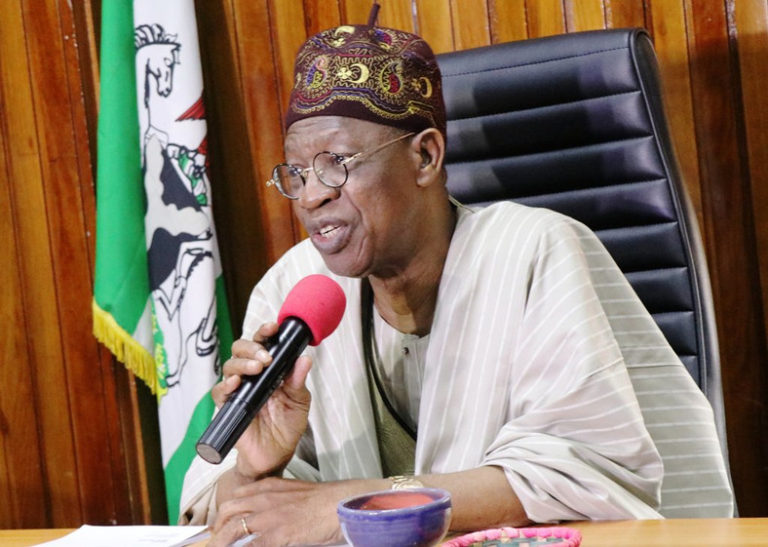
MINISTER of Information and Culture, Lai Mohammed, said on Monday that the Federal Government was prepared to take tougher measures on contact tracing as part of its response to the Coronavirus pandemic.

Mohammed said at a media briefing in Abuja that the Federal Government would not hesitate to deploy the military and the police for contact tracing in cases where persons suspected to have contacted the virus failed to voluntarily show up for testing.

“We should be ready for tougher measures. The forms they will take will be out from the end of today or tomorrow. However, Nigerians should be ready for tougher measures,’’ the Minister said.

He added, “If we don’t do proper contact tracing, the figure will multiply every five days. Nigerians must take ownership of this initiative.

“We won’t hesitate to use whatever measure to ensure that we do not endanger other Nigerians. Containment is very cheaper than cure.

“A few people have helped. If you know you travelled recently, give yourself up to relevant agencies.

“If the situation warrants, we may be forced to use the police and the military for contact tracing. The police are already working on that.

‘’We do not want the figure we have now to multiply. We should work towards containment which is cheaper,” Mohammed explained.

AFRICMIL tasks media organisations on diplomacy in reporting religious issues

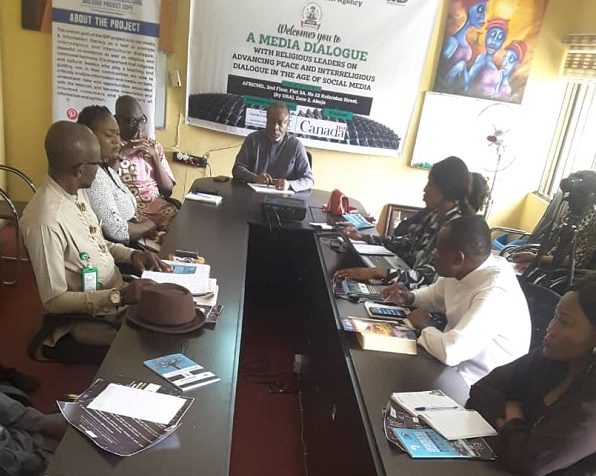
THE African Center for Media and Information Literacy (AFRICMIL) on Monday has tasked media organisations on the need to adopt diplomacy when reporting religious issues for the purpose of national cohesion, and peaceful co-existence among Nigerians.

The Center in partnership with National Orientation Agency (NOA) made this call in Abuja during a  round table dialogue titled: “Media Dialogue with Religious Leaders on Advancing Peace and Interreligious Dialogue in the Age of Social media” .

The dialogue aimed at exploring various ways to stem the tides of religious crisis in the country and how to report  it.

At the round table, media practitioners from various organisations stated the challenges encountered when reporting religious crisis, not neglecting the role of religious and political leaders in fueling unrest among the two major religions.

Speaking at the event, the Head of Media and Communication, Nigerian Supreme Council for Islamic Affairs (NSCIA), Aselemi Ibrahim noted that the concept of a single story fuels social crisis in the country.

“The media has not been fair in the reportage of the religious crisis as a social responsibility. Religious reportage should be geared towards national cohesion while considering cooperate existence of the nation,” Ibrahim said.

The media was advised to avoid the use of stereotypes in addressing perpetrators of crime in the society.

“Crimes should be reported the way they happened, and the religious background of the deviant be reported with less focus on his/her religion,” a media participant at the event said.

On the role played by religious leaders, the participants noted that there was a need for the leadership of Christian and Muslim groups  to communicate their interests without inciting chaos

Religious leaders were, therefore, enjoined to consciously choose their words and sensitize their followers not to act on any report they come across on the social media stinging their beliefs.

Speaking, the Director, Justice and Development and Peace Commission, Abuja Catholic Archdiocese, Solomon Uko blamed the media especially in their deeds of upholding more wrongs rather than good.

“They should be balanced in their reportage. The positive side should be the main highlight regardless rather than more of the negative,” the clergyman noted while enjoining the media to be considerate in its approach on disseminating religious issues in the country.

Also, Sambo Abdulahi an Imam and a representative of a Muslim group noted that it was pertinent for media practitioners to be faithful in their duties of reporting the actual facts of happenings in the society and avoid infusing their personal biases in their line of duties.

“We should separate the evil from the religion,” he said.

On his part, the Assistant Director Press, National Orientation Agency (NOA) Paul Odeniyi noted that media practitioners should uphold citizenship first, as a focus before region.

He said, “People should be penalized for their crime and the responsibility of the media is to report the crime the way it is”.

He reiterated the commitment of the Agency to partner with the Center to ensure that proper sensitization of religious leaders especially at the grass-root is carried out.

The Coordinator of AFRICMIL, Chido Onumah thereafter enjoined media organisations to ensure that conscious efforts are put in place to regularise media contents for objectivity and factualness.

Can the N1.5 trillion budget cut save Nigeria from the impending recession?

LAST week, the federal government through the minister of finance, budget and national planning, Zainab Ahmed, announced the proposed cut of the 2020 budget by N1.5 trillion.

This implies that if approved by the National Assembly, the nation’s 2020 budget will be cut by 14.16 per cent, from N10.59 trillion to N9.09 trillion.

This is based on the drastic plunge in global oil price which currently sold at $25.06 per barrel, the lowest since April 2003.

This cannot be  disconnected from the global outbreak of the deadly coronavirus after it first emerged in China.

According to the minister, “a 25 per cent cut of all government-owned enterprises and these include the ones that are in the national budget, the 10 top ones we included in the 2020 budget but also those we did not include in the 2020 budget.

“So, all of these would have their recurrent expenditure and capital expenditure cut down by 25 per cent.

“By these measures, we expect that the operating surpluses that would accrue to the federation will increase because when their operational expenditure reduces the operating surpluses that they remit to the treasury will also increase significantly.”

Diversification, oil price normalization are the remedy- Analyst

Based on the adverse economic effect of coronavirus, part of which is the slow economic growth, significant decline in oil price and trade imbalances, It is evident that the 2016 tales of recession may repeat itself again.

Financial analysts in. an interview with The ICIR have expressed concern over the government’s proposal to cut the 2020 budget by N1.5trillion.

A market research analyst and expert, Seyi Kolawole, in his own view explained that government’s move will only exacerbate the current situation and the looming recession can be realistic.

“The budget cut is really not a solution for the impending recession. Actually, it makes our situation a bit worse off”

He said the only antidote to the impeding recession is for the oil price to bounce back to the benchmark of $57 per barrel.

“Our revenues are under attack as a result of the massive fall in oil prices (our major source of revenue). Only a reversal of this fall (which is unlikely in the short term) can potentially save us from a recession.

“A diversified Nigerian economy would have helped to shore up our revenues but we have failed to achieve that yet and the irony is that some projects to help diversify the economy will be cut from the budget because we don’t have the money to fund them. So we remain oil dependent.

“I don’t think there is any quick fix for the pending recession, individuals and businesses can brace up themselves as usual and hope for a quick vaccine for the Coronavirus.

“In addition, the government needs to very quickly kick start the drive to diversify the economy strategically once we make it out of this recession in preparation for the next disaster that may affect oil prices which I believe may not be too far off.”

Nigerians over time  have been clamouring for the overhaul and diversification of the Nigerian economy from the oil sector as global oil price affects the whole country’s well-being financially.

Nigeria is the largest oil and gas producer in the whole of Africa with 10th largest oil reserves in the world.

Drugs that could be a game-changer against coronavirus onslaught

SINCE the global outbreak of the deadly coronavirus after it first emerged in China, there has been a frenzied quest across the global biotech industry, pharmaceutical companies and research organisations to develop  drugs to treat the disease.

The scramble for a “magic bullet” drug that would provide a cure for the highly contagious virus, has put researchers on frenzy.

On Sunday night, a team of scientists drew up a list of possible drugs that may be effective in treating coronavirus.

Some of the drugs are currently used to treat other diseases, and repurposing them to treat Covid-19, the ailment caused by the coronavirus, may prove to be faster than trying to invent a new antiviral from scratch, the scientists said.

The list of drugs was revealed in their study published on the website bioRxiv, though the drugs are all in the clinical trial stages.

Drugs such as haloperidol used to treat schizophrenia, and metformin, taken by people with Type 2 diabetes are also been tested.

The coronavirus pandemic, which has infected more than 235,000 globally and killed over 9,800 people, continues to trigger anxiety across several countries whose health care systems face the threat of being overwhelmed by the numbers of severe cases of COVID-19.

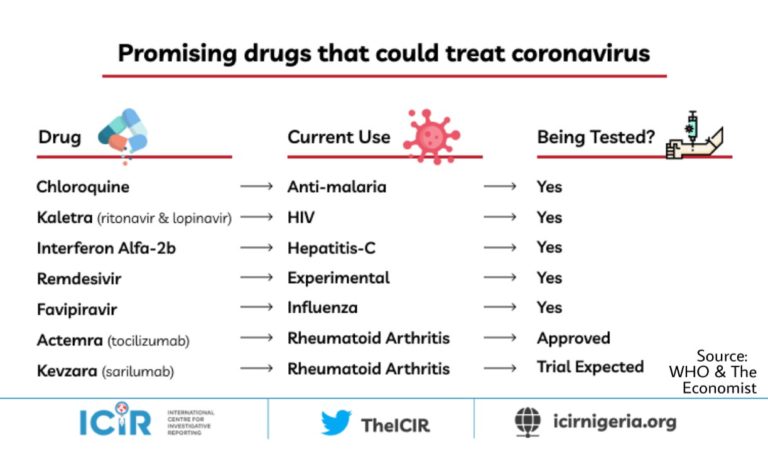
The ICIR examines the possible drugs been considered by scientists for treating the dreaded coronavirus and its associated complications.

Chloroquine

Chloroquine has been much in the news after it was announced by President Donald Trump of the UnitedS in a press briefing that chloroquine use may be the solution to the virus.

Anthony Fauci, the director of the National Institute of Allergy and Infectious Diseases, NAID, followed the president’s remarks with a warning that there was only “anecdotal evidence” that chloroquine might work.

Chinese researchers had used chloroquine to treat infected patients in guidelines issued in February after seeing encouraging results in clinical trials.

However, within days doctors and health officials warned about the drug’s lethal side effects and rolled back its usage.

Chloroquine kills the single-cell parasite that causes malaria. It is believed the drug can attach to a human cellular protein called the sigma-1 receptor. And that receptor is also the target of the coronavirus.

The World Health Organisation, WHO has also announced that chloroquine was among the four drugs being tested as potential coronavirus therapies, a part of an aggressive effort to jumpstart the global search for drugs to treat Covid-19. 

Countries are already signed up to participate in the clinical trial include Argentina, Bahrain, Canada, France, Iran, Norway, South Africa, Spain, Switzerland, and Thailand.

Remdesivir

The experimental drug has been touted as a possible cure for the virus after it was used to improve the clinical condition of the first patient infected by the coronavirus in the US.

The FDA has already allowed 250 patients to access the drug, the study states that Remdesivir is not expected to be largely available for treating a very large number of patients in a timely manner” because of its status as an experimental drug.

Health officials from WHO has noted that Gilead Sciences Inc, the makers of  Remdesivir has demonstrated efficacy in treating the coronavirus infection.

Gilead Sciences Inc recently revealed that it was temporarily putting new emergency access to the experimental coronavirus drug due to surging demand because it wanted people receiving the drug to participate in a clinical trial to prove if it is safe and effective.

Actemra

The drug is currently used for rheumatoid arthritis. It was developed by Roche’s Chugai Pharmaceutical unit and also employed to suppress cytokine release syndrome in cancer patients. Cytokine release syndrome is a hyper-reaction of the immune system, which is also found in patients with COVID-19.

However, Roche is launching a Phase III trial of Actemra plus standard-of-care patients with COVID-19 pneumonia. After treatment, patients in the trial will be followed for 60 days and an interim analysis will be performed in hopes of early evidence of efficacy. It is expected to begin enrolling patients in April.

Favipiravir

The National Medical Products Administration of China approved the use of Favilavir, an anti-viral drug, as a treatment for coronavirus. The drug has reportedly being considered effective in treating the disease with minimal side effects in a clinical trial involving 70 patients. The clinical trial is being conducted in Shenzhen, Guangdong province.

Kevzara

It is being tested against coronavirus infection in a first-in-human clinical trial sponsored by the National Institute of Allergy and Infectious Diseases, NIAID, it was used for 48 patients and its safety and tolerability is being studied.

Kevzara is approved for the treatment of rheumatoid arthritis and is known to block the interleukin-6 (IL-6) pathway, which causes an overactive inflammatory response in the lungs of COVID-19 patients.

Regeneron Pharmaceuticals has partnered with Sanofi, a French drug firm to evaluate Kevzara, a fully-human monoclonal antibody, in phase II/III clinical trial in patients with severe COVID-19 infection.

The biotech companies co-developed Kevzara, which received FDA approval in 2017.

Interferon Alfa 2b

A drug developed by Cuban’s biotech industry, Interferon alfa 2b, is known to boost the immune system and has proved effective in previous epidemics such as dengue fever and HIV/AIDS, was among the treatments used by Chinese medical authorities to curtail the coronavirus outbreak in Wuhan, China.

Several countries namely Chile and Spain, have made attempts to get access to the drug. Also with supplies of Interferon alfa 2b, a team of Cuban doctors has reportedly being sent to Italy to support medical efforts in Italy.

Kaletra

It is used to provide a boosting agent, and in combination with other antiretrovirals, for the treatment of HIV-1, the drug is a combination of lopinavir and ritonavir.

Lopinavir/ritonavir in combination with ribavirin showed reduced fatality rate and milder disease course during an open clinical trial in patients in the 2003 SARS outbreak.

Kaletra’s was being tested for its ability to cut viral load, which was critical because the drug was meant to directly attack the virus rather than merely relieving symptoms od COVID – 19.

However, the chances are now slim that Kaletra could represent an effective treatment for severe COVID-19 after it was being touted as a gamechanger in the coronavirus scourge its chances have been dashed by a trial failure in China.

In a clinical test for 199 Chinese patients, details of which were published in the New England Journal of Medicine showed that those receiving the treatment had no better outcome than those who had received other forms of care.

It didn’t improve the standard of care of the patients at improving their clinical symptoms, extending lifespan or cutting viral shedding in patients hospitalized with severe COVID-19.

COVID-19: Nigeria’s total exports of crude oil in 2020 could reduce by $19b— ECA

THE Executive Secretary of the Economic Commission for Africa (ECA), Vera Songwe said the COVID-19 outbreak could reduce Nigeria’s total exports of crude oil in 2020 by between US$ 14 billion and US$ 19 billion.

“Africa may lose half of its GDP with growth falling from 3.2 per cent to about 2 per cent due to a number of reasons which include the disruption of global supply chains,” said Songwe during a press briefing in in Addis Ababa, Ethiopia.

She said the continent would need up to US$ 10.6 billion in unanticipated increases in health spending to curtail the virus from spreading, while on the other hand revenue losses could lead to unsustainable debt.

Songwe noted that it is estimated that COVID-19 could lead to Africa’s export revenues from fuels falling at around US$ 101 billion in 2020.

According to her, remittances and tourism are also being affected as the virus continues to spread worldwide, resulting in a decline in Foreign Direct Investment (FDI) flows; capital flight; domestic financial market tightening; and a slow-down in investments – hence job losses.

“Pharmaceuticals, imported largely from Europe and other COVID-19 affected partners from outside the continent, could see their prices increasing and availability reduced for Africans,” she said.

With nearly two-thirds of African countries being net importers of basic food, shortages are feared to severely impact food availability and food security.

She expressed concerns that negative consequences are expected to worsen, if COVID-19 develops into an outbreak in Africa.

A decline in commodity prices could lead to fiscal pressures for Africa’s economic powerhouses such as South Africa, Nigeria, Algeria, Egypt and Angola, she added.

The ECA, in a presentation on the economic effects of the COVID-19 on Africa, suggests governments could review and revise their budgets to reprioritize spending towards mitigating expected negative impacts from COVID-19 on their economies.

Africa urgently needs $100b to avert further Coronavirus pandemic —African Ministers of Finance

AFRICAN Ministers of Finance have said that Africa urgently needs $100 billion to fight the further negative impact of the coronavirus in the continent.

This was part of the resolutions made by African Ministers of Finance on March 19 at the end of a virtual conference held to exchange ideas on the efforts of their respective governments in dealing with the social and economic impacts of COVID-19.

They noted that even before the COVID-19 pandemic, Africa was already experiencing a huge financing gap in funding measures and programmes aimed at realizing SDGs and Agenda 2063 targets and goals.

The Ministers emphasized that without coordinated efforts, the COVID-19 pandemic would have major and adverse implications on African economies and the society at large.

Original economic forecasts in most economies are on average, being downgraded by 2-3 percentage points for 2020 due to the pandemic.

They unanimously agreed that Africa needs an immediate emergency economic stimulus to the tune of US$100 billion.

According to them, the waiver of all interest payments, estimated at US$44 billion for 2020, and the possible extension of the waiver to the medium term, would provide immediate fiscal space and liquidity to the governments, in their efforts to respond to the COVID-19 pandemic.

The interest payments waiver should include not only interest payments on public debt, but also on sovereign bonds.

For fragile states, the ministers agreed on the need to consider waiving principal and interest and encourage the use of existing facilities in the World Bank, International Monetary Fund (IMF), African Development Bank (AfDB) and other regional institutions.

According to the Commission, almost half of this money could come from waivering interest payment for countries on the continent.

Government debt as a percentage of gross domestic product (GDP) in sub-Saharan Africa has doubled in the past decade but countries in the region will have to shelve plans for further Eurobond issuance as yields surge and the spread of the coronavirus limits travel.

Data compiled by the U.K.-based Jubilee Debt Campaign showed that external debt payments consumed an average of 13 per cent of African governments’ revenue before the outbreak.

Given the limited health infrastructure and the fact that most of the pharmaceuticals and medical supplies consumed in Africa are imported, they called on the international community to support the upgrade of the health infrastructure and to provide direct support to the existing facilities.

The Ministers underscored the need to support the private sector and protect the over 30 million jobs at risk, particularly in the tourism and airline sectors across the continent.

In other critical sectors including agriculture, imports and exports, pharmaceuticals and in banking, the ministers agreed that all interest and principal payments on corporate debt, leases, extended credit facilities, refinancing schemes and guarantee facilities should be used to waive, restructure and provide additional liquidity in 2020.

A liquidity line should also be made available to the private sector to ensure the continuity of essential purchases and all Small and Medium Enterprises (SMEs) that are dependent on trade can continue to function.

As part of an immediate health response, there is a need for a coordinated response in the logistics and delivery of testing equipment.

In this regard, the ministers emphasized the need to work with the WHO and existing continental institutions, in particular, the African Union and Africa CDC, while making maximum use of existing systems and funding partners, such as the Global Fund.

Particular attention should be placed on fragile states and vulnerable populations, especially women and children and those living in informal urban settlements.


MSMEs go through difficulties to access N220 billion CBN intervention fund

THE President of the Abuja Chamber of Commerce and Industry (ACCI), Prince Adetokunbo Kayode, said Micro, Small and Medium Enterprises (MSMEs) accessing the intervention fund of N220 billion issued by the Central Bank of Nigeria (CBN) has been a hassle.

Manufacturers expressed the slow rate of disbursing the funds to the MSMEs by the apex bank.

Recall, The CBN launched the MSME Development Fund on August 15, 2013, with a share capital of N220 billion.

The Fund was established in recognition of the significant contributions of the MSME sub-sector to the economy and the existing huge financing gap.

According to the apex bank, ten per cent of the Fund has been devoted to developmental objectives such grants, capacity building and administrative costs.

The CBN said that 60 per cent of the fund must be accessed by female entrepreneurs.

Ninety per cent commercial component will be released to Participating Financial Institutions(PFIs) at 2 per cent for on-lending to MSMEs at a maximum interest rate of 9 per cent per annum.

The CBN said eligible activities to be financed include agricultural value chain, services, cottage industries, artisans, trade and commerce and any income-generating business as may be prescribed by the bank from time to time.

Data from the apex bank showed that so far it had disbursed only N83 billion from the fund since it was launched to support the MSMEs sub-sector’s contributions to the economy and reduce its funding shortfall.

Kayode said since he assumed office as the President of ACCI, none of his members has been able to access the fund.

According to a CBN report published, MSMEs require improved financial support, studies show that Nigeria has a low amount of domestic investment through loans vis-à-vis other emerging markets.

Majority of the loans granted are issued to large corporate organizations and governments.